Top Left Link Buttons

Locations of our activity

Category Archives

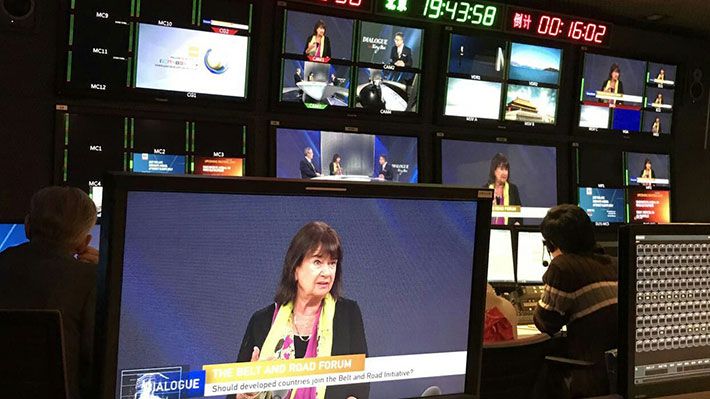
Shanghai Daily Interviews Helga Zepp-LaRouche

EDITOR’S Note: Helga Zepp-LaRouche visited Shanghai for the first time in the summer of 1971. In 1977 she married American economist Lyndon LaRouche, and the couple have since worked together on development plans for a just new world economic order. Zepp-LaRouche founded the Schiller Institute in 1984, a think tank devoted to the realization of these plans and a renaissance and a dialogue of classical cultures. In 1991 she was a coauthor of a study The Eurasian Land-Bridge/ The New Silk Road and in 2014 of the study The New Silk Road Becomes the World Land-Bridge, which has been translated into Chinese, Arabic, German and Korean. She is an expert in European humanist philosophy and poetry, Confucius, and history. After attending the recent Belt and Road Forum in Beijing, she visited Shanghai, where Shanghai Daily reporter Wan Lixin interviewed her.


Q: In what way do you think the Belt and Road initiative is significant for the world and China?

A: I think the Belt and Road initiative signifies a revolutionary move to a new epoch of civilization. The idea of having a win-win cooperation among nations is the first time that a concrete concept has been offered to overcome geopolitics. Since geopolitics was the cause of the two world wars, I think it is a completely new paradigm of thinking where an idea proposed by one country has the national interest basically in coherence with the interests of humanity as a whole. This has never happened. This has instilled tremendous hope among developing nations that they have the chance to overcome poverty and underdevelopment. And I think this is an initiative that will grow until all the continents are connected through infrastructure and development.

Q: What do you think are challenges confronting the world today?

A: I think the biggest challenge is that the trans-Atlantic financial system is in jeopardy, because the G7 countries did nothing after the financial crisis of 2008 to remedy the root causes of this crisis. The danger today is that we are going to have another financial crisis much worse than that of 2008. In this light I think the financial system associated with the Belt and Road Initiative, like the AIIB (Asian Infrastructure Investment Bank) and similar institutions, which are focused on investment in the real economy, are an anchor. Hopefully the Western nations will rethink their orientation of high risk speculation and eventually go back to the banking system represented by AIIB. U.S. President Trump announced that he will go back to the American economic system of Alexander Hamilton, and that’s potentially the kind of reform that makes the United States fit to cooperate in this new financial system. The second challenge is naturally terrorism. This requires international cooperation, and there I think the Belt and Road could offer a lasting solution by extending the initiative to Southwest Asia, and build up the economy in that part of the world that had been destroyed by wars which were based on lies. Why did you have to solve the problem of terrorism militarily first? You have to have an economic perspective so that people in the regions have hope for the future. So I think ending terrorism would require the Belt and Road Initiative and the reconstruction of the Southwest Asia and Africa.

Q: There has been evolving perception about globalization. How do you think the Belt and Road Initiative is reshaping this perception?

A: The old globalization really went entirely in one direction. First of all it made the deregulation of the markets and high risk speculation easy. And this increased the gap between the rich and the poor in an intolerable way in many countries. This mode of globalization is being rejected, as you can see by the Brexit and the rise of many right-wing movements in Europe. So this model has clearly failed. I think the new Silk Road, the win-win cooperation as proposed by China, has developed in incredible speed in the less than four years since President Xi proposed it. This new model of globalization is based on the common good of all participating countries. This is the more attractive form of globalization and this is why so many countries have joined it.

Q: What do you think are some of the factors that need to be considered when it comes to implementing the Belt and Road initiative across different cultures?

A: The Schiller Institute has organized hundreds of seminars and conferences on the New Silk Road for 26 years. We have always made the point that for this New Silk Road to succeed in the tradition of the old Silk Road, which was also an exchange of ideas and cultures, not just products and technology, you have to combine economic cooperation with dialogue between cultures. This dialogue must be on the highest level, so each culture has to present examples of the best of their culture, like Confucianism, Italian renaissance, the German classical period, and present the best works of arts in music and poetry, paintings and other forms of art. Our experience is that when people get into contact for the first time with expression of such high culture from another culture, they are surprised by its beauty. And this beauty then opens the heart and souls of the people. And this is the best medicine against chauvinism, xenophobia, and prejudice, and it opens the way for the love of other cultures. This is in conformity with Confucian teaching that all activity must be combined with strengthening of love for the mankind, because without that cultural component, that New Silk Road will not flourish.

Q: What do you think such high profile events like the recent summit suggest about China’s role in world affairs?

A: I think it a great honor for me to participate in this Belt and Road Forum, and I was deeply impressed by the speech of President Xi Jinping. Among all participants I spoke with there is consensus that we are actively participating in the shaping of history. All this means that China is right now leading the world in terms of providing the perspective for the future. I think this has been recognized by many countries in Latin America, in Africa, in Asia, and even some European countries start to recognize it is in their best interests to ally with that initiative. So I think it has made clear that China is the only country right now that offers a positive perspective to overcome the strategic bottleneck of our present times.

Q: In the past, the quest for prosperity invariably led to competition, strife, or wars. Is this avoidable?

A: Concerning the question of competition, strife and war, I think this must be replaced by joint development. Here I would like to quote from Pope Paul VI who said that “Development is the new name for peace.”

Q: How do you think the West responds to the Belt and Road Initiative?

A: The responses have been mixed, because you have those who want to stick to the old geopolitical thinking, to the status quo of their power, and to their understanding of their power position. I think this is an outdated way of thinking. Many think-tanks of the West are still publishing reports along these lines. But there is a wind of change. Many European countries have realized the potential of collaborating with the Belt and Road, which includes Greece, Serbia, Hungary, Slovenia, Czech Republic, Italy, Spain, Portugal, and Switzerland. So I think this tendency will increase. Those countries which are more reserved — like Germany — will have to change. But I think German industries, particularly those middle-sized industries, are absolutely in cooperation with China in the Belt and Road Initiative.

Q: Say something about your China experience.

A: I was first in Shanghai 46 years ago in 1971, after traveling on a cargo ship. Although it was not the best time to be in China, it had awakened my love for China. The city has changed completely. Except for some buildings on the Bund, I couldn’t find anything in my memory. I could not think of any other countries in the planet that have seen such gigantic changes. I think the Chinese people are much too modest. They should feel more confident about what they have accomplished. They have created the biggest miracle of the world, even bigger than the post-war German economic miracle. They should be very proud to be Chinese. The decision by Moody’s Investors Service to cut China’s sovereign ratings is insane. In German we have a saying: People should touch their own nose first before they made a stupid criticism.

(source: Shanghai Dailyhttp://www.shanghaidaily.com/opinion/chinese-perspectives/Belt-and-Road-initiative-instills-hope-for-peace-and-development-among-nations/shdaily.shtml
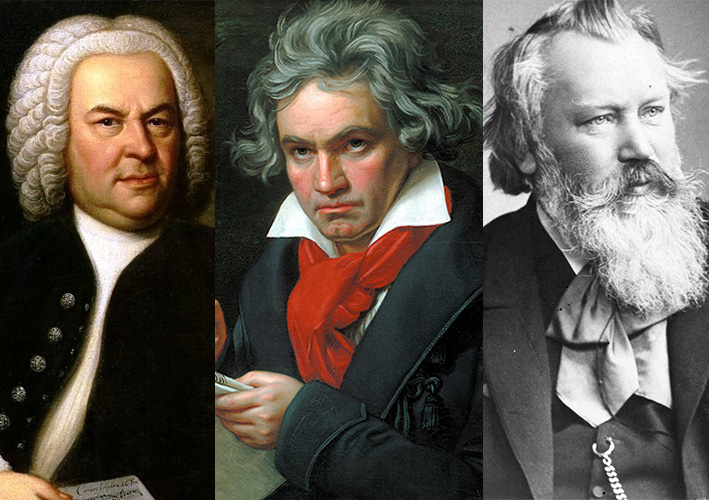



New Year’s Concert: Timeless Choruses of the Masters

You are invited to the 4th annual New Year’s Day Concert of the Virginia Schiller Institute Community Chorus and friends. Join us for timeless choral pieces from Bach, Mozart, Beethoven, Brahms and more. All are welcome, free admission, donations appreciated, reception to follow. Come ring in the New Year with us!

When: Wednesday, January 1, 2020 at 3:00 pm

Where: Holy Trinity Lutheran Church, 605 W. Market St. Leesburg, VA

Who: All are welcome! Reception to follow.


facebook post

Interested in singing in a chorus? We are a non-audition chorus made up of singers of a variety of backgrounds and experience. Come join us for the 2020 Spring/Summer season!

Learn more


Zepp-LaRouche Addresses a Forum at Largest Publishing House in China

In a major address to an audience of between 100 and 200 people at the Phoenix Press Publishing Group at their headquarters in Nanjing, China, Helga Zepp-LaRouche, the president of the Schiller Institute, gave a report-back from her attendance at the Belt and Road Forum in Beijing.

“The Belt and Road has injected optimism into many countries,” Zepp-LaRouche said, “and the momentum is unstoppable,” but bringing it fully to fruition “will not be easy.” Immediately after the summit, she continued, the attacks against the Belt and Road escalated, combined with attacks against President Trump, who had sent a high-level delegation to the BRI Summit. “The attacks were based on the absurd charges of collusion with Russia in the election,” she said.

“After the Cold War, the British and their American allies wanted to create a unipolar world,” she said. “And in doing so they have destroyed the Middle East and left it in a shambles.” And this precipitated the refugee crisis, the general reaction against “globalization,” and the rise of right-wing movements. “The Belt and Road,” she said, “will bring about the creation of the World Land-Bridge, which will connect all continents. And this is something we have been fighting for, for over 40 years,” she said.

She then described the fight of her and her husband, Lyndon H. LaRouche, Jr., to build a new world economic order: LaRouche’s call for an International Development Bank, the fight for the African development plan, and the Ibero-American initiative in the same direction in collaboration with Mexican President Jose Lopez Portillo, and the hundreds of seminars on five continents held by the Schiller Institute calling for a Belt and Road development.

“Transforming the Belt and Road to a World Land-Bridge will realize politically for the first time a real future for all the people living on this planet and will establish forms of governance for the world.” But to fully realize this, she said, “you must also study the ideas of my husband on the question of economics.”

Zepp-LaRouche then went through the all-important cultural aspects of the Belt and Road and the need for all of the different cultures involved to bring out their finest achievements, in order to use these to create a dialogue of cultures among the nations on the Belt and Road. She then went through the importance of Friedrich Schiller in German and Western culture and the importance of Confucius in Chinese culture, making a concrete comparison of the works of Schiller and Confucius and showing the close similarity in the ideas of these two great thinkers which were separated in time by almost 2000 years .

Zepp-LaRouche was followed by Bill Jones, the Washington Bureau Chief of EIR, who showed a power point presentation describing the struggle of the LaRouche organization from the time of Nixon’s abandonment of the Bretton Woods system. He described the 1970s attack of the Club of Rome and the publication of “Limits to Growth,” which was intended to transform the culture of progress into the culture of death with the international push for Zero Economic Growth and Zero Population Growth. He outlined the reaction of Lyndon LaRouche and the LaRouche organization to the Zero Growth movement, LaRouche’s call for the International Development Bank (IDB), and the subsequent call for the IDB and a New World Economic Order at the Colombo meeting of the Non-Aligned Movement in 1976, and by Guyana’s Foreign Minister, Fred Wills, at the U.N. General Assembly.

Jones described the struggle waged by LaRouche to bring President Ronald Reagan, who had adopted LaRouche’s concept of the Strategic Defense Initiative (SDI) as a peace proposal with the Soviet Union, into a working relationship with the progressive leaders in the developing sector, such as Mexican President Lopez Portillo and Indian Prime Minister Indira Gandhi. These efforts then led to a reaction by the people around Vice President George H.W. Bush, who connived to have LaRouche and several of his associates incarcerated on trumped-up charge. The election of President William Clinton brought LaRouche out of prison and back into an advisory role, with President Clinton’s attempts, albeit unsuccessful, to move in the direction of a new financial architecture. The creation of the Belt and Road Initiative (BRI) and the Asian Infrastructure Investment Bank (AIIB) represent, therefore, the type of structures that LaRouche and his movement have been trying to bring about for over four decades, Jones explained.

This was followed by Professor Bao Shixiu, a professor of military science, who outlined the strategic importance of the Belt and Road for China, showing how it will allow the country to overcome the traditional difficulties it has had with other countries, including India and Japan. Professor Bao underlined the seminal role of the LaRouches in bringing this initiative to the forefront, and the ongoing struggle of Lyndon and Helga LaRouche to overcome the opposition to it from the London-New York financial elites. Professor Bao also laid out both the economic and strategic implications of the Belt and Road for China, which would help ensure a harmonious climate in the region and in the world, which would allow it and all other countries to continue to develop.

There was a great deal of interest exhibited by the audience, particularly in Helga Zepp-LaRouche’s call for the dialogue of cultures and a heightened degree of interest in the work of Friedrich Schiller among the Phoenix staff, some of whom seemed to have had a rather extensive exposure to the works of German culture.


Belt and Road Forum

May 14 – 15, 2017, Beijing, China

Belt and Road Forum page >>


Houston, Texas Schillerfest: Truth is Beauty, Beauty Truth; That is What People Came to know

On November 9th, Schiller Institute activists and supporters in Houston, Texas came together to celebrate Friedrich Schiller’s 260th Birthday. In what has become an annual tradition in Houston, the afternoon of music, poetry and drama welcomed many participants, and was again held at Houston’s beautiful and cozy French language and cultural center.

This year some 60 people joined in our celebration, including those who were brought by friends or family. The number of new guests was striking, and many expressing their happiness at finding something that lifted them above the ugliness of everyday events.

In preparation, there had been a discussion as to how we could make this year’s celebration a means, providing our friends and activists with the tools they need, to also help elevate others above the ugliness and banality of the culture we are otherwise surrounded by. As a result, our Schillerfest was organized as a thoroughly composed afternoon of music, poetry and drama (not to mention good food), with this idea in mind. Among the highlights were classical poems in Russian, German, and Chinese presented by native speakers, who have become active with the Schiller Institute.

The afternoon began with an introduction by Houston Schiller Institute representative Brian Lantz, noting the triple anniversary of the 260th birthday of Friedrich Schiller, the 30th anniversary of the fall of the Berlin Wall, and the 35th anniversary of the founding of the Schiller Institute. Schiller himself had embarked upon a vigorous organizing campaign, to provide an aesthetic education of his fellow men and women, recruiting allies and collaborators, a process that continues today. His writings – such as “On the Aesthetic Education of Man” and “Theatre as a Moral Institution” reached around the globe, as did his plays, poems and histories. They were taken to heart by Pushkins’s circles in Russia, the circles of Keats and Shelly in England, and influencing education reform in China from the beginning of the 20th century down to today. Fredrick Douglas, the great American abolitionist, former slave, orator, author, diplomat and friend of Abraham Lincoln, writing in his newspaper, North Star, named Schiller “the poet of freedom,” and “one of us.” It was then Beethoven’s 9th symphony, set to Schiller’s poem “Ode to Joy” that was performed in Berlin, in celebration of the fall of the Berlin Wall 30 years ago. So the world has indeed been moved, shaped and made better by a poet, through “mere words.” So we are reminded that we are not animals, wedded to sense perception. We communicate instead in terms of discovered great ideas and principles which we apply willfully and freely to transform the world.

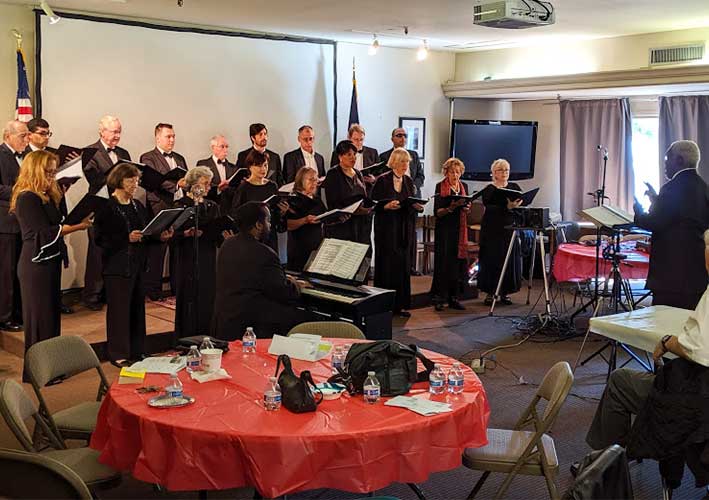
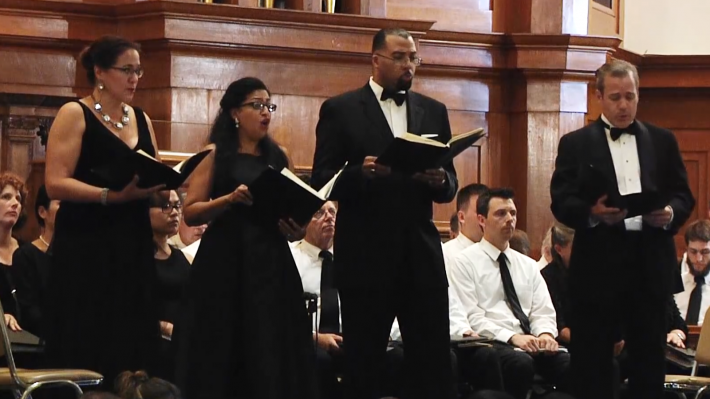
Houston Schiller Institute Community Chorus.

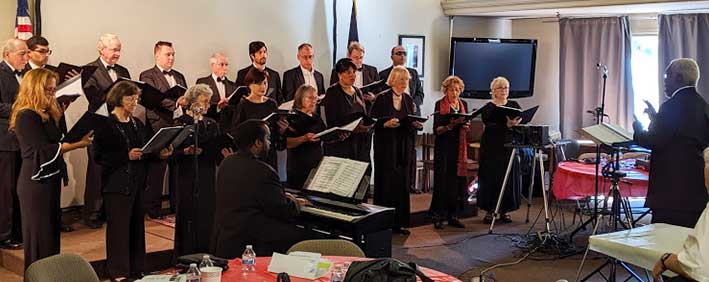
Houston Schiller Institute Community Chorus.

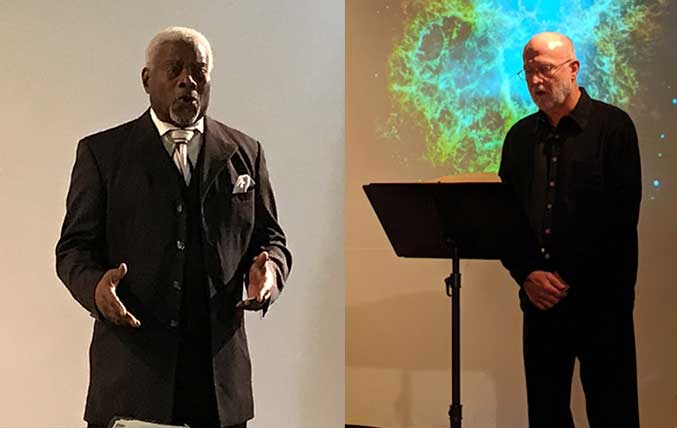
The Houston Schiller Chorus opened the music program with two four-part choral pieces by Haydn, and a chorale by Bach. This was followed by a very moving aria from Verdi’s setting of Schiller’s “Don Carlo” by our maestro Dorceal Duckens. Dan Leach then  introduced a program of poetic works, provoking all to understand—as Shelly and Lyndon LaRouche developed—that what is poetic is not always in verse. This section began with excerpts from Shelley’s ‘A Defense of Poetry”. This was followed by “Hymn to Intellectual Beauty,” Schiller’s “Columbus” in English and German, and “Tree of Fate” by Pushkin in Russian. The first half of the program was closed by the Schiller/Schubert piece “Dithyrambe” and two spirituals, Burleigh’s setting of “Deep River” and “Every Time I Feel the Spirit,” performed by the chorus.

Dorceal Duckens, left, and Dan Leach, right.

Dorceal Duckens, left, and Dan Leach, right.

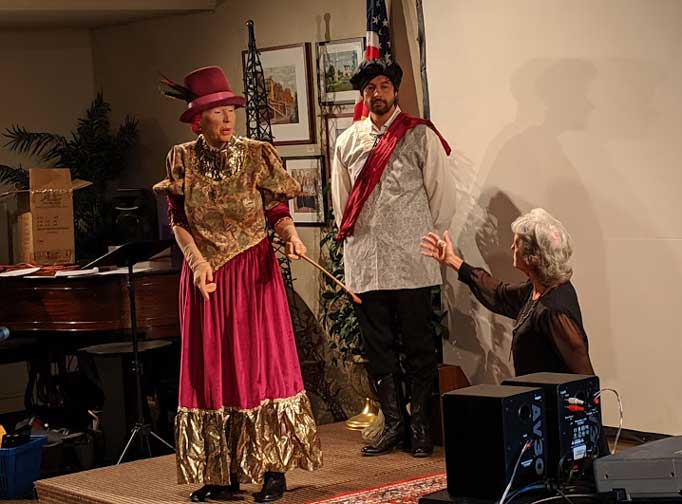
After a short intermission, the entire audience reassembled. Everyone indeed stayed to the end of the full program which was about four hours in total. The second half of the program was opened with Schubert’s “Staendchen.” Then were presented two contrasting scenes from Schiller’s dramas. The first scene was the meeting between Queen Elizabeth I and Mary Stuart from the play “Mary Stuart.” In this scene, neither of the main protagonists is able to overcome their own pride and rage and the future of England which could have been secured is lost. The second scene is from “William Tell,” where Gertrude Stauffacher organizes her husband Walter to put freedom before material possessions and to stand up to dictatorship. Both scenes were fully staged, with costumes and memorized dialogue.

Scenes from Schiller's dramas.

Scenes from Schiller’s dramas.

The final part of the program then began with a trio singing Beethoven’s beautiful canon setting of the final words of Schiller’s Maid of Orleans—”Kurz ist der Schmerz; ewig is die Freude”. This was followed by a very moving reading of Beethoven’s “Heiligstadt Testament,” followed by Shakespeare’s Sonnet 66. A Chinese activist then read a poem from the Tang dynasty period of China with the beautiful Chinese characters projected behind her and a classical Chinese instrument playing in the background. The poetry program was completed by a poem by Dan Leach, “Song of the Crab Nebula” with a beautiful image of the Crab Nebula projected behind on the screen.

Throughout, members of the audience were being provoked to recall what they actually already knew: the power of metaphor and of the beautiful. As when experiences and stories are recalled from our childhood, or when we remind ourselves of beautiful parables from the Bible or drawn from secular writings. Or when we recount a few profound lines from the Gettysburg Address of Abraham Lincoln. (Even his name has become a metaphor of sublime.) Or even a snippet of a profound speech by Martin Luther King. These metaphors are the means by which we touch one another, prompting recognition of a higher, unseen principles in a powerful way. Consider the words, “One small step for man; one giant leap for mankind.” These ‘mere words’ echoed around the world, and inspire Mankind today!

The beautiful afternoon program was closed by the Houston Schiller Chorus performance of three spirituals, conducted by Maestro Dorceal Duckins. Those spirituals were “Soon Ah Will Be done,” “Give Me Jesus,” and a song which Helga Zepp-LaRouche suggested several years ago for the Belt and Road Initiative, “Get on Board.” That spiritual has become the virtual theme song of the Houston Schiller Institute chorus.

Indeed, as Friedrich Schiller advocated, the individual is awakened to truth through beauty. All the participants in the Houston event experienced that in a some fresh way, as the beauty, metaphors and ironies of great artists were brought to life. As Schiller said of his plays, the intent is that the audience leave the theater better, uplifted persons, and so with poetry and song. So it was with the Houston Schillerfest. So encouraged, these awakening capacities may become subject to the will, to ennoble, and thereby for the exercise of true freedom.


Schiller Institute Seminar on Strategic Implications of the Impeachment Battle in the U.S.

The very same day that the impeachment trial against President Donald Trump was started in the U.S. Senate, EIR and the Schiller Institute gave a 2.5-hour background briefing in Berlin, featuring Harley Schlanger and former NSA Technical Director Bill Binney, the latter by video.

The participants from various nations and institutional backgrounds heard an extensive briefing by Schlanger about the strategic implications and history of the impeachment battle in the U.S. and the all-encompassing need to establish cooperation among the U.S., Russia, and China in the present strategic escalation, as Helga Zepp-LaRouche called for on January 7.

Schlanger described the British Empire’s role in bringing about regime change wars, the Blair doctrine of maintaining the failing “rules-based world order” of geopolitics and the bankrupt financial system of globalization. He contrasted those failures to the newly emerging paradigm of economic and political cooperation. It became clear to the participants that all of this was set up to end Trump’s explicit intention to stop the regime change wars and re-establish good relations with Russia — the nightmare for the Empire. Therefore, the impeachment question is of strategic importance for the whole world.

In the extended discussion period, questions included: Why is the British Empire still so important in all of this? If Trump is so peace-loving, why does he surround himself with war-hawks? Why did Gen. Michael Flynn not realize that he was under surveillance? What would happen if the Senate votes to convict Trump? How can the confrontation between Iran and the U.S. be stopped, and what role is this going to play in the U.S. elections? What was the role of then French President Sarkozy in eliminating Qaddafi?

The overall response by the participants demonstrated a growing demand to understand the full strategic picture, its historical dynamics, and above all the solution.


Interview by Sputnik with Helga Zepp-LaRouche

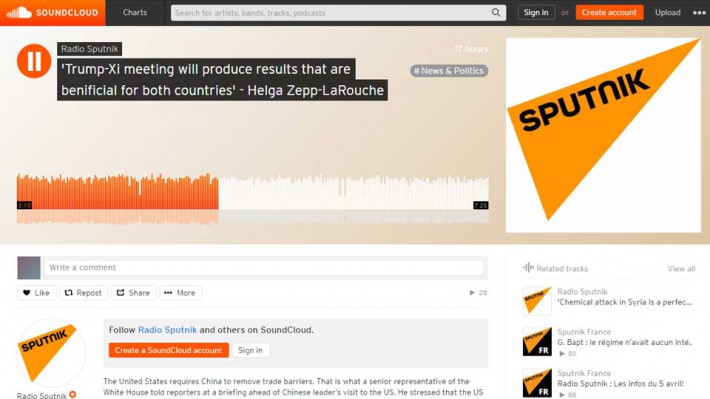
Listen to the interview on Sputnik >>

April 5, 2017 — This is a transcript of an interview by Sputnik with Helga Zepp-LaRouche, regarding the upcoming summit between Presidents Xi Jinping and Donald Trump:

Q: What will the tone of the meeting be?

HELGA ZEPP-LAROUCHE: Oh, I think it will be actually cordial. The Western media who are usually wrong are trying to reduce this whole question to some geopolitical conflict, but I think both sides have prepared this meeting very well. I think when Secretary of State Tillerson was in Beijing last month to prepare the visit, he said that the U.S.-China relationship in the Trump Administration would be a very positive relationship, built on no confrontation, no conflict, mutual respect, and always searching for a “win-win” solution. And that was exactly the formulation that was used by Xi Jinping in 2012 when he called for building a new type of major country relationship between China and the United States. Now, this was rejected by President Obama at the time. But the fact that Tillerson is now using the exact, same formulations shows a very positive signal. And I think that since China has put the New Silk Road policy on the table — or the Belt and Road Initiative, as it’s called now — since 2013, and has been building this New Silk Road, with the idea that the United States should join it, too, I would not be surprised at all, if something like that would be discussed, to the big surprise of many.

Q: I see. Now, earlier Trump had accused China of raping the U.S. economy. He called the country a currency manipulator, and even threatened to impose high tariffs on Chinese imports, though, with that said, what reaction should we expect from the Chinese leader? What positions will they be taking?

ZEPP-LAROUCHE: I don’t think that Xi Jinping will react to the campaign tone of the candidate Trump, because now Trump is President. And I think if they put on the table the idea that China would invest in the infrastructure in the United States, Trump himself has announced the need to have a $1 trillion program to reconstruct the American infrastructure. There was recently a conference in Hongkong where Chinese economists estimated that the real requirement is $8 trillion. Now, the way how to reduce the trade deficit is if there would be direct Chinese investment in infrastructure, maybe not immediately, but indirectly; maybe one would have an infrastructure bank, where China could put its investments in, or some solution like that. But I’m convinced that they will absolutely come out of this summit with results beneficial to both countries.

Q: It’s interesting that you talk about a positive solution the trade deficit, that you just mentioned, with China could possibly create a special investment bank, but is there anything else that Trump could do to somehow reduce this trade deficit? Or is there any way that President Trump could somehow improve the relations between the countries, and improve the trade between the countries?

ZEPP-LAROUCHE: Well, Trump has recently mentioned several times that he wants to go back to the American System of economy, the system of Alexander Hamilton, of Lincoln, of Henry Clay, and it is actually that system which made the United States great following the War of Independence. And that was a highly protectionist system. Alexander Hamilton created the United States by creating a National Bank, a credit system, and for example, the German economist Friedrich List pointed to the difference between the American System of economy and the British System of economy, meaning that the American System which was created by Hamilton basically says the only source of wealth is the creativity and productivity of the labor force; as compared to the British System which says you have to buy cheap and sell expensive, and control trade, and keep labor costs as little as possible. So, if you actually look at what China has been doing with the Chinese economic miracle of the last 30 years, it is much closer to the philosophy of Alexander Hamilton, than it would be to the system of globalization and so-called “free trade.” Because I think that the Chinese system of free trade is not exactly the same one what the British and the Americans under the Obama and Bush administrations have been thinking about. So, if Trump says, OK globalization led to an outsourcing productive jobs and I want to recreate the American economy, well, that’s the way how to reduce the trade deficit, because the reason why there’s a trade deficit is because many of the products in the last 16 years of the Bush and Obama administration became increasingly less competitive, for example the car industry. The reason why you have more cars imported, from Japan, Korea, Germany, than the other way around, is because these cars are better than American cars. And what America has to do, what President Trump has to do — and I think that’s what he intends to do — is to reconstruct the American economy on the highest productive level. The infrastructure is only the precondition, but then there will be other areas, like in the nuclear fission, but especially the development of fusion technology, space cooperation with other countries, so there are many areas where you can leapfrog into the most productive areas in the economy, and I think that’s what Trump intends to do.

Q: It’s interesting that you talk about that, and I really like that you mention that subject. Unfortunately we’ll have to do that at a different time. Apart from the issue that we’ve already discussed, are there are other issues that will be on the table between the Chinese leader and the U.S. President?

ZEPP-LAROUCHE: Well, obviously, the North Korea issue will be very high up on the agenda, given the recent missile tests by North Korea. But there, one has to understand that North Korea is doing this, not because they intend an aggression against South Korea or Japan, or the United States. They are doing it in reaction to the deployment of the THAAD missiles, which both China and Russia have also said are security threats to their own national security; and, North Korea is reacting to the very big maneuvers involving the United States, Japan, and South Korea, which are ongoing right now. So the way to reduce that, and that would be my guess, that they will get an agreement to re-propose the Six-Party talks, to try to find a solution, or even have maybe Five-Party talks, to try to really work out a real solution one could offer to North Korea. But it is my conviction that the only way how this conflict can be solved forever, is to extend the New Silk Road into Korea, have a unification of South and North Korea, and then develop together, the North, obviously, with the sovereignty of North Korea being taken into account; but I think the idea of overcoming the terrible economic hardships and using the high-skilled labor you have in North Korea! People don’t know, that there is actually a highly developed labor force in North Korea. So I think the New Silk Road Belt and Road Initiative, even in the short or medium term, would be the framework with which to solve the North Korea problem forever.

Q: All right. Well on that note I would like to thank you very much for joining me today, Helga. It was a pleasure having you here, and I’d love to have you back in the future.

ZEPP-LAROUCHE: OK, thank you.


9/11 Memorial Concert


This concert, held at the Presbyterian Church in Morristown, NJ was the fourth of four “9/11 Living Memorial Concerts” to honor all the victims of 9/11 and its aftermath.

Lynn Yen, the executive director of the Foundation for the Revival of Classical Culture (FFTROCC) opened the event, discussing the importance of the occasion, and why the Schiller Institute chose to perform the four African American Spirituals, the Mozart “Requiem” and the Handel “Amen” chorus at the concert. She also introduced Jose Vega, a student with the Foundation, two Islamic leaders in the audience, and Terry Strada, of the 911 Families and a tireless fighter for Justice. Ms. Strada received a standing ovation for her work.

Lynn Yen introduced Terry Strada, saying,” At this point I would like to introduce somebody very special to all of you. Many of you probably know of her. Her name is Terry Strada. She is the national chairwoman of the 9/11 Families United for Justice Against Terrorism. She and her organization were instrumental in the release of the 28 pages of the congressional report on 9/11. Without further ado, I’m going to turn the microphone over to her.”

Address by Terry Strada: 9/11 Families United for Justice Against Terrorism

Terry Strada addressed the hundreds of concert attendees in the church, which was full: “Thank you! Thank you very much! My name is Terry Strada, and I lost my husband on September 11th, 2001. Tom was 41 years old when he went to work that day, and never came home again. We have three children. At the time, they were 7 years old, 4 years old, and our youngest was only 4 days old.

terry_strada-lynn_yen-morristown-crop

Terry Strada, left, and Lynn Yen

“On September 12th, 2001 I woke up — well, I probably didn’t sleep that night — so when the sun came up, the questions were, “Who did this? Why would they do this?”, and “How could they possibly do this? How could they attack our country like this, and how could they kill so many innocent people in one day?”

“Because I wanted to know the answers, I started to ask the questions more and more. And so did more and more 9/11 families. United to Bankrupt Terrorism was our first title, and now we’re United Together for Justice Against Terrorism. Of course it was the 28 pages that we focused on in the beginning that needed to be released. And when they were released, there were two key things that we learned. One, is that Saudi Arabia has never been fully investigated for the role that they played in 9/11; and two, that it is indisputable that the Saudis played a very important role in 9/11.

The second piece of legislation that I’ve been working on for over four years now, is called the Justice Against Sponsors of Terrorism Act. This bill is intended to fix a minor problem in our current Foreign Sovereignty Immunity Act of 1976. So, it’s a 40-year-old law that has stood for 40 years, until we looked further into the Saudi’s role in 9/11, found the evidence, and tried to hold them accountable.

“What happened next was that the courts decided to misinterpret the law and dismiss them on sovereign immunity. Make no mistake. No country, no entity, no individual is entitled to immunity — sovereign immunity, any type of immunity — in the case of a terrorist act. This bill is intended to hold any nation accountable for a terrorist attack on U.S. soil that kills United States citizens.

We’ve chosen this path because it’s a peaceful way to fight terrorism. We don’t want to see more bloodshed; we don’t ever want to see more people die over 9/11. And we also want to protect our borders; we want to protect our country; we want to protect you; I want to protect my children. And the way that we do this, is by holding the nations accountable that fund known terrorist organizations, like al-Qaeda, ISIS, Boko Haram.

People say, “You can’t fight the lone wolf.” I say, “Yes, we can!” If we cut off the funding, and we destroy their capabilities to recruit and incite, and bring on more terror and to brainwash people, we can eliminate ISIS. And that is our long-term goal. The short-term goal, right now, is to get Saudi Arabia off of this crazy [situation] that they’re not held accountable.

“In May, the Senate passed unanimously this Bill, and on Friday, September 9th, it went to the U.S. House of Representatives. I was in the gallery and was honored and proud to see each and every one of our 435 Members in the House vote “Yes” for JASTA. [applause] Thank you, thank you. I don’t really know how many times this has ever happened on our history, that we have both Chambers of Congress voting “Yes” unanimously. What this means for the President: as of 4:00 today, he was still threatening to veto the Bill. The Bill will be sent over to his office for signature later on tonight, at the latest tomorrow. We’re doing everything we can to convince him to not do this.

You probably hear things in the news — and I’ll kind of wrap this up, because I want to hear the music as badly as you do — but you may hear in the news, things about the Bill. They’re simply not true, if they’re coming from the Administration. Unfortunately, they are the mouthpiece for the Saudis at this point. We just need to point out to them how important this is, to hold them accountable — any nation, going forward — would be held accountable, and how important it is for our country to have that type of security net.

“If the President does decide to veto this Bill, it will be our last hurdle; it may be our biggest. But we plan to overcome it, and override the veto. Hopefully the Senate and the House will fall into line and do that for us.

“If there’s anything that you’d like to do to help, going forward, it’s PassJasta.Org.  That’s our website. It’s updated as often as I can get to a computer and update it. There are usually just simple instructions of how you can reach out to the White House, your Representative, or a co-sponsor of the bill. This is very important legislation. I thank you very much for taking the time to listen to me, and now I’m so honored to have these wonderful musicians. I have heard them practice. You are in for a treat. This is going to be a very wonderful time now for us to just transcend ourselves from the evil, to a higher place — to a place where Good is. I believe Good will win, and I thank you for coming.”


Conference: A Time of Strategic Upheaval — Will Europe Be Able to Help Shape the New Paradigm? — Panel 1

This Schiller Institute conference is dedicated to the memory of Lyndon LaRouche. His ideas, his economic method, and his optimistic outlook about the potentials of human creativity for the lasting existence of humanity in the universe, are more relevant than ever. Today, the New Silk Road, joined by more than 130 nations, is the first opportunity for developing countries to overcome poverty and underdevelopment and is the achievement of his vision of a new, more just, world economic order. The core of his program for a new Bretton Woods system, in which the world’s strongest nations must work together to replace the oligarchic system, was, from the beginning, the industrialization of Africa, Asia and Latin America — the realization of the solidarity-building World Land-Bridge.


Interview with Helga Zepp-LaRouche — U.S., Europe Need New Silk Road Cooperation More Than Asia Does


Schiller Institute founder Helga Zepp-LaRouche, called the “Silk Road Lady” in China and the first promoter with Lyndon LaRouche of this policy in Europe, was interviewed by TASS May 31, 2016 on the decision for a new global war or for economic development and cooperation.

TASS: How would you assess the current international cooperation?

Zepp-LaRouche: There are two completely different dynamics on the planet right now. On the one side you have the convergence of President Putin’s very successful military flanks, such as his intervention in Syria, which created the potential for peace, combined with his various diplomatic interventions in Asia, parallel to the Chinese New Silk Road initiatives.

These efforts represent a win-win perspective for over seventy participating countries already.

On the other side there is an extremely dangerous confrontation from the side of the United States, Great Britain, the EU and NATO against Russia and China, which has brought the world to a multiple crisis, more dangerous than at the height of the Cold War.

TASS: In what areas it is more active and where it is not?

Zepp-LaRouche:In the case of Syria the cooperation between Foreign Minister Lavrov and Secretary of State Kerry, as well as the Geneva cooperation between Russia and the U.S., is very positive. However, as long as the United States do not abandon their policy of regime change, the situation remains dangerous. President Putin has proven to be a brilliant strategist.

This allows confidence that the warhawks in NATO will not succeed to lure Russia into a trap, giving them a pretext for a preventive attack.

TASS: What are the issues we need to step up cooperation between the West and Russia? Why?

Zepp-LaRouche: The reality is, that the entire trans-Atlantic sector is bankrupt and about to blow up in a bigger way than in 2008. Japanese Prime Minister Abe, after a very important visit in Russia, made that point at the recent G7 meeting emphatically, but was rebuffed by President Obama, who insisted, that “the recovery is improving”, which is absurd in light of the negative interest rates of the central banks and the debate around “helicopter money”.

Therefore the West needs, more than Asia, the kind of economic cooperation of the One Road One Belt/Eurasian Economic Union cooperation, integrating Eurasia from Vladivostok to Lisbon, but also inviting the U.S. to participate in this perspective. The only way a catastrophe can be avoided, is if we succeed to overcome geopolitics and reach a new paradigm, based on a global development partnership and the common aims of mankind.

TASS: Why, despite the obvious threat of terrorism, cybercrime and other international challenges, does the West so hinder cooperation with Russia?

Zepp-LaRouche: Almost all important conflicts derive from the effort of the Anglo-American empire to maintain an unipolar world, at a point, where it has de facto ceased to exist already. More and more forces in the world realize that they have to make existential decisions, and that the interests of their nations are much better served by stopping sanctions and confrontation against Russia and China.

The fact that Russia and China have created a very strong strategic partnership, with India a third partner, has shifted the strategic balance in the world. More and more countries are seeing it as more beneficial to cooperate for joint development, than to be under the yoke of military confrontation. We are at a branching point in history, and at such moments, what counts is leadership of the kind we have seen from President Putin.

Source: http://tass.ru/mezhdunarodnaya-panorama/3325807


NYC Event: Celebrating Schiller’s Birthday and the Fall of the Berlin Wall

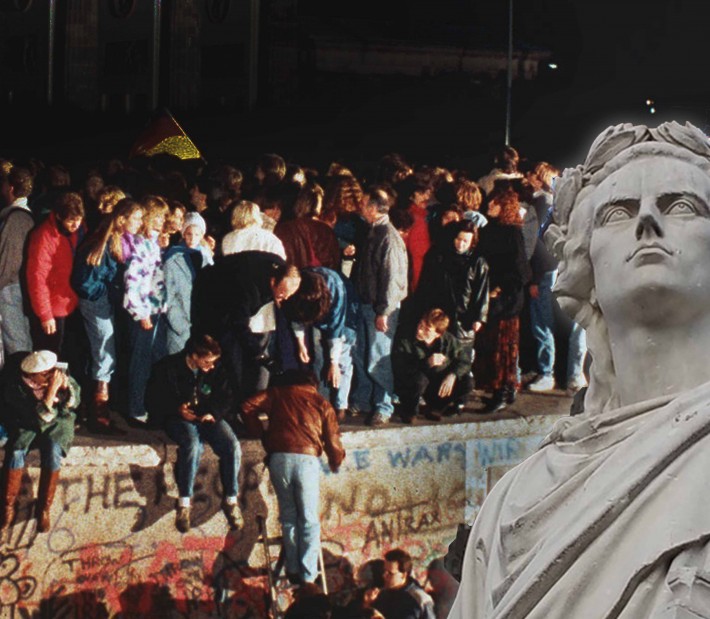
30 years ago 0n November 9, 1989, the Berlin wall came down. The anniversary marks a profound moment today where the irreconcilable differences between the hope expressed in 1989, which is embodied now by the New Paradigm, and the doom of geopolitics are coming to odds. The Schiller Institute in NYC celebrated the coincidence of the Fall of the Wall, Schiller’s birthday and the 35 anniversary of the founding of the Schiller Institute with a triumphant demonstration of beauty, outflanking the degenerate culture still dominating political discourse in the United States and Europe. Helga Zepp-LaRouche keynotes the event, followed by musical offerings from Schubert and Brahms and poetry by Schiller and Shakespeare.

A Three-Fold Anniversary
Address by Helga Zepp-LaRouche

Excerpt from video: “The Lost Chance of 1989”
Schubert/Schiller: Die Hoffnung
Michelle Erin, soprano – Margaret Greenspan, piano – Elliot Greenspan, speaker

Schubert/Schiller: An Emma
John Sigerson, tenor – Margaret Greenspan, piano

Shakespeare: Luciana’s Monologue from Comedy of Errors, Act 3, Scene 2
Leah DeGruchy

Max Caspar on Kepler as a Philosophical Mind
John Sigerson

Schiller: “Die Teilung der Erde”
Frank Mathis

Schubert/Schober: “An die Musik”
Lisa Bryce, soprano – Richard Cordova, piano


Page 6 of 11First...567...Last