Top Left Link Buttons

General

Category Archives

VIDEO: End Famine, Back Independent Family Farming, and Build a New Economic System

This new 17-minute video gives excerpts from eight farm, health and other participants—North America, Africa, Europe—at the Sept. 5-6, 2020 Schiller Institute Conference, “War Drive Towards Armageddon—Or a New Paradigm Among Sovereign Nations United by the Common Aims of Mankind?”

Famine is spreading worldwide, at the same time as the transnational, financialized food production and trade system is ruining independent, family-scale farming. Add to this the impact of COVID-19, and the necessity is clear, for a new economic system, as well as emergency action for food and health. This has been a focus of discussion at a series of international conferences by the Schiller Institute since April, with the aim of seeing these and all strategic security matters on the agenda of an emergency summit of the major powers, at the earliest possible time.

In the U.S., cattlemen are in the forefront of defending the principle of independent producers, the principle of the right of all people to nutritious food, and the necessity of breaking up the food cartels and their Wall Street/City of London controllers. Spokesmen on this video are ranchers from Colorado, Kansas and South Dakota.

Speakers include:
Bob Baker, Schiller Institute Agriculture Liaison Marcia Merry Baker, EIR Editorial Board
Nicole Pfrang, Kansas Cattlemen’s Association, Secretary-Treasurer
Marlette Kyssama-Nsona, Republic of Congo, Panafrican League UMOJA
Ron Wieczorek, South Dakota cattleman, 2018 candidate for U.S. Congress Mike Callicrate, Colorado/Kansas cattleman, Ranch Foods Direct
Paul Gallagher, EIR Editorial Board
Helga Zepp LaRouche, Founder and Chairman, Schiller Institute

Watch the entirety of Panel IV: “Building Trust in International Relations: The Role of Classical Culture and Combating World Famine” .


Bilateral Economic Agreements Are Made at FOCAC 2018

Sept. 4, 2018  — With over 50 African countries represented at the Forum on China-Africa Cooperation Summit, there was an opportunity for these countries to sign bilateral economic agreements, make political statements in support of the Belt and Road Initiative, and have bilateral meetings among the leaders. The following are a few reported in the African media.

* A Chinese consortium comprising The Dongfang Electric manufacturing company and Shanghai Electric, and the Egyptian Ministry of Electricity and Renewable Energy, signed a $4.4 billion agreement to build a clean-coal power station in Egypt, China Central Television reported. It will be located 500 miles from Cairo and made up of six units with a total capacity of 6.6 gigawatts. Construction is planned to be completed in six years.

Egyptian President Abdel Fattah el-Sisi held meetings with heads of Chinese firms operating in Egypt.
* Nigerian President Muahammadu Buhari heads a large delegation of ministers, governors, and heads of parastatals who have been negotiating agreements on behalf of their states and ministries on the sidelines of the summit. The Nigerian National Petroleum Corp. has been assured by China National Petroleum Corp. that it is committed to securing up to 85% of $2.8 billion needed to build the Ajaokuta-Kaduna-Kano (AKK) pipeline project, a statement from the corporation on Monday disclosed. The pipeline would enable connectivity between the East, West, and North that is currently non-existent. Funders would include the Industrial and Commercial Bank of China, Bank of China, and
Infrastructure Bank of China, with Sinosure, China’s Export Credit Agency, providing insurance cover. The remaining 15% will be provided by the contractors.

* The President of Namibia, Hage Geingob, acting chairman of the Southern Africa Development Community (SADC), appealed to China’s investment community to support the SADC region in developing its manufacturing, infrastructure, transportation, agriculture, and tourism sectors. Geingob said that, due to their extensive knowledge in industrial development and technology, Chinese will help SADC in realizing its dream.

* The Namibian delegation is negotiating a deal for the  Chinese to finance a new national airport, while elevating their relations to that of a Strategic Partnership.

* Zimbabwe President Emmerson Mnangagwa said, at the summit, that the BRI is important to support Zimbabwe’s plan to be a middle-income country by 2030.
“Zimbabwe was only lucky,” he said, to the extent that 800 to 1,000 years ago there was trade between the Munhumutapa Kingdom and China when we imported porcelain and silk from here and in turn you got our ivory. But today the Road and Belt Initiative has taken everybody onboard so that our economies can talk to each other, so that our economies can help each other modernize and mechanize. We are getting connected and benefiting from each other.”

Mnangagwa said, “We are happy that this is a country that has never colonized anybody, who today is giving us a helping hand to grow. As a matter of fact, China is helping us to become a middle-income country. As a result of that helping hand we leapfrog and go into a modern economy. Left alone it will take us more years to develop with our domestic investment, but given the technology, given the assistance, the financial know-how, we leapfrog and become an important cog in the global economy.”


An Inside Assessment on Medical Robotics

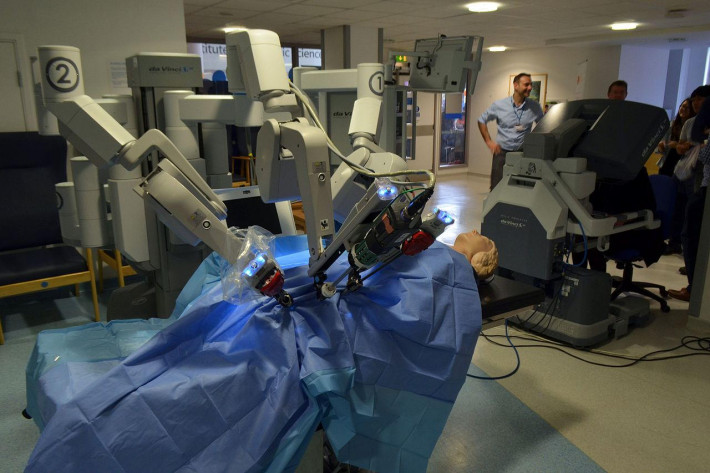
Christophe Assenmacher, Head of Urology at Clinics of Europe (Cliniques de l’Europe) St Elizabeth’s and Trainer in Robotic Surgery, gives an informed perspective of expanded use of medical robots.

“Take the surgeon,” he explains, talking to Robotics Tomorrow, “While they spend years studying, their ability to function under pressure, make precise movements and many other skills can be augmented by a robot to significant impact.” Indeed, whilst some patients might still feel hesitant to undergo surgery that is entirely automated, having a highly-trained and competent surgeon at the helm aided by a robot’s precision could reassure them they are receiving optimal treatment throughout.

“From my own practice, I’ve seen that robot-assisted surgery typically halves the length of hospital stays, reduces bleeding and blood transfusions, shrinks the risk of infection, lessens the requirement for painkillers and ultimately improves the standard of care for our patients,” Assenmacher states. Furthermore, of particular relevance during incidences of highly infectious disease such as COVID-19, robots can be deployed to perform essential tasks that would otherwise place people at risk, such as disinfecting rooms and dispensing medication. Assenmacher intimates that these capabilities could simply be the tip of the automation iceberg: “We certainly expect to see an evolution of nanorobots in the bloodstream, digital pills and social companion robots.” 

Assenmacher states that he personally uses the da Vinci Surgical System when performing specialised urological procedures, although the same equipment can be used for general surgery as well as cardiac, colorectal, gynaecological, head and neck and thoracic procedures too. The company’s website points out that a common misunderstanding of current surgical robotics is that machines carry out procedures independently of surgeons. This is incorrect: the da Vinci system functions as a tool or instrument by which the operator carries out the procedure using a control panel.

“The da Vinci system translates your surgeon’s hand movements at the console in real-time, bending and rotating the instruments while performing the procedure. The tiny wristed instruments move like a human hand, but with a greater range of motion. The da Vinci vision system also delivers highly magnified, 3D high-definition views of the surgical area.”


China Will Integrate Belt and Road with African Development Plans

Sept. 4, 2018  — The second day of the FOCAC Summit in Beijing consisted of a round-table chaired jointly by  President Xi Jinping and President Cyril Ramaphosa, and a series of side forums dealing with individual issues. Speaking at the concluding press conference of the summit, President Xi Jinping underlined the motif: “We will synergize China’s Belt and Road Initiative with African Union’s Agenda 2063 and the United Nations 2030 Agenda for Sustainable Development, and the national development strategies of African countries.”

Xi said, “Together we will better uphold the common interests of China and Africa, boost the strength of developing countries, and make the world a more balanced and better place for everyone to live in.”

Xi also had words of wisdom for other “international partners” of Africa. “We hope that Africa’s international cooperation partners could learn from each other, leverage their respective strength, build synergy, and jointly contribute to peace and development in Africa,” Xi said. He thanked President Ramaphosa for his close cooperation over the last few months in preparing for the summit, and welcomed President Macky Sall of Senegal as the new African co-chair of FOCAC. President Ramaphosa reiterated his strong support for the BRI: “…[t]he China-proposed Belt and Road Initiative provides the African continent with great opportunities. African countries all collectively accept and praise the initiative, hailing it a best way to address Africa’s challenges.” He pointed out that China and African countries agreed to work more closely together and share technologies and achievements, and listed a series of projects, including the China-Africa cooperation center for ocean science and blue economy, the China-Africa research center for the development of green agriculture, the China-Africa energy technological cooperation center, and the China-Africa geo-science cooperation center.

President Sall, in turn, expressed that he is “happy” over being able to co-chair FOCAC, and said he saw “great prospects” in coming years with more engagements with the private sector. “We will push our relationship to a higher level,” he said, calling the present period of China-Africa relations, a “golden age.”


Humanitarian Catastrophe Being Ignored on Lesbos

Sept. 10 — The situation on the Greek island of Lesbos where the Moria refugee camp was burned down is clearly a humanitarian catastrophe. It is not clear how many refugees are left without shelter—official reports say 3,500, others say 12,000 refugees are stranded in empty fields.

A second fire destroyed more of the camp on Sept. 8. It is obvious that some refugees themselves set the fires as the only way to break an impossible situation. The Migration Ministry said it would take “all necessary steps” to ensure that vulnerable groups and families had shelter. The fire also destroyed the new health unit’s intensive care area.

A passenger ferry and two Navy landing ships are being sent to accommodate some 2,000 of the refugees. The only option that makes sense is to evacuate the refugees from the island and transfer them to other countries than Greece. Only 400 unaccompanied minors from the camp so far will be transferred off the island. Greece has already requested at the EU level that other countries also take the refugees, but outside of expressions of solidarity nothing substantial has been done.

Meanwhile COVID-19 measures are being taken, with 19,000 test kits being sent to the island, as well as the deployment of more doctors and medical personnel to handle the situation.

Speaking at a virtual press conference today Francesco Rocca, president of the International Federation of Red Cross and Red Crescent Societies (IFRC), said it was “urgent” to move migrants from the Greek islands to the mainland, calling it a “humanitarian imperative.” He called it a “European crisis which requires concrete acts of solidarity by EU member states. Simply containing people is not the solution.”

Rocca said “No human being should live in the conditions in an overcrowded camp like in Moria.” He said that the camp was supposed to be a transit facility for refugees who were supposed to be processed and either deported or sent on to other EU countries. Nothing was done as the EU and its member states footdragging left the Greek government with the problem. Rocca told the media: “Local people, NGOs, the Red Cross, everyone is doing their utmost. But for how long? We must speed up the move of these people from the island.”


Three Gorges Dam and High-tech Farming Prevent Food Crisis in Spite of Record Flooding

China has often been subject to catastrophic flooding. Previously such floods, as they have experienced this year, would have led to tens of thousands of deaths, massive loss of farmland and the threat of famine. When China decided at the end of the last century to build the Three Gorges Dam, the largest dam of its kind in the world, there was some controversy. Too big, too expensive, and it wouldn’t help in a major flood, were the common arguments. But today the Three Gorges Dam received its largest contingent of water since it was constructed in 2003, and is continuing to perform. At 8 a.m.the inbound flow reached 75,000 cubic/meters per second.

President Xi is visiting the region in Anhui province further down along the Yangtze. While there has been much flooding and destruction, the loss of life has been minimal and scientific farming, including satellite technology, soil sensors and insect-monitoring lamps, the data of which  are transmitted simultaneously by the Internet of Things to smartphones and computers, have allowed them to mitigate losses. While grain production has from time immemorial and today been the number one issue for Chinese rulers, the devastated flooding will, thanks to technology, not prevent some bumper crops this year along the Yangtze and its tributary rivers.


Uruguay to Announce Formal Entry into Belt and Road Initiative

Aug. 3, 2018-The office of Uruguayan president Tabare Vasquez has announced on its website that it will formally join the Belt and Road Initiative (BRI), to be announced officially during the Aug. 20-27 “Uruguay Week in China” to be celebrated in the Chinese cities of Beijing, Guangzhou and Conqing.

Although the Uruguayans claim they are the “first” Ibero-American nation to officially join the BRI, both Panama and the Dominican Republic, which established diplomatic relations
with China during the past year, also claim to be the “first” in joining the BRI. Undoubtedly there will be many more “firsts”!

Uruguay’s Foreign Ministry and the Uruguay XXI trade promotion office are organizing the “Uruguay Week in China” event, and foreign minister Nin Novoa will lead the delegation
participating in it. Uruguay XXI’s director, Antonio Carambula, stressed that during the Aug. 20-27 events, “we will be presenting Uruguay as a nation of great investment opportunities
…. but also thinking of the possibilities of expanding to the rest of the region,” according to the montevideo.comwebsite.

Following the August events, Uruguay will send another large delegation to Shanghai, to attend the Nov. 5-10 China International Import Expo, hosted by the Chinese Commerce Ministry and the Shanghai municipal government. This is a huge affair, at which representatives of at least 100 countries are expected to attend. Several Ibero-American governments and companies have already committed to attending, and the Chinese continue to organize for this aggressively around the world.

(Chinese imports are in fact growing significantly faster than its exports now; a 21% annual pace in the first half of 2018, as opposed to 10% annual rate of growth in exports.) Also taking place in November in the city of Zhuhai is the China-Latin America-Caribbean Business Forum, which Uruguay hosted last year, and is another very large event including Chinese and Ibero-American businessmen and government officials. Later in November, Carambula announced, the “icing on the cake” will be Chinese president Xi Jinping’s state visit to Uruguay following the G20 meeting.


First Arab Nuclear Power Plant Now on the Grid

Unit 1 of the UAE’s Barakah plant — the Arab world’s first nuclear energy plant — has connected to the national power grid, in a historic moment enabling it to provide cleaner electricity to millions of residents and help reduce the oil-rich country’s reliance on fossil fuels. “This is a major milestone, we’ve been planning for this for the last 12 years now,” Mohamed Al Hammadi, CEO of Emirates Nuclear Energy Corporation (ENEC), told CNBC’s Dan Murphy in an exclusive interview ahead of the news.

Unit 1 is the first of what will eventually be four reactors, which when fully operational are expected to provide 25% of the UAE’s electricity and reduce its carbon emissions by 21 million tons a year, according to ENEC. That’s roughly equivalent to the carbon emissions of 3.2 million cars annually.

The Gulf country of nearly 10 million is the newest member of a group of now 31 countries running nuclear power operations. It’s also the first new country to launch a nuclear power plant in three decades, the last being China in 1990.

“The UAE has been growing from an electricity demand standpoint,”  Al Hammadi said. “That’s why we are trying to meet the demand (and) at the same time have it with less carbon emissions.”

The UAE’s electricity mix will continue to include gas and renewable energy, with “the baseload from nuclear,” the CEO added, which he described as a “safe, clean and reliable source of electricity” for the country.

The project is also providing “highly compensated jobs” for the Emiratis and will introduce new industries for the country’s economy, Al Hammadi said. The company noted that it has awarded roughly 2,000 contracts worth more than $4.8 billion for local companies.


Webcast: Dialogue, Not War!

The BRICS summit last week in South Africa demonstrated how far the New Silk Road spirit has spread, shaping relations between nations on the basis of mutual benefit. Under the leadership of China’s Xi, Russia’s Putin, and India’s Modi, both the official proceedings of the BRICS and the bilateral discussions which occurred during the summit showed that a new era of peaceful cooperation has emerged. Will the Trans-Atlantic nations join it, or follow the British imperial geopoliticians to sabotage it, using assassinations, regime change and general warfare to do so?

The “Singapore model,” of dialogue instead of war, which was created when President Donald Trump met with North Korean President Kim Jong-un, and then continued in the Trump-Putin Helsinki summit, has been under intense assault. The Fake News media have been deriding the results and denouncing the participants, Trump and Putin, while neo-cons and neo-libs in both U.S. political parties and in mainstream European parties are engaging in schemes to shut down the process. Unfortunately for them, the significant meeting between Trump and new Italian Prime Minister Giuseppe Conte cemented an alliance between the two nations, in opposition to the Trans-Atlantic status quo, and in the press conference afterwards, may have opened a new possibility to apply the Singapore model.

Asked whether he would speak to Iran’s leaders, Trump said “I’ll meet with anybody….There’s nothing wrong with meeting….. I’m ready to meet anytime they want to…. I think it’s an appropriate thing to do.” While there are still obstacles to overcome for a resolution to be achieved between the U.S. and Iran, Trump’s sentiment is a step forward. When it comes to matters of war and peace, dialogue is preferable to war, which can overcome the problems created by the geopoliticians, who clearly prefer war.

Helga Zepp LaRouche said the year 2018 should be the year in which humanity rejects forever the geopoliticians’ model, based on pitting each against all, to protect the interests of the Empire. She will speak on the most recent developments, and the road ahead, this Thursday. Be sure to “tune in.”


Building a Worldwide “Chorus of Voices” for a Great Power Summit to Implement LaRouche’s Solution to the Crisis

Schiller Institute founder Helga Zepp-LaRouche delivered the keynote address to an August 15, Spanish-language international videoconference organized by the Schiller Institute for the nations of Ibero-America and Spain, as part of the drive to build a worldwide chorus of voices calling for a summit of the five permanent members of the UN Security Council to meet in September to address the systemic crisis facing the planet. The highly-successful event had over 500 live participants in its two panels, and an archived version of Panel I, including Zepp-LaRouche’s speech, has already had over 30,000 views.

The event, titled “Towards a World Summit of Powers in September: The LaRouche Plan for a New Economic and Security Architecture for the Planet,” demonstrated the real thirst in the population for a full change in paradigm.

Moderator Dennis Small introduced the session by stating that the videoconference was meant as a “feeder event” to the upcoming Sept. 5-6 international SI conference. He noted that what we mean by a new architecture, should be viewed from the standpoint of Leibniz, who wrote in his “Principles of Nature”: “Our soul is architectonic also in its voluntary actions and in discovering the sciences according to which God has regulated things.

In its own realm and in the small world in which it is allowed to act, the soul imitates what God performs in the great world.” The English-language video of Zepp-LaRouche’s keynote can be found on this webpage. The two panels were as follows:

Panel I: “Towards a New International Security Architecture”
1) Helga Zepp-LaRouche (Germany), founder and President, Schiller Institute: “Happiness Is a Human Right for All Humanity”
2) Víctor Cortizo (Spain), lawyer, Professor, International Relations. Francisco de Vitoria University, Vice-President, Cátedra China: “Spain, a Bridge of the New Silk Road
3) Daniel Estulin (Russia), author: “Could Lyndon LaRouche’s Vision of a Space Imperative Become Reality?”
4) Walter Formento (Argentina), Director, Center for Political and Economic Research: “Real economic, science and technology from South America for the development of a new multi-polar world”
5) José Antonio Benllochpiquer (Peru), President, Christian Democratic Party: “Peru and the new international architecture”

Panel II: “Towards a New International Economic Architecture”
1) Jacques Cheminade (France), president, Solidarité et Progres: “The LaRouche Plan to Defeat the Pandemic, and its Causes”
2) Justo Vargas (Perú). Amazon Integration Network: “The Inter-Oceanic Railroad and the Development of the Amazon Region”
3) Carolina Domínguez (Mexico), International LaRouche Youth Movement: “If You Want to Educate Presidents to Demand a P-5 Summit, Build a Youth Movement”
4) Marco Méndez (México), Vice-president of the Mexican Union of Associations of Engineers: “Infrastructure as an element of development”
5) Dennis Small (U.S.), EIR Ibero-American Editor: “Why It Is Urgent to Exonerate Lyndon LaRouche and His Ideas”
6) Alberto Vizcarra (Mexico), Coordinator, Citizens’ Movement for Water: “The Time Has Come to Imitate Roosevelt”
7) Pedro Rubio (Colombia), President of the Association of Workers of the National Comptrollers Agency: “The Vernadsky Indicator: How to Double Food Production”

During the course of the event, greetings were presented from Mexicans Francisco Roman, of the Democratic Cardenista Peasant Center, and business leader Rafael Nava; as well as General Edwin de la Fuente, former Commander-in-Chief of Bolivia’s Armed Forces. It reads as follows: “Every effort to engage in dialogue in a world that is threatened as never before, cannot but be seen as hopeful, and more than that, as a light at the end of the tunnel. The planet has never before generated such wealth, and yet in
contradiction, such poverty for the great majorities. I am grateful for this great initiative, knowing that a [P5] summit could arrive at a happy agreement for world peace. I congratulate the Schiller Institute, its members, and its leader, the indefatigable Helga Zepp-LaRouche for this marvelous work on behalf of better days for all of humanity.”

TRANSCRIPT:

HELGA ZEPP-LAROUCHE: Let me greet you here from Germany. Obviously, this event is taking place at an unprecedented moment in history. If you look at the world situation in its complexity today, I think you will agree that we are confronted with a situation which is really beyond the comprehension of people only a couple of months ago. We are confronted with a pandemic. This pandemic is not yet under control by any means. We have, as a consequence of that pandemic, an incredible economic collapse. Some people say the largest since the end of World War II. Dennis mentioned already that especially in the developing countries, where 60% of all people have been working in the informal economy — meaning that they’re living from hand-to-mouth — when you have a lockdown, people are immediately threatened in their lives with starvation. Then naturally, we have the danger of a famine, which is becoming all the more great because of a collapse of agriculture. In Africa and Asia, many countries are threatened with a locust plague; again, the likes of which has not been seen for several decades. Naturally, you have the danger of the lack of, or a phenomenon that in many countries in the world, the people have lost the trust in their governments, in their leading institutions. Because in many parts of the world, the people don’t feel that these governments represent their interests in the face of this crisis.

That’s why we have been thinking, where should the solution come from under these extraordinary circumstances? Can it come from protests, demonstrations? Obviously not. Can it come from the existing institutions — the G7, the G20? Well, that is very unlikely. My late husband Lyndon LaRouche had campaigned for many years for the idea that in order to defeat the powers that be, which are responsible for this crisis, this is the British Empire located in the City of London, and Wall Street, and naturally their collaborators around the world. In order to have a power against that which can change the agenda and establish a new system, you need the four most powerful nations of the world to unite — the United States, China, Russia, and hopefully India.

Given the fact that you have right now rising tensions between the United States and China, where all kinds of reasons are being given. China supposedly wants to take over the world; China being responsible for the pandemic. In reality, it is the rise of China to become a leading power if not the leading power in the world, not actually threatening to replace the United States as a hegemon. But nevertheless, we are on the verge of a potential war between the two largest economies; the United States and China. This is why the question of where should the solution come from in these circumstances. I issued a call in the beginning of January of this year that it must be minimally the United States, Russia, and China to overcome geopolitics and establish common rules to meet the challenges which confront all of mankind.

A few days later, President Putin of Russia independently of that, called for a summit of the Permanent Five countries of the UN Security Council to have a discussion and work out principles for how to guarantee the long-term survival of civilization; how to give the world principles so that the dangers which we confront right now can be overcome.

Before I come to the point of what needs to be done to accomplish that, and one of the purposes of this conference is to bring together all the countries from Latin America and the Spanish-speaking world to play a role in that. Because I think what is needed to accomplish that is a chorus of international voices; of governments, of individuals, of institutions all working together to demand that this crisis needs a solution from the top. We need to have a complete change of the system. Let me review quickly who we are, since many people are on this program as participants or viewers who may not be aware about the crucial role the LaRouche organization and Lyndon LaRouche played in this fight.

Given the fact that we have today the very famous date of the 15th of August, this is not only Ferragosto in Italy, but it is also the day when, 49 years ago, President Nixon ended the old Bretton Woods system as it was established in the postwar period. He decoupled the dollar from gold; he ended the system of fixed exchange rates and replaced them with floating exchange rates. Not many people, if any, recognized what was the historical significance of that move. My late husband Lyndon LaRouche, who was absolutely studying the systemic flaws of the Bretton Woods system as it existed before, because when Franklin D Roosevelt had died, and the actual Bretton Woods system was not carried out as he had intended, but it was more designed by Churchill and Truman, who was really a little man completely influenced by Churchill. It left out the most important aspect; namely, that Roosevelt had intended that the Bretton Woods system should overcome the underdevelopment of the developing countries and increase the living standard of the entire world population, as the precondition for peace and a stable order for the postwar period. That was left out, and therefore, when Nixon made these moves, my husband immediately recognized what was the direction of the powers that be of the City of London, of the Wall Street financial powers. He said that if you continue on this path, that is, to implement monetarist policies, then you will have the danger of fascism, the danger of a new depression, the danger of war. Or, you will establish a completely different new, just world economic order.

He also immediately recognized that the policies conducted by the IMF at that moment and the World Bank — the infamous conditionalities — basically denying the developing countries to invest in health systems, infrastructure, and education systems. So, he commissioned a Biological Holocaust Taskforce, which had the task to investigate what would be the impact of these policies of the IMF on developing countries. He said, after having done intensive studies, that this was bringing about the danger of pandemics, because you cannot lower the living standard of entire continents over a long period of time without inviting the re-emergence of old diseases and the development of new pandemics.

He immediately started to provide solutions. One of the most existential, fundamental solutions he proposed was actually on April 27, 1975, where after a trip he had taken to Iraq, where he had met with many leaders of developing countries, he made a press conference in Bonn [West Germany], and he proposed the formation of the International Development Bank which was to replace the IMF. That concept would have worked, and immediately people associated with Lyndon LaRouche all over the world started to discuss that with the Non-Aligned Movement for one entire year. This proposal would have established an international development bank which would have provided $400 billion in credit every year in long-term, low-interest credit for well-defined projects of industrialization in Africa, in Latin America, in Asia. And it would have started the kind of technology transfer which, given the fact that this is now 45 years ago, if implemented would have meant that you indeed would have blossoming gardens in all of these continents. That idea was absolutely well-received by the countries of the Non-Aligned Movement, who, in their final resolution in Colombo, Sri Lanka, in 1976, basically took that entire proposal and adopted it. That was three-quarters of the human race saying, “We want a New World Economic Order.”

At that time, the Foreign Minister of Guyana, Fred Wills, presented this proposal to the UN General Assembly in New York. There was widespread support for it, and it could have been implemented. Well, it was not because you had the biggest backlash from the City of London, from the British Empire — which is essentially all the central banks, investment banks, insurance companies, hedge funds, and generally the military-industrial complex associated with these financial powers. And you had the biggest destabilization against Indira Gandhi, against Mrs. [Sirimavo] Bandaranaike from Sri Lanka. Zulfikar Ali Bhutto, the Prime Minister of Pakistan, was killed. As Henry Kissinger stated, which we published at the time, through documents that are unchallenged to the present day, Kissinger said, “We will make a bloody example of Bhutto,” because he challenged this present system. Also, President Gen. Juan Velasco Alvarado from Peru was destabilized.

But my husband and his movement, we started to continue this fight. The first comprehensive development plan for Africa, we presented in a big conference in Paris in 1976. In 1975 already, my husband proposed a development plan for Southwest Asia, which was called the Oasis Plan. This was the idea to develop new forms of water through nuclear energy desalination of large quantities of ocean water. Of using other modern technologies as they are used right now in Israel and some of the Gulf states. Then in the following period, in 1982, my husband was invited by López Portillo to come to the defense of Mexico when the peso was under attack, and huge amounts of capital flight took place. He wrote a program for the entire development of Latin America, called Operation Juárez, which, like the Africa plan, started from the assumption that both Africa and Latin America had no infrastructure to speak of, due to the colonialist tradition. So, basically, the first step of the industrialization of these two continents would have been the development of large-scale infrastructure ports, railway, integrated with highways, production of energy, distribution of energy, communications systems; all as the precondition for a real industrial development and the industrialization of agriculture.

In 1982, we also worked with Prime Minister Indira Gandhi from India, on a 40-year development plan for India, which she started to implement until she was assassinated. It was continued by her son, Rajiv Gandhi, and in a certain sense, that same idea of bringing technology transfer to the developing countries was also the core idea of the Strategic Defense Initiative, which my husband had worked on, which was then adopted by the Reagan Administration. Which was a revolutionary concept to dissolve the military blocs of NATO and the Warsaw Pact; develop new technologies to make nuclear weapons obsolete; use the new technologies from the military area in civilian applications as a gigantic science driver and use that to increase the productivity of the world economy and then have a technology transfer to the developing countries; and stop using these countries as proxy partners in wars between the superpowers.

This policy was continued with Lyn’s and my proposal for what to do after the collapse of the Soviet Union; namely, to build a Eurasian Land-Bridge connecting the populations and industrial powers of Europe with those of Asia. And use that New Silk Road to connect with all these other development projects.

These were very concrete projects. They could have been implemented by the European nations, by the United States, by the Asian industrialized countries like Japan. But they decided to go in the opposite direction. Already in the beginning of the 1970s at the same time my husband was talking about the New World Economic Order, Kissinger wrote something called NSSM-200, which was the idea that any kind of development of the developing sector had to be stopped; especially population-rich countries. They should be “encouraged” (to put it diplomatically) to reduce their populations through birth control, through limited access to raw materials, because these raw materials would belong to the United States, according to Kissinger. At the same time, the Club of Rome launched this incredible campaign about the so-called limits to growth. Which was a complete fraudulent computer model, where the end result was programmed first — namely that you had to stop growth and go to zero-growth in order to then say that all countries had to go for Green ideas, for zero-growth. That was really the beginning of this very negative ecology movement which is now dominating much of Europe, and which is also prevalent in the Democratic Party in the United States, and among some other circles.

At the same time, the U.S. Federal Reserve, from about 1973 on, started to push the idea of a controlled disintegration of the world economy. This was pushed by the Trilateral Commission and implemented by the Carter administration from 1977 on. That whole thing was really an effort to basically bring the world back under the control of the British Empire; keep the Third World in a colonial status; and run the world increasingly under the control of the Anglo-American establishment or the Anglo-American special relationship. That factor, of the Anglo-American control of the world, is something every patriot and every world citizen of the world should study. There is no better way than to look at what Kissinger actually said when he, on May 10th, 1982, went to Chatham House in London and actually bragged that he was de facto always working, that he always put the interests of the British much better than informing his own government. He really revealed himself as a British agent and pointed to the role of the British manipulation of U.S. policy ever since.

My husband, in reaction to that blatant admission of Kissinger that he was de facto working as an agent of this Empire, caused him to write an absolutely profound article called “The Toynbee Factor in British Grand Strategy”, which I would advise every participant of this conference to study and read, because it explains a lot of what is going wrong in the world today. It describes as the Toynbee factor the manipulation of the American establishment, but also the population. How to turn the population into hedonistic people who follow their impulses, and how to cause an estrangement of the citizen from a rational comprehension of the major national policy issues which really determine their lives and their futures.

It was that policy which was implemented after the collapse of the Soviet Union by the neo-cons in the United States — the Project for a New American Century — to try to create a unipolar world. Once the Soviet Union had disappeared, the need to keep up the technological progress to be combative with the Soviet military, after that disappeared, this oligarchy went fully in the direction of deregulation of the financial system, the abolishment of Glass-Steagall, and naturally, after Glass-Steagall was abandoned, China was invited to join the WTO with the absolute expectation that that would lead to China adopting the values of the Western liberal economic system of Western democracy. And the dream or utopia of Fukuyama, the American historian, about the end of history, would be implemented; that the whole world would be submissive under the control of this system of the British Empire by just submitting to the rules of that system. At that time also, the Green agenda was escalated, which later was announced as the great transformation of the world economy. The decarbonization, the elimination of first nuclear energy, then all fossil fuels, which has, to the present day, completely influenced many countries. Especially if you look at the EU, that policy has been adopted absolutely, almost completely.

There was one problem. China and many developing countries recognized that under this system, they would not have a chance. So, following the Asia crisis in 1997, but especially after the big financial crisis of 2008, led China to start a completely different policy. Already with Deng Xiaoping’s opening and reform policy after 1979, China had started to go on a policy of scientific and technological progress, of innovation, and uplifting with that policy 850 million people of its own population out of poverty; creating a very vast growing middle class, where the living standard became better and better. Then, in 2013, Xi Jinping announced in Kazakhstan, the New Silk Road. The idea to revive the spirit of the ancient Silk Road of connecting the Eurasian continent through the exchange of ideas, of cultures, of goods, of technologies. That policy was first absolutely neglected by the mainstream media and the think tanks of the West. But China continued to do that, and it started to offer that model of overcoming its own underdevelopment, to the developing sector, and started to build six major infrastructure corridors. Building infrastructure, railroads, in Africa, in Asia, in Latin American countries. This basically would have worked, because it was not geopolitically motivated, but China offered from the very beginning for this to be a win-win policy; inviting the United States and European countries and everybody else to participate in this New Silk Road conception.

This functioned to a certain extent quite well, but then from about 2018 onward, all of a sudden, all major think tanks from the Western countries started to paint China as an authoritarian regime, Xi Jinping as a dictator, China only wanting to replace the United States as the world hegemon. This was expressed in the first security doctrine of the United States in 2018 — the National Security Strategy Paper. The first major such speech was given by Vice President Pence, and followed by speeches to this effect by [FBI head] Christopher Wray, by [National Security Advisor] O’Brien, by Mike Pence, by [Secretary of State] Pompeo — who made several speeches to this effect. Portraying China as the big danger. Ever since, the military tensions have escalated in the South China Sea, along the Chinese coast. This is becoming quite dangerous to world peace. It should be clear to anybody that if the two largest economies in the world start to clash, the danger that this will get out of control and in the worst case, even lead to a nuclear war and the extinction of civilization is a very real danger. Which many people are aware of; which the Russians are aware of.

That is why we have demanded that the policy must be radically changed. If you look at the present combination of problems, we are in an existential crisis of civilization. Only if the major powers work together can we have any hope to solve it, because even if you take the industrial capacity of all countries together, it is not quite sufficient to solve it. So, what we are proposing, therefore, is that we have to orchestrate the situation so that every country starts to discuss as if they are the ones who can determine the outcome of this history. There will be, in all likelihood, hopefully this P-5 summit in September, and it must be way ahead of the U.S. election because if you don’t change the parameters before, the danger is that there will be chaos, an escalation of the pandemic, and provocations of all kinds as we have seen in many parts of the world, which may escalate. What this summit of the permanent five countries [of the UN Security Council] must adopt is a New Bretton Woods system. A new credit system which connects to what Franklin D Roosevelt had in mind when he proposed his version of the Bretton Woods system, and what Lyndon LaRouche has worked out in great detail over the decades. This New Bretton Woods system must replace the casino economy, re-implement Glass-Steagall banking separation, must establish a national bank in every country. And then, through agreements among these national banks, establish a new credit system.

Because it’s not the coronavirus which causes this pandemic. The proof of that is that China succeeded, between January and March, in two months of very rigorous methods of isolating, of tracing, of quarantine, of social distancing, of having built 22 hospitals in a few weeks, they were able to contain the virus, and practically bring it under control in Hubei province, and China was able to restart its economy, after they had defeated the pandemic.

Now, just imagine if every country would have a health system like China was able to mobilize; or just imagine that every country — Mexico, Haiti, Peru, and all the other countries — Mali — they all would have capabilities like China or like it used to be the case with the Hill-Burton standard in the United States, or as the German and French health systems were before the privatization of the health systems started, you could have stopped the pandemic! It never would have become a pandemic!

So the problem is not that China announced this too late. I mean, remember that China announced it some time at the end of January, that it was a pandemic, but then most Western governments, like the German government, they waited for weeks and weeks before they got the production of masks and ventilators and other equipment. So it was not China not informing the world, it was the arrogance of the Western countries to not think that it could ever arrive in their countries, like the German Health Minister Jens Spahn said, “Oh, this virus will never come to Germany.” What foolishness!

So if every country, therefore, would start to build, with the international cooperation, such modern health systems, hospitals, training medical personnel, increasing the number of doctors and nurses, you could actually not only contain this pandemic, but the danger of new pandemics which are absolutely around the corner at any moment. So, if you want to make the human race safe, the building of such a world system is the absolute first step. Naturally, you cannot build hospitals and have the necessary equipment without water, without energy, without infrastructure, so the building of the new health system must become the beginning of the construction of a new world economic order, and the kind of development which I was talking about we have been fighting for, for almost 50 years. And now, because of the Belt and Road Initiative, the New Silk Road perspective is an absolute possibility to be realized, and we have to get the United States and the European countries to stop their geopolitical opposition to that, but to join hands.

I think that all the countries in the world will be judged by future history — if we have one — by how they reacted to this crisis. And if they have the greatness to overcome their petty geopolitical concerns and join hands to work on this question of the new world economic order. The question is: Can we create a world in which human beings can live? Now, Xi Jinping, some years ago, I think it was at a big party convention, announced a plan for China, by the year 2050, where he said that by 2050 China should be a modern country, democratic, culturally advanced, the people of China should live a happy life, and that model should also exist happiness for all nations on this planet.

Now, I think that this idea of happiness is a fundamental human right of all human beings. It just happens to be in the Declaration of Independence, where it basically says, that the right to life, liberty and the pursuit of happiness is what is an inalienable right for all people. And when the Schiller Institute was founded 36 years ago, I was looking around in all the documents, to think what would be the best charter for the Schiller Institute. And I found that this Declaration of Independence was one of the best documents to express what should be the purpose of the Schiller Institute’s efforts. And I changed only a few words, maybe six words, to replace the “American colony” with “all countries” and the “British Empire” making it applicable for all countries in the world. And I think that this idea, that we have to have economic development and make sure that every single human being has the right to happiness, meaning in the tradition of Leibniz, not a good life, a happy moment for the hour, but to be able to develop all potentialities which are in each human person, to develop all creative potentials so that each human being can contribute in the best way to the development of the common good of society as a whole, and all of mankind, and in that way, be in correspondence to the harmonic ordering of the universe, by increasing the level of creativity, not only of the human mankind, but of the laws of the universe at large.

That idea of a harmonic development of all nations, that if every single nation develops their potential and regards it as their self-interest to develop the self-interest of the other one, is also already existing as a concept in Nikolaus of Cusa, who said that harmony in the world can only exist if you have the best possible development of all microcosms, as a precondition for harmony in the macrocosm. In other words, the idea of Franklin D. Roosevelt that all human beings must have a better living standard, be free of the wants, especially of material want, is the precondition for peace. And I think this is eminently possible, because if we now would unite, and say, we have to — in light of the pandemic, the economic crisis, the famine, the danger of war, — we have to join hands and develop Southwest Asia, which has been destroyed by wars for 20 years of meaningless, endless wars, which have killed millions of people, leaving the countries destroyed; Africa, which is absolutely smashed right now by the combination of these crises; Latin America, which is not able to cope with this crisis on its own; that it is the moral obligation for the leaders of the world to change this situation right now. And that can also, then, become the basis, if all countries work together on such a new world economic order, for an integrative, new security architecture. Because only if you have a common economic interest, is there any hope that you can have a security architecture which will integrate every single country.

Now, the big mistake after the collapse of the Soviet Union, was that no effort was made to integrate Russia into such an international architecture, and naturally, the present threat to decouple China and the countries which are associated with China, from the present economic system, is absolutely detrimental to world peace, and it should be replaced by the idea that the future of humanity must be a new system of international relationships, where the sovereignty of every country is respected, the different social security system is respect, and countries are working together for the common aims of mankind, such as a crash program for the realization of fusion power, international cooperation in space, and to establish the common aims for the next hundred years of the human species.

Now, I think the gravity of the crisis makes such a vision absolutely realizable. We want the five permanent powers of the UN Security Council to adopt, in principle, such an orientation. China has offered, repeatedly, as recently as a week ago, to the United States to cooperate on the fight against the pandemic; Russia has offered cooperation in the development of the distribution of the vaccines, and making sure the whole world has access to it in the quickest possible way; so there are these offers. And I think in order to realize this, making a complete break, a new paradigm, it needs a chorus of international voices who have to express their absolute desire and need to go in this direction.

I think this is an absolute necessity, but I think it’s also absolutely realizable, because we are in a world revolution. The old system is absolutely not to be saved, or cannot be saved, and the whole question is, can humanity, in time, can we give ourselves an order which guarantees the long-term survivability of our species? And that is what I wanted to tell you, and where I’m asking you to cooperate.

Question 1: Do you have an explanation of why President Trump is under such attack in the international media?

ZEPP-LAROUCHE: Yes, we do. I think the problem is that Trump has again and again shown that he has good impulses, he wants to definitely improve the relationship with Russia: he has demonstrated that in his summit with Putin in Helsinki very clearly, that if you have two Presidents, I think they can solve any problem. This is why we are pushing so hard to have this summit. Because the problem is that Trump is really surrounded by a nest of scoundrels: Pompeo, Esper, Navarro, all of these people are really neocons of the worst kind. Some of them are evangelicals, like Pompeo, who believes — who has said publicly he believes in the Rapture; which means if there’s an Armageddon, that’s not so bad because he believes that some of these people, that he belongs to the people who will be saved. I personally think he’s an Elmer Gantry — I don’t know if people know this movie [based on a novel by Sinclair Lewis].

I think the only way how you free Trump from the influence of British intelligence — obviously, in the P5 you have Great Britain, which always was a problem, but I think that if you have the three important countries, the U.S., Russia, and China — with Macron somehow wanting to improve relations, at least with Russia, and he says he does with China — I think there is a fighting chance. I think the three leaders, Trump, Putin, and Xi Jinping, when they have the chance to talk about matters directly, I’m absolutely convinced that of all the many options, this is the only one, but it has to occur long before the election, because this anti-China dynamic has to be interrupted. I think it’s very dangerous, because if you paint an enemy-image, where you say China is responsible for the pandemic, for the incredible economic damage, for the evictions — I think this is creating an environment where, then, other developments which could occur in the South China Sea, or around Taiwan, have the potential of really creating a big confrontation.

So that is why I’m appealing so much, that every government, every individual, every institution, should really support this summit publicly. We have prepared a resolution which hopefully you will use after this webinar, and help to spread it in all of these countries. Because I think that if we could generate a chorus of governments, institutions, and concern people, to address the participants in this summit ahead of time, it can help to orchestrate an environment. It will be a big battle, but the summit is the only chance I see between now and the U.S. election, to have an impact, to change the present constellation. And that’s what my deepest conviction is.

Question 2: Please discuss your concept of a Dialogue of Classical Civilizations.

ZEPP-LAROUCHE: I’m absolutely convinced that if people would just know the other culture, all the problems would disappear. Naturally, there are always some evil people who you will never be able to convince — that is an absolute minority.

I have made the experience that when you introduce Confucius to a European or American audience, they get completely excited. Benjamin Franklin was absolutely a follower of Confucius: He modeled his own moral theory on Confucian teaching. And in the same way, when you discuss what Confucius had to say about music, it is absolutely to the point that the kind of music one plays tells you if a society is healthy or in disorder.

In the same way, why is it that all these many Asians, but also naturally, Chinese, are absolutely excited about European classical music? Because they recognize that you can find in the other culture, and vice versa, always something which enriches you. So I think what all of you can help to do, is to set up a dialogue of culture; we can help you to organize musical concerts, dialogue of civilization where each nation brings the best compositions, the most beautiful poems, the most encouraging paintings. The Literati painting in Chinese tradition, for example, has the unity of poetry, painting and calligraphy: And I have seen, repeatedly, that if people see that for the first time, they all of a sudden understand what a metaphor is.

So I think the best thing which can be done right now, to counter this incredible anti-China propaganda — which really is the worst of McCarthyism, and “yellow peril” and all these horrible racist ideas from the past are coming back and being stirred up — The best really is to show the beauty of the other culture. I would encourage all of you who are watching this program, that you should participate. We can set up cultural events, we can further the dialogue of culture, even if it will not be like a live concert, but I think with the limitation of Zoom and other technologies, it also has the advantage that you can communicate with people. And start doing it, you haven’t even thought about doing that before the outbreak of the pandemic.

So I would suggest, anybody who wants to be part of the solution, that you become active with us, in setting up these kinds of dialogues of culture. And we have many, many collaborators in the Schiller Institute in all these countries, who can help to bring the best pearls of each cultures to the knowledge of all others, and that should occur immediately.

Closing Remarks

ZEPP-LAROUCHE: Actually, there was a lot of discussion about the City of London and Wall Street. And I think what is becoming clearer and clearer, is that this system which really accelerated after ’71, after Nixon abandoned the old Bretton Woods system, has become a real, criminal system: And I really mean “criminal.” Just take the case of the Wirecard scandal in Germany: Here you had a case where it now looks, many banks and parts of the government, they all knew that this was a ripoff! And they did not do anything about it! Then think about the LIBOR scandal, where three-digit billions were defrauded from people. Think about the Panama Papers scandal, the Madoff scandal, the Ponzi schemes — and I could add a lot of things. Most banks already have reserves to pay the fines, because it’s already prediscounted, that some of their criminal operations will be caught.

And I think that this system is morally at the end, it’s totally bankrupt, and the idea that you need to reform this system is really something every single person can understand. And if you add to that, the way the cartels are moving, how credits are being given, how the certification is occurring, so they’re trying to control everything against production, for speculation, and therefore, for a totally, thoroughly criminal system.

I think we have to spread the news about that much, much more, and more people will understand that we need a banking system which is not controlled by the City of London, but a national bank in every country, and that we need to move towards this idea of a of a New Bretton Woods system very, very quickly.

So I think that there is an incredible chance. I think people can improve, you can decide, you improve on the spot; the aesthetical education in Confucianism, in Schiller’s Aesthetic Letters, it shows you how you can enable yourself to play a bigger role in this present historical conjuncture. And I thank you all very much. It was a real pleasure to get to know you better. And I also hope that we can continue our collaboration in a very intensive way in the next period.


Page 126 of 146First...125126127...Last