Top Left Link Buttons

General updates

Category Archives

Flurry of Diplomatic Activity Around SCO Foreign Ministers’ Meeting Takes Up Belt and Road Projects

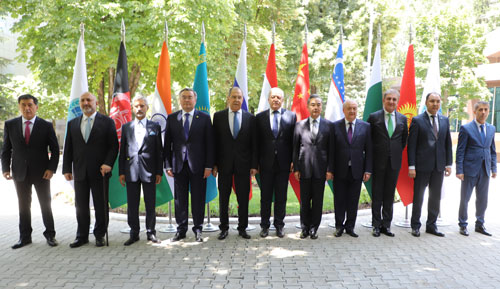
July 16 (EIRNS)—There continued to be a flurry of diplomatic activity around the Shanghai Cooperation Organization (SCO) ministerial and SCO Afghanistan Contact Group, which met July 13-14 in Dushanbe, Tajikistan. Before heading to Dushanbe, on July 12-13, Chinese State Councilor and Foreign Minister Wang Yi stopped in Ashgabat to meet with Turkmenistan President Gurbanguly Berdymukhamedov and other officials. China’s Foreign Ministry reported that during the meeting Wang Yi said, “the two countries should sign as soon as possible documents on the alignment of the China-proposed Belt and Road Initiative with Turkmenistan’s  development strategy to revive the Great Silk Road,” and  formulate a five-year plan for all-round cooperation.” This included China’s “cooperation  with Turkmenistan across the whole industrial chain of oil and gas.” On July 15-16, after the SCO conferences, Pakistan Prime Minister Imran Khan travelled to Uzbekistan, to meet with President Shavkat  Mirziyoyev.

The two leaders discussed cooperation in fighting COVID-19. Their “Joint Declaration on the Establishment of Strategic Partnership between The Republic of Uzbekistan and the Islamic Republic of Pakistan” emphasized: “The leaders stressed the importance of regional integration and connectivity as a cornerstone of economic development and progress. In this regard, they welcomed the exchange of high-level visits in the areas of trade, railways, transport and aviation.

“The two leaders reiterated their support for the Termez-Mazar-i-Sharif-Kabul-Peshawar railway project as an important initiative to create a rail link from Central Asia to the Arabian Sea through Afghanistan and the Pakistani seaports of Karachi, Gwadar and Bin Qasim….

“The two leaders also recognized the immense potential of the China-Pakistan Economic Corridor for the benefit of the entire Central Asianregion and beyond entailing greater connectivity and trade linkages through a network of transport, fiber optic cable, energy pipelines, and investment opportunities in its SEZs [Special Economic Zones].”

Over July 15-16 Uzbekistan President Mirziyoyev hosted the “Central and South Asia: Regional Interconnectedness. Challenges and Opportunities” with Prime Minister Khan and Afghanistan President Ashraf Ghani, as well as Foreign Ministers Sergey Lavrov, Wang Yi, and the other participants in the SCO Foreign Ministers’ Council, representatives of the U.S., Israel, Malaysia, Saudi Arabia, the United Kingdom, Japan, EU and UN.

Meantime, Afghani researcher Ahmad Bilal Khalil wrote in “Afghanistan the Shanghai Cooperation Organization,” in the July 14 issue of The Diplomat that Afghanistan’s development lies with the nations that comprise the SCO, for which he advocated Afghanistan having full membership. Khalil explained, “Afghanistan … has close economic and trade ties with most of the SCO member states…. According to the Afghan Statistical Yearbook, in 2017-18, more than 87% of Afghanistan’s total imports were from SCO countries; and more than 57% of Afghanistan’s total exports were destined to SCO member states.”


Space: China-Russia Lunar Exploration; will the U.S. Join?

Global Times Praises China-Russia Space Cooperation; Offers Joint Work with the U.S. as Well

March 11, 2021 (EIRNS) – The March 10 edition of Global Times contained an enthusiastic editorial on the announcement earlier this week that China and Russia will be cooperating extensively in space. Under the headline “China, Russia joint lunar exploration generates high expectations,” the editorial was upbeat about the prospects.

“First, this plan is very likely to be implemented. Russia accumulated rich experience in lunar exploration during the Soviet Union era, and it has developed a strong space technology… China and Russia have the stable political conditions necessary for long-term cooperation. The cooperation will in turn strengthen bilateral strategic mutual trust and promote comprehensive cooperation in various fields.”

Global Times explained that although the U.S. Artemis program, launched in 2017, is also an international space cooperation project, China and Russia were excluded from participating in it. “China-Russia space cooperation has the conditions to achieve equal and mutual benefits, and none will dominate over the other. The Artemis program is obviously dominated by the US, and others, including the European Space Agency, play the secondary role.”

The Chinese-Russian approach will be different, the editorial argued. “The joint construction of the lunar scientific research station between China and Russia will provide new channels and areas for international space exploration and boost its true internationalization… In the long run, most resources needed for human development will come from outer space. One day, there will be many businesses in the space industry and future generations will see wonderful changes in this field.”

Chinese-Russian space cooperation “can also set a positive example with political implications. We also hope that China-Russia cooperation in lunar exploration will stimulate and promote greater international cooperation. The invisible boundary between the East and the West will be further broken. But of course, it depends on how the US reacts and interacts with China-Russia cooperation in the future.”


“There They Go Again”: British Intelligence Launches New Smear Against Putin, Trump

Friday Questions: Why does The LaRouche Organization talk so much about “Geopolitics”?  The {Guardian} yesterday published new Fake News, claiming they have documents which “suggest” that Putin ordered Russian intelligence to elect Donald Trump.  Why resurrect these lies again, now?  With the U.S. withdrawing troops from Afghanistan, it is possible to break away from the imperial geopolitical doctrines which have controlled U.S. foreign policy since the assassination of JFK.  The era of endless wars, to defend City of London and Wall Street financial swindlers, could be brought to an end — that’s why it is crucial that Americans understand what the Geopolitical doctrine is, to know who our enemies are, and what they are trying to do — and how to defeat them!


COVID-19: Brazilian Infections Critical Point; Lula de Silva says were avoidable

Lula Calls Bolsonaro an “Imbecile” for His Handling of the COVID Crisis

March 11, 2021 (EIRNS) – Brazilian former President Lula de Silva yesterday delivered his first public speech since his phony conviction for graft was overturned by the Brazilian Supreme Court earlier this week, and he used the occasion to rip into President Jair Bolsonaro as an “imbecile” for his handling of the COVID pandemic. “Many of these deaths could have been avoided,” Lula stated, referring to Brazil’s stunning 268,000 deaths. Brazil has the second- highest number of COVID deaths in the world, after the United States.

Speaking to a rally of metalworkers in Sao Bernardo do Campo, his historic base, Lula charged, “This country is disorganized and falling apart, because it has no government,” and he demanded “Health, jobs and justice for Brazil… The people need jobs.” Lula may run for President against Bolsonaro in the October 2022 elections, although some voices have surfaced in the country calling for Bolsonaro to be driven out of office immediately, if the country is to survive.

Bolsonaro’s outrageous disregard for human life and dismissive attitude about any and all anti-pandemic measures (“stop whining” about the pandemic, he told Brazilians a few days ago), has converted Brazil into a threat to the health of the entire planet. According to Fiocruz, a respected biological sciences R&D center in Rio de Janeiro, the new P1 strain of the coronavirus that has emerged in Brazil, which is thought to be twice as contagious as the original strain, may also evade immunity built up by having had the original version of COVID, with a chance of reinfection estimated at between 25% and 60%. Furthermore, P1 is just one of several “variants of concern” that have become dominant in six of eight states studied by Fiocruz.

“This information is an atomic bomb,” said Roberto Kraenkel, of the Covid-19 Brazil Observatory, according to the Washington Post.

Fiocruz also reports that 15 state capitals have intensive care units (ICUs) that are at more than 90% capacity, including the two largest states, Rio de Janeiro and São Paulo. The national capital, Brasilia, is also reported to be at full ICU capacity, while two major cities — Porto Alegre in the south and Campo Grande in the southwest — have exceeded capacity. There is an imminent danger of the “overload and even collapse of health systems,” the R&D center warned.

BBC reported: “Scientists are concerned that Brazil has almost become a natural laboratory, where people can see what happens when coronavirus goes relatively unchecked… Global experts are calling for a plan — including rapid vaccination, lockdowns, and strict social distancing measures — to get the situation under control.” Brazilian epidemiologist Dr. Pedro Hallal told the BBC: “If we do not start vaccinating the population here very soon, it will become a massive tragedy.”

Brazil, with a population of 211 million, is by far the largest country in South America, and shares borders with 10 different nations: every country of South America with the exception of Chile and Ecuador. It has also has extensive historic ties and travel with Africa. And its population was one of the most ravaged by AIDS in decades past, opening up dangerous potentials in terms of its relationship to the coronavirus.


Beethoven: Sparks of Joy!

Beethoven: Sparks of Joy – A Call for Creatures of Prometheus.

Ballet  was a very popular entertainment in 18th century Vienna, and Beethoven composed his first ballet, the “Ritterballet” (Dance of the Knights) in 1791, while still in Bonn. Ten years later, he collaborated with the noted dancer and composer Salvatore Viganò on a ballet with mime, called “Creatures of Prometheus”.

A handbill for the first performance in the Burgtheater in Vienna on 28 March 1801 provides the following synopsis: “This allegorical ballet is based on the myth of Prometheus. The Greek philosophers who knew him tell the story in the following manner: they depict Prometheus as a lofty spirit who, finding the human beings of his time in a state of ignorance, refined them through art and knowledge and gave them laws of right conduct. In accordance with this source, the ballet presents two animate statues who, by the power of harmony, are made susceptible to all the passions of human existence. Prometheus takes them to Parnassus to receive instruction from Apollo, god of the arts, who commands Amphion, Arion and Orpheus to teach them music, [and] Melpomene and Thalia [to teach them] tragedy and comedy. Terpsichore aids Pan who introduces them to the Pastoral Dance which he has invented, and from Bacchus they learn his invention – the Heroic Dance.”

In addition to the overture, Beethoven composed 16 numbers. It was well received by the audience, with 21 further performances, but with one critic opining that “his writing here is too learned for a ballet”. Today, only the overture is regularly heard. The following performance is arranged as “a concert suite in four movements with overture”, omitting some of the numbers. [Notes by Margaret Scialdone.]


Great Leap Backwards: Pushback to Biden’s “30×30” Cuts in Food, Water …

Pushback Against Biden’s “30×30” Move to Cut Agriculture and All Human Use on 30% of U.S. Land, Water by 2030

Mar. 10 (EIRNS)–A key part of the Great Leap Backward is that land and water use must be dictated, first, by greening the environment, and only secondly, for agriculture use, which will produce far less food. This is explicit in the EU “Farm to Fork and Biodiversity Strategies” May, 2020 document; and in the 2020 Agriculture Law of Britain. For the U.S., this green dictate appears in the “30 x 30” scheme, which says that by 2030, human use of any kind—agriculture, forestry, transportation, energy, minerals–must be reduced on 30 percent of U.S. land and water, including oceans.

Biden was programmed to say this during his 2020 campaign, and it was formally announced Jan. 27, in his Executive Order 14008, “Tackling the Climate Crisis at Home and Abroad” (86 Fed. Reg. 7,619).

A huge pushback is underway. On Feb. 22, 17 state governors signed a letter to Biden, opposing the Federal government overreach on this. Many also issued their own press releases. The states include most of the farmbelt, e.g. the Dakotas, Montana, Nebraska, Idaho and others.

There are local meetings of all kinds in opposition. For example, March 2 in Wyoming, a resolution opposing the 30×30 plan, and calling for local consultation, was introduced in the Uinta County Commissioners meeting, by the county’s Citizens Coalition for Sound Resource Use. The Commissioners will take it up March 16.

Last night in the small town of Valentine, Nebraska, a public briefing was held by Margaret Byfield, who has been holding meetings across the Plains states to mobilize people. Her organization is the American Stewards of Liberty, based in Texas. See https://americanstewards.us/

The usual citation is made that 12 percent of U.S. land area is already currently in Federal control. Most of it is in the Western states, and varies widely state by state. However a 2020 estimate by the Federation of American Scientists is much higher.

The text of the EO 14008, in Section 216, directs various Federal departments to provide a report within 90 days of Jan. 27, “recommending steps that the United States should take, working with state, local, tribal and territorial governments, agricultural and forest landowners, fishermen, and other key stakeholders, to achieve the goal of conserving at least 30% of our lands and waters by 2030.”

The save-nature groups are all issuing specifics on where human uses should be locked out first—Sierra Club, National Geographic, Conservation Foundation and others. The National Wildlife Federation, for example, has put out, through its Associate VP for Public lands Tracy Stone-Manning, a starter list of which lands to lock up: 80,000 acres in Montana; 1.3 million acres of the Mojave Desert in Nevada; 250,000 acres in California of redwood forest and river rapids; and over 400,000 acres in Colorado.

The 30×30 catchy concept is also pushed in other nations, as a benchmark on the way to “50×50,” the crazed idea—also called “half Earth”—that by 2050, half of the land and water area of the Earth should be in a state of nature, minus people, so that biodiversity can prevail, and this, it is asserted, will keep creature life in balance, so that zoonotic diseases won’t happen, and life will be peachy.

The “half Earth” lunacy was promoted a few years back in a book by E.O. Wilson, the so called biologist. The Center for American Progress has backed it; and it was in the 2020 Democratic Party Platform, it is reported. A resolution was introduced in Congress on this. There is a 30×30 Ocean Alliance.

On October 4, 2020, Scientific American carried an article sub-titled, “The so-called 30 by 30 plan would protect 30 percent of U.S. lands and waters from development by 2030.” Under the main headline, “An Ambitious Strategy to Preserve Biodiversity,” the author is David Shiffman. He wrote,  “Scientific American’s historic endorsement of Joe Biden noted that Biden ‘has a record of following the data and being guided by science.’ With his campaign’s incorporation of 30 by 30 goals, that’s also true when it comes to biodiversity conservation…”

In May, the U.N. Biodiversity Summit will be in China in Kunming.


Russian UN Energy Forum in Run-up to Glasgow COP26 – Look to Nuclear, Hydro

July 15, 2021 (EIRNS)–In preparation for the Glasgow UN Climate conference – COP26 (Oct. 31-Nov. 12, 2021), the Mission of the Russian Federation to the UN held a virtual side event, titled, “Low Emissions Solutions in Energy and Beyond: Partnering with Businesses for a Sustainable Recovery.” The event was opened by Russia’s Minister of Economic Development, Maxim Reshetnikov, and included speakers from Russia, China, Japan, Australia, and the UK. The Schiller Institute attended the event, which had 60 participants.

Russia was represented by speakers from the IAEA and from Rosatom, as well as by the Minister of Economic Development. Minister Reshetnikov stated that Russia’s goal is to reduce emissions to less than 70% of Russia’s 1990 emission levels by developing all technologies, especially nuclear and hydropower. He appealed: “Don’t discriminate against any technology,” saying that this must be done in a cost-effective way and one that does not impede economic development.

Speaking as the Deputy Director General, and chief of the Nuclear Energy Dept. of the International Atomic Energy Agency (IAEA), Dr. Mikhail Chudakov made a series of sharp points addressing the importance of nuclear energy from the vantage point of urgent global energy deficits: 1) globally, 700 million people are still without access to electricity, and demand is growing, 2) nuclear is the most dense form of all energy sources — we need a level playing field for all low-carbon electricity sources, including access to financing, and 3) “Don’t forget about fusion:” Many companies are now investing over $2 billion in fusion research, which will yield a clean and unlimited new source of energy. Dr. Chudakov said that the promotion of nuclear power as a key part of the solution to the emissions question will be the message taken by the IAEA to COP26. Kirill Komarov of Russia’s Rosatom, documented in many dimensions the power of nuclear energy as a friend of the environment. For instance, in measuring Life Cycle Emissions (measured in gCO2eq/ kWh) we see the following: Solar – 48, Hydro – 24, Nuclear – 12, Wind – 11

Chinese Charge d’ Affaires at the China Mission to the UN, Amb. Dai Bing urged a “people-centered approach” to energy policy, which can create a “beautiful ecological environment.” Dame Barbara Woodward OBE, the UK Permanent Representative to the UN — who was apparently added to the program at the last minute — gave an arrogant speech attacking both Russia and the use of coal, demanding that nations adhere to the dictates of the Paris Climate agreement “4 to 5 times faster” — which will be the UK’s demand at COP26 in Glasgow. Corporate representatives from Brazil and Australia promoted biofuels, hydrogen production, wind, and solar panels.

The Schiller Institute’s Paul Gallagher posed this question to the panel of speakers: “Nuclear power plants have the highest power density per area and time of operation and are extremely reliable — but, they take a long time to build relative to other sources. Can this be solved through factory production of modular nuclear power units; how quickly can this become a reality?” Dr. Chudakov responded that Belarus had built a nuclear plant in only six years. So, the process can be expedited. “We need a clear policy of support of nuclear power from governments, governmental credits for infrastructure” so as to advance reactors and reduce construction time. “It’s easy to scale up when you produce the same unit. That’s why SMRs are the future. They need governmental support.” Russia and China are building nuclear plants because there is government support.

Russian scientists have a distinguished history of promoting — on the world stage — the universal use of nuclear power. Physicist, Academician Yevgeny Velikhov, then-head of the prestigious Kurchatov Institute, speaking at the Arctic Energy Summit in Alaska in October, 2007 addressed the vast “energy gap” between world supply and world demand for electricity. Dr. Velikhov was clear, then: sticking with the current dependence on oil, gas, and so forth will not work — there must be nuclear power.


U.S.-China High Level Meeting March 18

U.S. Sec. of State Blinken and National Security Advisor Sullivan to Hold First in-Person Meeting With Chinese Counterparts Yang Jiechi and Wang Yi In Alaska March 18

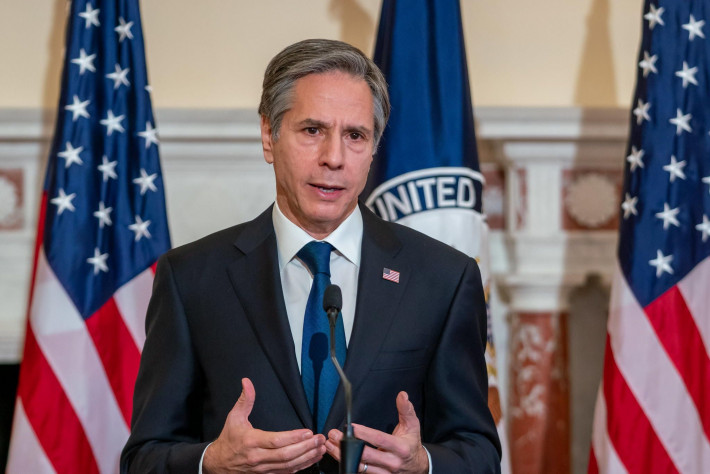
March 10 (EIRNS)–The State Department today confirmed that on March 18, Secretary of State Tony Blinken and National Security Advisor Jake Sullivan will meet in Anchorage, Alaska, with high-level Chinese officials Yang Jiechi, Director of the Central Commission of Foreign Affairs, and Wang Yi, Foreign Minister and State Councilor to discuss what Blinken called a “range of issues” including those on which there is “deep disagreement.” 

The Anchorage meeting will follow the March15-18 trip to Japan and South Korea, by Blinken and Defense Secretary Lloyd Austin. According to a Pentagon press release, the meetings with both governments are intended to bolster relations with allies in the region “in the face of long-term competition with China.” The State Department added that the meetings will “highlight cooperation that promotes peace, security and cooperation in the Indo-Pacific region and around the world.” Just prior to these meetings, President Biden will hold a virtual meeting on March 12 with his “Quad” allies–India, Japan and Australia.

Blinken will return from Asia directly to Anchorage where he will be joined by Jake Sullivan. Austin will go on to India, to meet with his counterpart and other national security officials, to also focus on “free, prosperous and open Indo-Pacific and Western Indian Ocean Region,” as reported by the Pentagon.


Webcast: Great Opportunity to Learn from 50 Years of Strategic Insanity

In reviewing the multiple strategic crises confronting humanity today, Schiller Institute leader Helga Zepp-LaRouche kept coming back to words such as “lunacy”, “insanity” and “dangerous immaturity” to characterize the policies pursued by leaders of the U.S., the U.K. and the EU. In their zeal to confront and provoke Russia and China, impose austerity while bailing out bankrupt corporate cartels, cut funding for health care, and impose an anti-human Green New Deal, the corruption behind their genocidal intent has become ever-more obvious.

Have we learned the lessons of the dangers implicit in allowing their imperial will to dominate international policy making?

One example of the potential for change is coming from the neighbors of Afghanistan, who met under the auspices of the Shanghai Cooperation Organization, and engaged in serious discussion of how to bring stability to the people of that damaged nation. Instead of using the withdrawal from Afghanistan to “pivot to Asia”, to contain China and Russia, Wang Yi made a proposal for cooperative economic development.


Beethoven: Sparks of Joy!

Beethoven: Sparks of Joy — Out of ruins; bring forth a renaissance.

“The Ruins of Athens” is the third of three plays written by August von Kotzebue for the opening of the lavish new theater in Pest (the first was “King Stephen”, and the second didn’t survive the censor’s knife). In the play, Athena wakes from a thousand-year sleep to find her city in ruins and under foreign occupation. She’s then whisked to Hungary, where a new center of learning and culture is being created.
For the play, Beethoven composed an overture and eight musical pieces, the best-known of which is the famous Turkish March (which is also the subject of his Opus 76 variations). [Notes by Margaret Scialdone.]


Page 62 of 104First...616263...Last