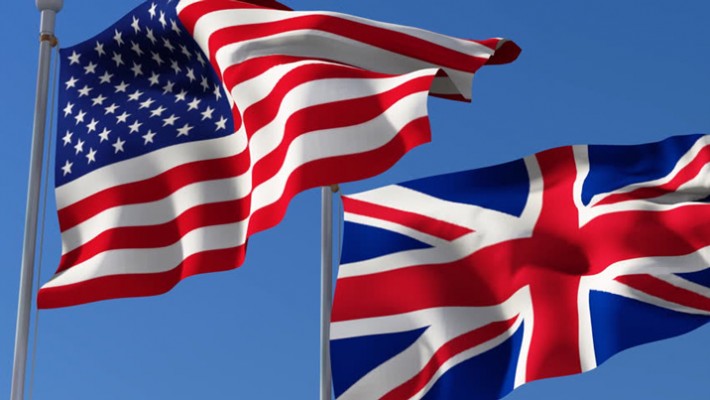
The extraordinary leak of cables from the British Ambassador in Washington to the Foreign Office in London makes clear that the Brits are still engaged in a broad campaign to destabilize the Trump administration, as they have been since his election. Helga Zepp LaRouche warned that Sir Kim Darroch’s statement that Trump may make another U-turn on Iran means that we must be alert for another False Flag provocation, designed to lead to a U.S. strike against Iran. The seizure of an Iranian tanker by British forces on a false pretense is an example of this kind of dangerous geopolitical game.
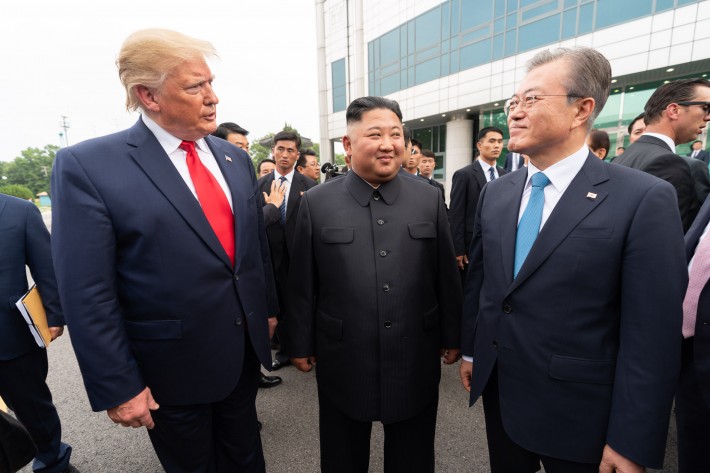
The presidential diplomacy at Osaka, is continuing. As a follow-up to the strategically significant Trump-Kim meeting at the DMZ, envoys from the U.S. and South Korea are coming to Europe to report on developments. Other activities include a meeting between Russian and U.S. officials on arms limitation talks; Putin’s visit to Italy; and new trade talks between U.S. and Chinese officials.
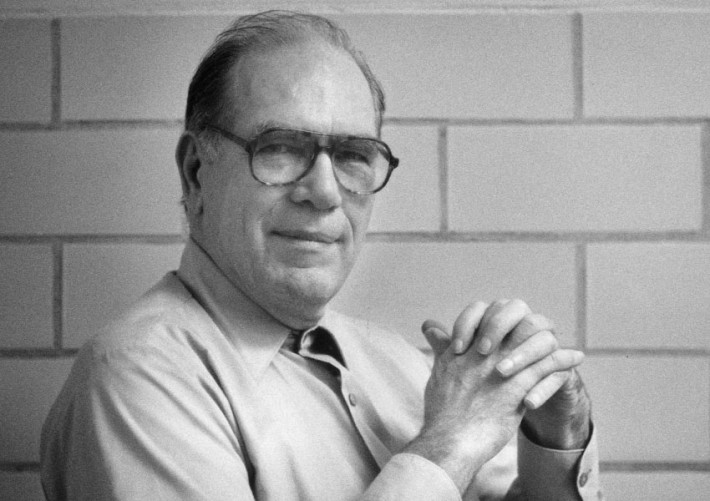
This is an extraordinary moment, which was prepared by the life work of Lyndon LaRouche, whose contributions include his prophetic vision for the future. Trump’s July 4 address captured this spirit, especially with his talk of the Moon-Mars mission. For this to be realized, the work of LaRouche must be studied by more people, who can then bring his ideas to those who do not yet know him. The campaign for his exoneration is an essential feature of making this happen.
In honor of the 35th anniversary of Helga Zepp LaRouche’s founding of the Schiller Institute, we’re re-releasing a 1984 documentary about the revolutionary genius of Friedrich Schiller.
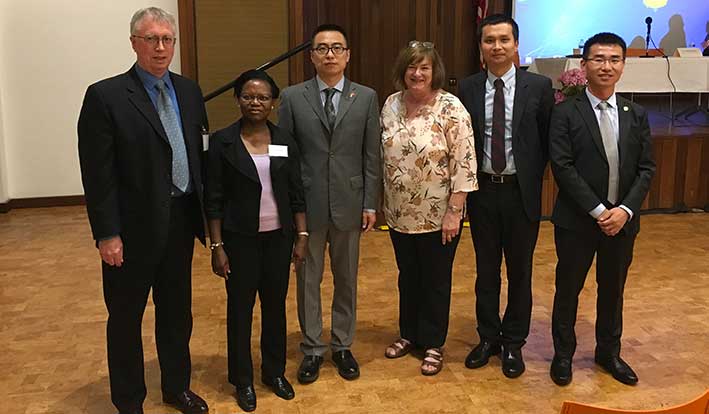
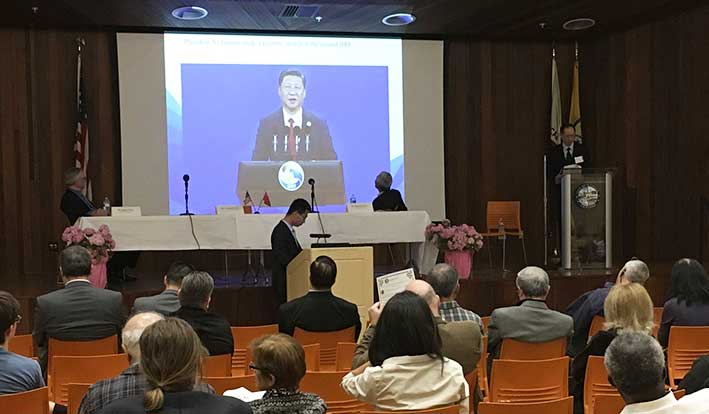
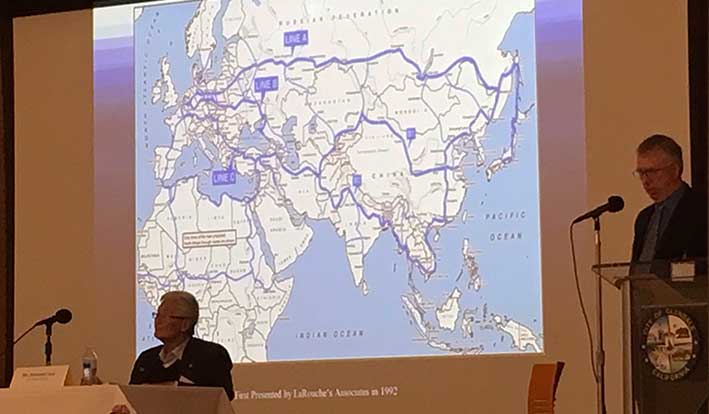
In the midst of a flare-up of tensions between the US and China, sparked by the Anglo-American establishment’s fierce commitment to drive a wedge between the two nations, the Schiller Institute held a forum on June 15 in the Los Angeles area to promote the idea of cooperation on the Belt and Road Initiative (BRI).
The session was opened by a movement from a composition for unaccompanied violin by J.S. Bach, performed by a student from the Los Angeles County High School of the Arts. This was followed by a five minute video of Schiller Institute founder and chairperson Helga Zepp-LaRouche, who greeted the attendees and provided a strategic context for the meeting. She deplored the recent nasty provocations being directed at China by some notorious political factions in the US, and presented a vision of an alternative path, where the US and China lead the world into the future based on the highest cultural and scientific principles, and the most ambitious infrastructure scheme in human history, the BRI.
Zepp-LaRouche was followed by Shi Yuanqiang, deputy consul general for the People’s Republic of China in Los Angeles. Shi provided a very thorough explication of the goals and structure of the BRI, stressing that there is extensive consultation between China and the other nations participating in the project, that all parties participate as equals and share in the benefits. He provided examples of the projects that are being built with Chinese collaboration in Africa and Central Asia, and elaborated on President Xi Jinping’s vision of a “Community of Common Destiny”, a mutually beneficial, “Win-Win” relationship among nations. Shi emphasized that there was a place at the table for the United States.
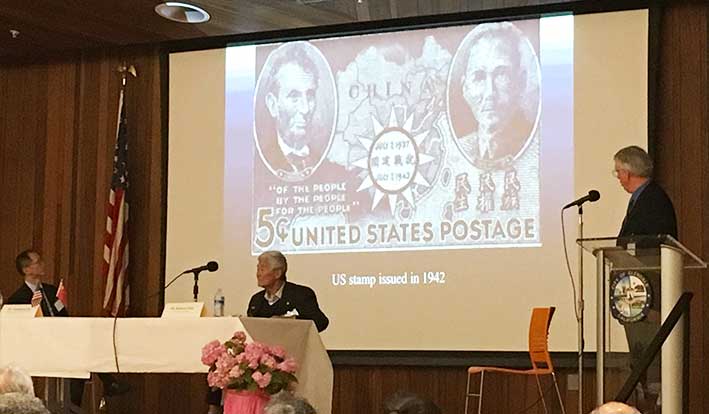
Following Shi’s presentation, there were remarks by Richard Chen, a board member of the US-China Forum who had acted as an interpreter for Chairman Deng Xiaoping during his historic visit to the US in 1979. Chen said that the two great accomplishments of the US after the end of World War II were the establishment of the United Nations, and the Marshall Plan. He compared China’s current role with respect to the developing nations, to the Marshall Plan.
The concluding presentation was by Schiller Institute representative Daniel Platt. He opened with an image that juxtaposed two historic paintings, showing Americans and Chinese fighting their respective battles against British colonialism during the American Revolution and the Opium Wars. Platt asserted that the methodology of the Empire, typified by the “Zero-Sum Game” approach of geopolitics, is an “article of faith” for today’s neoconservative movement. To this he contrasted President Xi’s concept of “Win-Win”, or Helga Zepp-LaRouche’s vision of humanity entering adulthood. He discussed the historical parallels between the US and China with Dr. Sun Yat-Sen’s embrace of the economic conceptions of Abraham Lincoln, and their shared approach to infrastructure development. He then reviewed the history of the proposals made by Lyndon LaRouche in the years following the dissolution of the Warsaw Pact, culminating in the World Landbridge.
Among the eminent personalities who took part in the forum were the consul generals of Kenya and Belgium, as well as consular officials from Armenia and Malaysia, and a large delegation from the PRC consulate.
Helga Zepp LaRouche said in her webcast on July 1 that the Trump-Kim meeting in the DMZ “revived the ‘Singapore Spirit'”, and demonstrated the potential when presidents of leading nations act together. The meeting, following discussions at the sidelines of the G20 summit involving Trump, Putin, Xi, Abe, and Moon, gets back to the idea of policy making on the level of presidents. Trump outflanked the British-oriented neocon warhawks in his own administration to set up the meeting and, from the ridiculously hostile reaction of Democrats, outflanked them as well.
While the G20 summit failed to address the burgeoning economic/financial crisis — she said it is not really designed to do so — the latest BIS report on the dangers of debt, especially corporate debt, and the effect defaults on such debt will have on banks, the potential still exists for applying Lyndon LaRouche’s Four Laws, to stop the danger of a crash. The positive signs from the Trump-Xi meeting, and the Trump-Putin meeting, point to the importance of taking up LaRouche’s Four Power agreement to set up a new financial system.
She called on Americans to take advantage of the July 4 holiday to reflect on the importance of restoring the spirit of the American republic, which was created in opposition to the British Empire.
TRANSCRIPT
Harley SCHLANGER: Hello! I’m Harley Schlanger from theSchiller Institute, welcome to our webcast with our founder andPresident Helga Zepp-LaRouche. It’s July 1, 2019. There’s been alot of developments on the strategic side of things, and Helga,why don’t we start with the Trump-Kim meeting in Panmunjom at theDMZ. What’s your assessment of this meeting?
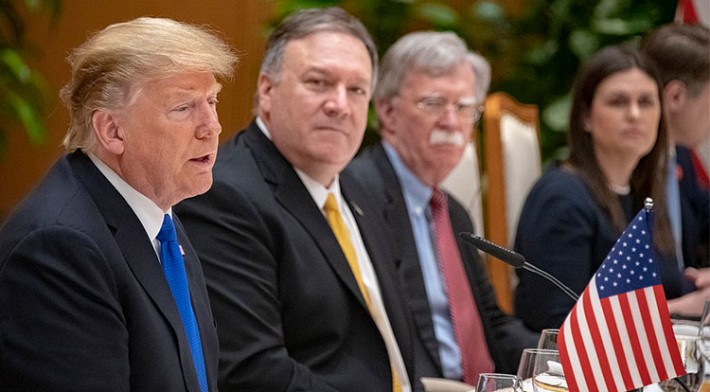
HELGA ZEPP-LAROUCHE: I think that is definitely going backto what I called the “Singapore Spirit,” referring to the firstsummit between Donald Trump and Kim Jong Un, and I think this ispotentially, the real thing. Because, as we had observed, thesummit in Hanoi was sabotaged essentially by, I think, Pompeo andBolton. But this time, I think the fact that in Osaka, on thesidelines of the G20 meetings, there were these meetings betweenTrump and Putin, Trump and Xi Jinping, Trump and Abe, which is inthe background, also, and also with South Korean President MoonJae-in — I think this is all back to the idea that policy isbeing made on the level of the presidents. There was this summitbetween President Trump and Xi Jinping, but they also had adinner about which very little is being reported; but Trump’sspontaneous decision was that he would go to the DMZ, meet withKim, which was sort of a surprise; then he went earlier than evenannounced, and he stepped symbolically over this very importantborder [into North Korea].
Now, the interesting thing about it, is that it is veryunusual is that the North Korean media, all, instantly, verybroadly reported about this, calling it a “historic meeting,”“bold,” and “efficient” and that the two leaders will stay inperson close contact from now on. And this is all really a signthat the chickenhawks in the Trump cabinet were outflanked. Andthe policy is back to being made by Trump. I think especially forthe viewers outside of the United States, who generally, at leastin the West, only have an extremely negative picture of Trumpfrom the media, it’s really important to see this difference:When President Trump has the freedom to act, he tends to do veryimportant things, and I think this is very, very promising.
Unlike with the previous summit follow-up, this time it willnot just be Pompeo who will do the follow-up, but there aresupposed to be working groups, entire teams from the StateDepartment and the North Koreans, and they’re supposed to followthis up.
The Italian politician Michele Geraci made a very importantcharacterization which I tend to agree with, where he said thisevent is probably the event of the year and it may be [i]the[/i] eventof the first term of the Trump Presidency. So I think there isall reason to be really optimistic, because, with Russia andChina in the background, and it seems to be that also SouthKorean President Moon was in the environment; he was on the videotogether at the press conference with these other two leaders,that all means that a potential for the solution for the NorthKorean denuclearization is shaping up on the horizon: Becauseonly if there are security guarantees for North Korea, wherebythey could denuclearize, and not fear that Kim Jong Un would facethe same fate as Saddam Hussein and Muammar Qaddafi — which isthe main reason why North Korea insisted on their nuclear program— but with Russia and China being in the picture, maybe anentire Asian security architecture which could solve the NorthKorea situation can be made possible. And if that would cometogether, and all signs right now speak for it, naturally, withthe Belt and Road Initiative, the New Silk Road as the economicdimension of this whole program, I think this is a very hopefulsign, and it would mean that one of the most dangerous crisisspots in the world strategic picture could be resolved.
So, I think this is very, very promising, and it reallyshows that on the level of the Presidents Xi Jinping, Putin,Trump, solutions can be found. And in this case, also, theJapanese government is in a supportive role. There are manyJapanese and Chinese scholars who want to improve therelationship between China and Japan. Naturally, South Korea hasall the interest that this problem should get resolved. So, Ithink this shows you the incredible potential of the New SilkRoad to be the inspiration for peaceful solutions and a durablepeace.
SCHLANGER: Helga, you mentioned the outflanking of thechickenhawks within the administration: It appears from thehysterical reaction of the Democrats that they were also caughtoff-guard by this meeting.
ZEPP-LAROUCHE: Oh, yes. The Democratic reaction just,absolutely, they lost it. Tim Ryan, for example, compared themeeting between Trump and Kim with the meeting between NevilleChamberlain meeting with Hitler in Munich in 1938. That shows youthat they really have fallen off the deep-end, so to speak. Idon’t see Kim Jong Un taking over all of Asia. But it just showsyou that the Democrats are really the war party, and the onlyvery good exception in this chorus of insanity, was in the firstDemocratic debate, where Democratic Presidential candidate TulsiGabbard spent the entire seven minutes she had to participate inthe debate in denouncing the danger of nuclear war, saying it’scloser than at any time since the end of the Cold War. Shedenounced the endless regime-change wars, [i]and[/i] she also attackedTrump that he had let the conflict with Iran get as close as 10minutes to war. So, Tulsi Gabbard, at least on the war issue, sheis a very good exception in the chorus of Democrats, and it’squite good that the population have increased their support forher after this debate, in the polls. That shows you that once youhave leaders who speak to the issue of war and peace, theAmerican people are not for war and that is a very importantlesson in this Presidential campaign.
SCHLANGER: Let’s look briefly at the G20 summit, because ititself seemed to be a waste of time, although there were all theside meetings that were quite significant.
ZEPP-LAROUCHE: Yes. The important fact is that the meetingbetween Trump and Putin did take place. Remember, that previoussuch summits there were last minute sabotage actions. This didnot happen. The Trump-Xi Jinping meeting was also very important,and naturally, many other bilateral meetings. But essentially allaround Trump, Putin, and Xi Jinping, while the EU was completelyirrelevant.
Now, as a criticism, I must say that the G20 [i]should[/i] haveaddressed the danger of a coming financial crash, and they didnot do that. But that has probably to do with the fact that theG20 is not a format which is capable of addressing this issue.
On the more positive side was a definite improvement in therelationship between the United States and China. Trump and XiJinping got the trade war at least stalled, so that there is roomfor new negotiations. The Huawei ban was lifted, at least for thetime being, so that American products can be sold to Huawei, andalso China agreed to import a large quantity of U.S. agriculturalproducts, so, that hopefully now this can get now get on a bettertrack. I’m not giving de-warning sign yet, but I think this wasdefinitely a step in the right direction.
But I said that the big one, that the G20 should haveaddressed the pending danger of a financial collapse did not takeplace, and that shows you that our proposal, that you need adifferent combination, preferably the combination of Trump,Putin, Xi Jinping, and Narendra Modi of India, to address theseissues is a viable idea, because the G20 failed again to do whatreally would be their responsibility to the world population.
SCHLANGER: There was a report that came out from the Bankfor International Settlements which said that we are, as a resultof overleveraged corporate debt, heading for a potential crash.What do you make of this report?
ZEPP-LAROUCHE: Well, first of all, that’s not the only voicewhich is warning of that, but the BIS, after all, is theso-called “central bank of central banks.” They have basicallyreiterated that the corporate debt crisis and their engagement inderivatives is the equivalent of what the subprime mortgagecrisis was in 2008.
Now, that obviously has been building up for a while, andnow, all the data for the first and second quarter of this yearshow that the world economy, with very few exceptions, mainly ofcountries which are working with the Belt and Road Initiative,but all the European countries, most of the Asian countries andthe United States, have actually all signs of a recession or zerogrowth, all the figures are negative; so I think we are in for avery big crisis.
Our related [i]EIR[/i] publications or that of our colleagues inthe United States, they basically just published a new study,“The Bitter Truth about the Economic Recovery,” referring to thesupposed recovery in the United States. We have there analyzedthe different segments of the U.S. economy, everything fromcollapse of infrastructure, unemployment, homelessness, the drugepidemic, the negative life expectancy in the United States —and the U.K., one should add — so all these parameters of thephysical economy show that there is no recovery. We have warnedall the time that the increase in the price of shares on thestock market is rather an alarming sign, rather than an indicatorof the real economy. For example, Deutsche Bank just announced,or is rumored to be having major layoffs and the stocks went upsignificantly.
So I think we are in an urgent situation, where the economicpackage which was designed by Mr. Lyndon LaRouche, some yearsago, the Four Laws — Glass-Steagall banking separation; aNational Bank in every country; a new credit system, a NewBretton Woods system, and the United States and Europe joiningwith the New Silk Road — [i]is[/i] an urgent, urgent question. Weneed to have a mobilization: So, I’m asking you our viewers andlisteners to help us. Contact us, because this crisis is comingon fast, and it would be almost a miracle if it wouldn’t takeplace very soon this year.
SCHLANGER: One of the important developments was the meetingof Trump and Putin, coming as it did, especially after the dangerthat we saw over the weekend before last, over Iran. What’s yourassessment of where things stand now between the United Statesand Russia?
ZEPP-LAROUCHE: It’s not yet a situation where one could besatisfied with, but, according to the Russian Defense Ministry,there were some inspections involving what they call the NewSTART agreement, Russian and U.S. military talking in thiscontext, and Russian specialists doing investigations in Turkeyand in Romania, according to the OSCE document. So, I think thatthere are clearly signs in the aftermath of the Putin-Trumpmeeting, that a normalization could occur. There was also anagreement between Russia and NATO: They agreed on somenon-escalation agreement, and that is not much, yet, but it meansthat for the time being that there will not be not an increase oftroops into the East on the borders of Russia, and no increase ofequipment. So that is not yet a solution, but at least these arevery tiny, baby steps which show some hope. And also the factthat President Trump accepted the invitation by President Putinto attend the 75th anniversary next year in Moscow, celebratingthe end of World War II, which is a good sign.
And also Macron obviously, after it’s not going so well forhim, in general, accepted such an invitation from Moscow which isa good step in the right direction — unlike, unfortunately, Ihave to say, the new head of the CDU in Germany, AnnegretKramp-Karrenbauer (or AKK, as she is called) who made another oneof her really mindless, Cold War speeches, defending thesanctions at a family-entrepreneur conference in Germany.
So the dividing line is really those people who try to getin a very dangerous strategic situation, some new discussion,dialogue, rapprochement with Russia, with China, and the West;and those who are in the old paradigm and are backward oriented.I think that that is an important difference.
SCHLANGER: Many Americans are wanting to know what actuallyis going on with the European Union. They seemed to play almostno role in Osaka, at the G20, and they couldn’t even elect a newleadership. Where is this headed?
ZEPP-LAROUCHE: I think the EU is essentially finished: Thisorganization which basically is a large bureaucracy, modeled onthe principles of the British Empire, have completely moved awayfrom the interest of their member-states, of the populationsthey’re supposed to be representing, and I think it’s fallingapart. I mean, the fact that they couldn’t agree on the successorof Jean-Claude Juncker for European Commission President; ManfredWeber, the candidate of Germany was completely rejected, andMacron made intrigues against him. Then, for the time being, theDutch social democrat Frans Timmermans was mooted — he wasopposed by the Visegrad Group [Czech Republic, Slovakia, Hungary,Poland] and Ireland, and I think Bulgaria. Naturally, then thereis wheeling and dealing that we will give that post to this one,and then the other one gets this post — this is all very muchwithout any dignity, and that becomes visible to the public eye,so they had to break off the EU summit because they couldn’t finda solution as a joint leadership. Now, that, in my view is areflection of the fact that there is no unity in the EU, andnaturally, the EU policies overall are completely unfit for anyof the crises which exist.
So it’s high time to replace the EU with somethingdifferent, and again, I have to quote Michele Geraci, who alsocommented on the fact that the EU has completely becomesuperfluous, and will vanish in a larger Eurasian kind ofcombination. And that actually makes a lot of sense, because youalready have the integration of the Belt and Road Initiative,Eurasian Economic Union, and if European countries would start toassociate with that, in the context of the joint building of theNew Silk Road, then all of these problems could be addressed.
And since I’m quoting Geraci, let me just mention one otherimportant, interesting thing he said, namely, that the West hascompletely underestimated the rapid growth of China, and thatChina is now a leader, not only in 5G technology with Huawei, butalso e-cars, e-batteries, DNA mapping, quantum particles, onecould add fast train systems, fusion energy research, Moonexploration. So I think China is on a very good trajectory, andcountries who really want to solve their problems shouldcooperate. Xi Jinping offered again, at the G20 in his speech,that the BRI is an open concept for international cooperation.And I think the countries of the West would be well-advised totake up this offer.
SCHLANGER: One exception to the dysfunction of the EuropeanUnion seems to be Italy. There’s a very significant statementissued by prominent Italian scientists, from the ItalianAssociation of Research Scientists and Technologists (ASTRI),attacking this climate hoax. What do you know about that, Helga?
ZEPP-LAROUCHE: It’s very important. This is a group ofextremely well-known and prestigious scientists who made anappeal to the Italian President, the Italian government, and theparliament, not to adopt policies of reducing CO2 emissions, withthe argument that CO2 is not a pollutant, that to the contrary,CO2 is extremely important for life on the planet. And that inany case, all of these claims about control of the climate byreducing this CO2 emissions is a complete hoax, that there is notone, single fact for that, and that in science, facts cannot bereplaced by the number of people who claim to have the sameopinion. And basically, that all of these predictions are basedon computer simulation models and not on any true physicalscience.
So, I think this is very important. There were about 70original signers, and then one signer, who is very famous, Prof.Antonino Zichichi, who was the leader for many decades of thefamous Erice center in Sicily. And I think this is somethingwhich deserves support by many people in other countries as well,so we are planning to publish this appeal. And actually, ifpeople are interested to have an honest debate, they should signthis appeal, so that reason is being brought back into thedebate.
They also note in this resolution, by the way, that theconsensus among the scientists on this issue, does not exist atall, but that there is a growing number and a large number ofscientists who are absolutely opposing the findings of thesemodels, and naturally, also say it’s a complete illusion to thinkthat you can control climate by CO2 reduction. Climate change isobviously taking place, but it’s almost a fakery to claim thatyou can influence the climate by such measures, because it’s notanthropogenic, it has to do with quite different phenomena in ourMilky Way, in the galaxy, on the Sun — all things which mancannot influence as such.
Now, talking about fakery, just to mention, that we willprobably pick this up in the next program next week, a group ofjournalists has just documented that the OPCW completely fakedtheir report on the supposed chemical weapons attack on Douma,Syria in 2018, and the initial report which the OPCW had,actually said it was staged event! So this is all now coming out,and the role of the British in that fakery, as well. But that wewill deal with more next week.
SCHLANGER: We are coming up to the moment where the BritishEmpire is increasing exposed as not just corrupt, but is thecontinuing dominant force in the old paradigm. This week is theweek of July Fourth, the founding of the American republic. Howshould people think about this situation, by reflecting both onwhat the American Founding Fathers did, and the upgrading of theAmerican Revolutionary ideal by your husband, Lyndon LaRouche?
ZEPP-LAROUCHE: I think the July Fourth celebration is notjust for barbecues: People should remember the proud history ofthe American War of Independence against the British Empire, theDeclaration of Independence, and the principles declared there.The idea of Benjamin Franklin, of Alexander Hamilton, and theFounding Fathers in general, to declare a republic, to give theUnited States a Constitution devoted to the common good, not onlyof the present generation, but of posterity, is an extremelyimportant inflection point in all of human history. And if theUnited States could go back, and with the present policies ofTrump, at least in the first steps, there is the hope thatAmerica can become a republic again.
Now, I’ve said this many times: If the United States wouldremind itself of the ideals of its origins, and actually start toimplement that and go away from being the junior partner of theBritish Empire, then America would have all the friends in theworld. And this [i]is[/i] the crucial step which will decide overworld war or world peace: So, I hope that people on this Fourthof July reflect on that, and make a step in this direction —especially, because shortly after the Fourth of July will be the50th anniversary celebration of the Apollo Moon landing. Therewill be many events, and the Schiller Institute will also havemajor events on that day, especially focusing not on the last 50years, but on the next 50 years, and what kind of economic crashprograms are needed to make possible what President Trump hadpromised, when he said that by 2024 there will be again a man,and this time hopefully also a woman, on the Moon: But thatrequires to go into the kind of economic crash mobilization as itwas defined by the Four Laws of Lyndon LaRouche. And it’sactually the absolute mandate to be implemented in the nearfuture.
So, I think we have an incredibly — what Friedrich Schillerwould call “a pregnant moment” in history. I think a greatcatastrophe has been barely avoided with the situation with Iran.And now with talks again between the U.S. and China and Russia,there is actually hope, but that is just the first baby step. Andwe need the full New Paradigm, a new system of internationalrelations, and especially a new economic system based on thephysical principles developed by Lyndon LaRouche. So therefore, Ican only appeal to you, as I have done in the past: Help us withthe exoneration, and the “Case of Lyndon LaRouche” which describesexactly what was done against him and why, and why it is soabsolutely crucial to exonerate him, to make the way free for hissolutions.
So, please watch these two videos, help us to circulate themas widely as possible, and join the Schiller Institute.
SCHLANGER: Well, Helga, thank you for joining us, and we’llsee you maybe even later this week, as events are happening sorapidly.
The central theme of Helga Zepp LaRouche’s webcast this week is that the release of the two documentaries on the life and works of Lyndon LaRouche provides essential weapons to defeat the apparatus that brought us within ten minutes of the launch of World War III Thursday. The international mobilization to exonerate LaRouche, she said, is the only way to stop World War III. She repeatedly appealed to viewers to join us in getting the widest possible audience for these two videos.
The decision by President Trump to call off an attack on Iran, ten minutes before it was launched, is an incredible story! The question raised by people all over the world, following his tweet that he called off the strike at the last minute, coming just after the New York Times reported on the “dual power” situation in the U.S. government regarding the decision to escalate cyber warfare against Russia, is, “Just who is making decisions in Washington?
Those British imperial geopolitical networks who were behind the launching of the Get LaRouche Task Force are the same as those behind today’s war drive. The ideas of LaRouche, which shine through the two documentaries released today, were the target of those who prosecuted him. Those ideas can be realized, beginning with the summits between Trump and President Xi, and with President Putin, at the G20 summit next week. As the documentaries demonstrate, the apparatus pushing for war, following its efforts to remove Trump, is the same which unjustly targeted LaRouche. While war was narrowly avoided this time, there will be more incidents which could lead to war, if this apparatus is not brought to justice.
There is no issue more important today, than to bring an understanding of this to the broadest segment of the population worldwide.
With LaRouche’s jailing, America and the world were deprived of their most illustrious statesman and economist.
Because LaRouche’s policies for replacing the deadly looting of Wall Street and the City of London with a just New World Economic Order of universal, high-tech development were not implemented, hundreds of millions of people around the world remained in poverty and tens of millions perished unnecessarily. It has only been with China’s recent adoption of policies very similar to those proposed by LaRouche up to 50 years ago, that the genocide has stopped in at least large parts of the planet.
It is time that the damage done by LaRouche’s incarceration three decades ago be repaired—not only because such a terrible injustice was done to LaRouche, but because that injustice has emboldened the British Empire to use the same methods against a sitting President of the United States, which endangers all of humanity. What better way to defend the United States of America and all of humanity than to exonerate LaRouche, ensure that his policies are at last adopted, and recognize his ideas for what they are, the acts of one of history’s greatest geniuses, affording him his rightful place in history?
Feature Documentary — The LaRouche Case: Robert Mueller’s First Hit Job
CGTN anchor Yang Rui interviewed Helga Zepp-LaRouche and Bill Jones during their recent China trip, which was aired on June 13 for the “Yang Rui Dialogue” program, headlined “BRI Incentives and Risk Assessment.” A transcript is provided below.
Transcript
YANG RUI: The Belt and Road Initiative has been thrust intothe media limelight for several years. With more and morecountries onboard now, China will not be the party that dictateswhere the cooperation is heading. For all parties’ commoninterests, China will inevitably undergo a range of policyadjustments along the way, to ensure the Initiative deliverswin-win results that are long-lasting and sustainable. But, whatis behind some of the criticisms against the Initiative, and whatcan the BRI us? Unilateralism undermines world economicpatterns. To discuss this issue and more, I’m happy to be joinedin the studio by Helga Zepp-LaRouche, founder and President ofthe Schiller Institute, and Bill Jones, Washington bureau chiefof Executive Intelligence Review.
That’s our topic. This is “Dialogue.” I’m Wang Rui.
Welcome to our show. Do you think the rest of the world hasdeveloped a better understanding about the Belt and RoadInitiative after so many years of debates, discussions and mediafanfare since 2013?
HELGA ZEPP-LAROUCHE: Well, I would think that the people ofAsia, for sure. I just attended the Conference on Dialogue ofAsian Civilizations, and the reaction to Xi Jinping’s speech wasreally extraordinary, because people realized that they areparticipating in the evolution of a completely new system ofinternational relations, which is overcoming geopolitics. Ithink people are sick and tired of confrontation and war as a wayof solving problems, and they appreciate very much that everyconflict on the planet can be solved through dialogue. So, Ithink this is very well understood in Asia, in Africa, even someof the Europeans are becoming very enthusiastic. As matter offact 22 of 28 EU nations are already cooperating. So I think therest will be a question of time.
YANG : But it seems the top concern of the EU about the BRIhas been the issue of transparency. Bill, what do you make oftheir concerns?
WILLIAM JONES: I think a lot of it is a tempest in ateapot. The Belt and Road Initiative has been transparent to thepeople who are receiving the investment, who are benefitting fromit. There is also an issue that people can see what’s happeningon the ground, with the improvement of the general conditions oflife of the people who are recipients of the Belt and RoadInitiative. The reason that there’s this objective is, however,that people are concerned, on the one hand, that it has been aChinese initiative, not an initiative taken by the EuropeanUnion. It is also breaking with the policies of the EU and ofthe West generally, of demanding conditionalities for anyinvestment that’s made in places like Africa, India, and Asia.China has been intent on building infrastructure: They don’tdemand certain conditions which are not necessary, and they’renot concerned about the different political systems that exist inthose countries: The goal is to improve the lives of the people,and people can see that on the ground. And the objections thatare raised to the so-called “transparency” issues, I think arejust an attempt to stop the momentum that has been created.
YANG : Helga, it seems, some of the member states of theEuropean Union are starting to break the silence, by standing upto the BRI memorandum, such as Italy, which indeed surprisedtheir American friends. Do you think what Italy has done, islikely to trigger a similar domino reactions that the Britishauthorities had done before the rest of the European Union hadfollowed suit, regarding the AIIB?
ZEPP-LAROUCHE: I think the Italian memorandum ofunderstanding with China can be the model for the relations ofall European countries with China, not only in the bilateralagreement, but to have a joint mission, for example, to developthe continent of Africa. Africa will have 2.5 billion by theyear 2050, and either the Europeans join hands with China andother nations to industrialize the African continent, or you willhave the biggest refugee crisis ever in history. And the Italiangovernment, especially Prime Minister [Giuseppe] Conte hasalready advocated that Italy intends to take the lead to bringthe Europeans into cooperation with the Belt and Road Initiative.And the good thing is that, contrary to what some people think,Conte also has a good relationship with President Trump.
So I think the strategic question, number one, is how do weget development among many nations in the world, but finally, theUnited States must be brought into the Belt and Road Initiative,because if you don’t do that, there is the danger of theThucydides Trap. But I think the Italian government is play avery constructive role in all of these questions.
YANG : Secretary Pompeo has been selling the idea, whereverhe goes, that China will be a threat. Why are we so bad?
Now, when we look at, say, our investment in theinfrastructure building in Africa, it seems to amount to aproject, a mega one, of industrialization, a massive project ofindustrialization. What about the consequences arising from, forexample, the trade war that is just started between the UnitedStates and China? What do you think of the impact of this tradedispute between Washington and Beijing upon Africa, and ourbusiness presence there?
JONES: It’ll be absolutely disastrous, because it willhinder, it will place an obstacle in the free development of theBelt and Road Initiative; it’ll raise suspicions that really haveno basis whatsoever. And it’s disastrous for the United States,itself: President Trump is not going to be able to create astrong economy in the United States through trade embargoes ortrade tariffs. He has to invest in infrastructure, he has toinvest in science and technology. And there are certain attemptsto do that now, over the last couple of weeks, in terms of thespace program in the United States and the attempt to have adiscussion with the Democrats over infrastructure. But if hedoesn’t bring down these tariffs, if he doesn’t create a goodrelationship with China, this is not going to work.
China, in fact, can help in building infrastructure: Theycould invest in an infrastructure bank in the United States withmuch of the money that is now held in Treasury bills, in order tobuild high-speed rail in the United States. The U.S. economy isgoing down, not because of trade, and not because of China, butbecause of a failure of governments over decades, in investing inindustry and technology.
YANG: The idea of a China threat covers many things, such asideology. Well, many say that the Cold War is making a comeback.So, does it mean, Helga, that many African countries have to takesides?
ZEPP-LAROUCHE: The Chinese model is very attractive to theAfrica countries, because it shows a way of how to overcomepoverty, the miracle which China has undergone in the last 40years is admired by many Africans, and they are now demanding tobe treated more equally by the Europeans. They don’t want tohear Sunday sermons and words about human rights and goodgovernance, and no investment. They demand from the Europeans,direct investment and not development aid which disappears intothe pockets of the NGOs.
So, I think we are in a period of transformation, whereeither the West finds its way back to better traditions, like thehumanist periods of the Classical period of 200 years ago, wherethere was actually a much larger affinity between the moralvalues of the European classics and China. For example, if youlook at the similarity between Confucius and Friedrich Schiller,after whom the Schiller institute is named, they have the sameidea of the moral improvement of the population. Confucius talksabout the aesthetical education of man; Xi Jinping has put a lotof emphasis recently on the aesthetic education of the students,because the goal of this is the beauty of the mind, and this isthe ideal which used to be the case for Europe, and for the earlyAmerican republic! The problem with the West is that, as you cansee in the United States, they have turned away to a very largedegree, from the ideas of their early historical period. Butthey’re going down: The West is in a moral collapse, the economyis far from being in such a great shape as they say, and thestatistics would say. So it’s really a question for the West tochange.
And I think there are many countries, you mentioned some inEurope already, which absolutely are willing to find a new model.I think it’s not so much a question of choosing; I think we arewitnessing the creation of new paradigm of internationalrelations, where the best of all countries and traditions mustcome into it.
YANG: Increasingly, there’s no question that much of thestrength that China can project into a continent like Africawould largely depend on the construction of “soft power.” What doyou know about Confucius schools in Africa? Why do you think theUnited States considered things we teach Confucius schools in theUnited States a threat, whilst it seems these schools are verypopular in the African continent?
JONES: Well, you see in the United States, there is a groupof people, some of whom are in the Trump Administration of aneoconservative bent, who have never come to terms with the factthat China will become a major industrial power. And they haveinitiated a major campaign similar to what was done during theMcCarthy era, to blacken China’s name on all levels — in thearea of economy, in the area of culture, in the area of socialgovernance. And so you have this situation where major scholars,who are most knowledgeable about the United States are now beingrestricted from coming to the United States! And this is a veryserious thing, because, it’s not only that we agree to disagree,but we must also find the common interests: We’re all on thesame globe, we have major problems that we have to resolve, notleast of which is population alleviation not only in China, butpopulation alleviation in the world. And we need populationalleviation in the United States: We haven’t talked about thatfor 40 years. That should be on the agenda. And China’sinitiative, to try to educate Americans about the ideas ofConfucius and to learn the Chinese language, which is a basicelement in learning another culture is learning their language,the Confucius Institutes have been very important in providing ameans of learning the Chinese language. Chinese right now,still, is one of the most important second languages in whichschoolchildren are trying to learn, because they realize this isgoing to become the most important language.
YANG: Language learning is fast becoming an instrument inbuilding interconnectivity, a very critical idea for ourunderstanding of the BRI. During the Cold War, the former SovietUnion was accused of spreading its ideology of communism. Today,one major factor that has prevented United States fromundertaking an all-out Cold War against China, the rising power,is that China is not as aggressive as the Soviet ideology: Wewant to build a community of shared future.
So, do you think what the United States is concerned with,holds any water? Where do you stand about the issue of ideology,of course, in the context of how to build a soft power, and theestablishment of Confucius Institutes?
ZEPP-LAROUCHE: Well, I think that what China is doing is amoral model of improving the livelihood for people, but alsodemanding that the people improve. Xi Jinping has talked aboutthe role of the artists, that they have to uphold the morality ofthe population. I think that one of the reasons why certaingeopolitical factions in the West are so negative, is because theliberal system has reached a point of degeneration, whereeverything is allowed, every perversion, every new pornography,every new violence, the entertainment “industry” in the West hasreally become terrible! And I think that the people who aremaking their profit with these kinds of things, they don’t likethe idea that somebody says, you should be morally a betterperson.
But I think we have reached a point in history, where, youknow, we are at the end of an epoch. I don’t think that thechanges we are experiencing are just the Chinese model versus theliberal model. But I think that we are experiencing a change asbig, or bigger than the difference between the Middle Ages inEurope and modern times, which will mean completely differentaxioms. And I think what Xi Jinping discusses in terms of the“shared community for the one future of humanity” it is reallythe idea of how you can put the interest of the one mankind aheadof any national interest. So, I think the way to look at thepresent situation is, where do we want to be in a 100 years fromnow? We will have fusion power. We will have the ability tohave limitless energy; we can create new raw materials out ofwaste by separation of the isotopes. We will have space travel.We will have villages on the Moon.
So, I think that at that time, humanity has to be one, orelse we will not exist! Take the recent imaging of the blackhole: This was only possible — first of all, it proved thegeneral relativity theory of Einstein, which is a wonderful thingall by itself, because it will mean new breakthroughs in science,at all levels. But, this was only possible, because you hadeight radio telescopes at different points in the world, inSpain, in Chile, in the United States, in the Antarctic, whichtogether could make this image! You could not have done such aproof of a physical principle of the universe by only one countryalone. And I think that that particular incident of imaging theblack hole, gives you a taste of the kind of cooperation mankindwill have in the future. And the key question is, do we getenough people to understand that in time, to make this jump?
YANG: Thank you so much. You’re watching “Dialogue,” withMme. Helga Zepp-LaRouche, founder and President of the SchillerInstitute, and Bill Jones, Washington bureau chief of ExecutiveIntelligence Review.
Welcome back: The BRI would not only cover the Sub-Sahararegion. Most countries in the South — I’m talking aboutSouth-South cooperation — would benefit from infrastructurebuilding. Let’s do a case study: Hambatota Port in Sri Lankahas caused many debates as to whether China has developed aconspiracy theory, whether the Western media concerns about the“debt trap” would hold any water? I would like to have yourthoughts very quickly.
ZEPP-LAROUCHE: I think this is turning the truth upsidedown. Because if you look, why is Africa underdeveloped? Fivehundred years of colonialism, and then about 70 years of IMFconditionalities. If you look at the 17 poorest countries inAfrica, which are in danger of defaulting, only in 3 of them isChina involved, but all the rest are indebted to the Paris Club.So the debt trap was created by the IMF before, and China isactually giving many grants and —
YANG: Do you agree, Bill?
JONES: I do agree with that. I think we’ve seen the debtsituation spin out of control, long before the BRI. We haveneeded international financial reform that we have been talkingabout, that Helga’s husband, Lyndon LaRouche has pointed out fordecades, prior to his recent death, of trying to change thefinancial system, in order to create credits for infrastructure,instead of credit for repayment of old debt. These countries inAfrica have been saddled with debt by the IMF, not by China. Asa matter of fact, most of the countries that are in the biggestdanger of their debt being a problem, are those which are notinvolved in the BRI — countries in Africa. And therefore, whathas to be done, is really a reform of the international financialsystem, in order to perhaps even write off some of this debt, andto insist, as we go forward, that any debt that’s given out willgo to increase the physical production capabilities of thesecountries, because if it does that, then it’s debt that’s goingto be repaid. But if it goes to repay old debt, or if it’s thecasino society that we’ve known over the last 20 years, it’sgoing to become a bubble, and we’ve got to change the way we dobusiness in that respect.
YANG: What about financing vehicles, Bill? Is that a majorissue for the beneficiary countries?
JONES: What we actually need is the creation of somethinglike an infrastructure bank in the United States, which wouldallow China to help invest in infrastructure there. Foreigndirect investment by China now becomes something of a problem,because of the atmosphere that has been created by the neo-cons;but otherwise, China could help with this. China has a differentorientation toward finance. Chinese finances to the Belt and Roadgo to transportation infrastructure. It brings the countriestogether, it creates a greater production capacities, and it hasbecome, I think, a template for how a functioning, how a healthyfinancial system has to operate. We’ve got to get away from whatused to be called the “bankers’ arithmetic,” in which moneychased after more money. The money has got to be used to financephysical economy, and then it becomes a means of growth for thepopulation, and is no problem in terms of repayment, because thepopulation becomes richer.
YANG: I wonder if you have followed very closely thedevelopment between Malaysia and China, on the construction ofthe east coast railway link, that has a lot to do with how we dorisk assessment, political and legal; and this helps us go backto one of the earlier questions on the issue of transparency. Sodo you think this poses a serious challenge to the prospects ofthe BRI in developing countries, some of which are youngdemocracies, according to Western standards?
JONES: Well, I think a lot of this is a matter of alearning curve that the BRI has been through over the last fiveyears. The Malaysia situation was unfortunate, but it haslargely been resolved, and it’s been resolved because China hasbeen very flexible in dealing with the countries on the BRI, andI think they have a clear indication, a clear orientation forimproving the situation in the countries in which they areinvolved. And if problems arise, or if discrepancies occur, Ithink they have shown a willingness to diplomatically resolve theproblem to the benefit of the countries that are involved. Andthey have to do that.
Look, a lot of mistakes were made by the Western countriesin terms of initial attempts to industrialize Africa, and as aresult of that, they left. They left Africa in the dust. Chinais there, there may be some mistakes in individual cases, butChina learns the lessons and does not leave, and this is theimportant thing: Because the fortitude of continuing with theproject, which is the most important project for mankind today isabsolutely necessary, and I think the Chinese government hasshown the fortitude necessary to move forward on this.
So, yes, problems may occur. They have occurred in thepast. They have been resolved, and I think they will be resolvedin the future, if they would occur again.
YANG: The last two remaining questions will be about, firstof all, the alleged westward expansion of the BRI through theEurasian continent. The other, of course, is the Maritime SilkRoad: Do you think this idea of a Maritime Silk Road, Helga, willhelp ease tensions further between China and other countries thathave competing claims on the maritime stakes in southeast Asia?
ZEPP-LAROUCHE: I think the combined concept of the BRI andthe Maritime Silk Road is really a program for the reconstructionof the world economy. And in the beginning, people said, “thisthis railway from east or west or north or south, more beneficialfor China or for Russia?” And I kept saying, “don’t worry aboutit, take it a couple of years from now and all of these networkswill grow into one.” This is why we published this report “TheNew Silk Road Becomes the World Land-Bridge.” Because, if youlook at it from the standpoint of the evolution of mankind, it isvery natural that eventually the infrastructure will reach allcontinents, will open up all interiors, will connect the maritimeconnections. And for example, Portugal and Spain and Greece andItaly, these are countries that want to be not only the hub forthe Eurasian Land-Bridge on the land line, but they also want tobe hubs for the maritime connection, connecting to all thePortuguese-speaking, Spanish-speaking countries. So, I thinkthis will also grow into a World Land-Bridge connection.
YANG: Bill, what do you think of the connection, betweenChina’s BRI and President Putin’s vision for the EurasianEconomic Union?
JONES: I think they will tend to converge, not on allpoints, but in the basic orientation, because what PresidentPutin wants to do, is to take those countries which have beentraditionally associated with Russia and create some kind ofcommon economic entity. But, the Belt and Road is providing theinvestment for all of these countries, including Russia, whichbenefits tremendously from it. And therefore, there is a meansof really bringing together the two most important countries inEurasia around a common goal of developing infrastructure,transportation infrastructure, and improving the conditions oflife in all these countries. So I think there is thisconvergence going on that will become greater with time.
Founder and president of the international Schiller Institute, Helga Zepp-LaRouche, was interviewed by Chinese host Yang Rui at the CCTV studio in Beijing, China on April 15, 2014.
The Memorial event commemorating the creative life of Lyndon LaRouche had a stunning effect on most participants, as the full extent of the incredible contributions made by Lyn came across clearly. Helga Zepp LaRouche emphasized that, while most people are trapped in a day-to-day struggle to make ends meet, Lyn challenged them to think 50 or 100 years ahead. The New Paradigm which is emerging was envisioned by Lyn decades ago, and he dedicated his life to realizing that beautiful vision he had.
Today, Putin correctly identified the crisis, that U.S.-Russian relations are deteriorating by the hour, even though the potential for the U.S., under President Trump, to have a “great relationship” with Russian and China, is still possible. This was made clear, she said, in the series of conferences recently, in St. Petersburg and Biskek. But the British empire continues to push for war, with Iran as a serious, immediate potential trigger.
She called upon listeners to watch the video of the Memorial, and to act to make sure that the upcoming documentary on the LaRouche case receives the widest circulation as possible. The solutions to the crisis exist, provided that people take up the mission of Lyndon LaRouche, and make it their own.
This new 36 page booklet about the Schiller Institute movement provides the history of our three decades long fight against the prevailing trend toward cultural and political barbarism, and it will help you organize others to participate in creating the urgently needed Paradigm Shift. We can and must pull mankind from the abyss and make a new Golden Renaissance!