The central theme of Helga Zepp LaRouche’s webcast this week is that the release of the two documentaries on the life and works of Lyndon LaRouche provides essential weapons to defeat the apparatus that brought us within ten minutes of the launch of World War III Thursday. The international mobilization to exonerate LaRouche, she said, is the only way to stop World War III. She repeatedly appealed to viewers to join us in getting the widest possible audience for these two videos.
The decision by President Trump to call off an attack on Iran, ten minutes before it was launched, is an incredible story! The question raised by people all over the world, following his tweet that he called off the strike at the last minute, coming just after the New York Times reported on the “dual power” situation in the U.S. government regarding the decision to escalate cyber warfare against Russia, is, “Just who is making decisions in Washington?
Those British imperial geopolitical networks who were behind the launching of the Get LaRouche Task Force are the same as those behind today’s war drive. The ideas of LaRouche, which shine through the two documentaries released today, were the target of those who prosecuted him. Those ideas can be realized, beginning with the summits between Trump and President Xi, and with President Putin, at the G20 summit next week. As the documentaries demonstrate, the apparatus pushing for war, following its efforts to remove Trump, is the same which unjustly targeted LaRouche. While war was narrowly avoided this time, there will be more incidents which could lead to war, if this apparatus is not brought to justice.
There is no issue more important today, than to bring an understanding of this to the broadest segment of the population worldwide.
With LaRouche’s jailing, America and the world were deprived of their most illustrious statesman and economist.
Because LaRouche’s policies for replacing the deadly looting of Wall Street and the City of London with a just New World Economic Order of universal, high-tech development were not implemented, hundreds of millions of people around the world remained in poverty and tens of millions perished unnecessarily. It has only been with China’s recent adoption of policies very similar to those proposed by LaRouche up to 50 years ago, that the genocide has stopped in at least large parts of the planet.
It is time that the damage done by LaRouche’s incarceration three decades ago be repaired—not only because such a terrible injustice was done to LaRouche, but because that injustice has emboldened the British Empire to use the same methods against a sitting President of the United States, which endangers all of humanity. What better way to defend the United States of America and all of humanity than to exonerate LaRouche, ensure that his policies are at last adopted, and recognize his ideas for what they are, the acts of one of history’s greatest geniuses, affording him his rightful place in history?
Feature Documentary — The LaRouche Case: Robert Mueller’s First Hit Job
CGTN anchor Yang Rui interviewed Helga Zepp-LaRouche and Bill Jones during their recent China trip, which was aired on June 13 for the “Yang Rui Dialogue” program, headlined “BRI Incentives and Risk Assessment.” A transcript is provided below.
Transcript
YANG RUI: The Belt and Road Initiative has been thrust intothe media limelight for several years. With more and morecountries onboard now, China will not be the party that dictateswhere the cooperation is heading. For all parties’ commoninterests, China will inevitably undergo a range of policyadjustments along the way, to ensure the Initiative deliverswin-win results that are long-lasting and sustainable. But, whatis behind some of the criticisms against the Initiative, and whatcan the BRI us? Unilateralism undermines world economicpatterns. To discuss this issue and more, I’m happy to be joinedin the studio by Helga Zepp-LaRouche, founder and President ofthe Schiller Institute, and Bill Jones, Washington bureau chiefof Executive Intelligence Review.
That’s our topic. This is “Dialogue.” I’m Wang Rui.
Welcome to our show. Do you think the rest of the world hasdeveloped a better understanding about the Belt and RoadInitiative after so many years of debates, discussions and mediafanfare since 2013?
HELGA ZEPP-LAROUCHE: Well, I would think that the people ofAsia, for sure. I just attended the Conference on Dialogue ofAsian Civilizations, and the reaction to Xi Jinping’s speech wasreally extraordinary, because people realized that they areparticipating in the evolution of a completely new system ofinternational relations, which is overcoming geopolitics. Ithink people are sick and tired of confrontation and war as a wayof solving problems, and they appreciate very much that everyconflict on the planet can be solved through dialogue. So, Ithink this is very well understood in Asia, in Africa, even someof the Europeans are becoming very enthusiastic. As matter offact 22 of 28 EU nations are already cooperating. So I think therest will be a question of time.
YANG : But it seems the top concern of the EU about the BRIhas been the issue of transparency. Bill, what do you make oftheir concerns?
WILLIAM JONES: I think a lot of it is a tempest in ateapot. The Belt and Road Initiative has been transparent to thepeople who are receiving the investment, who are benefitting fromit. There is also an issue that people can see what’s happeningon the ground, with the improvement of the general conditions oflife of the people who are recipients of the Belt and RoadInitiative. The reason that there’s this objective is, however,that people are concerned, on the one hand, that it has been aChinese initiative, not an initiative taken by the EuropeanUnion. It is also breaking with the policies of the EU and ofthe West generally, of demanding conditionalities for anyinvestment that’s made in places like Africa, India, and Asia.China has been intent on building infrastructure: They don’tdemand certain conditions which are not necessary, and they’renot concerned about the different political systems that exist inthose countries: The goal is to improve the lives of the people,and people can see that on the ground. And the objections thatare raised to the so-called “transparency” issues, I think arejust an attempt to stop the momentum that has been created.
YANG : Helga, it seems, some of the member states of theEuropean Union are starting to break the silence, by standing upto the BRI memorandum, such as Italy, which indeed surprisedtheir American friends. Do you think what Italy has done, islikely to trigger a similar domino reactions that the Britishauthorities had done before the rest of the European Union hadfollowed suit, regarding the AIIB?
ZEPP-LAROUCHE: I think the Italian memorandum ofunderstanding with China can be the model for the relations ofall European countries with China, not only in the bilateralagreement, but to have a joint mission, for example, to developthe continent of Africa. Africa will have 2.5 billion by theyear 2050, and either the Europeans join hands with China andother nations to industrialize the African continent, or you willhave the biggest refugee crisis ever in history. And the Italiangovernment, especially Prime Minister [Giuseppe] Conte hasalready advocated that Italy intends to take the lead to bringthe Europeans into cooperation with the Belt and Road Initiative.And the good thing is that, contrary to what some people think,Conte also has a good relationship with President Trump.
So I think the strategic question, number one, is how do weget development among many nations in the world, but finally, theUnited States must be brought into the Belt and Road Initiative,because if you don’t do that, there is the danger of theThucydides Trap. But I think the Italian government is play avery constructive role in all of these questions.
YANG : Secretary Pompeo has been selling the idea, whereverhe goes, that China will be a threat. Why are we so bad?
Now, when we look at, say, our investment in theinfrastructure building in Africa, it seems to amount to aproject, a mega one, of industrialization, a massive project ofindustrialization. What about the consequences arising from, forexample, the trade war that is just started between the UnitedStates and China? What do you think of the impact of this tradedispute between Washington and Beijing upon Africa, and ourbusiness presence there?
JONES: It’ll be absolutely disastrous, because it willhinder, it will place an obstacle in the free development of theBelt and Road Initiative; it’ll raise suspicions that really haveno basis whatsoever. And it’s disastrous for the United States,itself: President Trump is not going to be able to create astrong economy in the United States through trade embargoes ortrade tariffs. He has to invest in infrastructure, he has toinvest in science and technology. And there are certain attemptsto do that now, over the last couple of weeks, in terms of thespace program in the United States and the attempt to have adiscussion with the Democrats over infrastructure. But if hedoesn’t bring down these tariffs, if he doesn’t create a goodrelationship with China, this is not going to work.
China, in fact, can help in building infrastructure: Theycould invest in an infrastructure bank in the United States withmuch of the money that is now held in Treasury bills, in order tobuild high-speed rail in the United States. The U.S. economy isgoing down, not because of trade, and not because of China, butbecause of a failure of governments over decades, in investing inindustry and technology.
YANG: The idea of a China threat covers many things, such asideology. Well, many say that the Cold War is making a comeback.So, does it mean, Helga, that many African countries have to takesides?
ZEPP-LAROUCHE: The Chinese model is very attractive to theAfrica countries, because it shows a way of how to overcomepoverty, the miracle which China has undergone in the last 40years is admired by many Africans, and they are now demanding tobe treated more equally by the Europeans. They don’t want tohear Sunday sermons and words about human rights and goodgovernance, and no investment. They demand from the Europeans,direct investment and not development aid which disappears intothe pockets of the NGOs.
So, I think we are in a period of transformation, whereeither the West finds its way back to better traditions, like thehumanist periods of the Classical period of 200 years ago, wherethere was actually a much larger affinity between the moralvalues of the European classics and China. For example, if youlook at the similarity between Confucius and Friedrich Schiller,after whom the Schiller institute is named, they have the sameidea of the moral improvement of the population. Confucius talksabout the aesthetical education of man; Xi Jinping has put a lotof emphasis recently on the aesthetic education of the students,because the goal of this is the beauty of the mind, and this isthe ideal which used to be the case for Europe, and for the earlyAmerican republic! The problem with the West is that, as you cansee in the United States, they have turned away to a very largedegree, from the ideas of their early historical period. Butthey’re going down: The West is in a moral collapse, the economyis far from being in such a great shape as they say, and thestatistics would say. So it’s really a question for the West tochange.
And I think there are many countries, you mentioned some inEurope already, which absolutely are willing to find a new model.I think it’s not so much a question of choosing; I think we arewitnessing the creation of new paradigm of internationalrelations, where the best of all countries and traditions mustcome into it.
YANG: Increasingly, there’s no question that much of thestrength that China can project into a continent like Africawould largely depend on the construction of “soft power.” What doyou know about Confucius schools in Africa? Why do you think theUnited States considered things we teach Confucius schools in theUnited States a threat, whilst it seems these schools are verypopular in the African continent?
JONES: Well, you see in the United States, there is a groupof people, some of whom are in the Trump Administration of aneoconservative bent, who have never come to terms with the factthat China will become a major industrial power. And they haveinitiated a major campaign similar to what was done during theMcCarthy era, to blacken China’s name on all levels — in thearea of economy, in the area of culture, in the area of socialgovernance. And so you have this situation where major scholars,who are most knowledgeable about the United States are now beingrestricted from coming to the United States! And this is a veryserious thing, because, it’s not only that we agree to disagree,but we must also find the common interests: We’re all on thesame globe, we have major problems that we have to resolve, notleast of which is population alleviation not only in China, butpopulation alleviation in the world. And we need populationalleviation in the United States: We haven’t talked about thatfor 40 years. That should be on the agenda. And China’sinitiative, to try to educate Americans about the ideas ofConfucius and to learn the Chinese language, which is a basicelement in learning another culture is learning their language,the Confucius Institutes have been very important in providing ameans of learning the Chinese language. Chinese right now,still, is one of the most important second languages in whichschoolchildren are trying to learn, because they realize this isgoing to become the most important language.
YANG: Language learning is fast becoming an instrument inbuilding interconnectivity, a very critical idea for ourunderstanding of the BRI. During the Cold War, the former SovietUnion was accused of spreading its ideology of communism. Today,one major factor that has prevented United States fromundertaking an all-out Cold War against China, the rising power,is that China is not as aggressive as the Soviet ideology: Wewant to build a community of shared future.
So, do you think what the United States is concerned with,holds any water? Where do you stand about the issue of ideology,of course, in the context of how to build a soft power, and theestablishment of Confucius Institutes?
ZEPP-LAROUCHE: Well, I think that what China is doing is amoral model of improving the livelihood for people, but alsodemanding that the people improve. Xi Jinping has talked aboutthe role of the artists, that they have to uphold the morality ofthe population. I think that one of the reasons why certaingeopolitical factions in the West are so negative, is because theliberal system has reached a point of degeneration, whereeverything is allowed, every perversion, every new pornography,every new violence, the entertainment “industry” in the West hasreally become terrible! And I think that the people who aremaking their profit with these kinds of things, they don’t likethe idea that somebody says, you should be morally a betterperson.
But I think we have reached a point in history, where, youknow, we are at the end of an epoch. I don’t think that thechanges we are experiencing are just the Chinese model versus theliberal model. But I think that we are experiencing a change asbig, or bigger than the difference between the Middle Ages inEurope and modern times, which will mean completely differentaxioms. And I think what Xi Jinping discusses in terms of the“shared community for the one future of humanity” it is reallythe idea of how you can put the interest of the one mankind aheadof any national interest. So, I think the way to look at thepresent situation is, where do we want to be in a 100 years fromnow? We will have fusion power. We will have the ability tohave limitless energy; we can create new raw materials out ofwaste by separation of the isotopes. We will have space travel.We will have villages on the Moon.
So, I think that at that time, humanity has to be one, orelse we will not exist! Take the recent imaging of the blackhole: This was only possible — first of all, it proved thegeneral relativity theory of Einstein, which is a wonderful thingall by itself, because it will mean new breakthroughs in science,at all levels. But, this was only possible, because you hadeight radio telescopes at different points in the world, inSpain, in Chile, in the United States, in the Antarctic, whichtogether could make this image! You could not have done such aproof of a physical principle of the universe by only one countryalone. And I think that that particular incident of imaging theblack hole, gives you a taste of the kind of cooperation mankindwill have in the future. And the key question is, do we getenough people to understand that in time, to make this jump?
YANG: Thank you so much. You’re watching “Dialogue,” withMme. Helga Zepp-LaRouche, founder and President of the SchillerInstitute, and Bill Jones, Washington bureau chief of ExecutiveIntelligence Review.
Welcome back: The BRI would not only cover the Sub-Sahararegion. Most countries in the South — I’m talking aboutSouth-South cooperation — would benefit from infrastructurebuilding. Let’s do a case study: Hambatota Port in Sri Lankahas caused many debates as to whether China has developed aconspiracy theory, whether the Western media concerns about the“debt trap” would hold any water? I would like to have yourthoughts very quickly.
ZEPP-LAROUCHE: I think this is turning the truth upsidedown. Because if you look, why is Africa underdeveloped? Fivehundred years of colonialism, and then about 70 years of IMFconditionalities. If you look at the 17 poorest countries inAfrica, which are in danger of defaulting, only in 3 of them isChina involved, but all the rest are indebted to the Paris Club.So the debt trap was created by the IMF before, and China isactually giving many grants and —
YANG: Do you agree, Bill?
JONES: I do agree with that. I think we’ve seen the debtsituation spin out of control, long before the BRI. We haveneeded international financial reform that we have been talkingabout, that Helga’s husband, Lyndon LaRouche has pointed out fordecades, prior to his recent death, of trying to change thefinancial system, in order to create credits for infrastructure,instead of credit for repayment of old debt. These countries inAfrica have been saddled with debt by the IMF, not by China. Asa matter of fact, most of the countries that are in the biggestdanger of their debt being a problem, are those which are notinvolved in the BRI — countries in Africa. And therefore, whathas to be done, is really a reform of the international financialsystem, in order to perhaps even write off some of this debt, andto insist, as we go forward, that any debt that’s given out willgo to increase the physical production capabilities of thesecountries, because if it does that, then it’s debt that’s goingto be repaid. But if it goes to repay old debt, or if it’s thecasino society that we’ve known over the last 20 years, it’sgoing to become a bubble, and we’ve got to change the way we dobusiness in that respect.
YANG: What about financing vehicles, Bill? Is that a majorissue for the beneficiary countries?
JONES: What we actually need is the creation of somethinglike an infrastructure bank in the United States, which wouldallow China to help invest in infrastructure there. Foreigndirect investment by China now becomes something of a problem,because of the atmosphere that has been created by the neo-cons;but otherwise, China could help with this. China has a differentorientation toward finance. Chinese finances to the Belt and Roadgo to transportation infrastructure. It brings the countriestogether, it creates a greater production capacities, and it hasbecome, I think, a template for how a functioning, how a healthyfinancial system has to operate. We’ve got to get away from whatused to be called the “bankers’ arithmetic,” in which moneychased after more money. The money has got to be used to financephysical economy, and then it becomes a means of growth for thepopulation, and is no problem in terms of repayment, because thepopulation becomes richer.
YANG: I wonder if you have followed very closely thedevelopment between Malaysia and China, on the construction ofthe east coast railway link, that has a lot to do with how we dorisk assessment, political and legal; and this helps us go backto one of the earlier questions on the issue of transparency. Sodo you think this poses a serious challenge to the prospects ofthe BRI in developing countries, some of which are youngdemocracies, according to Western standards?
JONES: Well, I think a lot of this is a matter of alearning curve that the BRI has been through over the last fiveyears. The Malaysia situation was unfortunate, but it haslargely been resolved, and it’s been resolved because China hasbeen very flexible in dealing with the countries on the BRI, andI think they have a clear indication, a clear orientation forimproving the situation in the countries in which they areinvolved. And if problems arise, or if discrepancies occur, Ithink they have shown a willingness to diplomatically resolve theproblem to the benefit of the countries that are involved. Andthey have to do that.
Look, a lot of mistakes were made by the Western countriesin terms of initial attempts to industrialize Africa, and as aresult of that, they left. They left Africa in the dust. Chinais there, there may be some mistakes in individual cases, butChina learns the lessons and does not leave, and this is theimportant thing: Because the fortitude of continuing with theproject, which is the most important project for mankind today isabsolutely necessary, and I think the Chinese government hasshown the fortitude necessary to move forward on this.
So, yes, problems may occur. They have occurred in thepast. They have been resolved, and I think they will be resolvedin the future, if they would occur again.
YANG: The last two remaining questions will be about, firstof all, the alleged westward expansion of the BRI through theEurasian continent. The other, of course, is the Maritime SilkRoad: Do you think this idea of a Maritime Silk Road, Helga, willhelp ease tensions further between China and other countries thathave competing claims on the maritime stakes in southeast Asia?
ZEPP-LAROUCHE: I think the combined concept of the BRI andthe Maritime Silk Road is really a program for the reconstructionof the world economy. And in the beginning, people said, “thisthis railway from east or west or north or south, more beneficialfor China or for Russia?” And I kept saying, “don’t worry aboutit, take it a couple of years from now and all of these networkswill grow into one.” This is why we published this report “TheNew Silk Road Becomes the World Land-Bridge.” Because, if youlook at it from the standpoint of the evolution of mankind, it isvery natural that eventually the infrastructure will reach allcontinents, will open up all interiors, will connect the maritimeconnections. And for example, Portugal and Spain and Greece andItaly, these are countries that want to be not only the hub forthe Eurasian Land-Bridge on the land line, but they also want tobe hubs for the maritime connection, connecting to all thePortuguese-speaking, Spanish-speaking countries. So, I thinkthis will also grow into a World Land-Bridge connection.
YANG: Bill, what do you think of the connection, betweenChina’s BRI and President Putin’s vision for the EurasianEconomic Union?
JONES: I think they will tend to converge, not on allpoints, but in the basic orientation, because what PresidentPutin wants to do, is to take those countries which have beentraditionally associated with Russia and create some kind ofcommon economic entity. But, the Belt and Road is providing theinvestment for all of these countries, including Russia, whichbenefits tremendously from it. And therefore, there is a meansof really bringing together the two most important countries inEurasia around a common goal of developing infrastructure,transportation infrastructure, and improving the conditions oflife in all these countries. So I think there is thisconvergence going on that will become greater with time.
Founder and president of the international Schiller Institute, Helga Zepp-LaRouche, was interviewed by Chinese host Yang Rui at the CCTV studio in Beijing, China on April 15, 2014.
The Memorial event commemorating the creative life of Lyndon LaRouche had a stunning effect on most participants, as the full extent of the incredible contributions made by Lyn came across clearly. Helga Zepp LaRouche emphasized that, while most people are trapped in a day-to-day struggle to make ends meet, Lyn challenged them to think 50 or 100 years ahead. The New Paradigm which is emerging was envisioned by Lyn decades ago, and he dedicated his life to realizing that beautiful vision he had.
Today, Putin correctly identified the crisis, that U.S.-Russian relations are deteriorating by the hour, even though the potential for the U.S., under President Trump, to have a “great relationship” with Russian and China, is still possible. This was made clear, she said, in the series of conferences recently, in St. Petersburg and Biskek. But the British empire continues to push for war, with Iran as a serious, immediate potential trigger.
She called upon listeners to watch the video of the Memorial, and to act to make sure that the upcoming documentary on the LaRouche case receives the widest circulation as possible. The solutions to the crisis exist, provided that people take up the mission of Lyndon LaRouche, and make it their own.
This new 36 page booklet about the Schiller Institute movement provides the history of our three decades long fight against the prevailing trend toward cultural and political barbarism, and it will help you organize others to participate in creating the urgently needed Paradigm Shift. We can and must pull mankind from the abyss and make a new Golden Renaissance!
A memorial event celebrating the life and legacy of American statesman, Lyndon H. LaRouche, Jr. was held in Manhattan, June 8th, 2019 with simultaneous satellite events watching across the country. See the full program below.
Lyndon LaRouche in His Own Words
Dennis Speed, narrator
Hall Johnson (arr.): “When I Was Sinkin’ Down”
Hall Johnson (arr.): “I Don’t Feel No-Ways Tired”
Reginald Bouknight, tenor soloist
Schiller Institute Festival Chorus
Diane Sare, director
J.S. Bach: “Jesu, meine Freude,”BWV 227
Schiller Institute Festival Chorus
Andrés Vera, violoncello
Bruce Director, contrabass
John Sigerson, director
INTERMISSION
The Third Trial of Socrates
Dennis Speed, narrator
Roland Hayes: “They Led My Lord Away”
Elvira Green, alto
Roland Hayes: “Crucifixion”
Frank Mathis, baritone
Johannes Brahms: “Dem dunkeln Schoß der heil’gen Erde”
Schiller Institute Festival Chorus
John Sigerson, director
Ludwig van Beethoven: Sonata for Violonello and Piano, Op. 69
I. Allegro ma non tanto
II. Scherzo
III. Adagio cantabile
IV. Allegro vivace
Andrés Vera, violoncello
My-Hoa Steger, piano
Ludwig van Beethoven: “Adelaide,” Op. 46
John Sigerson, tenor
Margaret Greenspan, piano
Johannes Brahms: “Immer leiser wird mein Schlummer,” Op. 105, No. 4
Elvira Green, alto
My-Hoa Steger, piano
The Triumph of Lyndon LaRouche
Dennis Speed, narrator
Epilogue
Robert Schumann: “Mit Myrthen und Rosen”, Op. 24, No. 9
John Sigerson, tenor
Margaret Greenspan, piano
Wolfgang Amadeus Mozart: “Ave verum corpus,” K. 618
To be sung by everyone
J.S. Bach: Chorale “Wenn ich einmal soll scheiden” from St. Matthew Passion
Schiller Institute Festival Chorus
Schiller Institute founder Helga Zepp-LaRouche discusses her recent trip to China where she participated in the Conference on Dialogue of Asian Civilizations, May 15-16 in Beijing, keynoted by Chinese President Xi Jinping. Zepp-LaRouche and host Bill Jones discuss what’s actually at stake in the so-called US-China trade war, and how it’s possible to be resolved in a win-win manner for both nations. She warns that there is no benefit for the West to try to contain a nation like China, who has made so many contributions to human civilization. The only path forward that will be mutually beneficial for both countries, and their populations, is one of cooperation and overcoming the “Clash of Civilization” strategy of the western neo-cons.
Under the title: “U.S.-China Ties Key to WorldEconomy Growth,” UrduPoint in Pakistan on May 24 covered HelgaZepp-LaRouche’s interview with Sputnik. The interview was alsocovered in a Pakistani community newspaper, the Jago Timesbased in northwest Texas, May 25th.
“The state of relations between Washington and Beijing willdetermine the path of the global economic output in the nextdecade,” Helga Zepp-LaRouche, the leader of the GermanBürgerrechtsbewegung Solidarität, or Civil Rights MovementSolidarity party, told Sputnik. “The key to the future of theworld economy is the relation between the U.S. and China, whichalready has more than 300 million middle class consumers, anumber that will double in a decade,” Zepp-LaRouche said.
The upward trend of Chinese imports presents a chance forthe United States to reduce trade deficit between the twonations.
“China will import $40 trillion worth of imports in the nextfew years. All of this will offer excellent opportunities for theU.S. to reduce the trade deficit with China by exporting intothat growing market and will very likely be subject of a dealbetween Trump and Xi Jinping,” the politician added.
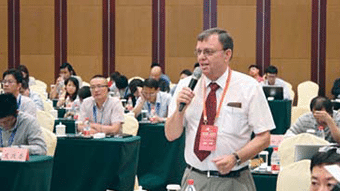
Schiller Institute founder Helga Zepp-LaRouche has just returned from a 10-day visit to China, including public presentations and private meetings, which she stated went exceptionally well.
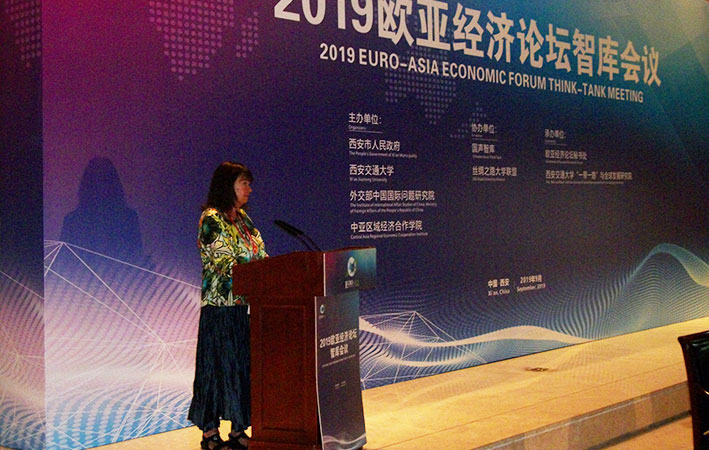
The trip began with her participation in the Conference on Dialogue of Asian Civilizations, held May 15-16 in Beijing, where President Xi Jinping delivered the keynote. Zepp-LaRouche presented a paper and a 10-minute speech, with the title “The Highest Ideal of Mankind Is the Potential of the Future,” which has already been published as part of the Conference proceedings. We feature it immediately below.
She also had daily, high-level meetings with representatives of many top institutions that she has been in touch with since the 1990s. She reported that these occurred at a moment of very grave tensions between China and the U.S.—because of the collapse of the trade talks, the Huawei affair, and other issues—which made her presence all the more important. Many people look to the LaRouche movement for solutions to these problems, she reported.
Zepp-LaRouche also delivered a speech at the Chongyang Institute for Financial Studies of Renmin University in Beijing, and granted a number of press and TV interviews.
In addition to Beijing, Zepp-LaRouche visited Nanjing where she met with the publisher of the Chinese-language edition of the first volume of “The New Silk Road Becomes the World Land-Bridge” special report, where she learned that the publisher had just published a second printing of that report, because they consider it one of the most important books of their publishing house. They also will be publishing a translation of the new report, “The New Silk Road Becomes the World Land-Bridge, Vol. II.”
The Highest Ideal of Mankind is the Potential of the Future
By Helga Zepp-LaRouche
It is the characteristic of turning points in history that the majority of people have no concept of what is occurring. Only those visionaries who have a clear idea of the positive potential of the future are able to intervene in the process at moments of decision, to avert potential catastrophes, and instead usher in a new epoch of humanity. We find ourselves in such a phase change: the old world order, as it developed after World War II and especially after the disintegration of the Soviet Union, is in a process of dissolution, but what the new order will look like is by no means decided yet. We are in a period when even international law seems to be overridden, as at the moment neither the UN nor any other institution seems to be able to enforce it.
But it is undeniable that the pendulum that favored Western civilization over recent centuries—though for thousands of years Asia had occupied an outstanding and even leading place in universal history—has long been swinging back. This is clearly supported by the demographic development of Asia, completely new strategic interventions such as the Belt and Road Initiative (BRI), and clear objectives, such as the concept “Made in China 2025” or the outlook that President Xi Jinping has set for China by 2050.
Tremendous opportunities for Asia arise from this, and perhaps along with them a completely new form of responsibility, which should ignite the inspiration to work out concepts about how to advance humanity as a whole. President Xi Jinping obviously has this very approach in mind when he speaks of the “Community of a Shared Future of Mankind.” We are now experiencing a precious moment, for never before in history has the conscious design of a new epoch, with the idea of a unified humanity as a higher idea, been so clearly defined as a task. If we want to create a more human order, it must be built on the best concepts that have been produced by various cultures. Those concepts must, so to speak, have an ontological character, because nothing in them can be accidental or of merely contemporary character, if they are to determine the Dharma—the moral codex—which the spiritual leaders, and with them Asian societies, are to follow in this new chapter of universal history.
It is also obvious that the impetus for defining this “righteous way” must come from the ancient traditions of Asia, such as Confucianism, Buddhism or Jainism, which are clearly linked to a commitment to lifelong self-cultivation and moral refinement of mankind. Though the West had the same claim in its Classical and Renaissance periods of humanism, the idea of the ethical improvement of man as a purpose in life is almost the opposite of the Western liberal model, where any priority of moral requirements or the superiority of one philosophy over another are emphatically rejected.
How then must the principles be designed, so that the new paradigm of a coming Community of Mankind is on such secure foundations that the requirements of modern natural science as well as those of a new system of international relations can be satisfied?
This question must be answered on different levels. A good starting point is The Five Principles of Peaceful Coexistence, or Panchsheel, as laid down for the first time in a formal way in the Trade and Transport Agreement between the Tibetan Region of China and India on April 29, 1954. The preamble states that the two governments have agreed on the following principles: 1. Mutual respect for each other’s territorial integrity and sovereignty, 2. Mutual non-aggression, 3. Mutual non-interference, 4. Equality and mutual benefit, and 5. Peaceful co-existence.
The first conference of independent Asian and African states in Bandung in 1955, led by Chinese Prime Minister Zhou Enlai and Indian Prime Minister Jawaharlal Nehru, expanded the Five Principles into the Ten Principles of Bandung. The same principles were underlined as a core element of international law at the 1961 Non-Aligned Conference in Belgrade. With the BRI, China has defined for the first time the concept of this relationship between nations as the basis of a global reorganization which is open to all nations. President Xi emphasized in his keynote speech at the first Belt and Road Forum in May 2017,
“We are ready to share the experience of development with other countries. We have no intention to interfere in other countries’ internal affairs, export our own social system or model of development, or impose our will on others.”
These principles of peaceful coexistence have deep roots in several Asian cultures. Some of these concepts are philosophical in nature, others are part of theological considerations. This article is about the identification of the approaches that have advanced humanity and are relevant to the future understanding among peoples. This is also the approach adopted by President Xi on his overseas visits, as he emphasized in a speech in New Delhi to the Indian elite in 2014:
“Even in ancient times, people in China came to the realization that a belligerent state, great as it may be, ultimately fails. Peace is paramount. Harmony without uniformity, and universal peace must be achieved. The Chinese concepts of ‘universal peace’ and ‘universal love’ are very similar to the Indian concepts of ‘Vasudhaiva Kutumbakum’ (the world as a family) and ‘ahimsa’ (do not inflict injury).”
Thus, in the ancient scriptures of India, the Vedic texts, the Upanishads, and the classical Sanskrit literature, there are many important concepts that have both a religious and a practical political significance. This includes, for example, the principle of ahimsa mentioned by Xi, the respect for all other creatures—not only the renunciation of any physical violence, but also of hurting the other in any way, either verbally or spiritually. Ahimsa is also a method of war prevention and conflict resolution, even for complex challenges in the real world.
The collections of the Rigveda are the oldest surviving complete literary work, and have been handed down orally for centuries with the help of sophisticated mnemonics. In the Rigveda there are fundamental thoughts on the cosmic order, which ultimately also provide the guideline for human action on earth.
In the Upanishads there are five principles that reflect the same basic orientation. The most basic concept is that of the all-embracing Brahman. “Ishawaram idam sarvam jagat kincha jagatvam jagat”—Everything that exists, wherever it exists, is permeated by the same divine power. This idea is found in a similar form in Gottfried Leibniz’s idea of the Monad, where within every Monad the entire lawfulness of the universe is contained.
The second principle is that the Brahman, the creative principle whose expression is the entire realized world, is in every individual consciousness, the Atman. Atman is the reflection of this all-embracing Brahman. It is the individual consciousness, but it is not fundamentally separate from Brahman. “Ishwara sarvabhutanam idise tishtati”—the Lord dwells in the heart of every individual. The relationship between Atman and Brahman is the core around which the whole Vedic doctrine revolves. In the philosophy of Nicholas of Cusa, this corresponds to the affinity of the macrocosm and the microcosm, which makes it possible for an intangible force—an idea created by creative reason—to bring about a further development of the physical universe.
A third Vedic principles is that because of their common spirituality all people are members of a single family. The Upanishads speak of humanity as amritashya putra, “Children of Immortality.”
The fourth concept the Upanishads present is the idea of the consubstantiality of all religions, all spiritual paths. “Ekoham svat virpra bahuda vadanti”—“The truth is one, the sage calls it by many names.” This idea corresponds to the “Sanatana Dharma,” the single religion which stands above all religions, an idea also expressed by Nicholas of Cusa in his Platonic dialogue “De Pace Fidei,” which he wrote immediately following the fall of Constantinople in 1453 and the associated bloody conflicts. In this dialogue, representatives of various religions and nations turn to God for help, because all of them are fighting wars against and killing each other in His name. God instructs them that they are all also philosophers in their respective nations and religions—beyond all religious traditions and teachings of the different prophets—and therefore can understand that above religion there is one God, and above different traditions, one truth. Incidentally, the Hindu Monk Swami Vivekenada cited the same argument in his famous speech before the World Parliament of Religions in Chicago on September 11, 1893: The followers of different religions have argued and fought each other purely because their point of view is too narrow, and they don’t grasp that the highest Being is infinite.
A fifth Vedic concept is that of the welfare of all creatures. “Bahujana shukhaya bahujana hitaya cha”—the Hindu philosophy seeks “the good of all people and all forms of life on this planet.” The affinity to the Confucian ideas of harmonious development of all is evident, as Confucius says explicitly: “They who have success should help others to succeed.” Naturally, this is the idea at the basis of the BRI and the conception of “win-win cooperation” between various nations. The Confucian philosophy also gives a name to the new era which was to begin with the prospective Japanese Emperor Naruhito: “Reiwa,” which literally means “pursuing harmony.” Japanese commentators emphasize that this term reaches back to the famous classical poetry anthology, “The Poem of Manyoshu,” though as the scholar Wang Peng points out, the term ling-he was used by the ancient Chinese emperors as the name for their reign, just as in present day China there are best wishes for peace and harmony.
The idea of a harmonious development of all as the basis for a world peace order is thus laid out in several Asian cultures, and stands in direct contradiction to the idea that relationships among nations constitute a zero-sum game. However, its realization in practice obviously requires a new stage of development in the evolution of mankind, the Age of the Spiritual Man, as Sri Aurobindo has expressed it; or the increasing dominance of the Noösphere over the Biosphere, in which Vladimir Vernadsky saw a trajectory laid out by the natural law of the universe.
The universe has an inherent lawfulness which advances it to higher stages of development. Vernadsky saw the creative reason of mankind as an essential component of that universe, as a geological power, which has been qualitatively advancing this higher development since the existence of human evolution. In the science of physical economy, Lyndon LaRouche delivered the proof of the absolute efficiency of human creativity, which distinguishes man from all known living creatures, with his concept of Potential Relative Population Density.
Yet this anti-entropic higher development is neither linear, nor the automatic result of objective processes—as in the variations found in historical or dialectical materialism, for instance—as, along with the objective effect of newly discovered physical principles in production processes, now a substantial component of this process has become the subjective intellectual and moral higher development of man.
In meeting the task of consciously shaping a new paradigm for humanity stated at the beginning of this article, it is certainly an enormous advantage for Chinese and other Asian cultures that, thanks to the philosophy of Confucius, the development of a moral character has been the most important goal of education in broad areas of Asia. Despite the considerable hype about the digitalization of the economy and the roll of artificial intelligence in future economic platforms, it will always be a question of the moral qualities of human beings which will determine whether the new technologies are deployed for the benefit of mankind, or for evil purposes. Thus, of first-rank strategic importance is the letter written several months ago by Xi Jinping to eight professors of the Chinese Academy of Fine Arts, where he emphasized the extraordinary importance of aesthetic education for the mental development of the youth of China. Aesthetic education plays a definitive role in the development of a beautiful soul, filling the students with love and promoting the creation of great works of art.
Thanks to the continual influence of Confucianism—only broken by the ten years of the Cultural Revolution—there is a continuing tradition going back thousands of years in which the development of a moral character represents the highest goal of education. It is thus taken for granted in China that attention to public morals and combating bad characteristics in the population constitute the precondition for a highly developed society. For example, the Court Report on Educational Goals of the Academic Ministry of the Qing government in 1906 required, above all course content, the teaching of public morals (gongde) and Confucian teachings on virtue, in order that “each has concern for others as he does for himself, and loves the state as one loves his own family.”
A key to understanding the special significance of aesthetic education in China today, however, lies not only in the teachings of Confucius—who assigned a crucial role in the development of a moral character to the occupation with poetry and good music—but in the scholar who has influenced China’s modern education system more than anyone else: the first Minister of Education of the Provisional Republic of China, Cai Yuanpei. Cai acquired the academic title of xiucai at the age of 15, due to his extraordinary intelligence and diligence, the highest title jingshi at age 24, becoming a bianxiu in 1894—and at the age of 26 had reached the highest level of academic career in the Qing dynasty. He had excellent knowledge of the classical script and was famous for his beautiful classical style.
During this time, Cai, along with the entire Chinese elite, was shocked that China was defeated in the war against Japan, and had generally lost out in every invasion since the Opium Wars, paying high reparations and ceding rights to the invaders. Among intellectuals, it was discussed how Japan—which for centuries was considered backward—had become so strong through the Meiji Restoration, and they sought to learn the lesson of this transformation.
The corruption of the Qing dynasty was also blamed for these disgraceful defeats. Cai was convinced that the state would only survive if there was a change in the consciousness of the people, and that this improvement could only be achieved by improving the content of education. Cai first began to investigate the Japanese and then the European educational systems. Finally, he traveled to France and Germany, where he studied civilizational and cultural history of the West in Leipzig from 1907 to 1911, before he was appointed as Minister of Education by Sun Yat-sen in 1912.
Cai undertook in-depth studies of the aesthetic writings of Alexander Gottlieb Baumgarten, Immanuel Kant and Friedrich Schiller, as well as the concept of education of Wilhelm von Humboldt. Inspired by the excellent studies on the history of philosophy of Wilhelm Windelband, and by direct study of Kant, Schiller and von Humboldt, he realized very quickly that Schiller’s conception of aesthetic education was not only in complete affinity with Confucian morality—Schiller’s concept of “the beautiful soul” completely corresponded with the Confucian idea of the junzi—but Schiller spoke about these questions with greater clarity and from a higher point of view than any earlier or contemporary philosophers. “The comprehensive theory of Friedrich Schiller and the idea of aesthetic education brought great clarity to everyone,” writes Cai. “Since that time, the European idea of aesthetic education can supply us with a great deal from which we can draw for developing our own understanding of the subject.” Cai Jianguo further quotes Cai Yuanpei: “In Germany, aesthetic education impressed me greatly. I want to use all my powers to promote them.” Cai created the Chinese term meiju, which had not previously existed in that language.
Schiller wrote the “Aesthetic Letters” in response to the failure of the French Revolution, and argued that from then on, any improvement in the political realm can only come from the ennoblement of the individual. Only if man rises above the transient happiness of the world of the senses, and engages his efforts not only for himself, but the community; not only for the present, but the future; not for physical pleasure, but spiritual creativity; only then could the state prosper. In the “Letters” and in further pioneering writings on aesthetics, Schiller developed why this ennoblement of character can be achieved by immersion in great classical art.
Cai Yuanpei recognized the striking coincidence between the teachings of Confucius and the aesthetics of Schiller. The immersion in poetry, music, and painting during one’s leisure hours awakens in the beholder an aesthetic pleasure in which lies neither a desire for nor a rejection of the sensible world. Rather, the taste is formed and the emotions are ennobled. Aesthetic sensibility embraces beauty and sublimity, thus forming a bridge between the sensual world and reason. Every human being has a mind, but not everyone is capable of producing great and noble deeds. Therefore this mind must become stronger as a driving force, by ennobling it.
In 1912, Cai wrote the “Theses on New Education” and the “Textbook on Moral and Personal Development for the Secondary School,” in which he characterized human conscience as the essential guide to behavior. In an essay of May 10, 1919, he wrote: “I believe that the root of our country’s problems is in the shortsightedness of so many people who want quick success or quick money without any higher moral thinking. The only medicine is aesthetic education.”
Of course, it should not go unmentioned that Cai, as president of the University of Beijing, led this institution to internationally recognized scientific renown, taking up many suggestions from Wilhelm von Humboldt, who established the unity of research and teaching, and the beauty of character as an educational goal at the University of Berlin. Because of Cai’s prestige, the University in Beijing soon became a magnet for many young Chinese scholars returning from overseas, just as he became the inspiration for many other art colleges and academies.
In my view, Cai Yuanpei’s conception of the state as a larger family in which the interests of the state must take precedence over the interests of individual families, is also of paramount importance for understanding the policies of President Xi Jinping and his idea of the “Community for the Future of Mankind,” because for him the prosperity of the state was the prerequisite for the happiness of the citizens. However, the interests of the world as the home of all living beings was also set before the interests of the individual state. Cai wrote: “Until the ‘great community’ of the world is realized, the interests of society cannot be identical with those of the world.” He also emphasized that in fulfilling the duty to the state, one must be careful not to contradict the duty of the world. He dreamed of a “great community” of the entire world, (datong shijie), which would be peaceful and harmonious, without class distinctions and state boundaries, without armies and war. All humans would understand each other in this world community and help one another. Cai saw the “Dialogue of Cultures” as the pathway to this goal: “I have often thought that a nation must necessarily absorb the culture of other peoples. This is like the body of a human being who cannot grow without breathing the air of the outside world, without eating and drinking.” Yes, he saw in this meeting of cultures the absolute prerequisite of higher development: “If one takes a look at the development of the world history, one sees that the confrontation of different cultures always leads to the emergence of a new one.”
The realization of this vision is absolutely identifiable through the dynamism and the “Spirit of the New Silk Road.” The principles that must determine the “righteous path” for the new paradigm are not static axioms, but consist of the prospects arising from the aesthetic education of, eventually, all human beings. In a world where economics is not based on the principles of profit maximization and the greatest possible satisfaction of individual greed, but on the best possible promotion of human creativity as the motor of an anti-entropic developing universe; if, so to speak, the “cosmic order” inspires political, economic and cultural life, then the dreams of Confucius, Schiller, Cai Yuanpei, Xi Jinping and Lyndon LaRouche are the political legislators of humanity. As Tagore expressed it in his famous dialogue with Einstein: “When our universe is in harmony with people, we feel the eternal that we know as truth, as beauty.”