Top Left Link Buttons

Mary Jane Freeman

Author Archives

Zepp-LaRouche on CGTN: “Fostering Cooperation in a Fragmented World”

Jan. 18, 2023 (EIRNS)–CGTN today published on its English-language YouTube channel (which has about 3 million subscribers) a 14-minute video commentary by Schiller Institute founder Helga Zepp-LaRouche, on the occasion of the Davos World Economic Forum. CGTN’s introductory blurb asked the question: “How should world leaders work together in a volatile situation? Join Helga Zepp-LaRouche, founder and president of the Schiller Institute, to explore these talking points.” The video can be found here.

 Helga Zepp-LaRouche:

          The world economic forum has given its annual meeting the title “Cooperation in a Fragmented World,” and shortly before the Forum published their Global Risk Report, in which they present the results of the latest Global Risk Perception Survey.  In that, they consider the current crisis, then the expectation of what many experts think will come out in the short term (two years), the most severe in the long term (ten years), in terms of the economy, the environment, society, and those geopolitical and technological risks that could become tomorrow’s crises.  Then they consider how these different crises could evolve into a “poly-crisis” by 2030. 

          Concerning the methodology used to come to their evaluations, they report that they interviewed over 1200 experts from academia, business, government, the international community, and civil society between September 7th and October 5th, 2022.  In other words, this Global Risk Report is not based on scientific methods, but rather on an Aristotelian method to arrive at the common denominator of the opinions of selected experts. 

          While there will also be attendance from countries of the Global South, who may try to set different accents, the World Economic Forum represents a good portion of the top global corporate establishment; and they clearly try to continue to push their agenda, which is an acceleration of the Great Reset, that they have been pushing before.  It completely leaves out the optimistic perspective, for example, of the circa 150 countries working with the Belt and Road Initiative and their optimism that through investments in infrastructure, agriculture, industry, and international scientific cooperation, etc., most of the problems they insist will dominate the next years can be overcome.

          Instead, there is a lot of talk about “progressive tipping points” and “catastrophic outcomes,” which are all designed to motivate the assembled business leaders and beyond, to adopt the program fitting the financial interests of the main financial players of the neo-liberal system.  For example, in the section called “Natural Ecosystems; past the point of no return” they write:

          “Human interventions have negatively impacted a complex and delicately balanced global natural ecosystem, triggering a chain of reactions.  Over the next ten years, the interplay between biodiversity loss, pollution, natural resource consumption, climate change, and socioeconomic drivers will make for a dangerous mix. 

          “Given that over half of the world’s economic output is moderately to highly dependent on nature, the collapse of ecosystems will have far-reaching economic and societal consequences.  These include increased occurrences of zoonotic diseases, a fall in crop yields and nutritional value, growing water stress exacerbating potentially violent conflict,” etc., etc.

          The deep Malthusian pessimism reflected in such a statement makes clear that this report is more a program of their intent than a scientific prognosis.  Because of human interventions, the world population has increased from a few millions after the last Ice Age to 8 billion.  If there will be a fall in crop yields, then [it will be] only because of the Green demonization of modern agriculture.  And if there will be a violent conflict, then only because the necessary development of new fresh water resources will be blocked by the Malthusian environmentalist agenda.

          Economic Risks in 2023

          Unfortunately, I think that 2023 will see an escalation of the financial and economic crises.  The central banks have tried to curb inflation by raising the interest rates rather rapidly.  Then, as we could see for example in Great Britain, they had to suddenly go from quantitative tightening to quantitative easing again, because of the danger of a chain reaction of over-indebted firms; thus going back to the inflationary money pumping.  Since the tendency towards hyperinflation is the result of ever more monetarist policies going for profit maximization at the expense of physical economy and the reckless liquidity injections following the systemic crisis of 2008 by the trillions of dollars, euros, and pounds, only an end to the casino economy could solve the problem.

          What should be put on the international agenda is the reintroduction of a Glass-Steagall banking separation, which puts the commercial banks under state protection, but forces the investment banks to straighten out their balance sheets on their own without taxpayer money.  Then, each country must create their own national bank, because credit creation must be under the sovereign control of the governments.  These national banks must then cooperate to create a new credit system, which is only devoted to investments in projects serving the common good of the people.  There are already efforts going on in this direction among many countries of the Global South — also, to create a new international currency.

          While it is very difficult to predict the exact time when the systemic crisis of the neo-liberal system will come to a head, it cannot be excluded that the decision to have a complete reorganization of the international financial system could force itself on the agenda in this year of 2023.

          Geopolitical Conflict Triggering a Chain of Reactions

          Right now, unfortunately, the crisis over Ukraine — which is not a crisis between Russia and Ukraine, but between NATO and Russia — is accelerating in a dangerous way.  I think it is extremely urgent that a diplomatic solution is found quickly to end the war.  There are various efforts, like Pope Francis has offered the Vatican as a venue for negotiations, and I and a group of Latin American legislators have written an open letter to the Pope to mobilize people around the world to support this idea.  We are also asking people to sign that letter.  Also, President Lula from Brazil has been asked to mediate by several countries from the Global South; and also President Erdogan from Turkiye has made some efforts.

          I think all of these proposals should be merged, because too much is at stake.  But, I think because the crisis around Ukraine is so dangerous, the initiatives made by President Xi Jinping with the Global Security Initiative, together with the Global Development Initiative are probably the most important angle to solve the crisis.  The Global Security Initiative is really a proposal for a new international security architecture, and obviously that must take into account the security interests of every single country on the planet for it to work. 

          I am aware that right now it does not look very likely that the countries of the so-called West would be willing to discuss such a new international security architecture, given the fact that NATO is trying to become Global NATO, and Japan and Great Britain have just signed the so-called “Reciprocal Access Agreement,” and the US, the UK, and Australia have signed the AUKUS pact.  But the BRICS countries already have a higher GDP than the G-7; and 17 countries of the Global South are applying for membership in the BRICS.  So, they are in the process of representing the vast majority of the human species.  And the countries of the Global South have made it quite clear that they don’t want to be drawn into a geopolitical conflict between the West on the one side, and the China and Russia on the other side.

          I think it is therefore quite possible that in the course of 2023, the financial crisis erupts even more dramatically, and that that will be the right moment to put the combination of the Global Security Initiative and the Global Development Initiative on the international agenda.  I think President Xi is very right that security can only exist if there is development.  So, I am sure that the vast majority of the countries who are striving to overcome the relics of colonialism, and who really want to develop into become modern and prosperous countries, would support such an intervention.

          And then hopefully, the countries of the West can see that it would be in their best interest to cooperate with the Global Security Initiative, the Global Development Initiative, and the Belt and Road Initiative.

          Global Risks in the Next Two Years

          There are policy initiatives which can overcome the inflation by reorganizing the financial system, by addressing the root causes for the crisis.  The excessive profit orientation at the expense of the physical economy clearly did not work.  And what the World Economic Forum calls the geo-economic confrontation can be stopped the moment these CEOs recognize that win-win cooperation with the majority of the countries in the world would also be in their best interest; since to cooperate with growing markets with billions of people with growing buying power is for sure better than to go bankrupt in a crash.  And the best way to cope with natural disasters and extreme weather events is to invest in basic infrastructure, water management, and scientific and technological progress in order to develop the technologies to have early warning systems, secure housing construction, and other means of adaptation.

          Disagreements on Cybersecurity in Major Countries

          There have been various attempts to have agreement between major countries on cybersecurity.   There was an agreement for example in 2013 between Russia and the United States to establish a secure phone connection, and a working group to mitigate cybersecurity threats.  In 2017, in light of the allegation of election interference made against Russia, Trump and Putin agreed to create a cybersecurity unit to prevent election interference and other cyber threats.  Trump praised it as a big step forward, but was forced to backtrack only 12 hours later, due to massive pressure from Congress and the mainstream media.  Then, in preparation work for the 2018 meeting in Helsinki between Trump and Putin, Russia offered the United States cooperation in the field of preventing cyberattacks on critical infrastructure — power plants, water supply and transport management systems, hospitals, banks, and so on.  The corresponding provision was included in the joint statement of the Presidents of the two countries prepared by the Russian side for adoption at the summit in Helsinki.  While the summit between the two Presidents worked well, all hell was unleashed against Trump afterwards by the same forces, and the agreement was not signed. 

          At this point, the trust between the West and Russia and China is at an historic low point.  Under these circumstances, an isolated agreement on cybersecurity seems very unlikely.  Therefore, a great vision is required on how a solution can be put on the table which addresses all the major problems together, such as a new, just world economic order based on such concepts as the Global Security Initiative in combination with the Global Development Initiative.

          I think that we have reached a point in the history of mankind where we really must get serious about the international order of relations among nations, and how we can organize them in such a way that we can self-govern as a species which is gifted with creative reason.  In an existential crisis, [such] as the one we are experiencing right now, and which is very likely going to get much worse, it is not the amount of money one owns that counts; but it is the quality of political leadership of exceptionally wise and moral men and women who have the ability to shape the future for the benefit of all humanity.

          In Davos, there will be a great number of billionaires, millionaires, and hangers-on to power.  It will be very interesting to watch if they are also up for the larger job required.


Xi Jinping Visit to Saudi Arabia to Be “Epoch Making” in China-Saudi Relations

Dec. 6, 2022 (EIRNS)—Chinese President Xi Jinping arrived in Saudi Arabia today for a state visit and also to attend two important summits—the Gulf-China Summit for Cooperation and Development, to include 14 leaders of the Gulf Cooperation Council (GCC), and the first ever Arab-China Summit for Cooperation and Development. He will be there through Dec. 9.

Xi was received with much pomp, his plane escorted into the King Khalid airport in Riyadh by six jets of the Saudi Royal Air Force, greeted warmly by Prince Faisal bin Bandar Abdullaziz, Governor of the Riyadh region, and by Foreign Minister Prince Faisal bin Farhan bin Abdullah. The warmth with which he was greeted and lavish ceremonies that will be part of his visit stand in stark contrast to last July’s visit by U.S. President Joe Biden, who met Crown Prince Mohammad bin Salman with a fist bump and later snarled, without success, that Saudi Arabia should increase oil production and improve its human rights record.

Robert Jordan, a former U.S. ambassador to Saudi Arabia and diplomat in residence at Southern Methodist University, described the U.S.-Saudi relationship as a “slow-moving train wreck and we shouldn’t be surprised to see consequences of that.”

In contrast, speaking at today’s Foreign Ministry briefing, spokeswoman Mao Ning described Xi’s visit as “the largest and highest-level diplomatic event between China and the Arab World” since the founding of the People’s Republic of China. “It will be an epoch-making milestone in the history of Arab-China relations.”

Holding the summit, she said, was “a joint strategic decision to strengthen coordination and solidarity under the current circumstances….We hope to jointly act on the Global Development Initiative and the Global Security Initiative, advance on high-quality Belt and Road cooperation and contribute to the peace and development of the Middle East and the world at large.”

Ms. Mao Ning had similar remarks on the upcoming China-GCC summit and on talks with the Saudi leadership. China and Saudi Arabia have a shared focus on development strategies, she said. Xi will have in-depth discussions with King Salman bin Abdullaziz al Saud and Crown Prince and Prime Minister Mohammad bin Salman and elevate the current strategic partnership to a higher level. [China Foreign Ministry announces import of the visit: https://www.fmprc.gov.cn/mfa_eng/xwfw_665399/s2510_665401/202212/t20221207_10986586.html ]


French “Food Production to Come to a Halt”

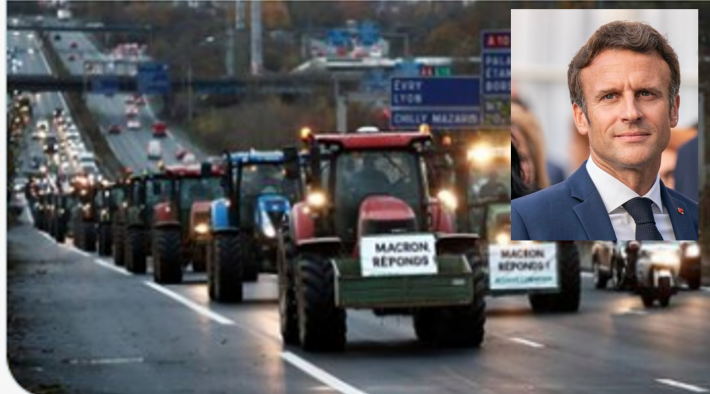
Dec. 7, 2022 (EIRNS)–“Food production to come to a halt” was the title of an article published by Le Figaro back in Sept. Unfortunately, what seemed unbelievable for many yesterday, has become reality today. After heavy industries, such as the rare French zinc, aluminum, and glass producers –hit by impossible energy price spikes and artificially kept alive government support– agro-food processors are now on the chopping block.

Yesterday, the French canned food specialist Cofigeo which has a €300 million turnover, announced it will “temporarily” shut down 4 of its 8 factories in France as of Jan. 2, which represent about 80 % of its production. Consequently, 800 of the 1200 employees of Cofigeo will receive an agreement of partial activity of long duration (APLD).

The decision is an answer to “the dramatic increase in energy costs (gas and electricity needed for cooking and sterilization of dishes), which will be multiplied by 10 from the beginning of the year,” said the group in a statement. “It will go from 4 million to 40 million euros overnight,” Mathieu Thomazeau, its president, told Le Figaro.

This is a thunderclap in the food sector and other food groups could be in great difficulty in January. Everybody has warned this would happen but the government refuses to listen. Already in September, Le Figaro reported that “After the prices of electricity and natural gas supplying dairies, sugar factories and canneries in France have risen by 350% and 380% respectively in one year, the first cracks in the food industry are showing up.” At that time, dairy manufacturers warned that power cuts could lead them to throw milk away. The French giant dairy industry Lactalis’ energy bill reaches 1 billion euros per year. That of the Breton group Sill (Petit Basque, Malo …) has jumped 800% since 2021. In sugar factories, the fear of winter load shedding has led sugar producers to launch their beet harvesting and processing campaigns earlier, even if this means sacrificing yields.

Besides soaring energy costs, the other worry is that production lines simply will grind to a halt for lack of products coming from farms. In field vegetables (green beans, peas, etc.), due to the drought, harvests have melted by up to 50% this year. As a result, canneries that process and package them are now receiving only half of their needs. Already, some of them are only working three days a week. Enough to fear shortages on the shelves before the next harvest of 2023. In recent days, the fragile balance of the sector has become even more tense, with major risks of disruption on fertilizers for the next crop year. European fertilizer factories have stopped production of 50% of their products and have severely limited their production of ammonia due to the prohibitive price of gas. This raises the risk of shortages for the coming winter. To avoid total collapse, many sectors (milk, meat) plead to be recognized as “trades of general interest” and be exempted from energy rationing.


Your Choice: Unlimited Fusion Power—Or Unlimited War

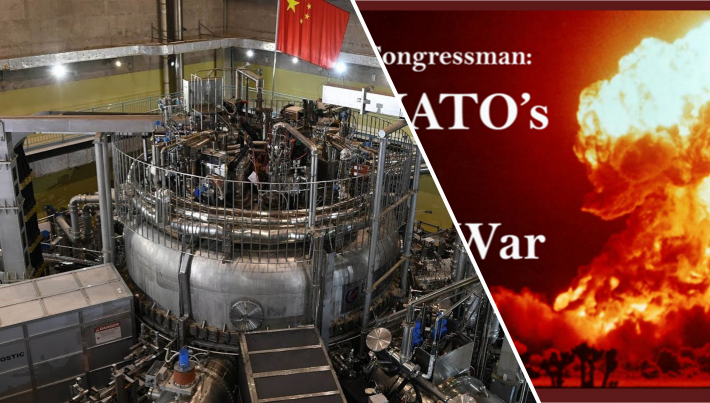
Nov. 30 (EIRNS)—China’s Science and Technology Daily reported Nov. 28 on the status of the Comprehensive Research Facility for Fusion Technology (CRAFT) being built at the Hefei University of Science and Technology. China, the report makes clear, is serious about meeting its goal of generating continuous fusion energy by 2028, for use in a hybrid fission fusion power plant, and generating fusion energy directly for the electric grid by 2035. Materials and technologies needed to control fusion reactions are already being tested at CRAFT, a giant complex which will be fully completed by 2024, as part of the broader fusion project based out of the university, which is home to the superconducting EAST, or Experimental Advanced Superconducting Tokamak, and the Chinese Academy of Sciences’ Institute for Plasma Physics.

This is great news for everyone worldwide. The phenomenal leap in humanity’s power on Earth and in the Solar System that will flow out of mastering controlled thermonuclear fusion reactions has been known for decades. Lyndon LaRouche founded the Fusion Energy Foundation in 1974 to promote its advance, and by the time the U.S. government shut it down in 1987, the foundation’s monthly magazine, Fusion, was one of the most popular science magazines in the United States.

The development of a full-scale fusion powered-economy has taken as long as it has for purely political, not technical or scientific reasons. The Malthusian, imperial oligarchy has been its mortal enemy, but when people understand the almost limitless progress which fusion power and its associated technologies can bring, Malthusianism is finished.

China is not only committed to developing fusion, but is bringing other nations in, to share in the development. Twelve days ago, China’s Institute for Plasma Physics announced that one of the institute’s four working tokamaks had been dismantled, packed carefully into six containers, and is now ready to be shipped to Thailand in mid-December, where it will be reassembled and put to work at the Thailand Institute of Nuclear Technology!

China is donating the tokamak to Thailand, along with training the Thai scientists and engineers who will run it. When officially launched in the first part of next year, scientists and engineers from across the Southeast 

Asian countries will be able to receive there the training they also need to run future fusion experiments and reactors in their own countries. 

That act is a microcosm of a world order befitting humanity.

Imagine what progress could be made in improving the lives of every human being on this planet, were the United States, Japan, France and Germany—for example—to do likewise.

Instead, the as-yet-unshaken commitment of the Anglo-American powers and their European cohorts to their dog-eat-dog view of humanity continues to threaten the annihilation of the human species itself. Not satisfied with the devastation their war against Russia has brought upon the world (Ukraine emphatically included), are preparing for “the big one,” as U.S. Strategic Command head Adm. Charles Richard puts it: a war against China.

Today, the Pentagon released its annual “China Military Power Report,” declaring that China’s determination to complete “the rejuvenation of the Chinese nation by 2049” is what makes China a threat to the U.S. The day before, the U.S. Defense Intelligence Agency announced that it has established a “China mission group” to integrate all work done by the DIA on China, because China represents “an existential threat to the long-term success of the United States.” 

The U.K. neocon thinktank, the Council for Geostrategy, has launched a campaign for His Majesty’s government to elevate its operations against China in the Himalayas region to the level of its commitment to its maritime Indo-Pacific “tilt.” Included in its recommendations, is fostering the India-China border conflict. Countering China was high on the agenda of the NATO Foreign Ministers meeting on its second day. NATO Secretary General Jens Stoltenberg and Secretary of State Tony Blinken declared before the meeting began today, that NATO is committed to standing together against China, as Stoltenberg bragged that NATO had been training and equipping Ukraine’s armed forces since 2014.

The U.S. military, for the third time, made an ostentatious show of one of its ballistic missile submarines, this time at the U.K.’s military base on Diego Garcia, in the middle of the Indian Ocean. Likewise, U.S. Strategic Command reported that earlier in November, it had carried out an exercise, Spirit Vigilance 2022, demonstrating that eight stealth bombers could taxi out and take off at once from a Missouri airfield. 

And they complain that Russian and Chinese strategic bombers flew a joint patrol over the Sea of Japan and the South China sea today? 

Where this is heading, is very, very frightening—and completely unnecessary. Human beings were made for something better; to cooperate in the development of each other, and taking joy in it. Let the citizens of the world take heart and join with the Schiller Institute in establishing a world order worthy of the principle that human beings are capable of governing themselves on behalf of all others. 


Russian Academy of Sciences Linked Sites Publish Schiller Institute Paper on Prospects for a Fusion Energy Economy

Nov. 26 (EIRNS)—Websites associated with Russia’s Institute for Scientific Information on Social Sciences of the Russian Academy of Sciences (INION RAS) have just published the address, titled, “Prospects for a Fusion Energy-Based Economy for the BRICS Nations and Partners,” by Richard A. Black of the Schiller Institute. The address was given at the Oct. 25-26 conference on “Scientific-Technological and Innovative Cooperation of BRICS Countries,” organized by the Russian National Committee on BRICS Research. The conference heard an address also on Oct. 25 by Helga Zepp-LaRouche on prospects and principles for a new international credit system, as designed by Lyndon LaRouche. The Russian websites which have published the paper are “Greater Eurasia: Development, Security, Cooperation” and “The Club of Subjects of Innovative and Technological Development.”  The INION of the Russian Academy of Sciences, which published the speech, is a section of the RAS. Taras Muranivsky, who headed the Schiller Institute in Moscow for many years until his death in 2000, was associated with that section of RAS, and Lyndon LaRouche had addressed it in 1994. 


Over a Million Mexicans March in Support of AMLO’s Government

Nov. 28, 2022 (EIRNS)–President Andres Manuel Lopez Obrador called a march in Mexico City on Sunday, Nov. 27, to which he would give a report on his government, four years in. An estimated 1.2 million Mexicans turned out, according to the official report by the (pro-AMLO) head of the Mexico City government, Claudia Sheinbaum.

It was a real show of force by AMLO against the neocon-led destabilization of his government. The crowd was very large and very festive, full of mariachi bands and people doing traditional Mexican dances as they marched, with delegations from around the country participating with their signs identifying their city or region. The slogans chanted were simple: “AMLO, you are not alone;” “It is an honor to be with Obrador;” and “Mexico is my party.”

The Schiller Institute was present, using the occasion to advise Mexicans of the nuclear war danger facing the world. As people gathered for the march to start, organizers gave megaphone briefings and distributed 2,000 leaflets next to their very big banner reading, “Citizens of the World: Unite. Stop Nuclear War! For a New World Economic Order. The Schiller Institute,” which they then carried as part of the march. While some were taken aback by the Schiller Institute’s message in the midst of this great fiesta, many people listened carefully to the briefings and were happy to take a leaflet. Many took videos and photos of the banner.

Unlike the march organized against him by the ultra-right opposition three weeks before, which saw perhaps 60,000 in a rich area of the city, when AMLO began his hour and a half speech, Mexico City’s giant Zocalo central square was full. The President began by noting his happiness that the majority of people participating in the march were young people. He reviewed his administration’s efforts, in particular, to “put the poor first,” and push aside the oligarchy’s grip on the government.

The President told the march that Mexico’s foreign policy is one of “non-intervention, self-determination, cooperation for development, and the peaceful solution of disputes; we act on the basis of the ideal of universal brotherhood.”

He also delivered an implicit warning to the rightwing opposition being mounted against him. Mexico is a “sanctuary of freedom” and the right to freedom of speech and dissent today, he said. “For example, here, in Mexico City, a few days ago, without any obstacle, the most famous personalities of the world’s ultra-right held their summit here.” He then added: “We never again wish to apply Article 33 of the Constitution, and we do not want anyone to call anyone a pernicious foreigner.” He did not say, but everyone knows, that Art. 33, which states that “foreigners may not in any way participate in the political affairs of the country,” grants the President “the power to expel from national territory any foreigner, according to the law, after a hearing.”


China’s Covid Crisis, 1,400 Times Better Than the U.S.’s on a Good Day

Nov. 28, 2022 (EIRNS)–The reality of the COVID-19 situation in China is that new cases/day in China increased from Oct 28 (1,168) to Nov 21 (26,115), and then leveled off in the last week (27,620 yesterday). This very high level (for China) is the equivalent of around 6,500/day in the US, about a sixth of what is reported to be going on in the U.S. today — and the US figure, due to the non-reporting of home testing, is a massive undercount.

Further, since China is testing and tracking so closely, their medical results are even that much more impressive. COVID-19 deaths in China, zero for many weeks, zoomed to 6 in the last week. Compare this to the US in the last week losing around 2,000 people to the virus and Germany around 1,000. Per population, this would be equivalent in China to 8,600 and 17-18,000, respectively; making the performance of the U.S. over 1,400 times worse, and that of Germany 2,800-3,000 times worse — not quite the same ballpark.

What are called two sub-variants (BA.F and BA.5.1.7) of Omicron’s BA.5 variant broke out a month ago. Both sub-variants evade immunity, both from previous infections and from vaccines; and both sub-variants spread faster. So, by November 11, China’s CDC and their Center for Disease Control and Prevention updated their control protocols with 20 adjustments, and ten days later the spread seems to have stabilized.

The faster transmission rate impacted the actions required to both test and track. Some local officials over-reacted with too general, and sometimes unnecessary lockdowns; some did not move hard enough. So, Chinese health officials have sent teams to the regions to work out the bumps in the process. As Wang Liping, from China’s CDC, put it: “Epidemiological investigators, transport staff and nucleic acid testing personnel should cooperate and exchange information, so as to grab the golden window of opportunity of 24 hours to prevail over the virus.” In China, six deaths are a national emergency.


Egeland Warns Europe Faces Hundreds of Thousands Of Ukrainian Refugees This Winter

Egeland Warns Europe Faces Hundreds of Thousands Of Ukrainian Refugees This Winter

Jan Egeland, the head of the Norwegian Refugee Council (NRC), said in an interview with Euronews that there will be hundreds of thousands of Ukrainian refugees this coming winter. “It is really a choice between freeze or fleeing,” he said. “Therefore, very many people are voluntarily fleeing… Europe has to prepare for hundreds of thousands of new refugees this winter, from Norway in the north to the southern European countries.”

“We’re in a race against the clock,” Egeland said. “I’ve been travelling all through the south and the east of Ukraine … and every city you go to is dark and people are freezing.”


Helga Zepp-LaRouche Briefs EIR on Urgency To Implement New Paradigm in Face of World War and Economic Crash Threat

Pre-release of EIR interview:

PAUL GALLAGHER: Today is Saturday, October 22, 2022, and this is the 60th anniversary of the day that President John F. Kennedy of the United States made a speech which told the world that it was in a nuclear warfare crisis, a countdown to nuclear war which could conceivably destroy civilization. Kennedy announced that the United States had determined evidence of Soviet provision of nuclear missiles to Cuba, and said that the United States would not tolerate this, absolutely, under any circumstances, and a crisis was on, which gripped the attention of the world and held people in fear of it for more than two weeks. [JFK speech is here.]

So now, this is Paul Gallagher of EIR. I’m speaking with Helga Zepp-LaRouche, founder of the Schiller Institute, and a frequent lead candidate of the BüSo political party in Germany, about the extraordinary situation which is developing there, and internationally.

So Helga, good afternoon to you.

HELGA ZEPP-LAROUCHE: Hello.

GALLAGHER: Let me start by saying, just in terms of setting our situation here, the Nord Stream natural gas pipeline is a submarine pipeline project of Russia and Germany under the Baltic Sea, that they worked on jointly for more than 15 years. It was suspended in 2022 under U.S. pressure, and on Sept. 26, it was sabotaged, by powerful explosions which were aimed to destroy it completely. It appears that this has had an impact on German political life, despite the fact that it’s being covered up.

Helga, can you analyze for EIR what has happened here, and what does it mean for Germany and the threat of war between NATO and Russia?

ZEPP-LAROUCHE: Well, the first thing to say is that the official media and channels are obviously trying to say as little as possible about it, which is already extremely ominous, given the fact that this worsens the energy situation of Germany for some time to come. Military experts have stated that the sabotage was of such a kind that it could only have been done by a state; it could not have been done by private divers, and that naturally limits the number of states which had access. Now the questions to ask is the cui bono, who had the capacity, who had the opportunity, and who had the motive? And then, as some military experts are saying, well, if it would have been Russia, it would have meant that Russia would have to go with submarines and other devices for 300 km through the Baltic Sea under the total surveillance and control of NATO, and therefore, if it would have been Russia, it would prove that they had a huge superiority in undersea warfare, in order to do that, practically under the nose of total surveillance of NATO. If that would be the case, it would have completely other implications about military balances.

But there are also now many people saying, if there would be any proof that it was Russia, you would have seen a barrage of press conferences by NATO, by the EU, by the governments; all the tabloids would have been full of it. But since nothing of this sort has happened, it doesn’t look like it was Russia.

Instead, in an answer to a question from a parliamentarian, the German government put out an official answer, which is also extremely odd: They said that they know it was sabotage—now how did they know that if there was no official investigation? Sweden, by the way, pulled out, and so there was some strange investigation involving only Germany and Denmark, but the German divers didn’t have the diving equipment to go to the depth of 70 and 80 meters, so the whole thing is very ominous. And the statement by the German government says that, for the sake of the wellbeing of the state, they will not reveal any other information.

Now, that is extremely strange: For a sabotage of such enormous economic, and therefore social and political implications, to leave it at that, naturally raises the suspicion which is being said by many people, that this was done by another state which is not friendly to the German government. Now, given the fact that the only states which could have done it would have been the U.S., the British, Poland, maybe Lithuania, but everybody says—also and knows—that nothing in this highly surveilled area of the Baltic Sea could have been done without the control and OK of the United States.

So why is the German government not saying anything? People more and more have the feeling, this present German government is not defending the interests of the German people, and that despite the fact that the German economy is going to crash against the wall this fall and winter, in a dramatic way, to which the sabotage of these pipelines will have played a crucial part.

GALLAGHER: Is anyone in Germany, given the tremendous escalation of prices and the sabotage of the German economy as the result of the loss of natural gas supplies, and oil supplies—but particularly natural gas—is anyone arguing there that Russia and Germany should fix this pipeline? Or are there actions at all against this NATO policy of full warfare against Russia?

ZEPP-LAROUCHE: I would say so! Just today, there are many demonstrations, and there have been many demonstrations in the last days and weeks, not only in East Germany, but especially there, but also, today, in many West German cities. And what people were saying in these demonstrations is that it is exactly like it was in 1989: This was the demonstrations in which the Berlin Wall came down as a result. And the demands are, stop the sanctions against Russia, stop the weapons sales to Ukraine; this is not our war, we demand a diplomatic solution. And most interesting is, the action of the city of Stralsund, where the parliamentary groups of the Christian Democrats (CDU), the Free Democrats (FPD), and the Linke (the Left Party) and the Social Democrats (SPD), and a citizens alliance called “Citizens for Stralsund,” all signed up for an initiative, offering the city of Stralsund to be the site for Ukraine peace talks. And they say that there’s nothing more important than peace on our Earth, and they refer to the great history of creating the Peace of Stralsund, which is a reference to the conflict resolution from 1370, when a war between Denmark and the Hanseatic League (including Stralsund) ended in the so-called Peace of Stralsund. So, more than 650 years later, they want to have a new Stralsund Peace, and that is just a most spectacular intervention, and I think the spirit of 1989 is clearly revived in these demonstrations. And they’re also demanding the resignation of the present German government.

GALLAGHER: Ah, so there is the spirit of 1989 for sure! There’s one well-known blogger and strategic expert, Alexander Mercouris, who argued in a video that this coverup of the situation with the pipelines, despite some very clear indications of what happened, that it means that the German government is under the control of a foreign power, which is unfriendly to Germany—that was the way that he put it. What’s your view of this argument? Does it bear on these demonstrations that are coming up and the behavior of the government?

ZEPP-LAROUCHE: Yes. There are many calls for this government to resign, which many people think is the worst government Germany has had in the entire post-war period. That applies for sure, for the Green Party—this is a so-called “streetlight coalition” involving the Greens, the Liberals [FDP], and the Social Democrats, of which the Greens are really the war party, the NATO party, with the most hawkish, belligerent policy, and you cannot differentiate what they say from Stoltenberg or Blinken. And the so-called Economic Minister Robert Habeck, who used to be very popular in the polls, has now plunged and has become an object of public contempt, because he is clearly pushing a policy which means the deindustrialization of Germany. And we are therefore facing a huge social explosion, not “facing,” we are in the middle of a huge social explosion in Germany.

GALLAGHER: Interesting. We’ve seen this recently in the United Kingdom, where Liz Truss, who was ready to push the nuclear button and a real warrior, she came in like hell on wheels into the prime ministership, and then very quickly her wheels fell off, and now she’s resigned, and they’re in a government crisis as well as a financial crisis. So, we see these things across Europe.

Let me ask you: You’re frequently featured and interviewed in the media in China, again yesterday, on CGTN’s “Dialogue” broadcast. In one interview, they focussed on your assessment of the situation in France and Germany, what can you convey to the Chinese people about the situation in Europe? What do you think is most important that they understand?

ZEPP-LAROUCHE: Well, they are looking at Germany, in particular, with complete disbelief: A once-proud people of poets and thinkers, and admired for its scientific and technological excellence in the whole world, is committing economic suicide in front of the world’s eyes. And it’s very difficult for people in Asia in general to understand why Europe is on such a self-destructive course.

What they are doing as a consequence is to speed up the construction of a new economic system, which consists of the countries of the BRICS, the SCO, the CICA [Conference on Interaction and Confidence Building Measures in Asia], and other organizations of the Global South, where they building an economic system which is focussed on the alleviation of poverty in the entire developing sector; and cooperation in mutual benefit; and it has to be said, to the grace of China, or to (there’s a word I’m missing), that they continuously offer to the United States and the European countries that they should cooperate rather than try to fight. But right now, it doesn’t look like people in the West have the wisdom to respond to this offer.

GALLAGHER: Well, if German business and households’ access to natural gas coming from Russia has been destroyed, as a result of this economic warfare on Russia, are the Biden administration’s economic measures against China reaching that same scale of the all-out economic warfare on Russia? And what do you think China’s reaction will be?

ZEPP-LAROUCHE: You know, if you look at the policy of the Biden administration and such people as German Foreign Minister Annalena Baerbock, who have said many times that they want to (quote) “ruin Russia,” or (quote) “prevent Russia from diversifying from oil and gas”—this was said already on Jan. 25 by some unnamed White House official—it did not work out so well.

The effect of this was that Russia turned to Asia and did relatively better than Germany, where you now have a complete blowback, and the country is under the immediate danger of deindustrialization, and given the size of the German economy, this will have a devastating effect for all of Europe.

Now, therefore, the threat to now do the same with China, what was done with Russia, I think it would only occur at the complete price of deindustrialization of the West, at least the European part of it. And China is working with about 150 countries in the context of the Belt and Road Initiative (BRI), the Global Development Initiative; and just at the present ongoing party conference of the 20th party congress of Communist Party of China (CPC), the report that was delivered there proudly states that Chinese economic policy is focussed on continuous innovation, scientific and technological progress, and furthering the creativity of their citizens. And the result has been a continuously prosperous economy. So, if the West wants to decouple from China, they will do so at their cost, leading to their own self-destruction: So, hopefully, they will wake up before it is too late.

GALLAGHER: Well, that was the last thing I wanted to ask you about: That the Schiller Institute is obviously mobilizing a large number of leading people around the world, and also young people around the world, to stop this nuclear war threat. And you’re the one that has launched these mobilizations: What do you think can make it possible to reach a situation of peace, and perhaps even development, before we are in an unsurvivable nuclear war?

ZEPP-LAROUCHE: Well, if you look around the world and ask normal people, like normal parliamentarians, elected officials, trade unionists, industrialists, farmers, fishermen, and so forth, nobody wants World War III! It’s a very small apparatus which is pushing this geopolitical confrontation which threatens the annihilation of the human species. So, this initiative you’re referring to comes out of meeting with Latin American parliamentarians and ex-parliamentarians, and we recognized that a similar desire for world peace and against this confrontation is prevalent all over the world. [Live event: Stope the War Before It is Too Late, Eliminate the Causes of the War Danger.] So the fact that what is at stake is the possible destruction of mankind, that makes, automatically, every citizen on the planet, to be a world citizen who has the right to speak out for the interest of humanity as a whole. And given the fact that the Schiller Institute is named after the poet Friedrich Schiller, who argued that there is no contradiction between a patriot and a world citizen—or that there doesn’t have to be—basically, we are now appealing to world citizens from all over the world to stand up against this war, and make sure that people understand that we have to make a jump in the thinking, to think in terms of a new paradigm, where everybody learns to think as a world citizen; which doesn’t mean you’re not a patriot, it just means you have to make one more step, you have to take the interest of humanity as a whole into account, and make sure that your understanding of your national interest is not in contradiction to that larger interest of humanity as a whole.

Because only if we all start thinking about the fact that we are sitting in one boat, and that if there is a nuclear war, nobody will live, and that we have, and that we have to find a new model of international relations as the precondition to get out of this crisis, that we will actually make it. And the response so far has been tremendous, because I think everybody who is concerned about world peace and the danger of war, is responding very well about this initiative, once they know about it. So help to spread the knowledge about it. [Second Seminar of Current and Former Elected Officials of the World: For World Peace, Stop the Danger of Nuclear War.]

GALLAGHER: OK, so five days from now, on Oct. 27, there is a second conference of those present and former elected officials whose deliberations you’ve been describing, and of course, at the same time, there are other meetings and discussions of potentially a new money system, a new credit system internationally, which are going on within the BRICS and elsewhere. Do you think that this can lead to an actual formation of development, an actual economic architecture, which can make development possible in the developing sector?

ZEPP-LAROUCHE: I think the need to implement that could arrive very suddenly: Because if you look at the panicky reactions in Great Britain, the desperate action to go for quantitative easing, jump to quantitative tightening, go back to quantitative easing—there’s a rapidity like that of Liz Truss going into 10 Downing Street, out of 10 Downing Street, and now they’re talking about Boris Johnson—“BoJo”—to come back, which is the farce of the century: I think the system of the City of London, and by implication the entire trans-Atlantic financial system, is teetering on the verge of dissolution. So the need to put a New Bretton Woods system, a new credit system on the international agenda may erupt more quickly than people think.

GALLAGHER: Great! OK, for EIR, I’ve been talking with Helga Zepp-LaRouche, head of the Schiller Institute, about those prospects and about this extremely complicated and dangerous situation around Europe, and Germany in particular. With that, I think we’ll wrap up our interview. Helga, thank you very much for your answers, and for taking the time with us for today.


For World Peace: STOP THE DANGER OF NUCLEAR WAR ~ 2nd Seminar of Officials

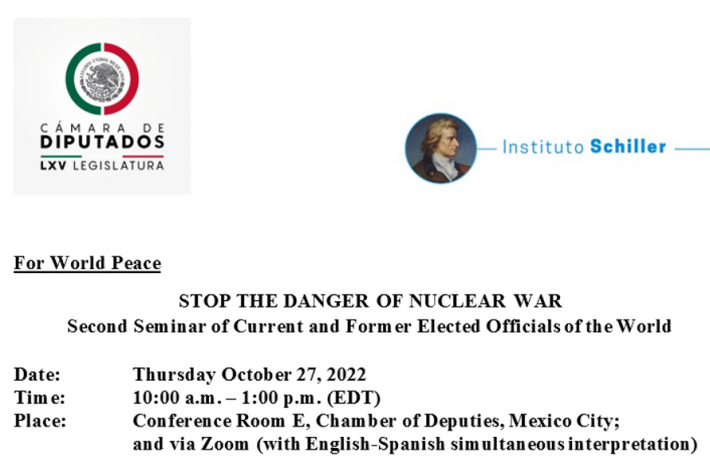
For World Peace

STOP THE DANGER OF NUCLEAR WAR

 Second Seminar of Current and Former Elected Officials of the World

Date: Thursday October 27, 2022

Time: 10:00 a.m. – 1:00 p.m. (EDT)

Place: Conference Room E, Chamber of Deputies, Mexico City; and via Zoom (with English-Spanish simultaneous interpretation)

Eight months into the war between Russia and Ukraine, with the active role of the United States and NATO, there are many dead and wounded, great destruction of all sorts of property, and very damaging economic and social consequences in Europe and the whole world, creating shocks which are worsening the very profound problems of the world economy, with consequences of a worsening crisis and greater unemployment, poverty and hunger.

It is known that this war can have far more serious consequences than what we are already suffering, including massive destruction and a crisis of global proportions never before seen, because it can lead to a confrontation with nuclear weapons between Russia and the United States and NATO.

Among the growing voices calling for a sensible approach, we highlight that of Pope Francis, calling for a negotiated, peaceful solution.

The undersigned political and social leaders, current and former legislators, and other elected officials from various countries, urge Russia, Ukraine, the United States and NATO to reach an agreement which, first of all, rejects the growing loose talk about the possible use of nuclear weapons and reaffirms the fundamental commitment of the Reagan-Gorbachev Formula of 1985, that “a nuclear war cannot be won and must never be fought.” To be lasting, such an agreement must also establish a new international security architecture that recognizes and respects the legitimate security interests of all the planet’s nations.

We recognize and emphasize that Russia, like the United States, NATO, Ukraine and all countries, has legitimate security concerns which must be taken into account and become one of the cornerstones of the new security architecture. A return to the successful principles of the 1648 Peace of Westphalia – respect for sovereignty, commitment to the good of the other, and forgiveness of debts that make true economic development impossible – is the kind of architecture we seek today.

The common good of the One Humanity is the obligatory premise for the good of each and every nation. In that way, among all the nations of the world we will be able to help build an organization of citizens in collective global action, and establish ourselves that way as a force to influence the international policy debate.

We call on people of good will around the world – notwithstanding our diverse and natural differences – to participate in this process of deliberation and search for peaceful solutions, including a thorough examination of the alternative economic policies to replace speculation, which has generated so much poverty and suffering, with a system of production and progress to meet the needs of a growing world population.

We reject all attempts to limit, intimidate, or prohibit such a deliberative process. And we call on the United States, NATO, Ukraine and Russia to advance in the direction that we present in this respectful call.

SIGNATURES:

  1. Donald Ramotar (Guyana); former President (2011-2015), former member of parliament (1992-2011, PPP)

2. Helga Zepp-LaRouche (Germany); founder, Schiller Institute

3. Jorge Robledo (Colombia); former Senator (2002-2022, Partido Dignidad)

4. María de los Ángeles Huerta (Mexico); former Congresswoman (2018-2021, MORENA)

5. Dr. Kirk Meighoo (Trinidad & Tobago); former independent Senator (2004, United National Congress)

6. Dr. Rodolfo Ondarza (Mexico); former Representative, Mexico City Legislative Assembly (2015-2018, PT)

7. Diane Sare (U.S.); candidate for the U.S. Senate from New York (2022, independent/LaRouche)


Page 5 of 55First...456...Last