Top Left Link Buttons

General updates

Category Archives

Brazil Media Covers the Schiller Institute Statement ‘President Alberto Fernández to China, Ibero-America to Mars’

Brazil’s Monitor Mercantil Covers the Schiller Institute Statement ‘President Alberto Fernández to China, Ibero-America to Mars’

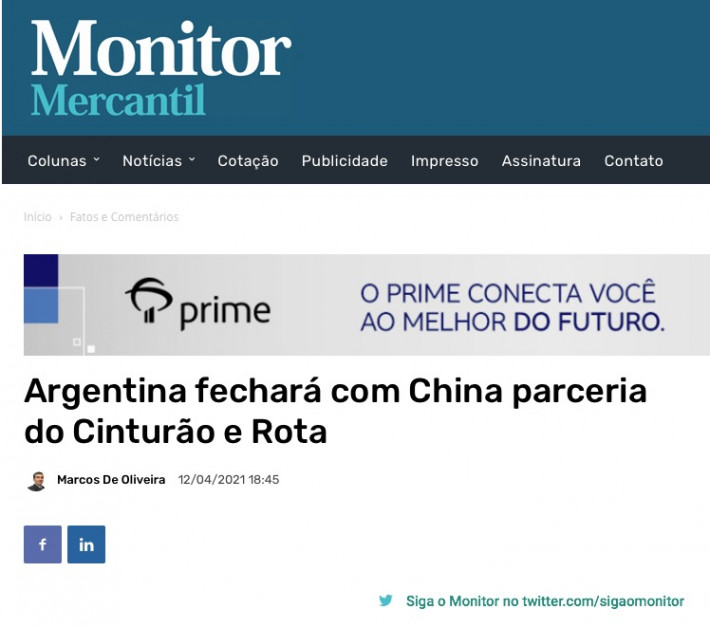
April 13, 2021 (EIRNS)—Brazil’s Monitor Mercantil, a political analysis daily widely read in leading circles in that country, yesterday published a short article headlined: “Argentina Will Sign a Belt and Road Partnership with China.” It reads:

“Argentine President Alberto Fernández will visit China in May with a mission which is fundamental for Latin America: he will sign a Memorandum of Understanding on the Belt and Road Initiative (BRI). This is a global infrastructure project involving nearly 150 nations, which breaks out of the merely financial economy sponsored by London and Wall Street, in favor of a high-tech, science-driver approach to development.

“For Latin Americans, it is an opportunity to develop partnerships in the areas of technology and infrastructure. The Chinese have for some time shown an interest in rail projects in the region. What is important for us is to make the investments conditional on transfer of technology and development, so that Latin America doesn’t remain a mere exporter of raw materials, as in colonial times.

“‘Such development is the way—the only way—to stop the drug trade, stop desperate migration, stop the gangs, stop the poverty, and stop the pandemic,’ according to a document issued by the Schiller Institute. The Germany-based group views cooperation between Argentina and Mexico as a lever to attract international support to address the entire region. “Meanwhile, Brazil continues on poor terms with China and is leaving the BRICS aside. It is precisely from 3 of the 5 countries that make up that bloc (Russia, India and China) that the vaccines come that could pull our country out of the health and economic quagmire in which it is sunk.”  The coverage can be found at this link.


Dominican Friend of the Schiller Institute Proposes Emergency Measures for Haiti

Oct. 18 (EIRNS)–A Dominican friend of the Schiller Institute who has been discussing the plan for reconstruction and development of Haiti, made a number of specific proposals on emergency measures he feels should be taken right away, in the context of the broader strategic program to transform the nation. While he took issue with the Institute’s proposal to solve Haiti’s vast energy deficit with nuclear energy, and only addressed the security situation in a general way, his proposals overall are serious and excellent. He emphasizes the Dominican Republic’s crucial role in developing Haiti and the whole island of Hispaniola. He writes:

“I want to make a couple of comments regarding the program to develop and save Haiti as well as my own country, because we are inextricably linked to the same consequences as this is one island and neither of our nations can relocate ourselves. I think that the program should be divided into two main parts:

1) A comprehensive emergency program to mitigate hunger, disease, uncertainty and the dissolution of the country. This would include:

–massive and sustained distribution of cooked, canned or fresh foods—cooked on the spot on stoves on trucks (many of these are already used in my country in disaster zones).

— set up mobile clinics on trucks that can reach poor neighborhoods in the cities or countryside;

—set up mobile schools, transported by truck, for basic education that can be located in rented locales;

—provide facilities, funding, tractors, consulting, etc., to small farmers who produce food, as well as to cattle ranchers and poultry farmers who raise cattle, pigs, chickens and eggs either at home or on farms;

–provide specialized machinery and personnel to build basic access routes, indispensable neighborhood roads or trunk routes, and small bridges

–provide large quantities of construction material to build low-cost houses, preferably prefabricated, and furnish them with household goods;

–build mobile government offices that would be used primarily for dealing with civil matters;

— identify sources of water to be made potable through chemical processes and osmotic filtration (in which I am a specialist).

–provide large quantities of clothing, shoes, sheets, mattresses, folding beds, mosquito netting and insect repellent;

–massive distribution of vitamins, minerals, painkillers, medicines to treat parasites and diarrhea, mobile laboratories for basic analyses of fluids, and dental clinics;

2) A strategic program like [the Schiller Institute’s Haiti program,] with which I fundamentally agree. We have to see how a mechanism for directing the process can be created without interference—so that everything can be monitored and be above board, because the whole [Haitian] government is illegitimate, and no one knows for sure what its plans are nor to whom it really answers. As I mentioned, the Dominican Republic can play a crucial role in the carrying out of any plan, as we’ve already done this [before] without international aid.


China Launches Core Module of its Space Station

April 29, 2021 (EIRNS)–With the successful launch today of the Tianhe core module of its space station, China begins to carry out the third phase of its manned space program. That series of missions was a 30-year program, culminating in the operation of an Earth-orbiting space station in 2020.

The first phase had the goal of demonstrating that manned space flight was safe. That was accomplished in 2003.The second phase, which lasted from then until now, demonstrated many of the technologies needed for long-duration spaceflight, such as extravehicular activity and refueling.

The space station will be under construction, requiring eleven launches of spacecraft. These include Shenzhou launches with crews and cargo deliveries. Mid- to late-May the Tianzhou-2 cargo spacecraft is scheduled to dock with Tianhe, after which three astronauts in the Shenzhou-12 mission will arrive at the station in June. As a first, the space station will carry out nine experiments from 17 countries. And China has worked very closely with the United Nations to provide experiments which are for developing countries.


UN Aid Conference Insists, Act Now, or Afghanistan “Will Truly Enter the Abyss”

Sept. 14, 2021 (EIRNS)—The Sept. 13, United Nations conference in Geneva on aid to Afghanistan succeeded in raising $1.1 billion, beyond the original target of $606 million. But given the dramatic reports by speakers on the dire humanitarian crisis and the urgent need for food and medicine to avert imminent starvation of tens of millions of people, the $1.1 billion won’t suffice. The situation is so fragile that 1 million children are at immediate risk of starvation if their immediate needs are not met, the New York Times reported Sept. 13. “At least 10 million children depend on humanitarian aid just to survive,” UNICEF’s executive director Henrietta H. Fore told the Times*. The World Food Program (WFP) estimates that 40% of Afghanistan’s crop has been lost this year, and the prices of basic food items are soaring. The Food and Agriculture Organization (FAO) is taking steps to help farmers so that they don’t miss the upcoming winter wheat planting season, and to keep life-sustaining farm animals alive, but the situation has been complicated by a severe drought. Over half of an average Afghan’s daily caloric intake comes from wheat, most of which is domestically grown, FAO director general Qu Dongyu, told the meeting.

World Food Program director David Beasley starkly warned that “14 million people—1 in 3—are marching to the brink of starvation…. On top of that, you have 14 million people in IPC2”—a category of acute food insecurity—“that are knocking on the same door, so if we’re not very careful, we could truly enter the abyss and see catastrophic conditions, worse than what we see now.” WFP estimates that 40% of Afghanistan’s crops have been lost for this year; the price of wheat rose by 25%, and the price of flour has doubled at local markets. Beasley stressed that a major concern is that 4 million people live in hard-to-reach areas, for whom, if food isn’t prepositioned before winter, “we will face a catastrophe. The time is now. We can’t wait six months. We need the funds immediately so we can move the supplies.”

Like other speakers, Beasley also warned, “if we’re not careful, and we’re not strategic, we could face mass migration, destabilization in the region, and for certain starvation for millions of Afghan people.” Beasley’s full remarks can be found here.

Making the same point, Gennady Gatilov, Russia’s permanent representative to the Geneva UN office, stressed that “Kabul’s traditional Western sponsors must provide active help to the country’s population to reduce or stop migration flows,” according to TASS.


Former British Foreign Sec. Proposes Global Fascist System To Enforce Anti-CO2 Measures

April 29, 2021 (EIRNS)–In an article in the inaugural issue of a new British journal called Environmental Affairs, former UK foreign minister William Hague proposes that British armed forces could be deployed, not to secure supplies of raw materials for the British Isles, as happened in the past, but rather to prevent them from being used by anybody. “In the past, the UK has been willing to use all of our firepower, both military and diplomatic, to secure and extract fossil fuels,” Hague wrote. “But in the future, the UK will need to use all of its diplomatic capacity to ensure that these resources are not used and that natural environments are protected.”

“This could result in uncomfortable situations where the need to coordinate international action on climate change runs against our other foreign policy priorities.”

Hague’s comments on resources made headlines in publications such as the Daily Mail, and it actually constitutes a blueprint for a global fascist system to enforce the shutdown of productive economic activities through such measures as sanctioning deforestation in other countries, international taxation of “specific high carbon products,” and mandatory labelling schemes for products “with risks of high environmental damage, such as food and clothing…”

Hague frankly admits that the shift to a “net zero” carbon emissions economy will result in greater global instability, not less. Aside from the obvious hardships that will be visited on many countries–he names Nigeria and Libya as two obvious examples–the transition will also sharpen “strategic competition” among the major blocs, particularly in the Arctic. But instead of Russia being the major strategic competitor in his context, it is China that worries Hague the most. The UK must cooperate with China on climate change even if it strongly disagrees with China on other matters. At the same time, the UK must wean itself from dependence on China for green technologies and the raw materials they require, such as cobalt. At the same time, the UK must remain aligned with the US on its geopolitical policies.


Andrei Kortunov Warns Afghanistan Is on “Life Support;” No Time for Delay!

Sept. 14, 2021 (EIRNS)—In an interview with TASS published Sept. 13, Director General of the Russian International Affairs Council Andrey Kortunov warned that, due to both U.S. and UN sanctions, Afghanistan faces the threat of famine. The country is now “on life support,” he said, because it depends entirely on assistance from international development institutes, the UN, the EU, and the U.S. In fact, David Beasley, director of the World Food Program, reported during yesterday’s UN conference in Geneva on aid to Afghanistan that 40% of its GDP comes from foreign aid, and 75% of its public spending from international funding. Kortunov admonished that, if the Taliban coming to power means there will be more sanctions placed on the country, it could jeopardize food deliveries. He told TASS that it will take an estimated $1 billion a month, minimally, to maintain basic social institutions and avoid hunger in certain regions—that is, $12 billion yearly.

Kortunov also highlighted the issue of who will control distribution of humanitarian and food assistance to Afghanistan. Take the case of Syria, he said, where the West claims that President Bashar al-Assad can’t be trusted to handle this task, so it’s left in the hands of international agencies and aid groups. “It is not to be ruled out that the same position will be taken in respect of the Taliban,” Kortunov said, explaining it would lead to a situation where the international community “will be ready to provide food assistance but on the condition that unimpeded access will be granted to the areas in need,” and the Taliban excluded from any decision-making as to whom aid should be delivered. In the Syrian case, Western arguments are simply a pretext for curtailing Syrian sovereignty under the guise of “humanitarian” protection. How this plays out in Afghanistan—a more complex situation—remains to be seen. The TASS article can be found here.


Lyle Goldstein Asks “Uncomfortable Question:” Why Is the U.S. Threatening Nuclear Russia on So Many Fronts?

Lyle Goldstein Asks an “Uncomfortable Question:” Why Is the U.S. Threatening Nuclear Russia on So Many Fronts?

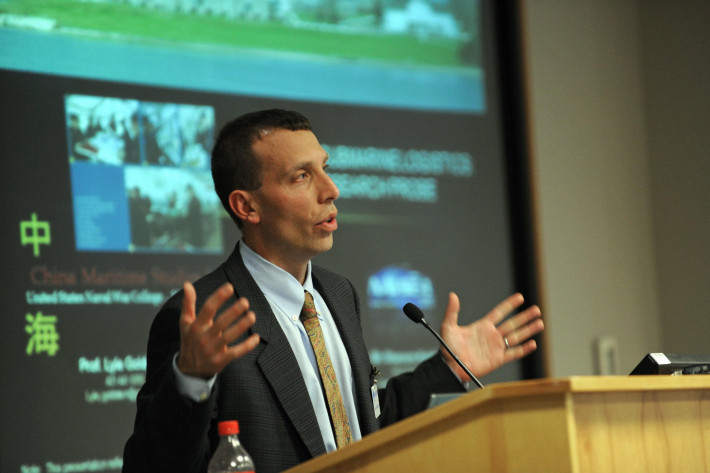
April 28 (EIRNS)–U.S. Naval War College analyst Lyle J. Goldstein again today sounded an alarm over the insanity of the United States treating fellow nuclear powers China and Russia as adversaries. Under the title, “Parsing Putin’s Red Lines,” Goldstein warns in an article posted on the American Committee for U.S.- Russia Accord blog, that people have failed to register the full import of Vladimir Putin’s warning last week to the United States and others not to cross Russia’s red lines, and specifically Putin’s own emphasis on the fact that Russia “will determine ourselves where these red lines are according to the circumstances of each situation.”

Goldstein wrote in his personal capacity, as a qualified military strategist:

“When it comes to fully bulked up nuclear powers like China and particularly Russia, the issue is absolutely grave, since we are talking about countries that can `end’ the U.S., perhaps in a matter of hours, even if we have the solace that we would take our adversary down in flames with us….

“Americans should ask the uncomfortable question: why do the U.S. and its allies appear to be encroaching upon so many different Russian red lines in so many `situations’ simultaneously? Indeed, Russian interests are now directly engaged against U.S. interests, or those of our allies, in a zero-sum pattern on a vast front stretching from the Arctic, to the Baltic, through Belarus to the Donbass and Crimea, and all the way down to the Caucasus and beyond.

“A common sense notion of peace, and indeed survival, for the 21st century must incorporate limits and crucially the principles of realism and restraint. We should not be touching the red lines of other major, nuclear armed powers on a daily basis. The fact that Western strategists seek to probe Russia’s red lines in Eastern Europe is itself a powerful indictment of U.S. foreign policy since the end of the Cold War….

“We must learn to live amicably with Russia or risk a continuing succession of showdowns on the pattern of the Cuban Missile Crisis– this time on Russia’s doorstep, with a Kremlin that has an infinitely more capable nuclear arsenal when compared to the early 1960s. In that unfortunate case, we may again be taught some lessons about red lines.”


General Milley Confesses — Do You Still Doubt There Was a Coup Underway Against Trump?

The book “Peril”, authored by Woodward and Costa, raises disturbing questions about the role of U.S. military leadership in sabotaging President Trump’s efforts — and now those of President Biden — to end the “endless wars.”  The same U.S.-British military-intelligence-corporate networks behind the 9/11 terror attacks, and the subsequent coverup, ran the attempted regime change coup called Russiagate, and continue to oppose replacing geopolitical confrontations and wars with peaceful cooperation.  It is now an urgent priority that citizens get behind the demand for a full investigation of the coup plots, and support the shift to a new era based on multilateral efforts to achieve peaceful economic development. 


Rosatom Launches `Atoms for Humanity’

April 28 (EIRNS) — According to Nuclear Engineering International, this “global nuclear awareness” initiative by Rosatom will be launched April 30. The theme is that modern nuclear technology is clean and reliable, but is much more than green electricity. It is a versatile tool to solve the most urgent challenges.

“Rosatom believes that it is high time to put a human at the center of nuclear debate. The Atoms for Humanity is a unique collection of stories capturing ordinary people from all over the world sharing how nuclear transforms their lives and helps fulfil dreams, both big and small,” the agency said in a release.

The project launch event, “Why Humanity Needs Nuclear”, will take place on 30 April. Kirsty Gogan, an internationally sought-after expert with over 15 years in advising the government on climate and energy, will host the discussion. Other speakers include Rosatom and World Nuclear Association executives, environmental experts, and “heroes of Atoms for Humanity documentaries”.


As War Hawks Press for New Wars, Addressing the War Danger More Urgent Than Ever

The moment of opportunity opened by the end of the war in Afghanistan, for multilateral cooperation for economic development, could close very quickly.  A False Flag event, occurring in the midst of almost daily military encounters by U.S.-NATO forces with Russian and Chinese military forces, could lead to a devastating war, either by miscalculation, or intent!  Dialogue is essential, as Gen. John Hyten, Vice-Chair of the U.S. Joint Chiefs of Staff, expressed in a speech two days ago.We also present a preliminary report on the smashing defeat of the California Recall.  Lyndon LaRouche famously warned, in 2003, that Recall is dangerous, as it is designed to manipulate momentary emotions, to undermine the American Presidential System, and replace it with a parliamentary system.


Page 42 of 104First...414243...Last