Top Left Link Buttons

Locations of our activity

Category Archives

Manhattan Conference: Building A World Land-Bridge—Realizing Mankind’s True Humanity, April 7th


Panel I


Thursday’s Schiller Institute Conference in New York City, “Building a World Land-Bridge—Realizing Mankind’s True Humanity,” marked a success for Lyndon LaRouche’s idea. Although further and fuller reports will follow, and this one only reflects a part of the proceedings, that much can already be said with certainty.

Helga Zepp-LaRouche opened the conference with a comprehensive and inspiring address entitled, “Beyond Geopolitics and Polarity: A Future for the Human Species,” in which she laid bare the immediate threat of annihilating war, and showed that the idea of the World Land-Bridge, which she developed with her husband during the period of the collapse of the Warsaw Pact, provides the only durable guarantee for peace. She went on to outline a dialog of civilizations in which each of the world’s civilizations is represented by the cultural high-points of its history, such as Germany’s Weimar Classic, and the United States as it was first conceived by Benjamin Franklin and Alexander Hamilton.

helga-IV-april-VII

Schiller Institute founder, Helga Zepp LaRouche giving the keynote address.

Transcript of Helga Zepp-LaRouche’s Keynote

DENNIS SPEED: So, on behalf of the Schiller Institute, my name is Dennis Speed. I want to welcome everybody here today. We have a greeting to the conference I’ll begin with, which is from the Chinese Chamber of Commerce of New York. It says: “Dear friends, On behalf of everyone at the Chinese Chamber of Commerce, I extend a warm greeting to all in attendance at the Schiller Institute conference. I truly believe the scientific triumphs of the past century, and the advancements in technology, were not through sheer luck or chance. Rather I believe it is the collective efforts of our species as a whole that allow us to grow and prosper beyond what we could ever accomplish as individuals. Only through cooperation between all nations can we all achieve a greater goal. The conference of the New Silk Road Becomes the World Land-Bridge will discuss issues including the designs for the development of Southwest Asia, as well as a path for United States recovery. We sincerely wish the conference will be very successful, and the attendees have a wonderful stay in New York City. Sincerely, Justin Yue, Chairman of the Chinese Chamber of Commerce in New York City.”

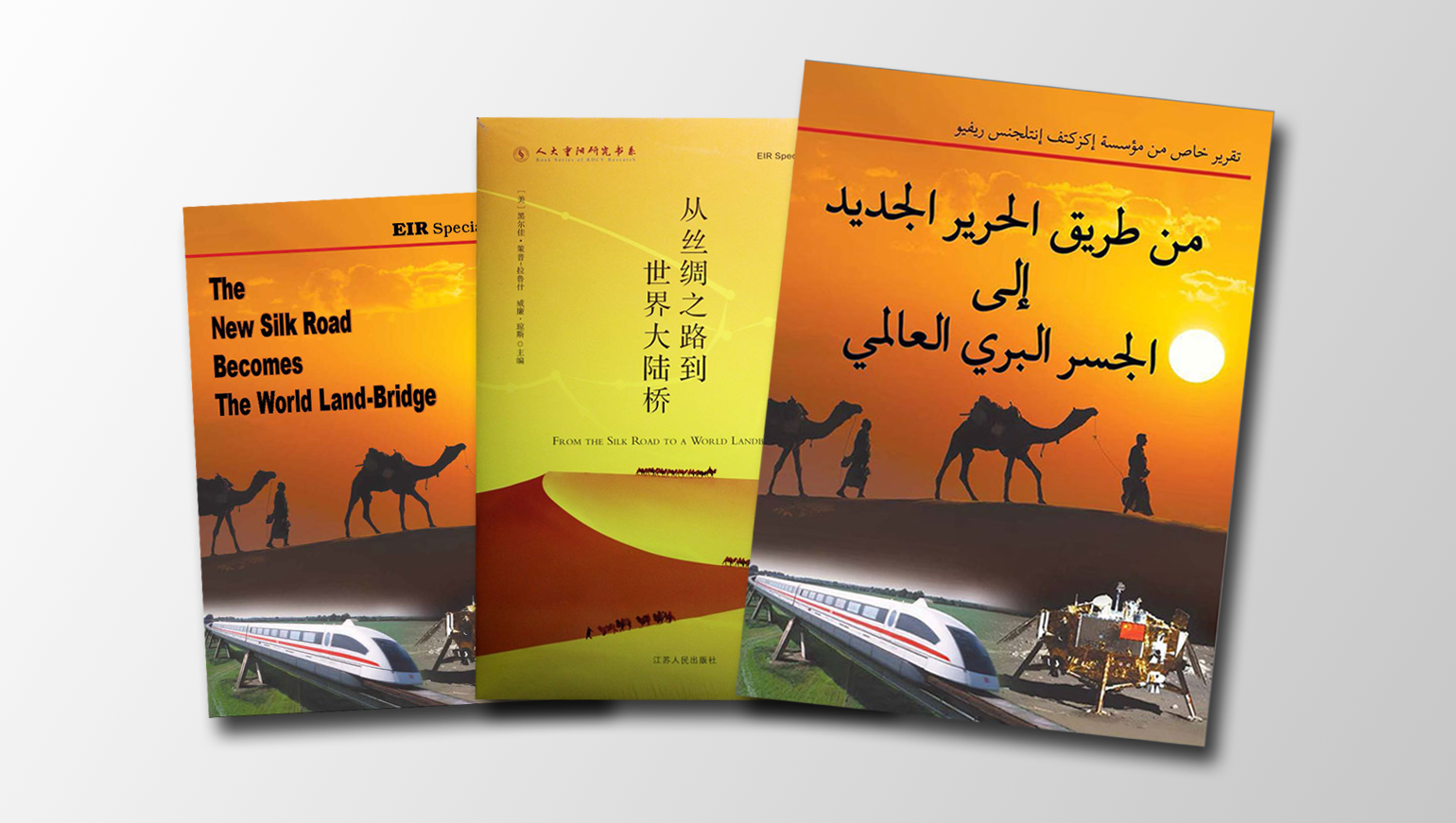
I just want to say a couple of things in welcome. Of course, what’s referred to in the statement in specific is “The New Silk Road Becomes the World Land-Bridge,” the report that was done at the end of 2014 by the Schiller Institute [sic], and I think everybody has our program so you have the list of our speakers. I just want to say the following in setting us off:

You know, New York City was founded by Alexander Hamilton and George Washington. I’m not talking about the chronological founding, but the fact that as an American city, it was founded on the principle of a single unified government. Hamilton’s role with George Washington in the first American Presidency, was a revolutionary one, which was more important than the victory on the battlefields of Trenton, Saratoga, and Yorktown. His four documents on the National Bank, the Constitutionality of the National Bank, the nature of credit, and the nature of manufactures are the basis for the real United States. It is that real United States that the Schiller Institute seeks to place back on the world stage in collaboration with, particularly, the nations of Brazil, Russia, India, China, and South Africa, in the pursuit of the policy called the World Land-Bridge.

The danger of warfare which now lurks and pulsates from a collapsed trans-Atlantic system is what brings us here today, in part, and the Schiller Institute has been doing conferences in Egypt, has spoken at conferences in Russia and India, and many other locations, in the past weeks, and in that light, and in that context, I’d like to go directly to introduce the person who has campaigned tirelessly for this policy. Together with her husband, Lyndon LaRouche, back in 1989, the glimmer of this policy was first enunciated as the Eurasian Land-Bridge, shortly after the fall of the Berlin Wall. In 1996, in June, a conference was held in Beijing, which put the idea of the New Silk Road on the map, and at that conference, the founder of our organization spoke, and that conference basically precipitated what then became known as the Shanghai Cooperation Organization. Many other things occurred. And now, on this stage, we are at the point where if our keynote speaker is listened to, there’s a world that can be made, can be created, of cooperation, and not destruction.

It’s always my honor and pleasure to introduce the chairman and founder of the Schiller Institute, Helga Zepp-LaRouche.

HELGA ZEPP-LAROUCHE: Well, dear guests and friends of the Schiller Institute, this conference is taking place at a very serious moment, and it has no lesser goal than that which has been defined by my husband Lyndon LaRouche with the Manhattan Project: that we have to turn the United States back to its founding principles. We have to get the United States away from its present imperial orientation, and the idea that it must pursue an unipolar world, and turn it back to the identity of a republic, as the Founding Fathers and the Constitution designed it.

This goal is something which almost the whole world thinks is impossible. I can assure you that, outside of the United States, the thinking people think the United States is hopeless, and I can assure you that that is a very common feeling. Many people don’t travel to the United States any more because they think it has become a place of horror. Yet, achieving this goal, to turn the United States back into a republic, is going to determine, in all likelihood, the fate of the entire human species.

There is right now an absolutely eerie tension in the air, because many people who don’t always say it, but know it—that we are right now closer to World War III than even at the height of the Cuban Missile Crisis. This has been stated by military analysts and nevertheless, there is no peace movement. There is nobody in the street talking about the fact that we are close to World War III. In the ’80s you had hundreds of thousands of people marching in the streets of Germany against the SS-60 and the Pershing 2. Today, where the situation is more dangerous, and experts have described that if there would be an incident, the warning time to launch general thermonuclear war would be 3 to 6 minutes.

So, only a few people are speaking that, while the vast majority of citizens in the United States and Europe is marching like lemmings towards the cliff.

I want to highlight a case of 78 year old pensioner, a retired teacher from the German city of Kaiserslautern, who, two days ago, was just denied his suit in the third level of the Federal administrative court in Leipzig, where he tried for the third time to sue the German government for allowing the United States to use the air base in Ramstein for a relay system of the drones, without which the drones could not be sent to the Middle East and elsewhere. [He said] that this would be against the German constitution, which does not allow Germany to ever again launch a war of aggression, or help other countries to do so. The judges ruled again that matters of international law can only be taken up by states, and not by individuals, but this pensioner of 78 years old, is planning to take this to the highest Constitutional court in Karlsrühe.

One is almost reminded of the story in the Old Testament where God was about to punish Sodom and Gomorrah for their sinful behavior, and was then convinced that if there would be only ten just men, the punishment would not be carried out. And I must ask: Are there ten honest men to stand up today?

Before I come to the solution, how we get out of this crisis, let me look at the very dire strategic situation. We are now having 12 days of joint military drills involving the United States and the Philippines, Australia, and Japan. The exercise is called Shoulder to Shoulder, and for the first time ever, the U.S. Defense Secretary Ash Carter will go there to be on the place [on site] next week. Now yesterday, Ash Carter said that the enemies of the United States are first, Russia; second, China; third, Iran; fourth, North Korea, and fifth—oh yeah, there was terrorism.

Parallel, you have the largest ever U.S.-South Korean military exercises until late April, also involving many troops, and the Philippine exercise includes an amphibious landing exercise to simulate taking one of the disputed islands in the South China Sea. The Philippine military also is sending a U.S. high-mobility artillery rocket system designed to shoot down aircraft. And basically it’s the first time that these exercises include Australia and Japan, in the effort to build a quadrilateral military counter alliance to China.

Now other things are taking place in the region. Two weeks ago, the Philippines allowed the United States to have access to five of its bases near the disputed waters in the South China sea, and they renewed the Enhanced Defense Cooperation Agreement. Now this is against the Philippine constitution, but they bypassed it by allowing the U.S. troops within Philippine bases, so that the Constitution would not apply. Now also Japan has a new national security law, which went into effect last Tuesday, where the national Diet passed a new security bill breaking away from the pacifist constitution of Japan, in order to enhance the alliance with the United States, and with it, the power to exercise the right for collective self-defense.

Now, the whole world watches: Does that mean that Japan is going to go back to its military past?

There is a tendency in Japan right now, to move into alliances with other claimants of the contested territories [in the South China Sea] to contain Beijing.

Now where is all of this leading? China’s position concerning the waters are written in what they call the Nine Dash Line in the South China Sea, and China claims that these are territories which historically belong to China, including the right to reclaim land and build bases on the Spratly Islands. China also says—and that is true—that this does represent a violation of the freedom to the seas, but it will just improve the living conditions of the people living there, give better ways to protect against pirates, and it does not hinder the passage of other ships.

Now the Philippines in 2013 filed a case in the International Court in the Hague, insisting on its right to exploit the South China Sea waters in its 100 nautical mile exclusive economic zone, as defined in the UN Convention on the Law of the Sea. China did not accept to be in this case, which is their perfect right, but is questioning the legitimacy of the case. The court should have at that point abandoned the case, but they accepted it, and the ruling is expected for the end of April/beginning of May.  The Chinese Defense Ministry said that they have the absolute right to then declare an Air Defense Identification Zone.

Now at the Nuclear Summit in Washington, which just took place, President Xi in a discussion with President Obama, told Obama that China would not accept any behavior in the guise of freedom of navigation, that violates its sovereignty in this region. One day later, exactly one day later, the United States announced a new patrol near the disputed islands in the South China Sea, and Navy officials announced that they plan to conduct more and increasingly complex exercises in the future. So the United States is playing a chicken game against China, increasing the tension over violations of opposite claims, in the forefront [in anticipation of] of the Hague ruling, to create an atmosphere that then, they hope, China would not dare to set up an ADIZ.

But China already said that it will defend its rights in the South China Sea. So the question is, could there be a war between the United States and China over some relatively worthless rocks and reefs in the ocean? Could it be that the United States goes to a war with China on the Philippines’ behalf?

Obviously the South China Sea is of geographical significance for China, but the interest of the United States is geopolitical, and it is the same reasoning as in the TPP, to affirm the right to set the rules in Asia. The United States insists that they will defend a unipolar world, that they are the only superpower, and that they will not allow any other nation to meddle in that. The claim that Russia is only a regional power, which Obama did, is very absurd given the fact that Russia has a nuclear arsenal which is a complete strategic match to that of the United States. And Putin just demonstrated very brilliantly a military flank in Syria against ISIS, that Russia is absolutely needed if you want to have political solutions. Russia played a positive role in the P5+1 negotiations with Iran, and is now helping to end, and making possible, the end of the war in Syria.

There are many leaders in the world who have said, without Russia, you cannot solve existential problems, like terrorism, ISIS, the refugee crisis in Europe. And one should also be reminded that these territorial disputes in the South China Sea are the result of the imperial intention dating back to the Versailles Treaty and the Paris Peace Conference in the aftermath of that in 1919, whereby the former German colonies in the Pacific Islands north and south of the Equator, were given in part to Japan, which at that time caused a tremendous feeling of injustice in China, leading to the May 4th movement. And all the people in China thought the Versailles Treaty was a complete fraud, and as we know from European history, it laid the seeds for World War II.

Now the same game was repeated in the San Francisco Peace Conference after the Second World War, where John Foster Dulles arranged for China to be excluded, despite the fact that China has the highest casualty rate in Asia against the Japanese, and fought the longest. But the Western powers drew the map in Eastern Asia without China, and John Foster Dulles deliberately declared certain Asian frontier territories without owners, an old imperial trick to manipulate then future conflicts, as was the case with the Sykes-Picot Agreement for Southwest Asia, or the 1919 Trianon Treaty for the Balkans.

The fact is that the unipolar world has already ceased to exist. It is a fact that China is rising; the United States is losing its hegemony. China is already exporting much more technologies than the United States. It is educating far more scientists, engineers, and the word in the science community internationally is, if you want to get anything done in frontier science, the place to go is China.

So China, except for a couple of minor corrections in its stock market, is doing very, very well economically—and do not believe what the New York Times is trying to tell you every day. Because China has embarked in the policy of the New Silk Road, the Maritime Silk Road, the One Belt, One Road policy on huge infrastructure projects to connect all the countries of Eurasia through infrastructure development and high technology investments. It is so attractive that already 60 nations are cooperating with China. It has created, together with other BRICS countries, a completely alternative economic system—the AIIB, which has immediately  had 60 founding members, despite the United States making enormous pressure on everybody not to join it; the New Development Bank, which is already operating this year; The New Silk Road Fund and Maritime Silk Road Fund, and many other such institutions.  There is a tremendous attractiveness of this program of a New Silk Road in the spirit of the ancient Silk Road in all of Asia, who are now all talking about increasing Asian connectivity.

The investments of these new banks are going exactly into the areas which were denied for decades by the IMF and the World Bank—namely, in infrastructure—and all of these countries are thirsty and hungry for exactly these kinds of developments. Many countries have recently expressed interest in becoming transport hubs for the New Silk Road and the Maritime Silk Road. Indonesia wants to become a hub. Sri Lanka, Afghanistan, Iran. The New Silk Road is moving very, very rapidly in all of Eastern Europe. Just now, when President Xi Jinping was in Prague on a state visit to the Czech Republic, President Zeman praised the New Silk Road and emphasized the role of Prague, the golden city, to be the gateway between Europe and China. The 16+1 countries just met in Riga, and they also—these are the 16 East European and Central European countries—all want to be connected to the One Belt, One Road policy.

So this is moving very, very positively.

You contrast that with the trans-Atlantic sector, the too-big-to-fail banks, Wall Street and London, which are completely bankrupt, and we are in front of an immediate financial crash, much, much worse than what happened in 2008, where the entire two quadrillion outstanding derivatives could blow up any minute. Furthermore the so-called tools of the central banks no longer function. As a matter of fact, every time a central bank does something to correct the problem, it boomerangs and has the opposite effect, as in the case of the Bank of Japan, Norway, or the ECB. When they go to zero interest rates, or even negative interest rates, it furthers the deflationary collapse instead of stimulating the real economy.

Now how desperate the situation in the trans-Atlantic system is you can see by the fact that the head of the European Central Bank Draghi is now talking about helicopter money. Now that is, if you remember, an invention of Ben Bernanke—the idea that in order to avoid a meltdown of the entire financial system, you just fly helicopters over cities, who throw down money, as much as is needed to prevent a meltdown. Now this obviously has caused a complete uproar in Germany, because people in Germany remember what the hyperinflation of 1923 was all about.

Then look at the condition of Europe. The refugee crisis, which is not being discussed much, but the reality is that it’s the result of the wars conducted mostly by the United States and the British in the Middle East, wars which were all based on lies. Iraq—no weapons of mass destruction. The war against Libya was initiated by a lie in the UN Security Council that it would not be a war. Look at Afghanistan: was September 11 really as it was presented? Look at the situation in Yemen and in many African states.

The refugee crisis, which is the biggest humanitarian crisis probably since the end of the Second World War—unbelievable fates of people—has revealed that there is no European Union, because there is no union. There is no unity. There is no solidarity. You have now a situation where children are stuck behind barbed wire, and police are shooting at them, trying to get the back. And then there was this absolutely shameful deal between the EU and Turkey, and Turkey—which, according to documents just delivered to the UN Security Council, is still supporting ISIS.

In Germany politicians are saying, oh, now we have fewer refugees. Yeah, but at what price. They’re being deported on a grand scale from intern camps in Greece, and it is a complete disgrace. Even the UN Human Rights Commission said this is a complete violation of human rights. It violates the Geneva convention on refugees, and all the aid organizations have already left their jobs, because they say, under these conditions they cannot do it. For example, the Doctors without Borders, and many others.

So the world is clearly in a complete mess and disintegration condition, and what is the answer of the leading institutions of the trans-Atlantic sector? Well, they pulled just now a big rabbit out of the hat called the Panama Papers. Now, one year ago, an anonymous source—which is always dubious—gave to theSüddeutsche Zeitung 11.5 million documents, which contained forty years of data concerning the firm in Panama called Mossack Fonseca, which specializes in letterbox firms for the purpose of tax evasion. Now then the International Consortium of Investigative Journalists deployed for one year 400 reporters in 80 countries, financed by whom? By George Soros. And then targeting politicians and industry leaders and sportsmen and others.

Immediately, naturally, the focus was on Putin, even though his name is nowhere to be found in these documents, and Xi Jinping. The New York Times did not waste a day since the beginning [inaudible 27:00] this of  Xi Jinping.

Now, let’s look at this operation: What is this? Jürgen Mossack, one of the founders, his father was a member of the Hitler Waffen SS; Ramón Fonseca Mora, the other guy, was the ex-president of the Panameñista Party, a party founded by the open Hitler supporter Arnulfo Arias Madrid; and the son was actively involved in the overthrow of General Noriega. Now the old Mossack was a member of the Nazi Waffen SS, and then offered his services after the war, to the U.S. government as an informant. Now that is entirely the profile of the Dulles brothers’ famous rat line, by which they transported Nazis from Germany via the so-called rat line, to South America, to deploy them there for other purposes.

The focus on Xi Jinping is obviously especially ridiculous, because if there is one political leader in the world who is conducting an anti-corruption campaign in a completely ruthless fashion, then it is him. So, what is the purpose of this? Obviously, it’s part of the present trans-Atlantic hybrid warfare against Russia and China, with the aim to have regime change, by a variety of means: by color revolutions, by NGOs which are financed from foundations which are probably in this tax-exempt scheme; sanctions, and now the Panama Papers with the obvious hope to steer an uproar among their own populations.  And it almost worked in the case of the Icelandic President, where now people are in front of the residence of President Olafur Grimsson, but the m.o. of this is really not a new one. The way this has been functioning for a very long time is, you use certain assets owned by the governments, or secret services, and allow criminal operations and behavior to go on for a very long time. And then, at a convenient moment, you blow it up, and you cause a shake-up.

Now this was done very efficiently in the 1990s in Italy, with an operation called “Clean Hands” where you had a national juridical investigation into political corruption.  And then they blew it all up, and it caused the end of the so-called First Republic of Italy, because all the parties got involved.  And anybody who ever travelled to Italy knows, that the entire postwar system of Italy was based on a principle called “amici di amici.” You may not approve of it, but that’s what it was, that you couldn’t get a job done without some kickback, public works would always have some bribes, and the whole operation was called Tagentopoli, or in English, “Bribesville,” meaning these kickbacks for public works.  It Italy, at that time, it involved 5,000 public figures; half of the Italian parliament; more than 400 city and town councils were dissolved, and the annual bribe rate in the ’90s was estimated to be $4 billion.

Now, Bloomberg recently reported that the Brazilian “anti-corruption” campaign against Dilma Rousseff, one of the BRICS leaders, is based on the Italian model.  It is called “Operation Carwash.”

So what they do, is they operate by a system of plea bargains, turn mafia bosses into snitches, and that way, you can roll up the whole political system.  Now what comes out there is very interesting, because it reveals the total criminal character, of the entire trans-Atlantic financial system.  In the case of Mossack Fonseca, which is only the fourth largest of such firms, so one has to assume that there are many, many more such cases, it turns out that the HongShang bank [Honkong and Shanghai Banking Corp., HSBC] is responsible for 20% of these letterbox firms, and then comes UBS (Union Bank of Switzerland), Crédit Suisse; almost all the German banks are involved.

So what do you do when you have such a problem? The only solution to stop this, is, obviously, what Franklin D. Roosevelt did in 1933, when he declared Glass-Steagall with separation of the banks, by simply bankrupting the fraudulent parts and that is exactly what is required today:  That you need to separate the banks, protect the commercial banks, and close down the derivatives, the toxic waste paper; and then, you need a Pecora Commission to look into who committed what crime, and for what purpose.

Now, the funny thing is that when the British cabinet member [Chancellor of the Exchequer] Osborne was asked, what about the fact that the father of [Prime Minister] Cameron is also now a target in the Panama Papers, he said, “oh that is a private matter”!  You know, so it is quite amazing what nerve these people have.

So, the FDR solution for the United States.  Then, we need to put down all of these crises, and I think it is absolutely feasible, but one has to take the path as it was now demonstrated by the negotiations between Secretary of State Kerry and Foreign Minister of Russia Lavrov, in the case of Syria.  There has to be a political agreement.

But then, you need a huge development program.  You need to do exactly what President Xi Jinping offered when he was in Iran, namely, to extend the New Silk Road, the One Belt, One Road policy into the entire Middle East.  Because you will not stop terrorism by dropping more bombs!  If you launch more drones and drop more bombs, one every killed terrorist you will create 100 new ones who hate the West even more than before.

So this is no solution. Obviously, ISIS has to be fought, and has to be gotten rid of, but you need a development perspective for the entire region, from Afghanistan to the Middle East, to the Mediterranean, from the Caucasus to the Persian Gulf. And we need to have a war on the desert:  We have to have new, fresh water, which is eminently possible with peaceful nuclear energy and desalination of large amounts of ocean water. We need to build new cities, agriculture, industry, so that the people of Syria, and Iraq, and Afghanistan, and Yemen, and Tripoli in Libya, and many, many African countries, that they have a future!

Why can we not take the offer of Xi Jinping to enter into a “win-win” cooperation with the large neighbors of the Middle East, Russia, China, India, Iran, Egypt, and build up the Middle East in a Marshall Plan/New Silk Road fashion.  The only reason why I’m mentioning the Marshall Plan, is because it reminds people that you can rebuild war-torn regions with a crash program.  I know that China doesn’t want to use this word, because the Marshall Plan has such a Cold War connotation; but we need to have a New Silk Road perspective.

Now, the same goes obviously to settle the Ukraine crisis. You probably heard that yesterday, the Dutch people voted in a referendum against the EU Association Agreement for Ukraine. This is very, very good:  Because it means that this horrible EU is one step further to its dissolution, because if you remember, it was the EU Association Agreement which was supposed to be signed by Yanukovych in late 2013, in the summit in

that started the whole Ukraine crisis.  Because Yanukovych, in the last moment realized, that it would have totally have given the territory of Ukraine access for NATO; it would have totally made possible economic warfare against Russia, because of the border and the agreements between Ukraine and Russia.  So he did not sign it in the very last moment.  And then, you had the color revolution, the Maidan, all of these things develop.  And if you look at the chronology of these events, it was not Russia acquiring the Crimea; Russia in every single instance, reacted to a provocative action by NATO and by the EU, including a fascist coup in February 2014 [in Ukraine].

So if you want to solve this problem now? Well, this is now the idea moment, because the EU Association Agreement just detonated, and it cannot be implemented, even if only 32% of the Dutch people voted on it, there were 64% in favor, the government in Holland does not dare to go along with it, because there are many people in 70% who did not vote who don’t like the EU, because remember Holland and France were the only two countries who voted against the EU Constitution in 2005.

So the ferment against this dictatorship which the EU has become, is just too big, and the lament today in the European media about the failure of this agreement is just absolutely loud and noisy.

OK. Let’s use this situation, where, and if there’s one veto, this agreement cannot go through, let’s use it to say: “Stop the confrontation with Russia!”  Extend the European Union and the Eurasian Economic Union of Russia into one Eurasian area from the Atlantic to the Sea of China.  Let’s extend the Silk Road perspective, to include Ukraine and develop it!  Because Ukraine is economically absolutely finished!  The people are living a horrendous life, as the result of that happened in the last three years.

Let’s do the same thing for Africa.  Do people really think that we can sit there, and the 1% of the rich become richer and richer, by means which we now get a better window with the Panama Papers, and the majority of people lose everything.  The middle class become the poor, the poor have shortened lives; the gap between rich and poor worldwide is becoming bigger and bigger; and 1 billion people go hungry every day.

Klaus Schwab, the director of the Davos Economic Forum a couple of months ago said, that if the present trends do not change, it is expected that 1 billion people will come as refugees to Europe in the next years.  Well, if it comes to that, and you have the effort to use NATO and Frontex, military ships and fire at the refugees to try to deter them, what remains then of the “European values”? What about our humanism?  What about any value?

So why don’t we take the New Silk Road  and say “well, we have now a very attractive economic model which is already functioning already very well in 60 nations of the world, and let’s join hands, the United States, and Russia, and China, and European nations, and develop Africa.  This is the moment, where we have to have a grand vision, to change the plight of so many people.

Now, in Germany, there is one minister, the Development Minister Gerd Müller who traveled a lot in Southwest Asia and in Africa, and he is mentioning now, which is a big step forward, every time, “we need a Marshall Plan, we need to develop these countries, because otherwise, they will bring all their problems to Europe.”

And let’s convince Japan that it is not in their favor to be drawn into military adventures against China.  Japan is a country, very much like Germany which has almost no raw materials, and achieved a very high living standard because of high rates in science and technology, and exporting.  And for Japan, the natural export market is all of Asia, is Africa, and they should be part of such a new world economic system; and not go the way the Bank of Japan is now going to zero interest rates, negative interest rates, and plunging deeper and deeper into the deflation.

The United States:   Is the United States so much above the need for a New Silk Road?  I mean, if you travel through either roads from Washington to New York, or even on the roads in New York, I don’t understand why the citizens are not in an uprising against these roads!  I mean, they are so bad, that the roads at the end of G.D.R., East German before it collapsed, they were smooth compared to what you have here!  So, what the United States would obviously profit from is to join the New Silk Road, to build infrastructure!  China built 20,000 km of fast train system by the end of last year, and they plan to have 50,000 km by the year 2025 or 2030, in any case, a very short period of time.  And the United States has built how many kilometers or miles of fast train?  Zero!

So what we propose, is that the United States, rather than wasting its industrial capacity in an ever-growing military-industrial complex, trying to militarize the whole world, you can transform these industries and build fast trains, build maglev trains, or import the Chinese fast train system — which is excellent.  It’s smooth, it’s quick, it doesn’t shake at all, like the European fast trains.  So build 50,000 miles of fast train in the United States!  Fight the desert in the Southwest of the United States!  Build a couple of new cities, you know: large parts of the United States are completely undeveloped.  Basically, after Teddy Roosevelt, no new cities were built in the west.  Build some “smart cities,” modern cities based on modular systems, but make beautiful cities!  That would be a real challenge, to build beautiful cities, and not more Houstons.  [applause]

So, we have put this program on the table: The New Silk Road Becomes the World Land-Bridge.

And the reason why we have proposed a development for the entire world, is because also, multipolarity is not the answer to a unipolar world.  Because the idea that you have multipoles, that you have groups of nations which still maintain their interests against other groups of nations, still has the seed of geopolitics.  And geopolitics is what caused two world wars in the 20th century, and if we would come to a new world war, it would be the annihilation of all of mankind.  Because the idea that you have a limited war somewhere in the Pacific or somewhere in Europe, is complete bunk, and all the military experts we talked to, top-level military  in Europe, the United States and elsewhere, are convinced that it is the nature of the existence of thermonuclear weapons, that it would come to a general, global war, if you start a war somewhere.

What we need to have is the replacement of geopolitics through a new paradigm; a new paradigm which must be as different as was the Middle Ages separated from what is called “modern times.”  The Middle Ages being, scholasticism, superstition, Flagellants, people just going crazy, believing in Aristotle; and when the Renaissance happened with Nikolaus of Cusa and some of the great thinkers of the Italian Renaissance, they designed a completely new paradigm which defined the role of the individual in a completely different way; it established the sovereign nation-state devoted to the common good for the first time; it made scientific and artistic progress possible in ways absolutely unknown before.

And we need, today, a completely new paradigm.  If we cannot lift our thinking above the present, petty, so-called self-interest, so-called “national interest” or interest, really, of the big corporations and Wall Street, then we will not make it as a human species.  What we need is an image of man, which is man as the only creative species, in our knowledge so far.  In the Chinese Confucian philosophy, there is the word, or the notion of ren, which is almost the same thing as in Christian humanism, the word agapë, of love.  That you have to have love and harmonious relation with your family, your neighbor, your nation and the international community of nations.

Now, the human species has come a very long way in a very short period of time.  If you think about the last 10,000 years, we have produced quite a number of great minds:  Confucius, Plato, Mencius, Nikolaus of Cusa, Kepler, Leibniz, Bach, Schiller, Beethoven, Tagore, Vernadsky, Einstein, just to name a few; and that is how people should be.

Now, you say, “these are people who are so extraordinary, they only come one in a century”; but I don’t think so.  I think that if we go now for the kind of reform which we are talking about, and you would eliminate poverty, that no more child, and no more person on the entire planet would be deprived of his or her basic needs.  I think if you then give all the children of this planet a universal education, to give them access to the great discoveries of the past, that you teach them Classical art, that you give them the kind of morality which used to be associated with Christian humanism, or with Buddhism, or with Confucianism, or other great cultures of this planet, well, I think the elimination of hunger and poverty would do the best for human rights you can do!  Because being poor and being hungry does not allow you to exercise your human rights.

So if we go on the other road, and say, let’s have a plan of global development, let’s stop geopolitical wars, let’s join hands to work together, so that every child of the future can have a perspective to become a scientist, to become a teacher, an artist, to become basically an astronaut or some other beautiful thing developing the human mind. Then, I think what we need, is, we have to go back to our own high traditions of our own cultures.  The Americans have to become republicans again, like Benjamin Franklin, or the Founding Fathers, Alexander Hamilton, Lincoln, Roosevelt, Kennedy.  I think  in Germany, we need to go back to the German Classics.  In other nations, we have high points of culture, which we have to revive.

And then we have to relate to each other from the standpoint of the actual highest form of our culture, and relate to the highest form of the culture of the other nation.

And then we will have a human world.

I think we should not give up on the idea that mankind is human! And that is what we have to fight for right now.  So I think that, if we do that, and to speak in modern English, the “new normal” will be that every person will be a genius. [applause]


Helga was followed by former U.S. Attorney General (1966-67) Ramsey Clark, who wove his own long experience into an account of recent world history which underlined the alternative to the war policies of most of the post-Kennedy U.S. Administrations.

The next speaker was a truly unique figure from China, that nation’s leading professor of journalism and the leader of much else as well, Li Xiguang. Professor Li has led a decades-long pilgrimage on behalf of the Silk Road,—across Central Asia, and down each of the three North-South routes, and back again. He has led no fewer than 500 of his students on this pilgrimage with him since 1990, and has written two volumes on the New Silk Road. Although his goals for the Silk Road are not religious goals—they are the same as those of the LaRouche movement—Professor Li models himself on the great Chinese cultural heroes, the Buddhist monks Xuanzang (602-664) and his predecessor Faxian (337-422). Both made extensive and arduous trips along the Silk Road, and brought back the first real knowledge of much of world civilization to China, including most especially Sanskrit language and culture and Buddhist scriptures in the original.

Xuanzang spent no less than 16 years on this voyage, and returned with 600 Indian texts. In 646, at the Tang-Dynasty Emperor’s request, he completed his 12-volume work, “Great Tang Records on the Western Regions,” which has become one of the primary sources for the study of medieval Central Asia and India, and the basis for the Sixteenth Century novel “Journey to the West,” one of the Four Great Classical Chinese Novels.

The afternoon session which highlighted the space program, which Kesha Rogers opened with a vivid presentation, will be reported later. The climax of that session was a question-and-answer session with Lyndon LaRouche by Skype connection. LaRouche led most of the questions back to the cardinal question that changes in the physical system, and in the future of mankind, are created by the thinking human mind itself; no animal can do this. Mankind is organized by his own acts of this type; it is these which lead either to failure or to success. This is the mind of the true scientist, of which Einstein is an example. But this account is only a characterization; the actual answers should be studied in detail.

panel-II_0

Attendance exceeded 200, not including the core membership. About a dozen foreign countries were represented from Europe, Asia and Africa, whether through diplomats, cultural associations or in other ways. Many musicians attended, and at least five people from the Brooklyn church where we performed the Messiah during Easter. This may have been the largest conference we have ever held.

Panel II Q&A Session with Lyndon LaRouche

DENNIS SPEED:  So, the first thing I’d like to do, is go to Lyn, since we haven’t heard him live; and he’s been listening the entire time.  So, do we have an audio on Lyn?  OK, we’re trying to bring you up here.

LYNDON LAROUCHE:  Aah, I am now speaking.

SPEED:  OK, very good.  So, you just want us to go right to questions, Lyn?  Or do you have anything you’d like to say at this point?

LAROUCHE:  No, just let the questions out; I think that’s the best way to do it.  I’ve been listening to things all the way through; now I want to hear some from you.

SPEED:  OK, so anybody who has questions, there are two microphones here in the center.  Just come down; and let’s just take the first question.

Q:  I have a question for Dr. Hsu.  Dr. Hsu, I understand terrestrial photovoltaic is actually, if you calculate all the energy required to manufacture panels, that it’s actually a net energy loss; that it takes more energy to manufacture the panels than you ever recover from the solar energy captured and converted to electricity in a terrestrial photovoltaic.  Are the efficiencies of space-based solar better than that?  And can you also talk to, to the extent you have knowledge of the terrestrial photovoltaic, is there optimism about the levels of conversion, or the efficiencies of conversion such that we might at some point have a net energy payback?  Or will it continue to be the case that the more solar we get, the more old solar — fossil fuels and things — we have to burn to get that, and that’s actually a negative result?

DR. HSU:  To answer your first question about terrestrial solar, there’s a lot of study, to answer your question, the reality is the efficiency of the solar cell has continued to improve.  And 5-10 years ago, you can hardly see 15%;  I talk about the solar cell efficiency.  And right now, you can easily see over 19%, even 20% poly-crystalline based solar cells. There’s also new type of material we call the synfilm; and there’s a different type of technology.  And those are not energy intensive to produce.  There’s First Solar, a U.S. company, and they produce the synfilm solar cells right now.  Based on their claim, their study exceeded 20-21; it’s approaching the 25% range.  So, as production process techniques improve, you’re going to see continued improvement on the efficiency.  So, the higher the efficiency, the better you return.  And also, sometimes people don’t realize the poly-crystalline solar cells, mono-crystalline solar cells, are made of dirt basically; silicon sand.  So, we understand 40% of Earth’s composition is this silicon sand, so they can really be made dirt cheap.  So, as technology improves, that question will be obvious to be answered.  There’s a lot of study.  One report came out of the NRL — the National Renewable Laboratory — in Colorado; and it has some dedicated study on the payback of terrestrial solar.

As regarding your question on space solar; the study based on the late 1970 NASA/DOE, it’s contracted to Boeing study.  The report at that time, the solar component, solar elements is based on, of course, the old poly-silicon technology.  But right now, I was in close communication with the Swiss Institute of Technology; a professor in his laboratory has achieved more than 23% efficiency on synfilm.  Those are not very hard to produce, and also are radiation-proof and can be utilized in a space environment.  I recommend there’s a study group called the Solar High Study Group; it’s a group of people like myself and NASA retired engineers and some of the people who were project managers in the Apollo era back in the 1960s.  It’s a volunteer group; they probably should report answering like safety, conversion efficiency, payback, and cost of space solar.  So, a lot of countries already have programs for doing that; like the governments of Japan and China, and also NASA has some small programs they’re working on, on the transmission, we call WPT technology — wireless power transmission.  So, it’s called solarhigh.org; and if you google the material, you can see. Originally, I was going to give a much detailed, technical presentation; but on the flight from Houston I changed my mind. I said probably for this audience, maybe I should talk first and most; a lot of people haven’t heard about the space solar concept.  So, I have another presentation I did not really select to present it here.

SPEED:  Let me just say the following:  What I want to do is, I want to take some questions for Mr. LaRouche, because as I said, we’ve heard from people here.  Let’s do that first, and then other questions that follow.  So, does anyone have a question directly for Lyn?

Q:  Good afternoon, Mr. LaRouche.  My name is R— K—; I’m from Old Towne, Maine.  And I’ve been following you for decades; and I’m glad you’re still here with us.  God bless you.  I’m 65 years old, but when I was going to school in 1971 in Wichita State University, a lot of things were happening in education. And that was the beginning of where we started studying the future.  Our textbook in that class about future change was about the dynamics of change.  And keep in mind that 20-year olds in that class were told that in 20 years’ time, we were going to have 4-day work weeks; gerontology work as a job creator; leisure activities — people should major in those, so that when people get older …  Pollution problems were going to be solved; everything was going to be great.  Twenty years later, I’m in a class at Bangor at the University of Maine, and I heard the same thing.  Well, now I’m 40 years older, and I’m not 20 years old anymore and naïve; and I’ve had a little experience.  Greed and corruption stops it every time.  And when we’re talking about talking about greed and corruption with all of this — space and whatever — it comes down to the petrodollar Ponzi scheme scam that has been foisted on this world.  And everybody who takes part in that, people think oil is just fuel; it’s textiles, it’s pesticides, herbicides, it’s pharmaceuticals, it’s everything. Everybody who’s making money off of that system wants it to continue; especially the ones at the top.  All this fighting that’s going on, the gas lines that wanted to go across Syria; blow Syria up.  The Libya, the gold dinar —

SPEED:  Excuse me, could you ask a question?

Q: cont’d:  They wanted to have a real, solid currency. Murder him.  If you don’t want to trade with the petrodollar, murder Saddam.  It just goes on and on.  We have to —

SPEED:  Excuse me, could ask a question?

Q: cont’d:  — attack the corruption of the Federal Reserve petrodollar Ponzi scheme scam.

SPEED:  Excuse me.

Q: cont’d:  The central banks are private banks; people don’t realize that, and we don’t talk about it.

SPEED:  Sir, you’re simply speaking.  Would you ask him a question?  [Q2 continues on, but mike is cut off.] Let me simply make a — hold on; let me just say something here.  Hold on.  Let me simply say something here.  We’ll have to shut the microphone down if you continue.

Let me say something to the audience, please.  This is a very serious gathering.  It’s not a circus.  If you have a question, please ask it; and ask it respectfully and be short, and hopefully have a thought when you get up to the microphone. Then, allow the speakers to respond.  OK, so Lyn?

LAROUCHE:  Yes, first of all, on this whole problem that was presented; what he was presenting in the course of his blast. First of all, these considerations are really irrelevant; that is, the types of considerations that he has defined are absolutely irrelevant.  But it’s based on an assumption which is a false assumption about the nature of mankind.  Now actually, mankind is a unique specimen; unlike any other known living creature.  Because only the human mind can create a new system of the physical system; and the physical system is to be determined by the action of the mental system.  That’s the way science actually works.  There are other interpretations, but they are mistaken.  It is the human mind, and the human mind alone, that is capable of generating a new physical state in the practice of the Solar System or any other such system.  Therefore, the idea of trying to make deductions from phenomena is a mistake.  There are relationships of phenomena to these kinds of things, but they are understood only in terms of their being an effect; not as being a cause.

Q:  Hi, Lyn; this is D— from Montreal.  I’ve been a full-time member for five years.  I just wanted to, based on what the organization has accomplished in terms of bringing people together in different parts of the world, bringing governments together; there was mention of the LaRouche Youth Movement, which to my knowledge was started in the year 2000 or something.  And we’ve obviously observed that we’re not getting younger, and the LaRouche Youth Movement is gotten older; but there’s always a new generation.  There’s always a new set of younger people.  The idea of who will be the next LaRouche Youth Movement generation, or whatever metamorphosis that takes; if you could say something about that.  And I just hearken back to what I know to be the history of when you started giving classes at Columbia University; where you were going to the school and actually addressing the students.  But with the idea — and I would give credit to the person if I remembered who it was — the idea that although we’re organizing people and we’re organizing them; it’s as important to see the people we’re organizing as organizers. And rather than us organizing them, we’re a tool, we’re a resource that they can come to, to help them organize in the schools, etc.  So, if you could say something on that.

LAROUCHE:  It’s wrong; there are aspects to that thing that are relevant.  But the principle that you present is wrong.  The character is, the humanity of mankind, is that the human individual, who has a voluntary creative power, in order to understand processes, is the individual, who actually efficientlydefines the destiny of the human species; not just in one person, but in terms, of the way of the practice of mankind among persons.  The usual interpretation of cause and effect in human behavior is wrong; it is the human mind’s creative powers, and the human mind has a very specific kind of creative powers.  And the creative powers of mankind are the source of the discovery of the principles of discovery, in themselves.

Otherwise, no; it doesn’t work.  You get all kinds of recipes, all kinds of stories; but none of them really work when you go down and test the matter in detail.

Q:  I’d just like to kind of bring up the subject of global warming and climate change.  Just in this sense:  I wonder if you, Mr. LaRouche, would agree that fossil fuels are comparatively — compared to where we are now — a very primitive form of energy generation.  And that as the population of the Earth increases, it’s hardly better than burning wood; we will simply not be able to sustain an advancing scientific civilization based on burning fossil fuels.  I think maybe you might agree with that, and that instead we have to look at the energy flux density; and say that we have to move on to something more advanced, such as nuclear fission, fusion, etc.  And how about something like this?  Pollution really is a big problem. Over there, they’re using coal fuels over in Beijing, and the smog is so horrible people can hardly live.  So, we do need to move on to something more advanced.

SPEED:  OK, so your question is about fossil fuels?

Q: cont’d:  Yes, but my other question is, can we avoid conflating that with this bizarre theory of global warming?  In other words, even if global warming is false — which I believe it is — nevertheless, don’t we need to progress to higher forms of energy generation?

LAROUCHE:  No, that’s not the way it works.  Take the case of human behavior first of all; and that simplifies what the issues are possibly.  First of all, all creativity of mankind is generated from the primary source of the creative powers of the human individual; not from some external source.  See, that’s what the difference is; what we call creativity in human behavior is the basis for the idea of what the principle of the human mind is.  The human mind is driven by a noetic power; that is, a creative power which is independent of the individual per se. But which some individuals are capable of discovering and using to develop new things.

For example, Einstein.  Now, Einstein is the only man who has succeeded so far in the past 100 years, in really understanding what is the basis of human behavior.  Einstein was unique in this respect; and in fact, in the recent 100 years, it has become obvious that he was right and the others were wrong. You see, the way society is organized, mankind is organized by mankind’s own actions; it is mankind’s generated actions that create the failures or successes of human behavior.  It is not something which you accept and experience by something that flew by you.  Very few people understand this; most people are wrong. They don’t understand how the human mind works.  The human mind is a creative process which is unique; and it is the human mind’s insight to principles, the discoveries of principles by the human mind, which creates the progress of mankind.

SPEED:  Very good.  That’s what I like to see; a man who’s been completely confused by the right answer.  [laughter]  We have another question over here.

Q:  Mr. LaRouche, I come from Queens.  My question is, what is the future of magnetic energy?

SPEED:  Negative energy?

Q:  Magnetic energy.

LAROUCHE:  This is not the way to look at it.  Everything that mankind does, accomplishes, everything that mankind as a species does, which no animal does.  See, no animal can replicate the role of the human mind; no animal can do that if the animal is functional.  And in fact, all of the greatest creative forces in the history of mankind are governed by those principles.  But the idea that you’re getting a practical approach to solutions is a mistake.  For example, the other kind works; it bounces.  You have people who are intrinsically themselves creative people; they discover principles.  They discover the experience of a principle, which may be their own achievement.  If they’re teased adequately, they will become more excited about what they have discovered; they will then turn around and try to lead an audience to recognize what they have discovered as a creative principle.  Now it’s the people who think creatively, successfully, who actually make everything good about the human species; the others tend to be not so good.

Q:  Hi, Lyn.  This is Ian Brinkley here, from Boston.  I was just thinking about how you’ve been responding to some of the questions here this afternoon, and it made me think of a particular problem which everybody who tries to engage in effective political organizing runs into.  Which is a certain kind of fear and anxiety which blocks the intention to convey a truthful idea when you see that you’re encountering an individual or a group of people who don’t understand something which they really need to understand.

LAROUCHE:  Yeah, most people have that problem; most people do have that problem.  And when you want to find out where the solution comes to, you have to look at the one case which is the most brilliant case of all:  Einstein.  Every physicist except Einstein was wrong on the crucial issues.  And only recently have people begun to admit that Einstein was right on the question of gravity.  So therefore, what you’re talking about is a principle of gravity; and it’s a principle of gravity whose characteristic is that it’s peculiar to mankind.  Einstein made discoveries which changed the course of the human species and change the course of history.  His mind did it.  It is the human mind, which when it is capable, which generates all of the great achievements of humanity.  And it’s often a minority of the human species which has the power to do that.

Q7:  Hello, Lyndon; this is A— from Montreal.  We all know that there’s a strong anti-growth movement; and they’re scared that if we use up all our material, we will gradually die.  And we know — Jason Ross gave us a great presentation on how our creativity can actually create new resources; like before nuclear power, it was not readily available.  We discovered that.  But this anti-growth movement will tell us, “Well, maybe our creativity will fail at one point.  Is there a limit to our creativity?  Is there one point where we will not be able to discover new things to replace our new technologies?”  To that, I usually answer, “Well, I prefer to believe that we will continue to discover; and I prefer not abandoning.”  But I wanted to know what would you say?  Do you have a better answer to that?

LAROUCHE:  I would say the point is, the truth of the matter is collectively, individually, all useful developments — expressions of the human mind — are peculiar to the human mind. Anything that’s valid, belongs to that category of human mind. Now what happens, this is not a perfect process; because you have a lot of people who make a lot of mistakes.  So therefore, the answer is, the effective result, the competent resultof the human mind’s work is to inspire a creativity which can be generated only by the human individual mind.

SPEED:  Let me just take a moment and ask if there’s anyone from the panel, who has anything that they want to add or say.

JASON ROSS:  I can say something; I hope you can hear me OK. One specific thing on — I’m at a real press conference, now. So, ladies and gentlemen, to answer the one thing about whether we’re going finish discovering things or not; I think that this goes to a theme that Mr. LaRouche has been bringing up a lot recently over the past couple of years.  Which is the approach of Bertrand Russell, and the 1900 shift in science; where, away from discovering totally new things, the practice of science increasingly became — at least officially — put in terms of “Can you derive your new thought in terms of what we already know?”  Where, what Russell tried to do in mathematics, to turn mathematics into logic, got also applied then to science in general.  And the opportunity to say, “Hey, we just don’t know everything yet; there is more to know,” got put aside.  Bertrand Russell had said in the 1890s, implicitly, that space couldn’t possibly be curved; and that properties of matter couldn’t be any different when you get into the very small.  So, in the 1890s, he said that the big discoveries of the 1900s would never happen; he said that there couldn’t be a quantum, and that there couldn’t be relativity.

So, in terms of the example of Einstein as having made a major discovery that overthrew what existed before; that didn’t add to it, but overthrew what had currently existed.  I think what he did as a personality was very important for thinking through what should science be?

KESHA ROGERS:  I think what is important to think about in this discussion that we’re having right now is, that we’re not dealing with a practical political debate.  It’s not about up and down votes, and opinions and whether or not you agree or disagree on a political view.  But you have to understand that this conference and this panel in particular, is so important, there’s very dividing issues on this panel, because Mr. LaRouche had something much more fundamental, on the question of, this is a human debate!  And I just think about the fact that you take Krafft Ehricke, and I mentioned him earlier, had a very profound concept of this idea of closed world system, versus an open world system.  And right now we’re still debating and living in a closed world system, that cannot achieve the type of creative goals and breakthroughs, and which is necessary for mankind to foster its true creative potential.  That’s what you have to get at.  So if you don’t think your questions are being answered, it’s because you are still stuck in that closed system, and you have to get out of it! [applause]

And so, when I called for a space — and I hope to accomplish this — an international space panel, I wanted to take up this very fight, this very question that doesn’t exist in our political arena right now!  And I ask the scientists, where are the politicians?  They are not responding to real science; that’s why I’m up here.  That’s why Mr. LaRouche and I are collaborating and working on this fight.

And so, just the last thing I want to say, is, Mr. LaRouche is bringing up the genius of Einstein, and he more recently talked about the creative genius of Brunelleschi, and I’d like for him to expound on that a little bit more.  Because when we’re talking about the process of creating these new cities, beautiful cities, creating a commitment to space, I think that’s the example we have to use.  And the point being, is, Mr. LaRouche is talking about fostering a conception which most people don’t think of, most people don’t think of themselves as having, which is, genius, being genius, creating genius, having your children become genius.  You can’t do that in this society!  It doesn’t foster it.  And we have to do that here, today. [applause]

TOM WYSMULLER: I could piggyback on something Jason talked about.  He talked about Bertrand Russell saying that basically most of the science is behind us.  When Einstein applied for a job at the patent office, and he worked as a patent clerk for a while, his boss told him, “there’s no future here, because everything that’s going to be invented already has.”  [laughter] So — that’s the truth.

Now, these days, you’re hearing a lot of stuff on the climate, and I want to address one of the questioners, that “the science is settled”!  Well, guess what?  It’s not settled! We’re getting new data every day about climate!  We’re learning things, we’re learning relationships that we didn’t know.  And you need tolook at the data.  And that’s one of the things that NASA’s been pretty helpful in, is provided the data.  It’s the people who areinterpreting it, and saying that there’s no questions left to ask, that are on the wrong side of that issue.

So, keep your minds open, keep your target toward Mars, and I do want to apologize:  because I was trying to cut my presentation short, I didn’t tell you how to avoid the parking ticket.  [laughter]  But! What I have in the back window of my car is a sticker and it says, “Get Your Ass to Mars!”  [laughter] I was overtime in a parking zone in New York City, they have alternate side of the street parking;  and the policeman’s walking up behind the car, looks at the sticker; he’s about to write me a ticket.  But then he engages in a conversation about it, and he finds out why I had the sticker there.  And he didn’t give me a ticket.

Q:  Hi, my name is A—.  I feel very honored to be here. I’m from Brooklyn.  Something that I do want to say that’s always stuck very close to me, was, an instructor once said to me, while studying Buddhism, “to a beginner, there are many possibilities, but to an expert there are few.”

Now I’m a beginner, and I’d like to keep a beginner’s mind. I know nothing; I come open, but something I did come to understand from NASA’s data, is that there is space junk.  For the past 60 years, we have been throwing manmade junk into space. Is there a way to pick up where we left off and make use and harness this space junk?

LAROUCHE:  Science.  Actual, efficient science!  And you may not be able to get a perfect correction of what the scientific principle is, but you can get closer and closer to it by experiencing your own errors, in judgment.

But the point is, nonetheless, that it is the human individual mind which is the only competent authority for solving these problems.  Now, some people are not as efficient in making these discoveries or development, but nonetheless, the human being is not an animal.  And the usual interpretation of human behavior, is based on the presumption, that mankind is an animal.  And that’s when the mistakes are made.

Q:  I completely agree by the way, with Lyndon LaRouche about the human mind.  But for the same reason, I don’t understand why such names is Tesla, for example, who is at least, maybe in my eyes the same level as Einstein; the great inventor of free energy.  Nobody spoke about, by the way, nobody spoke about numerous free energies, carry energy; we never hear about it.  The latest has to do with cold fusion and [inaudible 37.47] — you know, my memory’s not very good about it.  It’s a major breakthrough, but nobody mentioned it.  And I don’t know why, because, although it’s not very widely publicized, but it’s accessible.  I mean the majority of these guys  — same destiny: two or three people appeared in the whole — [crosstalk] against the United States of America, and they can be put in prison unless they turn over the discoveries.  [inaudible] turned over, and then they were closely watched and maybe something could happen to them.

SPEED:  Excuse I think we’re going to have to have your question repeated so we can all understand it.

DIANE SARE:  You’re asking about the cold fusion?

Q: [follow-up] Cold fusion is not basically it, but that was not mentioned either.  But there are so many new and newer inventions which were mentioned by LaRouche, and you know, people may believe that that’s all that’s available, that was presented

SARE:  I think he’s asking about many inventions that have been discovered but have not been made available because there’s a kind of Gestapo that prevents this from being allowed to be known.

Is that the idea?  Yeah.

Q: [follow-up] And among them is Tesla’s inventions…

LAROUCHE:  I don’t think in a functional way, this is not a proper question.  But however, there are cases where the individual who’s trying to follow something, may not be able to make the efficient connection between the two facts of relationship.

But all creativity, of mankind, that is of mankind as a social process, is based on a principle which is unique to the human individual mind.  Now some people don’t have an adequate development, of the human mind, but if they’re educated properly they can.  The case of Einstein is clear.  Einstein is, as you know,  an entire century has passed; Einstein has proven that his way of thinking, on the basis of his way of thinking, — not on the basis of some design, but on the basis of his way of thinking, made a discovery, which has proven and upset everybody.

So the point is, you have to understand that the source of creative powers of the human individual, lies within the human individual not within that nature.

SPEED:  Let me say before we go to the next question; someone on the dais here, pointed out that questions begin with words like, “who, what, why” [laughter], “which?”  You know, the problem of the age of Donald Trump has apparently visited the United States with a vengeance!  So, please:  Use the interrogative when you come to the microphone!  Thank you.

Q:  Mr. LaRouche, my name is K— S—, I’m from Baltimore, Maryland.  I was really overwhelmed by [Egyptian Consul who spoke in the morning panel] Mr. Farouk, and, Egypt, and the way they handled getting into the Land-Bridge thing.  Why can’t we do that as Americans?  Start our own fund, instead of waiting for the United States to turn around and say, “let’s get on board?”  Why can’t we do this like Egypt did [in financing the New Suez Canal] and tell the United States or our government to back out and let us just take it on ourselves?

LAROUCHE:  Well, you know the problem is, most of the members of the establishment in the United States today, are crooks.  And they have strong opinions!  And they believe in those opinions, or they pretend to believe in those opinions. And they do it, and they’re scattered all over the place.

So you’ll need something a little bit better than that.  And you’ve got to understand one thing:  The question is, is the mind of a scientist — specifically a scientist — is the mind of a scientist, or an especially good scientist, is his opinion or her opinion, is it or is it not, the source of the discovery of a principle which is otherwise not discovered?  That’s the issue.

Now, some people are better at that business and others are less good at that principle, but that’s the principle. The entirety of mankind’s success, as mankind, depends upon the creative powers, specific to some specific, individual human beings, —  or else they’re wrong!  That’s your alternative.

The medicine that is presented, is it correct or is it not? And all the important things in science, all the important things in human individual knowledge, depend upon the validity of these kinds of discoveries.  Without that, maybe we’ll get accidentally lucky or something, that does happen;  but the question is, when it comes to an actual principle, the creative principle, an efficiently creative principle, is actually generateduniquely by the mind of a human individual.  Now that individual may make mistakes; but the question of that individual’s ability, to make a discovery of that type, is what’s crucial. And some people are good at it; some of them are not perfect at it.  But the whole basis of the human process of human progress, depends upon that principle.  Otherwise, you’ve got nothing but animals!

SPEED:  We have 15 minutes left for questions, so please be questionable.  Try to state very clearly what is on your alleged mind.  [laughter]

Q: I’m very questionable.  This is more of a social scientific question, I guess.  We have many enemies to genius, and you’ve come up against your share in your lifetime, so I guess this is more of a social science question in terms of, do you have any insight, or principle we might use to overcome this fear-based life that we were brought up in? I mean, where we’ve seen genius thwarted time again.  So we’re here to bring something home where we can begin to instigate change. Any insights on that?

LAROUCHE:  The only insight is, that the educational system of the United States is lousy.  It could be improved!

Q:  Hi, Mr. LaRouche, I’m A— S— from Baltimore, Maryland. I totally agree with your creative moment and the individual. What is your position on synchronization of individual creative effort [crosstalk] in terms of a mastermind community?

LAROUCHE:  Oh, the problem is what happens is often we’ll find, we don’t know which end starts first sometimes.  You sometimes get a child who turns out to be a genius, and that’s a discovery.  And then you find somebody who is supposedly a leading scientist who’s a bum!  So therefore, you have to understand that there are categories that you have to learn to be familiar with, in order to discern which person is probably likely right, or at least right to have an opinion.

And that, the important thing, it’s very important for all mankind, to have access to human minds which are able to deliver maybe not just from the start, but from somewhere in the process; who are able to actually understand something which is tantamount to an original human principled discovery.  That’s what the whole thing is based upon.  That’s what every scientist does who’s competent.  The scientist will work and sweat and do all these kinds of things they do, in order to achieve something which is truth.  And what they’re trying to do is understand what the truth is of the matter.

And the whole system, of success of society, and cultures as such, depends upon the ability of some people, to make progress in discovery of human principles, absolute human principles, which are uniquely human.  In other words you cannot fake it; you cannot fake that. You cannot fake any kind of principle; you have to actually work, and fight your way through and find out, what the truth is.

And Einstein, for example, is an ideal example of the kind of person in society, who is capable of making those kinds of discovered things.

Q: Hey, Mr. LaRouche, my name is M—.  So, I just want to address some things that this gentleman said and a couple other people said, in regards to what’s kind of going on out there in the world.  I do have a question, I just have a few statements beforehand.

SPEED:  Make them very few.

Q: [follow-up] This lady here [rogers], I’m sorry I don’t know your name, on the panel.  You’re beautiful.  You said something along the lines of thinking outside the box, and we don’t want to get into this other stuff that’s going on.  But the fact of the matter is, it’s real.  There is a Gestapo like organization, there are these banks, there are these stuff going on, and in my humble opinion, I disagree that we shouldn’t be focussing on it, because I think it’s possible, and not just possible, I think it’s probable, that the fire out there, that these people, these greedy, corrupt, — I’ll just call it the fire — will eat us alive, and burn us alive before we have the chance to go out to Mars and do these things.  And that’s just my opinion, I think we need to really focus on that.  So my question is why would we not focus on that?  Why would we not get down to the bottom of that and really address these criminals and these thugs?

LAROUCHE:  Because the influence of the society’s culture, destroys the ability of the human being, the individual, in many cases, to be responsible.

We should educate our people better and treat them more kindly.

SPEED:  Kesha has something she wants to say.

ROGERS:  Just quickly, in response to the young man’s question. I think the point is, we are addressing it. We’re addressing it directly and we’re going after the enemy of humanity and human progress, by getting you to first recognize that the threat is to your humanity.  And yeah, the discussion has already been had, that we have a Wall Street criminal apparatus; the imperial powers of the London British Empire that stands in antithesis to that creative power and threat.

So, until you’ve destroyed that, until you’ve rid society of that threat, but you have to know what you’re going to rid it with, which is, with this conception and understanding of who we are as human beings, you’re right, we do have a problem. [applause]

Q:  Hi my name is R—M— of Goshen, New York.  I just wanted to ask you, if you could mention a few things on Louis Pasteur? On understanding and curing diseases and stuff?

LAROUCHE:  It’s a similar kind of thing.  Louis Pasteur was a genius.  He was a genius in terms of biology, and many other ways.  He actually was very variegated, in terms of his disposition for discovery.  And he’s really a great figure.  And he’s a most honorable figure.

Q:  I think you’re absolutely right, that people have to understand that even Einstein took a role of the threat of nuclear warfare, or warfare as such.  And I think your comments of direction of learning what Einstein knew, I think that’s pretty much the aspect that I’m taking on, myself.  So obviously, it’s a role that I think you’re playing very well.  I wanted to see if you could promote in some way, or form — to tell people basically, this is the only way that mankind will save itself.

LAROUCHE:  Well, no, you know, I’ve had quite a history in my lifetime, coming from  a fairly obscure background from military service, and going into all kinds of prestigious positions.  And therefore, my family, my wife and others, represent a part of a circle which is very important, and which is quite valid and which is very influential in many parts of the planet.

We have these skills, we don’t usually just go running around and talking about “I’ve got a skill, I’ve got a skill.” But you know that you have some skills, and you have proven them, as I have done many times.  And therefore, when I say I know something and argue it, I’m not fooling around, I’m just stating that I know on the basis of proven facts.  And that’s what I stick to.  And I’m also quite a fighting person; I’m a little old now, for fighting purposes, but I have done a lot of that sort of thing, in terms of political terms.  And this is part of what I do.

But I know, from my own standpoint, that I know what I’m doing in terms of science, insofar as I present a claim on science, I’m correct, because I’m experience; and a lot of other people aren’t.  So they should get some advantage in that.

Q: It’s an honor to be here, and Mr. LaRouche, it’s an honor to get a chance to ask you a question.  I’m from Boston, Mass., and my question is, how do we pursue new technology without losing the reliability of old technology?  Because it seems like all around the world, people are kind of stuck in a comfort zone with things that they know work, and don’t necessarily make the leap to newer technologies because of the lack of understanding and the lack of reliability being that it’s new technology.

LAROUCHE:  Your reference to a lazy mind, not coming up to a standard, is really the appropriate thing.  People will say, “I feel more comfortable, with what I think and the smell I exude, than I would anything else.”  And therefore they like to smell themselves and feel that that smell is the good smell; and they’ll just walk away from everything with that, without considering what the proper smell of the animal should have been. And if it runs into a skunk, well, that’s what the result is. [applause]

SPEED:  [laughs]  We’re going to take a final question, and then ask for summaries from the panel. And then we’ll be concluding.  Sir?

Q:  Hi Lyn, how’re you?  I have two questions:  Number 1: Do you write your goals down with pen and paper? And number 2, would be: What are those goals that you still have left?

LAROUCHE:  I do not.  I don’t need to.  If I thought I would, if there are occasions when somebody tries to give me a passage and essentially explain for it, then I’ll probably investigate and find out what the principle is.  But in the normal course of events, no, I don’t have any problem with that.

SPEED:  OK, let me ask if there’s any summary remarks?  If anybody from the panel first of all, wants to say anything, and then we’ll go to Lyn.

WYSMULLER:  Kind of paraphrasing in answer to the young lady who said when she was young, everything was possible, and then as she got older she found it wasn’t.  Well, the truth is, as you get wiser, you find out again, that there is much more to find out in the universe than you’ve ever dreamed of.  And I’m going to  close with a quote from Isaac Newton, I’m paraphrasing, but he said:  My life has been like a child walking along the beach, picking up one colored rock of sand and examining it and finding out something about it; and then finding another — while the great ocean of undiscovered truth lay before me.

We have a lot more to learn.  We have a lot more to learn.

SPEED:  OK Jason!  OK Jason!  [laughter]

ROSS:  Well, you know.  To be honest, I didn’t have any — I had a lot of specific thoughts on some of the specific questions. The only general thing I think would make sense, I imagine as a contribution would be, that, it’s just really important to develop a culture in this way. I mean, this evening, we’re going to be having a panel on musical — what we typically call “culture.”  Music, poetry, etc.

There’s also a culture to science. And it’s very easy to look at the fruits of science, or its effects, or what it does for you, and neglect the fact that there’s a whole culture to the practice of science:  How did it get made?  What were the people who figured things out like?  How did they think?

And I think that there’s as much  —  I won’t compare — there’s a great deal of beauty and insight that we can gather from that, just like we do with typical culture.  And that we need to have both of those, culturally, living in us.

SPEED:  Kesha?

ROGERS:  Well, I think I will end by saying that most of you came here today, because you know that our society is in grave danger, and we’re facing a grave threat to our existence as human beings, and want to do something about it.  And so, I think if you take the discussion that we’ve had here today, and will continue to have, you know, this idea of fostering a Renaissance for mankind, what is the requirement of mind, to truly bring that about?  And I think that — I just want to say that, for those of you who will be staying, and I encourage you to do so, the next panel discussion and presentations, gets at that very fundamental question.  As we look at what is necessary to inspire beauty in our society, we have to actually rid ourselves of this — as Jason said — of this culture of degeneracy, of ugliness, and that’s why, when Mr. LaRouche brings up Einstein, you know, you think about, Einstein knew that the fostering of his creative mind was also the participation in the beauty of great art, of great Classical music.

And the way that you dumb down a society is to take away that potential for what makes us human, what makes us beautiful. And so that’s what you should take from this conference.  And be inspired to go out there and organize your communities.  Because we have people represented here, of all different backgrounds, that in other countries, wouldn’t be sitting together at all! But we have a responsibility, here in the United States to foster something that is what the United States was actually organized and created around in the first place.  What our Founding Fathers had intended.

I was out in the hallway just a moment ago and someone said, “You know, it’s nice to hear all of this discussion about the great things that China and Russia, and various other countries are doing — but, you know, what about the United States?”  Well, that’s up to you!  What about the United States?  What are we going to do?  How’re we going to make the United States represent the greatness of who we are, as what we have fostered from the standpoint of, why China looked to the United States at one point in time as a great beacon of hope, under President Franklin Roosevelt?

And so, the United States has to join in this new mission, as I said, in fostering this new Renaissance, and this has to be taken as something real in all of our minds. [applause]

SPEED:  So, Lyn do you have any final remarks?

LAROUCHE: Just the fact that I’ve learned a little bit from what people do as opinions, again from this experience here; which is highly variegated, of course, in terms of the composition of the whole.  But some people get really fretful, about protecting their something-or-other, and that is a little bit problematic at times. But I think it’ll clear its way out.

SPEED:  OK.  I’d like to say to everyone that may be here for the first time, for some of you, who have never been in a dialogue with Lyndon LaRouche before:  This is the LaRouche experience! [laughter, applause] He may not even like the fact that I call it that, but for those of us who’ve been doing this with Lyn for 45, or 46 years as I have, it’s always new, it’s always challenging; it’s always fun, and it’s always damned irritating.  [laughter]

That concludes our panel for now.


What must be said in conclusion is that this conference marked a victory for an idea of Lyndon LaRouche’s: that of the Manhattan Project which he unveiled in October, 2014. Yet at that time, as Einstein famously wrote of Kepler in 1930 at the third centenary of his death, he was “supported by no one and understood by very few.” Lyndon LaRouche, the inventor of the Strategic Defense Initiative, and later the inventor, with his wife, of the Eurasian Land-Bridge, had once more invented a new and wholly different original idea. Again it has proven true.

Panel II


Panel III


Manhattan Project

Building a World Land-Bridge – Realizing Mankind’s True Humanity

Visit the page


EIR Seminar in Frankfurt on New Silk Road for Mideast and Africa

The seminar, “Solving the Economic and Refugee Crises with the New Silk Road!” organized by EIR in cooperation with the Consulate General of Ethiopia in Frankfurt, was attended by an audience of 75, consisting of representatives of several diplomatic offices, of subscribers and contacts of EIR in the region, and about 10 Syrians (students as well as refugees waiting for enrollment at universities). Several contacts even came from as far away as Berlin, and cities in Switzerland. Extending over the entire afternoon, the seminar featured presentations by Helga Zepp-LaRouche, chairwoman of the Schiller Institute; Hussein Askary, EIR Arabic Editor, Stockholm; Mehreteab Mulugeta Haile, Consul General Federal Democratic Republic of Ethiopia; Marcello Vichi, former Director, Foreign Department Bonifica company, author of the Transaqua concept; Andrea Mangano, Vice President, Italian Association of Water Engineers and contributor to the Transaqua outline. The speakers were joined by Mohammed Bila, Lake Chad Basin Commission, and Ulf Sandmark, Schiller Institute Stockholm and Swedish-Syrian Committee for Democracy, for an expanded panel in the second part of the seminar. The seminar was moderated by Claudio Celani of the EIR‘s European center in Wiesbaden.

In her keynote, Helga Zepp-LaRouche stressed that this would not be an academic seminar but rather a discussion about the fact that in this existential crisis of mankind, shown by the refugee crisis, the wars and the financial crash, solutions are within reach and must be realized now. In the wake of the terror attacks in Brussels yesterday, it is more than appropriate to recall former U.S. Senator Bob Graham’s statement of mid-November last year after the terror attacks in Paris then, that had the classified 28 pages of the Joint Congressional Inquiry into 9/11 been made public, such atrocities could and would have been prevented.

It is beyond any doubt that the Russian military intervention in Syria changed the rules of game, that it exposed the role of that pro-IS alliance of Saudi Arabia, Qatar, United States, and United Kingdom, and particular that of Turkey, whose policies have been attacked harshly by two former U.S. ambassadors to Ankara. The EU agreement with Turkey on the refugees is a travesty which fits in the general picture of Western and U.S. human rights violations which have just been exposed in a Chinese dossier. Whereas the West is talking about an insanity like “helicopter money” to save its own speculative banks, the Chinese “One Belt, One Road” initiative presents a real-economic offer for a win-win strategy; that is, not just in the interest of China but also of the other nations–and real development only will help to dry out terrorism. Either Europe works with Russia, China, India, Iran, Egypt, and other nations to launch a Marshall Plan for Syria and Africa, or its bankrupt economies will crash against the wall, Mrs. Zepp-LaRouche said.

askary-frankfurt

Hussein Askary from EIR, Arabic translator of “The New Silk Road becomes the World Land-bridge”.

Presenting the EIR World Land-Bridge report in its first Arabic translation, Hussein Askary reported that as this seminar was being held in Frankfurt, an event presenting the Arabic report was also taking place in Yemen today under conditions of continued Saudi airstrikes of Yemeni cities. The idea of the New Silk Road is more than just building a few roads and railroads; it is a concept of development corridors improving the life of some 450 million people in the Southwest Asian region, with Syria being at the center. This involves mega-projects of rapid development, financed by national development banks free of the obligation of paying the debt as demanded by the Western monetarist institutions. Like Egypt, Syria will focus on industrial zones, transport corridors and agricultural development, with China showing the way with its massive infrastructural engagement for instance in East Africa.

The Ethiopian Consul-General followed with a presentation on the economic strategy of his country, characterized by policies that have greatly improved the per-capita income, literacy rate, and public health care since the 1990s. With an envisaged annual GDP growth of 11%, Ethiopia wants to become a middle-income level country by 2025, made possible by opportunities for Ethiopians to set up a farm or shop at the price that many pay today to human traffickers to be brought to Europe as refugees. Ethiopia, itself, is the largest refugee host in Africa, with 800,000 refugees from South Sudan, Somalia, Eritrea taken in–a fact that nobody in Europe talks about. Ethiopia will be transformed from a primary-products exporter to a nation with high-value production and infrastructure, and the country’s cooperation with Russia, China, India, and Brazil in rail projects is important in this context.

Marcello Vichi then gave a review of the history of the Transaqua Project discussion during the past 35 years, from the first proposals presented by Italy’s Bonifica company 1982-1985, to African governments as well as the United Nations, pointing to a transfer of water from the giant Congo River as the only viable option for refilling Lake Chad. The proposal has largely been met with disinterest or pessimism as to the chance of its realization, has been discarded as allegedly “megalomaniac,” but the recent refugee streams have made Europe rethink its views, and Transaqua, which has always been more than just water for Chad — rather the broader framework for the development of entire Central Africa — is the only option that can attract the young generation of African labor force not to become refugees.

vichi-frankfurt

Marcello Vichi reviews the 35 year history of the Transaqua Project.

mangano-frankfurt

Marcello Vichi introducing Andrea Mangano as a leading proponent of the Transaqua project.


Andrea Mangano then gave an overview of what Lake Chad was 35 years ago and what it is now, with 90% of its water lost. It shares the problem with other evaporating inland lakes in the world that are no longer supplied by their traditional tributaries–the Aral Sea, Lake Urmia, Lake Turikana, the Dead Sea. The only thing that improves the situation is water transfer and reduced consumption by irrigation via new technologies. This is done by Transaqua, which will tap 5% of the water from the upper tributaries of the Congo River, which is otherwise flowing away unused into the Atlantic Ocean at volumes 14 times the water of Germany’s biggest river, the Rhine. Refilling the lake will be done with infrastructure construction that will give the entirety of Central Africa hydropower, irrigation for agriculture, and waterway transport, and relieve the region from its present land-locked situation.

Mohammed Bila elaborated on the Transaqua issue in the expanded panel, pointing to the big and ongoing migration wave southwards from Chad, since the huge drought of 1973 during which the Lake Chad already lost 40% of its water. The farmers and their cattle that have migrated to the south, will not return to Chad unless the lake is refilling, and unless the terrorist movement of Boko Haram has been crushed.

Ulf Sandmark reported on his two visits to Syria in 2014 and 2015, during which it became evident that the reconstruction of Syria actually implies the development of the entire Southwest Asia region, making it an integral part of the New Silk Road–to which he found the Syrians open-minded, and when the “Phoenix” reconstruction plan drafted back in Stockholm was presented to the Syrians during the second visit, it received broad coverage in the country’s media.

The discussion between the audience and the panelists featured more aspects of what was said in the presentations, ranging from the genocidal tradition of the British Empire which has sabotaged real development in Africa and Mideast, the hopelessness of the monetarist system, and the increased threat of a thermonuclear world war if the chance of changing course in the direction of cooperation with the New Silk Road is not taken by Europe and the United States; that it is a race of time to enter a new paradigm before the total collapse destroys everything. Also, that contrary to Western black propaganda, China is not engaged in Ethiopia for raw materials, since Ethiopia has none, but instead is a real partner for development. Zepp-LaRouche repeatedly insisted during the discussion that the participants of this Frankfurt seminar take home with them the commitment to set fire to the behinds of the policy-makers to get things fundamentally changed, that a real mass movement for development has to be created. Vichi made a passionate appeal to be optimistic as a must for people so that things can be changed. A new and creative image of man, as it was developed in the great Italian Renaissance, is required also today, Celani pointed out. Sandmark also insisted that the New Silk Road is not just for engineers but for everyone to study at more seminars and chapter meetings. The first chapter meeting on the Arabic language report in Yemen today was actually being presided over by the leading poet of that country, Askary added.


Egyptian Transportation Minisitry sponsored launching of Arabic version of EIR’s “World Land Bridge” Report

EIR‘s Southwest Asia specialist and Arabic editor, Hussein Askary, has concluded a very successful one-week trip to Egypt to launch and promote the Arabic translation of EIR‘s Special Report The New Silk Road Becomes the World Land-Bridge, and the ideas within the report. The report and the presentations made by Askary were enthusiastically welcomed by top government officials, economists, and media.

The highpoint of this intervention was the very high-level and well-attended launching of the Report under the auspices of the Egyptian Ministry of Transport in a seminar on March 17 at the headquarters of the Ministry, presided and introduced by Minister Saad El Geyoushi personally.

trans-minister

Egyptian Ministry of Transport Minister Saad El Geyoushi.

The other highpoint was the reception awarded Askary on March 20 by the Chairman of the Suez Canal Authority, Admiral Mohab Mamish, the man who oversaw the breathtaking building of the New Suez Canal. Mamish received Askary at his office in Ismailia right on the Suez Canal, and attentively listened to a detailed briefing on the importance of this achievement not only for Egypt’s economy, but also for the region and the global economy, too, if it is utilized as a development zone and hub for the development corridors stretching from China through Southwest Asia to Africa, and also as part of the Maritime Silk Road.

hussien-egypt_0

Hussein Askary with Admiral Mohab Mamish, Chairman of the Suez Canal Authority.

Askary’s meeting with Mamish, in which the latter received a gift copy of the report, was preceded by a presentation to the team working under Eng. Nagy Ahmed Amin, Director of Planning, and Research Studies Department at the Suez Canal Authority. Askary was later offered a private guided boat tour of the New Suez Canal.

At the launching seminar at the Transportation Ministry, Dr. Saad El Geyoushi personally presented Askary, as the Southwest Asia specialist of EIR and representative of the Schiller Institute, and in both his introductory remarks and commentary on Askary’s presentation, Dr. El Geyoushi expressed total concordance with the idea of the New Silk Road, and his government’s plans to integrate Egypt’s transportation networks into the New Silk Road dynamic. He also took the opportunity to announce that the Egyptian government intends to invest one trillion Egyptian Pounds (100 billion US$) in roads and railways, not only to develop Egypt’s transportation network, but also to connect Egypt to Asia, and, most importantly, to Africa to the south, in a 50,000 km network.

The packed hall at the Ministry hosted top experts and advisors of the Ministry and other institutions, and several Egytian TV networks and newspapers. Interestingly, the Chinese Arabic TV channel CCTV-Arabic, was present, and recorded an interview with Askary. Two other TV channels also interviewed Askary.

Two other seminars were organized: one by the Egyptian Society of Engineers (founded in 1920), which was held at the Cairo Great Library, and attended by former Egyptian Prime Minister Dr. Esam Sharaf (also a former Minister of Transport in several Egyptian governments), who was the main commentator on Askary’s presentation of the New Silk Road concept. Sharaf expressed his agreement with not only the economic and scientific aspects of the presentation and the report, of which he received a copy, but also with the political, strategic and cultural aspects, too.

seminar-egypt

Hussein Askary At Cairo Great Library.

sharaf-hussein

Hussein Askary With Egypt’s former Prime Minister Esam Sharaf at the Cairo Great Library.

He stated that he had just returned from a long visit to China, and that he deeply believed that the New Silk Road is the foundation of a new and more humane World Order, unlike the current order which has degraded human existence and dignity. He also emphasized the point raised in the report, that the New Silk Road and any other such projects are not mere trade routes, but development corridors that can transform all societies where they reach, along with the nations that decide to participate in them. He highly recommended that the current Egyptian government take this project seriously, and integrate it in its developmental plans and visions. Sharaf expressed his gratitude to EIR and the LaRouches personally, whom, he said he has taken note of, with their ideas and activities for a long time.

In addition to these events, Askary was invited to three TV shows (CBC Extra, Nile Cultural TV, and Nahdha TV) to present the report and the New World Order it represents.

The events taking place this week and all the discussions and debates that followed, clearly indicate that the idea of the New Silk Road and World Land-Bridge, and the utilization of these ideas for the development of Egypt, the Arab World, and Africa, is regarded as a way to save the Egyptian economy, which has been suffering the terrible consequences of submitting to the Transatlantic system and its institutions, such as the World Bank and IMF. Egypt is still suffering economically and socially, in addition to the security aspect that has been worsened by NATO’s unleashing of the Jihadist terrorist hordes in the region. The urgent demands of the people for reform and betterment of the living conditions are pushing the President Abdel Fattah El Sisi and his Prime Minister to resort at times to crisis-management policies. At the moment this report is written, the Egyptian government is facing a new reshuffling, with eight ministers reportedly being replaced. But the clarity of vision regarding the solutions to this crisis, and the resilience and determination shown by the Egyptian people and their leadership, represent a great hope for this nation and the region.

EIR-Arabic-Chinese-English-snap

EIR Special Report “The New Silk Road Becomes The World Land-Bridge” available here >>


Egyptian Transportation Minisitry sponsored launching of Arabic version of EIR’s World Land Bridge Report (Initial Report)

Cairo, March 17 — The Egyptian Transportation Ministry sponsored an event to launch the Arabic translation of the EIR Special Report “The New Silk Road Becomes the World Land Bridge” today at the headquarters of the Ministry in Cairo. Transportation Minister Dr. Saad El Geyoushi personally headed the seminar and presented Hussein Askary, as the Southwest Asia specialist from EIR (Executive Intelligence Review) and representative of the Schiller Institute. Both in his introductory remarks and commentary on Askary’s presentation, Dr. El Geyoushi expressed total concordance with the idea of the New Silk Road, and his government’s plans to integrate Egypt’s transportation networks to the New Silk Road dynamic. He also stated that the Egyptian government is intending to invest EGP 1 trillion Egyptian pounds ($100 billion) in roads and railways, not only to develop Egypt’s transportation network, but also to connect Egypt to Asia and most importantly to Africa to the south.

179

175

Hussein Askary, introduced as the Southwest Asia specialist from EIR (Executive Intelligence Review) and representaive of the Schiller Instutute, seated to the left of the Minister.
source: soutalomma.com

A packed hall hosted top experts and advisers of the ministry and other institutions, and several Egyptian TV and newspapers. Interestingly, the Chinese Arabic TV channel CCTV-Arabic, was present and taped an interview with Askary. Two other TV channels also interviewed him.

There are still few media reports, as the event took place in the evening.

178

Official website: http://www.soutalomma.com/158464


Helga Zepp-LaRouche Speaks in New Delhi

March 2, 2016 (Schiller Institute)–Helga Zepp-LaRouche, founder and Chairwoman of the Schiller Institute, spoke today in New Delhi at the Raisina Dialogue, co-sponsored by the Indian Ministry of External Affairs and the Observer Research Foundation. The two-day conference is described by its organizers as being “designed to explore prospects and opportunities for Asian integration as well as Asia’s integration with the larger world.” The event hosted more than 100 speakers from over 100 countries.


Helga Zepp-LaRouche’s Presentation (Video)


Helga Zepp-LaRouche’s Presentation (Audio)


Transcript of presentation

MODERATOR: Now we have Mrs. Helga Zepp-LaRouche to speak on the Chinese Belt and Road initiative…. You have the floor.

HELGA ZEPP-LAROUCHE: Well, thank you very much. I want to thank the organizers of this very distinguished forum to give me the opportunity to speak. Because I think most people know that mankind is in one of its most severe crises, and maybe the most important crisis in all of our history. The strategic situation is described by many analysts as more dangerous than during the height of the Cold War, which was the Cuban Missile Crisis; the trans-Atlantic financial system is headed for a new crisis, worse than 2008; and the refugee crisis in Europe is really not only a tremendous humanitarian crisis, but it is about to explode the EU.

Now, the question is, are we as a human civilization capable of changing wrong policies which have led to this crisis, or are we doomed to repeat the mistakes which have led, due to geopolitics, to two world wars in the 20th Century? But fortunately, we are also witnessing the emergence of a completely new paradigm. Under the leadership of the BRICS countries, a completely new set of relations among states is developing, based on mutual interest, economic cooperation, and collaboration in future-oriented, high-technology areas, such as thermonuclear fusion, the research into space, and therefore a deeper understanding of the physical principles of our universe.

The Chinese New Silk Road program, One Belt, One Road, is offering the Chinese economic miracle to be repeated in every country which wants to cooperate in this win-win perspective. Already 65 states are participating in this new model of cooperation, and it is in the process of overcoming geopolitics, and with that, the source of war, potentially forever.

The new agreement between U.S. Secretary of State Kerry and Russian Foreign Minister Lavrov concerning a ceasefire for Syria, is potentially a game-changer for the entire strategic situation, provided that especially Russia, China, and India immediately work with the countries of Southwest Asia to implement a comprehensive build-up program, not only for the war-torn countries of Syria, Iraq, Afghanistan, but for the entire region from Afghanistan to the Mediterranean, from the Caucasus to the Persian Gulf. And with the trip of President Xi Jinping to the region, to Iran, Egypt, and Saudi Arabia, the extension of the Silk Road is now on the table.

The Schiller Institute published a 370-page study with the title, “The New Silk Road Becomes the World Land-Bridge,” which is already available in Chinese, in Arabic, and soon in Korean, which is a blueprint for a comprehensive build-up of the whole world economy. It contains a very concrete plan for Southwest Asia. So this region, between Asia, Europe, and Africa, has a huge development potential, with great human and natural resources, and it is uniquely located.

The Five Seas strategy announced in 2004 by President Assad can still be a reference point for an infrastructure net between the Mediterranean Sea, the Indian Ocean, the Red Sea, the Caspian Sea, and the Black Sea, making this region potentially a prosperious hub, for the vast increases of trade between Asia, Europe, and Africa. Two major development corridors, one east-west, and another one north-south, will not only include integrated fast train systems, highways, pipelines, water projects, industries, and agriculture. With modern technologies, such as nuclear energy for the desalination of vast amounts of ocean water and the ionization of moisture in the atmosphere, we can green the desert and reconquer large areas of the desert for agriculture and human habitation. The New Silk Road, which already extends from Chongqing and Yiwu to Tehran, where the first Silk Road train arrived three weeks ago, can be extended from there via Baghdad, Amman, Aqaba, and then continue through a tunnel to Sharm el-Sheikh in the Southern Sinai to Cairo. The route crosses the Euphrates River, where ancient travel routes can be transformed into modern corridors, from the Basra port in Iraq at the Perusian Gulf, northwest to Aleppo. Existing railroads along the Euphrates in Iraq and a railroad between Aleppo in Syria and Deir ez-Zor on the Euphrates, should be modernized, and a new line from there to Baghdad connecting the main arteries of the Silk Road should be built. Again, this corridor should not just be rail, but should integrate transport, energy production, distribution, communications, and create the conditions governing the location for the development of industry and new cities. A land route to India connecting the Iranian rail network up to Zahedan on the Iran-Pakistan border, is on schedule to be completed. Other lines, for time reasons very briefly: from Deir ez-Zor to Tadmor-Palmyra to Damascus and Beirut. A north-south link from Syria to the industrial zones of the Suez Canal; a north-south railway from Damascus to Mecca and Medina; a tunnel under the Bab el Mandeb Strait from Djibouti to the Arab Peninsula, and links to Europe, the Black Sea, and Russia. India has good relations with practically all the countries of the region and has been asked already by Russia and China, to play a mediating role in such a developing perspective. As Prime Minister Modi said, 65% of the Indian population is under 35 years of age, and that is the greatest asset of the country.

These youth must be not only given a vision, to help to increase the productivity of Indian agriculture through the use of power, water, fertilizer, high-variety seeds, and so forth, so that the number of working people as farmers can be halved and that land be used for a build-up of infrastructure. But the youth of India can also be inspired to take it as their own mission, to participate in the economic transformation of Southwest Asia and Africa, and in this way, be part of creating a future for all of mankind. The realization of such a development perspective, is the only way how to end the refugee crisis and revive the economies of Europe and the United States, and to develop all of Asia. [applause]


For the first time the Indian Ministry of external affairs hosted together with the Observer Research Foundation (ORF) the Raisina Dialogue in New Delhi from the 1st to 3rd of March 2016.

The conference, with over 600 guests from over 100 nations, focused on Asia’s physical, economic, human and digital connectivity as well as the needed international partnerships to address the challenges in this century effectively.

The participation of speakers involved policy and decision makers, including cabinet ministers from various governments, high-level government officials and policy practitioners, leading personalities from business and industry, members of the strategic community, media and academia. Among the inaugural speakers were the Ministers of Foreign Affairs from Bangladesh and India, Abdul Hassan Mahmood Ali and Sushma Swaraj, and several former presidents: Hamid Karzai (Afghanistan), Chandrika Bandaranaike Kumaratunga (Sri Lanka), and Sir James Mancham (Seychelles). Furthermore the conference was addressed by the Indian Foreign Secretary S. Jaishankar, several other ministers of India, as well as Li Zhaoxing, former foreign minister of China. Ding Guorong, Senior Vice President of the Silk Road Fund, as well as many other incumbent and former politicians and last but not least the founder and head of the Schiller-Institute, Helga Zepp- LaRouche.

The panels addressed different aspects:

Under the title of “Wither European Union” the panelists, among them two members of European parliament dealt with the challenges of the Euro-zone with the refugee crisis and terrorism. Most of them blamed the lack of solidarity among the member states as the core reason to the crisis. In the Q&A session Helga Zepp-LaRouche could intervene by bringing in the only way how to solve the refugee crisis, the kind of Marshall Plan to rebuilt the whole region which was destroyed by all these wars. Even though the panelists did not respond directly to it, it made a huge effect and was brought up by another speaker later in the afternoon and in different side discussions. In her speech in the panel “Connecting a Continent: An Asian Union” Helga Zepp- LaRouche elaborated that idea in a much bigger context of the New Silk Road Process as the only means to avoid thermonuclear war. In the Q&A session she was able to elaborate her on her remarks and uplift the discussion into the strategic outlook.

Throughout the proceedings of the event many thankful and concerned people asked Mrs. Zepp-LaRouche to elaborate more on the issues she raised, especially on the war danger and the New Silk Road initiative.

Other panels included topics as “Asias Strategic Order”, which addressed the role of nuclear weapons vis-a-vis stability in the region, or “Waters of Asia”, which dealt with the transnational development of river basins and implications of energy corridors and international waterways. There were also several panels on different security items, one focussing on asymmetrical and sub-conventional security threats from state and non-state actors and how to respond to these.

The program to the conference can be found at: http://raisinadialogue.org


Saturday, October 5 Conference—Mankind as a Galactic Species: The Necessary Alternative to War

Join Helga Zepp-LaRouche and speakers from around the world LIVE on October 5 at 1pm EDT. to discuss mankind’s necessary development of a policy committed to our destiny in the stars. Only by considering mankind’s common destiny first can nations determine their appropriate national policy to serve both their own interest and that of the world. October 5th has been declared “International Moon Day” when thousands of people will be gathering to learn about the moon and man’s mission in space. We invite you to join us in our celebration and in the development of a political force capable of transforming mankind from mere Earthlings, to inhabitants of the Solar System and beyond.


Zepp-LaRouche in Xi’an: How to Help the West Better Understand the Belt & Road Initiative

by Helga Zepp-LaRouche

Presented at the 2019 Euro-Asia Economic Forum, which took place in historic Xi’an, China, bringing together over 1,000 people, representing more than 58 nations from Europe and Asia, for two days of presentations and discussion. Helga Zepp-LaRouche gave this speech as the keynote presentation to the Forum’s “Think Tank Meeting” on Sept. 11. 

For most Chinese, it is very difficult to understand why so many institutions in the West are reacting so negatively to the Belt and Road Initiative (BRI, or New Silk Road), and why an anti-Chinese mood has been stirred up recently; why in the USA, for example, Chinese scientists and 450,000 students are suspected of being spies, which is reminiscent of the worst days of the McCarthy period, while in Europe, some security authorities are making similar allegations. It is difficult to understand, because the Chinese people experience the reality of the BRI from a completely different perspective.

For the people of China, the experience of the last 40 years of reform and opening-up policy since Deng Xiaoping is an incredible success story. From a relatively poor developing country—as I myself experienced it in 1971, when I was in China for the first time—China has developed into the second, and in some categories even the first national economy in the world. Eight hundred million people have been freed from poverty; a wealthy middle class of 300 million and soon 600 million people with a good standard of living has developed. The pace of modernization is unparalleled in the world, as is demonstrated, for example, by the expansion of a 30,000-kilometer high-speed railway system that will soon connect all the major cities.

Schiller Institute founder, Helga Zepp-LaRouche addresses the 2019 Euro-Asia Economic Forum.

Schiller Institute founder, Helga Zepp-LaRouche addresses the 2019 Euro-Asia Economic Forum.

Since President Xi Jinping put the New Silk Road on the agenda in Kazakhstan, in September 2013, China has also made cooperation with the Chinese model of success available to all other states for “win-win” cooperation. In the mere six years that have passed since then, there has been an incredible response to the BRI, which now has 130 nations and more than 30 large international organizations cooperating with it. This, the largest infrastructure project in human history, has launched six major corridors, built railway lines, expanded ports, built industrial parks and science cities, and for the first time offers developing countries the opportunity to overcome poverty and underdevelopment.

From the very beginning, the BRI has been open to all the countries of the world. President Xi Jinping has not only explicitly offered cooperation to the USA and Europe, but has also said in countless speeches, that he is proposing a completely new model of international cooperation among nations, a “community for the shared future of mankind.” In doing so, he has proposed a higher conception of cooperation, unprecedented in history, which overcomes geopolitics and replaces it with a harmonious system of development for the benefit of all. In this sense, the BRI is the absolutely necessary economic basis for a peace order for the 21st century!

While in many countries of Asia, Africa and Latin America, and even some in Europe, the New Silk Road is welcomed as the greatest vision, as a concept of “peace through development,” as Pope Paul VI had formulated it in his encyclical of 1967, Populorum Progressio (On the Development of Peoples)—yet its adversaries call the same policy a “competition of systems.” Many Chinese do not understand why this violent reaction, fuelled by geopolitical motives, is taking place. Meanwhile, the West has begun to habituate itself to the changes that have fundamentally altered its political orientation and its scale of values over almost the last 50 years.

The crucial point is that a paradigm shift has taken place in the West since 1971, leading in the opposite direction from the path that China has taken.

Toward a New Fascism

When President Nixon triggered the dissolution of the Bretton Woods System on August 15, 1971, with its fixed exchange rates and gold reserve standard of the dollar, he set the course towards an increasing renunciation of a policy oriented toward the real physical economy, in favor of a policy aimed at the monetary profits of the financial economy, which was increasingly oriented toward maximizing those profits.

This tendency was reinforced by the abolition, in 1999, of the Glass-Steagall banking separation system, and the accompanying complete deregulation of the financial markets, which led to repeated financial bubbles, and finally to the crash of 2008. Yet the central banks have done absolutely nothing to remove the causes of that crash, but on the contrary, have promoted speculation in the casino economy at the expense of the real economy, through continued quantitative easing, zero interest rates and now even negative interest rates. As a result, the trans-Atlantic financial system, today, faces the danger of an even more dramatic crash than that of 11 years ago.

The late American economist, Lyndon H. LaRouche, JR. , 2018

The late American economist, Lyndon H. LaRouche, JR. , 2018

The American economist Lyndon LaRouche, my recently deceased husband, farsightedly warned in August 1971, that a continuation of Nixon’s monetarist policy would lead to the danger of a new depression and a new fascism—if it were not replaced by a new world economic order.

In 1972, LaRouche also opposed the Malthusian-inspired thesis of the Club of Rome, that the “limits to growth” had supposedly been reached; a false doctrine on which the entire environmentalist movement is still based today, and which has led to a “greening” of a large part of the political party spectrum of the West.

LaRouche replied with his book, There Are No Limits to Growth, which emphasizes the role of human creativity as the engine of scientific and technological progress, which is the factor that defines what a “resource” is. At the same time, he also warned that the shift in values towards a rock-drug-sex counterculture associated with this neo-liberal economic policy, would, in the medium term, destroy the cognitive faculties of the population, and thus not only cause a cultural crisis, but also ruin the productivity of the economy.

Unfortunately, this is exactly where we are today.

China took the opposite path in 1978. It replaced the anti-technology policy of the Gang of Four, with a dirigist real economy, based on innovation and financed by a state credit policy.

What is not understood in the West, is that the Chinese economic model is identical, in its basic principles, to the American System, as developed by the first Secretary of the Treasury of the young American Republic, Alexander Hamilton, and his concept of the National Bank and sovereign credit creation. This concept was elaborated by the German economist Friedrich List, who is very famous in China; it was the framework of Lincoln’s economic advisor Henry C. Carey, and it influenced the economic policies of Roosevelt’s Reconstruction Finance Corporation, with which he led the U.S. out of the depression of the 1930s. The Reconstruction Finance Corporation was later the model for the Kreditanstalt fur Wiederaufbau, with which Germany organized its post-war reconstruction and the German economic miracle.

So today, China is doing the same thing that was the basis of the economic success of the USA and Germany, before they turned away from this policy and replaced it with the neo-liberal model, whose “success” can be seen today in the  example of the world’s largest derivatives trader, the bankrupt Deutsche Bank.

Cai Yuanpei and Aesthetic Education

An extremely important aspect of the success of the BRI, which is insufficiently understood in the West, and, in my view, not sufficiently emphasized by China, is the basic cultural orientation of the 2,500-year-old Confucian tradition of Chinese society, which was only interrupted during the ten years of the Cultural Revolution. In China, thanks to this tradition, the common good plays a greater role than individualism, which has acquired a greater significance in the West since the Renaissance, but which, to some extent, has taken on a life of its own with today’s liberal change in values, and has degenerated into “everything is permitted.”

The Confucian tradition also implies that the development of the moral character is the highest goal of education, which is expressed in the term junzi, which roughly corresponds to Friedrich Schiller’s concept of the “beautiful soul.” It has therefore been taken for granted in China, for more than two thousand years, that respect for public morality and the fight against bad qualities in the population are the prerequisites for a highly developed society.

In the West today, with the abolition of the Humboldt educational ideal—the core of which had also been the development of the “beautiful character”—the idea of the necessity for moral improvement goes completely against the Zeitgeist, the spirit of the times. It is therefore only from the point of view of the liberal system, that someone could call China’s an “authoritarian system,” but by no means from the point of view of China’s own cultural history.

Italian economist Nino Galloni, Helga Zepp-LaRouche, Solidarité et progrès head Jacques Cheminade, and his wife, Odile Mojon.

Four participants of the 2019 Euro-Asia Economic Forum, Italian economist Nino Galloni, Helga Zepp-LaRouche, Solidarité et progrès head Jacques Cheminade, and his wife, Odile Mojon.

Anyone who wants to understand Xi Jinping’s intentions must consider his letter in reply to the request of eight professors of the Central Academy of Fine Arts (CAFA), about a year ago, in which he emphasized the extraordinary importance of aesthetic education for the spiritual development of China’s youth. Aesthetic education plays a decisive role in the development of a beautiful spirit; it fills the students with love, and promotes the creation of great works of art.

Confucius had already understood that the study of poetry and good music should have a decisive role in the aesthetic education of man, but a master key to the understanding of Xi Jinping’s vision, not only of the “Chinese Dream,” but of the harmonious development of the entire human community, is the scholar who created the modern Chinese educational system—the first Minister of Education of the Provisional Republic of China, Cai Yuanpei. During his travels in search of the best educational systems of his time, Cai finally, in Leipzig, came across the aesthetic writings of Baumgarten and Schiller, and, through the writings of the philosophical historian Wilhelm Windelband, became aware of Wilhelm von Humboldt’s educational concept. He was totally enthusiastic about the affinity of Schiller’s aesthetic education to Confucian morality, and recognized that Schiller influenced the spirit of German Classicism with “great clarity.”

Cai used these ideas to modernize the Chinese educational system, and created the new term meiju, for aesthetic education. This strengthened the idea, already found in Confucius, that the refinement of character can be achieved by immersion in great classical art, so that in this way, a bridge can be built between the sensual world and reason. In an essay of May 10, 1919, Cai formulated thoughts that could also build a bridge for today’s problems in the West:

“I believe that the root of our country’s problems lies in the short-sightedness of so many people who want quick success or quick money without any higher moral thinking. The only medicine is aesthetic education.”

Is the Good No Longer Conceivable?

Many people in the West today, find it hard to believe that China could be serious about its idea of win-win cooperation, because they have become too accustomed to the paradigm shift already described, with its axiom that all human interactions must be a zero-sum game. But we in the West should remember that the Peace of Westphalia of 1648, which ended 150 years of religious war, established the principle that a lasting order of peace must take into account the interests of others. It was the Peace of Westphalia which established international law and laid the foundations for the UN Charter.

It is the West, and not China, which has moved away from the principles laid down therein, such as absolute respect for the sovereignty of all states—adopting instead concepts such as the alleged R2P (right to protect), so-called “humanitarian” wars of intervention, and regime change through color revolutions, as we are currently witnessing in Hong Kong.

Xi Jinping’s vision of a “community of a shared future of humanity” corresponds to the Confucian notion of a harmonious development of all, a tradition to which Cai Yuanpei also contributed essential thoughts. He designed the dream of a “great community of the whole world” (datong shijie), which would be harmonious and without armies and wars, and which could be achieved through the dialogue of cultures, comparing the partaking of a culture by the culture of other peoples, with the breathing, eating and drinking of the human body, without which it can not live. Indeed, a look at history shows that any higher development of mankind has always taken place through involvement with other cultures.

It is significant that hardly any real analysts or politicians in the West have responded to Xi Jinping’s idea of a “community of destiny for the future of mankind” in any significant way. If it is mentioned at all, it is only in passing, as if it were not worth regard as anything other than communist propaganda, and as an announcement of China’s intention to play a leading role on the world stage in the future. But what Xi said at the 19th National Congress of the Communist Party of China (CPC) in 2017, was that by 2050, at about the 100th anniversary of the founding of the PRC, the people of China should have democracy, human rights, a developed culture and a happy life. And, not only the Chinese, but all peoples on this planet.

This implicitly poses the question—and answers it positively—that should occupy all philosophers, scientists and statesmen and stateswomen, in view of the many chaotic developments on our planet: Can the human species give itself an order that guarantees its long-term survival, and is appropriate to the specific dignity of humanity as a creative species? Xi’s concept of the one community of a shared future, very clearly presents the thought that the idea of the one mankind be put first, and only then can national interests be defined in agreement with it.

West Must Return to Cusa, Leibniz, Schiller

In order to be able to keep up with the discussion on this level, of how to shape this new order of “reformed international governance,” we in the West must  return to the very humanist traditions that we have pushed aside with the liberal system. Corresponding ideas can be found in Nicholas of Cusa, who considered a concordance of macrocosms possible only through a harmonious development of all microcosms. Or in Gottfried Leibniz’ idea of a pre-stabilized harmony of the universe, in which a higher order is possible, because with higher development, the degrees of freedom increase and therefore we live in the best of all possible worlds. Or in Friedrich Schiller’s idea that there need be no contradiction between the citizen of the world and the patriot, because both are oriented towards the common good of the future of mankind.

In conclusion: China must help the West to understand the concept of the New Silk Road. China must not react defensively to the anti-Chinese attacks, but should instead emphasize the brilliant periods of its own history all the more proudly and self-confidently: the depth of Confucian moral theory, which inspired Benjamin Franklin to his own moral philosophy; the profundity of Chinese poetry; the beauty of Literati Painting. And China should challenge the West to revive its own humanistic traditions, of the Renaissance, of Dante, Petrarch and Brunelleschi; of classical music in the culture of Bach, Beethoven and Schiller; and of republican traditions in politics. Only when the West experiences a great “rejuvenation,” reviving the ideas of Alexander Hamilton, Friedrich List and Henry C. Carey, can the problem be solved.

Leibniz was very enthusiastic about China, and he tried to learn as much as possible about it from the Jesuit missionaries. He was fascinated that the Kangxi Emperor had come to the same mathematical conclusions as he had, and concluded that there are universal principles accessible to all people and cultures. He even thought the Chinese were morally superior. He wrote: “In light of the growing moral decay, it seems to be almost necessary that Chinese missionaries be sent to us, who could teach us the application and practice of a natural theology. I therefore believe: that if a wise man were chosen, to judge not the beauty of goddesses, but the excellence of peoples, he would give the golden apple to the Chinese.”

The German middle class and the German small and medium-sized enterprises (SMEs), and cities such as Genoa, Vienna, Zurich, Lyon, Duisburg and Hamburg, and many more, have long since come to realize the potential that lies not only in the expansion of bilateral relations, but above all in the expansion of  cooperation in third countries, such as the industrialization of Africa and Southwest Asia.

The enthusiasm that is evident in international cooperation in space travel—the ESA cooperation in the projects of the Chinese Space Agency, the idea of international cooperation on the future Chinese space station, the construction of an international moon village and the terraforming on Mars—underlines that Xi Jinping’s vision of the community of a shared destiny for the future of mankind is within reach.


The Necessity of Redefining “Sustainable Development” as “Sustained Development”


The Belt and Road and Apollo Program: Sources of Inspiration

By Hussein Askary and Jason Ross

In just a few days, world leaders will gather in New York for the 74th U.N. General Assembly summit, whose theme this year is “Sustainable Development.” The gathering is expected to attract developing nations’ leaders who are eager to see the implementation of the prioritized UN Sustainable Development Goals (SDG2030). The priority goals are the eradication of poverty (Goal 1), eradication of hunger (Goal 2), providing good healthcare (3), quality education (4), clean water (6), available and affordable energy (7), economic growth (8), and infrastructure and industrialization (9). Despite the very real urgency of achieving these goals, the US, the EU, and the UN bureaucracy itself will likely place the greatest emphasis on Goal 13 (Climate Action)!

Wealthy doomsday prophets from Western countries will be descending on the UN building in New York, flying in planes, sailing on yachts, or crawling on the ground to preach the prophecy of the “end of the world” through the collapse of Earth’s climate—caused, they say, by continued economic growth and industrial development. They are joining a growing group of powerful financial and banking interests in the Western world who intend to enrich themselves through what they call “green growth” and “green finance.” The intention is to stop real economic growth and technological and scientific progress on a global scale to “save the planet.” In the meantime, the aspirations of poor countries and developing nations will have to take a back seat, because, obviously, there are more urgent matters than eliminating poverty and hunger, providing healthcare, education, and clean water and electricity to billions of people.

During the colonial period, the people of colonized nations were told that they were inferior beings, for whom poverty was the natural condition. In the post-colonial period, they were told that their poverty was the natural result of having corrupt leaders. Today, developing nations are told they are poor because the greedy, greedy industrial world caused climate change, and that they should never ever attempt to emulate the industrial world. Instead, they will get “climate-change mitigation” aid and handouts. Following this outlook would make poverty permanent (sustained) for generations. 

The continued drumbeat for ending economic development is not new, but it has reached a hysterical level threatening both industrialized and developing nations. The vague discussion of “sustainable development” is partly to blame. The authors of this article are inclined to believe that there is a fundamental contradiction and discrepancy between how this term is propagated in the West and how it is perceived in China and other developing nations. In China and other developing countries, it is read “sustainable development” (with emphasis on “development”), while in the West, the emphasis lies on “sustainable.”

The Main Premise: Limited Resources! 

The term “sustainable development” was formally codified by the United Nations through the 1987 Brundtland Report. (footnote 1) It is usually associated with promoting the use of so-called “renewable” sources of energy, such as solar and wind power, and is generally concerned with alleged adverse impacts of human activity on the environment. The referenced report states that “sustainable development” is defined as sufficient development to cover the “basic needs” of poor societies, i.e., the bare minimum to ensure survival, as well as extending to all nations and peoples the opportunity to fulfill their aspirations for better living standards.

However, the report states that many people in modern societies “live beyond the world’s ecological means, for instance in our patterns of energy use,” and warns that “sustainable development requires the promotion of values that encourage consumption standards that are within the bounds of the ecological possible and to which all can reasonably aspire.” How are these bounds determined? The report concedes that “the accumulation of knowledge and the development of technology can enhance the carrying capacity of the resource base. But ultimate limits there are, and sustainability requires that long before these are reached, the world must ensure equitable access to the constrained resource and reorient technological efforts to relieve the presume.” But are there truly ultimate limits for irreplaceable resources? Are the limits fixed by nature, or are they determined by our discoveries and inventions? 

The notion of limited natural resources and the so-called “carrying capacity” of the ecological system are not applicable to human society, since it is the level of scientific and technological progress which defines the range of “resources,” rather than an a priori “natural” limit. Therefore, adopting the “sustainable development” goals determined by such notions as are presented in the Brundtland Report poses a great obstacle to eliminating poverty and providing higher living standards and quality of life for all individuals and nations. What is needed is either a new definition of these notions, or the adoption of completely different concepts.

China has proven that the way out of poverty and onto the path of progress is through fast-track “industrialization” and large-scale development projects, including mega-projects, using the full range of resources, whether scientific, human, or natural. For example, all useful sources of energy, such as coal, oil, gas, hydropower, and nuclear power, must be used. While it is imperative that the sources of power with a greater energy-flux density, like nuclear fission and fusion, should replace the less dense sources, it is neither reasonable nor moral to ask poor nations to avoid the sources of power that enabled the United States, Europe, Japan and others to become modern industrial societies. The speed of power expansion required necessitates the use and construction of hydrocarbon power sources, while the needed nuclear industrial base is developed and scientific advances for fusion are made.

China’s economic miracle is based on implementing sound policies that seem to be the opposite of those demanded by such international institutions as the World Bank, the IMF, international environmental organizations, and financial consulting corporations and think tanks. China has followed a policy which was, ironically, the policy that made the US the greatest economic power on earth by the end of the 1940s, and made a ruined Germany the second greatest industrial power in the post-World War II world.
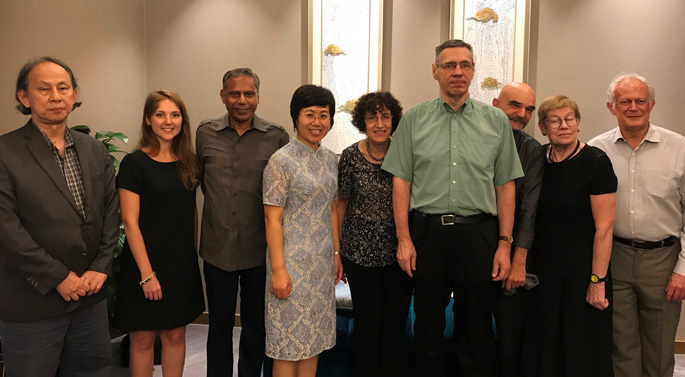
China’s is a dirigist policy of centralized, state-financed development of infrastructure and industry through national credit for long-term development, by using the latest technological and scientific innovations and developing new ones.

This discrepancy—between the proven successful methods of development, both current and historical (as in industrialization of the United States and Germany, for example) on the one hand, and what is now being promoted by international institutions on the other—must be addressed and eliminated. The new paradigm of development spearheaded by China and the BRICS nations is a key element in this process.

It is therefore necessary to state in clear terms, here, in this context, that the definition of the term “sustainable development” should mean the ability to maintain a process of providing ever higher levels of productivity and standards of living, both physically and culturally, to whole societies through scientific creativity and technological innovation. “Sustainable development” should not be used to mean the adaptation by society to an ever-shrinking base of fixed resources, because there is no such a thing as limited resources! What puts a limit to growth is the lack of cultural, scientific and technological progress.

China: The epitome of a developing nation

Between 1981 and 2018, China lifted 800 million of its citizens out of poverty—as attested by such institutions as the World Bank—by investing in urban and rural infrastructure projects, by completing mega-projects in transportation, water, and power, and by building an industrial and scientific capacity unparalleled in world history. The only close example of such rapid industrialization is the 1930s and 1940s New Deal and WWII mobilization under U.S. President Franklin D. Roosevelt. This unparalleled achievement can be replicated, in its outline, by all developing nations, although with different dimensions and characteristics. Over the past forty years, China built more water management projects than the United States had done in a hundred years. Another metric that emphasizes the immense magnitude of the undertaking is the fact that China used more cement in the three years 2011–2013, than did the United States during the entire 20th century! The Chinese 20,000 km high-speed railway network has already surpassed the combined networks of the Western European nations. China has 37 operating nuclear power plants (70% of which were built in the past decade alone), and a further 20 plants are under construction.
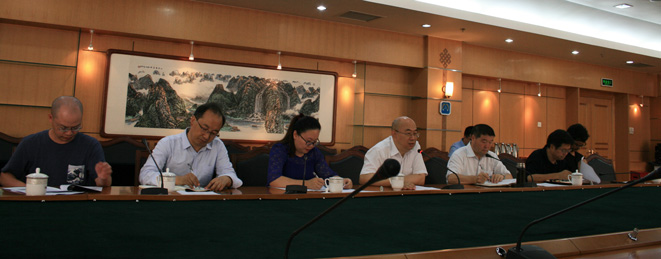
Enter the BRI 

The announcement of the Belt and Road Initiative (BRI) by Chinese President Xi Jinping in late 2013, (footnote 2) which was a breakthrough for the New Silk Road policy adopted by China since 1996, transformed China’s development policy into a global strategy, an all-inclusive initiative for all nations, without exception, to join and to shape. The BRI hinges on the construction of infrastructure mega-projects whose scale has not been seen in the world since the U.S. New Deal before World War II, the post–World War II reconstruction of Germany, and the U.S. space program of the 1960s.

The 6 Corridors of the Economic Belt of the New Silk Road (A-F) and the Maritime Silk Road (F) which were announced by President Xi in 2013. The other global transcontinental corridors were envisioned by the Schiller Institute as early as 1992. Credit: Belt and Road Institute in Sweden (BRIX)

The 6 Corridors of the Economic Belt of the New Silk Road (A-F) and the Maritime Silk Road (F) which were announced by President Xi in 2013. The other global transcontinental corridors were envisioned by the Schiller Institute as early as 1992. Credit: Belt and Road Institute in Sweden (BRIX)

The BRI is based on the solid foundation of China’s own economic miracle in the past few decades, and is backed by the entirety of the massive financial, technological, human resources base, and political power of China. It has evolved from a national Chinese project of economic development and industrialization into a massive intercontinental initiative for connectivity and economic cooperation, an initiative that more than 120 nations have joined so far. The BRI is already becoming the biggest economic undertaking in the history of mankind. The developing sector nations, many of which enjoy massive geographical advantages and human and natural resources, are poised to reap major benefits from this global initiative.

The fact that China is sharing its amazing experience of industrialization and development of the past three decades with the rest of the world is a key element of success. 

Through the BRI, China is offering the rest of the world its know-how, experience, and technology, backed by a $3 trillion financial arsenal. This is a great opportunity for West Asia and Africa to realize the dreams of the post–World War II independence era, dreams that have unfortunately been sabotaged for decades. The dramatic deficit in infrastructure both nationally and inter-regionally in West Asia and Africa can, ironically, be considered in this new light as a great opportunity. Although many other industrial nations in Europe, Asia and the Americas have technological and labor capabilities similar to those of China, they lack the vision and political will to apply these capabilities and to finance their use. Since West Asia and Africa are such strategically important areas for both East and West, it is, therefore, a perfect place for bringing the capabilities of the nations of the world into one concrete project of peaceful cooperation and development.

Encouraging signs have simultaneously emerged from African nations that have realized the importance of joining and benefiting from the new paradigm of development based on industrialization and large-scale infrastructure projects. Egypt, Ethiopia, Nigeria, and Kenya, for example, have all designed impressive national development plans that are being implemented in rapid steps. But even here, China’s role is decisive.

The China-Pakistan Economic Corridor (CPEC)—the most compact and well-defined BRI project—is revolutionizing Pakistan, a nation which until a couple of years ago was indebted and broken, economically. Now, Pakistan is bustling with optimism and its economy being transformed by all the power, water, transport, and logistics projects being undertaken at breathtaking speed under the CPEC. The industrial base of Pakistan which was mostly shut down in the past few years due to lack of electricity, is poised to reemerge now. Pakistans ports, like Gwadar, are in the process of moving from an isolated and abandoned fishing village to world-class maritime transport and logistics hub. China’s investments in Pakistan are reaching USD 60-70 billion from the originally planned level of $45 billion. 

Before the CPEC projects came to fruition, Pakistan’s economic development was stymied by the lack of electricity, which lack prevented the needed growth to escape the actual debt trap related to a lack of development. As a result of its large trade deficit, Pakistan’s growing foreign debt reached $95 billion in 2017. It has been running a yearly trade deficit of over $23 billion for the past few years. Pakistan’s main export items are raw materials and staple foodstuffs, and its main manufactured export is textiles. Staple food and raw materials suffer from price oscillations, whereas the textile sector’s competitiveness is crippled by the unreliable and inadequate energy supply. And it is precisely the crucial energy sector and transportation, that are the main focus of Chinese investments in the CPEC.

Pakistan’s energy imports have contributed significantly to its trade imbalance and indebtedness. Over the fiscal year 2017–2018, imports stood at $60.86 billion, 2.6 times the $23.22 billion of exports, resulting in a historically high trade deficit of $37.64 billion. Nearly a quarter of Pakistan’s imports were energy (oil and gas), amounting to $14.43 billion. (footnote 3) These energy imports constitute nearly half of the annual deficit! On August 3, 2018, the Pakistan Express Tribune reported that the British Standard Chartered Bank was to extend a $200-million commercial loan (at 4.2% interest rate) to Pakistan to finance LNG imports. The SCB is one of Pakistan’s largest lenders, with $1.1 billion in loans in 2016–2017 alone. This is how a nation walks into a debt trap.

Before the full completion of CPEC power projects, Pakistan’s total installed electrical capacity was 25,000 MW (2017), with the average demand being 19,000 MW.

Installed capacities, broken down by production type, was as follows: 1. Hydrocarbons (thermal) 14.7 GW, comprising 64% of installed capacity, 2. hydropower 7.1 GW (31% ), 3. nuclear 0.7 GW (3%), 4. wind, solar, biogas 0.4 GW (2%). (footnote 4)

Considered in terms of actual electricity production, the figures are as follows: (1) hydrocarbons (thermal) 58.5 TWh, comprising 60% of electricity production, (2) hydro 32.9 TWh (34%), (3) nuclear 5.0 THw (5%), (4) wind, solar, biogas 0.8 TWh (0.8%).

In the decade preceding the CPEC, Pakistan’s annual electricity consumption lingered in the range of 70–80 TWh, approximately 50 watts (or 440 kWh/yr) per capita. With the completion of a portion of the CPEC power projects, the nation’s electricity consumption rose to 100 TWh in 2018, bringing the average up to 500 kWh capita. This growth is good, but the figure is still far too low, and tens of millions of Pakistanis do not yet have access to grid electricity.

The CPEC energy projects will play a significant role in expanding electricity access in Pakistan. (footnote 5) This can eliminate the energy deficit and prepare the economy for a further surge in industrial activity. The breakdown of the investments that are completed, under construction or negotiation is as follows: Coal plants: 8,580 MW; Hydropower: 2,700 MW; other thermal plants (natural gas): 825 MW; Solar power plants: 900 MW; wind farms: 350 MW. (footnote 6) The expected total new electricity generating capacity is 13,355 MW. And the total cost of all these power generation projects (including mining of coal and electricity transmission lines) is estimated to be $23-30 billion, which is approximately the cost of two years’ imports of oil and gas, and less than the annual trade deficit.

To tell Pakistan today to stop the coal power plants amounts to telling its people to commit collective suicide. 

Pakistan was never enabled, or allowed, by its Western “friends”—who needed the country to fight the Soviet army in Afghanistan throughout the 1980s and the Taliban since 2001—to fully develop its clean and “carbon-free” nuclear power. This is poised to change, since China and Russia are fully capable of assisting in the construction of nuclear power plants. The choice of coal power at this moment is due to the fact that Pakistan has the raw material in abundance, because it takes a relatively short time (18-24 months) to construct a modern coal power plant, and because the necessary skills, equipment, and planning to produce them in large numbers currently exist. Nuclear power plants are complicated in both time and physical requirements. While coal may not be an ideal choice over the long term (30-40 years), the only reasonable alternative is nuclear power, for which the necessary construction capabilities must be geared up worldwide. For the Pakistani nation and economy to reach the platform of being able to build or participate in building its own nuclear power plants, its economy needs to be revived and developed now.

The attempt to supply the energy needs of Pakistan—or nearly (footnote 7) any nation, for that matter—by so-called “green” or “renewable” technologies for electricity production, would be an exercise in extortionately expensive futility, leading to real human suffering.

Chinese President Xi’s Philosophy of Development: “Make the cake bigger!”

Chinese President Xi Jinping.

Chinese President Xi Jinping.

By carefully reading the speeches and writings of the Chinese President Xi Jinping without ideological prejudice, we conclude that what Xi means by “sustainable development” is not what politicians and economists in the West mean by that term.

In his speech to the 19th National Congress of the Communist Party of China on October 18, 2017, Xi thoroughly describes the goals of development set out by him and the party, and clearly explains his understanding of the “Scientific Outlook on Development.” According to him, this is one of the key five guiding principles of the Communist Party of China (besides Marxism-Leninism, Mao Zedong Thought, Deng Xiaoping Theory, the Theory of the Three Represents). In point four of his speech, “Adopting a New Vision of Development,” Xi said: “Development is the underpinning and the key for solving our country’s problems.” He emphasized: “We must pursue a model of sustainable development featuring increased production, higher living standards, and healthy ecosystems.” 

Rather than focusing on “limited resources” and how to divide them, Xi often uses the metaphor of “rather than fighting over a small cake, make the cake bigger” when urging his party comrades to think outside the box. Most indoctrinated so-called experts in the Western world would see this today as a contradiction of terms, because they believe that increased production and raising the living standards cause ecological problems and will inevitably hit the wall of limited resources.

Even more provocative to Western observers are Xi’s repeated calls for the industrialization of Africa. In his speech at the Forum on China-Africa Cooperation (FOCAC) in Johannesburg, South Africa in December 2015, Xi said the following: 

“Industrialization is an inevitable path to a country’s economic success. Within a short span of several decades, China has accomplished what took developed countries hundreds of years to accomplish and put in place a complete industrial system with an enormous production capacity…

“It is entirely possible for Africa, as the world’s most promising region in terms of development potential, to bring into play its advantages and achieve great success…. The achievement of inclusive and sustainable development in Africa hinges on industrialization, which holds the key to creating jobs, eradicating poverty and improving people’s living standards.”

President Xi did not say this as a provocation to the West, but because he truly holds this view, which is completely in sync with China’s own fantastic feat of development in the past three decades. 

The most transparent and scientific definition of “sustainable development” according to Xi is described in a speech titled “A Deeper Understanding of the New Development Concepts,” which he delivered on January 18, 2016 at a study session of the implementation of the Fifth Plenary Session of the 18th CPC Central Committee. The term “coordinated development,” he says, has acquired new features. In the usual Chinese philosophical manner that is not fearful of contradictions that lead to solutions, he stated: “Coordinated development is the unity of balanced development and imbalanced development. The process from balance to imbalance and then to rebalance is the basic law of development. Balance is relative while imbalance is absolute. Emphasizing coordinated development is not pursuing equalitarianism, but giving more importance to equal opportunities and balanced resource allocation.”

Xi continued: “Coordinated development is the unity of weakness and potential in development. China is in a stage of transition from a middle-income country to a high-income country. According to international experience, this is a stage of concentrated conflicts of interest, in which imbalanced development and various weaknesses are inevitable. To pursue coordinated development, we should identify and improve our weaknesses, so as to tap development potential and sustain growth momentum.” (footnote 8) 

No state of equilibrium: Breaking the boundary conditions

In this speech and other speeches on the concepts of development, Xi has emphasized that the way to overcome such contradictions is to pursue scientific and technological creativity and innovation. It is very clear that Xi realizes that there is no such a thing as a “state of equilibrium,” but rather there is a process of progress and sustained growth, although he emphasizes that the goal is growth that is qualitative, rather than merely quantitative.

People in the West hear every day that the modern civilization has hit the wall, that limits of growth and technological development have been reached, that Earth’s carrying capacity has met its limit, and that the solution is to slow down, roll back industrialization and reduce the world population, because we cannot sustain growth indefinitely. 

The proponents of zero-growth base their theories on a fictitious “state of equilibrium” in nature between limited natural resources and the biological needs of all species, humans included, on this one and only planet! Life itself, the biosphere and the human species have proven that there is no such a static state of equilibrium, but that there is a process of progress and development. But that process of development usually bumps into certain boundary conditions, because a previous key “natural resource” is depleted. However, creative and revolutionary technological leaps break that boundary condition and brings life to a new and more intensive platform of progress. In other words, when a society hits a wall, it has to build a ladder and climb the wall to come to the new, but higher platform of economic development. That ladder is scientific and technological progress.

Human Creativity: the Greatest — and Infinite — Natural Resource

In a discussion of the role of science as a driver for the development of any nation, President Xi stated in a speech delivered to the Fifth Plenary Session of the 18th CPC Central Committee on October 29, 2015, “Innovative development focuses on the drivers of growth. Our ability to innovate is inadequate. Our science and technology is not fully developed, and is unable to create momentum to support economic and social development. This is the Achilles heel for such a big economy as China.” (footnote 9) Concerning the primacy of human creativity to so-called natural resources, Xi stressed: “So we must consider innovation as the primary driving force of growth and the core in this whole undertaking, and human resources as the primary source to support development. We should promote innovation in theory, systems, science and technology, and culture, and make innovation the dominant theme in the work of the Party, and government, and everyday activity of in society.” (footnote 10)

This chart of human population over historical time reflects the unique characteristic of human life among all life known to us. Our species continually breaks the limits to its growth, by developing new knowledge that opens up new resources and increases the productive powers of labor.

This chart of human population over historical time reflects the unique characteristic of human life among all life known to us. Our species continually breaks the limits to its growth, by developing new knowledge that opens up new resources and increases the productive powers of labor.

Elaborating on the history of the impact of scientific progress since the Renaissance on the industrial development of Europe and later the United States, Xi informed his Party comrades: “In the 16th century, human society entered an unprecedented period of active innovation. Achievements in scientific innovation over the past five centuries have exceeded the sum total of several previous millenia… Each and every scientific and industrial revolution has profoundly changed the outlook and pattern of world development… Since the second Industrial Revolution, the U.S. has maintained global hegemony because it has always been the leader and the largest beneficiary of scientific and industrial progress.” (footnote 11)

Xi is not expressing frustration and envy over the fantastic past progress of Europe and the United States, but is urging his people to learn from those successes. As Confucius said in the Analects: “He who learns but does not think is lost. However, he who thinks but does not learn is in great danger.” 

President Xi’s thoughts are clearly in harmony with those presented by American Economic Lyndon LaRouche, who has defined and treated economics in a scientific manner the same way physics is treated. LaRouche, the pioneer of Physical Economics, defined the process of progress of society as the building of new economic platforms.

The LaRouche View of Economics:  Successive Economic Platforms!

Following his service in World War II, economist and statesman Lyndon LaRouche tackled a central problem to understanding economic growth: the seeming impossibility of representing the incommensurable value of scientific revolutions. To give an example of the difficulty involved, consider the initial development of steam power. This new technology transformed the power of coal, which had been used as a source of heat, into a source of motion, making it tremendously more valuable than it had been. The ability to separate the process of production both from the muscle power of people and beasts, and from a reliance on such local peculiarities as the availability of wind or flowing water, transformed the economic geography completely. The power of an individual worked increased by an order of magnitude. Goods that previously were created by hand by artisans and were consequently available only to the wealthy, could now be produced efficiently in larger numbers, making them available to a broader population. How can these varied benefits — in changing resources, increasing productivity, and altering the importance of geography — be understood?

Lyndon LaRouche (1922-2019) speaking at a live webcast in 2010.

Lyndon LaRouche (1922-2019) speaking at a live webcast in 2010.

LaRouche begins his theory with a consideration of the most important metric of human economy, the potential population density that can be achieved by a given society’s cultural and scientific development, adjusted for the conditions of geography (including man made improvements to that geography). This metric, potential relative population density, gives a rough understanding of the economic power brought to bear by a civilization. True economic value exists in those processes and developments that act to increase this metric.

As an additional metric, LaRouche insists that the intensity of power applied by a society — at the point of production as well as more broadly considered per capita and per land area — must increase with economic growth. This metric, energy flux density, involves both the quantitative increase in power available, and also its qualitative nature, as expressed in its intensity. For example, a laser uses a greater density of energy than does a metal cutting device, yet it may be able to cut a metal part using less total energy. This is a reflection of the greater energy flux density embodied in the laser. A similar example is the increasing ratio of energy use specifically as electricity — a more concentrated form of energy — to total energy use in an economy.

In addition to the concepts of potential relative population density and energy flux density, add another: the concept of the economic platform as a superior concept to that of infrastructure.

Mankind Creates

As we progress, we rely increasingly on an improved environment. Rather than walking on paths made by herds of animals or floating on natural rivers, we use roads, rail lines, subways, sidewalks. We increasingly work in illuminated buildings and enclosed vehicles, safe from the ravages of weather, rather than unprotected outdoors. The substrate upon which we depend, this built environment, is often considered as an accumulation of pieces of “infrastructure.” LaRouche takes a fresh approach to this concept, as in a 2010 paper:

We should then recognize that the development of basic economic infrastructure had always been a needed creation of what is required as a “habitable” development of a “synthetic,” rather than a presumably “natural” environment, for the enhancement, or even the possibility of human life and practice at some time in the existence of our human species. . . .

Man as a creator in the likeness of the great Creator, is expressed by humanity’s creation of the “artificial environments” we sometimes call “infrastructure,” on which both the progress, and even the merely continued existence of civilized society depends. (footnote 12)

LaRouche reconceptualizes the history of human development from the standpoint of a succession of economic platforms. The earliest human civilizations were limited in their movements to land and to the oceans and rivers. And this water transportation itself required the technologies of ship-building and navigation. The sky itself served as an infrastructure platform, its stars providing a means of finding one’s way. The construction of new rivers, in the form of navigable canals, marked the next great stage of human advancement, providing a new platform upon which to develop. The land itself changed in value, as areas that were previously quite distant from the seas and rivers were brought within its reach, including through supplementary road networks. The railroads — rivers of steel — were the next great platform, utilizing the scientific knowledge of metallurgy and of the steam engine to transform our relationship to the land, and to space and time themselves. Distances that were traversable only in weeks could now be crossed in days.

Connectivity grew and the economic potential of land increased by the availability of rail transport.

The next great platforms upon which human civilization will be based, will rely on new technologies of greater energy flux density. With the realization of nuclear fusion, building on the gains already achieved through the control over nuclear fission, our relationship to travel and to resources will be fundamentally altered. Processing of ores, which today requires the use of coke produced from coal for its chemical transformation, could be achieved in a much simpler way. The value of high-level concentrations of mineral deposits will decrease, as lower concentrations will be economically viable to use. Our relationship to water — a precious resource required in great quantities — will take on a new form as we use nuclear fusion to use the plentiful water in the world’s salty seas. Our power over space will grow exponentially as nuclear-powered rockets propel us quickly through the solar system, and move asteroids that might strike the Earth onto safer orbits!

In all of this analysis, money itself plays a secondary, although important role. Money, being a scalar value, cannot be used to assign a value to the steam engine, to the development of railroads, to the 1960s Apollo mission to the Moon, or to the coming breakthrough of nuclear fusion. While money can measure more of what existed previously, the benefits of these leaps is that they allow us to accomplish more than we could before. In each of these cases, the potential population density of the human race is increased, processes of higher energy flux density are used or unlocked, and a greater platform of created environment upon which other activity unfolds is born.

LaRouche has consistently urged the creation of economic and political systems that cohere with the laws of physical economics. This means national and international credit systems under which long-term credit can be provided for projects that increase the physical productivity of the nation or society, including in the many circumstances that such investments would not be financially profitable to a private investor. Instead of suffering under economic “laws” that have no universal validity, the financial system itself must be subjected to the creative will of man, and brought into coherence with the long-term goals of the species.

Key in upgrading our potential is the conquest of space, that great domain lying always over our heads, beckoning us to look up and to think big! From space, there is only one Earth, populated by a single human race. From space, the overwhelming potential of that beautiful, creative species becomes manifest. It is for this reason that many of the greatest space visionaries and engineers have developed profound reflections on the human race itself. The German-American Krafft Ehricke is one such example.

A species not Earth-bound

Space visionary Ehricke, whose scientific contributions made the Apollo Program possible, strongly disputed the “limits to growth” philosophy, and his arguments in opposition to it were informed by his deep relationship to science and technology. In a 1984 speech, Ehricke said: “If you have a no-growth philosophy and if you regress into the Middle Ages, then you create an environment in which that, what you are asking the human being to do — namely to live with less and being very modest … and not to grow — is impossible, because a dog-eat-dog fight is bound to break out under those conditions. We’ve come too far. We have to go on. Life shows us that technological advances are the road to go. But based on those technological advances, must come the advances of the species and the advances of our civilization.” (footnote 13)

Ehricke argued that in the process of evolution on Earth, organic matter faced this crisis and overcame it: “Earth was like a gigantic flower, which soaked up solar energy and also utilized other energy to establish basic organic compounds, and amino acids. And when life began to stir here, there lived, of those fossil assets, Haldane’s famous ’soup that ate itself up,’ or something similar to that, and of course, eventually the resources ran out. And the first great crisis of life on this planet occurred, because they were living off previously generated organic substances… It was then, that we saw for the first time, two things: That what seemed to be an absolute limit to growth, was no limit to growth. It was a hindrance, that had to be overcome, and was overcome by technological advances — incredible technological advances, namely photosynthesis.”

The “first industrial revolution” is how Ehricke termed this advancement whereby organic matter found in outer space a new, extraterrestrial resource—solar radiation—for its continued development and survival.

Ehricke called for the human species to do the same, by going to outer space to explore and tap the unlimited resources that the solar system and the universe offers us: “This goes far beyond that… Information metabolism transcends planetary limitations, and is the metabolism on which life moves now over into space itself.”

Krafft Ehricke summarized his philosophy of astronautics in three laws, formulated in 1957:

First Law: Nobody and nothing under the natural laws of this universe impose any limitations on man except man himself.

Second Law: Not only the Earth, but the entire Solar system, and as much of the universe as he can reach under the laws of nature, are man’s rightful field of activity.

Third Law: By expanding through the Universe, man fulfills his destiny as an element of life, endowed with the power of reason and the wisdom of the moral law within himself. (footnote 14)

In a stark contrast to the mantra frequently repeated respecting environmental concerns that “there is no planet B,” the celebration of the 50th anniversary of the July 20, 1969 moon landing by the US Apollo 11 mission (Neil Armstrong, Edwin “Buzz” Aldrin and Michael Collins), has spread a new wave of optimism across the world, because it is such groundbreaking achievements that remind people of their true mission in life, on Earth and the universe — the mission to be creative, to discover and explore new frontiers of knowledge, science and technology while at the same time resolving a myriad of issues and conflicts that stem from the pessimistic and cynical view that the nature of humans is egoism and the characteristic of nations is to undermine each other and fight over purported “limited resources.”

A science city on Mars, as proposed by Lyndon LaRouche. In 1988, he wrote that “If the United States follows the approach I have proposed, we shall have our first permanent colony on Mars by the year A.D. 2027. During a few years following that, that colony will grow into an increasingly self-sustained community, the size of a medium-sized city on Earth. Long before A.D. 2027, the average U.S. taxpayer will have gained an enormous personal profit from the earlier, preparatory stages of the program as a whole.” The development of new scientific breakthroughs and technologies allows us, uniquely among known species, to transform our relationship to nature by improving the productive powers of labor. This creative potential, common to all people, is the basis for international collaboration in space, science, and culture, to advance the common aims of mankind.

A science city on Mars, as proposed by Lyndon LaRouche. In 1988, he wrote that “If the United States follows the approach I have proposed, we shall have our first permanent colony on Mars by the year A.D. 2027. During a few years following that, that colony will grow into an increasingly self-sustained community, the size of a medium-sized city on Earth. Long before A.D. 2027, the average U.S. taxpayer will have gained an enormous personal profit from the earlier, preparatory stages of the program as a whole.” The development of new scientific breakthroughs and technologies allows us, uniquely among known species, to transform our relationship to nature by improving the productive powers of labor. This creative potential, common to all people, is the basis for international collaboration in space, science, and culture, to advance the common aims of mankind.

“A community of shared future for mankind,” the concept pronounced by Chinese President Xi Jinping at the UN General Assembly in September 2015, should no longer be Earth-bound, but rather encompass everywhere human civilization reaches in the Solar System and the universe beyond. The fruits of space exploration by any nation should be celebrated and shared by all nations. This idea is shared by the best of the US and European astronauts and space scientists. When Armstrong set foot on the surface of the moon, he said this was “one small step for [a] man, one giant leap for mankind.” He did not proclaim it a “giant leap for the US,” but for all mankind, because he understood the full implications the achievement.

In a recent intervention at a George Washington University event titled “One Giant Leap: Space Diplomacy, Past, Present, and Future,” Buzz Aldrin called for the creation of an “international space alliance” where the U.S. would cooperate with the space programs of China, Russia, Europe, Japan and India. He correctly argued that colonizing the Moon and making it a launchpad for manned missions to Mars cannot be achieved efficiently by one nation. In addition to the technical necessity, cooperation is also a means to achieve global peace, and to advance scientific and technological cooperation which should eventually include every nation in the world.

Harrison (“Jack”) Schmitt, one of the astronauts on Apollo 17, which made the last human landing on the Moon, and who is perhaps the most insightful spokesman for the space program, told the Daily Telegraph (footnote 15) that “Moon and Mars settlement is extremely important for the dispersal of the human species throughout the Solar System, and possibly beyond.” Harrison Schmitt envisioned the “100th anniversary of Apollo,” saying that at that time “there will be settlements on the Moon, people living there permanently, producing the resources of the Moon… Settlements on the Moon are going to be a piece of cake.”

The Moon’s status as a launchpad to further space dreams arises from its physical characteristics. The lunar regolith (soil) harbors unique resources, its small mass allows for easy takeoffs, and its proximity to the Earth makes it a convenient location.

One of the Moon’s unique resources is related to power. The best designs for nuclear fusion power require nuclear reactions without neutrons (uncharged particles, which cannot be controlled electromagnetically), and the ideal fuel for these reactions is helium-3. This special isotope of helium is almost non-existent on Earth, but is constantly emitted by the sun. Because the Moon lacks a magnetic field (or an atmosphere), this fuel source flung generously by the sun is caught in the lunar soil, where millions of tons exist today. This helium isotope, the best fuel for nuclear fusion power, can serve humanity both in space and on Earth, to meet the needs of all nations for probably hundreds of years to come.

There are several other benefits of Moon industrialization. Water on the Moon can be broken down into hydrogen and oxygen, which can be used as fuel for rockets. Metals can be mined to set up local manufacturing on the Moon. This manufacturing will benefit from the Moon’s small size. As a result of the weaker gravitational attraction on the Moon, less than one-tenth as much power is required to a payload from the surface of the Moon to Earth orbit as would be required to bring the same payload from the surface of the Earth to Earth orbit. And since the Moon is relatively close by, the journey time is not long.

Schmitt emphasizes these benefits of lunar development:

“Not only will that assist a Mars mission, but helium-3 is an ideal fuel for electric power generation because it creates no radioactive waste and demands for electrical power are not going to decrease; civilization depends on it [electrical power], and this is one of the major potential and long-term sources.

“The Moon’s debris layer provides the opportunity to produce water, hydrogen and oxygen as fuels. It’s also very fertile, so if you want to produce food, that’s achievable. Settlements on the Moon are going to be a piece of cake.”

The industrialization of the Moon could become the joint development project of the world. Not only does it open the frontiers of space, but it also breaks the pessimistic and unscientific ideology of limited resources. One of the important objectives of the Chinese lunar mission is to gather the helium-3 that is uniquely abundant on the surface of the Moon.

Conclusion

Lyndon LaRouche has been famous for his promotion both of nuclear fusion and of a fully developed Moon-Mars program, which would serve for decades as a driver of new scientific and technological breakthroughs. His 1988 campaign for U.S. President included a thirty-minute video, The Woman on Mars, which detailed his program to the general audience of American voters and thinkers worldwide.

In a presentation he gave in 2010, LaRouche put forward the motivations for humanity to reach into the heavens: (footnote 16)

Therefore, we have to go to Mars, not because we want to get there, but we don’t want to fail to get there! … We’re going to a new conception of basic economic infrastructure, which started with the space pioneers in the 1920s, and into the United States. We began to realize that mankind needs a new dimension, beyond railroads, beyond old water systems, needs a new dimension for the expression of humanity in the Solar System.

This is not just for “getting there.” This is for giving man a mission, a natural mission for mankind, on which we will base the culture which increases mankind’s options, and also the security of humanity. That is, by developing ourselves, instead of sitting on one planet and depleting that planet and doing nothing else, and becoming fat and lazy—instead of that, let’s take on a mission!

Let’s look ahead 75 years, three generations. And let’s take what we have now, with these—we’ve got young people under 25 who are in a disastrous state of education in life. They’re going no place, unless we do something for them. We’re going to have to give them a mission, and an opportunity, which inspires them, so that their children will not be so damned stupid. And therefore, by three successive generations of development … I’m satisfied that we could develop the scientific and technological capabilities, in three successive generations—all the time, bringing our people up to a higher level of productivity—to make up for what we’ve lost, and to go beyond that…

We know we have to develop the Moon, which is accessible to us, readily, with technology already developed by us. We know we can develop an industry on the Moon, because you don’t want to take off from Earth, and lug a lot of things up from Earth; there’s just too much effort involved. Go to the Moon, take your technology to the Moon, develop industries on the Moon: You can build the spacecraft and other things you need to go to Mars!

The lunar regolith (soil) includes many of the basic elements required for industrial production of rocket components and fuel. And its helium-3 is an ideal fuel for nuclear fusion, surpassing anything economically available on Earth. Once components are built on the Moon, they can be easily brought to Earth orbit. In fact, bringing payloads from the surface of the Moon to Earth orbit uses less than 10% of the energy required to bring them from the surface of Earth to Earth orbit! LaRouche continued:

Why do we go to Mars? Because it’s the nature of man to do so: The nature of man is expressed by the fact that we are not a fixed species, with fixed behavior. We’re a species that must develop, as mankind has developed, despite all the setbacks. Mankind has greatly improved, since our first evidence of what mankind was on this planet. Improved through technology, through intellectual development, stimulated by technology; by improvements in culture, especially Classical culture.

And the purpose of man, is to find his place in the universe.

Don’t worry about what the destination is. We’ve got to find our place in the universe: We must develop! Mankind is creative. Mankind must create! Mankind must develop!

And if we do that—the space program, as we would develop it—my estimate is, that it will take three generations to develop the capability to actually put human beings safely on Mars. To solve the problem of gravitation in interplanetary flight and that sort of thing. We can do it! We don’t have a population which is trained, yet, to undertake that mission. But we have a population, which is ready to be uplifted from despair, now, and plan that the grandchildren of people today, of young people today—the grandchildren of young people today will solve that problem! And it should be our mission to dedicate the United States, in particular, and the planet as a whole to that mission, to give mankind a sense and a determination of a future which should belong to mankind.

Mankind was put in this universe for some purpose. We’re not always too sure what that purpose is. But we’re sure of one thing about that purpose: It requires, as history has shown us, the development of the intellectual powers of mankind, the intellectual powers of man’s progress. The future, if it means anything to have children and grandchildren, is to ensure that the children and grandchildren have made an upwards step, beyond what’s impossible now. And to do as we’ve done before, from our past experience, in making the kind of progress, the changes in behavior, and progress, and increase in the power of mankind, to solve great problems, problems of disease, all kinds of problems.

What is the greatest focus for this human mission? LaRouche answers:

Therefore, we have to put a name on it, and the name we put on it for the short term, is the Mars Mission. And we say, that within three generations, we’ll take this wretched nation, this poor, broken-down, ruined, betrayed nation, and, in cooperation with other nations on this planet, we will develop a technology and the people capable of carrying it, which will, step by step, bring man to his true dignity, to recognize the place of man in the universe. Not to what we’re going to do in the universe, ultimately, but to know we’re there!

And we need that.

You know, people talk about immortality and so forth—what’s it mean? Just another person being produced, to replace the one that died? No. Immortality is the certain understanding, that you are living today, because you are doing something, which is going to lead to the development of man’s power in the future. Your immortality lies in your grandchildren, and your great-grandchildren beyond that. Your immortality, your purpose of your life, is what comes out of it! That you’re a permanent part of the universe! Because, by developing within the universe, you’ve demonstrated that you’re not just a drop on the planet: You are part of the universe, forever!

And that should motivate you.

It is from this greatest of mission-orientations that we can draw inspiration for developing the necessary platforms of economic development to enable people from all nations of the world to live lives allowing us to meaningfully aspire to contribute something of enduring value to all of human history.

The endless pursuit of that goal is the only process of development that can truthfully be called sustainable.

Footnotes

1. Former Norwegian Prime Minister Gro Harlem Brundtland headed the UN-appointed World Commission on Environment and Development, which released the report “Our Common Future,” also known as the Brundtland Report, in 1987: http://www.un-documents.net/wced-ocf.htm
2. President Xi Jinping announced the creation of the “Economic Belt of the Silk Road” in a speech in the Nazarbayev University in Astana, Kazakhstan in September 2013. The Belt is a land-based economic corridor extending from eastern China to western Europe and engaging 69 nations in its path. One month later he announced, from Jakarta, Indonesia, the intention to launch the 21st Century Maritime Silk Road together with other nations. This includes building numerous ports on the sea lanes of the Pacific and Indian Oceans and the Mediterranean. The two projects complement each other and together make up the BRI. http://english.gov.cn/beltAndRoad/
3. “Pakistan’s Trade Deficit Stands at $30.19b” Salman Siddiqui, The Express Tribune, Aug 14, 2018
4. Figures from Pakistan’s National Electric Power Regulatory Authority, “State of Industry Report 2015”
5. For detailed description of the energy projects involved in the CPEC, consult the project’s official website
6. Since the expected capacity factor of solar and wind would be no greater than 30%, the energy generated by these systems should be estimated as being at most one-third their official capacity. These projects, by dint of the low intensity of their power sources, are also expensive. Considering both their cost and their likely capacity factors, the (intermittent) electricity produced by these projects will cost several times more than coal or large hydro.
7. There is a temporary exception of those few nations capable, by virtue of their geography, of utilizing large hydro plants and geothermal energy. Iceland is currently such an example, although future development will require energy beyond what can be supplied by these means.
8. Xi Jinping, The Governance of China II, pp. 226-227. (emphasis added)
9. The Governance of China II, Page 217. Speech titled “Guide Development with New Concepts”.
10. Ibid. Emphasis added.
11. Ibid.
12. Lyndon LaRouche, “What Your Accountant Never Understood: The Secret Economy” EIR, May 28, 2010.
13. “Lunar Industrialization and Settlement — Birth of Polyglobal Civilization” Presented at the October 1984 Conference of the National Academy of Science, on “Lunar Bases and Space Activities of the 21st Century”
14. Cited in Marsha Freeman, How We Got to the Moon: The Story of the German Space Pioneers (Washington, D.C., 21st Century Science Associates, 1993), p. 297.
15. https://www.telegraph.co.uk/science/2019/07/21/mining-moon-could-help-save-humanity-says-last-apollo-astronaut/
16. Transcript available as “Change is a’Comin’” EIR, July 16, 2010


The writers are the authors of the Schiller Institute Special Report “Extending the New Silk Road to West Asia and Africa”. Both are long-time members of the International Schiller Institute founded in 1984 by the German thinker Helga Zepp-LaRouche. 

authors Hussein Askary and Jason Ross

Hussein Askary, Iraqi-Swedish citizen, founding board member of the Belt and Road Institute in Sweden (BRIX). hussein.askary@brixsweden.com   brixsweden.com

Jason Ross, American citizen, Editor in Chief of the 21st Century Science and Technology Magazine.  jason@21stcenturysciencetech.com  21sci-tech.com 


Schiller Institute Seminar: The Role of the Belt & Road in Peace and Stability in West Asia & Africa

The Schiller Institute hosted a high-level seminar in Berlin, Germany on August 29 to provide a report on the true significance and substantial progress of the Belt & Road Initiative (BRI), especially regarding developments in Southwest Asia and Africa. Forty-five people attended, including representatives of Germany’s Mittelstand (small and medium-sized industries), the diplomatic community, and other institutions. A visiting delegation of scholars from the Chinese Academy of Social Sciences (CASS), an important academic organization and research center, presented papers on the role of the BRI in stabilizing the region through economic development. A common theme of virtually all presentations was that for peace to be achieved in this region, a commitment to real economic development is necessary, centered on advances in science and application of new technologies.

Moderator Stephan Ossenkopp of the Schiller Institute opened the event by emphasizing that there is an urgent need for a “rational dialogue” on what the Chinese are actually doing, as opposed to the negative reports in the western media. The BRI is not a unilateral, imperial project, but one which is comprehensive and inclusive.

Zepp-LaRouche Keynote

The keynote, from Helga Zepp-LaRouche, the Chairwoman of the Schiller Institute, expanded on this theme, noting that the BRI is “the most important strategic policy on the agenda.” The speed of its growth in the last six years has been amazing and it is of particular importance for rebuilding the war-torn nations of southwest Asia, and overcoming the suppression of nations in Africa, where Europe could have contributed to the industrialization of Africa, but has not.

Founder of the international Schiller Institute, Helga Zepp-LaRouche, delivering her keynote address.

Founder of the international Schiller Institute, Helga Zepp-LaRouche, delivering her keynote address.

Instead of allowing the opponents of development to turn China into an “enemy,” the truth of what China is doing needs to be more broadly known and understood. The Belt and Road Initiative is necessary for peace and stability, and should be joined by western governments, especially the United States.

Reviewing the present strategic crisis, which has worsened due to the unleashing by the British empire of destabilizations around the world, including against China, and Iran, Zepp-LaRouche said that Europe has an important role to play, if leading nations are to free themselves from their geopolitical strategic orientation.

She spoke of the tremendous potential for German Mittelstand companies to engage in joint ventures in third countries, noting that the policies of the present government do not favor that potential. She emphasized that key to creating change in the Trans-Atlantic region is to inspire optimism, to particularly emphasize the potential unleashed by the new initiatives in space exploration. We must think at least fifty years ahead, she said, and reject the pessimism that is being spread by the Greenies and the financiers who back them.

Chinese Presentations

There were five speakers from Chinese Academy of Social Sciences (CASS). Prof. Tang, the leader of the delegation, spoke on “China’s Concept on Security and Middle East Security,” providing a broad view of the BRI approach to the subject.

He was followed by Prof. Yu, who spoke on the topic, “BRI and the Peace Between Palestine and Israel,” emphasizing the importance of economic development for Palestine, which is essential to realizing the two-state solution to the ongoing crisis. Prof. Wang addressed the “BRI in the Gulf Cooperation Council and Gulf Security” and Dr. Wei, “Iraq’s Reconstruction and China’s Role,” in which he highlighted the difficulties in rebuilding a nation subjected to a war that had destroyed much of its infrastructure. Dr. Zhu spoke on “BRI in Egypt and China-Egypt Cooperation,” presenting an optimistic evaluation of how the cooperation between the two states has provided tangible benefits.

dkf8797sd

Other Schiller Institute speakers were Hussein Askary, co-author of Extending the New Silk Road to West Asia and Africa, a book-length report, who gave an impassioned account of the progress of the BRI in the two regions, and Claudio Celani, whose report on the Abuja, Nigeria conference on Transaqua provided a concrete picture of what is possible with international cooperation—but also the obstacles created by international financial institutions and their geopolitical strategies which must be overcome.

There were questions from the audience after each presentation, evidence of a hunger for real solutions and a desire to draw out more of the thinking of the representatives from the CASS. Several questions were directed to Helga Zepp-LaRouche, including one on Malthusianism, another on the India-Pakistan crisis. A lively discussion continued after the formal proceedings concluded.

Helga Zepp-LaRouche: “The Strategic Implication of the New Silk Road”


Tang Zhichao: “China’s Concept on Security and Middle East Security”


Hussein Askary: “The Belt and Road to Peace and Prosperity in West Asia and Africa”


Yu Guoqing: “BRI and the peace between Palestine and Israel”


Wang Qiong: “BRI in the GCC and Gulf Security”


Claudio Celani: “Why the Transaqua Solution for Lake Chad is a Test of Morality for Europe”


Wei Liang: “Iraq’s Reconstruction and China’s Role”


Zhu Quangang: “BRI in Egypt and China-Egypt Cooperation”


France and the Maritime Silk Road: Past, Present and Future

The July 2 Schiller Institute conference, “France and the Maritime Silk Road: Past, Present, and Future,” held in Nantes, was a major intervention on a hot topic: France has a maritime Exclusive Economic Zone (EEZ) of 10 million square kilometers and the world’s second largest maritime economic area. Nantes—a port city of 900,000 on the Atlantic Ocean and the birthplace of the visionary Jules Verne—has a place in France’s “blue economy.”

Schiller Institute booth at the La Mer XXL Exposition in Nantes, France on June 30, 2019.

Schiller Institute booth at the La Mer XXL Exposition in Nantes, France on June 30, 2019.

The four-hour conference with nine speakers was part of an international maritime exposition, La Mer XXL, that drew 38,000 visitors. Several of the speakers at the Schiller event had important institutional roles in France and all of the speakers were passionate about their subjects and conveyed a sense of optimism and mobilization. The creative ideas and science-driver perspective of Lyndon LaRouche, for the common good of mankind, were very much present.

The Expo was organized by one of the largest media groups in France, the Group Ouest-France; the Maritime Credit Bank; and the French Maritime Cluster, a business association encompassing all ocean-related enterprises—ports, transport o and from ports, shipbuilding, fishing, aquaculture, and deep-water research institutions in biology and mining (oil, rare earths).

Odile Mojon at the literature table during the La Mer Expo.

Odile Mojon at the literature table during the La Mer Expo.

For twelve days, June 28 to July 10, the Schiller Institute manned an exhibit at the Expo. At least 200 exhibitors—associations, companies, research institutions—had booths to present their work. Schiller Institute representatives were able to present the full spectrum of the Institute’s activities and the 484-page French edition of the Institute’s World Land-Bridge report released in November 2018. In the months preceding the event, the Schiller Institute had sent out mailings to regional industrialists and companies; French and Chinese engineers and scientists; and its own contact lists, and followed up with personal contact.

The four-hour, in-depth Schiller conference drew 60 people including representatives from the Friends of the Maritime Museum of La Rochelle, and the Maritime Cluster of Luxembourg, who were eager to get copies of the Land-Bridge report. People came from as far as Provence and Switzerland to participate.

Several copies of the Land-Bridge report were sold on the spot and more during the book dedication event set up at the Expo library. A professor from Africa, who attended the conference, when passing our booth the next day, said he was so excited that he persuaded his university to order five copies.

Prof. Michel Cantal-Dupart (left) and Karel Vereycken, two of the speakers at the Schiller Institute Conference in Nantes, France on July 2, 2019.

Prof. Michel Cantal-Dupart (left) and Karel Vereycken, two of the speakers at the Schiller Institute Conference in Nantes, France on July 2, 2019.

The Schiller Institute’s Karel Vereycken, who has studied the maritime domain for several years, was the moderator, and opened the floor to greetings: André Sobczak, a Nantes city councilman and the 15th Vice-President for International Relations of the Nantes Metropolitan Area, warmly welcomed the participants; Anne Lettrée, CEO of China’s Silk Road Business University and co-organizer of the event; two Minister Counselors of the Chinese embassy who were unable to attend at the last minute, and Minghong Chen, Chairman of the French-Chinese Intercultural Center.

Maritime Silk Road: Ancient and Modern

Karel Vereycken speaks on the Maritime Silk Road.

Karel Vereycken speaks on the Maritime Silk Road.

Vereycken presented the idea that the Maritime Silk Road in history—in China and other countries—has always been a space of cooperation and not of confrontation. With images of beautiful pottery, other ceramics, and other artistic or mechanical objects and utensils, he showed how each one, produced in one area, had designs and decorations coming from elsewhere, thanks to trade on the Maritime Silk Road. He presented another example of the high degree of development of that trade, the shipwreck of an Arab vessel made in Oman, from 826 AD, which was discovered recently on the sea floor near Java, Indonesia complete with the 60,000 pieces of ceramics and manufactured goods, including some with Persian motifs.

University Professor Antoine Cid followed, on Zheng He’s maritime expeditions to the Gulf and eastern Africa in the early 15th century and China’s peaceful and diplomatic objectives of cooperation. This activity was not limited to Zheng He, or to that period of time. Prof. Cid hypothesized that the Chinese, in the early part of the 20th century, decided to make this excellent story a positive epic narrative to convey the message that China is not a conquering power, on sea or on land.

Henri Tsiang, a former researcher at the Pasteur Institute, who also played an important role in mediating between France and China after World War II, went through what is happening in the South China Sea, the issues and the actors, and how the withdrawal of the United States from the Trans Pacific Partnership (TPP) has led to the expansion of other peaceful trade initiatives in the zone, a good way of solving disputes that had been used by geopolitical forces to harass China.

Sebastien Goulard, a public affairs consultant, and founder and coordinator of OBOReurope, countered the fake “debt trap” narrative and other false stories circulated to slander China. He made clear that problems can and do arise here and there, due to changes in political power in participating countries, and due to differing conceptions of investment terms: for the Chinese it’s the long term, while for the West it’s the time of an election cycle.

He showed that the Chinese are quick to find new solutions: The sale of Sri Lanka’s Hambantota port to a Chinese company, with the possibility offered to the state to acquire up to 50% ownership in 20 years, protects that port from political changes created in the country by competitors to China, in this case, India. Chinese investments, he showed, improve competition in a good way. After the Chinese financed the port, the Indians decided to build an airport, which in the meantime has become complementary to the port!

Sébastien Périmony discusses his recent trip to Africa with a conference attendee.

Sébastien Périmony discusses his recent trip to Africa with a conference attendee.

Sébastien Périmony of the Schiller Institute Africa Desk spoke about projects of the African terrestrial and maritime “silk roads,” and reported on his recent experiences in Ivory Coast and Angola. 

Contributions followed from people actively involved in New Silk Road cooperation.

The Silk Road Today and Tomorrow

The next speaker, Professor Mohamed Jebbar, held the audience in rapt attention. He is a professor of microbiology at Brest University, Director of the Microbiology Laboratory of Extreme Environments (LM2E) and co-director of the French-Chinese Laboratory of Deep-Sea Microbiology, called MICROB-SEA, which he fought for several years to establish. The laboratory’s objective is to study the conditions of ocean life at a depth of 5,000 meters—where the total absence of light had led people to believe that life was not possible, or that it was determined by life above those limits. Prof. Jebbar explained that life does exist at those depths, and that it is organized by bacteria that accomplish through chemosynthesis what the Sun accomplishes on the Earth’s surface through photosynthesis. He explained to the audience how this works.

His Franco-Chinese research center collaborates with the astrobiologists of the European Space Agency (ESA) and other space agencies to see what those extreme conditions can teach us about the existence of life in space. The first test carried out in a joint effort between the Chinese and ESA was to see if the microalgae called spirulina, sent in satellites, could grow in space.

Anne Lettrée spoke on “Earth, innovation, technologies, art, nature and health, a whole program.” She is an executive of the Silk Road Business School (Paris and Xi’an) who has become impassioned with China and fully supports the New Silk Road. She is creating a large holistic park, the Garden of Titans, in Normandy, with spaces for research, artwork, and theater, combined with ecology. Jane Han, the official representative in France of China’s largest photovoltaic company, confirmed China’s interest in this park conception.

Two important French figures spoke in the last section on the future of the New Silk Road. Michel Cantal-Dupart, architect, urban planner, and professor at CNAM (Conservatoire Nationale des Arts et Métiers—School of Industrial Arts and Crafts) is engaged in large urban architectural projects and territorial infrastructure—inland waterways, rapid transport—and works with the UN to develop these programs in developing countries. He was clear in his anger at the lack of vision by successive French governments for the  development of France’s waterways and canals—the largest set of inland waterways in Europe, which are all totally disconnected today. Instead of having a system, France has a series of dead ends.

He was followed by Bernard Planchais, the recently retired operational Director General at the National Naval Construction Company (formerly DCNS and today the Naval Group), producing civilian ocean liners and military vessels such as the Mistral and submarines. Planchais presented a “war plan” for France to develop its maritime economy, since France commands, after all, the second largest maritime zone in the world. While at the DCNS, Planchais worked with the nuclear sector to develop Flex Blue, a program using nuclear submarine technology to build small nuclear plants operating on the ocean floor—a great idea which, like many others, was never developed at all by our successive governments.

The conference concluded with Odile Mojon’s presentation of the Schiller Institute’s Land-Bridge report, in the context of the ongoing fight by Helga Zepp-LaRouche today to bring about a just new world economic order.

The organizers of the Expo were impressed by the size of the group gathered for such a four-hour, in-depth conference and requested three minutes of video footage of our event to use in their Expo publicity.


Schiller Institut⁠e⁠ in China⁠—Xinjiang Province: China Rejects All Accusations

by Christine Bierre, Bierrechristine@gmail.com

Hardly had the breakthroughs of the Xi-Trump meeting occurred at the G20 Summit in Osaka, Japan than London and its neo-conservative allies, in and out of the Trump administration, escalated a new flank in the war of nerves against China. Following the demonization of the Belt and Road Initiative (BRI) by London’s neo-con and liberal acolytes in the United States and Europe, the trade-war hype, the Huawei saga, and the Hong Kong mass demo destabilization, in come accusations of mass torture in Xinjiang.

Attacks have been growing in recent months against China’s counter-terrorist offensive in this region, one that has suffered the most from the spillover of terrorism spawned in recent years’ Middle East wars. A Uyghur contingent that had joined ISIS and Al Qaeda in those wars brought that terrorism home to China. Accusations have been made that China has illegally jailed 1-3 million Uyghurs, and is subjecting them to torture, brainwashing and even organ harvesting!

china-provinces-map-600

Photo Credit: Adam Ludwiczak


These accusations came to a head on July 10 when a group of 22 nations (18 European nations joined by Japan, Australia, Canada and New Zealand), addressed a letter to Michelle Bachelet, the United Nations High Commissioner for Human Rights, noting “disturbing reports of large-scale arbitrary detentions of Uyghurs, and other Muslim and minority communities.” On July 13, however, a group of 37 other countries sent their own letter to the UN authorities, backing China and praising its government for having invited diplomats, think-tanks and media to visit Xinjiang, noting that “what they saw and heard in Xinjiang was in total contradiction with what had been reported by certain Western media.” Among the signers were ten Muslim States!

Foreign Affairs Ministry in Beijing with Wang Lixin Deputy director general at the Department of External Security Affairs and international tour of journalists.

Foreign Affairs Ministry in Beijing with Wang Lixin Deputy director general at the Department of External Security Affairs and international tour of journalists.

The Chinese government has, in fact, successfully conducted a counter-terror operation and is continuing to organize visits to Xinjiang. Between July 7 and 14, representing the French Schiller Institute’s China desk and as a journalist who writes on strategic and defense questions, this author had the opportunity of participating in one such visit, with a very interesting group of experts. They were representatives from Russia, Italy, France, Poland, Pakistan, Thailand, and New Zealand, including journalists and academic think-tank experts, most of whom had in-depth experience and knowledge of China. Our eight-day “Information Mission” concentrated on China’s policies towards ethnic and religious minorities in general, and on its policies of counter-terrorism in the Xinjiang Uyghur Autonomous Region (XUAR).

China’s Policies Towards Minorities

Our tour started with seminars at the Institute of Tibetology and the Institute of Borderline States, in Beijing. China, with its more than 5,000-year history, is a centralized but multi-ethnic and multi-religious state, home to 56 different ethnic groups, which benefit from having equal rights with the Han majority (92%). China has created 5 autonomous regions and 30 autonomous prefectures, in which minorities are granted some advantages beyond those available to the Han majority, such as favorable quotas to enter schools and greater access to jobs in the public companies as well as an exemption from the “one child only” policy that had been applied to the Han. Religious practices are strongly protected as long as they don’t promote separatist or extremist ideas. The Koran, the Bible and other scriptures are published by the State and are accessible through the internet and available at all libraries. The Muslim religion is practiced in 39,000 mosques in China (25,000 in Xinjiang alone) and requires only certification of the Imams.

Seminar at the Institute of Tibetology in Beijing.

Seminar at the Institute of Tibetology in Beijing.

The contribution of ethnic minorities to the particularly rich cultural and religious heritage of China is fully recognized by the State. However, due to the difficulty of reaching out to them in the border lands of China (e.g., Mongolia, Tibet, Xinjiang) and the daunting challenges of their geography, economic development has lagged, a weakness which the enemies of China have always exploited. 

Xinjiang has been part of China ever since the Han dynasty, under the name of “Western territories.” But, at the end of the 19th and beginning of the 20th century, taking advantage of China’s weakness, the British, the Russians, and the Japanese fought for the control of this area in what was then called the “Great Game.” The ideologies of Pan-Turkism and Pan-Islamism promoted by the different camps gave birth to a movement in favor of an “Oriental Turkestan.”

Xiahe county at Tibetan autonomous prefecture in Gannan (Gansu).

Xiahe county at Tibetan autonomous prefecture in Gannan (Gansu).

Some were calling for an independent state on Xinjiang’s territory; others, for an Islamic State extending from Turkey to Xinjiang. The heirs to the British Empire today are following the same policies towards the Uyghurs and Tibetans. Is it a coincidence that the so-called freedom and liberation movements are both financed by the National Endowment for Democracy in Washington and that their main propaganda instrument, Radio Free Asia, was recreated by the U.S. government in 1996 and has been run by it ever since?

What is important in the Chinese counter-terror offensive is that it is based on the recognition that economic development is the key to solving those problems: “We have to eliminate the soil which allows extremist groups to recruit people, and that is poverty,” insisted Xu Jianying of the Institute of China’s Borderlands at the Chinese Academy of Social Sciences in Beijing. The counter-terrorist campaign is also based on a clear differentiation between those who have committed major crimes, who are punished severely, and those who have committed minor crimes, who are offered a very positive rehabilitation program if they admit to their crimes and clearly express a desire to change. The Chinese policy aims, says the government, at striking the right balance between “severity” and “leniency.”

Gansu and Xinjiang

Our visit took us to two of the poorest provinces of China today, Gansu and Xinjiang. But thanks to modern road and rail infrastructure such as the Beijing-Urumqi Expressway inaugurated in 2017 and the Lanzhou-Urumqi high-speed train, these provinces are rapidly catching up with the rest of the nation. Both provinces played key roles in the ancient Silk Roads and are strategic to the success of the BRI today.

Gansu has a Tibetan minority and Xinjiang, a large minority of Muslim Uyghurs (45%). In these areas our group saw the ongoing “poverty alleviation” measures that had started with the Western development strategy (1999) and were accelerated by the BRI beginning in 2013. We also witnessed the strong protection given by the State to local cultures and to the practice of religions, and, in Xinjiang in particular, the ongoing massive rehabilitation efforts in this area, which has almost eliminated all terrorist attacks in the last three years, to the great relief of local populations and the Chinese government.

Labrang Buddhist monastery at Tibetan autonomous prefecture in Gannan.

Labrang Buddhist monastery at Tibetan autonomous prefecture in Gannan.

Gansu is a province with great disparities: a very mineral-rich soil, but a mountainous and desert-like geography. The rich Tibetan autonomous prefecture of Gannan (TAR) is an exception to this. We visited this beautiful area, home to some 120 Buddhist temples, and in particular to the Labrang monastery of the Gelugpa school of Tibetan Buddhism. Here, a monk, with a Socratic outlook, having engaged in a 20-year study of philosophy, gave us a tour. “Man is not a beast,” he stressed. “He has access to the light of reason. Man can know truth, but for that he must first know himself!”

We visited a model village in Gaxiu that will replace 95 poorer villages totaling 1,800 inhabitants, as part of the extensive effort to meet the goals set by Xi Jinping of eliminating all extreme poverty by 2021. Five such new villages, equipped with clinics, primary schools, and areas for growing vegetables, have been already built. Twenty-five more will be built by next year. The villages are financed by the government, but built by the people, who become owners of their homes. Richer provinces also contribute 0.1% of their income. Today, in this area, 100% of the population has access to clean water and to 15 years of free education. With the orientation towards industry, ecological investments and tourism, a Tibetan yak herder today can expect to go from a yearly 9,000 Yuan income to 30,000 Yuan.

Model Tibetan village in Gaxiu (Gannan).

Model Tibetan village in Gaxiu (Gannan).

Xinjiang Uyghur Autonomous Region

On July 12 we headed towards Xinjiang, taking a bus through the mountains on good roads that had gas stations and restroom facilities. First we visited Turpan, then the capital city, Urumqi.

These areas are the supposed site of the alleged massive arrests by the Chinese government. This Western state is strategic to the success of the BRI. It not only represents a sixth of China’s territory and is very rich in raw materials; it is also the door to the Silk Road leading to Europe. Without a peaceful Xinjiang, there will be no Belt and Road Initiative! Xinjiang has a large Uyghur minority and shares borders with eight states (Mongolia, Russia, Kazakhstan, Kirghizstan, Tajikistan, Afghanistan, Pakistan, and Kashmir) in which poverty and religious extremism is often endemic. This is the province in China that is most exposed to terrorism.

However, as the Ministry of Foreign Affairs official accompanying us stated emphatically: “The Chinese government is not fighting Muslims or Uyghurs; it is fighting terrorism that has spilled over into our country through these borders, from people going back and forth to the wars in the Middle East.” Between 8,000 and 15,000 Uyghurs are reported to have joined ISIS and Al-Qaeda in the war against Syrian President Bashar al-Assad, with the explicit aim of pursuing their Holy War against Beijing next.

A large International Exhibit on terrorism in Urumqi demonstrates, with extensive photo and video material, the extent of problem. No less than 14,000 bloody attacks occurred in Xinjiang between 1992 and 2015—suicide bomb attacks, vehicles launched against people in crowded areas, arbitrary knife, machete and axe attacks against ordinary people. The high point of these attacks was the 2009 riots in Urumqi which left 197 dead and more than 1,600 wounded.

A Preventive War Against Terrorism

This is the background to understanding what the Chinese government calls a preventive counter-terrorist policy. First, the decision was taken to improve the living standards of the local population, through development of infrastructure. And it works! Infrastructure has boosted tourism in the ancient city of Turpan, from 8 to 10 million visitors between 2016 and 2017 and up to 6 million in just the first six months of 2019.

In a White Paper on Xinjiang published on March 2019, the Chinese government lists the efforts it is conducting to “ensure and improve public well-being” in this area. Among those efforts are plans to transfer 100,000 jobs to southern Xinjiang (2018-2020); creating 1,400,000 new industrial jobs; free universal health checkups; health insurances for 15 serious illnesses; improving the social security system; and increasing allowances granted to impoverished populations.

While those having committed major crimes undergo “severe punishment,” those having committed minor crimes and having confessed, repented, and shown willingness to reintegrate into society, are treated with “leniency” and offered a full rehabilitation package.

Those who accept reintegration are then recruited to vocational centers where they undergo a well thought-out strategy of rehabilitation that can go from several months to several years. The first phase is the mastering of spoken and written Mandarin, along with their own languages, to be able to integrate in the society; then civic education given by legal experts, which educates people on China’s standards of criminal law. 

Trainees then can choose among different vocational activities they want to learn in order to improve their chances to get gainful employment. The choices offered depend on the job potentialities of the local market. Options range from hairdressing, to garment production, medical first aid, tourism, and factory work. According to the White Paper, these rehabilitation centers for minor delinquents adopt “a boarding school management system,” in which “students can have home visits on a regular basis and can ask for leave to attend to personal matters. When the trainees meet the proper trade assessment standards, they get completion certificates and are assisted in getting jobs.”

Visiting Vocational Centers

When we arrived in Turpan, it was over 103 degrees Fahrenheit, which is normal in its 100-day summer season! We first visited the Gaochang District vocational education and training center that has a capacity of 600 students.

The counter-terror policies were clearly carefully thought out. Xinjiang is well known for its beautiful folklore. What better way to counter the Wahhabite ideology, which rejects progress and social activities, than with beautiful music and dance? We were invited to watch a dance performance by a highly professional group, with projected images of local realities and of modern China in the background.

Beautiful Folk dance and projected images, Gaochang District vocational and training center (Turpan).

Beautiful Folk dance and projected images, Gaochang District vocational and training
center (Turpan).

We then visited the vocational classes. One group was reading out loud in Mandarin a text composed by the class, focusing on local values. Later we spent some time in the civic education classes, before moving to vocational classes in learning how to use sewing machines, how to apply first aid, and a class training tourist guides. We then witnessed a group receiving art lessons: ten people were learning figure drawing and the use of watercolors in one room; another group was practicing calligraphy, copying and translating between Chinese and Uyghur; others were singing in a chorus accompanied by instrumental musicians.

Dancing at Gaochang District vocational and training center (Turpan).

Dancing at Gaochang District vocational and training center (Turpan).

There were many young people in those groups, especially young women. In the artistic classes, there was a form of playfulness and freedom, which is the key to reorienting people towards productive ideas of society, and contributing to social harmony, rather than criminal behavior. The environment we saw in those classes is coherent with the Chinese government’s stated policy of creating not only a functioning Xinjiang, but also a “beautiful Xinjiang.” Through these efforts and others, we saw a productive cross-cultural approach, bringing together different ethnic groups and the Han, coherent with the national orientation of China as a multi-ethnic unity, without trying to eliminate or marginalize minorities. 

Urumqi

At Urumqi, we visited a cross-cultural center, created in 2001, working on the same principle. People of different ethnic groups are brought together to practice dancing, choral singing, cooking or other activities in order to better know each other. Here also, the environment was free and playful.

Our last stop in Urumqi was the White Mosque where the Imam reported the participation of 200 to 300 people in services every day; 1,000 to 2,000 on Fridays, and up to 5,000 during Ramadan. Parallel to the ongoing crackdown on terrorists in the area, the government has improved the material conditions in these mosques—providing water, electricity, flush toilets, radio and television facilities, libraries, and fans and air conditioning.

Urumqi International Bazaar crowded on Sunday.

Urumqi International Bazaar crowded on Sunday.

We visited the museum and public areas, confirming what other witnesses have reported, that the security situation has vastly improved in Xinjiang. The police presence and checkpoints, which were very visible last year, have disappeared. We were able to walk around the large, beautiful central park, which was thick with probably as many as 10,000 people enjoying themselves in the environs. The last stop was shopping at the bustling Grand International Bazaar.

China Denounces ‘Double Standards’

In such information missions, often the fear is that the country visited might restrict your access, displaying select showcase locations. The composition of our group was very helpful in addressing this concern, many having long experience in China and the regions of China that we were visiting. The group included Russian scholars from the Far East Institute of the Russian Academy of Sciences, who have visited the province and working closely with Chinese institutes on the Xinjiang minorities, for more than 15 years; a former Pakistani Air Force officer, who is now a journalist and TV anchorman—his first visit to Xinjiang goes back to 1974; and the head of a China-New Zealand friendship association who organizes tourist trips to China, and is also involved half the year in poverty reduction programs in China. 

All these experts confirmed the important improvement of living standards and infrastructure in the areas with which they were familiar. Our Pakistani expert, a practicing Muslim, who has a keen interest in seeing that Muslims can practice freely, confirmed that this is the case.

What we saw therefore, during this intense trip, is a model which has been able to cope with a highly degraded security situation, by giving to many Uyghurs, the possibility of looking towards a better future and integration in the nation. The Chinese government White Paper from last March openly discusses that “a large number of people are undergoing training.”

The terrorist problem is not Chinese in origin. China has been successful in bringing some 800 million people out of extreme poverty in the last 30 years. The approach to its western regions is aimed at solving the economic problems of provinces like Gansu and Xinjiang. But foreign powers, which since the end of the 1990s have been playing with fire, have been using Wahabbite extremists as cannon fodder first in Afghanistan, then against Libya and Syria. Chinese officials met on this trip denounced, in this respect, the “double standards” of some Western countries, which make distinctions between “extremists” useful to themselves, and others they decide to battle, letting “useful extremists” operate against China, some based in European countries.

In order to bring terrorism once and for all to an end, I am convinced, it is urgent, that this problem be brought up, once again, at the UN Security Council, as was done most effectively during the Syrian war. We were told, in briefings during the trip, that this approach is one supported by China.

Christine Bierre, Bierrechristine@gmail.com


Page 7 of 11First...678...Last