Beijing Welcomes Helga Zepp-LaRouche’s ‘Declaration of China Experts from All Over the World’
March 26 (EIRNS)—The Spokesperson’s Office of China’s Ministry of Foreign Affairs released the statement following today:
The French Schiller Institute statement condemned the recent anti-China movement. Chinese Spokesperson Hua Chunying stated: “It reflects the rational and just voice of insightful people in the international community.”
At the regular press conference of the Ministry of Foreign Affairs on March 26, a CCTV reporter from the main station asked: “On March 24, the Schiller Institute released on its website a ‘Declaration of China Experts from all Over the World,’ which was jointly signed by 34 dignitaries from 18 countries, including former politicians, diplomats and scholars. The statement condemned the recent international anti-China movement, and called on the West to acknowledge China’s development achievements and splendid culture, have cooperation rather than confrontation with China. What is China’s comment?”
Hua Chunying: “We have taken note of the above-mentioned statement. It represents the rational and just voice of visionary people in the world, condemns and rejects the crazy words and deeds of the western anti-China forces that wantonly attack, smear and even crafted rumors against China in disregard of facts.
“The signatories of the statement have either lived and worked in China, or traveled to China on a regular basis for long stays. They all have first-hand experience and objective observation of China. Many of them have witnessed the remarkable achievement China has scored since reform and opening up. They witnessed the journey where the Chinese Communist Party and Chinese government, with a people-centered approach, led 850 million Chinese people out of extreme poverty. More recently, they have seen how 1.4 billion Chinese people, united as one, defeated the COVID-19 epidemic. Their statement once again proves that seeing is believing.
“As a matter of fact, many foreign friends who have been living in or dealing with China for many years find that the closer they get to China, the more they will see that China in reality is far from, or even completely opposite to the image some Western media and politicians try to portray. I saw a lot of video clips uploaded by foreigners saying that they realized they were fooled by foreign media reports only after arriving in China and seeing the country as it is. China has always been open to the world. We welcome people from across the world to get closer to us and understand China. We hope certain individuals in the west will discard bias, return to rationality, liberate their thinking, seek truth from facts and view China from an objective perspective.”
PANEL 1: “Hang Together, or Hang Separately”: Free and Sovereign Republics, or Digital Dictatorship? (Saturday, Dec. 12, 2020, 9 a.m. EST)
Panel I speakers: Moderator’s Welcoming Remarks Helga Zepp-LaRouche, Schiller Institute President: Introduction Marino Elsevyf (Dominican Republic), Attorney-at-Law, Member of the 1995 Martin Luther King International Tribunal: Report from the International Investigative Commission on Truth in Elections David Meiswinkle (US), Attorney-at-Law; Report from the International Investigative Commission on Truth in Elections Viktor Dedaj (France), citizen-journalist, “The Crucifixion of Julian Assange: A Journalist Committed to Truth and Peace.” Harley Schlanger (US), Board of Directors, Schiller Institute, Inc., “What Are the Principles and Facts Concerning the Recent US Election” David Christie (US): ”The British Empire’s Digital Dictatorship: Censorship and Mass Social Control” Q & A Session
PANEL II: Escaping the Danger of World War III: A Strategic Order Based on the Common Aims of Mankind (Saturday, Dec. 12, 2020, 1:00 p.m. EST)
Panel II Speakers Helga Zepp-LaRouche, Schiller Institute President Yan Wang, PhD, “The Chinese Economic Model” Marcelo Muñoz (Spain), Founder and President Emeritus, Cátedra China, “China and the US: Rivalry, Confrontation, or Cooperation” Ole Doering, PhD (Germany), Sinologist and Philosopher: “A Salutogenic Symphony with Ancient Chinese Philosophy: Harmony as Polyphonic Accord and Peace as Expressive Equilibrium. Can We Make It Work?” Prof. Emmanuel Dupuy (France), Founder and President, Institute of European Prospective and Security (IPSE): “What is at Stake in the on-going Renovation of Nuclear Doctrines and Ballistic Treaties: What Agenda for the European Countries in the Context of a Strategic Autonomy of Europe.” Col. Richard H. Black (USA Ret.), former head of the Army’s Criminal Law Division of The Pentagon, former State Senator (Va.): “NATO Must Be Dissolved” Q & A Session Paul Gallagher, (US), Executive Intelligence Review, Editorial Board, “LaRouche’s New Bretton Woods and the Central Banks — There’s Not Enough Room in this World for Both of Them” Marc-Gabriel Draghi (France), Economist: “Orderly Debt Cancellation: Historical Precedents and Present Relevance.” Q & A Session
PANEL III: Overcoming the World Health Crisis and the Hunger Pandemic: Thinking on the Level of the Coincidentia Oppositorum (Sunday, Dec. 13, 2020, 9:00 a.m. EST)
PANEL IV: A Human Future for Youth: A Beethoven-Driven Renaissance of Classical Culture (Sunday, Dec. 13, 2020, 1:00 p.m. EST)
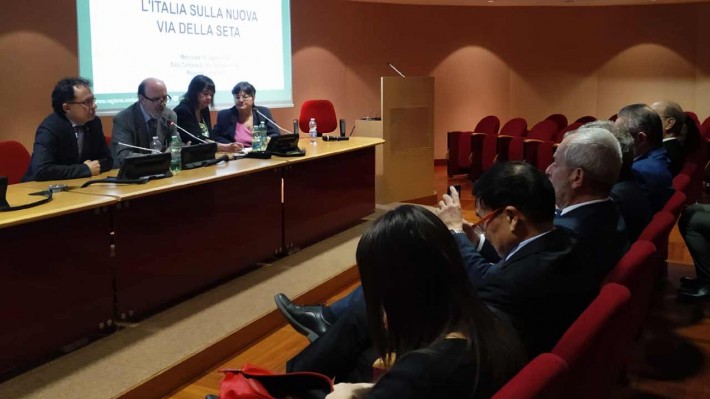
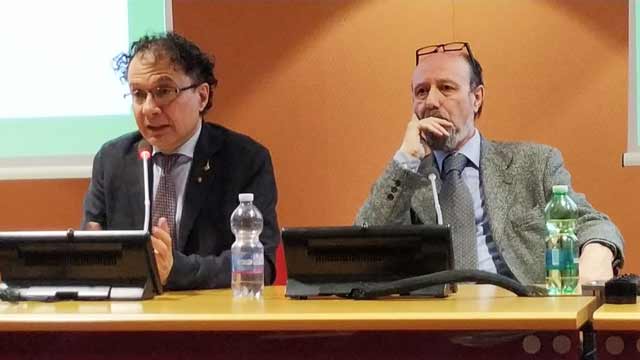
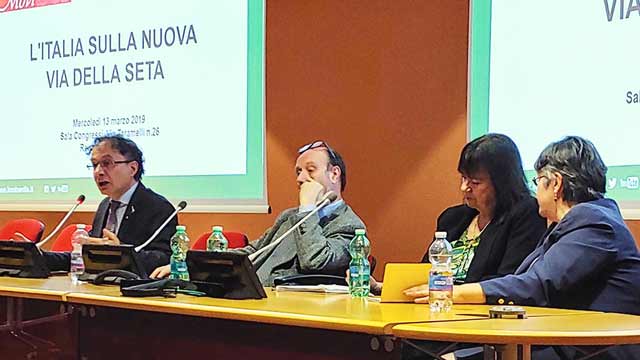
The conference “Italy on the New Silk Road” organized byMovisol (LaRouche’s movement in Italy) and the Lombardy Region(state legislature) in Milan Wednesday, was a success, withUndersecretary Michele Geraci (of the Task Force China in theItalian government) opening it and emphasizing the importance ofthe MOU which Italy will sign with President Xi Jinping on March22 in Rome, of the benefits for Italy of this cooperation withChina, including for the development of the Italian Mezzogiorno.
Undersecretary of the Task Force China in the Italian government, Michele Geraci and EIR’s Claudio Celani.
Geraci was followed by Helga Zepp-LaRouche, who explainedthe more profound meaning of this important development for therest of the world, the realization of the New Paradigm for whichLyndon LaRouche and the Schiller Institute have been working forthe last 30 years. See a full text of Helga’s remarks below.
There was a short message from Sen. Tony Iwobi, the firstNigerian parliamentarian elected for the Lega, about thehistorical significance on the Transaqua project, which was thendescribed in detail by Engineer Bocchetto of Bonifica, which isworking on the feasibility study with China.
Geraci, Celani, Zepp-LaRouche and Movisol leader, Liliana Gorini.
Liliana Gorini, chairwoman of Movisol, concluded theconference by thanking the Lombardy Region, which had helped toorganize it, and dedicating it to Lyndon LaRouche, who is knownin Italy not only as the “visionary” of the New Silk Road, asformer Economics Minister Giulio Tremonti defined him Tuesday in Corriere della Sera, but also as the main promoter ofGlass-Steagall and LaRouche’s Four Laws, and reminding people howmany parliamentarians who had heard him speak at the ItalianFinance Committee at the Parliament in Rome in 1998, admittedyears later that he was completely right.
TRANSCRIPT OF HELGA ZEPP-LAROUCHE’S REMARKS
ZEPP-LAROUCHE: It is in one sense quite amusing to seewhat high waves the possibility of Italy signing the MOU withChina is causing right now. Because, when Xi Jinping announcedthe New Silk Road in 2013 and then proceeded to make treaties inthe meantime, I think it’s with 112 countries, an enormous growthdeveloped, six major industrial corridors, the Belt and RoadInitiative became very quickly the largest infrastructure projectin history, ever. And the strange thing was that for about fouryears, in the mainstream media in the United States and Europe,there was practically no reporting about this.
And then, all of a sudden, in an obviously coordinated way,the major think tanks of Europe and the United States started aseries of attacks, studies, that China is causing countries tofall into a debt trap, that it’s just an effort to replace theUnited States as the dominant force in the world, to becomeChinese imperialists, that the Belt and Road projects are notviable, that China is an authoritarian system and Xi Jinping is adictator. So all of a sudden, you had a barrage of attacks onthis concept.
The funny thing is, if you would ask and listen to theleaders of the countries cooperating with the Belt and Road, likethe Africans, the Asian countries, the Latin American countries,they would be full of praise and say that with the Chinesecooperation, they have for the first time, the opportunity toovercome the underdevelopment and poverty they had suffered as aresult of Western colonialism, and 70 years of IMFconditionalities, which prevented them from having exactly thatkind of development. And they were full of praise, calling Chinaa friend — so you get a completely opposite view.
I have come to the conclusion that everything in the Westernmainstream media are saying about China is fake news, and just alie. And it comes from the fact that many people in the Westsimply have lost the ability to imagine that any country, letalone China, could promote something which is, indeed, for thecommon good of all of humanity. When Xi Jinping talks about the“shared community of the common future of mankind,” or the“community of destiny,” he means it! And isn’t it obvious thatin the time of thermonuclear weapons, in international spacetravel, of conquering all the problems of the world, that we haveto think about the one humanity first, before we talk aboutnational interests? As a matter of fact, the concept of a win-wincooperation for the Belt and Road Initiative, it has all theeconomic aspects which are beneficial to all the countries thathave participated.
But it is much more than that: Because from the standpointof the evolution of mankind, if you take a step back, and don’ttake a look at the conflict between Marseille and Trieste, whichI understand is obviously very important for the Italians, but ifyou look at the larger point of view, isn’t it natural thatinfrastructure development would eventually open up allcontinents and connect them?
So now, all of a sudden, you have this eruption ofanti-China propaganda, but it comes from the fact that we are nowat a point where something is happening, which has alreadyhappened 16 times in history, namely, that the up-to-now dominantpower is being surpassed by the up-to-now second largest power.And in history this has led 12 times to war, between those twocompeting power, and 4 times it was just that the second powersurpassed the dominant power without war. China has emphasizedmany times, they don’t want, obviously, to follow the 12 exampleswhere this conflict would lead to war, but they also don’t wantto simply replace the United States in the role of the leader ofan unipolar world, but that they want to build a completely newsystem of international relations based on sovereignty, onrespect for the different social system, on non-interference, andactually proposing a completely new system of internationalrelations.
So, the big question strategically is you have the conflictbetween the United States and Russia, which is obvious, becauseof the cancellation of the ABM Treaty, then the Russian reactionto that, and now the cancellation of the INF Treaty — so thereare many who think that we are actually close, in worse strategiccrisis than during the height of the Cuban Missile Crisis,because of the relations between the United States and Russia.But if you talk to some strategic insiders on both sides of theAtlantic, they easily admit that the much more dangerous conflictis actually the one between the United States and China: Willthe United States accept the rise of Asia, and the Belt and RoadInitiative is just the obvious expression of that? Or, is whatwas said by the RAND Corporation a couple of months ago, thatit’s better to have the war with China now, than in 10 years,because the casualties will be less?
Well, obviously, this is something we have to change, and Ithink that the best way to change it is, indeed, to bring in thisreality of a new paradigm of thinking altogether: We have toleave geopolitics. We have to leave the idea that there can be alegitimate interest of one country, or a group of country,against another bloc of countries, because this was what ledtwice to world war in the 20th century. As a matter of fact, Ithink the potential to overcome this conflict is absolutelythere. I know in Europe, many people are fainting when youmention the name of President Donald Trump, but President Trumpis not seeking confrontation with Russia — as a matter of fact,he wants to have an improved relation with Russia, which heproved in the summit with Putin in Helsinki. And despite thepresent trade tension, President Trump always talks aboutPresident Xi Jinping as his very good friend, and China being agreat country and that he wants to actually have a goodrelationship between the United States and China.
So the attacks on Italy, coming from the White House — the[i]Financial Times[/i] mentioned this Garrett Marquis — is notrepresenting the same view as Trump. It comes from a faction ofthe neo-con which are unfortunately also in the TrumpAdministration, but the factional situation in the United Statesis very divided. You have the Democrats and the neo-cons tryingto get Trump out of office with Russiagate, but on the otherside, I think President Trump has proven a tremendoussustainability against the efforts to drive him out of office,and his supporters are absolutely backing him, and the chancesthat there will be a second Trump Administration are actuallyvery, very high.
Now one of the accusations against China and the Belt andRoad Initiative is that it would divide Europe. I thinkeverybody knows Europe is divided already, without China: Youhave the North-South conflict because of the EU austerity policy,which impoverished, Greece, Italy, Spain, Portugal, gave nodevelopment to the East European countries, so they are now happyto cooperate with the Belt and Road initiative, because the EUdid not provide these things. Now, the second area of divisionis obviously the migrant issue, where you have the divisionbetween East and West — the East European countries do not wantto have any part of the proposed quota system of the EU.
Now, what Italy is actually doing in this context is reallya role model, because the kind of cooperation between Italianfirms and Chinese firms in the development of Africa is actuallythe only human way to address the refugee question.
So you have right now 13 countries which have already signedthe MOU with China; you have, now with Italy, the first G7country (which is really overrated, because the G7 is no longerthat important as compared to the G20, for example). And youhave many ports — Mr. Geraci said, if actually all the ports ofEurope which are already wanting to be a hub between not only theNew Silk Road over the land route, but also hubs to the MaritimeSilk Road, Portugal and Spain becoming the hub for all theSpanish- and Portuguese-speaking countries around the world. Sothere is a completely changed attitude developing very quickly.
Now, also even in Germany and France, the two countrieswhich are now trying to put the brakes on the most, apart fromthe EU Commission, there are many cities which are absolutelyrecognizing their self-interest to cooperate with the Belt andRoad Initiative. You have three states in Germany —Schleswig-Holstein, Bavaria, and Brandenburg — which all thetime have huge delegations back and forth; you have many citieswhose mayors are complete fans of cooperation with China, and itis an increasing dynamic, which is growing more rapidly than youwould think.
So, if you would ask my prognosis, I think the perspectiveof unifying Europe, not necessarily under the EU bureaucracy, butin the conception of de Gaulle, more like a “Europe of theFatherlands” uniting with China, with Russia, with the Belt andRoad Initiative, the Eurasian Economic Union [EAEU], and Europeancountries, to cooperate fully in this new paradigm is absolutelythere.
Well, I think that that is also the only way how Europe canimpact the strategic situation: Because if you had a unitedEurope of the Fatherlands cooperating with the Belt and RoadInitiative, including Germany and France, that would be the bestway to get the United States to also give up their opposition —which I said, is not Trump himself, but these other forces — andget the United States to join the new paradigm. And I think thisis the [i]only[/i] hope we have to avoid a catastrophe where we wouldend in World War III with nuclear weapons, meaning the extinctionof civilization. So in that sense, what Italy is doing right now,is of the greatest historical importance, because Italy, withwhat you are doing, with the MOU but also with the joint ventureswith China in Africa, can become the role model for all the otherEuropean countries.
But the New Silk Road is not just an economic concept.Obviously, infrastructure, investment, all of this is extremelyimportant, as the backbone, but it has a much more, and not sowell-known cultural/moral dimension, which I think is bestexpressed in the fact that the Chinese thinking is actually basedon the Confucian theory, namely, that you absolutely must haveharmony among all the nations, developing all in a harmoniousway. And when some think tanks say that there is now acompetition of systems between the Western liberal model and thestate-guided model of the Chinese state economy, well, what theyreally mean is, China has developed its whole policy based on aConfucian orientation, which means that the state is also incharge of the moral improvement of its population through theaesthetical education. As a matter of fact, Xi Jinping has saidrepeatedly, that he puts the highest emphasis on the aestheticaleducation, because the result of this is the “beauty of the mind”and the “beauty of the soul.”
So the problem is, the reason why some people in the Westregard that as a competition, is because Western neo-liberal andliberal philosophy has moved away from that conception: We areno longer humanists. We are no longer thinking as during theItalian Renaissance or the German Classical period, but we havereplaced that with a liberal thinking of “everything is allowed,”every degenerate form of culture is allowed, everything goes — Idon’t want to elaborate that, but if you look at the violence,the pornography in the entertainment, we don’t have to worry. Wewill lose that competition of the systems, simply because we arenot taking care of our future generations, but allowing them tocompletely morally decay.
And that is why I think that we have to understand that theonly way how Europe can persist in the coming future is notthrough military power — what Mr. Macron is proposing isridiculous — but we will preserve our European culture [i]only[/i] ifwe return to the greatest tradition of our own history, meaningreviving the spirit and the ideas and principles of the ItalianRenaissance, of the Ecole Polytechnique of France, of the GermanClassical music, literature, and poetry. Only if we rise againto our best traditions can we persist in the coming world.
So I think that the cultural dimension of the New Silk Roadis as important, if not more important, than the question ofeconomics.
I would be happy to take any questions. Thank you.
The Schiller Institute held the first U.S. national conference in over fifteen years on President’s Day weekend, yielding a tremendous success in respects to the quality of presentations and the participation by supporters around the world attending the conference. The conference, now presented in full below, conveys a truthful and optimistic view of the potential for mankind as a whole to overcome the crisis facing the world as the previously reigning, now dying, British Empire fights for its survival against the new world order taking hold in the vision of Lyndon and Helga Zepp-LaRouche.
Panel I — Let Us Create a New, More Human Epoch for Mankind
Lyndon LaRouche Speaks: A Talent Well Spent
Jacques Cheminade, President of Solidarité & Progrès, The coming world of Lyndon LaRouche
John Gong, Professor of Economics at the University of International Business and Economics, Beijing, Chinese Investment and American Infrastructure under the new Sino-US relations
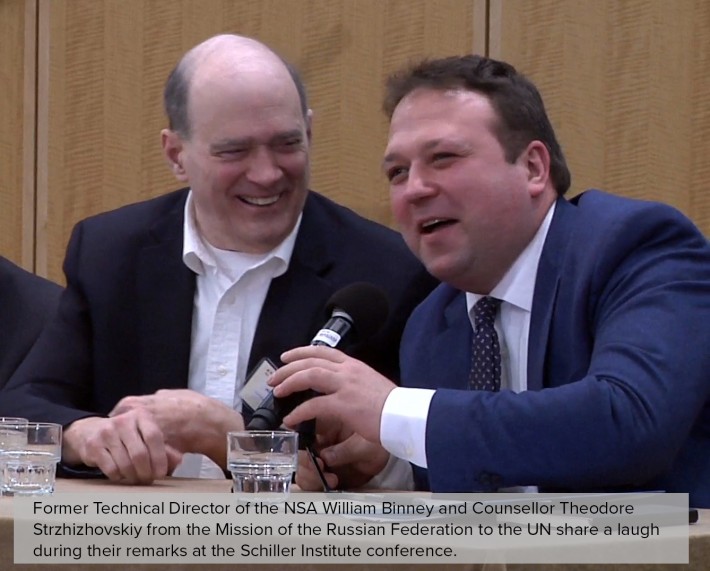
H.E. Ambassador Vassily A. Nebenzia, Ambassador and Permanent Representative of the Russian Federation to the United Nations, Presented by Counsellor Theodore Strzhizhovskiy, Mission of The Russian Federation to the UN, Prospects for East-West Collaboration: The Russian Federation’s View (transcript)
William Binney, Former Technical Director, NSA
Jason Ross, Schiller Institute co-author “Extending the New Silk Road to West Asia and Africa”, The Urgent Need for a New Paradigm in Africa
Dennis Small, EIR Ibero-America Editor, Justice for the World: Why Donald Trump Must Exonerate Lyndon LaRouche Now
Panel II — The Aesthetic Education of Man for the Beauty of the Mind and Soul
Schiller Institute combined chorus:
Benjamin Lylloff, arr: “Mo Li Hua” (“Jasmine Flower”)
Benjamin Lylloff, director
H.T. Burleigh, arr: “Deep River”
William L. Dawson, arr: “Ev’ry Time I Feel the Spirit”
Diane Sare, director
Megan Beets, LaRouchePAC Scientific Research Team, “Artistic and Moral Beauty“
Bruce Director, Secretary-Treasurer, US Schiller Institute
“On LaRouche’s concept of significance of Art for Science and Science for Art”
Diane Sare, Managing Director of the Schiller Institute NYC Chorus, “The Choral Principle”
Johannes Brahms: “Dem dunkeln Schoß der Heil’gen Erde”
(text from Schiller’s “Song of the Bell”)
Schiller Institute Chorus
John Sigerson, director
Johann Sebastian Bach: Brandenburg Concerto No. 5 in D Major, BWV 1050
I. Allegro
Schiller Institute Orchestra
John Sigerson, director
Soloists: Gregor Kitzis, violin; Laura Thompson, flute; My-Hoa Steger, piano
Ludwig van Beethoven: Choral Fantasia, Op. 80
Schiller Institute Orchestra, Chorus, and Soloists
John Sigerson, director
My-Hoa Steger, piano
Q&A Session
Panel III — The Frontiers of Science
Yuting Zhou, piano, Johannes Brahms: Rhapsody, Op. 79, No. 1 in B minor
Kesha Rogers, LaRouchePAC Policy Committee, Former candidate for U.S. Congress, The Frontier of Space: Fulfilling Mankind’s Destiny as Man in the Universe
Thomas Wysmuller, Founding member of The Right Climate Stuff, What NASA has Done and Where NASA is Going
Larry Bell, Founder, Sasakawa International Center for Space Architecture, College of Engineering, University of Houston, What Makes People Exceptional
Benjamin Deniston, LaRouchePAC Scientific Research Team, LaRouche’s Strategic Defense of Earth
Hal BH Cooper, Jr. PhD PE,Infrastructure needs for the Rail, Energy and Water Systems to Promote Future Economic Development of Africa
Message to the Schiller Institute national conference, Feb. 16, 2019 by H.E. Ambassador Vassily A. Nebenzia, Ambassador and Permanent Representative of the Russian Federation to the United Nations, presented by Counsellor Theodore Strzhizhovskiy: “Prospects for East-West Collaboration: The Russian Federation’s View”
[This transcription was created by the Schiller Institute]
DENNIS SPEED: Next we have a statement from His Excellency Ambassador Vassily A. Nebenzia, Ambassador and Permanent Representative of the Russian Federation to the United Nations. It will be presented by Counsellor Theodore Strzhizhovskiy of the Mission of the Russian Federation to the UN: “Prospects for East-West Collaboration: The Russian Federation’s View.”
THEODORE STRZHIZHOVSKIY: Ladies and Gents, it’s a real pleasure for me to be here, giving the tribute to the role which Russian-American relations plays in the modern world, and the contribution of the Schiller Institute to that relation, we prepared a statement which I will read now.
First of all, I welcome the organizers, participants and guests of this conference. The Schiller Institute is known for its valuable contribution to the understanding of international political processes, and development of new approaches to the global challenges. The conferences held under your auspices are respectful platforms, where the most urgent present-day issues can be discussed without politicizing and ideological clichés.
We were very saddened by the bitter news about the passing of Lyndon LaRouche, the founder and inspirer of the Schiller Institute. We would like to express our deepest condolences to Helga Zepp-LaRouche, as well as to the relatives and colleagues.
We are convinced that the paradigm of international, political, and economical intervention that he had proposed will be further developed by his apprentices and associates. [applause]
We believe that the assent of a more human epoch is only possible when the world enjoys a more equitable, polycentric model of governance. However, recently we have become witnesses of the attempts to shatter the world security architecture, substitute agreed universal norms by some rules-based order, where rules are invented, depending on the geopolitical interest to concrete countries. Nonetheless, dangerous for the global stability is the striving of the governments of some countries to unilaterally impose their will on the global community, or on specific sovereign states, or even to interfere in their domestic affairs. In the same light, we should view the use of sanctions as a tool to execute pressure and punish the countries that implement an independent policy.
Russia is proud to be located between West and East. Historically, we have been implementing multitask foreign policy and developing relations with other countries in the spirit of mutual respect. Russia comprehensively helps to search for, based on international law, collective decisions to the global problems which all the countries face today. We consecutively engage in the activities of the UN and Group of 20, to contribute to the relevant forms of interaction, for example, Collective Security Treaty Organization, Eurasian Economic Union, Commonwealth of Independent States, Shanghai Cooperation Organization, BRICS. One of the conceptual pillars of developing this sort of cooperation was proposed by President Putin in his initiative called, “Greater Eurasian Partnership.” It would bring together member states of the Eurasian Economic Union, Shanghai Cooperation Organization, and Association of Southeast Asian Nations. Probably one day, it would encompass the European Union. The previous year was marked by a number of significant steps to implement this project: The Eurasian Economic Commission and ASEAN signed a Memorandum of Understanding which was crucial for the extension of the geography and economy of the Eurasian Partnership. Adoption of the declaration on further development in integrational process in the Eurasian Economic Union made it possible to extend the establishment of common markets and add to it such areas of cooperation as education, research, health care, and trade. The Eurasian Economic Union and Chinese initiative, One Belt, One Road, joined the integration and transportation projects on contractual and legal basis of the agreement on trade and economic cooperation.
Bilateral cooperation of Russia and China also takes on global dimension. Our effective foreign policy coordination, including the UN platform, has become a significant factor of stabilization in global policy.
We are also committed to foster our relations with another privileged strategic partner: India. This commitment was reiterated in the joint declaration “Russia-India Reliable Partnership in a Changing World,” adopted at the bilateral summit in October.
We cannot but mention an unofficial summit, Russia-India-China, that took place in December in Buenos Aires after a 12-year pause.
Relations between Russia and the U.S. are also crucially important for global stability, because we are two states, major nuclear powers and UN Security Council permanent members. We face shared challenges: international terrorism, military and humanitarian crises, drug trafficking, transnational crime, and others. The success of our joint efforts of these and many other tracks is that both Moscow and Washington are interested in what is needed in the sustainable development of all countries. Russia understands the increased responsibility of both states for global peace and security. We have repeatedly expressed our readiness to normalize the relations between our countries. We hope that systemic political dialogue with our American partners, based on mutual respect and consideration of each other’s national interests, will be resumed.
We are convinced that the present-day world has no alternative to cooperation and merge of potentials. Only this path may lead to the assent of a more human epoch.
We wish for this conference to be creative, and contribute to mutual trust and confidence of global affairs. We wish you every success and hope we will have meaningful discussions.
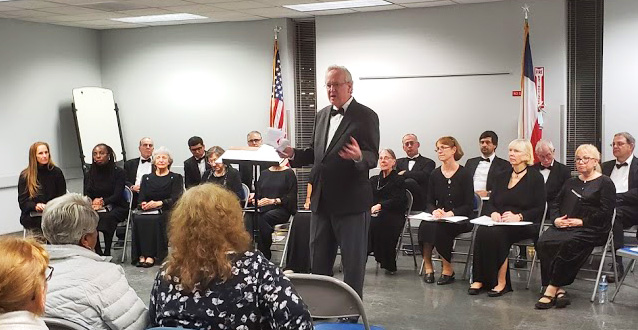
On Friday, January 25, the Schiller Institute Houston Community Chorus invited members of the community to celebrate the life of Dr. Martin Luther King Jr. at an event in southwest Houston.
Texas Schiller Institute spokesman Brian Lantz opened the event highlighting the shifts occurring globally towards greater cooperation, and that Dr. King knew the only way to create a durable peace was through the reconciliation of differences and non-violent cooperation, even if some attempt to stifle it. He described how King saw cooperation through the idea of agapic, unconditional love for humanity, as expressed in the first Corinthians. Dr. King was an avid lover of classical music and opera, as was his wife, Coretta Scott King, a trained pianist and classical singer.
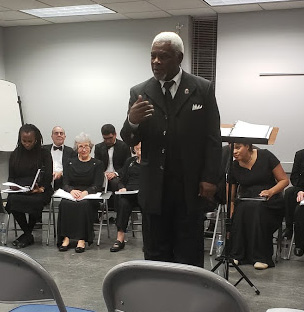
Texas Schiller Institute head Brian Lantz’s opening remarks on Dr. King.
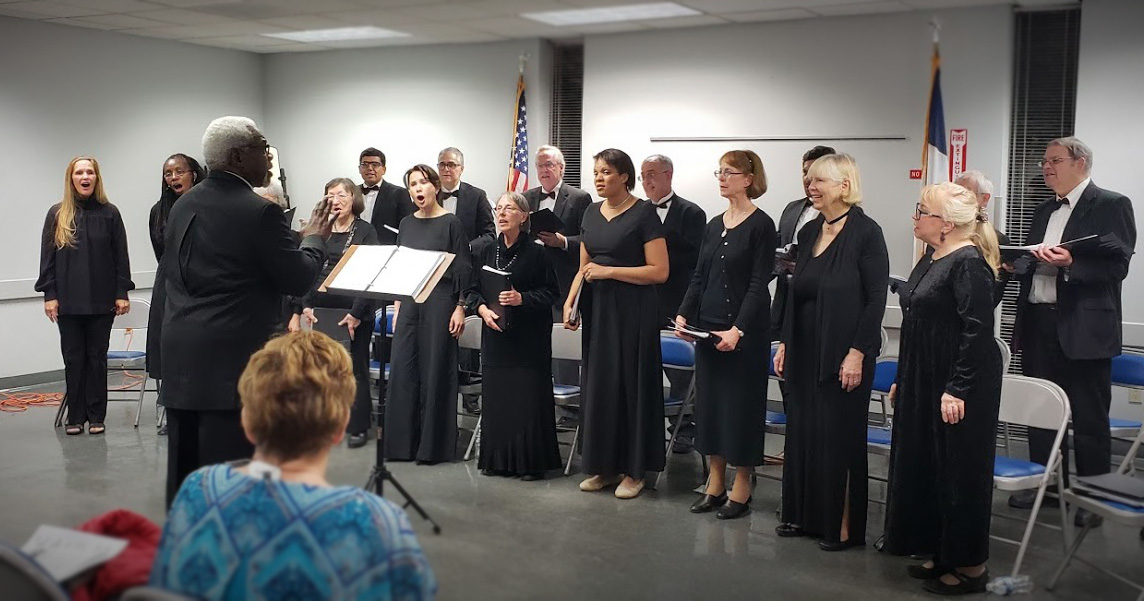
The chorus opened the concert with a four part polyphony of the anthem “Lift Every Voice and Sing”, followed by a collage of short audio speeches by Dr. King. The program continued with four selections from the Mozart Vespers, Mozart’s “Ave Verum Corpus”, a traditional Chinese folk song, “Jasmine flower” (Mo Li Hua), and a number of spiritual selections, one of which was led by tenor Brian Lantz. Among the highlights of the evening were the solo spiritual performances of “Go Down Moses” sung by Maestro Dorceal Duckens, and “Swing Low Sweet Chariot” sung by Kesha Rogers.
Maestro Dorceal Duckens singing ‘Go Down Moses’.
The audience was truly transformed by the power of the music and the selection of clips from Dr. King intertwined. At the end of the event the audience was asked to stand and cross arms and join in in singing “We Shall Overcome.”
The Houston Schiller Institute Community Chorus.
Newer members to the chorus expressed how happy they were to sing with the chorus. Everyone was overjoyed by the experience and you had a sense that the concert had a transforming quality on everyone. It was not just entertainment, and no one left the room as the same person they were when they entered.
On January 1st, the Virginia Schiller Institute Community Chorus continued its tradition of ringing in the New Year with a concert of Classical music in Leesburg, VA. Megan Beets, director of the chorus, opened the concert quoting Friedrich Schiller, “Live with your century, but be not its creature; give to your contemporaries, but what they need, not what they praise…. Your own nobility will awaken theirs, and their unworthiness will not defeat your purpose.” She challenged the audience with Schiller’s maxim that a beautiful culture is not an option, but that beauty and the beautiful character is a necessary condition for mankind. She also reminded the audience of the true context in which we welcome the new year,
Virginia Schiller Institute Choral Director, Megan Beets
“…we are in a period of great change and transformation for all mankind. The old order of empire and war is collapsing as we speak, and new possibilities for the future of humanity are coming to the fore–for example, the fact that a little over 12 hours ago, a little space craft from planet Earth called “New Horizons” flew by and gathered data from an an object in the farthest reaches of our solar system, over 4 billion miles away. Or that in the next day or two, a little spacecraft from planet Earth called “Chang’e 4”, launched by China, will attempt the first-ever landing on the far side of the Moon.”
With this introduction, the 90+ minute program began, a lively mix of offerings by the chorus and musician friends, including vocal and instrumental soloists. The chorus performed Spirituals, two pieces from Handel’s Messiah, and two “Glorias”—one a chorale from Bach’s Wachet Auf and the other from Beethoven’s Mass in C. Other offerings included Bach solo strings—one each for violin, viola, and cello; the first movement of Dvorak’s “American” string quartet; a Mozart trio from Cosi fan tutte; a trumpet air from a Bach cantata; and vocal solos including a Schumann lied, Russian folk songs, and Burleigh’s “Honor! Honor!”
The audience, 100 people (with roughly 50 musicians on top of that) was diverse mix of teachers, musicians, students, former local politicians, friends of the church, and others who had seen the concert advertised in shops and in newspapers. Attentive and engaged throughout the entire 90+ minute event, the general response from the audience was one of awe. Many attendees, coming to hear music, were struck by the directors opening remarks and how fitting they are for today’s times. “I can’t believe what I heard and saw, this was wonderful, I could hardly keep from crying!”, reported a local businesswoman and former federal government employee who came off a weekly paper ad. “Awesome! Such diverse talents! Diverse community too!” “Wonderful way to begin the year. Thank you so much!”
Several of the soloists who performed also reiterated their appreciation for the opportunity to work the Schiller Institute. One soloist, inspired by the Schiller Institute’s “top-down” approach to thinking about global events and culture, and moved by Michelle Fuchs’ two Russian pieces, decided she would also start working on Russian songs as a way to share their culture with Americans. Another soloist said, “I wouldn’t miss these concerts for anything, they have become very special to me.” And a third soloist, “I’ve been watching this group; the tone of it is improving every time I hear it, it’s getting pretty good.”
The reception afterwards was festive and celebratory, with audience members expressing their gratitude towards the Schiller chorus for uplifting their state of mind, and creating such a memorable cultural impact in their community.
For more information on the Virginia Schiller Institute Community Chorus, contact va.chorus@schillerinstitute.org.
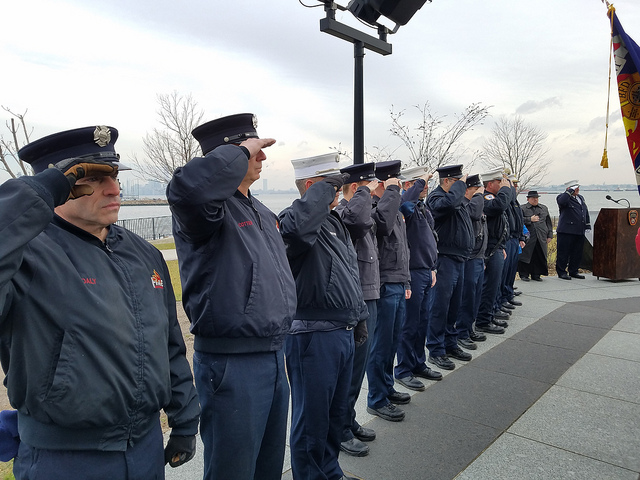
On January 3rd, 2019, for the third year in a row, a memorial was held in Bayonne, New Jersey for the victims of the December 25th, 2016 plane crash which took the lives of the many members of Russia’s famous Alexandrov Ensemble, journalists, philanthropist Elizaveta Glinka, and others. This memorial, organized by the Schiller Institute, took place at the foot of the “Tear Drop Memorial,” a 100-foot statue gifted to the United States by the Russian Federation in 2005 in honor of the victims of the September 11th, 2001 terrorist attacks.
Members of the Schiller Institute and the Schiller Institute NYC Chorus, led by Diane Sare, Founder and Co-Director, were joined by the Bayonne Fire Department Honor Guard, Captain Haiber and Chief Weaver of the Bayonne Fire Department, Dmitry Chumakov, Deputy Permanent Representative of the Russian Federation, Dr. Louay Falouh, Minister Counselor of the Syrian UN Mission, Father John Fencik of Saint Mary’s Carpatho-Russian Orthodox Church, and others in the ceremony. In opening the ceremony, the Chorus sang both the Russian national anthem (in Russian) and the US national anthem. The Bayonne Fire Department Honor Guard stood at attention throughout the forty five minute ceremony.
These performances were followed by comments from Deputy Permanent Representative Chumakov, who paid tribute to the victims of the 2016 tragedy and spoke to the continuation of the efforts of both the reconstituted Alexandrov Ensemble and the Charity Foundation of Elizaveta Glinka. He concluded with significant statement of Russian policy in Syria: “Considerable progress has been made on Syria in 2018. Now we need to step up joint efforts to launch the Constitutional Committee in Geneva, that would enjoy support of the Syrian parties, in accordance with the decisions of the Syrian National Dialogue Congress in Sochi. Syria’s future must be determined by the Syrians themselves in a political process they conduct and control with international mediation. Such an approach would contribute to settling and overcoming the consequences of the war; re-establishing the country’s full sovereignty and territorial integrity.” Mr. Chumakov’s full statement is available on the Russian Federation UN Mission’s website.
Then spoke Dr. Louay Falouh, Minister Counselor of the Syrian UN Mission, who thanked the government of the Russian Federation for their work to support Syria, and expressed his deep condolences for the losses of December 25th, 2016. Chief Weaver and Captain Haiber of the Bayonne Fire Department separately gave profound remarks expressing their condolences, as well as their thanks to Russia for the comfort they personally felt when visiting the Tear Drop Memorial. Bayonne first responders received enormous numbers of people fleeing by boat from Manhattan on 9/11. Captain Haiber told the audience, “At times like this, we are neither Russian nor American—we are human.” He also spoke in Russian, expressing his wishes for peace and friendship.
Father Fencik, whose close relative had been the translator at the famous meeting on the Elbe River between Soviet and American forces, gave an invocation saying that these dead will never be forgotten, and then gave a sung prayer in Russian.
At the conclusion, Diane Sare, Founder and Co-Director of the Schiller Institute NYC Chorus, spoke on behalf of the Schiller Institute and the Schiller Institute NYC Chorus, and read aloud the written message from Schiller Institute President Helga Zepp-LaRouche.
Two years after the tragic death of 64 members of the Alexandrov Choir Ensemble on their way to Syria on December 25th, 2016, that country is now almost entirely freed from the terror of ISIS due to the determined intervention of Russia in collaboration with the Syrian army. This liberation demonstrates what human beings can do when they unite with a good plan and for a just cause, and that, as Friedrich Schiller would say, even the most tyrannical foe can be subdued. As now there will be a more hopeful period in the history of Syria, with the economic reconstruction and the return of millions of refugees, the memory of the Alexandrov Choir Ensemble will be written into the history of Syria and should be celebrated every year with beautiful concerts in many cities, celebrating the Russian-Syrian friendship and the immortality of great art and the artists, who devote their lives to the ennoblement of mankind.
— Helga Zepp-LaRouche, Founder, Schiller Institute
Diane concluded her remarks by saying that this moment called to mind to words that Handel had immortalized the his Messiah “Death is Swallowed up in Victory.”
Each of the speakers made a special point of thanking the Schiller Institute for organizing the event. Russian news service TASS, as well as TV stations Russia 1 and RT were present.
Participation in this event had a profound effect on our activists and choir members who joined in. Patrick from Connecticut said, “I was so glad to be there and be a part of this. As I looked around and saw who was gathered here, I felt like we were on a kind of different planet from the rest of the population – and how important is that we do this.”
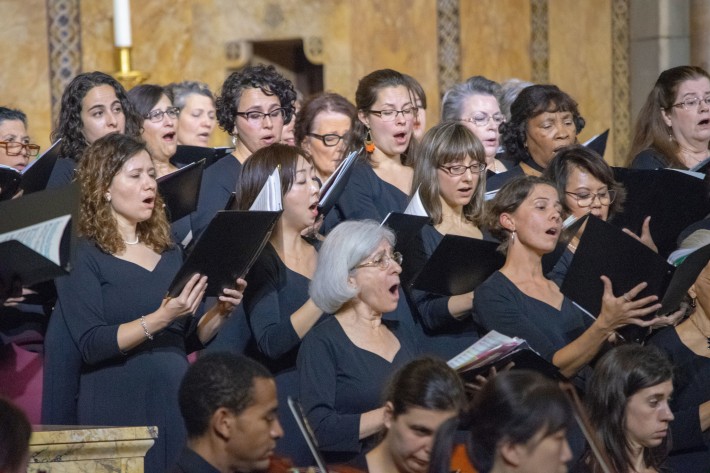
On November 18, 2018, the Schiller Institute NYC Chorus performed a concert at St. Bartholomew’s Church in New York City in celebration of Friedrich Schiller’s birthday. The concert included performances of Bach, Brahms, spirituals, Beethoven’s Choral Fantasia, Op. 80, and Beethoven’s Mass in C, Op. 86.
“It is my view that only if we reinstate a beautiful image of Man and celebrate this in the highest forms of Classical music, Classical poetry, beautiful painting, that we can get Mankind back its dignity. And therefore, at this joyful occasion of Schiller’s birthday, in a very tumultuous environment, and very tumultuous situation, the world is more in need of a Classical Renaissance than ever. So join the Schiller Institute, and the chorus, and let us create a better human civilization.” Helga Zepp-LaRouche, excerpt from concert program
We hope you enjoy and are inspired to act with us by this beautiful performance.
On Sunday, December 9th, 2018, the Schiller Boston Community Chorus hosted a classical music concert at Christ Church in Quincy, MA, which featured music from Russia, China, the United States, Europe and more. The intention of this concert was to bring together the cultures that are involved in, or should be involved in, the Belt and Road Initiative, and to demonstrate the universality of beauty and the principle of Classical composition.
Ana Maria Ugarte and Brian Landry.
The musical program was a beautiful mix of pieces and was introduced by Director of the Boston Schiller Community Chorus, Jen Pearl, who spoke of the urgent need for a Classical Renaissance, challenging people to think big, referencing the Chang e-4 launch (China’s latest mission to land a rover on the far side of the Moon).
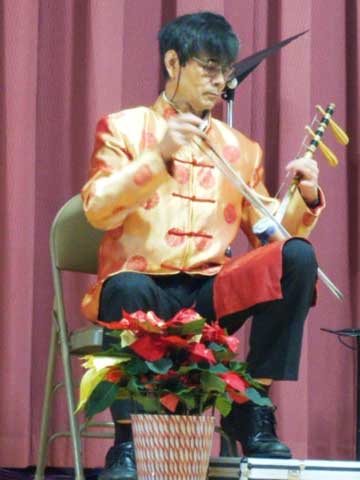
The concert was opened by operatic tenor Brian Landry, who drew people in with Messiah’s “Comfort ye” and “Every Valley.” The program included Brian and his wife, contralto, Ana Maria Ugarte, performing the duet “Gesu Bambino”and solos including “Deep River,” “Oh Holy Night,” and “Ave Maria”. The chorus and New Paradigm octet performed several Spirituals, Schumann’s Bankelsanger Willie, and Dem Dunkeln Schoss der heilge Erde, by Brahms. Other soloists included Michelle Erin Fuchs from the Schiller NYC Chorus performing a hauntingly beautiful rendition of “I wonder as I wander,” the Appalachian spiritual by John Jacob Niles and two beautiful Russian folk songs. Also a performance by a Jinghu player and a special treat, a Chinese soprano who performed two beautiful Chinese songs in her very light and high trained bel canto voice.
Among the 65 or so attendees were old friends, new friends just met at various Tree Lighting ceremonies and Christmas markets, members and leaders of the church congregations and networks with whom we have collaborated in various Chinese organizations, who expressed interest in our work on the New Silk Road and their strong wish for Americans to get on board with this optimistic and future oriented perspective. One attendee, upon realizing that some of the chorus member’s young children were able to sit through the entire concert and enjoy it, offered to bring their grandchildren to the next concert.
Donna Liao sings Chinese folk songs with bel canto technique.
The mother of one of our members said our concert was much better and more high quality than a recent professional group she saw perform Faure’s Requiem (which she hated). One very new chorus member brought five family members. The Chinese Jinghu player expressed disbelieve in how in-tune our chorus was, and how difficult it is for the opera group he performs with to stay in tune. One woman in the audience said “you all are a real asset to this community.” A Chinese father, who generally supports Xi Jinping, but also has been a bit skeptical, brought his young daughter to the concert and was moved by how passionately some of our chorus members conveyed the ideas of the music. He has been at a few events, read up on the Schiller Institute, and after the concert expressed renewed optimism saying the Belt and Road Initiative is having a very positive effect on the world.
Dr. Qingen Ke playing the Jinghu.
A number of people were curious about the New Silk Road and one woman collected extra concert programs to send to her son in South Carolina, who’s a minister. A group of three old friends who worked with the LaRouche movement in the 1990s and resurfaced for this event, expressed what many in the audience and chorus was sensing, that in these difficult times events like these are essential to uplift the minds and spirits of our people.
The reverberations are still coming in from this concert. Our chorus here is committed to grow and spread the rays of great classical ideas throughout our community. The potential for growth is massive, as there is a real hunger for profundity out there and a desire to connect our very diverse population, with a large Asian component, through that creative potential which is universally human.
For more information about the Boston Schiller Institute Chorus, contact schillerbostonchorus@gmail.com.