



Founder and president of the international Schiller Institute, Helga Zepp-LaRouche, was interviewed by Chinese host Yang Rui at the CCTV studio in Beijing, China on April 15, 2014.
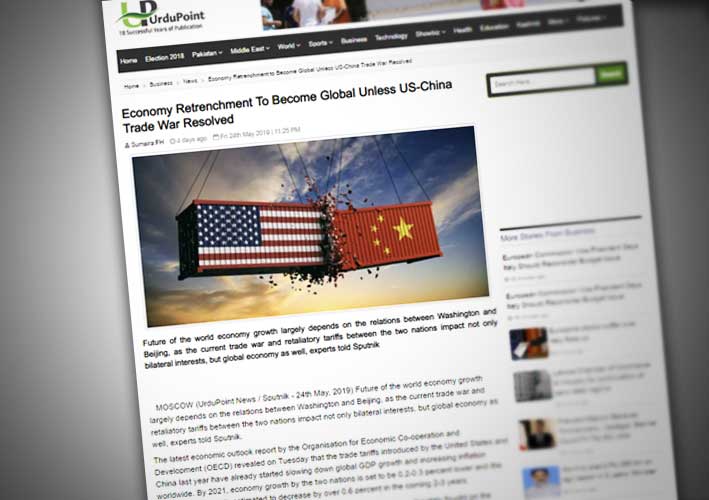
Under the title: “U.S.-China Ties Key to World Economy Growth,” UrduPoint in Pakistan on May 24 covered Helga Zepp-LaRouche’s interview with Sputnik. The interview was also covered in a Pakistani community newspaper, the Jago Times based in northwest Texas, May 25th.
“The state of relations between Washington and Beijing will determine the path of the global economic output in the next decade,” Helga Zepp-LaRouche, the leader of the German Bürgerrechtsbewegung Solidarität, or Civil Rights Movement Solidarity party, told Sputnik. “The key to the future of the world economy is the relation between the U.S. and China, which already has more than 300 million middle class consumers, a number that will double in a decade,” Zepp-LaRouche said.
The upward trend of Chinese imports presents a chance for the United States to reduce trade deficit between the two nations.
“China will import $40 trillion worth of imports in the next few years. All of this will offer excellent opportunities for the U.S. to reduce the trade deficit with China by exporting into that growing market and will very likely be subject of a deal between Trump and Xi Jinping,” the politician added.
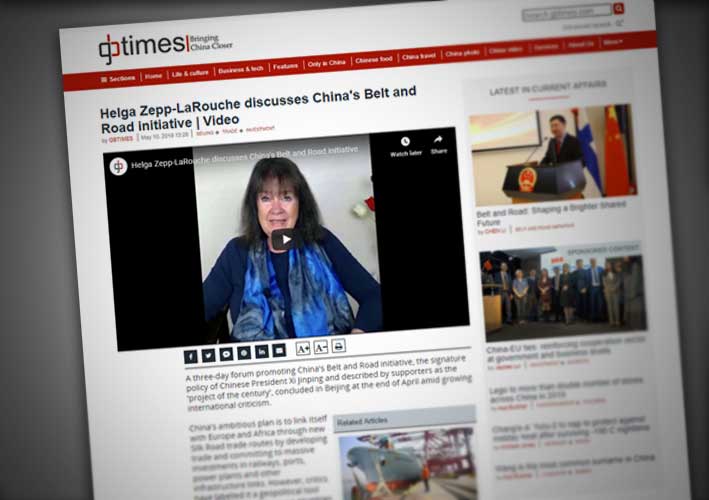
[Transcript included] Helga Zepp-LaRouche gave an excellent 42-minute video interview to GBTimes’ Senior Editor Asa Butcher on May 10. GBTimes is a Chinese multimedia site based in Finland, and established to enhance a dialogue between China and Europe.
Transcript
GBTimes: We’ll begin. I’m going to focus on the Belt and Road Initiative today, following on from the Forum in Beijing last week. If you could describe your feelings on the outcome of the Forum that concluded last week in Beijing.
HELGA ZEPP-LAROUCHE: Oh, I think it was very a really important progress as compared to the first Belt and Road Forum. The first Belt and Road Forum was filled with optimism and the knowledge of all the participants that we were experiencing the birth of a new system of international relations — that was already extremely important. But I think the Second Belt and Road Forum saw a consolidation of that, so you have actually a new system of international relations which is overcoming geopolitics, and I think this is one of the most important outcomes, apart from, naturally, the enormous economic development which was presented. But I think the idea that you have a system which has a win-win possibility for everybody to cooperate, is the way to overcome geopolitics, and that is the remaining danger, which after all, caused two world wars in the last century. So this is a real breakthrough for humanity.
GBTimes: There’s been a growing criticism and backlash against the BRI. Do you think this is misunderstanding, suspicion toward this new system? What are your thoughts on that?
ZEPP-LAROUCHE: It’s actually a temporary phenomenon, because the funny thing was, here you had the largest infrastructure program in history, ever, with enormous changes for Africa, for Latin America, for Asia, even for European countries, and the Western media and think-tanks pretended it did not exist for almost four years! And then, all of a sudden, they realized, “Oh, this is really growing so rapidly; it is including more than 100 countries.” So they started what I think was a coordinated attack, slandering the Belt and Road Initiative, with arguments which I think can all individually can be proven to be a lie. It comes from the old geopolitical effort to control the world by manipulating countries against each other, and with the Belt and Road Initiative, I think that possibility is vanishing, and that’s why they’re so angry and hysterical.
GBTimes: What could China do to reduce this demonization of the BRI?
ZEPP-LAROUCHE: I think China is already doing a lot. For example, even Handelsblatt, which was very negative towards the Belt and Road Initiative in the past, they had to bring an article which brought out the fact that the whole argument that China is putting the countries of the third world into a “debt trap” is not holding. For example, the IMF just released figures that there are 17 African countries which may not be able to pay their debt, but China is only engaged in 3 of them, and all of the others have huge debts to the Paris Club and to other big Western banks — so, who’s putting whom into a debt trap?
All of these arguments will be very easy to counter-argue, and the more China makes known its beautiful culture, people will be won over. Because the beauty of Chinese painting, of Classical music, it will win over the hearts. And the most people understand what China is actually doing, the less these attacks will be possible to maintain.
GBTimes: The attacks are more on China than on the Belt and Road Initiative, you say?
ZEPP-LAROUCHE: Well, yes. They’re on China because China is the major motor behind it. And some of the attacks were that China is supposedly an autocratical dictatorship, and surveillance state and all of these things. But first of all, concerning surveillance, I think the NSA and the GCHQ have outdone anybody already. And naturally China has a system which uplifts the morality of the people: This is based on the Confucian tradition, and for some of the very liberal people in the West, that is already too much, because it disturbs their idea that everything goes, everything is allowed, and from that standpoint, any kind of emphasis on morality is too much for these people.
GBTimes: Isn’t sometimes criticism of new ideas and initiatives healthy? It’s what we understand here in the West, we don’t openly unquestionably accept new things. We do question, and we are a little bit cynical sometimes.
ZEPP-LAROUCHE: It’s superfluous. It’s a waste of energy and it distracts people from accomplishing what needs to be accomplished: Namely, to overcome poverty in Africa, in Latin America, even in Europe. You know, Europe has 90 million poor people, and I have not seen a plan by the European Union to overcome poverty by 2010, which China intends to do with its own poor people.
So I think it’s a waste of energy, and it comes from what I call, when people put on geopolitical spectacles and have neocolonial headphones, then they see and hear the world quite differently from what it is, namely, they only project their own views.
GBTimes: Having been writing about China for the last 5-7 years, it has made a dramatic entrance onto the world stage, when I started writing about it many years ago. And the speed of its arrival, the size of the investments, it can scare a lot of countries — just family and friends who don’t know much about China, they want to know about my job where I’m introducing China to the West, as this bridge. There’s a lot of a misunderstandings. Do you think some of it comes from this ignorance? And how could that be changed?
ZEPP-LAROUCHE: I have the feeling that everybody who was in China, either as a tourist or as a business person, investing or trading, they all come back and they have a very, very positive view. People are impressed about what they see, the really incredible fast train system. Then, if you go in the region of Shenzhen, Zhuhai, Guangdong, Macao, Hong Kong, this is the powerhouse of the world economy, not just the Belt and Road Initiative.
Compare that with the decrepit infrastructure in the United States or many parts of Western Europe, for example. Less than two years ago, I was in Zhuhai at a conference, and we visited this bridge between Hong Kong and Zhuhai and Macao, linking this entire triangular: And this bridge was built, I think, in six years or eight years, including planning! Now, in Germany, we have a famous bridge between Mainz and Wiesbaden, which has been in repair for almost six to eight years, and it’s still not ready!
So, I think if people go to China, they come back and they are completely impressed, because they see that in China, people have now virtues, like industriousness, ingenuity, creativity — these are all values we used to have in the West, like when the Germany economic miracle was made in the postwar reconstruction, these values and virtues were German. But now, no longer. Now, we have all kinds of other crazy ideas, and therefore China is taking the lead.
So the people who go to China come back with a positive image, and those who have not been, naturally, they’re scared by the negative reports in the media. So the more people can actually go and form their own image, the better.
GBTimes: I have myself, I’ve seen a disconnect between China and Chinese society, and then the role of the Chinese government, the more negative side that gets covered about in the Western media. Do you think, for instance, with the BRI is just a way to legitimize the Chinese leadership in the world, and to raise it up to the same level that is given to the other countries? Do you think that’s acceptable?
ZEPP-LAROUCHE: Well, it is a challenge. Some of the Western institutions talked about that there is now a competition of the systems, meaning the Chinese state model and the Western free market model. And in one sense, it is true; the only problem is that if you have the neo-liberal system, especially after the crisis of 2008, only favoring monetarist interests — the banks, the speculators — and the gap between the rich and the poor becomes ever wider, naturally, then, if you have a country where that is not the case, namely, China having a policy which is oriented toward the common good, an increasing well-to-do middle class of 300 million people, which in 5-10 years will be 600 million people, and obviously the vector of development is upward, naturally that is regarded as a threat by the neo-liberal establishment, which only takes care of its own privileges.
So in a certain sense, the challenge does exist, but I think there is the possibility of a learning process, so one can be hopeful that even some elements of the Western elites will recognize that China is doing something right.
GBTimes: What do you think China could learn from the Western mode? And vice versa, what do you think the two could learn from one another?
ZEPP-LAROUCHE: I think China can learn a lot from the West, but I’m afraid to say, not from the present, contemporaries, or, there is very little to learn. Naturally, ESA cooperating with the Chinese space agency, there is a lot of exchange possible. But in terms of general, cultural outlook, I think China has to go back about 200 years to find positive things in Europe, or the United States, for that matter. You know, European Classical culture can be an enormous enrichment for China, but these are composers who are Bach, Mozart, Beethoven, Schubert, Schumann, or great poets. But these are all things which, unfortunately are not dominating the cultural outlook of most Europeans and Americans today. So there has to be a dialogue across the centuries, and then both sides can profit from each other.
GBTimes: In a sense, you’re very pessimistic about the Western stands at the moment. Do you think China is the only option available to the West at the moment?
ZEPP-LAROUCHE: No, I’m not pessimistic, I’m just saying that you see that some of the elites, or so-called elites, are hardened in their view. You have others who are absolutely recognizing that the whole mankind needs to cooperate together in new ways, for example, Switzerland. You know the President of Switzerland, who participated in the Belt and Road Forum just signed a memorandum of understanding, not only for Switzerland, but for a whole group of Central and Eastern European countries, which Switzerland is representing in the international organizations.
So there is a big motion. You have Italy signing a memorandum of understanding with China, on the development of Africa. Greece wants to be the gateway between trade from Asia, through the Suez Canal all the way into Europe. Portugal and Spain want to be the hub for the Portuguese- and Spanish-speaking people around the world.
So there is a lot of dynamics and motions, I’m just referring to some of the monetarist views and those people who talk about the “rules-based order” all the time, but what they really mean is austerity.
So, I’m not talking about the West in general. I think the West — I’m an optimist about the potential of all human beings — I’m only talking about certain parts of the establishment in the West.
GBTimes: You mentioned Italy and Switzerland. How significant is it that they signed up to the BRI now?
ZEPP-LAROUCHE: I think this is extremely important. First of all, Italy, as you know, is the third largest economy in Europe. The north of Italy is highly industrialized and has a lot of industrial capability; many hidden champions actually are in northern Italy. So, if such a country is now, as the first G7 country, officially joining with a memorandum of understanding, this can become the model for all of Europe. And Prime Minister Giuseppe Conte who just participated in the Belt and Road Forum came back and said exactly that: That Italy plans to be the leader in bringing about a better relation between China and Europe. So I think this is extremely important.
And Switzerland, even if it may be a small country, they are independent; they are sovereign, they are not part of the European Union. And President Maurer just declared, or his spokesman, that they do not need advice from the European Union because they can make their own policy. So, I think this is all a new, healthy spirit of self-consciousness and self-assertion, which is very good, and can be indeed a sign of hope for everybody else.
GBTimes: How do you see it impacting Europe, their participation in the BRI, in the short term, and perhaps in the longer term?
ZEPP-LAROUCHE: Well, there are different learning curves: Some are quicker, others are slower. For example, the so-called four big countries — that does not include Italy — that did not send heads of state or government, but only ministers, Spain, France, Germany, and I think Great Britain, by not sending their heads of state sort of expressed their reservation. But then even the German Economic Minister Altmaier, who on the first day of the Belt and Road Forum basically said, “we have to have transparency and rules,” with the usual kind of arguments, but the next day, he said something much more positive. He said: Oh, this was much better than I expected, the Chinese are actually trying to solve problems, and I will come back in June with a large delegation of businessmen. So, I actually find this quite good. It shows that eventually, I think, I hope, reason will prevail.
GBTimes: I think some of the obstacles for Western countries, is like Turkey refusing to participate because of the Uighur problem; that there are other issues that aren’t related to the Belt and Road, that China has to overcome first.
ZEPP-LAROUCHE: All of these problems will eventually be solved, because I think the key to solving of any regional, ethnic, historical cultural problem is development. If people actually see the advantage of turning non-developed countries or areas into prosperous ones, into having more youth exchange, young people understanding each other, people-to-people exchange, dialogue of cultures, bringing forth the best tradition of each culture; plus, naturally, real improvement of living standards, longevity, I think that even if not all develop with the same speed, we are at a tremendous change of an epoch of human civilization. The idea of these local and regional conflicts will eventually not be there any more.
If I just can point to the fact that now the eight radio-telescopes working together, being able to make, for the first time, images of the black hole in a galaxy which is 55 million light-years away, proving that Einstein’s theory of general relativity was actually correct — now, that, for me is the sign of the future: Because this image could not have been made by one country alone. It needed telescopes sited in Chile, in Spain, in the United States, in the Antarctic, and you needed the whole world actually working together to make such a technological breakthrough possible.
I think that that will be the kind of relationship people will have to each other in the future, and I think this is what Xi Jinping really is the kind of thing he means when he says, “a shared community for the one future of humanity.” Because the common interest will eventually come first, and then everything else will fall into place.
GBTimes: Another one of the criticisms was currently “all roads lead back to Beijing” rather than a multilateral approach to BRI, where it’s between other country, it always leads back to China at the moment. Do you think that is a problem?
ZEPP-LAROUCHE: I don’t know. First of all, I think Russia has a big influence, I think the African countries are becoming much more knowledgeable and confident about their own role. There are many Africans who speak that, in the future, Africa will be the new China with African characteristics. So, I think it’s all changing very quickly, and those people who complain that there is too much Chinese influence, well, then they should bring in their active, creative contribution, and define what the new platform of humanity should be.
And I think China has said many times, and I have absolutely every confidence that that is the case, that they’re not trying to export their social model, but that they’re just offering the experience of the incredible success of the last 40 years of the form in opening-up, and basically tell developing countries, “Here, if you want to have our help in accomplishing the same thing, we are willing to provide it.” And naturally, the countries of the developing sector, which had been neglected, or even treated negatively by colonialism, by the IMF conditionalities, when they now have the absolute, concrete offer to overcome poverty and underdevelopment, why should they not take it?
So, I think all these criticisms are really badly covered efforts to hide their own motives. I really think China is doing the best thing which has happened to humanity for a very long time, and I think the Belt and Road Initiative is the only long-term plan for how to transform the world into a peaceful place. And I think that should be applauded and people should have a cooperative approach.
GBTimes: My next question was going to be, how confident are you that the BRI will pay off for China, but I get the sense that you’re very confident.
ZEPP-LAROUCHE: Oh, I think it already paying off! First of all, it makes it more easy for China to develop its own western and internal regions, because they are now sort of integrated into the Belt and Road transport routes to Europe, to Central Asia, integrating the Belt and Road Initiative with the Eurasian Economic Union, and hopefully eventually also the European Union. So I think it is already bringing benefits to China.
And from an economic standpoint, the more a country exports high technology goods and technologies, the more than becomes a motor to develop one’s own industry even to high levels. So it’s like a self-inspiration, so to speak, and that is already paying off. That’s what any country should do.
GBTimes: You mentioned technology: It’s also the digital Silk Road, Digital Belt and Road. Of course, China has a lot of control over its internet, on the Great Firewall: How much of a barrier do you think that will be for countries to build relationships via the Belt and Road Initiative?
ZEPP-LAROUCHE: You mean the G5 question and Huawei?
GBTimes: Well, partly that, too, but also the control of the internet inside of China, which is difficult for Western companies to do business, to establish themselves, as there are a lot of controls there. Do you think that could be a barrier, as part of the digital Belt and Road, that’s also being discussed.
ZEPP-LAROUCHE: Well, I think there can be ways of making arrangements which are satisfying to everybody. This whole question of “digital control” and so forth, is highly exaggerated, because, if you look at who is controlling the internet, you have the big firms, Apple, Google, Facebook, and they are very linked with the Western government’s. You know, in a certain sense, after the scandal of the NSA listening into everybody’s discussions, which erupted a couple of years ago and which was never changed or remedied or anything, we are living in a world where that already happening. And I think China is not doing anything more than the NSA or the already mentioned GCHQ doing that in the West.
So I think the fact that China has a competitive system, to this Western system is what causes all of this debate. Because the people who had the control of the internet first, they should like to keep it that way, and they regard China as a competitor, which they don’t like, but that’s a fact of reality now.
GBTimes: One question I have is why do you think the Belt and Road Initiative is needed, when there’s the Asian Infrastructure Investment Bank, now? Do you think the two are mutually exclusive, or do they work together?
ZEPP-LAROUCHE: No, I think the Belt and Road Initiative has many financing mechanisms. You have the AIIB, you have the New Silk Road Fund, you have a lot of the Chinese banks themselves which are doing the investment. I have been advocating for a very long time, that the West should modify its own credit institutions to work on a similar principle. Now, that would be actually very possible, because the American System of economy as it was developed by Alexander Hamilton, who created the first National Bank as an institution for issuing credit, that is actually very close to what China is doing. As a matter of fact, I would even go so far as to say, that the Chinese economic model is much closer to the American System, as it was developed by Alexander Hamilton, and then revived by Lincoln, by Henry C. Carey, by Franklin D. Roosevelt; so if the United States would say, we create our own national bank; and Germany, for example, would say, we go back to the Kreditanstalt für Wiederaufbau, the Credit Institution for Reconstruction, which was used for the reconstruction of Germany in the postwar period, which was also a state bank, — or it still is a state bank — then you could have a new credit system, whereby each country would have their own national bank; you would have clearing houses in between them to compensate for duration of investment, or the differences between small and large countries with lots of raw materials, or not so much — you need these clearinghouses. But you could create a new credit system, a New Bretton Woods system with fixed exchange rates, having a stability in the system which the Western system presently does not have.
So, I think that the more countries go to these kinds of credit financing of projects the more stable this new system will become.
GBTimes: Do you think the United States will ever become part of the Belt and Road Initiative, under the Presidency of Donald Trump, or perhaps whoever is voted in next
ZEPP-LAROUCHE: That’s actually the big question, you know: Will the rise of China be answered by the United States, either with a war, the Thucydides trap which some people have mentioned as a danger? There were in history twelve cases where a rising power overtook the dominant power up to that point, and it led to war; and there were four cases where it happened in a peaceful way. Now, China, first of all, has offered that neither of these two options should occur, but they have offered a special great power special relationship model, based on the acceptance of the other social model’s sovereignty, non-interference. And I think Trump with his America, First policy is more inclined to respond to such a model than the previous administrations of Obama and Bush, who had these interventionist wars in the Middle East and everywhere else for exporting their system of so-called “democracy” and human rights.
So I think President Trump has said very clearly that he wants to have a good relationship with China. He calls President Xi Jinping his friend all the time. And I think the present trade negotiations actually, in my view, demonstrate that the United States would suffer tremendously, if they would try to decouple from the Chinese economy. They probably would suffer more than China, because China is much more capable, in my view, to compensate for the loss of the relationship with the United States.
But I think that the hopefully reasonable way would be to say, “OK, let’s use the foreign exchange reserves of China which they have in terms of U.S. Treasuries; let’s invest them through an infrastructure bank in the United States, to help to modernize American infrastructure.” And that would be an urgent need, because if you look at the U.S. infrastructure, it’s really in a terrible condition, and President Trump, who is talking today, I think, with the leading Democrats Pelosi and Schumer on a new infrastructure legislation; the sums which are discussed here, from what I have heard so far, are so small! First of all, the Republicans don’t want to have Federal spending; the Democrats are talking only about “repair,” and small issues.
So, what is lacking in these discussions is a grand design, where you would take the approach China has taken for the modernization of its infrastructure: To have fast train systems among all the major cities, to have slow-speed maglev trains for intra-urban transport. Now, you could take that same approach and modernize the entire infrastructure of the United States. And if China would, in turn, off that U.S. companies would integrate more into the projects of the Belt and Road around the world, it would be beneficial for both. Some American companies are already doing that, like Caterpillar, General Electric, Honeywell, but that could be a real incentive for the United States to go in tis direction.
Hopefully it will happen that way, because if not, I think a clash between the two largest economies would be a catastrophe for the whole world: So, let’s hope that the forces of good will all work together to get to this positive end.
GBTimes: Let’s talk about the Schiller Institute itself as a think tank. What is your day-to-day role in the promotion of the Belt and Road Initiative? How do you work to support it?
ZEPP-LAROUCHE: Oh, you know, this all goes back to the life’s work of my husband, who died recently: Mr. Lyndon LaRouche; who spent, actually, the last 50 years, to work on very concrete development projects. The first such project we presented in ’76 in Paris. This was a comprehensive plan for the infrastructure development of all of Africa. Then we worked together with the President of Mexico José López Portillo on a Latin American development plan — this was ’82. We worked with Indira Gandhi on a 40-year development plan, and also in the beginning of the ’80s, we developed a 50-year development plan for the Pacific Basin. And then, when the Berlin Wall came down, and the Soviet Union disintegrated, we proposed to connect the European and Asian population and industrial centers through development corridors, and we called that the Eurasian Land-Bridge.
So we have been engaged in these kinds of big projects for the transformation of the world economy for the last decades, and naturally, we proposed it to China in the beginning of the ’90s. I attended a big conference in ’96 in Beijing, which had the title, “The Development of the Regions along the Eurasian Land-Bridge.” And China, at that time, declared the building of the Eurasian Land-Bridge the long-term strategic aim of China by 2010. Then, naturally, came the Asia crisis in ’97, so the whole thing go interrupted.
We were very happy when Xi Jinping announced the New Silk Road in 2013, because, in the meantime, we had kept working for this. We had many conferences, actually hundreds of conferences and seminars all over the world. So this is has been one major point of what the Schiller Institute has been doing for the last decades. So naturally, we are very happy that now, what was only planning on our side is now being realized by the second largest economy in the world, and therefore, it becomes reality: And that makes quite happy.
GBTimes: Is there anything else you’d like to add? I’ve asked my questions and a lot more. Is there anything we haven’t touched upon, you’d like to talk about?
ZEPP-LAROUCHE: We could talk a little bit more about the culture of the New Silk Road.
GBTimes: Please — in what way?
ZEPP-LAROUCHE: Well, I think that the New Silk Road, or the Belt and Road Initiative, it’s not just about economics and infrastructure. But I think equally important, if not more important, in my view, is the cultural side of it: That it could lead and will hopefully lead to an exchange of the best traditions of all cultures of this world. And by reviving the best traditions, like Confucianism in China, Beethoven in Germany, and Schiller; Verdi in Italy, and so forth and so on, it will ennoble the souls of the people, and I think that that is the most important question right now, because I agree with Friedrich Schiller, according to whom this institute is named: That any improvement in the political realm can only come from the moral improvement of the people. And therefore, I think it’s also very interesting to me that President Xi Jinping has emphasized the aesthetical education as extremely important, because the goal of this is the beautiful mind of the pupil, of the student.
Now, that is exactly what Friedrich Schiller said, who in the response to the Jacobin Terror in the French Revolution, wrote his Aesthetical Letters in which he develops his aesthetical theory, which I find is in great cohesion with what Xi Jinping is saying; and that has also to do with the fact that the first education minister of the Chinese Republic studied in Germany, and he studied Schiller and Humboldt; his name was Cai Yuanpei — I’m probably pronouncing it wrong again — but he was the first president of the Beijing University, and I think there is a great affinity, a much greater affinity between the thinking of the aesthetical education as it is discussed by Xi Jinping and as it does exist in the Schiller-Humboldt tradition in Germany, in particular. I would just hope that that kind of a dialogue could be intensified, because then I think a lot of the prejudices and insecurities about the other culture would disappear, and you would bring back and bring forth the best of all sides.
GBTimes: How could this be accomplished, do you think? What sort of forms?
ZEPP-LAROUCHE: You can organize conferences, you can more consciously make the poetry known — I think poetry is very, very important, which is naturally not so easy, because as Schiller said, you have to be a poet in two languages to do justice to the poetry of one language. You could have more conscious theater performances, not just as an entertainment but involving students, children, adults, and make more exhibitions, make more deep-level understanding of the other culture.
I think China is doing an enormous amount of that, but I would have still some suggestions to make it more than entertainment, because many people go to these things, and they don’t quite “get it” what it’s all about; and then, it was nice, but the deeper philosophical, poetical, musical meaning could be made more pedagogically intelligible, and I think that would be a way of opening the hearts of more people, because they would recognize what treasures are there to be discovered.
GBTimes: Do you have any closing words on the Belt and Road you’d like to share with our readers?
ZEPP-LAROUCHE: I think we are probably the generation on whom later generations will look back to, and say, “Oh! This was really a fascinating time, because it was a change from an epoch to another one.” And I have an image of that, which is, this change that we are experiencing right now, is probably going to be bigger than the change in Europe between the Middle Ages and modern times. In the Middle Ages you had people believing in a whole bunch of axioms, the scholastics, Aristotelianism, witchcraft — all kinds of strange beliefs — and then, because of the influx of such thinkers as Nicholas of Cusa, or the Italian Renaissance, the modern image of man, of science and technology, of the sovereign nation-state, all these changes happened, and they created a completely different view of the image of man and of nature, and the universe, and everything we call “modern society” was the result of this change.
Now, I think we are in front, or the middle of such an epochal change, where the next era of mankind will be much, much more creative than the present one, and that’s something to look forward to, because we can actually shape it, and we can bring our own creative input into it. And there are not many periods in history when that is the case: So we are actually lucky.
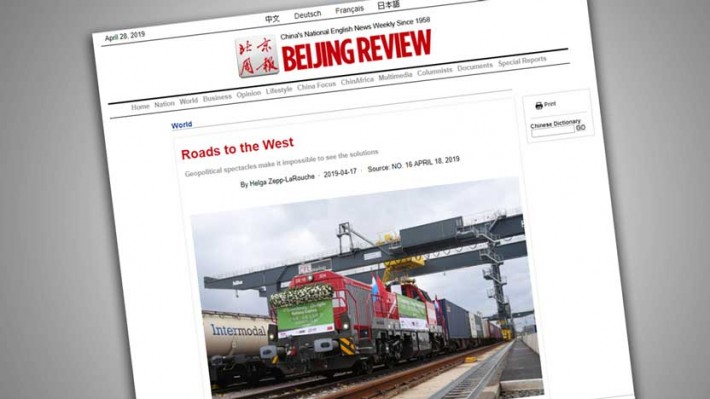
The prestigious Beijing Review on Thursday, April 17, published a major article by Helga Zepp-LaRouche, titled, “Roads to the West—Geopolitical Spectacles Make it Impossible to See the Solutions.”
Zepp-LaRouche starts,
“For the last several years or so, Western media and mainstream politicians have chosen to largely ignore the Belt and Road Initiative, which Chinese President Xi Jinping proposed in 2013. The initiative, consisting of the Silk Road Economic Belt and the 21st-Century Maritime Silk Road, efficiently addresses the infrastructure needs of developing countries, which the West simply pretended not to exist.
“But, at a certain point it dawned on the Western establishment that China was not only building an enormous amount of railway lines, ports, bridges, power plants and industrial parks in Asia, Africa and even in parts of Europe, but that the prospect of poverty alleviation offered by China instilled an unprecedented spirit of optimism.”
See the full article here.
Kirk Meighoo in Trinidad & Tobago, a former Senator and a notable academic and political figure in the country, has done a beautiful 1-hour podcast with Helga Zepp-LaRouche as his guest. The podcast centered on the issue of the Chinese role in development around the world, as part of the global New Silk Road (Belt and Road Initiative, BRI). Zepp-LaRouche reviews 45 years of initiatives from her husband, Lyndon LaRouche, and herself, for the kind of American System economics embedded in the BRI, and evaluates how the United States can be brought aboard.
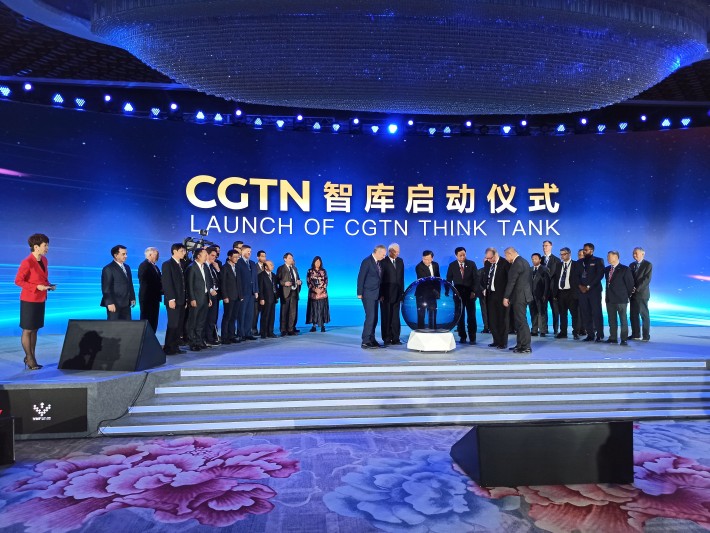
China’s English language international media organization, CGTN (China Global Television Network), founded on Dec. 4 the “CGTN Think Tank” as part of the third annual Global Media Summit, with over 300 people attending from the world’s political, business, media and technology circles. The new think tank will have “cooperative relationships with 50 renowned think tanks worldwide, with goals to offer insights on world development and promote communication among different cultures,” according to a statement from the network. Here is a short video of the launching ceremony.
Among the founding members at the event was Helga Zepp-LaRouche, as the “Founder and President of the Schiller Institute.” Other prominent members include the heads of associations dedicated to a dialogue of civilization, Chambers of Commerce, and other similar institutions.
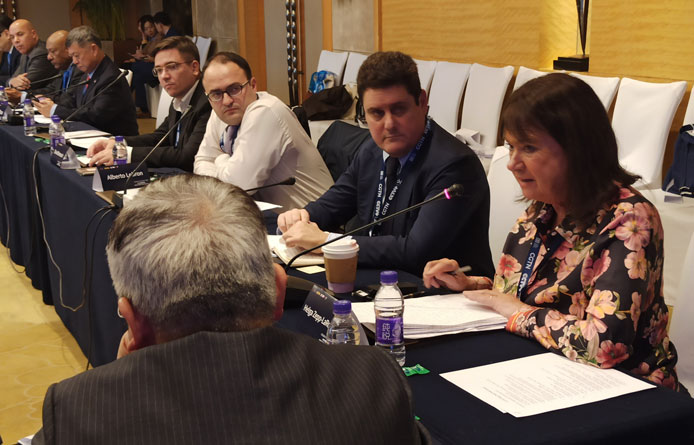
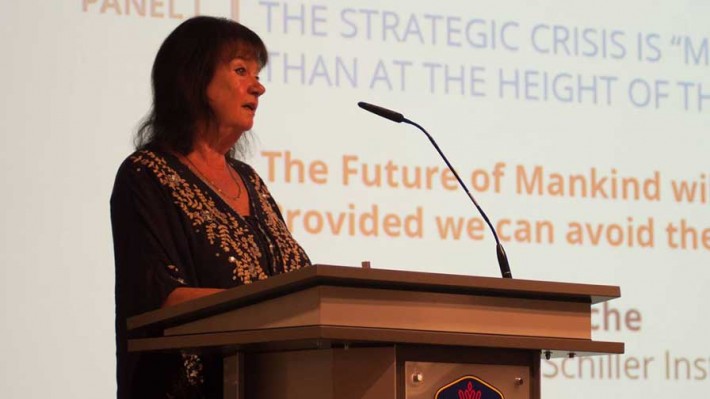
Helga Zepp-LaRouche addressed the first panel at the event, focusing on the rapidly unraveling Western financial system and the urgency of a new Bretton Woods conference to establish a new system coherent with the spirit of the New Silk Road. She stressed the necessity for the United States and Europe to cooperate with the Belt and Road Initiative in the industrialization of Africa and in the reconstruction of Southwest Asia. Extending the BRI into a global World Land-bridge conception, she explained, would also lay the basis for replacing NATO. “Not only is NATO ‘braindead’, but it is obsolete, because it does no longer express the self-interest of its member countries. Now, once we have a global Belt & Road Initiative cooperation, we can also create a new international security architecture. And while people may think that this is a Utopian conception, it is the only way out an existential crisis for all of humanity.”
She also was interviewed by the English-language China Radio International (see below).
Mrs. Zepp-LaRouche reported how upset her Chinese interlocutors are, about deteriorating relations between the U.S. and China, and the vile attacks on China from the United States, fearing that relations are not likely to be restored for a long time. Although they are aware of the impeachment drive against Donald Trump, most have no sense of the coup being carried out. Nor are they generally aware of the severity of the financial crisis and the looming crash, she added. Therefore, she focused on those issues in her interview with CRI.
China Radio International Interviews Helga Zepp-LaRouche
The interview, recorded for the hour-long “World Today” program China Radio International/China Plus on Dec. 5, features Schiller Institute president and founder Helga Zepp-LaRouche for 12 minutes. She makes the point that the main problem in present U.S.-Chinese relations is the neo-cons in both U.S. party leaderships; that President Donald Trump is under extreme pressure by the attempt to overthrow his presidency and therefore is not quite acting towards China the way he would like.
Trump wants good relations with Russia and China, Zepp-LaRouche told the program. Once this cabal is defeated, she said, U.S. relations with China will improve. The Chinese model of economic development, particularly the elimination of poverty, is building a new paradigm which is the constructive alternative to the doomed Western system, and China is actually doing what the United States did in the period after the American Revolution. In Xinjiang, China has a positive approach that the Western media have taken no notice of; and in Hong Kong, the British role is the key factor, HZL stressed.