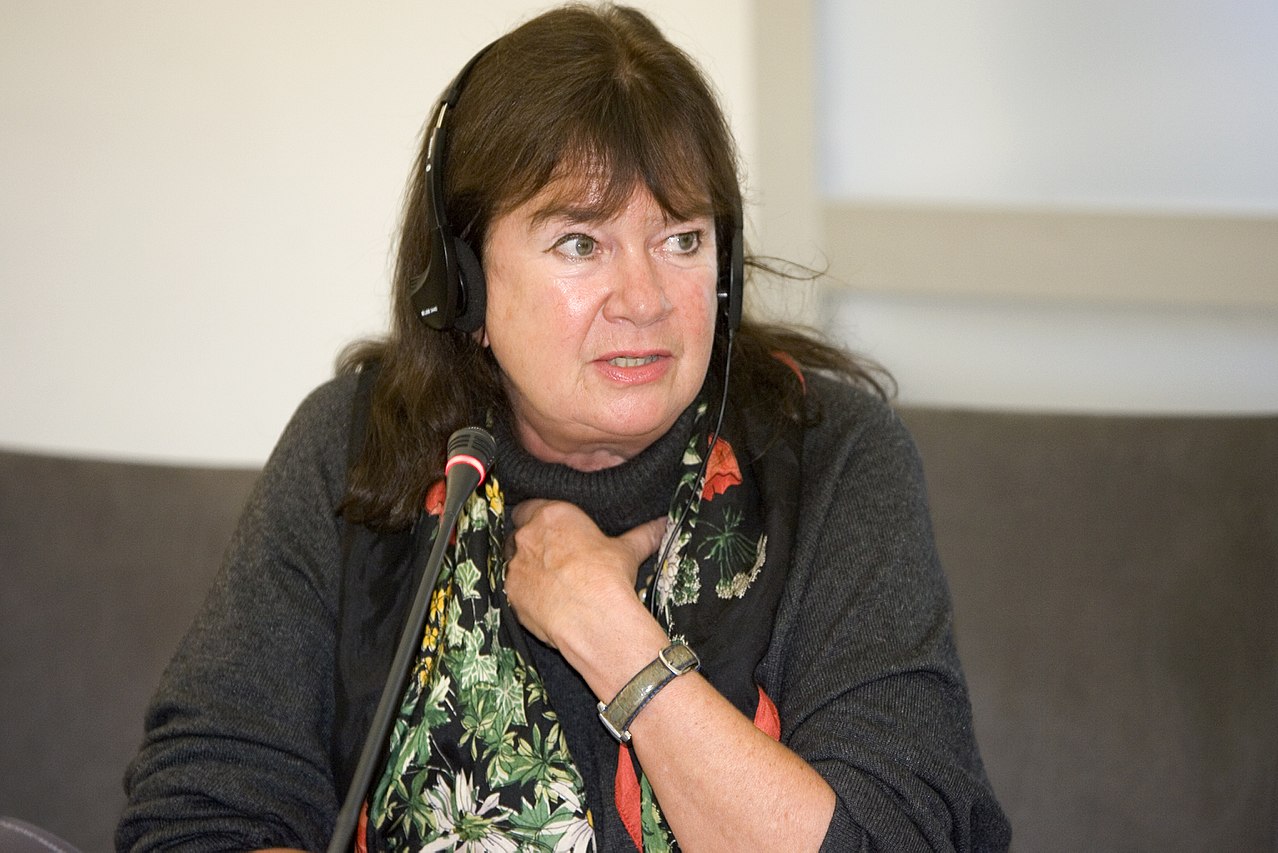
Russian Satellite News Agency, Moscow, April 13th — Helga Zepp-LaRouche, the founder of Schiller Institute in Germany, said in an interview covered by the Russian Satellite News Agency that the sooner the Presidents of the United States and Russia meet, the more opportunity they will have to eliminate the two countries’ conflict threats.
The expert said: “As Trump said on Twitter, the deterioration of U.S.-Russian relations is largely the result of actions within the U.S. against him. Special investigations by Mueller and various committees of the country over the past year have found no ‘Russian traces.'”
LaRouche concluded: “The sooner Trump meets with Putin, the more opportunity they have to stop the provocation.”
U.S. President Trump discussed the possibility of holding bilateral meetings with Putin during the telephone conversation on March 20. However, according to the Kremlin, due to the sharp deterioration of relations between the two countries, the issue would not be discussed at the beginning of April.
Helga Zepp-Larouche Participates in the Beijing Belt and Road Forum for International Cooperation
‘We are in a phase-change for humankind!’
May 15 — Helga Zepp-LaRouche, founder and president of the International Schiller Institute, is right in the middle of the action in Beijing during the Belt and Road Forum for International Cooperation. This comes after decades of leadership by Lyndon and Helga LaRouche for just this kind of mobilization for worldwide development. Since the 1990s, and Zepp-LaRouche’s first participation in an international conference in China, where she called for a “Eurasian Land-Bridge,” she has become widely known as the Silk Road Lady.
Helga Zepp-LaRouche on CGTN’s “Dialogue”
Representing the Schiller Institute, Helga Zepp-LaRouche spoke on May 14, on the first day of the B&R Forum, on the panel, “Belt and Road for Facilitating Strong, Balanced, Inclusive and Sustainable Global Economy.” She said, “The Belt and Road Initiative has the obvious potential of quickly becoming a World Land Bridge, connecting all continents through infrastructure, such as tunnels, bridges, reinforced by the Maritime Silk Road. As such, it represents a new form of globalization, but not determined by the criteria of profit maximization for the financial sector, but for the harmonious development of all participating countries on the basis of Win-Win cooperation.
“It is therefore important, that one does not look at the BRI from the standpoint of an accountant, who projects his statistical viewpoint of cost-benefit into the future, but that we think about it as a Vision for the Community of a Shared Future. Where do we want humanity as a whole to be in 10, 100, or even in a 1000 years?” Is it not the natural destiny of mankind, as the only creative species known in the universe so far, that we will be building villages on the moon, develop a deeper understanding of the trillions of galaxies in our universe, solve the problem of–’til now–incurable diseases, or solve the problem of energy and raw material security through the develipment of thermonuclear fusion power? By focusing on the common aims of humanity we will be able to overcome geopolitics and establish a higher level of reason for the benefit of all.”
In particular, Zepp-LaRouche addressed the question of the role of the United States, whose delegation in Beijing was led by a special adviser to Pres. Trump. Presenting the most positive, ‘big picture,’ Zepp-LaRouche explained, “Looking at the world land map, the United States is not merely a country surrounded by two oceans and two neighbors, but can be a center part of an infrastructure corridor which connects the southern tip of Ibero-America, through Central and South America, with the Eurasian transport system via a tunnel under the Bering Strait…”
Predictably, the geopolitics crowd, centered in London, is having a fit. The Economist in London today ran a stream of bilge, headlined, “The Economist explains, “What Is China’s Belt and Road Initiative?” They write that businessmen in Central Asia call it the “One Road, One Trap,” because B&R projects are unreliable. And “the Belt and Road Forum has an unfortunate acronymn, BARF,” etc.
But back in reality, not only does the Belt and Road Forum mark the process of potential world economic and scientific lift-off, but there is a vital process underway of deliberation over points of immediate suffering and possible all-out war. President Trump’s envoy in Beijing, Matthew Pottinger, is now in South Korea for consultations over concerns in the region. On Syria, as peace talks start on May 16, called “Geneva 6,” numbers of meetings are set for this week, of Mediterranean leaders who met in Beijing with both Xi and Putin. In Washington, D.C., May 16, Turkish President Recep Tayyip Erdogan will meet with President Trump. On May 17, in Sochi, Italian Prime Minister Paolo Gentiloni will meet with Putin. Likewise, Greek Prime Minister Alexis Tsipras met in Beijing with Xi, Putin, and also with Russian Foreign Minister Sergei Lavrov.
Today Helga Zepp-LaRouche summed up the great potential–our great challenge–by describing the May 14 opening of the Belt and Road Forum: “Yesterday was a fantastic, historic moment!” She was speaking on China Global Television Network’s “Dialogue with Yang Rui” program, run live, prime time. She exclaimed, “We are in a “phase-change for humankind!”
Helga Zepp-LaRouche on CGTN ‘Dialogue’
May 15, 2017
Helga Zepp-LaRouche is a feature guest in a program “Dialogue” on CGTN, 24-hour English news channel of China Central Television (CCTV), based in Beijing, on the eve of “the Belt and Road Forum” held on May 14 – 15 in China.
Helga Zepp-LaRouche: I think it’s very important strategic initiative because it’s the only way how you solve all problems–regional, cooperation, underdevelopment, poverty. It’s really a historic mission. I cannot see anything else, not from the United States, for sure, not from Europe and so I’m really optimistic. I think yesterday was a fantastic, historic moment.
Q: But, do you think China is ready?
Zepp-LaRouche: Oh, I think so. First of all, the Chinese economic miracle of the last 30 years has surprised the world. And now through the Belt and Road Initiative, China is offering to export that model of development to other countries. And if you look at the success of the Belt and Road Initiative in the last four years, it is absolutely breathtaking! And I am shocked — every day the Chinese government comes up with a new initiative, which offers a solution to a problem. And it’s just very attractive idea. This is why so many countries want to be part of it. It’s much more attractive to have win-win cooperation in the context of the New Silk Road than to be part of a military alliance, which just gets countries into trouble. So this is why the whole center of power has completely shifted to Asia. And I am convinced that yesterday we experienced the formation of a new world economic order. It was a truly historic moment, and I think most of the participants at the Belt and Road Forum had that profound sense of being in the middle of making history for a new era for civilization. And I am very excited because this is a phase-change of humankind. I think we are on the verge of…
Yang Rui: No wonder President Xi Jinping calls the Belt and Road Initiative the project of the century.
Q: [India says] Hey, the Sino-Pakistani economic corridor will somehow go through the contentious territorial area of India, Kashmir; therefore, they refuse to get involved with the Belt and Road Initiative. The spokesperson of the Indian Foreign Ministry even protested against the idea of the economic corridor between China and its geopolitical rival, Pakistan. What do you think of the rivalry, the geopolitical rivalry that China wants to really keep a distance from?
Zepp-LaRouche: Well, first of all, India has always been the subcontinent and therefore they have a long tradition of geopolitical thinking. But, I think this has been reinforced by the British colonialism, and the British, and formerly the U.S. administration before Trump played on that. They played Pakistan as the state terrorism state, and trying to hype up sentiments in India to further this conflict. And I think the opposite is true. Because of the British division of India into Pakistan, Bangladesh and India, the only way how this can be overcome is increasing the connectivity among all the countries–Nepal, Bangladesh–all these countries want to be integrated. And they call it “connectivity”; they don’t call it the “Silk Road” and they don’t call it “Belt and Road Initiative,” because that’s associated with China. But in substance, all of these countries are urging for more development like that.
Q: What’s interesting is that both sides [China and U.S.] announced their joint projects, the list of projects, simultaneously. Do you think something must have been discussed at the Mar-a-Lago summit in Florida, between Trump and President Xi Jinping? And actually the announcement of this list of mega-projects between the two sides is an indispensable part of what has been agreed upon by the two heads of state?
Zepp-LaRouche: I think so, because President Trump has announced that he wants to have investment in $1 trillion worth of infrastructure in the next ten years. The American Society of Civil Engineers estimates that $4.5 trillion actually is required, and Chinese experts have said that the United States needs $8 trillion worth of infrastructure. Now China in the past years has shown a tremendous expertise in building fast trains and other projects of infrastructure, and China has also $1.4 trillion in U.S. Treasuries, which we have proposed it invest in an infrastructure bank or national bank in the United States, and then invest in the building of infrastructure. Now that would be a total game change. And if China, in return, would invest in the Chinese market, which is growing because of the growing buying power, you could replace the competition between the United States and China through cooperation. And then they could join hands and have joint investments in third countries, like rebuilding the Middle East, developing of Africa. I think it’s important that you’re not just talking about infrastructure and economics. We are really talking about a new era of civilization, where you replace geopolitics with a completely new set of relations among countries. And if the United States and China could solve this–you know, I have said many times that if President Trump would go for this, he could become one of the greatest Presidents in the history of the United States. And many of his critics don’t think that is possible, but I am absolutely convinced that we are very close to it.
Q: In effect, overseas observers pointed out, it seemed as if [President Xi] was talking to two audiences at the opening ceremony. For the international audience, he promised to export our technology, our ideas about Belt and Road Initiative, to reestablish the world order and to reconsider the idea of globalization internally. He also promised to rejuvenate the nation, to tell a China story through the Belt and Road Initiative…. To the surprise of many who are very skeptical about the economic relationship between Japan and China, two arch-competitors, economically and geopolitically as well, the Japanese government decided to send a senior delegation, which was headed by the head of the ruling party, the LDP, Liberal Democratic Party. And this head of the delegation also handed over a letter from Prime Minister Shinzo Abe to the host of the Belt and Road Initiative summit. What do you think of the possibility that Japan will seize this opportunity to drastically improve, not only the balance of ties, but also to enjoy the dividends of the Belt and Road Initiative, so that it will not be excluded from rebuilding the world economic order?
Zepp-LaRouche: I think it is very clear that Prime Minister Abe has the intention to do that. I think he sent de facto the number two of the LDP to the summit. I think it has to do with the change in perception that the world is indeed changing. If you look at the rapprochement between Russia and Japan over the last period where Abe has the intention to have a peace treaty during his time in office. There were many visits of Abe to Russia, and vice versa, Putin was in Tokyo, so I think given the fact that China has a very close relationship with Russia, and the offensive policies of the United States, of intervention in foreign wars — with Trump, he has said he doesn’t want to do this anymore, the situation in the South China Sea has completely shifted, it’s no longer such an important hot spot — I think we are on the verge of fixing the world according to completely new rules. And I think it’s really a time for people to rethink and not stick to old geopolitical schemes, which have been in the Cold War, because we are on the verge of a completely new era of civilization, and I think what Abe did, reflects that.
Q: Ironically, the young leader of the D.P.R.K. test fired a missile to coincide with the policy speech by President Xi Jinping at the Opening Ceremony. Yet the elected leader of the R.O.K., Mr. Moon, promised to reconsider the deployment of the THAAD, a missile…. That may have paved the way for an apparent improvement in the relationship, which has been frayed seriously by the THAAD deployment. What do you think of the R.O.K. delegation and in fact, a rumor went around the internet that President Trump called for a boycott of the belt and road summit saying “Hey, why did you invite the D.P.R.K. to attend the summit when the international society, through the UN Security Council imposed yet another economic sanction — which I believe is well underway — what do you think of the concerns, allegedly, the major concerns by the international media?… But I am afraid that those who are very skeptical about China’s intent, may point out, citing President Bush, Jr., that bad behavior should not be rewarded. So this invitation for the D.P.R.K. delegation has been very controversial. I’d like to have your take?
Zepp-LaRouche: Well, I think there are some people who are thinking in terms of the old paradigm of geopolitics, and they can just not imagine that a country, especially a large country like China would be motivated by Confucian ideas. And I have studied China for the better part of my life, and I have come to the conclusion that the present government, in particular, is not based on anything other but the Confucian idea of harmony among nations. And some people realize that. For example the Italian Prime Minister Gentiloni who at the Belt and Road Forum, gave a fantastic speech, where he said…
Q: Excuse me, but harmony would become a lost sense, if we do not respect some of the principles, which have a lot to do with national security. The nuclear program of the D.P.R.K. has indeed endangered three northern provinces if any nuclear fallout were to occur! That would be a major threat [crosstalk] to national security.
Zepp-LaRouche: But the new President of South Korea has basically said that he wants to go back to the Sunshine Policy of economic cooperation with the North. North Korea only has nuclear missiles because they were afraid they would have the same fate as Saddam Hussein or Qaddafi. And once the threat is away and we return to the Six Party Talks and the Sunshine Policy, and especially if this is in the context of the Belt and Road Initiative, I am absolutely confident that this problem will go away very shortly.
Q. The last question is whether there’s going to be a collision or a clash between Russia’s brainchild of having the Eurasian Economic Union and the Belt and Road Initiative? Because there have been speculations by the media who say, “Hey, Russia may show its great concern about China’s interference with the internal affairs of its traditional backyard, Central Asia through perhaps the role of the Shanghai Cooperation Organization.” And therefore, they focus on whether there’s going to be inconsistency and discrepancy between Russia’s Economic Union and the Belt and Road Initiative: What’s your take?
Zepp-LaRouche: You will be happy to hear that President Putin, who was the guest of honor at the Belt and Road Forum, already gave a press conference where he said that not only does Russia support the Belt and Road Initiative, but he will take an active role in promoting it. And if you look at the number of leaders and countries that are now joining, you have a total change in the dynamic– Tsipras from Greece, the Serbian government, the Czech Republic, Hungary, Belarus, Italy, Spain, Portugal, and Switzerland–all of these countries have said they want to become hubs of the Belt and Road Initiative. So even if the German Economic Minister at the Forum was not so friendly, let’s say, I think Germany will be soon surrounded by countries that want to be part of it, and I think this will tilt the situation. The former Prime Minister of France Raffarin gave a passionate speech why France should be in it, and he was sent by the new President Macron. So I’m absolutely convinced in half a year, the majority of the nations that are still reluctant will recognize that it is in their best interest. Because, for example, Germany should have a fundamental interest in cooperating. I mean, German industry, the Mittlestand, the medium-sized industry, are exactly the complementary kind of economic force that would perfectly work with China. And I think it will come around., I promise.
Yang: Despite the success of Emmanuel Macron, the European Union is indeed in trouble. And President Trump’s idea of prioritizing American interests, putting America first, may also isolate this country from the rest of the world. During this absence, China is said to be ready to assume the leadership. Is China ready? We’ll keep this discussion open. Until next time, goodbye.
Mrs. Zepp-LaRouche addressed the conference on Sunday and Monday, both at the Thematic Session on Think Tank Exchanges and at the 5th Global Think Tank Summit.
There has been a breathtaking dynamic of the New Silk Road in the three and a half years since pronounced by President Xi Jinping in 2013. The Belt and Road Initiative has the obvious potential of quickly becoming a World Land Bridge, connecting all continents through infrastructure, such as tunnels, bridges, reinforced by the Maritime Silk Road. As such, it represents a new form of globalization, but not determined by the criteria of profit maximization for the financial sector, but for the harmonious development of all participating countries on the basis of Win-Win cooperation.
It is therefore important, that one does not look at the BRI from the standpoint of an accountant, who projects his statistical viewpoint of cost-benefit into the future, but that we think about it as a Vision for the Community of a Shared Future. Where do we want humanity as a whole to be in 10, 100, or even in a 1000 years? Is it not the natural destiny of mankind, as the only creative species known in the universe so far, that we will be building villages on the moon, develop a deeper understanding of the trillions of galaxies in our universe, solve the problem of till now incurable diseases, or solve the problem of energy and raw material security through the development of thermonuclear fusion power? By focusing on the common aims of humanity we will be able to overcome geopolitics and establish a higher level of reason for the benefit of all.
It is obvious, that the World Land Bridge is ideal for completing the development of the landlocked areas of our planet. The colonization of nearby space will be the obvious next phase of the infrastructural opening up of the natural habitat of man.
Looking at the world land map, the United States is not merely a country surrounded by two oceans and two neighbors, but can be a center part of an infrastructure corridor which connects the southern tip of Ibero America through Central and South America with the Eurasian transport system via a tunnel under the Bering Strait. Since President Xi Jinping made the offer to President Trump for the US to join the Belt and Road Initiative, there is now a practical proposal on the table, where the US can become an integral part of the World Land Bridge. The infrastructure requirements of the US, which are enormous, could be a perfect opportunity to convert all or part of the $1.4 trillion China is holding in US Treasuries into such investments via an infrastructure bank. For example, the US really needs approximately 40,000 miles of fast train lines, if they would want to match the Chinese plan to connect every domestic larger city by fast train by the year 2020.
The US economy would experience a tremendous boost through such a grand scale infrastructure investment, and could in turn export into the fast growing Chinese market, and once competition is replaced by cooperation, the opportunities for joint ventures between the US and China in third countries are enormous.
Since President Trump has declared his intention to reintroduce the American System of Economy of Alexander Hamilton, Henry C. Clay and Abraham Lincoln, and also reintroduce the Glass Steagall legislation of Franklin D. Roosevelt, the possibility of an early establishment of a National Bank and a Credit System in order to channel Chinese holdings into infrastructure investments is near.
While more and more European nations, both outside and within the EU, are recognizing the tremendous potentials of the BRI and express the intention to become a hub for Eurasian cooperation, the EU itself has been reserved, to be diplomatic.
There is however one huge challenge, where the member states of the EU could be convinced to cooperate with the BRI: It is the refugee crisis. The only human way to heal this moral wound of Europe is the active integration of European nations in a Grand Design development plan for all of Africa with the BRI.
The positive new prospect of US-Russia de-escalation and military to military cooperation in Syria, along with the Astana process, now puts stabilization of the entire region in sight. Offers by China to extend the New Silk Road to Southwest Asia already exist.
The New Silk Road must–as the ancient one did–lead to an exchange of the most beautiful expressions of culture of all participating countries in order to succeed. The true meaning of Win-Win cooperation is not just the material benefit of infrastructure and industrial development, but of making the joyful discovery in other cultures of the beauty of their classical music, poetry and painting, and, by knowing them, strengthen our love for mankind as a whole.
In the building of the World Land Bridge all nations will cooperate on studying how to apply the laws of the Noosphere to the establishment of durable forms of self-government. The development of the creative mental powers of all people in all nations, will give all of mankind the sense of unity and purpose which will make our species truly human. When we organize our societies around scientific and artistic discovery, we will perfect our knowledge on how we can continuously advance the process of self-development of mankind, intellectually, morally and aesthetically, and we will find our freedom in necessity–doing our duty with passion!
Quotes of World Leaders from the Belt and Road Forum
Paolo Gentiloni
Italian Prime Minister
‘The Belt and Road Initiative is perhaps the most important infrastructure modernization project underway in the world today… Bringing the Chinese economy closer through this gigantic infrastructural operation is enormously interesting to Italy, not only for our government but also for our universities and public and private businesses.’
António Guterres
United Nations Secretary-General
‘The Belt and Road Initiative and the 2030 Agenda… aim to deepen ‘connectivity’ across countries and regions: connectivity in infrastructure, trade, finance, policies and, perhaps most important of all, among peoples.’
Alicia Barcena
Executive Secretary of the Economic Commission for Latin America and the Caribbean (ECLAC)
‘The Belt and Road Initiative represents a renewal and a profound commitment with the fundamental values of our global social and economic well-being: interconnection, deeper commercial and investment links, transparency and opening-up, and the need to ensure economic growth goes hand-in-hand with social progress. This is a speech concerning a change of era, Chinese President Xi Jinping made a very innovative proposal, with a panoramic perspective bringing together the objectives of all the countries.’
Hailemariam Desalegn
Ethiopian Prime Minister
‘The Belt and Road Initiative is the largest and non-conflicting economic cooperation of the 21st century.’
Jean-Pierre Raffarin
Special envoy of French President-elect Emmanuel Macron, Former French Prime Minister
‘This forum marks a new and decisive step in the progress of the initiative. To remedy the lack of infrastructure in Asia will require the efforts of all those good will ready to contribute to the region’s prosperity and that of the rest of the world.’
Michelle Bachelet
Chilean President
‘The breadth of the One Belt, One Road, the high level of participation and its strategic dimensions, highlight its capacity to become the biggest economic cooperation project in place today.’
Christine Lagarde
International Monetary Fund Managing Director
‘The Belt and Road Initiative aims to connect economies, communities, and people. It holds great potential to bring benefits in terms of high-quality infrastructure, inclusiveness, and economic cooperation.’
Matthew Pottinger
U.S. National Security Council East Asia Director
‘American companies have much to offer here. U.S. firms can offer the best-value goods and services required over the life of a project. U.S. firms have a long and successful track record in global infrastructure development, and are ready to participate in ‘Belt and Road’ projects.’
‘For those in the less developed community, our greatest task is to raise our aspirations to meet those of the people living in the countries that are still in need of many more investment for development. The Belt and Road Initiative is most remarkable for just the size of the aspiration.’
Milos Zeman
Czech President
‘The One Belt, One Road Initiative is the most significant project in all our modern history. I salute China for this courageous, long-term project.’
Philip Hammond
Special envoy of British Prime Minister Theresa May, Chancellor of the Exchequer
‘It is my belief that Britain, lying at the western end of the Belt and Road, is a natural partner in this endeavor.’
Najib Razak
Malaysian Prime Minister
‘With the vision of shared prosperity and win-win situation, I believe Malaysia and other countries will realize the potential of the Belt and Road Initiative. The initiative as one that can stimulate development among different sectors and industries via better infrastructure, in turn will facilitate world transportation and logistics, so all countries can access to larger markets.’
Roberto Azevedo
World Trade Organization Director-General
‘Infrastructure is essential. A lack of proper transport network was on top of the trade cost list and the One belt, One Road is hugely important in responding to this need.’
Recep Tayyip Erdogan
Turkish President
‘This is going to be the kind of initiative that will put an end to terrorism.’
Peter Thomson
President of the UN General Assembly
‘The Belt and Road Initiative brings enormous benefits to all involved and serves as a main driver of the global transformation emerged by the UN 2030 Agenda for Sustainable Development.’
Nawaz Sharif
Pakistani Prime Minister
‘Let me make it very clear, the China-Pakistan Economic Corridor, an economic undertaking, is open to all countries in the region.’
Alexis Tsipras
Greek Prime Minister
‘We highly value the importance of this initiative for people-to-people contact, cultural exchanges and tourism, and we see the great opportunities in the 21st Century Maritime Silk Road.’
Aleksandar Vucic
Serbian Prime Minister and President-elect
‘Serbia is China’s staunch friend and reliable partner. Serbia has benefited enormously from participating in the Belt and Road forum. Key projects of the Belt and Road Initiative have yielded positive results… Serbia expects to deepen cooperation with China in a host of areas, including the economy and trade, mining, infrastructure, finance, aviation and tourism.’
Brigitte Zypries
Special envoy of German Chancellor Angela Merkel, Minister of Economic Affairs
‘The Belt and Road Initiative aims to improve infrastructure between Asia and Europe. This will bring the world’s two largest trading partners in Asia and Europe closer.’
Shanghai Daily Interviews Helga Zepp-LaRouche
June 1, 2017
“I think the Belt and Road initiative signifies a revolutionary move to a new epoch of civilization. The idea of having a win-win cooperation among nations is the first time that a concrete concept has been offered to overcome geopolitics…”
“Belt and Road Enterprise Offers Assistance to All”
The Silk Road spirit followed by the Belt and Road initiative offers pioneering ideas for contemporary international cooperation, the delegates told the People’s Daily upon the arrival of the Belt and Road Forum for International Cooperation, agreeing that the proposal will bring benefits to all.
“Is China’s initiative an answer to financial bubble brewing?”
Perhaps, it is wise to learn from history that every time there are solid developmental projects for the good of humankind, the ruling financial oligarchs of this world bank bankroll conflicts and world wars (i.e the British oligarchs and Wall Street like the Rothschilds, Harriman, Prescott Bush, et al funded Hitler initially).
Willing to Turn OBOR into Path for Peace: Xi Jinping
The event was attended by high-level leaders from 29 nations, the United Nations Secretary General, the President of the World Bank (WB), the Director General of the International Monetary Fund (IMF).
March 6, 2017 –China United Television, a major TV station in south China’s Shenzhen province, like most of the Chinese channels, is having ongoing news coverage of the two, week-long National People’s Congress and the CPPCC meetings. Interspersed in their coverage of the Congress are comments by Schiller Institute President Helga Zepp-LaRouche and {EIR} Washington Bureau Chief Bill Jones, based on answers to questions that had been pre-recorded and sent to the station for this purpose. The topics included the importance of the U.S.-China relationship, the significance of the Belt and Road, and the possibility of cooperation with the United States in infrastructure investment. Three of the segments can be found at:
The recent interactions between Chinese President Xi Jinping and U.S. President Donald Trump, particularly their latest phone conversation, are very positive signs of the potential to develop a new type of bilateral relations, a German expert said Friday.
“President Trump’s letter and subsequent phone call with President Xi Jinping are very positive signs that he indeed wants to develop a constructive relationship with China,” Helga Zepp-LaRouche, founder of the Germany-based think tank Schiller Institute, said in an exclusive interview with Xinhua.
EDITOR’S Note: Helga Zepp-LaRouche visited Shanghai for the first time in the summer of 1971. In 1977 she married American economist Lyndon LaRouche, and the couple have since worked together on development plans for a just new world economic order. Zepp-LaRouche founded the Schiller Institute in 1984, a think tank devoted to the realization of these plans and a renaissance and a dialogue of classical cultures. In 1991 she was a coauthor of a study The Eurasian Land-Bridge/ The New Silk Road and in 2014 of the study The New Silk Road Becomes the World Land-Bridge, which has been translated into Chinese, Arabic, German and Korean. She is an expert in European humanist philosophy and poetry, Confucius, and history. After attending the recent Belt and Road Forum in Beijing, she visited Shanghai, where Shanghai Daily reporter Wan Lixin interviewed her.
Q: In what way do you think the Belt and Road initiative is significant for the world and China?
A: I think the Belt and Road initiative signifies a revolutionary move to a new epoch of civilization. The idea of having a win-win cooperation among nations is the first time that a concrete concept has been offered to overcome geopolitics. Since geopolitics was the cause of the two world wars, I think it is a completely new paradigm of thinking where an idea proposed by one country has the national interest basically in coherence with the interests of humanity as a whole. This has never happened. This has instilled tremendous hope among developing nations that they have the chance to overcome poverty and underdevelopment. And I think this is an initiative that will grow until all the continents are connected through infrastructure and development.
Q: What do you think are challenges confronting the world today?
A: I think the biggest challenge is that the trans-Atlantic financial system is in jeopardy, because the G7 countries did nothing after the financial crisis of 2008 to remedy the root causes of this crisis. The danger today is that we are going to have another financial crisis much worse than that of 2008. In this light I think the financial system associated with the Belt and Road Initiative, like the AIIB (Asian Infrastructure Investment Bank) and similar institutions, which are focused on investment in the real economy, are an anchor. Hopefully the Western nations will rethink their orientation of high risk speculation and eventually go back to the banking system represented by AIIB. U.S. President Trump announced that he will go back to the American economic system of Alexander Hamilton, and that’s potentially the kind of reform that makes the United States fit to cooperate in this new financial system. The second challenge is naturally terrorism. This requires international cooperation, and there I think the Belt and Road could offer a lasting solution by extending the initiative to Southwest Asia, and build up the economy in that part of the world that had been destroyed by wars which were based on lies. Why did you have to solve the problem of terrorism militarily first? You have to have an economic perspective so that people in the regions have hope for the future. So I think ending terrorism would require the Belt and Road Initiative and the reconstruction of the Southwest Asia and Africa.
Q: There has been evolving perception about globalization. How do you think the Belt and Road Initiative is reshaping this perception?
A: The old globalization really went entirely in one direction. First of all it made the deregulation of the markets and high risk speculation easy. And this increased the gap between the rich and the poor in an intolerable way in many countries. This mode of globalization is being rejected, as you can see by the Brexit and the rise of many right-wing movements in Europe. So this model has clearly failed. I think the new Silk Road, the win-win cooperation as proposed by China, has developed in incredible speed in the less than four years since President Xi proposed it. This new model of globalization is based on the common good of all participating countries. This is the more attractive form of globalization and this is why so many countries have joined it.
Q: What do you think are some of the factors that need to be considered when it comes to implementing the Belt and Road initiative across different cultures?
A: The Schiller Institute has organized hundreds of seminars and conferences on the New Silk Road for 26 years. We have always made the point that for this New Silk Road to succeed in the tradition of the old Silk Road, which was also an exchange of ideas and cultures, not just products and technology, you have to combine economic cooperation with dialogue between cultures. This dialogue must be on the highest level, so each culture has to present examples of the best of their culture, like Confucianism, Italian renaissance, the German classical period, and present the best works of arts in music and poetry, paintings and other forms of art. Our experience is that when people get into contact for the first time with expression of such high culture from another culture, they are surprised by its beauty. And this beauty then opens the heart and souls of the people. And this is the best medicine against chauvinism, xenophobia, and prejudice, and it opens the way for the love of other cultures. This is in conformity with Confucian teaching that all activity must be combined with strengthening of love for the mankind, because without that cultural component, that New Silk Road will not flourish.
Q: What do you think such high profile events like the recent summit suggest about China’s role in world affairs?
A: I think it a great honor for me to participate in this Belt and Road Forum, and I was deeply impressed by the speech of President Xi Jinping. Among all participants I spoke with there is consensus that we are actively participating in the shaping of history. All this means that China is right now leading the world in terms of providing the perspective for the future. I think this has been recognized by many countries in Latin America, in Africa, in Asia, and even some European countries start to recognize it is in their best interests to ally with that initiative. So I think it has made clear that China is the only country right now that offers a positive perspective to overcome the strategic bottleneck of our present times.
Q: In the past, the quest for prosperity invariably led to competition, strife, or wars. Is this avoidable?
A: Concerning the question of competition, strife and war, I think this must be replaced by joint development. Here I would like to quote from Pope Paul VI who said that “Development is the new name for peace.”
Q: How do you think the West responds to the Belt and Road Initiative?
A: The responses have been mixed, because you have those who want to stick to the old geopolitical thinking, to the status quo of their power, and to their understanding of their power position. I think this is an outdated way of thinking. Many think-tanks of the West are still publishing reports along these lines. But there is a wind of change. Many European countries have realized the potential of collaborating with the Belt and Road, which includes Greece, Serbia, Hungary, Slovenia, Czech Republic, Italy, Spain, Portugal, and Switzerland. So I think this tendency will increase. Those countries which are more reserved — like Germany — will have to change. But I think German industries, particularly those middle-sized industries, are absolutely in cooperation with China in the Belt and Road Initiative.
Q: Say something about your China experience.
A: I was first in Shanghai 46 years ago in 1971, after traveling on a cargo ship. Although it was not the best time to be in China, it had awakened my love for China. The city has changed completely. Except for some buildings on the Bund, I couldn’t find anything in my memory. I could not think of any other countries in the planet that have seen such gigantic changes. I think the Chinese people are much too modest. They should feel more confident about what they have accomplished. They have created the biggest miracle of the world, even bigger than the post-war German economic miracle. They should be very proud to be Chinese. The decision by Moody’s Investors Service to cut China’s sovereign ratings is insane. In German we have a saying: People should touch their own nose first before they made a stupid criticism.
April 5, 2017 — This is a transcript of an interview by Sputnik with Helga Zepp-LaRouche, regarding the upcoming summit between Presidents Xi Jinping and Donald Trump:
Q: What will the tone of the meeting be?
HELGA ZEPP-LAROUCHE: Oh, I think it will be actually cordial. The Western media who are usually wrong are trying to reduce this whole question to some geopolitical conflict, but I think both sides have prepared this meeting very well. I think when Secretary of State Tillerson was in Beijing last month to prepare the visit, he said that the U.S.-China relationship in the Trump Administration would be a very positive relationship, built on no confrontation, no conflict, mutual respect, and always searching for a “win-win” solution. And that was exactly the formulation that was used by Xi Jinping in 2012 when he called for building a new type of major country relationship between China and the United States. Now, this was rejected by President Obama at the time. But the fact that Tillerson is now using the exact, same formulations shows a very positive signal. And I think that since China has put the New Silk Road policy on the table — or the Belt and Road Initiative, as it’s called now — since 2013, and has been building this New Silk Road, with the idea that the United States should join it, too, I would not be surprised at all, if something like that would be discussed, to the big surprise of many.
Q: I see. Now, earlier Trump had accused China of raping the U.S. economy. He called the country a currency manipulator, and even threatened to impose high tariffs on Chinese imports, though, with that said, what reaction should we expect from the Chinese leader? What positions will they be taking?
ZEPP-LAROUCHE: I don’t think that Xi Jinping will react to the campaign tone of the candidate Trump, because now Trump is President. And I think if they put on the table the idea that China would invest in the infrastructure in the United States, Trump himself has announced the need to have a $1 trillion program to reconstruct the American infrastructure. There was recently a conference in Hongkong where Chinese economists estimated that the real requirement is $8 trillion. Now, the way how to reduce the trade deficit is if there would be direct Chinese investment in infrastructure, maybe not immediately, but indirectly; maybe one would have an infrastructure bank, where China could put its investments in, or some solution like that. But I’m convinced that they will absolutely come out of this summit with results beneficial to both countries.
Q: It’s interesting that you talk about a positive solution the trade deficit, that you just mentioned, with China could possibly create a special investment bank, but is there anything else that Trump could do to somehow reduce this trade deficit? Or is there any way that President Trump could somehow improve the relations between the countries, and improve the trade between the countries?
ZEPP-LAROUCHE: Well, Trump has recently mentioned several times that he wants to go back to the American System of economy, the system of Alexander Hamilton, of Lincoln, of Henry Clay, and it is actually that system which made the United States great following the War of Independence. And that was a highly protectionist system. Alexander Hamilton created the United States by creating a National Bank, a credit system, and for example, the German economist Friedrich List pointed to the difference between the American System of economy and the British System of economy, meaning that the American System which was created by Hamilton basically says the only source of wealth is the creativity and productivity of the labor force; as compared to the British System which says you have to buy cheap and sell expensive, and control trade, and keep labor costs as little as possible. So, if you actually look at what China has been doing with the Chinese economic miracle of the last 30 years, it is much closer to the philosophy of Alexander Hamilton, than it would be to the system of globalization and so-called “free trade.” Because I think that the Chinese system of free trade is not exactly the same one what the British and the Americans under the Obama and Bush administrations have been thinking about. So, if Trump says, OK globalization led to an outsourcing productive jobs and I want to recreate the American economy, well, that’s the way how to reduce the trade deficit, because the reason why there’s a trade deficit is because many of the products in the last 16 years of the Bush and Obama administration became increasingly less competitive, for example the car industry. The reason why you have more cars imported, from Japan, Korea, Germany, than the other way around, is because these cars are better than American cars. And what America has to do, what President Trump has to do — and I think that’s what he intends to do — is to reconstruct the American economy on the highest productive level. The infrastructure is only the precondition, but then there will be other areas, like in the nuclear fission, but especially the development of fusion technology, space cooperation with other countries, so there are many areas where you can leapfrog into the most productive areas in the economy, and I think that’s what Trump intends to do.
Q: It’s interesting that you talk about that, and I really like that you mention that subject. Unfortunately we’ll have to do that at a different time. Apart from the issue that we’ve already discussed, are there are other issues that will be on the table between the Chinese leader and the U.S. President?
ZEPP-LAROUCHE: Well, obviously, the North Korea issue will be very high up on the agenda, given the recent missile tests by North Korea. But there, one has to understand that North Korea is doing this, not because they intend an aggression against South Korea or Japan, or the United States. They are doing it in reaction to the deployment of the THAAD missiles, which both China and Russia have also said are security threats to their own national security; and, North Korea is reacting to the very big maneuvers involving the United States, Japan, and South Korea, which are ongoing right now. So the way to reduce that, and that would be my guess, that they will get an agreement to re-propose the Six-Party talks, to try to find a solution, or even have maybe Five-Party talks, to try to really work out a real solution one could offer to North Korea. But it is my conviction that the only way how this conflict can be solved forever, is to extend the New Silk Road into Korea, have a unification of South and North Korea, and then develop together, the North, obviously, with the sovereignty of North Korea being taken into account; but I think the idea of overcoming the terrible economic hardships and using the high-skilled labor you have in North Korea! People don’t know, that there is actually a highly developed labor force in North Korea. So I think the New Silk Road Belt and Road Initiative, even in the short or medium term, would be the framework with which to solve the North Korea problem forever.
Q: All right. Well on that note I would like to thank you very much for joining me today, Helga. It was a pleasure having you here, and I’d love to have you back in the future.
Schiller Institute founder Helga Zepp-LaRouche, called the “Silk Road Lady” in China and the first promoter with Lyndon LaRouche of this policy in Europe, was interviewed by TASS May 31, 2016 on the decision for a new global war or for economic development and cooperation.
TASS: How would you assess the current international cooperation?
Zepp-LaRouche: There are two completely different dynamics on the planet right now. On the one side you have the convergence of President Putin’s very successful military flanks, such as his intervention in Syria, which created the potential for peace, combined with his various diplomatic interventions in Asia, parallel to the Chinese New Silk Road initiatives.
These efforts represent a win-win perspective for over seventy participating countries already.
On the other side there is an extremely dangerous confrontation from the side of the United States, Great Britain, the EU and NATO against Russia and China, which has brought the world to a multiple crisis, more dangerous than at the height of the Cold War.
TASS: In what areas it is more active and where it is not?
Zepp-LaRouche:In the case of Syria the cooperation between Foreign Minister Lavrov and Secretary of State Kerry, as well as the Geneva cooperation between Russia and the U.S., is very positive. However, as long as the United States do not abandon their policy of regime change, the situation remains dangerous. President Putin has proven to be a brilliant strategist.
This allows confidence that the warhawks in NATO will not succeed to lure Russia into a trap, giving them a pretext for a preventive attack.
TASS: What are the issues we need to step up cooperation between the West and Russia? Why?
Zepp-LaRouche: The reality is, that the entire trans-Atlantic sector is bankrupt and about to blow up in a bigger way than in 2008. Japanese Prime Minister Abe, after a very important visit in Russia, made that point at the recent G7 meeting emphatically, but was rebuffed by President Obama, who insisted, that “the recovery is improving”, which is absurd in light of the negative interest rates of the central banks and the debate around “helicopter money”.
Therefore the West needs, more than Asia, the kind of economic cooperation of the One Road One Belt/Eurasian Economic Union cooperation, integrating Eurasia from Vladivostok to Lisbon, but also inviting the U.S. to participate in this perspective. The only way a catastrophe can be avoided, is if we succeed to overcome geopolitics and reach a new paradigm, based on a global development partnership and the common aims of mankind.
TASS: Why, despite the obvious threat of terrorism, cybercrime and other international challenges, does the West so hinder cooperation with Russia?
Zepp-LaRouche: Almost all important conflicts derive from the effort of the Anglo-American empire to maintain an unipolar world, at a point, where it has de facto ceased to exist already. More and more forces in the world realize that they have to make existential decisions, and that the interests of their nations are much better served by stopping sanctions and confrontation against Russia and China.
The fact that Russia and China have created a very strong strategic partnership, with India a third partner, has shifted the strategic balance in the world. More and more countries are seeing it as more beneficial to cooperate for joint development, than to be under the yoke of military confrontation. We are at a branching point in history, and at such moments, what counts is leadership of the kind we have seen from President Putin.
The Arabic-language newspaper Al-Ittihad in the United Arab Emirates published a column by Mohammed Aref, a science and technology consultant, on Chinese President Xi Jinping’s visit to Saudi Arabia, Egypt, and Iran, congratulating the New Silk Road Lady—Helga ZeppLaRouche—and the Schiller Institute for this new visionary policy.
The column, titled “China’s 51st Century” (according to China’s record of its history), gives a poetic and exciting image of the tour by President Xi to the region and of China’s emphasis on the New Silk Road and economic development in its policy declaration.
In 1997, Aref was the first Arab journalist to write a full-page review of EIR’s first Eurasian Land-Brige Report, in the London-based Arabic daily Al-Hayat, of which he was the Scientific Editor.
After debunking the argument that China’s economy is in decline, Aref states: “China is redrawing the map of the world, turning the seven continents into six by making Asia and Europe one continent. ‘Let the world be, for no one can succeed in conquering the world and changing it,’ as the Chinese saying goes, and as expressed by the Chinese Foreign Ministry Arab Policy Paper which was issued last week, in which is revived the Silk Road, which used to link Chinese with the Arab world for more than 2,000 years. The road of Chinese wisdom is like the a ‘Silk Road’ which connects the greatest continental AsianEuropean landmass, and extends to the shores of the Pacific, Indian, and Atlantic oceans through infrastructure for agriculture, industry, trade, technology, science and culture.”
In his concluding paragraph, Aref reports ZeppLaRouche’s historic role:
“‘The Arab-Asian Land-Bridge: The Pulsating Heart of the New Silk Road’ was the title of my report in a London newspaper in November 1997, and I never imagined then that this project, which was designed by the Schiller Institute, would be adopted by China and that the Chinese President would bring it with him to the Arab region this week. Last September, Beijing celebrated the release of the Chinese translation of the new report, ‘The Silk Road Becomes the World Land-Bridge.’ In the next month the Arabic translation of the report will be published, and is prepared by Hussein Askary, the Iraqi member of the Schiller Institute, which was established by the German Academician Helga LaRouche, who is called by the Chinese ‘The Silk Road Lady,’ because she paved the way for the New Silk Road through hundreds of conferences and scientific and political seminars, and she ‘established the concept of the Eurasian Land-Bridge as a war prevention tool,’ according to the Chinese Scholar Deng Yifan. Helga LaRouche and China are like the woman, about whom the Chinese proverb states: ‘The female always surpasses the male by her calmness, and she becomes fruitful even in her silence.’ And the other proverb: The Great Country is like the lower part of the river, where the earth of the world meets the female of the world [Daodejing, Chapter 61—ed.].”
CGTN anchor Yang Rui interviewed Helga Zepp-LaRouche and Bill Jones during their recent China trip, which was aired on June 13 for the “Yang Rui Dialogue” program, headlined “BRI Incentives and Risk Assessment.” A transcript is provided below.
Transcript
YANG RUI: The Belt and Road Initiative has been thrust intothe media limelight for several years. With more and morecountries onboard now, China will not be the party that dictateswhere the cooperation is heading. For all parties’ commoninterests, China will inevitably undergo a range of policyadjustments along the way, to ensure the Initiative deliverswin-win results that are long-lasting and sustainable. But, whatis behind some of the criticisms against the Initiative, and whatcan the BRI us? Unilateralism undermines world economicpatterns. To discuss this issue and more, I’m happy to be joinedin the studio by Helga Zepp-LaRouche, founder and President ofthe Schiller Institute, and Bill Jones, Washington bureau chiefof Executive Intelligence Review.
That’s our topic. This is “Dialogue.” I’m Wang Rui.
Welcome to our show. Do you think the rest of the world hasdeveloped a better understanding about the Belt and RoadInitiative after so many years of debates, discussions and mediafanfare since 2013?
HELGA ZEPP-LAROUCHE: Well, I would think that the people ofAsia, for sure. I just attended the Conference on Dialogue ofAsian Civilizations, and the reaction to Xi Jinping’s speech wasreally extraordinary, because people realized that they areparticipating in the evolution of a completely new system ofinternational relations, which is overcoming geopolitics. Ithink people are sick and tired of confrontation and war as a wayof solving problems, and they appreciate very much that everyconflict on the planet can be solved through dialogue. So, Ithink this is very well understood in Asia, in Africa, even someof the Europeans are becoming very enthusiastic. As matter offact 22 of 28 EU nations are already cooperating. So I think therest will be a question of time.
YANG : But it seems the top concern of the EU about the BRIhas been the issue of transparency. Bill, what do you make oftheir concerns?
WILLIAM JONES: I think a lot of it is a tempest in ateapot. The Belt and Road Initiative has been transparent to thepeople who are receiving the investment, who are benefitting fromit. There is also an issue that people can see what’s happeningon the ground, with the improvement of the general conditions oflife of the people who are recipients of the Belt and RoadInitiative. The reason that there’s this objective is, however,that people are concerned, on the one hand, that it has been aChinese initiative, not an initiative taken by the EuropeanUnion. It is also breaking with the policies of the EU and ofthe West generally, of demanding conditionalities for anyinvestment that’s made in places like Africa, India, and Asia.China has been intent on building infrastructure: They don’tdemand certain conditions which are not necessary, and they’renot concerned about the different political systems that exist inthose countries: The goal is to improve the lives of the people,and people can see that on the ground. And the objections thatare raised to the so-called “transparency” issues, I think arejust an attempt to stop the momentum that has been created.
YANG : Helga, it seems, some of the member states of theEuropean Union are starting to break the silence, by standing upto the BRI memorandum, such as Italy, which indeed surprisedtheir American friends. Do you think what Italy has done, islikely to trigger a similar domino reactions that the Britishauthorities had done before the rest of the European Union hadfollowed suit, regarding the AIIB?
ZEPP-LAROUCHE: I think the Italian memorandum ofunderstanding with China can be the model for the relations ofall European countries with China, not only in the bilateralagreement, but to have a joint mission, for example, to developthe continent of Africa. Africa will have 2.5 billion by theyear 2050, and either the Europeans join hands with China andother nations to industrialize the African continent, or you willhave the biggest refugee crisis ever in history. And the Italiangovernment, especially Prime Minister [Giuseppe] Conte hasalready advocated that Italy intends to take the lead to bringthe Europeans into cooperation with the Belt and Road Initiative.And the good thing is that, contrary to what some people think,Conte also has a good relationship with President Trump.
So I think the strategic question, number one, is how do weget development among many nations in the world, but finally, theUnited States must be brought into the Belt and Road Initiative,because if you don’t do that, there is the danger of theThucydides Trap. But I think the Italian government is play avery constructive role in all of these questions.
YANG : Secretary Pompeo has been selling the idea, whereverhe goes, that China will be a threat. Why are we so bad?
Now, when we look at, say, our investment in theinfrastructure building in Africa, it seems to amount to aproject, a mega one, of industrialization, a massive project ofindustrialization. What about the consequences arising from, forexample, the trade war that is just started between the UnitedStates and China? What do you think of the impact of this tradedispute between Washington and Beijing upon Africa, and ourbusiness presence there?
JONES: It’ll be absolutely disastrous, because it willhinder, it will place an obstacle in the free development of theBelt and Road Initiative; it’ll raise suspicions that really haveno basis whatsoever. And it’s disastrous for the United States,itself: President Trump is not going to be able to create astrong economy in the United States through trade embargoes ortrade tariffs. He has to invest in infrastructure, he has toinvest in science and technology. And there are certain attemptsto do that now, over the last couple of weeks, in terms of thespace program in the United States and the attempt to have adiscussion with the Democrats over infrastructure. But if hedoesn’t bring down these tariffs, if he doesn’t create a goodrelationship with China, this is not going to work.
China, in fact, can help in building infrastructure: Theycould invest in an infrastructure bank in the United States withmuch of the money that is now held in Treasury bills, in order tobuild high-speed rail in the United States. The U.S. economy isgoing down, not because of trade, and not because of China, butbecause of a failure of governments over decades, in investing inindustry and technology.
YANG: The idea of a China threat covers many things, such asideology. Well, many say that the Cold War is making a comeback.So, does it mean, Helga, that many African countries have to takesides?
ZEPP-LAROUCHE: The Chinese model is very attractive to theAfrica countries, because it shows a way of how to overcomepoverty, the miracle which China has undergone in the last 40years is admired by many Africans, and they are now demanding tobe treated more equally by the Europeans. They don’t want tohear Sunday sermons and words about human rights and goodgovernance, and no investment. They demand from the Europeans,direct investment and not development aid which disappears intothe pockets of the NGOs.
So, I think we are in a period of transformation, whereeither the West finds its way back to better traditions, like thehumanist periods of the Classical period of 200 years ago, wherethere was actually a much larger affinity between the moralvalues of the European classics and China. For example, if youlook at the similarity between Confucius and Friedrich Schiller,after whom the Schiller institute is named, they have the sameidea of the moral improvement of the population. Confucius talksabout the aesthetical education of man; Xi Jinping has put a lotof emphasis recently on the aesthetic education of the students,because the goal of this is the beauty of the mind, and this isthe ideal which used to be the case for Europe, and for the earlyAmerican republic! The problem with the West is that, as you cansee in the United States, they have turned away to a very largedegree, from the ideas of their early historical period. Butthey’re going down: The West is in a moral collapse, the economyis far from being in such a great shape as they say, and thestatistics would say. So it’s really a question for the West tochange.
And I think there are many countries, you mentioned some inEurope already, which absolutely are willing to find a new model.I think it’s not so much a question of choosing; I think we arewitnessing the creation of new paradigm of internationalrelations, where the best of all countries and traditions mustcome into it.
YANG: Increasingly, there’s no question that much of thestrength that China can project into a continent like Africawould largely depend on the construction of “soft power.” What doyou know about Confucius schools in Africa? Why do you think theUnited States considered things we teach Confucius schools in theUnited States a threat, whilst it seems these schools are verypopular in the African continent?
JONES: Well, you see in the United States, there is a groupof people, some of whom are in the Trump Administration of aneoconservative bent, who have never come to terms with the factthat China will become a major industrial power. And they haveinitiated a major campaign similar to what was done during theMcCarthy era, to blacken China’s name on all levels — in thearea of economy, in the area of culture, in the area of socialgovernance. And so you have this situation where major scholars,who are most knowledgeable about the United States are now beingrestricted from coming to the United States! And this is a veryserious thing, because, it’s not only that we agree to disagree,but we must also find the common interests: We’re all on thesame globe, we have major problems that we have to resolve, notleast of which is population alleviation not only in China, butpopulation alleviation in the world. And we need populationalleviation in the United States: We haven’t talked about thatfor 40 years. That should be on the agenda. And China’sinitiative, to try to educate Americans about the ideas ofConfucius and to learn the Chinese language, which is a basicelement in learning another culture is learning their language,the Confucius Institutes have been very important in providing ameans of learning the Chinese language. Chinese right now,still, is one of the most important second languages in whichschoolchildren are trying to learn, because they realize this isgoing to become the most important language.
YANG: Language learning is fast becoming an instrument inbuilding interconnectivity, a very critical idea for ourunderstanding of the BRI. During the Cold War, the former SovietUnion was accused of spreading its ideology of communism. Today,one major factor that has prevented United States fromundertaking an all-out Cold War against China, the rising power,is that China is not as aggressive as the Soviet ideology: Wewant to build a community of shared future.
So, do you think what the United States is concerned with,holds any water? Where do you stand about the issue of ideology,of course, in the context of how to build a soft power, and theestablishment of Confucius Institutes?
ZEPP-LAROUCHE: Well, I think that what China is doing is amoral model of improving the livelihood for people, but alsodemanding that the people improve. Xi Jinping has talked aboutthe role of the artists, that they have to uphold the morality ofthe population. I think that one of the reasons why certaingeopolitical factions in the West are so negative, is because theliberal system has reached a point of degeneration, whereeverything is allowed, every perversion, every new pornography,every new violence, the entertainment “industry” in the West hasreally become terrible! And I think that the people who aremaking their profit with these kinds of things, they don’t likethe idea that somebody says, you should be morally a betterperson.
But I think we have reached a point in history, where, youknow, we are at the end of an epoch. I don’t think that thechanges we are experiencing are just the Chinese model versus theliberal model. But I think that we are experiencing a change asbig, or bigger than the difference between the Middle Ages inEurope and modern times, which will mean completely differentaxioms. And I think what Xi Jinping discusses in terms of the“shared community for the one future of humanity” it is reallythe idea of how you can put the interest of the one mankind aheadof any national interest. So, I think the way to look at thepresent situation is, where do we want to be in a 100 years fromnow? We will have fusion power. We will have the ability tohave limitless energy; we can create new raw materials out ofwaste by separation of the isotopes. We will have space travel.We will have villages on the Moon.
So, I think that at that time, humanity has to be one, orelse we will not exist! Take the recent imaging of the blackhole: This was only possible — first of all, it proved thegeneral relativity theory of Einstein, which is a wonderful thingall by itself, because it will mean new breakthroughs in science,at all levels. But, this was only possible, because you hadeight radio telescopes at different points in the world, inSpain, in Chile, in the United States, in the Antarctic, whichtogether could make this image! You could not have done such aproof of a physical principle of the universe by only one countryalone. And I think that that particular incident of imaging theblack hole, gives you a taste of the kind of cooperation mankindwill have in the future. And the key question is, do we getenough people to understand that in time, to make this jump?
YANG: Thank you so much. You’re watching “Dialogue,” withMme. Helga Zepp-LaRouche, founder and President of the SchillerInstitute, and Bill Jones, Washington bureau chief of ExecutiveIntelligence Review.
Welcome back: The BRI would not only cover the Sub-Sahararegion. Most countries in the South — I’m talking aboutSouth-South cooperation — would benefit from infrastructurebuilding. Let’s do a case study: Hambatota Port in Sri Lankahas caused many debates as to whether China has developed aconspiracy theory, whether the Western media concerns about the“debt trap” would hold any water? I would like to have yourthoughts very quickly.
ZEPP-LAROUCHE: I think this is turning the truth upsidedown. Because if you look, why is Africa underdeveloped? Fivehundred years of colonialism, and then about 70 years of IMFconditionalities. If you look at the 17 poorest countries inAfrica, which are in danger of defaulting, only in 3 of them isChina involved, but all the rest are indebted to the Paris Club.So the debt trap was created by the IMF before, and China isactually giving many grants and —
YANG: Do you agree, Bill?
JONES: I do agree with that. I think we’ve seen the debtsituation spin out of control, long before the BRI. We haveneeded international financial reform that we have been talkingabout, that Helga’s husband, Lyndon LaRouche has pointed out fordecades, prior to his recent death, of trying to change thefinancial system, in order to create credits for infrastructure,instead of credit for repayment of old debt. These countries inAfrica have been saddled with debt by the IMF, not by China. Asa matter of fact, most of the countries that are in the biggestdanger of their debt being a problem, are those which are notinvolved in the BRI — countries in Africa. And therefore, whathas to be done, is really a reform of the international financialsystem, in order to perhaps even write off some of this debt, andto insist, as we go forward, that any debt that’s given out willgo to increase the physical production capabilities of thesecountries, because if it does that, then it’s debt that’s goingto be repaid. But if it goes to repay old debt, or if it’s thecasino society that we’ve known over the last 20 years, it’sgoing to become a bubble, and we’ve got to change the way we dobusiness in that respect.
YANG: What about financing vehicles, Bill? Is that a majorissue for the beneficiary countries?
JONES: What we actually need is the creation of somethinglike an infrastructure bank in the United States, which wouldallow China to help invest in infrastructure there. Foreigndirect investment by China now becomes something of a problem,because of the atmosphere that has been created by the neo-cons;but otherwise, China could help with this. China has a differentorientation toward finance. Chinese finances to the Belt and Roadgo to transportation infrastructure. It brings the countriestogether, it creates a greater production capacities, and it hasbecome, I think, a template for how a functioning, how a healthyfinancial system has to operate. We’ve got to get away from whatused to be called the “bankers’ arithmetic,” in which moneychased after more money. The money has got to be used to financephysical economy, and then it becomes a means of growth for thepopulation, and is no problem in terms of repayment, because thepopulation becomes richer.
YANG: I wonder if you have followed very closely thedevelopment between Malaysia and China, on the construction ofthe east coast railway link, that has a lot to do with how we dorisk assessment, political and legal; and this helps us go backto one of the earlier questions on the issue of transparency. Sodo you think this poses a serious challenge to the prospects ofthe BRI in developing countries, some of which are youngdemocracies, according to Western standards?
JONES: Well, I think a lot of this is a matter of alearning curve that the BRI has been through over the last fiveyears. The Malaysia situation was unfortunate, but it haslargely been resolved, and it’s been resolved because China hasbeen very flexible in dealing with the countries on the BRI, andI think they have a clear indication, a clear orientation forimproving the situation in the countries in which they areinvolved. And if problems arise, or if discrepancies occur, Ithink they have shown a willingness to diplomatically resolve theproblem to the benefit of the countries that are involved. Andthey have to do that.
Look, a lot of mistakes were made by the Western countriesin terms of initial attempts to industrialize Africa, and as aresult of that, they left. They left Africa in the dust. Chinais there, there may be some mistakes in individual cases, butChina learns the lessons and does not leave, and this is theimportant thing: Because the fortitude of continuing with theproject, which is the most important project for mankind today isabsolutely necessary, and I think the Chinese government hasshown the fortitude necessary to move forward on this.
So, yes, problems may occur. They have occurred in thepast. They have been resolved, and I think they will be resolvedin the future, if they would occur again.
YANG: The last two remaining questions will be about, firstof all, the alleged westward expansion of the BRI through theEurasian continent. The other, of course, is the Maritime SilkRoad: Do you think this idea of a Maritime Silk Road, Helga, willhelp ease tensions further between China and other countries thathave competing claims on the maritime stakes in southeast Asia?
ZEPP-LAROUCHE: I think the combined concept of the BRI andthe Maritime Silk Road is really a program for the reconstructionof the world economy. And in the beginning, people said, “thisthis railway from east or west or north or south, more beneficialfor China or for Russia?” And I kept saying, “don’t worry aboutit, take it a couple of years from now and all of these networkswill grow into one.” This is why we published this report “TheNew Silk Road Becomes the World Land-Bridge.” Because, if youlook at it from the standpoint of the evolution of mankind, it isvery natural that eventually the infrastructure will reach allcontinents, will open up all interiors, will connect the maritimeconnections. And for example, Portugal and Spain and Greece andItaly, these are countries that want to be not only the hub forthe Eurasian Land-Bridge on the land line, but they also want tobe hubs for the maritime connection, connecting to all thePortuguese-speaking, Spanish-speaking countries. So, I thinkthis will also grow into a World Land-Bridge connection.
YANG: Bill, what do you think of the connection, betweenChina’s BRI and President Putin’s vision for the EurasianEconomic Union?
JONES: I think they will tend to converge, not on allpoints, but in the basic orientation, because what PresidentPutin wants to do, is to take those countries which have beentraditionally associated with Russia and create some kind ofcommon economic entity. But, the Belt and Road is providing theinvestment for all of these countries, including Russia, whichbenefits tremendously from it. And therefore, there is a meansof really bringing together the two most important countries inEurasia around a common goal of developing infrastructure,transportation infrastructure, and improving the conditions oflife in all these countries. So I think there is thisconvergence going on that will become greater with time.
Founder and president of the international Schiller Institute, Helga Zepp-LaRouche, was interviewed by Chinese host Yang Rui at the CCTV studio in Beijing, China on April 15, 2014.