



The absurdity of Central Bank flunkey Mark Carney’s call for African countries to “get rich” by selling “carbon offsets” to rich countries — i.e., not developing their own land and resources — exposes again the Malthusian intent for the Green New Deal: a radical reduction of the world’s population. Instead, what is needed is real infrastructure, beginning with building a modern health-care system in every nation. Join with the Schiller Institute (SI) in mobilizing to place this on the agenda of the Global Health Summit in Rome on May 21. (You can get the statement here: Global Health Security Requires Medical Infrastructure in Every Country—Major Industrial Nations Must Collaborate Now! | The Schiller Institute


This video compilation is from the recent November 13-14, 2021 Schiller Institute Conference. The entire proceedings can be seen here.
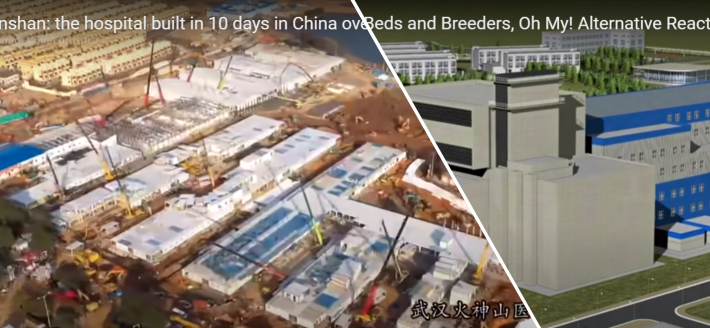
The Great Task of Real Infrastructure: Modern Healthcare Systems in Every Nation
May 17 (EIRNS)—The great building task for the industrialized and industrializing nations is clear. Building modern hospital and well-staffed healthcare systems in every nation on Earth will meet such an urgent need to preserve human life—one that cannot be met by any other attack on the pandemic—that it alone deserves the name of an infrastructure platform for the further progress of the human race. And it is an agreement among the most technologically advanced and economically developed nations which can launch such a global mission, and which is no less ambitious than a Moon-Mars mission, necessarily involving the same beneficial effects of technological breakthroughs.
If this task is taken up, as proposed by the Schiller Institute and Committee for the Coincidence of Opposites, 10 MW of new power will be needed to supply every set of hospitals with 1,000 beds, provide a lot of fresh water to them, heat and light the housing for their staff—hundreds of gigawatts of new power, and widely distributed throughout the developing nations in particular. World food production will effectively have to double since “food is health,” to quote Committee leader Dr. Joycelyn Elders. Approximations of Tennessee Valley Authority-scale development projects will evolve from the projects undertaken for the best of disease monitoring, testing and above all modern treatment capacities.
A new nuclear technology platform is waiting to be put in factory production to supply this huge project: small modular nuclear reactors. NuScale, the only company with a prototype approved by regulators thus far, is being offered the cooperation in production it needs by the Canadian firm Prodigy Clean Energy, while other Canadian companies and provinces develop their own small modular reactor (SMR) projects. Prodigy intends to build SMR marine power stations in shipyards. The Danish company Seaborg Technologies plans to fit ships with small nuclear reactors, to send power to countries across the developing sector, and believes it can start providing that power by 2025, according to Neutron Bytes blog May 14. This is a 100 MW molten salt-cooled reactor. NuScale’s target for 60 MW operating reactor modules is 2026. Russia is already capable of producing small floating nuclear reactors.
All the other target dates can be brought forward as soon as the technologically leading nations—China, the United States, Russia in particular—agree to jointly generate credit for the modern health systems to care for pandemic victims.
Standing against this mission for humanity, is the new Malthusianism which wants to sacrifice human life to “the planet” and a myth that human science and technology are impotent and destructive. As made clear already in 2019 in an article in the medical journal The Lancet by the Harvard T.H. Chan School of Public Health, 5 billion people who don’t have modern healthcare can’t have it because “if we do it in a model that has been developed in rich countries, it will break the climate—and we can’t afford that.”
Nor are we, say the Green New Dealers, permitted to double world food production to cope with widespread food insecurity and famine—and food is health. According to the investors’ group FAIRR, “The oil in the ground was being mispriced. It doesn’t have value. It’s obsolete, and therefore it’s stranded. The same is going to happen for agriculture and animal agriculture.”
The same Green New Dealers nonetheless think we should scour the Earth for vast, now unknown supplies of rare and strategic minerals and metals, in order to build billions of completely unneeded electric vehicles over the next three years—and they call their charging stations “infrastructure”!
Scrapping the Green New Deal, we can build a real new infrastructure platform for the world’s people and the economies of nations, as the Schiller Institute proposes to the Global Health Conference in Rome this week.
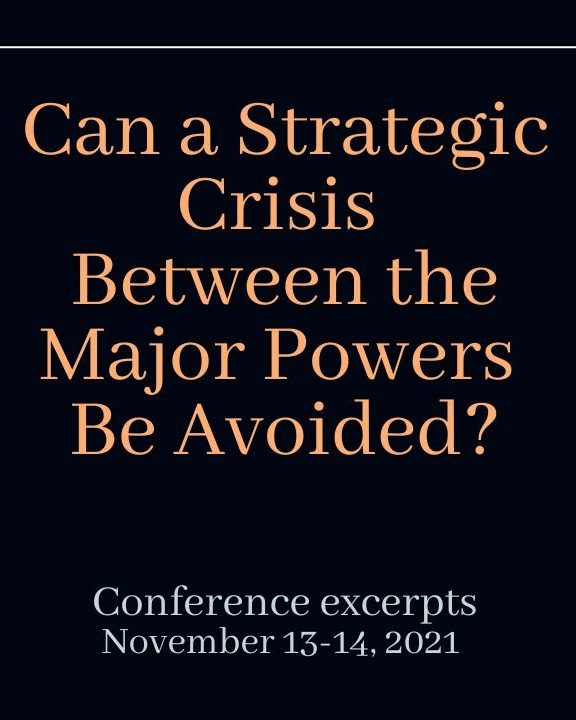
This video compilation is from the recent November 13-14, 2021 Schiller Institute Conference. The entire proceedings can be seen here.
Helga Zepp-LaRouche, Founder and President of The Schiller Institute Keynote Address: “A Terrible End or a New Paradigm?”
Ms. Chen Xiaohan (China), Deputy Secretary General, The Chinese People’s Association for Peace and Disarmament (CPAPD) Topic: “Major Country Relations and Global Development”
Ambassador Anna Evstigneeva (Russia), Deputy Permanent Representative, the Russian Federation Mission to the UN Topic: “Situation in Afghanistan after Foreign Troops Withdrawal”
Dr. Andrey Kortunov (Russia), Director General, Russian International Affairs Council (RIAC) Topic: “Is There a Pathway for an Improved Relationship Between the U.S. and Russia?”
Col. Richard H. Black (ret.) (U.S.), former State Senator; former Chief of the Army Criminal Law Division, Office of the Judge Advocate General, The Pentagon Topic: “U.S.-China Relations: Potential for War Avoidance and Cooperation”
Dr. George Koo (U.S.), Chairman, Burlingame Foundation; Retired international business consultant Topic: “The Survival of Our World Depends on Whether the U.S. and China Can Get Along”
Kirk Wiebe (U.S.), Senior Analyst (Ret.), U.S. National Security Agency (NSA), member, Veteran Intelligence Professionals for Sanity (VIPS) Topic: “До́брое бра́тство — лу́чшее бога́тство –Brotherhood is the Best Wealth”

For 58 years, the “official” story of the JFK assassination — that he was killed by a “lone assassin”, Lee Harvey Oswald — has been protected, along with the actual perpetrators, by classification of key documents, and a blizzard of lies from government and media. The same is true of Russiagate, and numerous other crimes committed by the intelligence community, on behalf of the global financial oligarchy which deploys them. President Trump promised full declassification, but did not achieve it. Now, Joe Biden has postponed release of the remaining JFK docs until December 2022. Today, DNI Haines is presenting new docs to NATO which purportedly show Russia is preparing to invade Ukraine! The veil of secrecy must be ripped off, before it is too late!
As the Israelis continue to carry out a scorched earth policy against the Palestinians in Gaza and the West Bank, with the support of Biden and his team, it is clear this is not the path to peace. The whole region, from Afghanistan, Iraq and Syria to Gaza, has been subjected to devastation, the result of applying British imperial geopolitics to a region which needs instead investment and economic development. LaRouche’s 1975 “Oasis Plan” laid the basis for such an approach. Today, the extension into the region of China’s Belt-and-Road Initiative can provide a path to peace. It is time now to convene a summit of the Permanent 5 members of the U.N. Security Council, as President Putin has called for, and which has the full support of the Schiller Institute’s Helga Zepp LaRouche.

The following 7-point call was issued by CLINTEL Group President Guus Berkhout and was presented November 14th, 2021 at a Schiller Institute Conference, “All Moral Resources of Humanity Have To Be Called Up: Mankind Must Be the Immortal Species!”
- Please, don’t act like a parrot. Be critical against the many false prophets, who are trying to take advantage of you and set you up against the impressive progress your parents and grandparents have realized. Bear in mind that the information these prophets tell you is one-sided and misleading.
- Deepen your knowledge on the facts of our climate. By doing so, you will discover that there is no evidence that points to a climate crisis. Yes, climate change exists and it is of all times. But don’t worry, the current global warming is gentle (only ca. 0.14° C per decade) and it has already made many, many positive contributions to the quality of life.
- Do you know that the difference between the mean annual temperature in cold Finland and warm Singapore is more than 20° C. Yet, both these countries are most successful. Mankind is very clever in adapting to very different climates! Declaring current global warming of 0.14° C per decade a catastrophe is totally out of proportion. Think about that, while you are protesting.
- Did your teachers ever tell you that CO2 is a blessing for everything that lives on our planet? Far from being pollution, CO2 is the molecule of life, providing food for plants. Without plants there would be very little animal life and no human life at all. Think about that as well, while you are protesting.
- Don’t confuse climate change with environmental pollution! They are two completely different phenomena. Climate change is largely caused by the primordial natural forces and environmental pollution is largely caused by human behavior. Climate change requires clever adaptation measures and environmental pollution asks for clever clean production technologies.
- Please, don’t waste your life by solving a problem that does not exist. Instead, put all your talents and energy in developing a productive sustainable economy. Only then can you realize enough financial means to increase the standard of living beyond the basic needs. When you go back to the unproductive past and make yourself poor, you are no longer in control of your future!
- History shows that living on planet Earth requires adaptation all the time. If you continue to advance science and technology, you generate new capabilities to adapt to climate change, to protect our natural environment, to conquer the universe and to take care of one another. This is the formula for creating a better world.
FINALLY DEAR YOUNGSTERS,
For all of you who have been poisoned by fear of what is to come, forget the dodgy preachers of doom and gloom at COP26; they ruin your future by destroying everything your parents and grandparents have built.
The Schiller Institute has launched a mobilization to insure that when the Global Health Summit opens in Rome on May 21, attendees will have been confronted by the call for establishing world-class health care capabilities in every nation. A statement on this is available here on the site As the pandemic tragedy unfolds in India, it is evident that failure to act on this is deadly, and not just for the people of India. Similarly, the Biden administration policy of a hands-off approach to Netanyahu’s war crimes against Palestinians cries out for action. The confluence of crises we face is the result of the breakdown of the system, strategically, economically and morally. Join with us to organize for solutions, at a moment when too many react with angry resentment or worse, resignation and submission.

China’s CGTN conducted two interviews with Schiller Institute chairwoman Helga Zepp-LaRouche on the celebration of eight years of the Belt and Road Initiative, one for with the “Dialogue Weekend” program and the second with “Global Business.” Here are the transcripts:
Dialogue Weekend
LI QIUYUAN: Welcome to this edition of Dialogue Weekend: I’m Li Quiyuan.
In the fall of 2013, while on visits to Kazakhstan and Indonesia, Chinese President Xi Jinping unveiled the plan to build the Silk Road Economic Belt and 21st Century Maritime Silk Road, otherwise known as the Belt and Road Initiative. Eight years on, how is the project progressing, and how has it helped all those involved? And what obstacles have been overcome during the construction? To review the last eight years of the BRI, I’m glad to be joined by Prof. John Gong from the University of International Business and Economics; and Miss Helga Zepp-LaRouche, founder and president of the Schiller Institute. Great to see you both.
Why don’t I start with Professor Gong first? Explain to us some context here: Why try to propose this, building this New Silk Road in the very beginning, and also why did the President announce this while travelling abroad? And also, eight years on, eight years into this project, where are we now, as far as its construction?
PROF. JOHN GONG: Hi Qiuyuan, you’re nice to have me here. It’s a long question, but let me first start by saying what the Belt and Road Initiative is not: It is not a geopolitical play, it’s not a geostrategic play, it’s not intended to seek a spread of influence. It’s mostly an economic play. There are several reasons why China started this initiative. I think the broader context is that this is a time when Chinese companies started to expand overseas, started to build a global supply chain, and in this course, Chinese companies quickly started to discover that the markets they’re mostly activating, these are the developing countries, the third world countries, they are handicapped by basic infrastructure for things like railways, port facilities, electricity network, telecom network—all these things are lacking for the Chinese companies to operate properly in these markets. And there’s a mutual benefit in developing these countries’ basic infrastructure. And this is also the time, when there was an access capacity in the basic building materials, mostly useful infrastructure buildouts for things like cement, steel, those things. We’re talking about a time in 2013, 2012.
And I would also mention this is also a time when China’s foreign exchange reserve was at an all-time high, and we would like to see the foreign exchange reserve at close to $4 trillion at the time, mostly sitting in the United States, buying American government’s Treasury bills and bonds.
So all these reasons combined contributed to the very natural evolution to using that money, using that excess capacity, and using the capabilities of Chinese companies of building infrastructure to help those developing countries to develop those projects. And I think this is the broader context: it work for both ways, and it works in particular in a way to benefit the host countries where the Chinese companies are operating, and these infrastructure projects are taking place.
LI: Helga, let me get your take on this: How do you evaluate the progress being made in the past eight years regarding this initiative?
HELGA ZEPP-LAROUCHE: Well, I think it’s the most impressive infrastructure project in the history of all of mankind. And China for the first time has given the developing countries the chance to overcome poverty and underdevelopment. And if you look at the progress, there is now the China-Laos high-speed rail project, which is fantastic. It will be extended to Thailand, and beyond. And soon, the previously not so developed country, like Laos, will have a high-speed rail system, which Europe and the United States can only dream of!
Then you have the [China-Pakistan Economic Corridor] CPEC treaty, the Middle Corridor, all these projects in Central Asia, all these investments in Africa. So I think it has brought in an incredible shift in the strategic situation, by overcoming underdevelopment, for the first time, for all of these countries. So I think, despite all the opposition, I think it’s a great success.
LI: But now after all of China’s investments in Africa, we once again are hearing criticism or accusations of China setting so-called “debt traps” for the countries participating in the BRI. This is the most frequent criticisms we’ve heard about this initiative. Professor Gong, talk to us about it: Beijing has made it clear that this initiative is by no means a debt trap. What has been done by China to support its claim?
GONG: We have to go back to the origin of the so-called “debt trap” theory. I think it originated in India with respect to, in particular, the port project in Sri Lanka. The idea is basically conspiracy theory….
LI: Now, we’ve seen the pandemic COVID-19 causing massive disruptions and damage to economic activities all around the world including the global supply chain, such as thousands of containers sitting on the Los Angeles docks, waiting for truckers and warehouse personnel to transport and deliver goods. It would seem that the world desperately needs an economic boost now, more than ever. But, Helga, do you see the BRI being it, providing great opportunities for corporations, for countries involved? Could they benefit from a smoother and more efficient global trade infrastructure?
ZEPP-LAROUCHE: Oh, yes. You have already all the countries of Asia, many in Africa, even of Europe—you have Portugal, Italy, Spain, Greece, the 16+1 East European countries that all are absolutely onboard of the BRI. But I think some of the so-called advanced countries like Germany, they would benefit the most if they would stop thinking in terms of geopolitical prejudices, because, for example, if they would join hands with China right now in the development of Afghanistan, which suffers the worst humanitarian crisis on the planet, and urgently needs to be integrated into the Belt and Road Initiative if it wants to ever have stability. So Germany, for example, is very concerned about the refugee crisis, and rather than building a wall around the EU outer borders, which is what the EU is considering right now—like the old Limes in the Roman Empire—I think the European countries, and hopefully also the United States, join hands; and they have a moral obligation because NATO countries were for 20 years in Afghanistan and they left the country in complete shambles. So, to reconstruct Afghanistan—and Haiti, and Syria, and Yemen, and all of these other countries that are in dire condition—if Germany and Europe would help and cooperate with China and the Belt and Road countries to develop Southwest Asia and Africa, there would be no refugee problem.
And I think we need a rethinking of this very, very urgently, because we have a tremendous moment in history. The Western financial system is not in good shape: You have signs of hyperinflation; the supply chain problem, you mentioned. So I think we need a rethinking. And the Schiller Institute is doing a lot of conferences and activities to convince the industrialized countries that it would be in their absolute self-interest to cooperate with the BRI and play a positive role in history.
LI: Helga, thank you for taking the time to talk to us. We appreciate your perspective.
Professor Gong, a final question on this part to you: Certainly great steps have been made on the BRI over the last eight years, but what lessons can we draw from these experiences? And what challenges has the project faced as it reaches out for wider cooperation?
GONG: Well, let me first supplement your previous question. Helga actually knows my position on this issue. I wrote a paper several years ago, talking about how America can actually benefit from the Belt and Road Initiative. The article’s title is “Make America Great Again—with Chinese Money.”
As a matter of fact, I actually as an opportunity to make a keynote speech at a conference organized by Helga, the Schiller Institute. [Create a New Epoch for Mankind • February 16, 2019, Morristown, NJ]
There could have been greater opportunities between China and the United States to address the infrastructure problems you have just mentioned. You talk about the supply chain hiccups, or these clogs at Los Angeles and Long Beach ports, all of these things can be substantially addressed by combining the capabilities of infrastructure buildouts, in China, together with investments in the United States. But unfortunately, that’s not going to happen.
Now, back to your question about lessons in the past, I think this is a perfect example to show that there are opportunities if China and other countries will just come together and cooperate, and purely think of this from an economic perspective and setting aside all these, you know, these talks about geostrategic, geopolitics lens, not seeing these things through that lens, I think there could be huge opportunities. There are tons of countries out there who indeed benefit from these infrastructure investments. So, I think the biggest lesson is, this is a purely economic play, and there will be mutual benefits deriving from this. And that let’s have both sides going to this in cooperative spirits should generate benefits for both countries.
And as well as the better exchanges, through human to human, people to people exchanges, and also economic benefits as well. So I think that’s the biggest lesson. And United States could have—I emphasize again, could have—benefitted immensely, if we go into this with, as we say, with a cooperative spirit. But unfortunately, it’s not happening.
Global Business
ANCHOR: For more on the Belt and Road Initiative, I want to bring in Helga Zepp-LaRouche, founder and president of the Schiller Institute, who’s now in Wiesbaden. Helga, welcome to the program. You know, President Xi Jinping saying the BRI is really about finding the biggest common ground for all, and I think it’s interesting to contrast that with what we hear oftentimes, from the West in terms of only working with like-minded countries. This is about working with all countries, large and small, to find their greatest common denominator.
So, Helga, at a time of such uncertainty, how important do you think is the BRI in terms of growing the economic pie for all?
HELGA ZEPP-LAROUCHE: I think it is, for sure, the most important strategic initiative on the planet right now. Because you say “uncertainty,” I mean, these uncertainties show for example, in the form of a hyperinflationary tendency: You see the energy prices skyrocketing, food prices, and we may actually head towards a hyperinflationary blowout of the entire system. And at such a moment, to have the Belt and Road Initiative which focusses entirely on the physical side of the economy, can actually become the absolute important savior for the world economy as a whole. So I think the existence of the Belt and Road Initiative is the most important initiative on the planet.
ANCHOR: And Helga, of course, one big topic that we are all talking about these days, from the public sector to the private sector, is how we can collectively tackle climate change. How do you see the Belt and Road Initiative really promoting sustainable and green development, especially for developing economies, who need more help in terms of making that green transition?
ZEPP-LAROUCHE: Well, you know, in the Glasgow COP26 summit, it became very clear that behind a lot of this climate policy, is also a Malthusian effort to prevent the developing countries from developing, and that has been expressed very clearly by India, Indonesia, Nigeria, which all did not go along with the program of Glasgow.
So I think China, on the other side, is offering especially cooperation in nuclear energy, which has a very high energy flux-density and therefore, is potentially the energy source for more developed economies. So I think the role of China and the BRI countries which all are going in the direction of promoting nuclear energy, also for the developing countries, are representing a very, very important alternative to the Malthusian policies coming from the financial centers in London and Wall Street.
ANCHOR: Hmm. So we have growing the economic pie for all, energy cooperation, green development, and of course, one other extension. Helga, of the BRI, is the Health Silk Road, and this is China aiding Belt and Road partner countries, by sharing medical knowledge about the coronavirus; last year providing medical aid as well, last year and this year. Help I believe will be a critical part of BRI cooperation going forward. How do you see this element of the Initiative developing, post-pandemic?
ZEPP-LAROUCHE: Well, I think it is very clear that China right now is helping many African countries to build vaccine production, so they can develop their own vaccine. I have been saying, since the outbreak of this pandemic, that it will only stop if we build a world health system: That means a modern health system in every single country. Because the idea to only take care of the rich countries with vaccines, and modern hospitals, does not work, because then the poor countries are left behind, and then the virus is mutating, and will come back and hit the entire human population.
So I think we have to have a very big emphasis on a modern health system in every single country: Which means modern hospitals—China has proven you can build a modern hospital in two weeks in Wuhan—but the developing countries need encouragement and help. They need energy, they need clean water, in order to do that. I think the most urgent ones right now are Afghanistan, Haiti, Syria and Yemen: These are the countries that need, urgently, international cooperation to build modern health systems, if they are supposed to survive. I have proposed something called “Operation Ibn Sina” which named after the great universal thinker of the Afghanistan region, from around the 10th century. And that could become the spearhead for a health system in every country in the Islamic world, but also for all the developing countries. And that’s the only way how the pandemic will stop, and future pandemics.
ANCHOR: Yes. And speaking about closing gaps all around in terms of the development gap, closing the energy and green development gap, what about the digital connectivity gap? The digital connectivity benefits provided by the BRI down the road can be absolutely huge, in terms of getting especially emerging and developing economies, really into the digital sphere. The pandemic, we’ve seen, has really accelerated digitization. How do you see the BRI boosting digital connectivity, and really helping to narrow the digital divide between developing economies and advanced economies?
ZEPP-LAROUCHE: I think the fact that China was able to deal with the pandemic so much better than almost every other country on the planet has to do with the fact that the health sector is largely digitalized, and contact tracing, smart cities integrated—I think that’s future.
The problem is, the West is opposing that because there is a difference: In China the population for the most part trusts the government, and thinks that these measures are being applied for the common good. In Western Europe, for example, or the United States, there is a deep mistrust between the population and the government, and therefore, there is a lot of opposition. But look at Germany, right now, or many European countries: The pandemic is exploding again. And that is, for sure, they are still using photocopy machines, and very archaic means to trace the pandemic. And if Europe would have the kind of digitalization like China we would be in much better shape.
So I think that is clearly the way to go, and hopefully, people start to rethink and correct a lot of prejudices which do not come from facts, but they come—for example, the U.S. Senate just agreed upon a strategic act, which spent several hundred million dollars every year to counter the so-called “influence” of China! If that money would be spent on building hospitals and building real infrastructure for the benefit of the people, the United States image would gain much more than from these kinds of measures!
So again, I can only hope there will be a rethinking and a lot of the prejudices which have been spread should be put into the garbage pile.
ANCHOR: Yeah, instead of spending trillions of dollars on never-ending wars in foreign lands, I think definitely that money, at least for the United States, can be better put towards working with other countries in terms of boosting development around the world. And of course, that’s what the BRI is about, is really focussing and emphasizing cooperation, especially in the world that we live in today, and our future generations will need that cooperation. We must see that through the BRI. Many thanks for sharing your thoughts with us, Helga. That’s Helga Zepp-LaRouche, founder and president of the Schiller Institute.
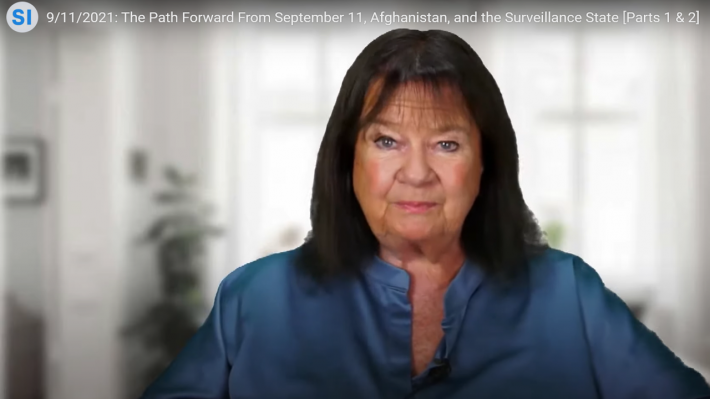
The contrast between the flop of the Malthusians with the failure of their “climate summit”, and the successful deliberation at the 2-day Schiller Institute conference demonstrates that there is an urgency in breaking with the present paradigm, and achieving cooperation among all leading nations. The dividing line is between Trans-Atlantic nations sticking with neoliberal, colonial policies, and geopolitical provocations, and those nations committed to cooperation for economic development.
Helga developed this contrast, as it exists regarding all major crises, from addressing the humanitarian disaster facing Afghanistan; the crisis at the Poland-Belarus border; the COVID pandemic, which is surging through Europe; and dealing with hyperinflation, caused by the decision to bailout bankrupt corporations, rather than invest in developing new manufacturing centers at the frontiers of science. She called on viewers to join the Schiller Institute, at a moment when historical decisions are being made. The changes we have proposed will work; but, if these changes do not take place, the West will collapse, due to moral bankruptcy.