Goethe and Beethoven: “Getting Along with Girls” Notes by Fred Haight
The Classics are often associated with imagery of stuffy-old-white-male who have nothing relatable for the contemporary youth generation. We beg to differ.
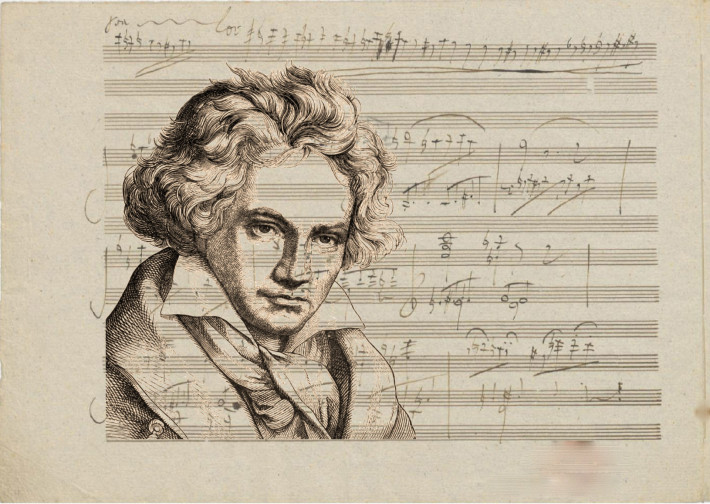
Goethe’s Mit Mädeln sich Vertragen (Getting Along with Girls), written in 1787, is a poem that makes hilarious fun of the “machismo” mentality of any young, over-confident, would be Don Juan. Beethoven captures Goethe’s imagery perfectly (including a mock sword fight), in this short work for Bass and Orchestra, WoO 90 (composed around 1790-92).
Mit Mädeln sich Vertragen:
Mit Mädeln sich vertragen,
Mit Männern ‘rumgeschlagen,
Und mehr Credit als Geld;
So kommt man durch die Welt.
Ein Lied, am Abend warm gesungen,
Hat mir schon manches Herz errungen;
Und steht der Neider an der Wand,
Hervor den Degen in der Hand;
‘Raus, feurig, frisch,
Den Flederwisch!
Kling! Kling! Klang! Klang!
Dik! Dik! Dak! Dak!
Krik! Krak!
Mit Mädeln sich vertragen,
Mit Männern ‘rumgeschlagen,
Und mehr Credit als Geld;
So kommt man durch die Welt.
With girls I get along,
With men I brawl,
With more credit than money;
This how one goes through the world.
A song, sung on a warm evening,
Has already won many a heart for me;
And I back the jealous one against the wall, His sword in his hand; Out, fiery, fresh, The feather duster!
The meeting today in Geneva has been played down by both sides. Yet, the fact they are meeting is significant. It comes in the midst of worsening relations between the U.S. and Russia. And it follows a not-fully successful effort by the Anglo-American geopolitical War Hawks to pull the “Alliance of Democratic States” into an agreement for heightened confrontation with Russia and China. While some of the rhetoric was harsh, with wild accusations against both states, it is also clear that not everyone was buying into the idea that more sanctions and bluster against them would accomplish anything, especially when no real evidence backing the charges against Putin and Xi has been presented. In the absence of a solid front in favor of heightened confrontation against Russia and China, is it possible that an actual dialogue might begin?
A team of researchers from the Italian National Tumor Institute in Milan has detected the presence of the SARS-Cov-2 virus in Italy already in September 2019 in a study that “may reshape the history of pandemic”. The team has tested blood samples of individuals enrolled in a lung cancer screening and reported the results in a study published by the “Tumori Journal” datelined Nov. 11. They “investigated the presence of SARS-CoV-2 receptor-binding domain (RBD)–specific antibodies in blood samples of 959 asymptomatic individuals enrolled in a prospective lung cancer screening trial between September 2019 and March 2020 to track the date of onset, frequency, and temporal and geographic variations across the Italian regions. SARS-CoV-2 RBD-specific antibodies were detected in 111 of 959 (11.6%) individuals, starting from September 2019 (14%), with a cluster of positive cases (>30%) in the second week of February 2020 and the highest number (53.2%) in Lombardy. This study shows an unexpected very early circulation of SARS-CoV-2 among asymptomatic individuals in Italy several months before the first patient was identified, and clarifies the onset and spread of the coronavirus disease 2019 (COVID-19) pandemic. Finding SARS-CoV-2 antibodies in asymptomatic people before the COVID-19 outbreak in Italy may reshape the history of pandemic.”
Independent of this and other worthwhile investigations into the origin of the virus, the attacks leveled against China for various supposed crimes of malfeasance or deliberate promotion of the virus’s spread have been, in the main, lies spread to drive a wedge between China and other nations, especially the United States.
The marathon begins at 7am EST on Friday, February 12, and end at midnight. In commemoration of Lyndon LaRouche’s passing on February 12, 2019, we invite you to meet, or reacquaint yourself with the mind and the personality of one of the greatest geniuses of the last 100 years. Genius without beauty is not genius at all. Join our LaRouche marathon, and bring your friends young and old alike.
If you haven’t already, sign up for emails from the LaRouche Organization.
Beethoven’s Sense of Humor Part 2: “To beat, or not to beat.” Notes By Fred Haight
In part 1 of Beethoven’s humor, we wrote about “Rage of a Lost Penny”. Today, we talk about the humor in Beethoven’s 8th symphony.
Johann Nepomuk Maelzel tried his hand at Artificial Intelligence about two centuries ago. It did not work out so well for him. In 1821, he brought an automaton chess player called “the Turk” to the United States and toured widely with it, claiming to have invented it and that the “automaton” had the intelligence to regulate its moves. This fraud was later exposed by Edgar Allan Poe in an essay. It turned out that his automatic chess player contained a man hidden inside it (picture below). The machine was in fact invented by Wolfgang von Kempelen and bamboozled the public for decades before being discovered.
Maelzel also claimed to have invented the metronome. Actually, he did not invent that either.
In 1813, Maelzel encouraged Beethoven to compose what could possibly be his worst piece, “Wellington’s Victory”, which celebrates Wellington’s military victory over Napoleon. Maelzel laid out all of the parameters and special effects to make it sound like a battle, including quotes of “Rule Britannia.” Performances featured interludes by Maelzel’s automaton trumpeter and his Panharmonikon, an automatic orchestra.
Despite the composition’s commercial success, Beethoven ended up suing Maelzel when he tried to pass the work off as his own. Beethoven described him as “a rude, churlish man, entirely devoid of education or cultivation.”
Listen to this canon that maked fun of Maelzel and his metronome.
These days, scholars who love to spoil all the fun, claim that the canon was actually written by Beethoven’s aide-de-camp, Anton Schindler, and passed off as praise for Maelzel by Beethoven. That does not quite make sense. Here are the words of the canon:
Ta ta ta, dear Maelzel
ta ta ta, live well, very well
ta ta ta, you Banner of Time
ta ta ta, you great metronome.
ta ta ta ta ta ta.
Faint praise indeed. Besides, Schindler was very critical of taking Beethoven’s metronome markings literally, because he personally had experienced Beethoven change his mind about what tempo his works should be taken at. Beethoven alleged comment to Schindler: “No more metronome! Anyone who can feel the music right does not need it; and for anyone who can’t, nothing is of any use; he runs away with the whole orchestra anyway.”
Now to Beethoven’s 8th symphony. The second movement resembles this canon. The same scholars argue that the symphony came before Maelzel patented his metronome, so it could not be a parody of it.
Give us a break! In the symphony, Beethoven is clearly making fun of a too strict tempo. But we ask you, the audience to listen and tell us what you think!
Instead of engaging the leaders of Russia and China in a serious deliberation on what to do about the multiplicity of crises affecting the world, the G7 and NATO leaders put forward a series of unserious, if not downright lunatic proposals, during their confabs over the last days. Their proposals for global infrastructure and battling the COVID pandemic were not serious, but instead would continue the policies which have left infrastructure — including that of public health — incapable of serving the needs of nations and their people. As for their strategic communique, it is more of the same false accusations against Russia and China, to justify military buildup and geopolitical confrontation. Where are the statesmen and women, when they’re needed? They will be at the Schiller Institute online conference, June 26-7. Join us!
Iraq is seeking to build eight nuclear power plants by 2030, to eliminate its endemically bad electricity footprint, a product of destruction by the Children of Satan — most recently of George Bush’s 2003 Iraq War destruction, but going as far back as the 1981 bombing of the (almost complete) Osirak nuclear reactor by Israel. The oil-rich country, OPEC’s second-largest producer, is seeking to go nuclear partly under pressure from global green de-carbonizers, who are trying to raze all oil production from the planet.
According to {Bloomberg News}, who interviewed Kamal Hussain Latif, chairman of the Iraqi Radioactive Sources Regulatory Authority, “Iraq is seeking to build eight reactors capable of producing about 11 gigawatts, [and seeking] funding from prospective partners for the $40 billion plan and pay back the costs over 20 years.” Iraq has been in contact with both Russian and South Korean officials about a deal, they say.
Detailing the sorry state of electricity in Iraq, {Bloomberg} notes that Iraq currently has 18.4 GW capacity, which includes 1.2 GW imported from Iran. They estimate “normal” demand to be 28 GW — exceeding 30 GW in the “torrid” summer months. By 2030, Iraq’s demand is expected to rise to 42 GW, so the 11GW nuclear that they are seeking is right in step with demand.
The bright future with nuclear fission and fusion power will be discussed at the upcoming Schiller Institute conference.
For the Common Good of all People, not the Rules Benefiting the Few!
International Schiller Institute/ICLC online conference, June 26/ 27, 2021
Beethoven and Tragedy: The Coriolan Overture Notes By Fred Haight
We have already talked about Beethoven’s sense of the heroic; and the power and optimism expressed in his Third Symphony, his only opera Fidelio, and the Egmont Overture.
However, an important part of trying to create a positive outcome for society, involves the study of tragedy. This does not refer to the way in which people use the term today, such as a natural disaster, but what happens when the flaws in both a leader and a society result in failure, or worse, betrayal?
Heinrich Joseph von Collin wrote his play, Coriolan, in 1804, the year that Napoleon crowned himself as Emporer. That same year, Beethoven scratched out the dedication of his Third Symphony to Bonaparte, lamenting that now Napoleon would become just another tyrant, and trample on the rights of men. That same year, Schiller premiered his last play, Wilhelm Tell, celebrating the ancient triumph of ordinary Swiss people over the threat of subjugation by the Hapsburg Empire.
In the next year, 1805, the French army occupied Vienna, and many of the city’s leaders left. Von Collin was an opponent of the French occupation, but also seems to have served as some sort of diplomatic liaison. In 1807, Coriolan was performed with a prelude composed by Ludwig van Beethoven. Von Collin was a classicist, familiar not only with Shakespeare, but with the ancient Greeks and Romans. Von Collin’s play is a Germanic rewrite of the ancient story of Gaius Marcius Corialanus, which Shakespeare also wrote about, in his play Coriolanus. We will use Shakespeare’s play Coriolanus, supplemented by the historical writings of Livy and Plutarch, to give a brief account of this tragedy of a flawed military leader and a flawed Roman Republic.
Gaius Marcius Coriolanus was promoted to General after showing great personal courage in defeating the Volscians at the city of Corioli, and was given the honorary name Coriolanus. He made an effort to seek higher political office, but had a deep flaw, in that he DESPISED the ordinary people—the plebeians. That was not just Coriolanus. There was a severe overall divide in the Roman Empire between the plebeians and the patricians. He had to win their approval to be promoted, but he absolutely refused to obey the standard ritual of showing them his war wounds. Worse, he was a speculator, who hoarded grain even while the people starved. He insulted the people, calling them “crows pecking at eagles”. As a result, Coriolanus, the war hero, was exiled from Rome. His wounded ego was so enraged that he went to his old enemies, The Volscians, and offered to lead their army in an attack on Rome. They marched together. The Romans were so freaked out that as Coriolanus and the Volscians approached, they sent Coriolanus’ mother (who had far too much influence on him), and his wife and children to talk him out of it. He relented. Thus, he became seen as a traitor by both the Romans AND the Volscians, who were at the gates of Rome. In Shakespeare’s play, he was murdered. In the Collin, he committed suicide.
If you read Shakespeare’s Julius Caesar, you see the same problem within the Roman Republic: a huge rift between the people and those in power—the plebeians and the patricians. The patricians had no respect for the plebeians, and the plebeians were fickle, having had no sense of loyalty to the patricians. In 1804, this history would be resonating in people’s minds, as the French Revolution descended into barbarism, with the “sans culottes” decapitating the aristocracy in droves, and as a great general, who promised to liberate the people, became a tyrant.
This performance of the Coriolan Overture is conducted by Wilhelm Furtwangler, recorded in 1943, as Germany and the world experienced an even worse tragedy.
“The red planet has captured human imagination for centuries. Now, we are at a junction where we know a great deal about the planet, and we have the vision and technology to explore further. Mars is an obvious target for exploration for many reasons. From our pursuit to find extraterrestrial life to someday expand human civilization to other planets, Mars serves as a long-term and collaborative project for the entire human race.”
In a fascinating interview with Space.com on Feb. 8, the day before orbital insertion, UAE Space Agency chair and Minister for Advanced Sciences Sarah al-Amiri described how Hope was designed for its mission as “the very first holistic weather satellite of Mars,” mapping the dynamics of Mars’s weather system throughout the entire day, in every region of Mars, over the course of an entire Martian year, through the combination of its three key instruments, shifting its orbit (from closer in to further out), and monitoring Mars’s lower and upper atmosphere, and the interactions between them.
“Our objectives from the get-go,” she emphasized, “are to ensure that Hope’s science is complementary to other missions and [therefore] usable to various science groups, and also new in nature so that it can continue the vast exploration efforts by different nations about Mars.”
Hope is a product of national determination and international cooperation which exemplifies how other developing countries and regions can also leapfrog into being space-faring nations. The UAE is a young nation—founded only 50 years ago—but its founder, Sheikh Zayed bin Sultan Al-Nahyan, recognized that “money is meaningless if not mobilized for the good of man,” the country’s oil wealth “valueless without national human resources qualified for and capable of building up the country” through science and industry.
It was that understanding that led far-sighted leaders of the UAE to invite physical economist Lyndon LaRouche to deliver the keynote address to a two-day regional symposium on “The Role of Oil and Gas in World Politics,” at the UAE’s Zayed Centre in June 2002, and to develop both nuclear power and space programs.
Space Agency chair al-Amiri argues that the purpose of UAE’s space program is that of “stimulating a lot of change within the U.A.E.’s economy that today more than ever should have a solid foundation in science. The best way to do that, from what we have been experimenting with as a nation, has been an exploration mission to space.”
To develop its Earth-orbit satellite program in the 2000’s, the UAE turned to South Korea to jointly design and build its first two satellites, then launched from Kazakhstan. Its Space Agency was founded in 2014, and the goal of sending a probe to Mars by 2021, the 50th anniversary of the nation’s founding, adopted quickly thereafter. By 2018, the UAE space team was able to design and build a satellite itself. To meet the tougher technical challenges of building a spacecraft for another planet, the UAE Space Agency partnered with three U.S. universities: the University of Colorado’s Laboratory for Atmospheric and Space Physics in Boulder, Arizona State University, and the Space Sciences Lab at the University of California, Berkeley campus. Hope was then launched to Mars on a Japanese rocket from the Tanegashima Space Center!
A veteran of NASA Mars missions, now based at Northern Arizona University who worked on the design of one of Hope’s instruments, Christopher Edwards, told the Wall Street Journal that the Hope mission “is like nothing I’ve ever experienced in the spacecraft program so far. There’s a huge training aspect to it and a huge collaborative aspect that is like nothing else.”
Today’s webcast focuses on three topics. 1. The continuing fight to defeat the vote fraud done on behalf of a Biden presidency; 2. The significance of the Pentagon shake-up undertaken by President Trump, which provides clear evidence that he intends to win the vote fraud fight, and pursue his strategic objectives — especially to end the “endless wars” — in a second term; 3. Why the defeat of Trump is a necessary precondition for the “Global Reset”, with its intent to establish a banker’s dictatorship, which will enforce a genocidal Green agenda.