



In commemoration of Lyndon LaRouche’s passing on February 12, 2019, we invite you to meet, or reacquaint yourself with the mind and the personality of one of the greatest geniuses of the last 100 years. Genius without beauty is not genius at all. Join our LaRouche marathon, and bring your friends young and old alike.


Helga Zepp-LaRouche stated today that the agreement released following the summit between President Putin and President Xi last week was extremely important, and has shaken things up in a positive way. The two leaders reasserted the concept of peaceful coexistence, which includes non-interference in other nations’ affairs, reflecting the principles of the Bandung conference. Coming at the time of the ramping up of tensions between NATO and Russia, it is shaping the potential for a new international geometry, which requires a discussion of a new security architecture. President Macron’s meeting with Putin pushed things in that direction, and other smaller countries are speaking out — for example, Pakistan’s President Imran Khan. She is hopeful about what might come from Germany, but agreed with Zakharova, the spokeswoman for the Russian Foreign Ministry, that Germany remains a “U.S. protectorate.”
The other major development she highlighted was the Schiller Institute-RIAC seminar yesterday addressing achieving a solution to the humanitarian crisis in Afghanistan. She described the announcement by President Biden that the U.S. will release funds frozen by the U.S. which belong to Afghanistan, which can be used to purchase food, medicine, etc., is a “step forward”, but what is required to fully overcome the crisis there is the cooperation of all major powers, with the regional powers, to fully integrate the country into the regional economy.

The pathetic attempt by UK Foreign Minister Truss to imitate her model, Margaret Thatcher, in her confrontation with her Russian counterpart, Sergei Lavrov, fell flat, as she came off looking like an ill-prepared buffoon. At the same time, the French and Germans saw in a Normandy Four meeting in Berlin, that the Russians are right, that it is Ukraine — NOT Russia — that is blocking the fulfillment of the Minsk Accords. And the EU’s version of a Green Build Back Better plan was hit by a blow from Senegal’s President, who said Africans are more concerned about having electricity than in meeting the COP 26 agreement’s demands on hydrocarbons.

The Russian International Affairs Council (RIAC) and the Schiller Institute (SI) will be convening a seminar on Thursday, February 10, 2022 at 4 PM Moscow time/2 PM CET/8 AM EST on the topic, “The Humanitarian Crisis in Afghanistan: Toward a Long-term Solution.” Among the topics to be addressed by a panel of six speakers will be:
- What are the causes of the Afghan humanitarian crisis?
- What are the geopolitical implications of a failed state in Afghanistan?
- What is needed to reverse the immediate threat of mass starvation and refugee problems?
- A long-term solution to the humanitarian crisis: the role of the global powers.
Opening and closing statements will be presented by Dr. Andrey Kortunov, Director General of RIAC, and Helga Zepp-LaRouche, chairwoman of the SI.
Additional speakers will include:
Ivan Safranchuk, Director at the Center for Eurasian Studies of MGIMO University
Temur Umarov, Fellow at the Carnegie Moscow Center
Jim Jatras, U.S. diplomat, former advisor to U.S. Senate Republican leadership
Graham Fuller, 25 year career as a CIA operations officer, author
Questions may be submitted to questions@schillerinstitute.org

A coordinated diplomatic effort by French President Macron and German Chancellor Scholz to resolve tensions with Russia over security guarantees shows some promise. Unfortunately, the war hawks making policy for the U.S. and U.K. continue to spread through compliant media their false narrative of an “imminent” Russian invasion, and a buildup of NATO forces at or near the borders of Russia. What are they covering up with their incessant campaign of bluff and bluster?
Make sure to watch Schiller Institute’s Seminar tomorrow at 8 AM EST “The Humanitarian Crisis in Afghanistan — Toward a Long-term Solution.”
Why is it that U.S. nuclear war exercises are good, as we are told they are “to secure our freedoms”, but Russian exercises are described as a prelude to invade another country? Who has invaded more countries in recent years, the combined U.S./NATO forces, or Russia and China? Which alliance has used false flags as an excuse for war, organized Color Revolutions to carry out coups, and imposed sanctions to punish innocent civilians? The lying narratives must stop! The Schiller Institute will hold a joint event with the Russian International Affairs Council on Feb. 10 to discuss a solution to the crisis in Afghanistan. Join us: https://schillerinstitute.com/blog/2022/02/07/seminar-the-humanitarian-crisis-in-afghanistan-toward-a-long-term-solution/
by Helga Zepp-LaRouche · February 6, 2022
“A nuclear war cannot be won and must never be fought,” the five nuclear powers and permanent members of the UN Security Council affirmed in a joint statement on Jan. 3 of this year. Since the use of nuclear weapons always involves the risk of using the entire nuclear arsenal, a percentage of which is enough to cause the extinction of the human species, the confirmation of this fundamental insight should actually have practical implications for the military strategy of all nuclear powers.
Notwithstanding this joint statement, in the last week of January, the U.S. Strategic Command launched the Global Lightning exercise, designed to test the readiness of U.S. nuclear forces.
Although this was a so-called “routine” maneuver integrated this year with the U.S. Indo-Pacific Command and thus aimed at a possible confrontation with China, in the context of heightened tensions between Russia and the United States and NATO, it can be seen as just another—but perhaps the most dangerous—element in the way that the West is playing with fire with respect to Russia and China.
The timing of the maneuver coincided with hitherto unproven allegations by the United States and UK that Russia was planning a military attack on Ukraine between late January and mid-February, which the Russian government has repeatedly denied. The nuclear command-and-control exercise is based on the U.S. Strategic Command’s current nuclear war plan. Hans M. Kristensen, Director of the Nuclear Information Project of the Federation of American Scientists, was able, under the Freedom of Information Act, to obtain the cover page of this plan, entitled Stratcom Conplan 0810-12, Strategic Deterrence and Force Deployment, Change 1. Kristensen, one of the most competent specialists in the field of nuclear strategy and weapons, explained to Newsweek that the Global Lightning exercise does not simply assume a nuclear first strike by one side or the other, but an extended nuclear war that will continue after the first exchange of strikes.
Even though the individual components of this new war plan, which has been operational since April 30, 2019, are subject to the highest levels of secrecy, the outlines of this conception emerge. The assumption is that the United States and NATO would be able to survive a nuclear first strike by Russia or China, then retaliate, absorb further attacks, retaliate again, etc., in an ongoing military confrontation. This nuclear war plan includes not only nuclear weapons but various other lethal systems such as missile defense systems, directed energy weapons such as electromagnetic pulse weapons and lasers, cyberattacks, and Space Force attacks from space. Who would be able to survive such a prolonged nuclear war? The few people who can nest in deep underground bunkers? It makes the morbid fantasies of Dr. Strangelove look like a child’s birthday party.
Last year’s Global Lightning maneuvers in April 2021 focused on a potential conflict with Russia; this year it was devoted to a possible confrontation with China. The Pentagon’s various strategy papers since 2017 had increasingly defined Russia and China as geopolitical rivals and adversaries, replacing the fight against global terrorism with great-power competition as a strategic priority. At the same time, the modernization of the nuclear triad begun by the Obama Administration continued and the threshold for the use of nuclear weapons was increasingly lowered by the stationing of low-yield warheads on Trident submarines, among other things.
The Strategic Conflict
Although there was little official comment, President Putin’s March 1, 2018 announcement was about Russia’s new nuclear systems. These included the Avangard hypersonic glide vehicle (launched from an ICBM, it travels at 20 times the speed of sound and boasts excellent maneuverability that renders the American missile defense system essentially obsolete;” the hypersonic aeroballistic missile Kinzhal; as well as nuclear-powered cruise missiles, fast underwater drones and laser weapons—a shock to the western military establishment. Meanwhile, China has also developed its own hypersonic missiles with infrared homing technology, a capability that the American military may not have for two to three years. American satellite imagery has also located about 300 missile silos under construction in scattered locations across China, some of which may remain empty, but others would have nuclear missiles in a state of “launch on warning” to forestall a disarming surprise attack.
This is broadly the strategic background against which Putin presented two treaties to the United States and NATO on Dec. 17, demanding that they be legally binding: no further eastward expansion of NATO, and no offensive weapon systems stationed on Russia’s borders; plus guarantees that Ukraine would not be admitted to NATO.
Unlike many trans-Atlantic politicians and media outlets, Gen. Harald Kujat, the former Inspector General of the German Armed Forces, believes that the gathering of some 120,000 Russian troops near the Ukrainian border—some of them, however, hundreds of kilometers away—is not indicative of an impending attack on Ukraine, but that Russia wants to demonstrate strength with this threatening backdrop in order to force negotiations with the U.S.A. and NATO on an equal footing.
So far, the United States and NATO have refused to make any commitments on Putin’s key demands, and appear only willing to make what Russia considers secondary commitments on new disarmament talks. Putin has announced “military-technical measures” in the event of a definitive refusal. In view of the fact that the stationing of potentially offensive weapon systems in the vicinity of the Russian borders in connection with NATO’s eastward enlargement—this includes, for example, the Aegis missile defense system stationed in Poland and Romania—created a situation for Russia comparable to the stationing of Soviet missiles in Cuba, the question arises as to what these “measures” might look like.
The American Russia expert Gilbert Doctorow suspects that they could include the stationing of nuclear-armed SS-26 Iskander-M short-range missiles in Belarus and Kaliningrad in order to threaten the NATO front-line states and eastern Germany in return. He further suspects Russia may plant sea-launched hypersonic Zircon nuclear-armed cruise missiles off the coast of Washington, D.C., which Russian experts have previously said could destroy the American capital so quickly the President would not have time to board Air Force One to escape. Theoretically, the Zirkon hypersonic missiles could, of course, also be used anywhere on the seven seas and are very difficult for conventional air defense to detect and intercept in view of their velocity—nine times the speed of sound—and maneuverability in flight.
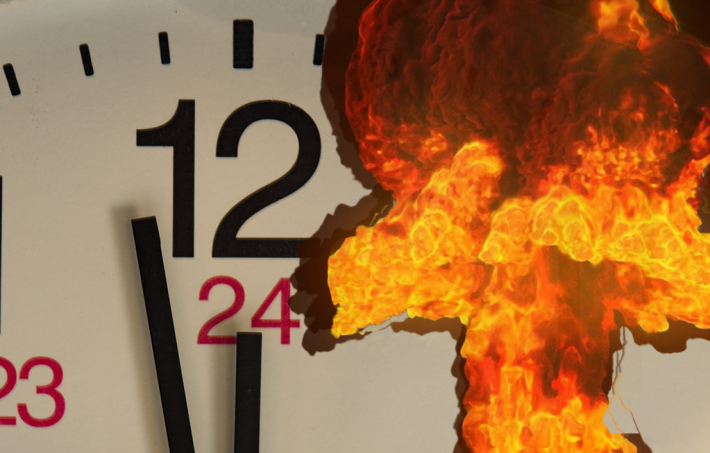
So it is only logical that the Bulletin of the Atomic Scientists’ Doomsday Clock on Jan. 20, 2022 showed only 100 seconds to midnight. That’s only about a minute and a half until the nuclear apocalypse. Even though, since the escalation of the Ukraine crisis, after a deep sleep of almost 40 years, the anti-war movement has issued a whole series of appeals, public calls and open letters—most recently from 100 organizations in the U.S.A. demanding that President Biden de-escalate the tensions with Russia—the enormous extent of the threat has by no means penetrated the public consciousness.
Uncertainty about the Causes
But even among most Westerners who recognize the imminent danger, there is a lack of clarity about the underlying causes of the existential danger to human existence. They are to be found, on the one hand, in the systemic character of the crisis of the neoliberal financial system, which has now entered its hyperinflationary final phase; and on the other hand, in the claim of the financial establishment in the City of London, Wall Street and Silicon Valley to a unipolar world in which only the power interests of this establishment determine what shall happen in the “rules-based order.”
The dilemma now arises from an opposing dynamic. Since the paradigm shift of August 1971, prophetically recognized by Lyndon LaRouche—when Nixon effectively ended the Bretton Woods system by abolishing fixed exchange rates and thus paving the way for speculative profit maximization—there has been an increasing shift in the trans-Atlantic world away from investments in the productive physical economy and towards speculation in increasingly exotic derivative-based financial products, of which the most recent folly is “shifting the trillions” into the Green New Deal.
From the standpoint of the physical economy this policy—of making investments in industries with the lowest possible energy-flux density—ultimately represents an extensive destruction of capital, just like investments in the military production of weapon systems and the army. The fact that this effect is usually not recognized has to do with the confusion about monetary values, money vs. real wealth, and the illusion that the share values of listed companies say something about the productivity of the economy. Of course, it is in the interest of the yacht-owning billionaires, some of whom have long since acquired condominiums in deep-seated bunkers in Australia and elsewhere, that the bubble economy be sustained for as long as possible, even as the proportion of the population that is impoverished continues to increase, and the middle class shrinks.
When the Soviet Union dissolved in 1991 and the trans-Atlantic establishment, despite all warnings—for example from Pope John Paul II—succumbed to the fantasy of having “won” the Cold War, and interpreted the “end of history” to mean that the whole world must now subject itself to the neoliberal rules-based order, there was no longer any need to keep any promises made to Russia not to expand NATO eastward. The whole spectrum of instruments for cementing the unipolar world was used: regime change, either through color revolutions or “humanitarian” wars against all governments that held other values. Victoria Nuland publicly boasted that the State Department had spent $5 billion on NGOs in Ukraine alone, which initially led to the 2004 “Orange Revolution.” When President Yanukovych refused to join the EU Association Agreement in late 2013, not least because the EU is fully linked to NATO in terms of treaties and security, the not-so-democratic side of the rules-based order came to the fore in the form of the Nazi Maidan coup of February 2014. This did not result in any annexation of Crimea by Putin, but rather a referendum by the people of Crimea, who wanted to withdraw from Kiev’s fascist policies. Even then, Putin stated that the West was actually concerned with containing Russia and that, if not in Ukraine, they would have found another excuse for doing so.
The decisive hardening towards Russia and China became visible, in 2017 at the latest, in the changed language in the security doctrines of the Pentagon and the characterization of these two countries as “enemies” and “autocracies.” While the Western institutions initially reacted to the announcement of the New Silk Road by Xi Jinping in September 2013 with an extensive blackout for an amazing four years, these institutions have now reacted to this largest infrastructure project in human history as if it were an existential threat—namely to the unipolar world!
Virtually all sanctions that have been imposed anywhere in the world unilaterally, i.e., without UN Security Council resolutions, ultimately had the chief purpose of preventing China’s economic rise and Russia’s regaining the status of world player.
The transcript of the Jan. 25 background press briefing by two unnamed White House officials shockingly reveals this intention. They present a whole spectrum of “serious economic measures”—starting at the highest level of escalation—to thwart Putin’s strategic ambitions to industrialize his economy, by denying him access to all modern, advanced technologies, such as AI, quantum-computers, and any technology related to defense or aerospace, to prevent him from “diversifying” the economy beyond exporting oil and gas. The objective is the atrophy of the Russian economy.
This policy, formulated in incredibly brutal language, is nothing more than a continuation of Jeffrey Sachs’ so-called “shock therapy” of the 1990s, which had the explicit aim of reducing Russia from the status of a superpower at the time of the Soviet Union to that of a commodity-exporting Third World country. That policy was then, as it is now, a declaration of war—the only difference being that Putin is not a pathetic figure like Boris Yeltsin, pampered by the West for geopolitical motives, but a brilliant strategist who knows how to defend Russia’s interests.
The no less hateful tirades against China, which can be heard today from court scribblers of the Empire, as well as from former Maoists of the SDS era who have now risen to top positions in the Green Party, cannot change the outstanding success of the Chinese economy, which recorded a growth rate of over 8% in 2021 despite coronavirus. China has done more for human rights than any country of the so-called Western community of values, lifting 850 million people out of poverty domestically— including the Uyghurs, who now enjoy vastly better living standards and faster-than-average population growth—and offering many developing countries for the first time the chance to overcome poverty.
The silence of the same circles on the largest of all humanitarian catastrophes, triggered by Western sanctions in Afghanistan, in which one million children are starving and a total of 24 million people are at risk of dying this Winter, seals their complete discrediting.
Joint Statement by Putin and Xi
If various authors have warned that the campaigns against Russia and China could lead to even closer ties between these two countries, then rest assured that this is exactly what has now happened during Putin’s visit to the Olympic Games in China. However, there is an urgent need to remove the ideological spectacles and recognize the extraordinary opportunity presented for the whole world by the joint declaration of Presidents Putin and Xi in this extremely dangerous world situation.
The 16-page document entitled, “Joint Declaration of the Russian Federation and the People’s Republic of China on International Relations Entering a New Era and Global Sustainable Development,” calls for replacing geopolitical confrontation with economic cooperation as the basis for a common security policy. Both nations are calling on NATO to refrain from further expansion plans, to move beyond Cold War thinking, and to enshrine the long-term security guarantees that Russia is demanding. The role of international organizations such as the G20, BRICS, APEC and ASEAN should be strengthened, they say. Russia will cooperate in realizing China’s proposed “Global Development Initiative” and emphasizes the importance of the concept of the “community of a common destiny for mankind.”
Let’s think back to the hundred seconds before midnight on the doomsday clock: Who can deny that we are an indivisible community of destiny? In recent weeks, more level-headed voices have spoken out in favor of a new pan-European security architecture including Russia and Ukraine, which could be enshrined in a new Helsinki agreement. However, in view of the complexity of the world situation, the threat to world peace affecting all states, and the inseparability of the security of all, it is necessary to go beyond Helsinki and create an international security architecture that encompasses the security interests of all states on Earth.
This architecture must be based on the principles of the Peace of Westphalia; i.e., it must guarantee the interests of all states and, above all, their right to economic and cultural development. The maintenance of world peace presupposes a total and definitive renunciation of Malthusian politics, and requires undivided access to the achievements of scientific and technological advance for all nations. This new order— the prerequisite for the survival of the human species—requires a new paradigm of thought that must draw upon the best traditions of all cultures at the highest humanistic level.
We have a choice: Either we keep the clock ticking until the last of the hundred seconds has struck, and then there will be no one left to comment on the result; or, we can remember that we are the only known creative species in the universe, and shape our common future together.
zepp-larouche@eir.de
Further reading:
Franco-German call on France to Leave NATO and Bolster P5
Invitation – Schiller Institute International Online Conference

The desperation evident in the succession of increasingly blatant lies, coming from Anglo-American spokesmen about an impending Russian invasion of Ukraine, demonstrates that they know their attempt to dictate the shape of the post-Cold War world is reaching an end. Each day, a new fabrication is produced, while in the background, a new Russian-China alliance has been cemented, caling for a new global security architecture which protects the interests of people in all nations. The issue of war or peace has never been so clear — can the Anglo-American war drive be stopped?
The ability of the Empire to keep the world on a course of war and depression depends on their ability to control the narrative, through intense psychological warfare. Their most important weapon in this is to promote the belief in the “Magic of Money”, to seduce otherwise intelligent people to seek personal security, rather than to mobilize to defend the Common Good. Join us to mobilize to bring down the Empire of the Mind, and replace it with the principles of the American System of physical economics, as developed by Lyndon LaRouche in his Four Economic Laws.

Russian Envoy Warns of Explosions in Afghanistan if Economic Aid Not Sent
Feb. 2 (EIRNS)—Members of the “Extended Troika” —Russia, China, Pakistan and the U.S. — a diplomatic format set up to coordinate policy on Afghanistan, are currently working out the date for their next meeting, which should take place before the end of February, Russian Special Presidential Envoy for Afghanistan and Director of the Foreign Ministry’s Second Asia Department, Zamir Kabulov, told TASS news agency on Jan. 31. He also reported that a number of other nations, including Japan, are preparing to reopen their embassies in Kabul, which will help gradually normalize the situation in Afghanistan, while laying the groundwork for restoring ties between the country’s new leadership and other countries, he noted.
Russia is focusing its efforts on “completion of the inter-Afghan peace process” (which requires, for one, an “ethnically-balanced government,” Kabulov said), as well as how the international community can participate “in the inclusive post-conflict rehabilitation” of Afghanistan. To help foster the peace process, Russia would be happy to host talks in Moscow between representatives of the Taliban government and domestic opposition forces, should they wish to do so, the envoy told TASS.
There are reports that such talks did begin. A source “close to the Resistance Front” —the Tajik-Afghani force led by Ahmad Massoud— told Afghanistan’s Tolo News yesterday that Russia had mediated a meeting recently in Moscow between Massoud and the First Deputy Prime Minister of the Taliban government, Mullah Abdul Ghani Baradar. The meeting remains unconfirmed, however; there is “no official information … about the trip of Mullah Abdul Ghani Baradar to any country,” a government press spokesman told Tolo News.
Massoud did meet with acting Afghan Foreign Minister Mutaqqui in Tehran a few weeks ago, a meeting which Kabulov told TASS had “ended inconclusively.” But in Kabulov’s view, “nevertheless, the very instance of such a meeting inspires optimism. It was an indication that the Taliban authorities have given serious thought to making the new government more balanced in ethnic and political terms.”
But without economic aid, Afghanistan could blow up, he warned. Terrorism declined sharply when the Taliban first came in, he told TASS. “However, in autumn, with no money in Afghanistan, the Taliban’s counter-terrorist potential began to falter, and terrorists of all kinds began to reappear.” There is a lull in terrorism now, because of winter, but come Spring, he warned, the “probability” of “large-scale resistance” cannot be ruled out. Kabulov cited the potential for inter-ethnic conflict, “which is fraught with active armed actions,” and insisted: “It is important for the Taliban movement and the international community right now to take utmost efforts primarily to stabilize the social and economic situation inside the country.”