Top Left Link Buttons

General updates

Category Archives

Beethoven: Sparks of Joy!

Beethoven: Sparks of Joy – String Trio, Opus 9, No. 2

The Opus 9 no. 2 string trio differs from its siblings in its quietly introspective character, with Beethoven’s melodic genius fully on display, especially in the second and fourth movements.
Here it is in full score, performed by the Grumiaux Trio. [Notes by Margaret Scialdone.]


How British Geopolitical Manipulation Leads to War

The discussion of the repeal of the Authorization to Use Military Force (AUMF), which was nearly unanimously passed in 2002 by the U.S. Congress to justify the invasion of Iraq, while long overdue, shows how the U.S. foreign policy continues to be dominated by British geopolitical doctrine.  The Brits deploy all sorts of False Flags and psychological warfare to control policy options and manipulate popular opinion.  As the Schiller Institute’s Helga Zepp LaRouche has emphasized, to end the era of regime change wars, geopolitics must be repudiated definitively!


Climate Models: With Enough ‘Free Parameters,’ Data Will Confess to Anything

Aug. 3, 2021 (EIRNS)—One of the criticisms leveled against the climate models used to terrify the world with the unfathomable horror of a change of 1.5 degrees by the turn of the century, relates to how modelers deal with uncertainties.

The entire Earth is a very complex system to model, and our understanding of many of its processes—wind patterns, rainfall, ocean circulation—is incomplete. This means that models cannot claim to be based purely on fundamental physics and well-known laws of nature, the way a simple physics demonstration used in a classroom would.

Instead, each of the uncertain values that is incorporated into the final model has some “wiggle room” in the specific value given to it.

If there are only a few uncertainties, the model as a whole will have only a few adjustment points, and there may be a very small range of setting the uncertain parameters that results in the model accurately producing past data, against which it can be verified.

But if there are many “knobs” on the machine, so to speak, there can be many ways of adjusting them such that the model matches the past relatively well (given the extremely incomplete data, no one expects perfection), while offering wildly different predictions for the future.

Climate models have many free parameters, many knobs to adjust, such that their matching past data says little about their ability accurately to predict the future. In this sense, you can get the underlying climate data to confess anything you’d like about the future, including out- of-control warming.

The Executive Director of the CO₂ Coalition recently wrote about the origin of climate models: “The father of these models was Cold War military theorist John von Neumann, who wanted to see if we could cause drought in the Soviet Union. He failed, thank goodness. Von Neumann joked, ‘with four parameters I can draw an elephant, and with five I can make him wiggle his trunk.’”

Professor Will Happer uncovered a 2010 paper by Jürgen Mayer et al. (DOI: 10.1119/1.3254017) that does just that. They use a Fourier coordinate expansion with four complex parameters to successfully parameterize a shape resembling an elephant. And adding a fifth causes the trunk to move around as its path is traced.

(Unlike the cases in climate models, in this case there was no data against which to validate the parameters, so the authors were completely free to set them as they pleased.)

What can a climate modeler achieve with hundreds or thousands of free parameters?


28 Nations Participate in China’s Belt and Road Partnership on COVID Vaccines Cooperation

August 3, 2021 (EIRNS)—On June 23 of this year, at the Asia and Pacific High-Level Conference on Belt and Road Cooperation, presided over by China’s State Councilor and Foreign Minister, Wang Yi, 28 nations joined in launching the China Initiative for Belt and Road Partnership on Covid-19 Vaccine Cooperation. The statement announcing this initiative stressed that international cooperation and solidarity are key to fighting the pandemic, that “people and their lives” must be put first, and that no one is safe until everyone is safe. It emphasized that vaccines must be equitably distributed and that there must be “open, fair and non-discriminatory international cooperation on vaccines.”

A number of other recommendations for the BRI vaccine cooperation initiative included facilitating joint vaccine research, development and technological exchanges; promoting partnerships between vaccine producers and developing countries for joint vaccine production, to scale up global production; encouraging regional and multilateral development banks to provide more concessional financing to developing countries for their vaccine procurement and production; and “strengthening Belt and Road cooperation on connectivity to ensure cross-border flows of vaccines.”

According to the Chinese Foreign Ministry yesterday, in less than two months the BRI vaccine initiative has yielded impressive results, reaching cooperative agreements with several of the initiative’s 28 co-sponsors on a total of 775 million doses of vaccines, including in the form of concentrates, of which 350 million doses have been delivered. In addition, Chinese companies have started joint production with four co-sponsors of this initiative, whose names were not specified, and are discussing joint production “with other interested countries.” In today’s foreign ministry press conference, spokesman Wang Wenbin reported that China has provided vaccine assistance to over 80 countries and vaccines to 40 countries, also reporting that China is collaborating with other developing nations to mass produce the vaccine. It was also announced today that the World Health Organization has granted emergency use authorization to China’s Sinovac vaccine. (The full initiative statement is detailed here.)

The 28 countries include: Afghanistan, Bangladesh, Brunei, Cambodia, Chile, China, Colombia, Fiji, Indonesia, Kazakhstan, Kyrgyzstan, Laos, Malaysia, Maldives, Mongolia, Myanmar, Nepal, Pakistan, the Philippines, Saudi Arabia, Singapore, Solomon Islands, Sri Lanka, Tajikistan, Thailand, Turkmenistan, United Arab Emirates, Uzbekistan, and Vietnam.


Great Reset, Green New Deal Collapsing, Along With Economy

Ignore the lies you hear about a “roaring economic recovery”.  As inflation increases, the strategy of the globalists to save their imploding system — the Great Reset and the Green New Deal — can be defeated by a mobilization of Americans, in collaboration with other nations unwilling to submit to a central banker’s dictatorship and the Fake science behind the “net-zero carbon” fraud.  The latest examples of rejection of the fraud come from the Chancellor of Austria and the government of India.  Join us to defeat the latest genocidal effort from the imperial Malthusians.


Beethoven: Sparks of Joy!

Beethoven: Sparks of Joy – Opus 9, No. 1: A Gem Trio Dedicated to an Irishman Who Served in the Russian Army!

Beethoven’s Opus 9 is a delightful set of three string trios, deserving of broader popularity than they enjoy today. They were dedicated to one of his early patrons, Count Johann George von Browne, the son of an Irish soldier of fortune who had risen to the rank of major general in the Russian army. This one, Op. 9, no. 1, was written in 1798. Here is a riveting performance of the Opus 9 no. 1 from the Camerata Pacifica. [Notes by Margaret Scialdone.]


British Empire Prepares for Perpetual Geopolitical Confrontation

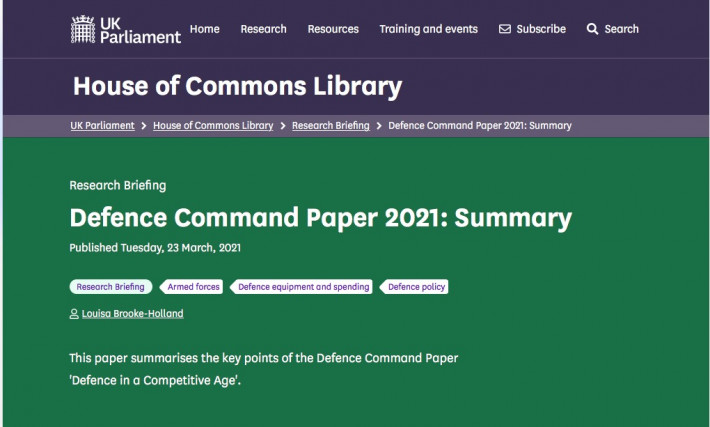
The U.K. Defence Command Paper, “Defence in a Competitive Age,” released by British Defense Secretary Ben Wallace yesterday as a follow-up to the defense, security, and foreign policy review released last week, focuses on the “21st century threats” that the U.K. supposedly faces in a world allegedly characterized by permanent confrontation. “Those of us in government charged to protect and defend have a duty to enter new domains, as well as continuing investment in the traditional ones, but always adapting to the threat,” Wallace wrote in the foreword. “History shows us, time and time again, that failing to do so risks irrelevance and defeat. As the threat changes we must change with it, remaining clear-eyed about what capabilities we retire, why we are doing so, and how they will be replaced.” Therefore, the process for developing the new policy began with “assessing the threats we are encountering and anticipating, before considering how we should address them, and only then with which equipment, and what resources are required to field them.”

“We must actively champion those shared values of liberty, justice and tolerance that have given billions of souls the world over the chance of a better life, and do so through our actions, not just our words. U.K. diplomacy is underwritten by the credibility of the U.K. armed forces, and they will be more integrated, active and agile, capable of both deterring threats and defeating enemies,” Wallace declared. This is all to be backed up by £188 billion in defense spending over the coming four years–an increase of £24 billion or 14%–which, Wallace claimed, “is an investment in that vision of security and prosperity in 2030.”

But the real axiomatic basis for what’s behind the new policy is this: “The notion of war and peace as binary states has given way to a continuum of conflict, requiring us to prepare our forces for more persistent global engagement and constant campaigning, moving seamlessly from operating to war fighting.” The armed forces “{will no longer be held as a force of last resort} [emphasis added], but become more present and active around the world, operating below the threshold of open conflict to uphold our values and secure our interests, partner our friends and enable our allies, whether they are in the Euro-Atlantic, the Indo-Pacific, or beyond.”

In other words, the United Kingdom will be in a permanent state of confrontation, if not always a shooting war, against Russia, China, and any other designated enemies who refuse to submit themselves to the “rules-based international order” dictated by the Anglo-American empire.

https://assets.publishing.service.gov.uk/government/uploads/system/uploads/attachment_data/file/971859/CP_411_-_Defence_in_a_competitive_age.pdf


Beethoven: Sparks of Joy!

Beethoven: Spark of Joy – Opus 3, his first trio, reveals echoes of Mozart’s Divertimento K. 563

Beethoven’s earliest chamber works were composed for string trio (violin, viola, and cello). During the 1790s he published five string trios and the Opus 8 Serenade before abandoning the genre in favor of other combinations –  notably including the string quartet, and sonatas for piano and one other instrument. His first trio, known as Opus 3, takes as its model Mozart’s Divertimento K. 563 – both consist of six movements, and are composed in the key of E-flat – but even in his earliest works Beethoven is no imitator, but imbues each work with his unique creative spirit. Here is the Opus 3 with full score, performed by the Grumiaux Trio. [Notes by Margaret Scialdone.]


NASA’s Goddard Institute Pours Cold Water on Climate Change Sales Pitch

NASA’s Goddard Institute Pours Cold Water on Climate Change Sales Pitch

Aug. 1 (EIRNS)–Under the headline “U.N. climate panel confronts implausibly hot forecasts of future warming,” a July 27 article in Science magazine covers the bombshell that has just hit the IPCC’s climate modelers: “Many of the world’s leading models are now projecting warming rates that most scientists, including the model makers themselves, believe are implausibly fast.”

Now, the article says, “scientists have scrambled to understand what went wrong.” Some of them are wondering how they can “turn their models into useful guidance for policy makers” – which was their supposed raison d’être in the first place! Worst of all for them, their feet are being held to the fire by Gavin Schmidt, Director of NASA’s Goddard Institute for Space Studies, who said: “It’s become clear over the last year or so that we can’t avoid this [fixing the models].”

The IPCC is in trouble, because by the time the modelers’ bias was exposed, the supercomputing runs were already done and the IPCC report, based on these implausible fast warming rates, was nearing completion. The IPCC is now perilously close to being totally discredited, even by its own disciples. Meanwhile, other scientists, who actually measure phenomena rather than fiddle with models, are using recent observational data [gasp] “to rein them in.”

Here is a warning by one of the IPCC’s own climate projection leaders, Claudia Tebaldi, a climate scientist at Pacific Northwest National Laboratory: “For now, policy makers and other researchers need to avoid putting too much stock in the unconstrained extreme warming the latest models predict.”

Already climate papers are appearing using CMIP’s [Coupled Model Intercomparison Project] unconstrained worst-case scenarios for 2100. “But,” says the Director of NASA’s Goddard Institute for Space Studies, “that practice needs to change. You end up with numbers for even the near-term, that are insanely scary—and wrong.”


Death by Starvation: 400,000 to Die in Ethiopia by Thanksgiving

Aug. 1 (EIRNS)–The UN warned on Saturday of “catastrophic” food shortages set to sweep world’s hunger hotspots over the next three months. Among the 23 hotspots are Ethiopia’s embattled Tigray region, southern Madagascar, Yemen, South Sudan and northern Nigeria. These worst-case locations have now progressed to starvation and death situations. “Hunger Hotspots,” issued jointly by the UN’s Food and Agriculture Organization and their World Food Programme identified that in the August-November period “acute food insecurity is likely to further deteriorate.” Ethiopia is facing 401,000 people dying of starvation without an immediate intervention of humanitarian aid.


Page 57 of 104First...565758...Last