Top Left Link Buttons

General updates

Category Archives

Haiti Stands “at the Gates of Hell” Where Human Life Is Unbearable

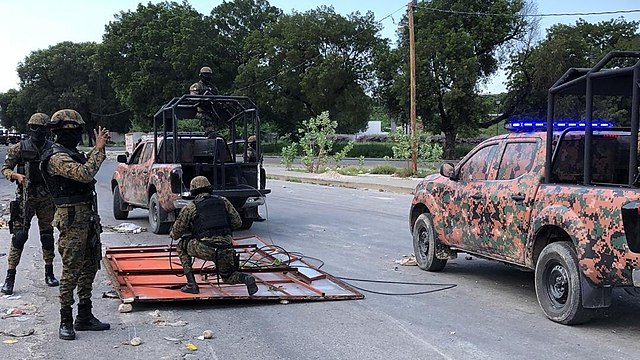
This was the headline in today’s edition of the Haitian online daily Haite Libre, describing the unbearable existence that citizens of Port-au-Prince and other cities face every day, because of the ongoing work stoppages and gang activity that have affected every aspect of human life. The armed gangs which make transportation by road of gasoline and diesel fuel impossible, also block trucks’ access to the main petroleum storage facility at Varreux, holding hostage 25,000 barrels of gasoline and 50,000 barrels of diesel fuel that should be going to gas stations, hospitals, communications companies, state water and electricity companies, etc. Yet, there is no functioning police force to deal with the gangs. As the Miami Herald’s veteran Haiti expert Jacqueline Charles pointed out in an Oct. 25 interview with Slate, the gangs are far better armed than the police and, as many observers have pointed out, act like a quasi-state, in the absence of a functioning state or functioning state institutions.

So today, most hospitals in Port-au-Prince are not open except for perhaps a skeleton crew of a few doctors and nurses or a couple of medical students. There is no fuel for the power plants that keep the generators going that provide electricity for operating rooms or oxygen tanks. At Haiti’s largest cancer treatment center, X-ray machines and other equipment lie idle—there is no power to run them. Hospital director Kedner Pierre told CNN’s Matt Rivers that refrigerators have been packed with ice to try to preserve some chemotherapy medicines. The National Ambulance Center can’t deploy ambulances, because there is no fuel. The nearby Hospital Universitaire de la Paix is turning away pretty much every patient because, aside from fuel shortages, there aren’t enough doctors or nurses on staff. Personnel can’t get to work, or sometimes sleep at the hospital, as kidnapping is a risk for anyone traveling on the streets. Rivers concludes, then, “that one of Haiti’s largest hospitals simply isn’t functioning.” This is the case at every healthcare facility in the capital..

But the damage doesn’t stop here. Fuel shortages are also affecting mobile telecommunications services whose antennas are powered by generators that can’t function without fuel. Digicel, Haiti’s largest mobile network, reports that 433 of its 1,500 antenna sites are not operational because there is no fuel for generators, Le Nouvelliste reports. The Haitian government department in charge of potable water and sanitation, DINEPA, warns of water shortages as it lacks the diesel fuel needed to keep operational its powerful generator that in turn supplies energy to the stations and pumps that supply drinking water. The state electric company, EDH, warns of blackouts. A former Haitian consul in the Dominican Republic, Edwin Paraison, who has lived in Santo Domingo since the 2010 earthquake, told Dominican TV yesterday that, obviously, Haiti needs the help of the international community to deal with the gangs and security situation. But, he warned, the solution must not be one imposed on Haiti by the international community, but rather the result of a dialogue between the international community and Haitian authorities and civil society to determine together a strategy to deal with the current untenable security situation.


The Issue Facing Humanity: Development Versus Depopulation

As the United Nations General Assembly convened in New York yesterday, the only real issue before the members is that of Development versus Depopulation.  While British PM Boris Johnson was openly pushing depopulation, President Biden made an effort to hide behind rhetoric about “diplomacy” and “no Cold War”; but his actions last week, in formally announcing a new strategic alliance with the Brits and Australia — against China and Russia — shows why so many nations no longer trust the U.S.  In contrast, China’s Xi called for a new Global Development Initiative, based on multilateralism, and non-interference in other’s internal affairs.  


Kissinger on U.S.-China War Threat

Kissinger on U.S.-China War Threat

May 2 (EIRNS)–Henry Kissinger warned that pushing the conflict with China is threatening the extinction of humanity. Speaking to the McCain Institute’s Sedona Forum on April 30, said: “For the first time in history, humanity has the capacity to extinguish itself in a finite period of time. We have developed technology beyond what anyone imagined 70 years ago.”  This is not only a nuclear issue as it was then, Kissinger said, “but also a high-tech issue with artificial intelligence, now based on the fact that we are now a partner of machines, and machines can make their own decisions.”   

Kissinger also observed that while the Soviet Union was a major nuclear power, it was not, like China today, a major technological power. “A conflict today with such a high-tech power would be of such colossal input and significance…. It’s the biggest problem for America; it’s the biggest problem for the world. Because if we can’t solve that, then the risk is that all over the world, a kind of Cold War will develop between China and the United States.” 

While the U.S. must remain “true to its principles,” Kissinger said, there must be “continual negotiations with China,” as well as with Russia. It was a mistake, he said, “that we haven’t had serious negotiations with Russia for over a decade.” Diplomacy cannot always resolve the problems, he said, but if it fails, “we have to be sure that we have tried all options.” 
Russia had a powerful nuclear military capacity, he said, but they “didn’t have developmental technological capacity as China does. China is a huge economic power in addition to being a significant military power.”


Venezuela Exposes How U.S.-Imposed Economic Sanctions Block Vaccines

Venezuela has finally been able to make the down payment required for developing countries to begin to receive their allocations of COVID-19 vaccines from the international COVAX facility, Vice President Delcy Rodríguez announced on April 9. But Rodriguez reported that the government was only able to do so through elaborate maneuvers to secure Swiss francs for the purchase. President Nicolas Maduro explained the next day, that Venezuela could only do this by “liberating some resources which had been kidnapped by the U.S. and deposited in Swiss francs, because if it had been done in dollars, the U.S. Federal Reserve would have stolen it.”

That Venezuela was forced to go through such maneuvers to be able to purchase vaccines, exposes the lie by successive United States administrations, that U.S. economic sanctions do not affect humanitarian aid or the people of the dozens of nations on which sanctions have been imposed. Neither the President or Vice President gave any details, but Maduro said “at the right time,” people will find out how they had freed up a tiny portion of the country’s own reserves to make the needed payment to COVAX. (The 59.2 million Swiss francs paid equal a little over half of the $120 million cost of nearly 11.4 million vaccine doses.)

Led by Mike Pompeo and John Bolton, the Trump administration enacted sanctions against Venezuela which are nothing less than an economic blockade, a blockade which Biden’s Secretary of State Tony Blinken has reaffirmed. Under the sanctions, Venezuela’s foreign reserves held abroad have been seized by the Federal Reserve, Bank of England, and other banks. At the same time, Venezuela is prohibited from selling its oil on international markets—a measure enforced by U.S. navy gunboats as well as legal threats—thus shutting down its primary means of earning new dollars to cover vital imports, including food, medicines—and vaccines.

President Nicolas Maduro reported on April 10th that a great diplomatic and legal effort had been required to access enough of Venezuelan government funds which had been “kidnapped by the Federal Reserve” under the “criminal financial sanctions” to make the payment. The Biden administration had refused the government’s appeal for some of its frozen reserves to be released for the Venezuelan government to purchase vaccines, driving Maduro to even offer “oil for vaccines” on March 29—although, that, too, would be “illegal” under U.S. sanctions.

Venezuela is one of the South American countries where the coronavirus is surging right now, and particularly the Brazilian variant, yet until now, the only vaccine commitments the government has been able to line up were for Russia’s Sputnik V and EpivacCorona (for which payment arrangements were made), China’s Sinopharm (donated), and Cuba’s yet-to-be approved Abdala.


Afghanistan’s Drought and Water Crisis Worsening; 2,000 Health Facilities Close

Afghanistan’s Drought and Water Crisis Are Worsening; 2,000 Health Facilities Close

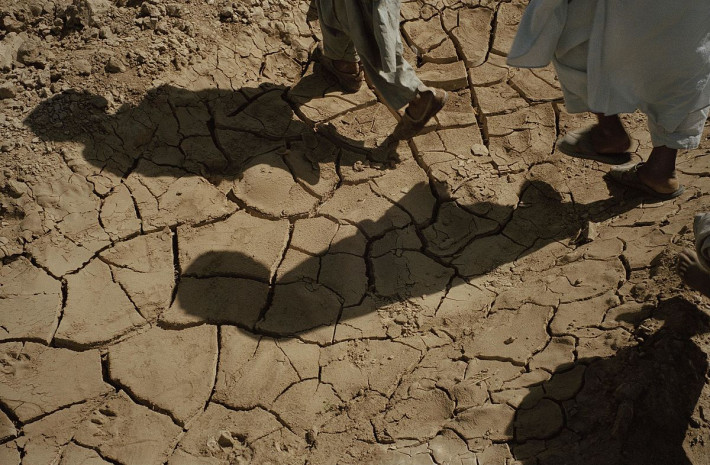
Oct. 25, 2021 (EIRNS)–Afghanistan’s collapse in physical economic and agricultural production, the implosion of its health system, as well as the threat to human life, has gotten worse over the last two months. The nationwide drought is intensifying, while the West applies a tourniquet to the flow of necessary funds.

Physical economic conditions never stay in a “metastable state;” they either get better or worse.

In June of this year, then-Afghan President Ashraf Ghani officially declared a drought in Afghanistan. This was based on information from several agencies, including the International Federation of Red Cross and Red Crescent Societies (IFRC), which declared that “80% of Afghanistan is exposed to serious drought”—30% to “severe drought,” and 50% to “serious drought,” comprising 80%—and the remaining 20% part of the country was exposed to “moderate drought.”

Richard Trenchard, the UN’s Food and Agricultural Organization director for Afghanistan, stated in late September, “This is the worst drought in 35–36 years. Many public institutions which provide a safety net, have ceased to function. Farmers have very little to fall back upon.”

Farming is being destroyed. The UN reported August 25, “Some 40 percent of [Afghanistan’s] crops have been lost to drought in the second massive water shortage in three years—further heightening food insecurity.” The World Food Program already reported that 14 million people in Afghanistan are food insecure, a number that is doubtless rising.

But the shortage of water is affecting not only agriculture, but the whole economy and society, which depends on water. A 2008 report reported “that drinking water supplies reach only 23 percent of Afghanistan’s total population… The country’s total sanitation coverage [is] only 12 percent.”

Two critical infrastructural sectors expose some of the crisis.

Afghanistan has only a combined approximately 100 private and public hospitals for a nation of 40 million people, a meager amount. The nation’s health system is run through a network of 2,200 “health facilities,” about 200 of which appear to be primary health clinics; it is not clear how large the other facilities are. These 2,200 facilities are run through an institution called Sehatmandi which is administered by the World Bank through the Afghanistan Reconstruction Fund and the Afghan Ministry of Public Health. It is funded through the World Bank, the European Union, Canada and Global Financing Facilities.

When the Taliban came to power in the period of August 17–18, these funding institutions cut off money. On September 30, Alexander Matheou, the Asia Pacific director of the International Federation of Red Cross and Red Crescent Societies stated that “over 2,000 health facilities have closed.” He added that more than 20,000 health workers in the country were no longer working or were working without being paid; more than 7,000 of them are women. “People might agree to work without salaries for a few more weeks,” Matheou stated. “But once medicines run out totally, if you can’t switch on the lights, if you’ve got nothing to offer somebody who comes to your clinic, then they’ll shut the doors.”

Under intense pressure, on September 20, the Global Fund and the United Nations Development Fund signed an agreement to supply $15 million to the 2,200 health facilities. This is a drop in the bucket.

International donors pledged in October $1.2 billion to Afghanistan. But there are three roadblocks: 1) it is not clear how much of the pledged money will be really delivered; 2) it takes sometimes months for the money to get into the system; and 3) above all, the clinics are greatly inadequate, Afghanistan needs hundreds of new advanced hospitals, tens of thousands of skilled doctors and nurses, and so forth.

In the meantime, COVID is looming. Nine of Afghanistan’s 37 COVID hospitals have closed. Afghanistan has put a reported only 2.2 million COVID jabs into people; it has 1.2 million doses of vaccine waiting to be distributed, that haven’t been. They will expire by the end of the year.

This is pure and simple genocide.

As for water, Afghanistan has an annual surface water runoff water volume of 57,000 million cubic meters per year, which comes out to approximately 1,425 cubic meters/year per capita. This is insufficient, but would be a start. However, Afghanistan does not have an adequate water basin catchment system, and precipitation is not evenly distributed geographically.

In 2016, India spent $275 million to complete what is now called the “Afghan-India Friendship Dam” in Herat province on the Hari River. It will irrigate 75,000 hectares of land. But otherwise, new dam construction and broader water management hardly exists.

The U.S. is blocking more than $9 billion in Afghanistan’s central bank that belong to the Afghan people. The World Bank, IMF, and EU are blocking hundreds of millions more. (See the Schiller Institute’s demand for release of the Afghans’ funds at this link.)

These more than $10 billion, were they deposited in a fund under sovereign Afghan control, could be used to build hospitals, administer the COVID-19 vaccine; begin emergency food and water distribution; make down payments on dams and water management projects; build power stations, etc. Immediate building in Afghanistan must start.


Beethoven: Sparks of Joy!

Beethoven: Sparks of Joy – Lessons from history: act for your nation.

Eleonore Prochaska was the daughter of a Prussian soldier, raised in a military orphanage after the death of her mother. She was one of many German women who fought in the Napoleonic Wars, though most were ejected from the army when it was found out that they were women. In 1813, Prochaska disguised herself and joined the the Lützow Free Corps under the name August Renz, serving first as a drummer, then in the infantry. She was severely wounded in battle and died three weeks later. In death, she was memorialized as a chaste heroine and “Potsdam’s Joan of Arc”. A momument to her memory, “Der Heldenjungfrau zum Gedächtnis”, or “In memory of the maiden-heroine” survives to this day in Potsdam’s Old Cemetery.
In 1814, Johann Friedrich Duncker accompanied the King of Prussia to the Congress of Vienna, and asked Beethoven to compose incidental music for his play, “Leonora Prohaska”. The play was never performed, as the subject had already been treated in Piwald’s “Das Madchen von Potsdam” which was performed that year.
Beethoven’s music has four parts:
1) Chorus, “Wir bauen und sterben’ (We build and die);
2) Romanze (Es blüht eine Blume im Garten mein) (A Flower blooms in my garden);
3) Melodrama;
4) Trauermarsch (Funeral March);
The fourth number is an arrangement for full orchestra of the funeral march from the Piano Sonata No. 12 in A flat major, Op. 26, transposed from A flat minor to B minor.
This rarely-heard work is performed here by the Berlin Philharmonic, conducted by Claudio Abbado. [Notes by Margaret Scialdone.]


President Xi Jinping’s Speaks on 50th Anniversary: The Restoration Of The Lawful Seat Of The People’s Republic Of China in The United Nations

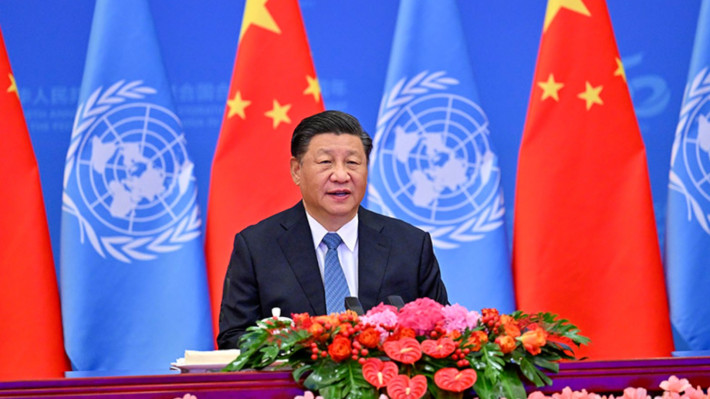
October 25, 2021 (EIRNS)–On October 25, at a meeting in China to commemorate the People’s Republic of China taking its lawful seat in the United Nations, Chinese President Xi Jinping reviewed the last 50 years’ progress of China and world development, and stated the necessary principles which, if followed, will foster peace, and keep nations out of war. Xi stated:

“Fifty years ago today, the 26th Session of the General Assembly of the United Nations adopted, with an overwhelming majority, Resolution 2758, and the decision was made to restore all rights of the People’s Republic of China in the United Nations and to recognize the representatives of the Government of the People’s Republic of China as the only legitimate representatives of China to the United Nations. It was a victory for the Chinese people and a victory for people of the world.

“Today, on this special date, we are here to review the past history and look to the future, and that makes our gathering all the more significant…

“On this occasion, I wish to express, on behalf of the Chinese government and the Chinese people, heartfelt gratitude to all countries that co-sponsored and supported UN General Assembly Resolution 2758, and to pay high tribute to all countries and people that stand on the side of justice.

“The past five decades since New China restored its lawful seat in the United Nations have witnessed China’s peaceful development and its commitment and dedication to the welfare of all humanity.”

Xi’s speech, affirming China’s commitment to and emphasis on the well-being of all humanity—as opposed to geopolitical blocs and actions taken outside of international law—comes just days after the U.S. State Department’s extremely dangerous provocation against China, in which State Department representatives met with government representatives of Taiwan to discuss “Taiwan’s ability to participate meaningfully at the UN…,” which would be in complete violation of UN Resolution 2758, and the one-China principle. Read the entire speech here.


World Food Program’s Beasley in Haiti: ‘We’ve Got to Help These People’

Sept. 18 (EIRNS)–The Executive Director of the World Food Program’s David Beasley has been in Haiti for several days to work with aid teams and publicize the need to take action. On Sept. 16, he sent a video tweet from Maniche, showing how “house, after house, after house, after house in Maniche was completely destroyed… you can see how bad it is, and we’ve got to help these people.” There have been four weeks of clean-up, but there is destruction all over the place. He wrote, “This is why these families need our support to recover and rebuild.” On Sept. 17, he visited a cooked-meals operation run by the World Central Kitchen.


The New Paradigm Will End London’s “Rules-Based Order”

Both Biden’s Secretary of State Blinken and National Security Adviser Sullivan were trotted out for Sunday news shows to defend the “rules-based order” against threats from Russia and China.  The order they back is a global central banker’s dictatorship, to be enforced by U.S. and NATO military might.  The oligarchs they work for are the true authoritarians, and their goal is not only to take away our freedoms, but our lives, as their order is putting us on the verge of World War III.  Time for a New Paradigm, to replace their collapsing, bankrupt and immoral system. 

Register for the Schiller Institute May 8th conference: https://schillerinstitute.nationbuilder.com/20210508-conference Email me at HarleySch@gmail.com and find me on twitter.


Pakistan’s PTV World Features Helga Zepp-LaRouche

Sep. 20 (EIRNS)–On Pakistan’s “PTV World” broadcast, Faisal Rehman hosted Helga Zepp-LaRouche of the Schiller Institute and Pakistan’s Ambassador to Italy, Jauhar Saleem. Rehman began by welcoming “Our guest, Ms. Helga!” with an opening question as whether the world had entered into a clash of civilizations. Zepp-LaRouche answered that she had read Samuel Huntington’s Clash of Civilizations, and, first, it must be said that he knew very little about the civilizations that he wrote about.

Further, the world is not about “geopolitics but geo-economics” — employing the distinction recently made by Pakistani President Imran Khan. AUKUS is not the spirit of the time. The AUKUS attempt may even provoke something like de Gaulle’s response to NATO, as in 1958. This move has destroyed trust in Biden. He had just said, in pulling troops out of Afghanistan, that this was the end of an era; the end of useless wars. Was he serious? Or was it just to concentrate forces against China? This is not good for Biden, as trust in his word is undermined.

Rather, the New Silk Road is the pathway – and the Schiller Institute, by the way, has been on this pathway since 1991. So, does Australia want to be an aircraft carrier for this new military alliance? Or does it want an economic future for its own people? The situation is that there is a decaying neo-liberal system, and it has been refusing to respond to offers from China and Russia.

After a question and some discussion with Ambassador Saleem, Rehman turned back to Zepp-LaRouche, and asked: How would the U.S. and China, given the present conflicting positions, move ahead? Zepp-LaRouche set out that, objectively, neither China nor Russia represent a threat. There have been many offers on demilitarization from Putin — including to Germany, when he spoke, in German, to the Bundestag. And China has lifted 850 million of their people out of poverty. The BRI is not a threat. They are offering to developing countries to conquer poverty.

We need to take a step back. It is a nuclear-armed world, and there is the threat of war by accident, war by miscalculation. China’s Global Times clearly warned that China will fight and win certain conflicts, such as Taiwan. Therefore, we must stop geopolitics. In Afghanistan, David Beasley from the World Food Program made clear that 90% are hungry. Afghanistan’s Health Minister Majrood explained that 90% have recently been denied health care. The recent move to use the Extended Troika (of China, Pakistan, Russia and the United States) involves reaching out and collaborating to develop Afghanistan. It can be integrated into the BRI — and there is the offer to Europe and the US to join in. Pino Arlacchi, e.g, was able to conclude an agreement in 2000 with the Taliban on opium production.

There are presently two billion people in the world without access to clean water. We need a modern health sector in every country. Not doing so simply means that there will be more mutations, new variants and the defeat of the last round of vaccines. Clearly, this crisis requires a new paradigm. Afghanistan can be the new building block. The human species is the only one endowed with creative reason. We can find cures for a pandemic, for overcoming poverty, even colonizing Mars. You know, in February, the United Arab Emirates, China and the United States all had Mars missions at the same time. It is time to become an adult species.


Page 38 of 104First...373839...Last