Top Left Link Buttons

Helga Zepp-LaRouche

Category Archives

A New Era Beckons: Will Peaceful Cooperation Replace Imperial Regime Change Wars?

The statement by President Biden, that the “era of military operations to remake other countries” has ended, raises two crucial questions: 1) Will governments fully reject the geopolitical axioms which led to “endless wars”? 2) What comes next? Providing answers to these questions was the task undertaken by Helga Zepp-LaRouche in her weekly dialogue today.

It is a moment for “serious reflection,” she emphasized. The unipolar approach of the post-Cold War has collapsed. Will small regime change wars be replaced by bigger wars? Or will the wealthier nations work together to bring prosperity to the whole world? This is an historic moment, which has caused so much hysteria that the Financial Times and the New York Times both claim that Biden’s defense of the way the U.S. withdrew from Afghanistan shows there is no difference between Biden and Trump!

She called on our viewers to get involved, and work to bring humanity into a world of reason.


Webcast: Afghanistan—Chance for a Positive Reorientation

Helga Zepp-LaRouche delivered a thoroughly composed analysis of how the world has changed since August 15, 2021, when the Taliban marched into Kabul, and the U.S. and NATO left. “A whole system is coming to an end. The policy has failed.” All the lives lost, the chaos in the country, and the money spent—and stolen—served the interests of a greedy elite, but benefited no one else.

She reported on the prescience demonstrated by participants at the Schiller Institute conference on July 31, and then the solutions presented in the follow-up conference on August 21. The solution begins with a rejection of neoliberalism and imperial geopolitics. Biden’s rejection of the demand by Boris Johnson and the Europeans that the U.S. remain in Afghanistan longer has provoked hysteria among the war hawks responsible for the catastrophe, typified by Tony Blair.

It is now up to the Americans and the Europeans to join with Afghanistan’s neighbors to forge a durable peace, based on economic development. This means the West must junk the delusion that the “Rules-Based Order” must be accepted by all nations.


Webcast: Expose the Real Human Rights Violators, the Neocons and Neolibs of London and Wall Street

Asked about the just-released State Department report accusing China of genocide against the Uyghur minority population in Xinjiang province, Helga Zepp-LaRouche declared that this is a “very serious matter…a complete lie.” This is a deliberate effort aimed at regime change against the Chinese government, and they are aware of the intent, as Foreign Ministry spokesman Hua Chunying has indicated.

The real human rights violations are perpetrated by those imposing sanctions in Syria, as part of a continuing effort at regime change there. She ridiculed U.S. Secretary of State Blinken, who spoke in favor of the deadly sanctions against Syria, who is continuing the Pompeo policy of sanctions to shut down the Nord Stream 2 pipeline, and she stated that these policies are not different in intent from the use of triage in poor areas of the U.S. in the treatment of minorities suffering from the COVID virus.

In discussing the escalating attack on classical culture as a form of racist oppression — a reference to a recent attack on Mozart and Beethoven initiated from Oxford University — she made the connection between this CCF-type ideology to the anti-human outlook of the German Greens, who are hoping to win the chancellorship in the coming elections. The Greens “marched through the institutions”, she said, backed by the Military Industrial Complex — but they are still “’68ers”, Maoist “cultural revolutionaries” in many ways, in their outlook.


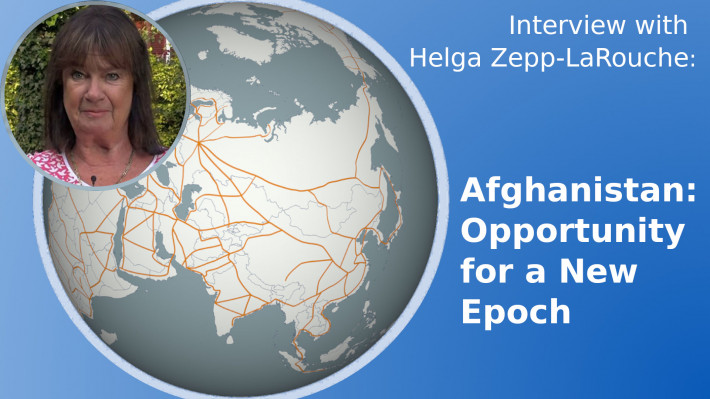
Webcast: Afghanistan – Opportunity for a New Epoch

The dramatic developments surrounding the Taliban takeover of Kabul expose the failure of this regime-change war, and the previous ones since WWII. The war was wrong from the beginning, as the continuing investigation by the 9/11 families into who was responsible for the September 11, 2001 attacks are uncovering, and as Lyndon LaRouche warned that day, but more needs to be done. And there was never a viable war plan.

Some western political leaders are reacting thoughtfully. German CDU chancellor candidate Armin Laschet stated that this was the biggest failure of NATO, ever. Danish Foreign Minister Jeppe Kofod called for reflection and soul-searching. Helga Zepp-LaRouche pointed out the special responsibility that the U.S. has, in President John Quincy Adams’ words, to not go abroad, in search of monsters to destroy.

Now, as presented in the July 31, 2021 Schiller Institute video conference, “Afghanistan: A Turning Point in History after the Failed Regime-Change Era,” there is a potential for a new era of real nation-building in Afghanistan, and the rest of the world, if the Western nations cooperate with the Chinese-led Belt and Road Initiative, along with Afghanistan’s neighbors, and drop their geopolitical goals of preventing China and Russia from playing leading roles in the world. Many Afghan development plans are already on the drawing boards, and there is great humanitarian need, starting with building a modern health system, other infrastructure and agricultural alternatives to opium production. There will be great pressure on the Taliban from the outside, with offers of economic development contingent upon how they act.

International Conference

Afghanistan: A Turning Point in History After the Failed Regime-Change Era

Watch here →

Online Seminar sponsored by the LaRouche Legacy Faoundation

On the 50th Anniversary of LaRouche’s Stunning Forecast of August 15, 1971: So, Are You Finally Willing to Learn Economics?

Event Proceedings →

Stay tuned for upcoming conferences!


Webcast: How was Lyndon LaRouche Able to Forecast Today’s Systemic Crisis 50 Years Ago?

In reviewing the crises facing mankind, Helga Zepp-LaRouche began and ended with an appeal to viewers to join her and the LaRouche Legacy Foundation this Saturday, for an in-depth review of why we are facing a systemic collapse, and why it is finally necessary for the world to learn how Lyndon LaRouche was able to forecast the collapse, and constantly offer alternatives.

The central issue for her late husband, she said, was a rejection of the approach of systems analysis, typified by his opponents, such as Norbert Weiner and von Neumann, which dominates all fields; and instead putting forward solutions derived from the approach of classical science and culture. Despite the horrendous conditions facing us since the destruction of the Bretton Woods system in 1971, LaRouche maintained his optimistic belief that solutions can be found, based on application of human creativity.

Watch the conference at the LaRouche Legacy Foundation website on Saturday, August 14, at 9 AM EDT.


CGTN Dialogue with Zou Yue Interviews Helga Zepp-LaRouche and Others on Xinjiang

Helga Zepp-LaRouche was one of the guests on CGTN’s “Dialogue” program’s coverage of the situation in Xinjiang. She focused on the tremendous development of China that he she had seen over the years, and the background to Xinjiang destabilization in Brzezinski’s creating terrorism in the U.S. war against the Soviet Union in Afghanistan. Also appearing on the show was Sultan Hali, speaker at the recent Schiller Institute conference.


China Welcomes Zepp-LaRouche’s China Petition

Beijing Welcomes Helga Zepp-LaRouche’s ‘Declaration of China Experts from All Over the World’

March 26 (EIRNS)—The Spokesperson’s Office of China’s Ministry of Foreign Affairs released the statement following today:

The French Schiller Institute statement condemned the recent anti-China movement. Chinese Spokesperson Hua Chunying stated: “It reflects the rational and just voice of insightful people in the international community.”

At the regular press conference of the Ministry of Foreign Affairs on March 26, a CCTV reporter from the main station asked: “On March 24, the Schiller Institute released on its website a ‘Declaration of China Experts from all Over the World,’ which was jointly signed by 34 dignitaries from 18 countries, including former politicians, diplomats and scholars. The statement condemned the recent international anti-China movement, and called on the West to acknowledge China’s development achievements and splendid culture, have cooperation rather than confrontation with China. What is China’s comment?”

Hua Chunying: “We have taken note of the above-mentioned statement. It represents the rational and just voice of visionary people in the world, condemns and rejects the crazy words and deeds of the western anti-China forces that wantonly attack, smear and even crafted rumors against China in disregard of facts.

“The signatories of the statement have either lived and worked in China, or traveled to China on a regular basis for long stays. They all have first-hand experience and objective observation of China. Many of them have witnessed the remarkable achievement China has scored since reform and opening up. They witnessed the journey where the Chinese Communist Party and Chinese government, with a people-centered approach, led 850 million Chinese people out of extreme poverty. More recently, they have seen how 1.4 billion Chinese people, united as one, defeated the COVID-19 epidemic. Their statement once again proves that seeing is believing.

“As a matter of fact, many foreign friends who have been living in or dealing with China for many years find that the closer they get to China, the more they will see that China in reality is far from, or even completely opposite to the image some Western media and politicians try to portray. I saw a lot of video clips uploaded by foreigners saying that they realized they were fooled by foreign media reports only after arriving in China and seeing the country as it is. China has always been open to the world. We welcome people from across the world to get closer to us and understand China. We hope certain individuals in the west will discard bias, return to rationality, liberate their thinking, seek truth from facts and view China from an objective perspective.”

Spokesperson’s Office of the Ministry of Foreign Affairs
Official release of China’s foreign policy
Authoritative interpretation of China’s position and attitude


China Media Cover Schiller Institute Petition Rebuking Demonization of China

Schiller Institute’s China Petition in Chinese Media

Mar.25 (EIRNS) — The Schiller Institute petition denouncing the attacks on China signed by 30 leading experts, was reported in the Chinese media. The China Global Television Network, published an article on the petition but did not name the signatories. Then China Central Television republished the CGTN article. This was followed by a report in CCTV on the French Schiller Institute’s French translation of the petition with a summary in Chinese. Below is the CGTN article in full. Also see links at the end.

China experts urge cooperation, not confrontation with China

The West should do better to respond to an offer of cooperation from China rather than seek confrontation, and find a common way to solve the crises challenging all of humanity, according to a declaration published on Tuesday by the Schiller Institute, a political and economic think tank based in Germany.

The declaration, which was signed by over 30 experts, including the institute’s founder and president Helga Zepp LaRouche, denounced what it said was an intensifying international campaign against China.

“For some time, an international anti-China campaign has escalated, where think tanks, mainstream media and strategic reports of all sorts paint a picture of China and its alleged intentions which is simply not true and is extremely dangerous. An enemy image is being projected that in the worst case leads to war,” it said.

All signatories to the declaration have had “direct experience with China, be it that we have lived or worked there, or from repeated travel over longer periods of time.”

Based on their experience and witnesses, they said the Chinese people are “fundamentally more optimistic about the future than the West” after the nation’s successful poverty eradication campaign. And “trust in government is substantially greater,” which is illustrated and strengthened by the effective way China brought COVID-19 under control.

The statement also said that China has been making progress in science and technology as well as innovation, urging the West to “do better to respond to the offer of cooperation, than seeking confrontation.”

Links to CGTN story.

Link to CCTV story.

Link to CCTV report on French Translation.


Webcast: Collapse in Relations with Russia and China Increases the Danger of War

In reviewing the aggressive diplomacy of Biden’s Secretary of State Blinken in the last days, Helga Zepp LaRouche pointed to the collapse in relations between the U.S., NATO and the EU with Russia and China as an extremely “worrisome” situation. The push for a “global NATO” is fed by the ongoing lies, such as those about the alleged suppression by China of the Uyghurs and the “anti-democratic” attack on the British agent Navalny, which then become the justification for sanctions. While the west is touting its “shared democratic values” and support for a “rules-based order”, the Russians and Chinese are moving closer together, as a point of opposition to the dangerous geopolitical provocations aimed at them.

Mrs. LaRouche counterposed the ongoing anti-Russia, anti-China campaign with the conference held by the Schiller Institute, which was centered on a real dialogue among many nations and leading citizens seeking solutions, rather than seeking political advantage.


Schiller Institute Afghanistan Webinar: Circulate a Common Interest Development Program Right Away

July 31 (EIRNS)–Today the Schiller Institute brought together in a five-hour intense discussion at an international virtual conference, diplomats and experts from many nations, including Afghanistan, Russia, China, Pakistan, the United States, Italy and others, on the theme: “Afghanistan: A Turning Point in History After the Failed Regime-Change Era.”

Helga Zepp-LaRouche (Germany,) Chairwoman and founder of the Schiller Institute, who has been leading a process of institutional and informal dialogue for the past 18 months, said at the conclusion of today’s event, that we now “have a perspective of where to go.” The priority is “to put development on the table, which will be difficult to refuse” by anyone, and to give all the support possible to make it happen. The last speaker of the day, Hussein Askary (Sweden/Iraq,) Southwest Asia Coordinator for the Schiller Institute, put it forcefully, that we must “make development the first item” in any talks, not the last. He warned, “Keep the warlords and the British out!” Askary’s presentation, which covered concrete aspects of development, was titled, “Put Afghanistan on the Belt and Road to Peace.”

The event was opened by Moderator Dennis Speed (U.S.A.), who said that the deliberations would change the usual conception of war or peace, to partake of the diplomacy of formulating policies for mutual understanding and development. He introduced a short 1985 video by statesman-economist Lyndon LaRouche making the point, with reference to President Abraham Lincoln’s record, that the power of infrastructure transforms an economy. Zepp-LaRouche’s opening remarks stressed that we are at a special moment in history, where geopolitical confrontation must be ended, and a new paradigm begun—not only for Eurasian integration and prosperity, but for universal history. She showed the beautiful “Golden Mask” artifact, to make the point of the 5,000-year history of the Central Asian region.

Playing a lead role in the discussion from beginning to end was Professor Pino Arlacchi (Italy), who participated from Italy. Currently Sociology Professor at the Sassari University, he was Executive Director of the UN Office for Drug Control and Crime Prevention (1997-2002,) and former European Parliament Rapporteur on Afghanistan. He spoke on, “Eradicate Opium in Afghanistan, Develop Modern Agriculture, Build the Nation, Now.” He described his original plan which by 2001 had nearly eliminated opium poppy growing in Afghanistan, which then was reversed under the ensuing years from 2001 of U.S. and NATO military operations. Arlacchi again proposed a plan in 2010, which was thwarted by the EU, Britain and the U.S. Today, Afghanistan is the source of over 80% of the world’s opium drugs. Arlacchi laid out what can and must be done today. The needed approach uses alternative agriculture—supporting farmers to switch to other crops, and similar realistic methods. Arlacchi stressed how relatively inexpensive this is, given the huge leverage by the drug cartels. Farmers in Afghanistan might get $300 to 350 million for their opium crop, which then is worth $20 billion to organized crime in Europe. There are many alternative crops of great use and value, for example saffron.

The diplomats presented a sweeping picture of the present situation. Ambassador Hassan Shoroosh (Afghanistan), the Afghanistan ambassador to Canada, spoke from Ottawa, saying that there is a “new chapter of partnership” ahead, which must be worked out. His talk was, “The Way Forward for Afghanistan.” He said that his country is “positioned to serve as a land-bridge” in Eurasia, and reviewed in detail various transportation corridors, from the Lapis Lazuli Corridor, to the Five Nations Railway route.

Ambassador Anna Evstigneeva (Russia,) from the New York City, where she is Deputy Permanent Representative at the Mission of the Russian Federation to the UN. Her presentation was titled, “Russia’s Outlook for Afghanistan and Eurasia.” She stressed that the goal is stability, and there is no military solution. There are important frameworks among the neighbors in the region, including the CSTO and SCO and bilateral relations. There is a special role for the “extended troika,” which has been in place for many years. There are meetings coming up in the near future. She noted that transport and infrastructure are of great significance.

Dr. Wang Jin (China,) Fellow at The Charhar Institute, spoke on the topic, “Afghanistan and the Belt and Road Initiative.” He presented four key aspects of China’s concerns: 1) that there are no “spillover” impacts of instability; 2) that there is a future of advancement for Afghanistan; 3) that extremism and terrorism do not gain ground; and 4) that China and Afghanistan have positive ties.

From Pakistan, Mr. Hassan Daud spoke. He is the CEO of Khyber Pakhtunkhwa Province Board of Investment. He pointed out that Afghanistan is one of “the least integrated” economically in the Central and South Asian region, after these decades of strife. He spoke of the great “economic spillover” that will ensure, with Pakistan leveraging its position and resources to become a logistical hub, and extending benefits to Afghanistan through CPEC and the BRI. We must have “the spirit of the ancient Silk Road” again. He called for more seminars on this, involving scholars, chambers of commerce and others.

From the United States, Ray McGovern spoke. He is a former analyst at the U.S. Central Intelligence Agency, co-founder of the Veteran Intelligence Professionals for Sanity. Addressing the topic, “The Real Interest of the United States in Asia,” he made many strong points, including that there must be “accountability” for the string of commanders who lied about what the U.S. was doing in Afghanistan, also in Iraq and elsewhere. He dramatically pointed out, that there weren’t even competent “situation estimates” that should have been done, about terrain, weather, LOC—lines of communication, and other standard assessments of what the U.S. is doing in places. In 2010, the U.S. Navy logistics was paying $400 a gallon to put gas in the tanks of military vehicles in Afghanistan! He hit hard at the racism involved in presuming you can do anything, anywhere; he quoted Kipling.

Many others were involved in the two question and answer periods, with important exchanges over key topics. For example, Earl Rasmussen, Vice President of the Eurasian Society, raised the point of the necessity to build trust. Dr. Stephen Fischer, an American physician, reported on a year he spent in public health in Afghanistan, working with a provincial reconstruction team. Zepp-LaRouche stressed many times, that in the context of the prolonged pandemic, it is imperative that we move in Afghanistan, and everywhere, for public health and modern medical care infrastructure.

Ambassador Anna Evstigneeva made a concluding point, that it is “important to rise above geopolitics.” She said that in Russia, “at all levels, including President Putin,” we are ready for cooperation.” Helga Zepp-LaRouche called on the panelists, and anyone in the viewing audience, to contribute to the development program perspective under discussion, and mobilize. Prof. Arlacchi, who has a new book out, Against Fear (in Italian,) gave parting words that, “peace is stronger than war. Let’s be more courageous. Not a victim of huge deceptions.” The full conference is archived for viewing. Now is the time to join the Schiller Institute.


Page 24 of 47First...232425...Last