Top Left Link Buttons

General

Category Archives

Live: Defense Expert Ted Postol Warns: Trump’s “Golden Dome” Poses an “Enormous Danger” (May 28, 11 am Eastern/ 5pm CET)

Dialogue between Helga Zepp-LaRouche and military expert Dr. Theodore Postol.

Defense Expert Ted Postol Warns: Trump’s “Golden Dome” Poses an “Enormous Danger”

In an already tense strategic climate, the introduction in the U.S. by President Trump of a “Golden Dome” missile defense system increases the threat of nuclear war with Russia and China, rather than enhancing security.  Dr. Theodore Postol, who is a renowned expert on modern warfare and nuclear weapons, will discuss with Helga Zepp-LaRouche his conclusions about the danger inherent in the design of the system.

In his review of the proposal, Postol concludes that 1.)  this proposal of the Trump Administration poses an enormous danger to geopolitical stability; and 2), the second part of the Trump Administration’s proposal, which is to expand the ground-based missile defense system, would simply increase the size of a defense system that now provably has no missile defense capability. 

However, he believes that rather than serving as a deterrent, the appearance of an expanded missile defense program might well result in the Russians and Chinese feeling compelled to expand their offense of nuclear forces to offset perceptions that the United States might have some residual capability to negate their nuclear deterrents

When combined with the insistence of Germany’s new Chancellor Merz that the limits be lifted to the range of long-range missiles provided to Ukraine, we are entering a moment of extreme instability which heightens the risk of nuclear war. 

This discussion follows last weekend’s Schiller Institute conference which focused on the “LaRouche Solution” to the strategic crisis, centered around the battle to establish a new strategic and development architecture to replace the collapsing Unipolar Order.


Live with Helga Zepp-LaRouche: Three Stooges Plus One Rally Behind the Puppet Zelensky (May 14, 11am EDT/ 5pm CET

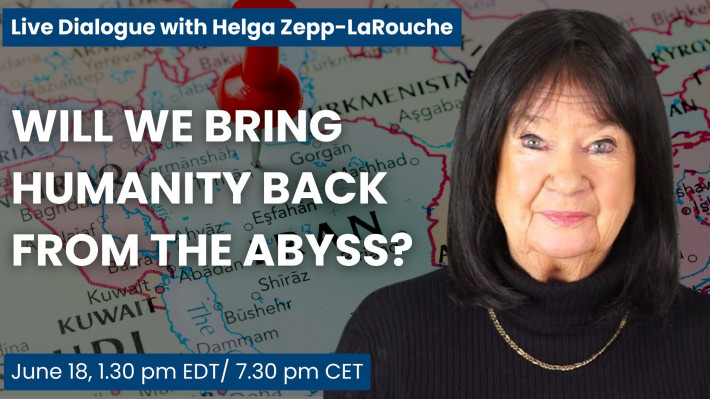
Join Helga Zepp-LaRouche, founder of the Schiller Institute, in her weekly live dialogue to discuss the creation of the New Paradigm for mutual economic development. Send your questions to questions@schillerinstitute.org

At 2 a.m. Sunday morning, May 11, Russian President Vladimir Putin, after three full days of non-stop meetings and ceremonies devoted to the commemoration of the Victory against Fascism in Europe, held a press conference and proposed the resumption of full negotiations with Ukraine to put an end to what is actually a NATO war imposed on that nation. Putin proposed that these negotiations restart in Istanbul, Türkiye this Thursday, May 15.

The European leaders who had joined Zelenskyy in Kiev, in direct opposition to the 30 heads of state who had assembled in Moscow for the Great Victory, had demanded a few hours earlier that a 30-day ceasefire begin Monday morning. They were, however, caught sleeping, in more ways than one, by Putin’s 2 a.m. press conference, and his unexpected proposal. “Russia is ready for talks without any preliminary conditions. There are combat actions and war going on now, and we propose to resume negotiations that were not interrupted by us. Well, what’s wrong about it?”

As Putin and others know, it was Ukraine that ceased the discussions that were terminated in Istanbul, Türkiye, in April 2022. Of course, it was then Prime Minister Boris Johnson of Great Britain who had, on April 9 of that year, traveled to Kiev to demand that Ukraine walk away from the already-agreed negotiations with Russia—and Ukraine had done so. To this day, Ukraine’s decree, passed in their parliament in late 2022, forbids any Ukrainian President from negotiating with Russia, so long as Putin remains in power. Ukraine “is still legally prohibited from negotiating with the Russian side,” said Russian Presidential press secretary Dmitry Peskov in March.

So, although a blustering Volodymyr Zelenskyy later on Sunday dared Putin, “High Noon” Western-style, to “meet him in Istanbul” this Thursday, Ukraine’s unelected leader knows that the Russians are aware that the Kiev decree is still in effect. U.S. President Donald Trump—not one to stand on ceremony, certainly—had advice for Ukraine: “President Putin of Russia doesn’t want to have a Cease Fire Agreement with Ukraine, but rather wants to meet on Thursday, in Turkey, to negotiate a possible end to the BLOODBATH. Ukraine should agree to this, IMMEDIATELY. At least they will be able to determine whether or not a deal is possible, and if it is not, European leaders, and the U.S., will know where everything stands, and can proceed accordingly!” While many have asserted for days that “no one knows where Trump stands” on the matter of Russia and Ukraine, today’s statement is unequivocal: “Ukraine should agree to this, IMMEDIATELY.”

One of the outflanked European heads of state who met with Zelensky is Germany’s Chancellor Friedrich Merz, who is the first chancellor in the post-war era to have the dubious honor of being crowned chancellor only after a second round of voting. In mid-April, the very same Friedrich Merz suggested on ARD television’s Carmen Miosga show that German Taurus long-range missiles should be sent to Ukraine so that the country could get off the defensive after three years of war against Russia. Merz mentioned the possibility of destroying the most important land link between Russia and the Crimean peninsula, as an option. Merz had already supported the delivery of cruise missiles to Ukraine before the early parliamentary elections on February 23. According to media reports, both Friedrich Merz and government spokesman Stefan Kornelius have stated that details and discussions regarding the Taurus delivery will not be made public in the future. What might that mean?

Helga Zepp-LaRouche and Dr. Werner Rügemer, in a joint live dialogue on January 29, had already warned against Merz, the Chancellor from Black Rock.

The second notable event Sunday was that newly-elected Pope Leo XIV, appearing in St. Peter’s Square before more than 100,000 people, and unexpectedly leading the open-air assembly in the singing of the “Regina Caeli” Easter antiphon. Leo, who is the first member of the Augustinian order to be elected to the Papacy, the first native-English-language Pope since Pope Adrian IV of the 12th century, and the first Pope from the United States, also made clear why he chose his name. “In his first meeting with Cardinals on Saturday, the new Pontiff said that he chose his papal name to continue down the path of Pope Leo XIII, who addressed ‘the social question in the context of the first great industrial revolution.’” CNN reported.

Consider these two very different “flanks” as flowing from one, higher strategy of victory for the human race. War must become obsolete, but that cannot happen unless the cause of war is removed. For that to occur, the world requires “A Beautiful Vision for Humanity in Times of Great Turbulence!” Such is the subject, purpose, and mission of the May 24-25 conference of the Schiller Institute.

Join Helga Zepp-LaRouche, founder of the Schiller Institute, in her weekly live dialogue to discuss the creation of the New Paradigm for mutual economic development. Send your questions to questions@schillerinstitute.org


Live with Helga Zepp-LaRouche: Three Dangerous Hot Spots, One Solution (May 7, 11 am Eastern/5pm CET

Join Helga Zepp-LaRouche, founder of the Schiller Institute, in her weekly live dialogue to discuss the creation of the New Paradigm for mutual economic development. Send your questions to questions@schillerinstitute.org

May 5, 2025 (EIRNS)—Today’s different zones of strategic crisis are in various phases of escalation, or temporary de-escalation, in Ukraine, in the Pakistan-India conflict, and in Southwest Asia, with the warfare and horror in Gaza the most urgent to be stopped.

This world situation points up the role of the Schiller Institute conference in three weeks, titled, “A Beautiful Vision for Humanity in Times of Great Turbulence,” and the vital process of the International Peace Coalition, which now has met for 100 weeks straight.

Helga Zepp-LaRouche, Schiller Institute founder and leader, has insisted on the point of approaching all crises from the highest level. She said today that we have to “create a world to solve issues through development.” The dynamic is in motion and gathering force. The BRICS summit will take place in July in Brazil.

Zepp-LaRouche put forward the task of mobilizing for the next five weeks for the Oasis Plan approach, in the countdown to the June 2-4 UN meeting in New York City, on the two-state mandate for Gaza and a reconstruction plan. In the course of this mobilization, the May 24-25 two-day Schiller Institute conference in the Metropolitan New York area is the place to confer on the principles involved. Register now. Join up with the International Peace Coalition, beginning this Friday.

Diane Sare, President of The LaRouche Organization (TLO) published a leaflet titled VE Day 2025: Celebration and Rededication for circulation around the celebrations of the defeat of Fascism in Europe. Sare writes:

“Therefore, let us not only celebrate the victory won on the battlefields of Europe eight decades ago, but let us now resolve that none of those dead in that war, or the tragic series of wars which came after, shall have died in vain. We must act now so that the innocent Palestinian infant, and the fallen IDF soldier, the fearless Russian youth, or the conscripted Azov fighter, will be immortalized in their better nature – the universal goodness of Man, which for reasons unknown is obscured or buried among the tortured souls who have been the aggressors, but who are human nonetheless.  No human is an animal.”

“Our actions today, to bring about a just world, will fulfill the purpose of those departed souls who perished in innocence, guilt, or valor, no matter what they may have thought their purpose was.”

Join Helga Zepp-LaRouche and the LaRouche Movement and become an active participant in the creation of the New Paradigm.

Join Helga Zepp-LaRouche, founder of the Schiller Institute, in her weekly live dialogue to discuss the creation of the New Paradigm for mutual economic development.. Send your questions to questions@schillerinstitute.org


Amid U.S. tariff war, expert urges renewed China-EU cooperation

As the U.S. tariff war intensifies, China and the European Union have recently increased high-level contacts. Some observers suggest the EU is turning to China as an alternative to Trump’s America. At a CGTN roundtable marking 50 years of China-EU relations, Helga Zepp-LaRouche, president and founder of Germany’s Schiller Institute, urged both sides to defend the global order and develop the Global South.


Wielding Development As the ‘Weapon of Peace’

May 2, 2025 (EIRNS)—For nearly two years, the International Peace Coalition, which was organized to unite peace movements from around the world without regard to ideology, has been holding weekly online conferences with over 55 nations represented and thousands of participants. On May 2, the Coalition celebrated a milestone with its 100th consecutive meeting.

Helga Zepp-LaRouche, Founder of the Schiller Institute, presented a sobering progress report. Despite the growing influence of the Coalition, “We are seeing a very disturbing increase in conflicts.” Though there may be regional causes to these conflicts, the underlying basis is the tension created by the decline of the old, colonial system, and the emergence of the new one. She addressed the new outbreak of hostilities between India and Pakistan, calling for an independent investigation of the terror incident which sparked it. The situation there is escalating. The use of nuclear weapons is being discussed on both sides.

A new deal was announced in Ukraine, where the U.S. can exploit raw materials and some U.S. troops will remain in Ukraine, which may be “not to the liking of the Russians.” Unfortunately, “some crazy Europeans are committed to keep this war going.”

On the trade war front, she warned that tariffs could trigger a default by developing nations and/or collapse of the financial system. President Trump has not thought this through.

Since March 2, Israel has blockaded Gaza, and using food as a weapon of war is a war crime. We have called for an international mobilization to put the LaRouche Oasis Plan on the agenda of a high-level conference which the UN has scheduled on the two state solution, to take place on June 2-4, 2025 in New York. The late Pope Francis called development “the weapon of peace,” making him an implicit supporter of the Oasis Plan.

As important as regional measures may be, we need to end geopolitics for a lasting solution. We need a new paradigm that puts the one humanity first. We continue to call for the Ten Principles of a New International Security and Development Architecture.

Col. Richard H. Black (ret.), former head of the U.S. Army’s Criminal Law Division at the Pentagon and former Virginia State Senator, warned that “during the Biden administration, the U.S. became wildly provocative toward China.” He offered a timeline of provocative acts, such as the visit by Congresswoman Nancy Pelosi and others to Taiwan for the express purpose of provoking China. “Consider the enormity of a possible war with China, and compare that to Vietnam,” said Black. The Vietnam War was costly to the U.S. and ended in defeat. China is 29 times the size of Vietnam, with a vastly larger population and far more advanced technology.

Ambassador Hossein Mousavian, former ambassador from Iran to Germany, described how Iran had endeavored to compromise with the West; they agreed to cooperate with the IAEA, and to export uranium enriched to 60% to Russia, in order to allay fears that they intended to develop nuclear weapons. The Trump administration had made some progress with negotiations, but then the U.S. technical team that was to be sent to Oman was canceled, apparently due to an intervention by Netanyahu, who said that Israel would only accept the “Libya model” (which culminated in the utter destruction of Libya.) U.S. Secretary of State Rubio claims that the only use of uranium enrichment is for bombs, which is a ridiculous untruth. Mousavian offered a long list of states that have enrichment programs but no nuclear weapons.

Ofer Bronchtein, a former advisor of Israeli Prime Minister Yitzhak Rabin, and President of the Paris-based International Peace Forum, is presently an advisor to French President Emmanuel Macron on the Israeli situation. He believes that the French/Saudi initiative for a two-state solution can succeed, and is trying to build a coalition to support it. Zepp-LaRouche asked him to join the mobilization for the Oasis Plan. He replied that Rabin understood the importance of water: “Without water, there won’t be peace.”

International Law Under Threat

Jonathan Kuttab, International Human Rights Lawyer, Executive Director of Friends of Sabeel North America and Co-Founder of Nonviolence International, spoke on the problem of Israel’s “utter impunity of ignoring international law,” no longer even bothering to offer “the excuse of military targets.” More than 230 journalists have been killed by the IDF, more than in any previous conflict. “We now see a deliberate attack on international institutions, on international courts, and on international law itself.” This has implications that go far beyond the Israeli-Palestinian conflict.

Excerpts were shown of a video interview by EIR’s Gerald Belsky with Maoz Inon, an Israeli peace activist and leader of the peace demo in Jerusalem May 8-9, the People’s Peace Summit. He said that “the only way to change reality is in the field of dream.” We need to shout it, dance it, sing about it, to legitimize the dream. We need diplomacy, dialogue and negotiation. The current wildfires in Israel are a consequence of investment that should have gone into water management being diverted to military use.

LaRouche activist Robert Castle gave a youth outreach report. He has been working with the Jose Vega congressional campaign in the Bronx, intersecting students on the way to classes and “challenging the young citizens of our republic to ask themselves whether they have a moral responsibility to intervene in this crisis.”

Zepp-LaRouche fully agreed with Kutab: it’s not just about Gaza, the larger issue is the non-response of the world community to the Gaza genocide, which can lead to a complete collapse of international law and descent into barbarism. International law did not exist before the Peace of Westphalia, which made it necessary.

Discussion

Zepp-LaRouche answered a question on the India-Pakistan conflict by asking, cui bono? Many nations that aspire to join BRICS have been targeted with economic/financial warfare or violent destabilization.

Kutab was asked, what can civil society do when governments fail to take action? He endorsed BDS, and said we should organize football and cultural organizations (which played a big role in ending apartheid in South Africa.)

A German participant renewed his plea that solar energy be used in place of nuclear energy for the Oasis Plan. He was invited to participate in the upcoming conference, where that topic will be discussed. Co-moderator Dennis Small reminded him that energy flux-density is the metric for evaluating energy sources. Because the Iberian Peninsula went entirely for solar and wind, there was a complete collapse of their energy grid last week.

A question was posed: Was the November 1995 assassination of Rabin the tipping point for the current crisis? Kutab responded, “There’s no question that Rabin himself was trying to deal with that situation in a new way.” But there were problems both before and after Rabin.

Moderator Anastasia Battle reported that there has been an attack on the Freedom Flotilla in international waters, which some IPC participants have been on board the flotilla. We hope for their safety and well-being.

In response to a question from the Chinese Media Group on the trade war, Zepp-LaRouche said, “President Trump is presently vacillating and responding to pressure.” She cited Nicholas of Cusa, who said that if you have a systemic problem, you cannot solve it by addressing side issues. The human creative mind always has the capacity to resolve the problem on a higher level than the level on which the problem arose. In conclusion, she renewed her plea for people to join forces with us in working to put the Oasis Plan and Ten Principles on the agenda for the upcoming conference in June.

eir


Helga Zepp-LaRouche and Diane Sare: The Secret to a New Paradigm: A LaRouche-Hamilton Credit Policy, April 30, 11 am

Join Helga Zepp-LaRouche, founder of the Schiller Institute, and Diane Sare, President of TLO to discuss the necessary LaRouche-Hamilton economic policy to build the New Paradigm. Send your questions to questions@schillerinstitute.org

After her return from China, where she participated in an international conference in Qufu, the birthplace of Confucius, Helga Zepp-LaRouche summarized the global situation and the necessary mobilization of the International LaRouche Movement as follows:

“If you look at the world as a totality, you have essentially two motions: you have the motion toward destruction, the oligarchical principle, war, austerity, degradation of people and their so-called cultural tastes. But it’s an entropic motion. But then you have on the other side, those forces in the world that are somehow, in whatever fashion comes from their cultural tradition are in a constructive mode: building, furthering the cause of humanity. And in a certain sense, I can see very clearly the potential, in that those forces in the world who are in line with the laws of the universe, are becoming stronger, and stronger, and stronger. And what we are seeing right now, is just an end-struggle, if you like, of a dying system which clearly is unable to reform, because its proponents are so absolutely determined to their own privilege, that they cannot even see the interest of their nation.

And I think what we have to do, is, we have to give people that sense that humanity is, in one sense growing up, and it’s quite natural that they would turn at many places in the world to Lyn’s ideas, because from all the thinkers, from Confucius, Leibniz, Kepler, whoever else—I mean, Lyn has taken all of these tendencies a step forward, and he has, in his entire life’s work, given the world a way how to become coherent. And I think it’s very clear that all the forces who are striving toward this, eventually recognize that. And I think what it means is that what we have to do in the United States, and in Europe, is to make people conscious of that, and actually only the good-meaning people have to take a really relatively small step: and that is, to consciously reject the idea that you need an enemy, that confrontation is the way to go, to take the step instead to cooperation. And then, everything will fall into place.”

Zepp-LaRouche also emphasized two tasks facing all friends of humanity: First, to stop the escalation of warfare. Second, to recognize the failure of the policy behind the warfare and to initiate a new, correct policy. The Schiller Institute’s two upcoming international conferences – one in Europe and one from May 24-25 in the New York metropolitan area (online and in person) – have a special responsibility in this regard.

Join Helga Zepp-LaRouche, founder of the Schiller Institute, and Diane Sare, President of TLO to discuss the necessary LaRouche-Hamilton economic policy to build the New Paradigm. Send your questions to questions@schillerinstitute.org


Zepp-LaRouche in China: There Are Some People Who Don’t Like the Coming End of 500 Years of Colonialism

April 27, 2025 (EIRNS)—“There is right now a huge struggle going on in the world, which I think China is one of the leaders of,” Schiller Institute founder Helga Zepp-LaRouche stated in an April 25 panel discussion in China on “Innovation Pathways in the Global Green Transition,” organized by the China Media Group, with CGTN host Yang Zhao. Speaking along with ambassadors and media specialists, Zepp-LaRouche set the tone for the entire discussion:

“This is the effort by the countries of the Global Majority to overcome 500 years of colonialism for good, by no longer being exporters of raw materials, but to develop the production chain in their own countries. There are obviously some people who don’t like that; and they would like to maintain the neo-colonial forms.”

As Zepp-LaRouche was speaking, “the people who don’t like that”—the practitioners of British geopolitics centered in the City of London and Wall Street—were busy launching deadly provocations around the globe, to make sure that the BRICS nations are destabilized, and that the U.S. and NATO stay on course for an end-game confrontation with Russia and China.

In the India-Pakistan theater, an April 22 terrorist attack killing 26 tourists in the Indian-controlled area of Kashmir has led to rapid escalation on both sides. India has announced it is suspending the all-important 1960 Indus Waters Treaty between India and Pakistan—which regulates the flow of water to the two countries, both of which need it desperately—and revoked nearly all visas of Pakistanis residing in India. High-level Pakistani authorities are talking openly about the option of launching a nuclear strike against India—which is also a nuclear weapons power! Fortunately, the Defense Minister of Pakistan has pointed the finger at outside forces deploying terrorism in the region—and named Great Britain and the United States as the guilty parties for the last 30 years.

In Russia, authorities have captured the man who assassinated Gen.-Lt. Yaroslav Moskalik of the Russian General Staff on April 25, and identified him as an agent deployed by Kiev. Leading Russian intelligence experts quickly explained on national television: “We should remember … that terrorist acts of this kind are done under the supervision and direct guidance of the British special services.”

And in Iran, a huge explosion rocked the port of Bandar Abbas on April 26, killing at least 25 and injuring nearly 1,400. Although it has not yet been determined if this was an accident or sabotage, it happened at the precise moment that the U.S. and Iranian governments are involved in delicate negotiations that are essential to bring peace to the war-torn region of Southwest Asia—which the Israeli and British governments are devoutly committed to preventing.

India, Russia, Iran—all are members of the BRICS, which is leading the struggle to create a new international development architecture to replace the current bankrupt system.

As Zepp-LaRouche stated in her remarks during the panel discussion in China:

“We have now the 70th anniversary of the Bandung Conference, and at that time in 1955, President Sukarno and Zhou Enlai and Nehru were warning that colonialism still exists in its modern form, through trade relations, access to credit, and so forth. So now we are in this historic epochal change where the countries of the Global Majority want to overcome that, in large part possibly through the rise of China and through the development of the BRICS countries.”

The upcoming May 24-25 conference of the Schiller Institute will bring together leading intellectuals and statesmen from nations of both the North and the South, to deliberate on how to best bring about precisely such an epochal change.


We Have One Future, Like It or Not

International Peace Coalition 98

by EIR Staff

April 18—The 98th consecutive weekly online meeting of the International Peace Coalition (IPC) commenced with greetings by Helga Zepp-LaRouche, founder of the Schiller Institute, who emphasized that “the situation in Ukraine remains one of utmost volatility.” The likely incoming Chancellor of Germany, Friedrich Merz, has said that he will send Taurus missiles to Ukraine. But the Taurus relies on intelligence from the United States. Will President Donald Trump approve this? And the Taurus must be operated by German soldiers, making Germany a direct party to the war. This situation is fraught with danger. Former Russian President Dmitry Medvedev recently said that if the British and French send soldiers, they will come back in coffins. Zepp-LaRouche said that Merz “knows no inkling of a diplomatic solution,” and warned that something is happening in Germany which echoes what happened 80 years ago.

On the positive side, a disaster was averted when Trump refused to give U.S. backing to an Israeli attack on Iran’s nuclear facilities. There also continues to be positive developments in the Global South. China and Brazil agreed to build the Bi-Oceanic Railway across South America. And on April 18, the Valdai Discussion Club hosted an event called “70 Years On: The Legacy of Bandung. An Expert Discussion” which raised the question, “Is Bandung 2.0 possible?” This is in reference to the 1955 Bandung Conference, also known as the Asian-African Conference, held in Bandung, Indonesia, which laid the foundation for the later emergence of the Non-Aligned Movement.

She noted that Presidents Robert Fico of Slovakia and Alexsandar Vučić of Serbia will defy the EU and attend the Victory Day celebration in Russia on May 9. She commented as well that the trade war with China will cause inflation in the U.S. and large layoffs in China, and posed the question, are there people of reason who can step beyond geopolitics?

Seeds Grow Without a Sound

Alex Krainer, a well-known financial advisor and economic analyst, described an ongoing transition in the world economy that many may have missed. It has become very easy for a person in the West, with a few clicks, to order products from China and India. He clarified the controversy over tariffs, using as an example, a pair of Nike shoes that cost $10 to make in China, but retail for $100 in the U.S. A 25% tariff would be applied to the $10 that it costs to make the shoes, not the $100 retail price, adding only $2.50 to the cost of the retailer. For a more extravagant example, he cited a $38,000 handbag that costs $1,000 to make. The trade war has revealed things about the “bling factor.”

Schiller Institute leader Dennis Small cited an article in the Financial Times which asks whether we are now facing the “Trump Shock,” comparing it to the “Nixon Shock” of 1973. Trump’s trade war can ignite the explosion of the bubble of financial aggregates and derivatives which will never be paid. Small compared it to lighting a match in a room full of dynamite; the problem exists “not because of the match, but because of the dynamite.”

A new financial geometry is developing around the BRICS. “We’re seeing physical economic flows in exactly the way that Lyndon LaRouche talked about.” Brazil will gain “great circle” access to trade with China via the proposed Bi-Oceanic Corridor. China vastly outpaces the world in physical output of steel, etc.—but “the real growth area is science and technology.”

IPC coordinator Anastasia Battle presented a report on youth outreach, describing an organizing tour of New York university campuses with congressional candidate Jose Vega and others, and showed a series of photos of booktables and a special invitation to the upcoming international youth meeting April 22 with Helga Zepp-LaRouche.

In response to Krainer’s presentation, Zepp-LaRouche noted that Friedrich Merz says it’s an outrage that every day 400,000 parcels arrive from China. But the Spirit of Bandung is sweeping the Global South, ignored by Western media. Because of the rise of China, the developing nations feel that they are strong enough to end colonialism.

Krainer noted that improved world trade means opportunities for people in the industrial world as well. Merz’s opposition to Chinese imports is leading Europe to “a new Middle Ages.”

Discussion

Steven Starr, one of the nation’s foremost experts on nuclear war, asked Krainer to comment on the role of Wall Street and the City of London in influencing world events. Krainer said that power lies in the central banks, IMF, and the families that control them. For example, in the immediate aftermath of the 2014 Maidan coup, it was the IMF that influenced Kiev to launch an assault against the Donbass region of Eastern Ukraine. Citigroup formed much of former President Barack Obama’s Cabinet.

In response to a question on Iran, Zepp-LaRouche said that the real issue is Israel’s 200-plus nuclear weapons. We need a new security and development architecture which takes into account the security needs of all nations, including Iran. Fortunately, there is some talk of combining the Egyptian peace plan with the LaRouche Oasis Plan.

In response to a question about fascism, she described an in-depth discussion with former U.S. Ambassador Chas Freeman about the emergence of a new fascism. The crux is the image of man; fascists believe that some group of people is superior. They also pursue policies of ruthless austerity.

Relations with Afghanistan

IPC co-moderator Dennis Speed reported, in answer to a question, that Russia has recognized the Taliban. Zepp-LaRouche added that 65,000 Taliban fighters were able to defeat NATO, but they were not ready to govern, and the new government is factionalized on the question of the status of women; you can’t rebuild while also condemning women to outsider status. The Taliban cracked down on opium production, which caused a loss of income for farmers. A proposal was made by former UN leader Pino Arlacchi to aid farmers in transitioning to food production, but it was denied by the UN. Russian recognition is positive, but “it’s only in the baby shoes.”

Jose Vega asked the question: “Did our Founding Fathers believe in ‘America First’?” Speed answered the congressional candidate, saying that people confuse the idea of America with the place of America. If by “America First” you mean the idea, then it applies to the whole world. Zepp-LaRouche’s Ten Principles are close in spirit to the Declaration of Independence, and one should read them to hear the echo of the American Revolution. The Revolutionary War was insufficient to overturn the system of aristocracy and oligarchy. The Constitutional Convention was the key revolution, as well as U.S. Treasury Secretary Alexander Hamilton’s reports. The people who best understood this assembled in 1955 in Bandung.

Conclusion

Zepp-LaRouche appreciated a comment from one of her countrywomen, who argued against the fatalism of her fellow citizens who quail before the power of the oligarchy, and advocated that “every drop of activism helps.” We must put international pressure on Germany and the EU. Trump should leave NATO; that would be the best thing that could happen. In fact, “we all should leave NATO,” which has “transformed into an extremely aggressive organism.”

If we can avoid extinction in a nuclear winter, then we can disagree on secondary matters. Regardless of one’s ideology, “We have one future, like it or not. … If this present chapter of history goes wrong, we all have none.”


Schiller Institute Releases Names of 60 Prominent International Endorsers of Helga Zepp-LaRouche Declaration: No to European Rearmament! Yes to a New Global Security Architecture!

The Schiller Institute today released a list of 60 names of prominent individuals from 20 countries who have endorsed the March 8, 2025 call from the Institute’s founder, Helga Zepp-LaRouche, “Instead of Rearming for the Great War, We Need to Create a Global Security Architecture!” It is being issued at a time when Europe is at an historic crossroads, where a difference alternative must be urgently put on the table if a catastrophe is to be avoided.

The statement begins, “The European Union (EU) and most European governments are in the grips of a war hysteria that can only be compared to the warmongering madness that broke out before World War One.”

It concludes, “Europe has reacted to Trump’s sudden signals for an end to the Ukraine war and a resumption of diplomacy with Rusia with great panic – and cries for war. But there is still time to currect this potentially fatal course. If Europe wants to overcome its current economic misery, the way out lies in cooperation with the nations of the Global South, which has long since become the Global Majority.

“Humanity has reached the point where it must overcome the old patterns of thought steeped in geopolitics and the Cold War, and replace them with a new global security and development architecture that takes into account the interests of all nations on this planet. A positive example for this is provided by the Peace of Westphalia, which came about because the warring parties came to the conclusion that if the war continued, no one would be able to enjoy victory, since there would be no survivors. How much more convincing this argument is in times of thermonuclear weapons which, if used, would lead to the extinction of all mankind!”

For the full text of the statement, which has been endorsed by many others worldwide, see Instead of Rearming for the Great War, We Need to Create a Global Security Architecture! The text includes a link for new endorsements, and the Schiller Institute urges all individuals in agreement with the statement to add their names, and circulate the statement as widely as possible.

List of prominent endorsers as of April 24, organized alphabetically by country, and alphabetically by last name within country. Affiliation/background for identification purposes only.


Daud Azimi, Afghanistan/Germany, Engineer; Board Member, Peace National
Front of Afghanistan

Ute Kollies, Austria, Former Deputy Regional Director for West Africa, UN
Office of Coordination of Humanitarian Affairs (OCHA)

Gen. Edwin Alfonso De La Fuente Jeria
, Bolivia, Former Commander-in-Chief of
the Bolivian Armed Forces

Tom Gillesberg, Denmark, President, Schiller Institute in Denmark; former
independent candidate for parliament

Ramón Emilio Concepción
, Dominican Republic, Attorney-at-law; Presidential
Pre-candidate, PRM party (2020)

Mariano Nguema Esono Medja, Equatorial Guinea, Focal Point in Equatorial
Guinea, United Nations Regional Center for Peace and Disarmament in Africa

Jacques Cheminade, France, President, Solidarité et Progrès; former
presidential candidate

Col. (Ret.) Alain Corvez, France, consultant on international strategic
affairs

Col. (Ret.) Jacques Hogard, France, INF-LE, Land Army

Jérôme Ravenet, France, Doctor of Letters and Associate Professor of
Philosophy

Ali Rastbeen
, France, President, Académie de Géopolitique de Paris

Dr. Jur. Wolfgang Bittner, Germany, Author

Joachim Bonatz, Germany, Vice President, East German Board of Trustees of
Associations (Ostdeutsches Kuratorium von Verbänden e.V.), Berlin

Margret Bonin, Germany, Global Women for Peace United Against NATO

Frank Bornschein, Germany, City Councilor, Schwedt; Friends of Peace Schwedt
e.V.

Karl Cammann, Germany, Prof. (em.) Dr.

Holger Hüttel, Germany, Chairman, local branch of Die Linke, Sangerhausen

 Dr. (med.)  Helmut Käss, Germany, International Physicians for the Prevention of Nuclear
War (IPPNW)

Harald Koch, Germany, former member, Bundestag; founding member,
Bündnis Sahra Wagenknecht (BSW)

Wolfgang Lieberknecht, Germany, Internationale FriedensFabrik Wanfried, (IFFW)

Ulrich Leonhardt, Germany, Aufstehen Schwerin (Rise Up Schwerin)

Dr. Cornelia Nenz, Germany

Stephan Ossenkopp, Germany, Vice Chairman, BüSo; journalist, “Die
Multipolare Welt”

Karin Pflug, Germany, Honorary City Councilor, Quedlinburg

Dr. Andrey Redlich, Germany, Founding member, Society for Human Rights
(German section), (ISHR).

Thomas Rehm
, Germany, Head of workers council, Saale Energie GmbH

Dr. Rainer Sandau, Germany, Technical Director, Satellites and Space
Applications, International Academy of Aeronautics (IAA)

Jan Veil, Germany, Freie Linke, South Hesse

Leonidas Chrysanthopoulos, Greece, Ambassador ad honorem; Secretary General,
Black Sea Economic Cooperation Organization (BSEC), 2006-2012

Raúl Aníbal Marroquín Casasola, Guatemala, Coordinator, Citizen Observatory
for Peace “La Pupila del Cielo”, San Cristóbal

Maurizio Abbate, Italy, Chairman, ENAC (Italian Institute for Cultural
Activities)

Vincenzo Romanello, Ph.D., Italy/Czech Republic, Nuclear engineer; founder,
Italian chapter, Atoms for Peace.

Bruno Romano, Italy, Movisol

Alessia Ruggeri, Italy, trade union leader

Marino Savina, Italy, National President, ANDICOSI (National Association of
Security Employees)

Daisuke Kotegawa, Japan, Former IMF Executive Director for Japan; former
Japan Ministry of Finance official

Pigbin Odimwengu
, Kenya, Accountability and Transparency Party, 2022
Presidential Candidate

Rafael Nava y Uribe, Mexico, President, Mexico-Colombia Chamber of Commerce

Celeste Sáenz de Miera, Mexico, Director, Journalists Club of Mexico A.C.

Alberto Vizcarra Osuna, Mexico, Member of Coordinating Committee, National
Front for the Rescue of Mexican Farmland

Prof. Driss Larafi, Morocco, Professor of Political Science and
International Relations, University Ibn Tofail

Kees le Pair, Ph.D., Netherlands, Physicist, Univ. of Leiden; former Ass’t
Professor, American University of Beirut; Science Advisor, Dutch Military
Research

Adewale Aiyedun, Ph.D., Nigeria, Forensic Investigator, Audit and Security
Consultant

David Ajetunmobi, Nigeria, Trade union leader-auto sector

Adeshola Kukoyi, Nigeria, Founder, Equilibrium Perspectives, University of
Lagos

Julia Vellila Laconich, Paraguay, Former ambassador from Paraguay to
Bolivia, Uruguay, Peru, and UNESCO (Paris)

Kjell Lundqvist, Sweden, Chairman, European Labor Party

Ulf Sandmark, Sweden, Chairman, Schiller Institute in Sweden

Father Harry Bury, United States, Minneapolis/St. Paul Non-Violent; U.S.
Priests Association

Carroll Childers, United States, Major General (ret.), U.S. Army; retired
weapons developer, U.S. Dep’t. of the Navy and U.S. Marine Corps

Graham Fuller, United States/Canada, Former U.S. diplomat and CIA official;
former Vice-Chair, National Intelligence Council

Jack Gilroy, United States, Veterans for Peace; Pax Christi-Upstate New
York; Pax Christi International

Martin Melkonian, United States, Treasurer, Long Island (NY) Alliance for
Peace and Justice

Lorin Peters, United States, Pax Christi, Northern California Chapter

Earl Rasmussen, United States, Lt. Col. (ret.), U.S. Army; international
consultant

John Shanahan, United States, Civil engineer; president, Go Nuclear Inc.;
editor, website: allaboutenergy.net

Steven Starr, United States, Professor, University of Missouri; nuclear
warfare expert

John Steinbach, United States, Hiroshima Nagasaki Peace Committee, National
Capital Area

J. Kirk Wiebe, United States, Retired analyst, National Security Agency; NSA
Whistleblower

Jim Wohlgemuth, United States, Veterans for Peace, Nashville (TN) chapter;
radio host


Schiller Institute Announces Speakers for Panel 1 of Its May 24-25 Conference

April 20, 2025 (EIRNS)—The Schiller Institute has announced a partial list of distinguished speakers on Panel 1 of its May 24-25 international conference. The in-person and online conference is titled, “A Beautiful Vision for Humanity in Times of Great Turbulence!”

Panel 1: “Strategic Challenges and the Emerging New Order:”

  1. Helga Zepp-LaRouche (Germany), Founder, The Schiller Institute
  2. H.E. Naledi Pandor (South Africa), former Minister of International Relations and Cooperation, South Africa
  3. H.E. Donald Ramotar (Guyana), Former President of Guyana
  4. Ambassador Jack Matlock (U.S.) former United States Ambassador to the Soviet Union, 1987-1991
  5. Ambassador Chas Freeman (U.S.), former U.S. Assistant Secretary of Defense for International Security Affairs, 1993-1994
  6. Prof. Dmitri Trenin (Russia), Academic Supervisor of the Institute of World Military Economy and Strategy at the Higher School of Economics University (HSE) (Moscow)
  7. Ray McGovern (U.S.), former Senior Analyst, U.S. Central Intelligence Agency (CIA); Founding Member, Veteran Intelligence Professionals for Sanity (VIPS)

A Beautiful Vision for Humanity in Times of Great Turbulence!

Schiller Institute International Conference, May 24-25, 2025,
online & in person in the NY Metropolitan area

The strategic situation is presently undergoing not one, but several tectonic changes. These changes are effectively burying the unipolar order that emerged after World War II, and then again in a new form, after the end of the Cold War. Francis Fukuyama’s thesis of the “end of history,” by which he meant world domination by the Western liberal model of democracy, turned out to be one of the most short-lived “eras” in history.

Following President Donald Trump’s return to the White House, the trans-Atlantic relationship very quickly shattered, with a deafening burst of noise. “The U.S. is now the enemy of the West,” screamed London’s Financial Times, in a front-page article which concluded: “The West is dead.” The special relationship between the U.S. and the U.K., which was the pillar of the unipolar order, has been broken, never to be restored.

It is now coming to light that the pro-EU forces in Europe were allied with the very same “deep state,” sometimes called the “permanent bureaucracy,” under attack by the Trump administration. Vice President J.D. Vance’s remarks at the Munich Security Conference about the lack of democratic practices in Europe struck a raw nerve in the European “permanent bureaucracy.”

If President Trump succeeds in not only ending the Ukraine war, but also permanently banning the species-threatening use of nuclear weapons, through a process of cooperation and dialogue with Russia and China, he will deserve a place on Mount Rushmore. This would mean nothing less than replacing the practice of geopolitical confrontation against the BRICS states and the Global South with cooperation for the mutual benefit of all.

The second tectonic change is marked by the process in which the nations of the Global South are presently overcoming 500 years of colonialism with the help of China and moving to become middle-level-income countries in the near term. Instead of regarding this development as a threat, European nations and the United States should happily welcome the elimination of grinding poverty for billions of people now being liberated to achieve their full potential. The only way the danger of global nuclear war and the subsequent annihilation of the human species can be overcome, is by cooperation with the Global Majority.

The conference will also reflect on the life’s work of Lyndon LaRouche. The LaRouche Legacy Foundation (LLF) will present ample evidence that Lyndon LaRouche, as early as the 1960s, had forecast the present crisis of the liberal system with astounding accuracy. If the world had listened to LaRouche’s analysis, and his warning of Nixon’s destruction of the old Bretton Woods system, by the introduction of floating exchange rates, the world would never have entered the present existential crisis—a crisis characterized by a zooming speculative financial bubble, collapsing physical economy, and an unquenchable drive for war and the Schachtian militarization of the economy associated with it.

The scientific method of LaRouche’s physical economy is most closely approximated today by China, which is why that country is so enormously successful, a success which can be replicated by any nation that chooses to do so.

The major challenge facing the world as a whole, is to finally create a just, new world economic order, and to apply the concept of peace through development. At the conference, there will be an important discussion of the campaign by the Schiller Institute to put the Oasis Plan, first proposed by LaRouche in 1975, on the agenda for all of Southwest Asia. There will be a special focus on a development plan for the African continent in line with the African Union’s Agenda 2063, which shares the spirit of the Oasis Plan.

We need to catapult the entire world out of the present misery of geopolitical confrontation, out of the barbaric conception that everything is a zero-sum game, and that one always needs an enemy. We have reached a moment in history in which we absolutely need to reach a new paradigm that proceeds from the idea of the one humanity first, and then brings into cohesion the interests of all nations with that of the one humanity. We must create a new era in human history, based on completely new axioms, not those of the old order which has just imploded. For that, we need a new global security and development architecture that takes into account the existential interest of every single nation on the planet. It is the quality of a degraded, or a sublime character of culture, which determines how we think. The needed new paradigm requires that we replace the present ignorance, indifference and outright chauvinism with respect to other cultures, with curiosity, interest, knowledge and even love for the different cultures of the planet. The Schiller Institute conference will feature a dialogue of cultures and civilizations, whereby the uniqueness, as well as the universal principles uniting art, will be brought forth.

Mankind is at its most important branching point ever. If we continue as barbarians, we will suffer the fate of the dinosaurs and troglodytes. But we also have hope because man is capable of the limitless perfection of his reason and beauty of character. This must inform our vision of the future.

SATURDAY, May 24, 10:00 a.m. EDT

8:00 a.m.—Registration

10:00 a.m.-1:00 p.m.—Panel One: Strategic Challenges and the Emerging New Order

2:00-5:00 p.m.—Panel Two: The Beauty of the Diversity of Cultures

7:00-10:00 p.m.—Panel Three: The LaRouche Program To Create 3 Billion New Productive Jobs in a Generation

SUNDAY, May 25, 9 a.m. EDT

9:00 a.m.-12:00 p.m.—Panel Four: The LaRouche Legacy Foundation on the Actuality of LaRouche’s Ideas

1:00-4:00 p.m.—Panel Five: The Role of Youth in Shaping the Earth’s Next 50 Years

4:00-6:30 p.m.—Breakout session and discussion for youth

6:30-9:30 p.m.—Panel Six: The Industrial Revolution 4.0: Space, Fusion and AI

A Beautiful Vision for Humanity in Times of Great Turbulence!

Schiller Institute International Conference, May 24-25, 2025,
online & in person in the NY Metropolitan area


Page 7 of 145First...678...Last