


Schiller Institute founder Helga Zepp-LaRouche issued an open letter on Nov. 5, calling for representatives of all religions and cultures around the world to start a dialogue to solve the strategic crises facing Mankind, inspired by Nicolaus of Cusa’s “coincidence of opposites” method of thinking, as recently emphasized by Pope Leo XIV in his Oct. 25 Jubilee Audience sermon. Zepp-LaRouche’s letter is followed by a packet of print and video documentary materials, including crucial writings on Cusa by Zepp-LaRouche and her late husband, Lyndon H. LaRouche.

This interview was given to EIR News on November 7 2025. Subscribe to EIR News: https://eir.news/ for your daily updates and to EIR’s YouTube channel for the latest video updates and interviews: https://www.youtube.com/@EIR-LaRouche
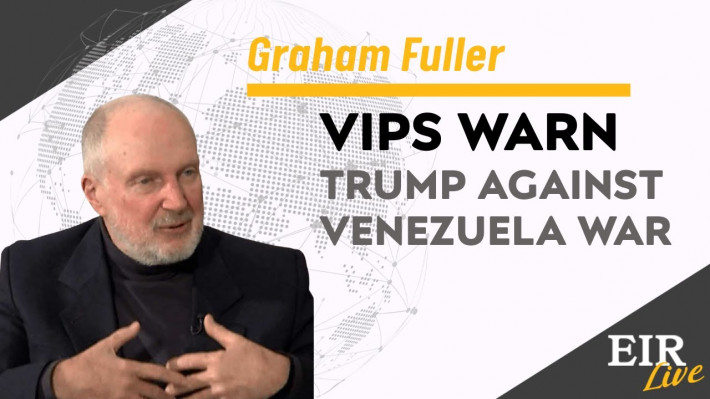
Graham Fuller, a former US diplomat and CIA official, is a co-signer of a Nov. 5 Alert Memorandum to President Trump released by the Steering Group of Veteran Intelligence Professionals for Sanity (VIPS), which warns President Trump against plunging the U.S. into “a wider and/or `forever’ war” with Venezuela. EIR Ibero-American Editor Dennis Small interviewed Fuller on Nov. 7, noting the urgency of the issue, as the USS Gerald R. Ford aircraft carrier group is currently on its way across the Atlantic towards the Venezuelan coast, where it is expected to arrive Nov. 11—12.
Fuller explained the reason for the VIPS warning: “What’s going on here? Why, in the middle of an appalling genocidal war in Gaza,” is the Trump administration considering a new war? The VIPS statement is meant as “a warning shot across the bow to suggest we’re drifting into another of these classic scenarios of a war that seems relatively pointless, cannot possibly achieve anything, and ends up miring the U.S. in a true quagmire.”
Fuller emphasized that Russia, China and other nations of the Global South, such as the BRICS, no longer accept a world in which “the U.S. asserts its right to act with impunity.” A new paradigm of global relations is being demanded, and is needed. He stated that the U.S. “butting heads” with China and Russia is the wrong approach, and must give way to a change in the “potential nature of international relations… I want to emphasize, above all else, the question of human agency, which Helga Zepp-LaRouche has talked about… We’re not simply billiard balls on a table.” The U.S. has to change, Fuller concluded; above all “it’s a mind-set issue.”
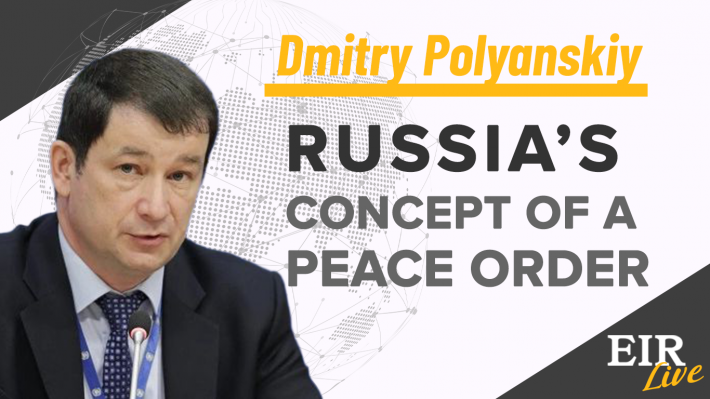
The Two Largest Nuclear Powers: Cooperation, or Confrontation? Join EIR News on our YouTube channel today, November 5, at 10am EST/ 4pm CET for a live interview of the Russian Federation’s First Deputy Permanent Representative at the United Nations, Dmitry Polyanskiy, conducted by Helga Zepp-LaRouche, editor-in-chief of EIR.
Join EIR News on our YouTube channel today, November 5, at 10am EST for a live interview of the Russian Federation’s First Deputy Permanent Representative at the United Nations, Dmitry Polyanskiy, conducted by Helga Zepp-LaRouche, editor-in-chief of EIR.
The danger of nuclear extinction war has not abated, as Dr. Ted Postol of MIT showed in his October 24 comments to the International Peace Coalition. Nevertheless, a new paradigm of peace through development is shining through, as reflected in the circulation of the Bering Strait Tunnel project as a solution to the crisis in US-Russia relations, by Kirill Dmitriev, CEO of the Russian Direct Investment Fund. A representative of the RDIF participated in the October 22 EIR international roundtable discussion on the strategic implications of the Bering Strait Tunnel project, during which program Zepp-LaRouche shared her view:
“[T]he realization of the Bering Strait Tunnel is potentially and very likely the answer as to if we have war or peace. Because, if we get to an agreement between the two largest nuclear powers in the world, to replace confrontation with cooperation which is to the benefit not only of those two countries, but actually of all countries in the world, it can be the game changer which marks the departure from the present extremely dangerous moment in history.”
How does the Russian government view the strategic dynamic? What are the principles of the “polyphonic world order” advocated by Russian President Vladimir Putin? Join the program to learn more.
Subscribe, like, and share!

Join Helga Zepp-LaRouche in her live dialogue and discuss the issues and solutions that move the world and its people. Send your questions, comments, and reports to questions@schillerinstitute.org or post them in the next live stream.
Our present phase of history is a time of terrible tension between those promoting war, and those promoting resolution of disputes. Deliberate backing of armed conflict in an age of nuclear weapons is insane. But there are growing forces of reason and hope.
Pope Leo XIV’s raising, on Oct. 25, the breakthrough concepts of Cardinal Nicholas of Cusa (1401-1464) is an important advance for forces seeking peace. Cusa’s concept of seeking and proceeding on the higher level of overcoming differences has repeatedly been studied, reported, and advocated by Lyndon and Helga LaRouche over decades. But most particularly, Mrs. Zepp-LaRouche formed an activist association in 2020 that she named the Committee for the Coincidence of Opposites, based on Cusa’s idea of the coincidentia oppositorum (coincidence of opposites), which organization came to be the precursor to the International Peace Coalition, founded in June 2022, at the initiation of Zepp-LaRouche, and now functioning as a critical platform for world dialogue.
At the Vatican on Oct. 27, Prime Minister of Hungary Viktor Orban met with Pope Leo. Orban has volunteered for Budapest to be the venue for a meeting between U.S. President Donald Trump and Russian President Vladimir Putin. Orban posted on X today, “I asked His Holiness to support Hungary’s anti-war efforts. Private audience with His Holiness Pope Leo XIV.”
Other figures and associations, likewise acting on the side of humanity, include leaders of the Global Majority, the BRICS, the expanding Shanghai Cooperation Organization, and collaborating initiatives. In the Indo- and Asian-Pacific this week, there are signals of this direction. Speaking of amity, on Oct. 26 India’s Prime Minister Narendra Modi, addressing the ASEAN-India Summit in Malaysia by video, pointed out that India and the ASEAN 11 nation members, now constitute 25% of the world’s population, and intend to continue to function as friends.
On the sidelines of the APEC summit in South Korea this week, President Trump reports he will meet with China’s President Xi Jinping. On Oct. 28, President Trump, now in Tokyo, Japan, is scheduled to meet with Prime Minister Sanae Takaichi, who has expressed concern to pursue a foreign policy of stability and peace in the region. This goes against the prevailing Western insistence that China is the enemy.
The most direct threats of warfare continue to come from the Europe-centered “Coalition of the Willing,” directly charging that Russia is the enemy, bent on invading Europe. Add to this the U.S. belligerence in the Western Hemisphere, building up military forces in the Caribbean.
In the last 10 days, military spokesmen in France have called for contingency readiness that could see French forces placed directly in Ukraine. Chief of Staff of the French Army Gen. Pierre Schill told members of the Defense Committee of the National Assembly on Oct. 24: “We will be ready to deploy forces under security guarantees, if necessary—for the benefit of Ukraine.” He stated that 2026 will be the “year of coalitions,” pointing out that upcoming multinational military exercises, “Orion 26,” will test land, air, and naval contingents, wherever they have to go.
In the Caribbean, U.S. military activity and force deployment have escalated, along with homeland propaganda that fighting the dope trade means taking down Venezuela. The guided missile destroyer USS Gravely has now docked in Port of Spain, Trinidad and Tobago, within seven miles of Venezuela. The story is that the ship is carrying out training exercises until Oct. 30. The aircraft carrier USS Gerald R. Ford has been ordered to the Caribbean, from its present location in the Mediterranean. There have been nine U.S. airstrikes on boats in international waters in the Caribbean, plus two in the Pacific off the western coast of Central America. At least 43 persons were killed.
The International Peace Coalition will convene its 126th consecutive weekly meeting on Friday, Oct. 31, at 11 am (ET).
Join Helga Zepp-LaRouche in her live dialogue and discuss the issues and solutions that move the world and its people. Send your questions, comments, and reports to questions@schillerinstitute.org or post them in the next live stream.

Oct. 25, 2025 (EIRNS)—The 125th consecutive weekly meeting of the International Peace Coalition (IPC) on Friday, Oct. 24, was not the usual panel discussion, but instead a dialogue between Schiller Institute founder and IPC initiator Helga Zepp-LaRouche and Theodore Postol (U.S.), professor emeritus of Science, Technology and National Security at the Massachusetts Institute of Technology.
Zepp-LaRouche began by describing the present strategic turmoil, where we are buffeted between hope and chaos. The Wall Street Journal said that the U.S. had given permission to Ukraine to use Tomahawk missiles to strike deep into Russia. U.S. President Donald Trump then denied the story, and Russian President Vladimir Putin warned that a Russian response would be serious, even overwhelming. There was also some confusion about the planned Trump-Putin summit in Budapest, which was on, then off again. Regarding Gaza, Zepp-LaRouche remarked, “The so-called peace deal does not seem to hold.” The Israeli Knesset voted to annex the West Bank, a repudiation of Palestinian statehood and an indication of Israeli obstruction to peace. The window of opportunity to stop World War III may be closing soon, she warned.
On the hopeful side, she reported on the Bering Strait Tunnel Project round-table discussion, which took place on Oct. 22, with experts on engineering, rail development, finance, and diplomacy from the U.S., Russia, Italy, and Germany.
Putin’s Leadership vs. German Lunacy
Zepp-LaRouche described Putin as “one whom one can only admire for his seemingly endless patience.” She charged that the “regime-change” people who want to get rid of “that thoughtful Putin” have not considered who would replace him, who would control Russia’s nuclear arsenal. Her sentiments were echoed by Postol, who said: “Whenever Putin shows restraint that saves humanity from catastrophe, they think it shows weakness on his part … he shows extraordinary ability to finesse these situations…. We can only be grateful that we did not have a Joe Biden equivalent in the Russian leadership.”
On the other hand, Zepp-LaRouche described how German Chancellor Friedrich Merz has shifted to an “idiotic” policy of “strategic uncertainty” regarding the deployment of Taurus missiles to Ukraine. To keep one’s opponent guessing is “really playing with fire,” she said. Postol added that he finds it hard to believe that anyone could have such a lack of grasp of history as to behave as Merz is behaving: “Germany is now being subjected to strategic deception by its political leadership and the American leadership.” Merz is lying when he says that the missiles deployed to Germany will not be nuclear armed. “The Russians will have no choice but to treat these weapons as nuclear armed,” Postol said. If they are conventional, they are meaningless. He compared this to the installations in Poland and Romania of defensive missiles that can quickly be converted to offense; the Russians do not have the luxury of speculating as to what the current status of those missiles may be. Merz’s approach will tremendously increase the likelihood that nuclear war will begin on German soil.
Teetering on the Brink of Nuclear War
Postol reported that there had been catastrophic events in the past few days, and that Trump’s statements and actions have seriously damaged the prospects for diplomatic progress. Putin has wisely offered to adhere to START provisions for a year while negotiations take place on renewing the treaty. However, due to Trump’s actions, “I think that Russia has now been put in a situation … where it really has no choice but to solve its security concerns on the battlefield in Ukraine.”
Postol, a leading expert on the consequences of the use of nuclear weapons, revisited some of the alarming material he has presented in past IPC meetings. “A nuclear war will effectively end modern civilization,” he said. “This is simply a fact of physics…. Fighting and winning a nuclear war is simply not technically feasible.” Statements by Merz, French President Emmanuel Macron and British Prime Minister Keir Starmer betray a deep ignorance of these facts.
Because of the extreme destructive effects of nuclear weapons, any nation that is attacked with them will be forced to respond with nuclear weapons in a desperate effort to save itself. Able Archer was a 1983 NATO military exercise, simulating a war with the Warsaw Pact, conducted with high-level participants, including then-U.S. Secretary of Defense Caspar Weinberger. By day five of the exercise, it had escalated to the hypothetical use of strategic nuclear weapons—and the U.S. and Soviet Union no longer existed.
Regarding the physical effects of the use of nuclear weapons, Postol said that most people imagine the main devastation to be the result of the shockwave, but that is just a secondary effect. Extraordinary damage is done by the initial fireball, which is much worse than the shockwave. The fireball would set fires over a vast area—approximately 600-700 square kilometers would be instantly ignited. Hurricane-force winds would be sucked into this area by upward convection, causing a gigantic firestorm, a fire tornado. Shelters would turn into ovens. Three-hundred-kph winds would accompany the shockwave that follows. Postol illustrated this very dramatically and passionately with historic images.
Europe’s War Dance
Zepp-LaRouche noted that Putin had changed Russia’s strategic doctrine one year ago, from a basic “no first use” doctrine to one under which Russia reserves the right to use nuclear weapons, when even a conventionally armed country backed by a nuclear power threatens the national existence of Russia. The previous doctrine was not sufficient to deter existential threats.
Postol commented on the rearmament drive from leading NATO nations: “As for all this talk about going to war with Russia, it’s almost laughable.” Russia clearly has no intention to invade Europe or occupy Ukraine. They have been forced to take action because of the behavior of the West. In January of 2022, then-U.S. Secretary of State Antony Blinken told Russian Foreign Minister Sergey Lavrov that the U.S. reserved the right to put nuclear weapons in Ukraine. Why is anyone surprised that Russia then invaded Ukraine?
Zepp-LaRouche asked Postol for his take on the strident calls for a conventional arms buildup. Postol said that the collapse of the German economy is a direct result of the Ukraine war. When Biden blew up the Nord Stream pipeline, he did much more damage to Germany than to Russia. “Germany is in the process of deindustrializing,” but Merz is not concerned with that. He wants to divert limited funds away from the people of Germany to prepare for an unnecessary war with Russia. European leaders are so desperate to cover up their own responsibility for the economic collapse that they are willing to initiate a war with Russia.
Good and Evil
When the session was opened to questions, one person asked about the question of evil in strategic politics. Zepp-LaRouche stressed the tenth of her Ten Principles of a New International Security and Development Architecture, that man is basically good. She said that the origin of evil is the system of oligarchy. Friedrich Schiller said the most important requirement for humanity is Empfindungsvermögen (empathy). What good does it do you to have written on your tombstone that you owned 200 Porsches and ate kilotons of caviar? Hannah Arendt was not entirely wrong about the “banality of evil.”
Postol agreed that man is good, with some qualification. He said that man is also “cursed with animal instincts.” We need a world where reason can overwhelm our animal instincts. Unfortunately, he said, there are very few people in positions of power today who wish to do good. European leaders of today created the conditions which led to the Ukraine war. They lack the courage of a Nikita Khrushchev to admit it when they have made mistakes.
Conclusion
Zepp-LaRouche expressed her appreciation of Postol as a “voice of reason,” saying that if you don’t start with what Postol laid out about the reality of nuclear war, you will end up wrong. She encouraged all participants to redouble their efforts to halt the march toward nuclear war, before the window of opportunity closes forever. [eir]
The following is a machine translation of an interview Helga Zepp-LaRouche gave to TASS news service on the now widely discussed proposal for a Bering Strait Tunnel connecting Russia and the United States. The late American statesman and economist Lyndon LaRouche had long advocated the building of the Bering Strait Tunnel great project:
Expert Zepp-LaRouche Assesses the Prospects of a Tunnel between Russia and the United States
It would embody the concept of “peace through development,” says Helga Zepp-LaRouche, founder of the Schiller Institute.
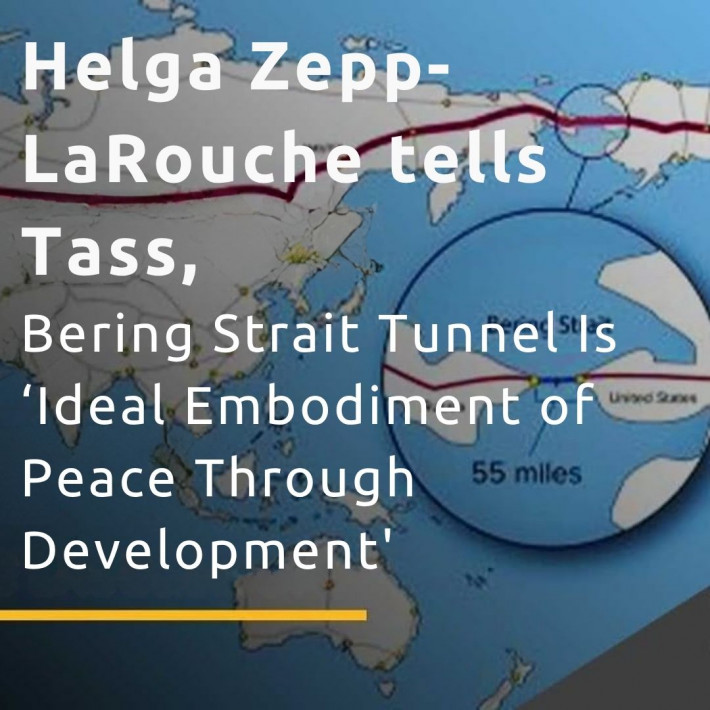
WASHINGTON, October 18. /TASS Correspondent Sergei Yumatov. A tunnel built under the Bering Strait and connecting Russia and the United States would be the ideal embodiment of the concept of “peace through development.” Helga Zepp-LaRouche, founder of the Schiller Institute, outlined this position in an interview with a TASS correspondent.
“It is obvious to President Trump that normalizing U.S.-Russia relations will open up enormous prospects for developing economic cooperation between the two countries. The most impressive [project] would be the ‘Putin-Trump tunnel,’ which, as Kirill Dmitriev, CEO of the Russian Direct Investment Fund, noted on social media, would become a 70-mile link between America and Afro-Eurasia across the Bering Strait,” the expert noted.
According to her, “the tunnel would help open up the entire Russian Far East for development and create enormous investment opportunities for resource-poor countries.” “The Putin-Trump Tunnel would be the ideal embodiment of the ‘peace through development’ concept,” Zepp-LaRouche emphasized. The choice of Budapest as the venue for a new meeting between Russian and American leaders, according to the expert, “will remind Europeans of the nearly lost art of diplomacy.” “This is good for the entire world,” she concluded.
President Donald Trump called the Bering Strait tunnel project, which would connect Russia and the United States by rail, “interesting.” Kirill Dmitriev, the Russian President’s Special Representative for Economic Cooperation with Foreign Countries and CEO of the Russian Direct Investment Fund (RDIF), stated that such a tunnel could be built in less than eight years, and its cost would not exceed $8 billion.
The idea of connecting the transport systems of Eurasia and America via a tunnel has been discussed for decades. As The Times newspaper noted in 2011, citing British experts, freight transportation along the Eurasia-U.S. highway would also connect resource-rich but sparsely populated areas of the planet with key overpasses, and would be less expensive, faster, and safer than by sea.
Read also:
1. Dmitriev: Discussions on Tunnel Connecting U.S. and Russia Have Begun.
2. Zepp-LaRouche Expert: Russia and the U.S. Could Build a Tunnel under the Bering Strait.
3. The State Duma Called Trump’s Question to Zelenskyy about a Tunnel between Russia and the U.S. Trolling.

Oct. 17, 2025 (EIRNS)—The 124th consecutive weekly online meeting of the International Peace Coalition commenced with optimistic remarks by Helga Zepp-LaRouche, Schiller Institute Founder and International Peace Coalition initiator. “All reasonable people in the world should be happy about the recent phone call between President Trump and President Putin,” she said, announcing the upcoming meeting between the two Presidents which is scheduled to take place in Budapest. She had no reading yet on the Oct. 17 meeting between Trump and Zelenskyy, but predicted that there is now a “big big question mark” over the delivery of Tomahawk missiles to Ukraine. She spoke of the possibility of a “Putin-Trump tunnel” connecting Alaska to Siberia, adding that the multi-national development of Siberia would represent an “incredible boost to the world economy.” This brings back the idea to the European continent that “diplomacy is the way to resolve conflicts.”
Zepp-LaRouche reported that the momentum of President Trump’s Gaza peace plan has carried over into the Ukraine situation. We published yesterday a very important interview with H.E. Ambassador Prof. Dr. Manuel Hassassian, Palestinian Authority Ambassador to Denmark, which underscores the absolute necessity of a “peace through development” approach, centered upon the Oasis Plan, originally proposed by Lyndon LaRouche in 1975.
“The Historical Roots of the”Peace Through Development” Plans
Later during the meeting, Schiller Institute activist Tim Rush reported on a think tank conference in Washington, D.C., where he noted a shift in world opinion against Israeli genocide. He intervened from the floor, referencing the Oasis Plan and the Eisenhower administration’s Water for Peace conference in 1967, to illustrate that these ideas have history. He referred the participants to a June 28, 2024, article in EIR titled “When ‘Water for Peace’ Was at the Center of U.S. Politics—1953-1968”. Co-moderator Dennis Speed noted a similar historical parallel, in a hand-drawn map recently shared by the Russian Ambassador to the U.S. and made public by U.S. Rep. Anna Paulina Luna, which envisioned a “Kennedy-Khrushchev World Peace Bridge” over the Bering Strait, a predecessor to the tunnel proposed by LaRouche in his World Land-Bridge plan.
Dialogue Between Israelis and Palestinians
Ali Rastbeen, director of the Académie Géopolitique de Paris, is a French national of Iranian origin. He said, of the peace plan for Gaza, that regional actors must maintain a balance between Israeli security and justice for the Palestinians. The regional actor he chose to emphasize was Iran. “Iran has remained silent—no official declaration … we haven’t seen that since 1979,” he said, calling this a “major strategic change…. Iran has been marginalized, no longer projecting power through proxies … a forced re-definition of its role…. Its influence has decreased, to the profit of the Arab countries.”
Rastbeen emphasized that we are entering a new era with the end of proxy wars. Regional power in the Middle East is now measured in the ability to negotiate, provide stability and cooperation.
Mossi Raz, former Knesset member and Director of Peace Now in Israel, observed that neither Hamas nor Israel can solve its problems by using force, and emphasized that pressure from the international community made this agreement possible. Pressure from the international community made this agreement possible. He warned that the success of the agreement was threatened by “misunderstandings on both sides”: the Palestinians are upset that Israel has continued to kill Palestinians, Israelis are upset because Hamas has not delivered all the dead hostages. The international community must keep pressure on both sides to comply exactly with the agreement, in order to prevent a further outbreak of war.
An excerpt was shown from Zepp-LaRouche’s video interview with Dr. Hassassian, who said that “President Trump has flexed muscles on Israel” to get a breakthrough in negotiations. He warned that the occupation has to end, and an independent Palestinian state with the 1967 borders is necessary for lasting peace and security. Zepp-LaRouche replied that “this is a very precious moment” to transform the dynamic of the region with the Oasis Plan. Hassassian agreed, saying, “This is the right time for your organization to push forward and to market the Oasis Plan… The benefits will not go just to the Gazans and the Palestinians,” but to the region as a whole.
Zepp-LaRouche said in response to Rastbeen’s description of a shift from ideology to diplomacy in Iran, that this is an interesting angle from which to look at the crisis. But the most important shift will be to an emphasis on economic development. This would “completely change the parameters.” Instead of coercion, we need a policy of mutual benefit. Raz offered his support for the Oasis Plan, but added that the economic dimension is a major factor, but not the only factor.
Discussion
A participant asked whether the “peace through development” approach is really desirable, given that economic growth threatens our “finite planet.” Zepp-LaRouche explained that there is a common misconception that growth must be linear and quantitative, as opposed to what the Schiller Institute proposes, which is qualitative growth such as the development of fusion energy, which China is making a reality.
Dennis Speed asked Raz to respond to former Knesset Speaker Avraham Burg’s assertion that Israel’s acts are at odds with Jewish tradition. Raz responded by acknowledging the importance of diplomacy and dialogue. Zepp-LaRouche added we have called for a dialogue of cultures, based on the best traditions of each culture in science and art, where human creativity expressed itself. “People have lost the idea of what a renaissance really is,” she said. “Collaboration among cultures would always spark a new development.”
A participant asked: Are we talking about a kind of consciousness we have never seen before? Zepp-LaRouche responded by saying that we must both reactivate our best traditions, and also create something new. It must be as different as today’s bestialized culture, as the Renaissance was from the Middle Ages, which were dominated by superstition and barbarism.
An African participant stated that she strongly supports the Oasis Plan, but asked: Why must we forgive the perpetrators of the genocide, of the killer sanctions? In response, Zepp-LaRouche insisted that we have to take advantage of branching points in history, in which we can influence the shape of things to come. We clearly have such a conjuncture, now that 500 years of colonialism is coming to an end. We should not try to impose the Western neoliberal model, but respect the singular characteristics of various cultures. We have to end the idea that conflicts can be resolved by military means.
In concluding remarks, Raz said that we need to incorporate the Oasis Plan among other issues which must be resolved, and it will take years to resolve them all.
In response to a question about China’s tightening of its export controls on rare earth elements, Zepp-LaRouche said that this “could bring the whole military-industrial complex to a screeching halt.” China’s next five-year plan could mean a change of relations among nations, a model of governance based on sovereignty, non-interference and cooperation.
An Ecuadorian reported that her new neoliberal government is attacking the indigenous population, which is protesting unjust austerity measures. Co-moderator Dennis Small said that Ecuador is part of a larger pattern; the neocons are willing to invade Venezuela, create regime-change in Peru (which they have done through an orchestrated scandal), and bail out Argentina, in order to maintain their control.
Zepp-LaRouche reminded the participants that although the discussion has focused on Gaza, she had emphasized at the start that the Trump-Putin meeting in Budapest is of crucial importance because of the ever-present danger of nuclear war, as was described by Ted Postol in the previous week’s IPC meeting. He will give another presentation at the next meeting. “In the age of nuclear weapons, we cannot have war as a method of conflict resolution”; we must return to diplomacy. [eir]
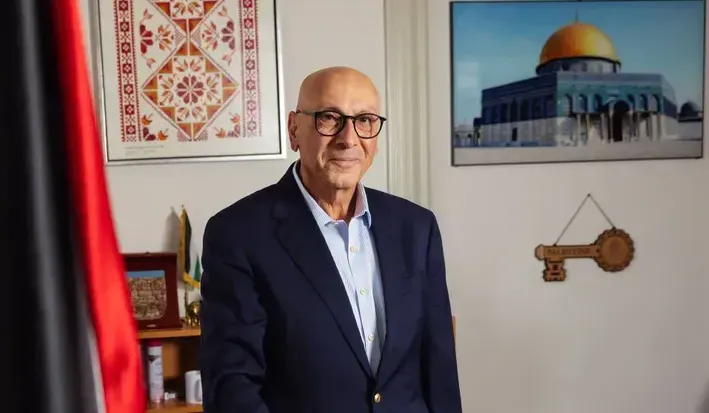
Helga Zepp-LaRouche interviewed Palestinian Authority Ambassador to Denmark H.E. Prof. Dr. Manuel Hassassian on October 14, 2025, who gave his full support for the Schiller Institute and Lyndon LaRouche’s Oasis Plan.
Introduction to LaRouche’s Oasis Plan
Helga Zepp-LaRouche characterized the interview as being exactly the right thing for this historical moment and a very important contribution to Schiller Institute’s renewed campaign for the Oasis Plan for peace through economic development for Palestine, Israel and the entire region.
Ambassador Hassassian expressed the hope that the war against Gaza, which has caused so much carnage, has finally ended. He called for the establishment of a Palestinian state to achieve lasting peace, and gave a full, lengthy endorsement of the LaRouche Oasis Plan as a crucial vision for the economic development of the region. He called for governments to adopt the plan and integrate it into other plans under discussion. Now is the time to market the Oasis Plan, he said. The Ambassador also praised the Schiller Institute for its initiative.
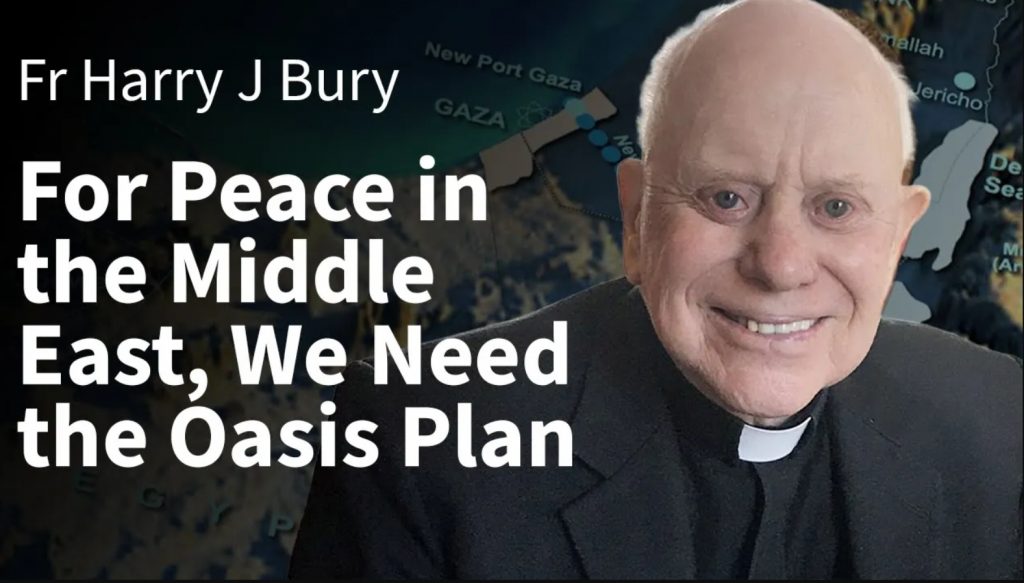
Father Harry Bury, world-famous Catholic priest known for his courageous actions in 1971 when he chained himself to the U.S. Embassy gate in Saigon to protest the Vietnam War, and in 2005, when he was abducted in Gaza while serving as a human shield between Israeli soldiers and Palestinian citizens, has announced a new initiative to address the crisis in Gaza and all Southwest Asia. His initiative is coming at a vital time, given that world peace hangs by a very thin thread. This world crisis begs the need for all peoples to join hands together to not only end the suffering in Southwest Asia, but to create a world where conflict, war and genocide become obsolete.
We appeal to His Holiness Pope Leo XIV to lend his support for such a plan for peace. It was Pope Paul VI in his Populorum Progressio who said “Development, the New Name for Peace”, and this idea is more important now than ever.
On Friday October 3rd, 2025 Father Harry Bury issued the following statement to the International Peace Coalition to address all congregations, synagogues, and mosques around the world:
FATHER HARRY BURY:
“As a Roman Catholic priest in the Twin Cities of St. Paul and Minneapolis in Minnesota, USA, I founded an association named Twin Cities Nonviolent. Our mission is to create an environment in which the Twin Cities and beyond can become free from violence. In so doing, we have partnered with the Schiller Institute in promoting the Oasis Peace Plan, which is peace through development, particularly financial development.
“This [idea of a] peace plan is already being implemented [in principle] by the BRICS nations—B for Brazil, R for Russia, I for India, C for China, and S for South Africa—with more than 14 other nations joining them, mostly from the Global South. That makes, with these nations joining them, perhaps representing about three-quarters of the population of the world. Amazing. The mission for this plan of development is for the developed nations of the planet to stop competing and to cooperate in contributing to the underdeveloped nations so that all the nations experience equity; that every nation be equal to every other nation.
As a consequence, the mayors of St. Paul and Minneapolis have declared their respective cities actively nonviolent cities. Thus, the Schiller Institute and TwinCities Nonviolent are modeling cooperation at the international level by together promoting the Oasis Peace Plan, and locally by insisting ex-gang members in north Minneapolis develop to enable them to get jobs that pay a living wage, or if they wish, to start their own business. In the future, we intend to do the same training with the young warriors in Africa.
We invite you, participants in the International Peace Coalition to join this mission.
We are also considering writing to Pope Leo and asking him to encourage the Oasis Peace Plan through development throughout the world, to get as many people involved as we can. The Oasis Peace Plan through development is creating hope to the hopeless. Thank you very much.”

Join Helga Zepp-LaRouche in her live dialogue and discuss the issues and solutions that move the world and its people. Send your questions, comments, and reports to questions@schillerinstitute.org or post them in the live stream chat.
Monday Oct. 13 was a bittersweet day. Hamas released all 20 of the remaining Israeli hostages, not including the 4 deceased who were also returned to their families. At the same time, Israel released 2,000 Palestinian prisoners—some of whom had not been seen for decades—to shouts of joy and celebration. Much-needed humanitarian aid, medicine, and cooking fuel also began to flow into Gaza by the truckload, in a way that has not happened for months and years.
Despite all this, it’s impossible to ignore the less-than-ideal speech of U.S. President Donald Trump in the Israeli Knesset, replete with his adulation of the wicked Miriam Adelson; or the toothy grin of Prime Minister Benjamin Netanyahu, who deserves prison instead of praise; or the reports of widespread arson across the Gaza Strip, as evacuating IDF soldiers leave yet further destruction in their wake. This includes the incineration of one of Gaza’s last remaining waste treatment centers, putting all of Gaza City, after two years of genocidal war, finally without this vital piece of infrastructure.
So yes, bittersweet: Because a ceasefire has been achieved and the killing has stopped, yet the perpetrators escape responsibility, justice has not been served, and talk of a Palestinian state appears nonexistent.
A fundamental sea change is required to turn this brief but invaluable moment into something truly lasting—not only for Palestinians, but also for Israel and for the region as a whole. And the current batch of leadership around Trump and Netanyahu, especially if Tony Blair is allowed to play a role, is inadequate at best. A transcendental change is required if a return to the bloodshed and the same cycle of violence is to be avoided.
Toward this end, it’s important to consider the words of former Speaker of the Knesset Avrum Burg, who wrote on Oct. 12 about the developments of the recent days: “There are moments in history when not only states change but entire nations. It is not borders that are redrawn but consciousness itself; not governments that are replaced but the collective soul that undergoes transformation. After 1945 the Germans awoke from the nightmare of Nazism and faced what had been done by them and in their name. After Vietnam, Americans emerged from the shattering of national innocence as a different people. The war in Gaza is such a moment for the Jewish people. It is not another round in the endless cycle of Middle Eastern violence but a historic turning point. It is a moment in which we must look in the mirror and recognize what we have become. And it is ugly.”
Burg goes on to call for exactly such a transcendental change. He condemns the policies of vengeance, racial supremacy, and religious fundamentalism, and instead evokes the better traditions of Judaism. “The beating heart of Judaism was never physical force but spiritual refinement,” Burg continues. “The Jewish hero was never the neighborhood bully but ‘the one who conquers his own impulse,’ and ‘the one who turns his enemy into a beloved friend.’” He calls for a “Global Jewish Fund for the Reconstruction of Gaza,” as well as other actions to salvage the situation for Palestinians, and pave the way for a peaceful coexistence between the two peoples. These are not intended as a mere “political gesture,” he writes, but rather are “the only way to survive spiritually.”
As a former leading member of Israel’s government, Burg’s sentiment underscores the potential that exists for such a transcendental shift. In this context, the LaRouche Oasis Plan for Southwest Asia becomes more important than ever. The Oasis Plan has the potential to completely change the parameters of the current negotiations, establishing the physical requirements for the prosperity of all and redefining the environment in which long-term peace can blossom.
This is not a period to sit and criticize, but one to envision what a better future can and must look like, and organize for it. Join the effort.