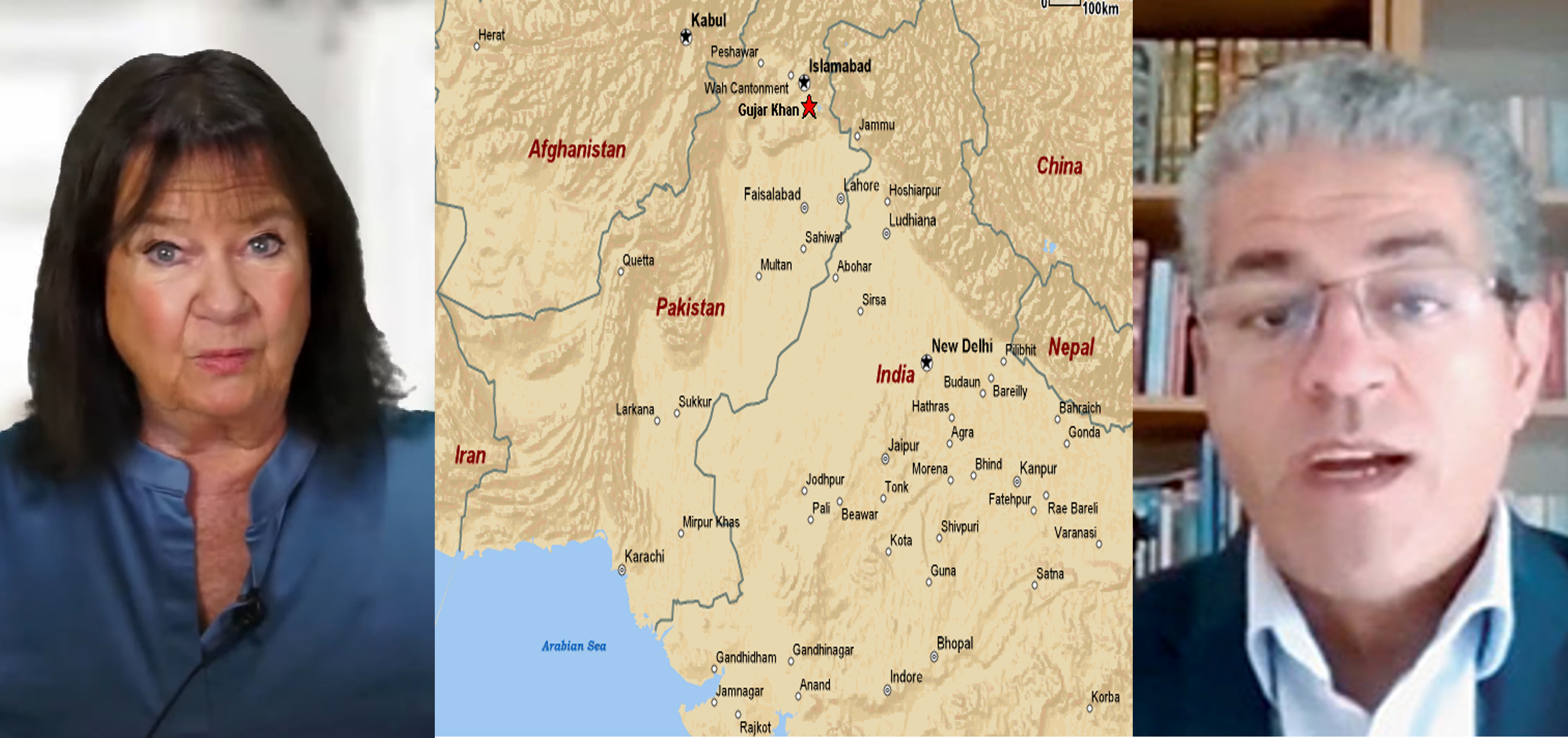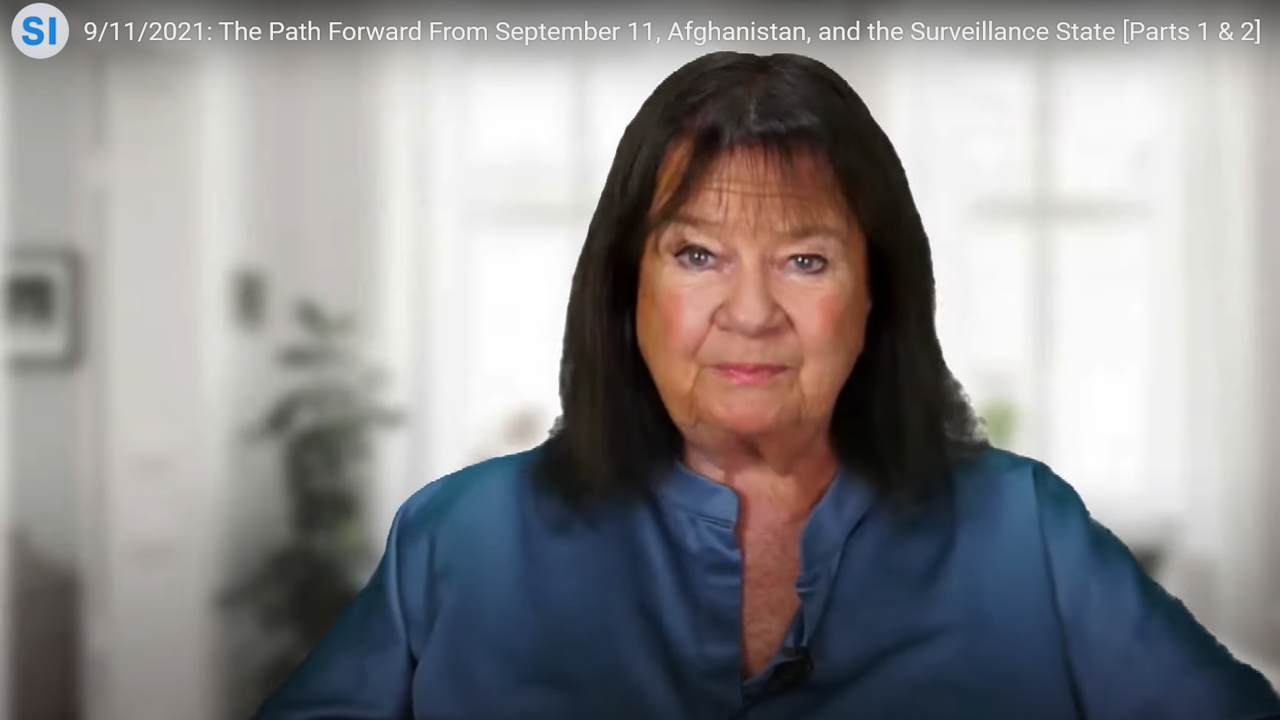
Dec. 3 (EIRNS)–The following is a transcript, done by EIR, of the Thursday, Dec. 2, 2021 broadcast on CGTN of “Dialogue,” with Helga Zepp-LaRouche as a guest.
XU QINDUO: [recording starts in progress] … achieved over the past eight years, what are the concerns behind it, and how does it embody Green development? To discuss these issues and more for the first part of the program, I’m joined by Shiran Illanperuma, research analyst at Econsult Asia, and Helga Zepp-LaRouche, founder and president of the Schiller Institute. For the second part of the program, I’ll also be joined by Erik Solheim, president of the Green Belt and Road Institute. That’s our topic; I’m Xu Qinduo.
Welcome to the show, Helga. For starters, how do you evaluate China’s Belt and Road Initiative, the BRI, over the past eight years?
HELGA ZEPP-LAROUCHE: I think it has changed the world for the better. It is historically the largest infrastructure project ever undertaken in the history of mankind. I think with all the attacks on it recently, there is a very good way of looking at it, and that is to imagine that it would not exist. Just imagine if Xi Jinping would not have announced the New Silk Road and the Maritime Silk Road and all these projects would not have been undertaken. The world would be in a much worse situation. You would have much more poverty; the pandemic would still be here. However, the developing countries would not have received a lot of help from China, because it was this civilizational contribution by China to first lift its own population — 850 million people — out of poverty. And then have the economic strength to offer to the developing countries the model and offering them to do likewise by applying the same economic principles. So, I think the world has changed for the better in ways it never has happened in history before, and I think this will be recognized eventually by everybody; including those people who don’t seem to be so happy with the existence of the Belt and Road Initiative, because they will recognize in the coming period, which will be characterized by more upheavals, inflation, even a hyperinflation in the Western liberal system. You will have new waves of the pandemic because these other countries did not manage as well as China to deal with it. And in the end, it will be clear that the cooperation with the Belt and Road Initiative is really the savior of civilization.
XU: Jiran, if you look at the Belt and Road Initiative, in particular for the developing world — more investment, more trade, more connectivity — it is a good thing in particular for developing countries, right?
SHIRAN ILLANPERUMA: Yes, I would definitely agree, especially coming from Sri Lanka, which is situated in the Indian Ocean very strategically close to some of the busiest shipping lines in the world. For example, the Hambantota Port, which was an investment from China, is situated just ten nautical miles off the shipping route. So, building that regional connectivity is really beneficial for Sri Lanka, as well as for its neighbors.
XU: Helga, the China-Laos Railway constructed in the BRI is the first international railway mainly funded and constructed by China, directly connected with the Chinese railway network after the proposal of the BRI in 2013. So, how significant is it to Laos? And how important is it to the BRI?
ZEPP-LAROUCHE: I think this is one of the most exciting projects I know of, because Laos has so far not been a very developed country. And by having a high-speed railway connecting Kunming with first Laos, but then beyond that to Singapore, Thailand. This connects ASEAN with China; it opens up the connectivity for Laos for eventually the entire Belt and Road infrastructure. Also, it’s not just a railway, even so it is very exciting and it will be very high-level technologically. But infrastructure corridors which always develop out of such transport lines open up the potential for the real industrialization of the country. So, I think this is a major breakthrough, and I think given the rather desolate condition of the railway system in the United States and Europe, I think people will go to Laos and Laos can be proud of having such a modern system, which will be a shining example for many other countries around the world.
XU: Shiran, you talked about the Hambantota Port. In 2017, Sri Lanka and China signed this deal with the leasing of Hambantota. Then there were criticisms — mostly from Western media — that Sri Lanka was forced into the deal, afterwards it was lured into a “debt trap” with easy access to Chinese money. What do you make of that criticism?
ILLANPERUMA: I think it’s nonsense, basically. The facts speak for themselves. Unfortunately, this narrative has been forward as you say by the Western media. But not just Western media. It has been picked up locally as well, whether it’s politicized or deliberate misinformation, that’s another topic. But if you just look at the facts, only 10% of Sri Lanka’s debt is to China; 50% is to international sovereign bonds, most of which are held by US banks and financial institutions. We have the same amount of debt to China as we do to Japan or the ADB, but nobody says we have a Japanese of ADB debt trap. So, that’s one thing.
Then, on the other hand, if you look at the facts of the case, Sri Lanka never actually defaulted on the loan that it took for the Hambantota Port. What happened was that in 2017 there was a huge balance of payments crisis, which forced the government to go to the IMF and then later it disinvested from Hambantota Port. But as you said, that was a 99-year lease that was given to a Chinese company, and we got an infusion of US$1 billion for that; something around that amount. That was not used to settle debt or anything like that. It was used to buffer our reserves. So, there was no debt default, there was no debt [ inaudible ] or anything of the sort.
XU: One thing is like a prominent feature of building infrastructure — it’s long-term. And also, it takes a long time to see positive results; usually like you are building a road, when does your return come back? It takes years, right? If you look at this Hambantota Port, experts say, “The Chinese-built Hambantota Port is expected to create 200,000 jobs and contribute $11.8 billion to the Sri Lankan GDP per year.” How do you evaluate the potential of the port?
ILLANPERUMA: As you said, the potential is huge. And it’s not just the port, because the port is kind of a catalyst for a lot of other things. Sri Lanka has traditionally lagged a bit behind in terms of manufacturing. The port has an industrial park adjacent to it which is also operated as part of the port. So far, there has been investments of $300 million into a tire factory; there’s been a plug-and-play electronics manufacturing factory; there have been deals signed for ship building, yacht building specifically. So, there’s a lot of potential to create jobs, and for Sri Lanka to improve its exports. Because of the way it’s situated in Hambantota Port, there is a lot of agricultural land as well as land that can be used for industrial investments. So, the potential is quite huge, and already I can tell you that there are a lot of locals who are employed there in the RO-RO facilities at the Hambantota Port. So, that’s quite a lot of potential for Sri Lanka to improve its exports, its regional connectivity, and tap into global value chains.
XU: There’s a criticism for Chinese, they say there is a lack of transparency and it’s increasing Chinese influence, or even Chinese military influence. So, what’s your response to that, Helga?
ZEPP-LAROUCHE: The argument that it’s just to increase the military influence is sort of ridiculous, given the fact that the United States has about 1000 bases around the world, and China has a meager one or two. But I think more important is not to just look at the label. I think what’s behind it is an ideological difference. I think this has been expressed most clearly by the head of the World Economic Forum, Klaus Schwab, who in his new book, Stakeholder Capitalism, says the famous sentence that “The real problem is overcoming poverty, because that desire to overcome poverty is what causes the climate catastrophe.” So, for these people, real development is the problem, because it supposedly according to their wrong science, damages the planet by causing climate change. Which is obviously completely wrong. What China is doing, look at what happened at the FOCAC meeting where China again for the I don’t know how many times, is forgiving the debt to the least developed countries. That has not been done by the countries of the Paris club likewise. But I think this ideological question that that there is a Malthusian faction who do not want the developing countries to develop. I think that has been left out of the discussion so far, but without recognizing that that is the motive, and it’s in the old tradition of Malthus, of the British Empire. It’s the same philosophy as what was behind the Opium Wars, or what was behind the British policies in India, and Africa for that matter. Nothing has changed in terms of this colonial outlook, which is the idea that the developing countries should stay undeveloped and be just the reservoir for raw materials for the rich countries.
If you look at the behavior during the pandemic right now, where the rich countries were hoarding vaccines, they were not trying to distribute masks and other medical supplies. We have now the result of that in the form of the pandemic spreading with omicron and mutations which are the result that you cannot leave pockets of the world without medical help. Then you get that as a result. So, I think we have reached a point where we need a complete change of the system. I think the model China has offered so far is the best available on the planet.
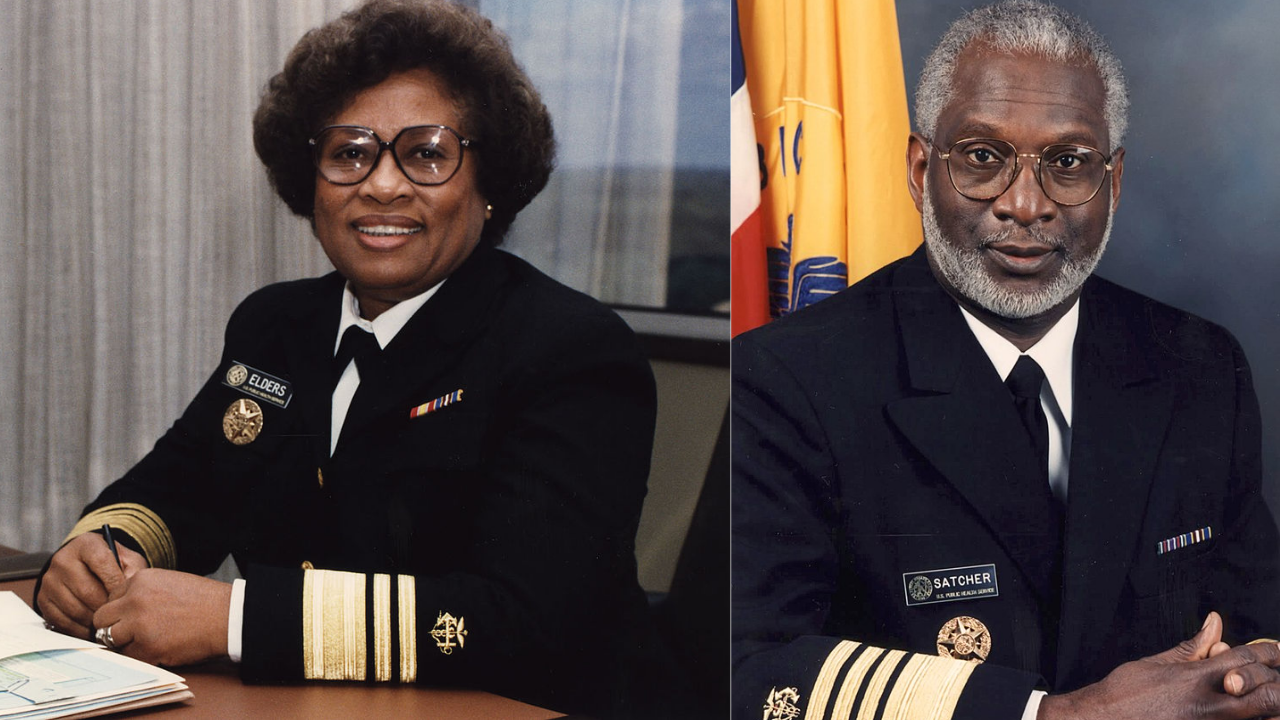
Dr. Joycelyn Elders, Committee for the Coincidence of Opposites, on Caribbean Facebook Forum on Health Security
May 27, 2021 (EIRNS) – A forum was held today in Trinidad Tobago, streamed on Facebook Live Video with the online participation of Dr. Joycelyn Elders, former U.S. Surgeon General, who co-founded the Committee for the Coincidence of Opposites in 2020 with Helga Zepp LaRouche, Schiller Institute President. The topic was, “Building Global and National Health Infrastructure in the Wake of Covid.” Host Dr. Kirk Meighoo opened the hour-long dialogue, which is the second of a weekly series for a new season of his The Story Club series, with quotes from the May 14 Committee release, “Global Health Security Requires Medical Infrastructure in Every Country—Major Industrial Nations Must Collaborate Now!” The forum also airs in India.
Joining Dr. Elders were Dr. Tim Gopeesingh, from Trinidad Tobago, and Marcia Merry Baker, from EIR News Service. Dr. Gopeesingh’s long background of both medical specialty—gynecological oncology—and long, high-level public service, parallels Dr. Elders, who is a pediatrician, and the two compared views on many concrete aspects of health care, from teaching, to community health, to hospitals. Gopeesingh was a Cabinet Minister, Member of Parliament, Senator, and Health Administrator. He personally oversaw a dramatic expansion of the medical care delivery capacity in Trinidad Tobago. He was on the faculty of the University of the West Indies—which has multiple locations in several nations, and served as Clinical Dean of the Faculty of Medical Sciences there from 1994-1997.
The two physicians stressed the necessity for building capacity to deliver care. Elders said that the pandemic has revealed the “soft underbelly” of the inadequacies of medical and public health systems. On the U.S. situation, she said that for years the U.S. has not had “health care.” Instead, it has “sick care.” Both doctors spoke of providing health care in the community.
Gopeesingh described some of the capacity he had helped to build up, including new hospital resources. Then, he said, another administration came in and let the system languish. One hospital was completely shut down; now with COVID-19, it has been reopened. Elders concurred strongly, that “leadership” is the biggest need in public health and medicine. She presented “Five Cs” for leadership. Among them, Concern, Competence, and Commitment. Elders recounted when and why the Committee for the Coincidence of Opposites was founded in 2020, as the “brainchild” of Helga Zepp-LaRouche, to show that people can work together.
Baker identified the green evil we now see from the Wall Street-City of London crowd. UN Climate Action Envoy, and former Bank of England governor Mark Carney tells Africa that they should not develop their resources or build infrastructure. They should sell carbon offset credits for retaining a primitive economy, and just die off, while the bankers try to create a green bubble for themselves off the new carbon credits market. This must be stopped. Baker reported the opposition to this, in the form of the critical initiatives for a new world health security system, for example, the Mexico-Argentina vaccine production partnership, the provision of vaccine to the Honduras mayors by El Salvador after they appealed for help, the achievements of Cuba in their work on new vaccines and bio-medical research. She called for the major powers to get together and collaborate.
Dr. Gopeesingh warned against any shallow thinking that once this terrible pandemic is over it will be smooth sailing. Not at all. The coronavirus has appeared before in deadly form (SARS, MERS) and may do so after the SARSCov2 period. The cold virus requires vaccination every two years. We have to get realistic. Link to the full program is at this Facebook link: https://fb.watch/5LyRSLABHY/
MILAN, Nov. 23, 2021 (EIRNS)—Alessia Ruggeri, chairwoman of UPI Italia, an association of small and medium-sized enterprises, and a renowned trade unionist in Sicily, today endorsed Helga Zepp-LaRouche’s proposed “Operation Ibn Sina” for Afghanistan with a press release which was published today in Il Corriere di Sicilia, a daily read in all of Sicily and is expected to be published in the next days in other Southern Italian papers. {Read the article here.} The press release is entitled “Helga Zepp-LaRouche launches Operation Ibn Sina to save the Afghan people” and reads:
“The Committee for the Republic, through its spokeswoman Alessia Ruggeri, endorsed the Ibn Sina initiative of the Schiller Institute. ’I believe that the world is experiencing a quite sad political, economic and social moment, with the complicity of mainstream media. We have to regain the lucidity and ability to intervene in support of a right cause. The Afghan people are paying the price of international geopolitical strategies which deny their inalienable rights guaranteed by the UN Charter.
“ ‘I therefore accept with great honor the invitation of the Committee for the Coincidence of Opposites to be a part of it and give a significant European contribution,’ Alessia Ruggeri concludes, thanking Liliana Gorini, chairwoman of Movisol, an Italian political party inspired by Lyndon LaRouche.
“Also the lawyer Roberto Zappia endorses the appeal in support of the Afghan people, first exploited for the affirmation of the territorial and political hegemony of the world powers and subsequently abandoned to the voracity of the finance and to its cynical ruthless logics.”
The press release goes on to quote Helga Zepp-LaRouche on Operation Ibn Sina from the recent Schiller Institute conference and Dr. Joycelyn Elders on the recent activities of the Committee Coincidence of Opposites, particularly in Africa. {See Dr. Elders’ call, Open Letter to Virologists and Medical Experts.}
Nov. 23, 2021 (EIRNS)—From Helga Zepp-LaRouche:
Your Excellency Prime Minister Saleh bin Habtour; Your Excellency Mr. Hisham Sharaf, Minister of Foreign Affairs of Yemen, a good friend of the Schiller Institute; Dear Members of the Yemeni BRICS Youth Parliament and its Chairman Mr. Fouad Al-Ghaffari:
Ladies and gentlemen who are gathered in the Capital of Yemen, Sanaa, I send you the most heartfelt greetings from Germany!
We are fully aware of the tremendous strain you are under as a result of the criminal blockade, which, as long as it continues, means that all this talk in the West about a “rules-based-order” is worse than meaningless. Because if they condone, de facto, this blockade, they condone the result—which is the death and suffering of a very large number of [the] Yemeni people! You have been incredibly courageous and inspiring for all members of the Schiller Institute around the world, by not giving up your fight to have a better future for your country and the world!
In these days, the New Silk Road launched by President Xi Jinping will have its 8th anniversary and the role of the BRICS in the world has increased to become a more and more influential element in world history. I am sure that Yemen will be an important part of it in the not-so-distant future, and [that] your organization will have been the decisive element in having accomplished that, and in that way reconnecting the glorious history of Yemen with a hopeful future.
The Schiller Institute has launched “Operation Ibn Sina,” which is to bring modern health systems to Yemen, Afghanistan, and Syria and as a synonym, to have a renaissance of the period, when your region of the world carried the torch of universal progress for all of mankind.
I also like to [recall] how proud my late husband, Lyndon LaRouche, was of your unchanging industriousness for study of his scientific method, and I would like to encourage you to expand it, and make sure that it will have entry into the education system of your country. Yemen will be the birthplace of many geniuses, which will transform humanity into becoming truly human.
The old paradigm, a world divided by geopolitical aggression and the rule of a few over the many, is clearly coming to an end, and the new paradigm of cooperation, and a dialogue of cultures is becoming stronger and stronger. We join with you, and an increasing number of countries and forces in the effort to bring this change about, and give you the solemn promise, that we will always remain your true comrades-in-arms, until you have gained the sovereignty of Yemen, and are truly free.
With great affection, in the name of the entire international Schiller Institute, Helga Zepp-LaRouche
Nov. 23, 2021 (EIRNS)—Today, leaders of the Schiller Institute and the LaRouche Movement joined other international figures in participating in a conference called to celebrate the “First BRICS Day” in the capital of Yemen, Sanaa, under the auspices of Yemeni Prime Minister of Yemen Abdulaziz Saleh bin Habtour. The conference, held at the Emergency Medical College, had been organized by the Yemeni BRICS Youth Parliament and its Chairman and long-time collaborator with the Schiller Institute, Mr. Fouad Al-Ghaffari, to celebrate Yemen’s commitment to securing full independence and development by working with the BRICS nations—Brazil, Russia, India, China, and South Africa—and playing a key role as part of the New Silk Road initiated by China.
The event took place as the Saudis were continuing a new wave of bombardment targeting the capital, Sanaa. Yet the Yemeni government considered it so important that the Prime Minister, joined by the Ministers of Vocational Education, Foreign Affairs, and Culture, all participated, joined by Yemeni parliamentarians and other national figures. The Yemeni official news agency Saba News has already published a lively wire report on the event, which conveys the deep commitment of Yemen’s leadership to help end today’s dominance of the Western liberal system, freeing nations to develop. The Prime Minister expressed his thanks to the friends in Russia, China, and the other speakers who sent messages of solidarity from Germany, India, France, Iraq, and the United States of America. (The Saba News item is linked here.)
Helga Zepp-LaRouche, Chairwoman of the Schiller Institute, was the first of the 11 international guests whose recorded video message was presented, following the opening remarks by the Dean of the Emergency Medical College. She was introduced as the New Silk Road Lady. She was followed by Tushar Gandhi, great-grandson of Indian leader Mahatma Gandhi, and Chairman of the Mahatma Gandhi Foundation. Jacques Cheminade was next, representing the Solidarité et Progress, presented as a former French presidential candidate. The Schiller Institute’s Hussein Askary followed with the video presentation on the history of collaboration with the BRICS Youth on the Yemen Reconstruction Plan “Operation Felix” and the LaRouche School of Physical Economics.
There was a high-level Russian representation, with a message from Anatoly Karpov, chess legend and member of Duma. Larisa Zelentsova, the Russian President of the International Alliance of BRICS Strategic Projects (BRICS Alliance) (iabrics.org) sent a video message. A message was also sent by Albert Zhukov, founder of the Golden Chariot Transport Award. Purnima Anand, President of the BRICS International Forum, India, also sent a message.
Two messages were sent from the United States, one by LaRouche movement organizers Marsha and Doug Mallouk, and one by independent candidate for U.S. Senate in New York, Diane Sare.
These speeches and messages were preceded with a ceremony where PM bin Habtour received the BRICS Youth Award and Transport Golden Chariot award. Minister of Foreign Affairs Hisham Sharaf signed the first copy of the new edition of the Yemeni BRICS “Sustainable Development University Curriculum,” which is a compilation by Fouad Al-Ghaffari of projects and works in economics centered around Lyndon LaRouche’s economic method. A chapter is dedicated to what the authors have characterized as “LaRouche’s Five Keys of Progress” which are a reworking of the “Metrics of Progress” from the EIR Special Report “The New Silk Road Becomes the World Land-Bridge, 2014.” Another chapter is dedicated to the latter special report. A chapter includes a short version of “Operation Felix” for the reconstruction of Yemen from 2018, completed in 2018 as a joint project of the Schiller Institute, BRICS Yemen, and the Yemeni Investment General Authority.
Many references to Helga Zepp-LaRouche and the Schiller Institute’s resolutions and calls regarding Yemen are also in the book. A chapter is dedicated to the Arabic LaRouche School of Physical Economics launched by Askary, with links. The 160-page book in Arabic language has a general outline of the UN Sustainable Development Goals 2030. But on every page the LaRouche Five keys are superimposed on the 15 UN Sustainable Development Goals.
Following the statements by the foreign VIPs, Al-Ghaffari made a 15-minute presentation on the history and nature of the Yemen BRICS operations since they were founded in December 2014.
The Minister of Vocational Education also made remarks, and the conference was concluded by a statement by Prime Minister bin Habtour.
First reports from the event are that it was a surprise for everyone, due to the high-level of international representation from intellectual and scientific layers. This is a great victory for the people and leadership of Yemen on behalf of all humanity.
And it is a celebration of seven years of hard work and cooperation with the Schiller Institute and LaRouche Movement, which began when Fouad Al-Ghaffari attended EIR’s release of its Special Report “The New Silk Road Becomes the World Land-bridge,” in Washington, D.C., keynoted by Helga Zepp-LaRouche. After meeting with Marsha and Doug Mallouk, he carried the copy of the report he purchased back to Yemen to start this new organization to teach Yemeni youth as well as policy-makers about the LaRouche economic method, the New Silk Road / Belt and Road Initiative, and the BRICS. A few months later, in March 2015, the war of aggression by Saudi Arabia and the UAE was launched with the aid of the U.S. and Britain. Despite this criminal war and subsequent murderous blockade, the BRICS Youth of Yemen continued their studies and mobilization of government agencies.
Nov. 21 (EIRNS)–This is the edited transcript of the speech delivered by Mrs. LaRouche, the founder of the international Schiller Institutes, on November 17 to the online conference, “Humanitarian Roundtable for Afghanistan,” sponsored by the Council on Global Relations (CGR) located in Metro Washington D.C. The conference was convened by the CGR to address “the need for urgent assistance and a shift in narrative,” and to “make a difference in the lives of 39 million Afghan people facing a collapsed economy in the heart of a brutal winter coming out of 40 years of war.”
Hello to all of you.
I just want to state emphatically that the money that is being withheld by the U.S. Treasury—but also Commerzbank, Bundesbank, and the Bank for International Settlements—this money belongs to the Afghan people. I think that this is what we have to face, given the situation that was pointed out by both Dr. Beasley [of the UN World Food Program] and Dr. Tedros from the World Health Organization, that 97% of the people are in danger of being food insecure. And food insecure is just another word for starving to death.
Then you have a health crisis—95% of the people have no access to healthcare. And that is happening in a condition of famine and of the COVID crisis. So, to withhold that money for any more days means you’re risking the lives of people. So, I think the first step must be an absolute demand that the money which rightfully belongs to the Afghan people must be released without condition. I think this idea of giving it piecemeal and making conditions and so forth, that just will contribute to chaos. It will force the Taliban to resort to opium production, which they do not want to do. I think I mentioned in a previous discussion that Pino Arlacchi, the UN special representative in the fight against drugs in 2000, had an agreement with the Taliban, in which they agreed to stop all opium production.
The increase of the opium production occurred during the NATO presence—especially this year, opium production went up by nine percent in the period before the Taliban took over. Then the price shot up to the sky, because there was an expectation that Taliban would not continue the opium production. The price went up because of potential scarcity. So, the people who are withholding the money from the Taliban are pushing the opium trade! That should be stated very, very clearly.
Secondly, if you’re now not supporting a government that you may not like politically—but it’s there—and if you don’t support them being successful, you are encouraging the opposition. And what is the opposition? It has been largely terrorist groups, and you know that terrorism will spread, not only in Afghanistan but throughout the region. The big question is that maybe that is the intention, as a geopolitical force against the countries in the region, especially Russia and China.
So, the people who are withholding the money—and I want to be very, very clear, because there is no point in talking about nice things if that is not settled first—the people who are withholding the money are doing it completely illegally. And I think they should be held accountable. Any death which occurs from here on will be the guilt of the people withholding the money. And I think that has to be stated first.
I think if we can agree on that, then I’m willing to talk about a better vision. Psychologically, I can understand that it is very difficult for the NATO countries and their armies, after having lost a war having been in the country for 20 years. I talked to some people who were there, and I understand that this is a trauma. They did not expect it, and they are having a very hard time switching to another mental attitude. But that has to occur if Afghanistan is to be saved.
I have thought a lot about what can be done to give hope to a country that has gone through hell for the last 40 years. And really through hell for the last several 100 years—going back to the Great Game, to Brzezinski and his Islamic card that started this whole present disaster. People in Afghanistan have lived through trauma, and they need something to put the country back together with a beautiful vision. This region of the world was once known as the land of the 1,000 cities. Admittedly, this was on the order of 3,000 years ago, but there was once a period in which this region was one of the cradles of mankind. I think to be grounded in one’s own great tradition is a very important stepping-stone for building a positive future.
Then, naturally, there are many poets one could mention. The fact is that there is a health crisis right now of biblical dimensions, a pandemic which is unprecedented in terms of the potential of where it may go. So, my idea is: It has to start with the modern health system. Afghanistan needs modern hospitals. They can be built in two weeks. The Chinese proved in Wuhan that you can build a modern hospital of 1,000 beds in two weeks. Then you need doctors, modern, educated doctors, nurses, health workers. A lot of the diaspora Afghanis are doctors. They are in the United States, they are in Europe. They can be mobilized to come back and help to build a modern health system. And that modern health system can be the beginning of an economic transformation. If you are going to have a modern health system, you need water, you need electricity, you need other infrastructure. But that building of a modern health system can become the engine of hope and the engine of economic reconstruction. This, however, needs to have a beautiful vision, an idea of what that means.
Many years ago, I studied the works of Avicenna, or Ibn Sina as he is called in the Arab world. He was one of the great universal thinkers. He lived from 980 A.D. to 1038 A.D. He was not only an extraordinary thinker; he developed philosophical conceptions which had influence way beyond the Arab world, and to the Mediterranean, and to European thinkers. But especially it is known that he was an extraordinary physician. He wrote several medical books, and a canon on medicine which was the standard work in Europe until the 17th Century, and in some cases even the 19th Century. He developed an idea of the anatomy of the body, the nerve system, the psychology. He knew about new diseases like breast cancer. He developed the connection between muscles and nerves. He wrote a whole book about modern medicines based on herbs and other such things. But he is famously known to have been one of the great sons of Afghanistan.
He was probably born in Bactria. There are also some people who say, no, he was born in Bukhara, or maybe in Persia. It does not matter. His father was for sure born in Bactria, and he is for sure a son of the region.
He is an example of how somebody coming from Afghanistan can be a contributor to universal history, by moving mankind forward, by developing a whole new, modern medical science. So, I’m suggesting that the effort to save Afghanistan be called Operation Ibn Sina, because it somehow captures both the proud tradition and also a vision that Afghanistan again can be a pearl of the nations of the world. Afghanistan will be contributing something to other nations. You need to give people who have gone through such hell a vision of a beautiful future.
I think that would capture the imagination of a lot of the people, both inside Afghanistan and out. The danger is terrorism and drugs, and you want to have an image which presents a completely different future, one based on the intellectual tradition which made this country a great country in the past, and it means that it will again be a great country in the future.
Schiller Institute Representative Injects Necessary Principle Into Dialogue on China Policy
Nov. 18 (EIRNS)—At a Watson Institute conference entitled “Rising Tensions in the Taiwan Straits: Will the Chinese Civil War End with a Bang or a Whimper,” the following exchange occurred between Schiller Institute representative Cloret Ferguson and the two very prominent speakers, Ambassador Chas Freeman and Professor Lyle Goldstein.
Cloret Ferguson: It’s a pleasure to see and hear both of you. My question is, why would we not seek a more Westphalian approach to the question of China and US relations? For instance, the fact that China has elevated more than 850 million of its own population out of dire poverty and has said that they are reaching out to the whole world, to solve the problem of poverty of the whole world in 30 or 40 years, why would we not approach these relationships and take that branch as a means to solve the problem on a much more noble plane? Why would we not accept this as the pathway for relations between China and the US instead of dwelling on the past. We have the biggest military arsenal in the world!
Chas Freeman: The military industrial complex is us. We have a very militarized foreign policy. The first thought when we run into a problem abroad is, sanctions, which is coercive, a form of war, an economic war; then we send in the Marines, or if the Marines aren’t available, the Army or somebody. This is our mentality, and it comes out of our history, I suppose. You are very rational; that is exactly what I think we should be doing, that is, we should accept that there is no military answer that is acceptable to the Taiwan question, either for China, or for us. We need to find a way to take it off the track that it is now on toward a fight. I don’t know about you, but at the moment, Americans have no consensus on what the past means; our founding myths are all being deconstructed, our heroes are being toppled from their pedestals. New heroes are not really being invented that appeal to everyone. We are more divided than ever. We don’t agree on what the present is; we have no common vision of the future. And if you doubt that, look at Washington DC at the present. What Ed said, China has a clear ambition and a strategy for achieving it. We are countering it with fumbling and internal division, and a focus on military uses of force.
Lyle Goldstein: I think this is a very wise question, and for those of you not familiar with 17th- Century European diplomacy, this term, the Westphalian model, is something we really ought to get back to, and I think it is generally studied in international relations classes, but I don’t think it’s known beyond that, but I’m glad you brought it up. I do think it’s absolutely critical to a way forward with China. All it is, is a basic principle, countries can be different, probably should be different, they shouldn’t interfere in each other’s affairs, and this eventually stopped the incredible warring that was going on between various Catholic and Protestant states in Central Europe. It’s very applicable to today, that most diplomats agree with these basic principles, but it seems to me, I’m not sure why this is completely broken down in the modern discourse in international politics. I have a feeling it has something to do with Twitter and journalism and Cable News, and all this, and kind of democracy run amok. I think George Kennan and people like that would certainly favor returning to the old ways, to this understanding that it is quite normal that countries are run in very different ways, and to resist the temptation to constantly be telling other countries how to run their affairs.
The Significance of The Belt and Road Initiative – Zepp-LaRouche contributes to dialogue
Nov. 19 (EIRNS)–On this eighth anniversary of the announcement by China’s President Xi Jinping, of the Belt and Road Initiative (BRI,) which he made in Kazakhstan Nov. 19, 2013, calling it then, One Belt, One Road, President Xi spoke at the symposium on the project, discussing in detail its many achievements and continuing intent, functioning as the modern-day Silk Road, for the common good of all.
Helga Zepp-LaRouche, Schiller Institute President, and long known in China and internationally as the “Silk Road Lady,” for her advocacy of the concept, gave three interviews today, on the occasion of the BRI anniversary. She appeared on CGTN TV, in two interviews, one on Global Business, and another on the Dialogue Weekend program; and she was interviewed on her weekly Schiller Institute webcast, titled, “Most of the World Is Hungry for Change.” See transcript of both interviews here.
Beginning in the early 1990s, she and her husband Lyndon LaRouche, promoted the idea of the “World Land-Bridge,” of development corridors. The latest books they issued on this were two volumes (2014 and 2018) of the “The New Silk Road Becomes the World Land-Bridge,” along with “Extending the New Silk Road to West Asia and Africa” (2017.) These presented details, region by region, for world economic development.
In each interview today, she stressed the urgency for Western nations to rethink, and give up geopolitics and neo-colonialism, which have brought the world to the brink of nuclear war, worsening famine and persisting pandemic. Nations have been deliberately kept in poverty. These conditions, and induced strife, have produced mass migrations. She said on her webcast, “We have to have a re-thinking. Germany, the United States, other European countries should stop this geopolitical confrontation and say, ‘We have a pandemic, we have a mass famine, we have a refugee crisis of Biblical dimensions, and we must join hands and build infrastructure, hospitals, schools, industry, agriculture in all these countries…’.” She stated, “Let’s just build infrastructure, let’s build up Africa, this is the natural thing, and the Chinese are doing the natural things, and we should stop bickering about it, because we should take the moral lesson from the Chinese in this respect.”
President Xi Jinping reported that as of August, 2021, 170 nations had, in various ways, cooperated with the BRI. Now today, in terms of combatting the pandemic, 110 of these nations have received some of the 1.7 billion doses of vaccine.
Zepp-LaRouche drew attention in her webcast, to the fact that the same principle is involved in what China calls its “Belt and Road Health Initiative,” and what the Schiller Institute is campaigning for, in calling on nations to collaborate in building a world health system. This means facilities, staff, water, power, food, infrastructure.
We have a moment of special opportunity now. A week ago in Glasgow, COP26 ended as FLOP26. It was a failure for its organizers—the gaggle of royals, banksters, billionaires and the like, who want nations to agree to commit suicide, “to save the planet.” A critical number spoke out against this in Glasgow, and their view was again re-stated yesterday in Abuja, Nigeria, by Foreign Minister Geoffrey Onyeama. He said simply, while standing alongside visiting U.S. Foreign Sec. Antony Blinken at a joint press conference, that Nigeria is “a gas-producing country…and we’re looking to gas to help to address our energy needs.” So, he called on Blinken to do something to stop the international financial institutions from refusing to lend to fossil fuels development. Nigeria has the right to use its resources and develop.
Now it is the time for all humanity to step forward and take the lead. Zepp-LaRouche replied to CGTN reporter Michael Wang’s question about her opinion of the BRI at a time of uncertainties in the world: “I think it is, for sure, the most important strategic initiative on the planet right now. Because—you say, `uncertainties’—these uncertainties show right now in the form of hyperinflationary tendencies—you see the energy prices skyrocketing, food prices, and we may actually head towards a hyperinflationary blowout of the entire system. At such a moment, to have the Belt and Road Initiative, which focuses entirely on the physical side of the economy, can actually become the absolute, important savior for the world economy as a whole. So, I think the existence of the Belt and Road Initiative is the most important initiative on the planet.”
New Xinhua Video on the BRI Features African & Ibero-American Leaders, Schiller Institute Rep
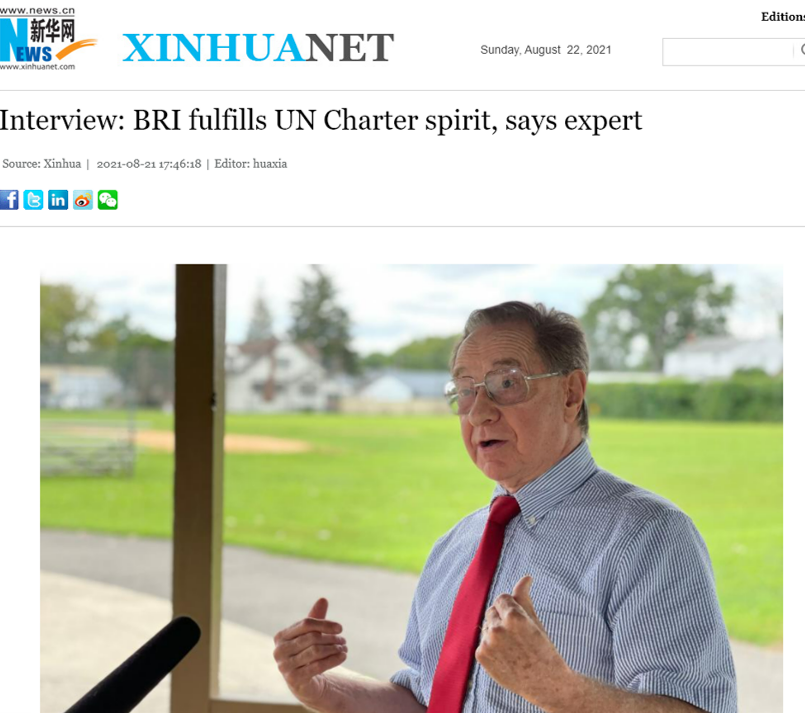
Nov. 20 (EIRNS)–“Xi Urges Continuous Efforts to Promote High-Quality BRI Development” is the headline of a new Xinhua print and video release, dated 11/20/21, which features short statements from Zimbabwe President Mnangagwa, former Brazilian President Temer, and think tankers including the Schiller Institute’s Richard A. Black on the success of the BRI in uniting over 140 countries and 30 organizations in global manufacturing and development.
In the 10-minute English-language Xinhua video, Black, identified as the Schiller Institute representative at the UN, is shown in a recent video interview describing a unique feature of the BRI: a great economic power, China, has extended its arms worldwide to all nations — including those nations which are poor and are small — and deals with those nations as equals. This is an aspect of a win-win strategy of rapid, mutual economic benefit. (The article with the embedded video is found here.)
May 19 (EIRNS)—Educating and Challenging the Resistance to Malthusianism and War Grow; Challenge Axioms To Create the Alternative
The legitimacy of a government in the eyes of history — its “mandate from Heaven” — is to promote the common good of its people and of humanity in general. Which governments in the world today can be said to deserve this legitimacy?
In welcoming ambassadors from two dozen countries to Russia, President Putin identified, in his own way, the fundamental principle that Schiller Institute founder Helga Zepp-LaRouche has emphasized is required for human survival — agapē: “The epidemic has proved a real test for such universal human values as solidarity, mutual assistance, and love for humanity…. It is possible to ensure peace, stability and sustainable global development only through the efforts of the entire international community…. We are convinced that everything must be done to prevent the tragedy of World War II from repeating itself, so that its lessons will not be forgotten. All of us must cherish the priceless experience and spirit of allied relations during the struggle against common challenges and threats…. We must ensure the well-being and prosperity of all human beings.”
The Committee for the Coincidence of Opposites, which Zepp-LaRouche co-founded, insists in its recent statement that “Health security is possible anywhere, only by provision everywhere of sufficient public health infrastructure and medical treatment capacity. This, in turn, depends directly on expanding water, power and food, which is associated with building up industrial capacity, as well as providing for adequate transportation, housing and other basics.”
Against this humanist outlook stands the imperial, Malthusian model for society. It is represented in its more historical form in the City of London and Wall Street — whose increasing power over the nominally sovereign governments of the trans-Atlantic world recalls the earlier “privatization” of the British government under the British East India Company. And it has also adopted a new guise in the “synthetic left” which calls for an end to development and a redefinition of progress in identitarian and environmentalist terms — of “progressives” who think there should be fewer people, “progressives” taken in by uncontextualized appeals to effectively support fascist policies under the rubric of defending human rights.
This Malthusian monster seeks to implement a worldwide Great Reset that will reduce the potential human population of the world: dramatically increasing the physical cost of providing and consuming energy (through drastically reducing the use of hydrocarbons while demanding greatly expanded mining to produce rare earth elements necessary for batteries and motors) while pointlessly and perilously heightening the danger of deadly military conflict with Russia and China, to prevent any other paradigm from taking hold. Rather than moving for the development of low-income nations in Africa, the Malthusian beast seeks to pay these nations not to develop, by essentially allowing developed nations to pay for carbon offsets, which would be transferred to poor nations to leave their resources (at least those for domestic consumption rather than export) in the ground.
But human beings are resource creators, not merely resource consumers. The climate change catastrophism promoted today as a new secular (or Satanic?) religion, like such earlier studies as the 1980 Global 2000 Report, relies on the same old discredited Malthusian theorizing that has led its predecessors to make terrifying forecasts that were soon falsified by reality.
Human beings are resource creators, not merely resource consumers. Every new “mouth to feed” is associated with a new “mind to educate.” It is the ability of each human individual to make enduring contributions to human history that demands peace and development throughout the world.
It is for the sake of past, present, and future humanity that this view of the human individual be brought forward to guide policy, rejecting the depraved outlooks that would tolerate Israeli murder, Green destruction of productivity, and the drive to draw the United States into war with Russia and China.
Will we become deserving of the praise of the future?