



Ignore the lies you hear about a “roaring economic recovery”. As inflation increases, the strategy of the globalists to save their imploding system — the Great Reset and the Green New Deal — can be defeated by a mobilization of Americans, in collaboration with other nations unwilling to submit to a central banker’s dictatorship and the Fake science behind the “net-zero carbon” fraud. The latest examples of rejection of the fraud come from the Chancellor of Austria and the government of India. Join us to defeat the latest genocidal effort from the imperial Malthusians.

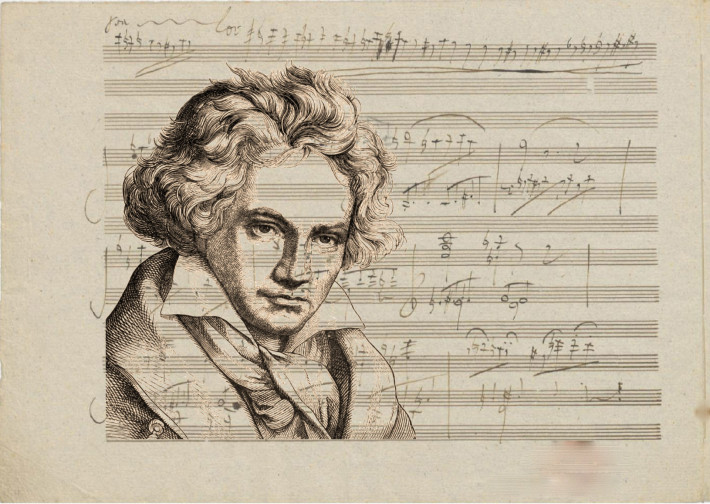
Beethoven: Sparks of Joy – Opus 9, No. 1: A Gem Trio Dedicated to an Irishman Who Served in the Russian Army!
Beethoven’s Opus 9 is a delightful set of three string trios, deserving of broader popularity than they enjoy today. They were dedicated to one of his early patrons, Count Johann George von Browne, the son of an Irish soldier of fortune who had risen to the rank of major general in the Russian army. This one, Op. 9, no. 1, was written in 1798. Here is a riveting performance of the Opus 9 no. 1 from the Camerata Pacifica. [Notes by Margaret Scialdone.]
Is the potential explicit in Lyndon LaRouche’s concept of a Four-Power agreement — between the U.S., India, China and Russia — to reorganize the bankrupt financial system and move away from geopolitical confrontation, shaping the talks last month between officials of the U.S., China and Russia? The threatening rhetoric continues from the U.S. side, but there is an opportunity now to move from the lowest level of relations, driven by imperial geopolitics, into the possibility of mutually beneficial agreements. As a disastrous situation looms facing renters, homeowners, landlords and banks, there must be a “LaRouchian” shift to a New Bretton Woods, based on a restoration of the American System of economics. Cooperation between the leading nations is essential to avoid an accelerating downward collapse of the global economy.

Russian Foreign Minister Sergey Lavrov and his Chinese Foreign Minister Wang Yi, struck out against U.S. policy against their countries, including its sanctions and geopolitical games, in a joint press conference in Guilin, Guangxi, during Lavrov’s official two-day visit to China.
“We reject zero-sum geopolitical games and reject unilateral illegitimate sanctions that our Western colleagues resort to more and more often,” Lavrov said in the joint press conference with Wang Yi today. “We noted the destructive nature of the United States’ intentions to undermine the UN-centered international legal architecture relying on military-political alliances of the Cold War era, and creating new closed alliances in the same vein.” Russia and China, however, will ensure that their bilateral relations are “safe and are not threatened by those states, which are unfriendly towards our countries.”
He denounced the West‘s claims that Russia and China are carrying out vaccine diplomacy.
“Our partners in the West are trying to portray Russia and China as some kind of adventurers in the field of so-called vaccine diplomacy. This is absolutely not true,” he said. He informed the media that Russian President Vladimir Putin has called on all countries that their vaccine policies must be guided solely by considerations of humanity and the interests of saving lives. “It is absolutely necessary for everyone, including our partners in the West, to remember that.”
Lavrov also declared Russian relations with the European Union are nonexistent: “There are no relations with the European Union as an organization. The entire infrastructure of these relations has been destroyed by unilateral decisions made by Brussels.”
He pointed out that “There are only a few European partner countries that have a desire to act based on their national interests.” And therefore, “Objectively, this led to cooperation between Russia and China developing faster than what is left of relations with the European countries.”
For his part, Foreign Minister and State Councilor Wang Yi also minced no words for the EU for imposing sanctions on China over alleged human rights violations in Xinjiang. “They [sanctions] will not receive the support of the international community, especially the so-called sanctions imposed on the basis of lies. I believe that all countries should oppose this,” Wang Yi said. “[Western powers] should know that the days when they can arbitrarily interfere in China’s internal affairs by making up stories and lies are long gone.”
Russia and China will work for the protection of the world order based on international law, Wang affirmed. “We should act as guarantors of justice in international affairs. China is ready to promote the international system established by the United Nations, protect the world order based on international law, and abide by universal values such as peace, development, justice, democracy, equality and freedom.”
The U.K. Defence Command Paper, “Defence in a Competitive Age,” released by British Defense Secretary Ben Wallace yesterday as a follow-up to the defense, security, and foreign policy review released last week, focuses on the “21st century threats” that the U.K. supposedly faces in a world allegedly characterized by permanent confrontation. “Those of us in government charged to protect and defend have a duty to enter new domains, as well as continuing investment in the traditional ones, but always adapting to the threat,” Wallace wrote in the foreword. “History shows us, time and time again, that failing to do so risks irrelevance and defeat. As the threat changes we must change with it, remaining clear-eyed about what capabilities we retire, why we are doing so, and how they will be replaced.” Therefore, the process for developing the new policy began with “assessing the threats we are encountering and anticipating, before considering how we should address them, and only then with which equipment, and what resources are required to field them.”
“We must actively champion those shared values of liberty, justice and tolerance that have given billions of souls the world over the chance of a better life, and do so through our actions, not just our words. U.K. diplomacy is underwritten by the credibility of the U.K. armed forces, and they will be more integrated, active and agile, capable of both deterring threats and defeating enemies,” Wallace declared. This is all to be backed up by £188 billion in defense spending over the coming four years–an increase of £24 billion or 14%–which, Wallace claimed, “is an investment in that vision of security and prosperity in 2030.”
But the real axiomatic basis for what’s behind the new policy is this: “The notion of war and peace as binary states has given way to a continuum of conflict, requiring us to prepare our forces for more persistent global engagement and constant campaigning, moving seamlessly from operating to war fighting.” The armed forces “{will no longer be held as a force of last resort} [emphasis added], but become more present and active around the world, operating below the threshold of open conflict to uphold our values and secure our interests, partner our friends and enable our allies, whether they are in the Euro-Atlantic, the Indo-Pacific, or beyond.”
In other words, the United Kingdom will be in a permanent state of confrontation, if not always a shooting war, against Russia, China, and any other designated enemies who refuse to submit themselves to the “rules-based international order” dictated by the Anglo-American empire.
While the discussion of Afghanistan focuses on the dangers ahead, and is generally pessimistic — while presenting no alternative — the Schiller Institute provided a beautiful example of how collaboration in the development of that nation points to the prospect of peace and prosperity for the world. With the extension of China’s Belt-and-Road Initiative into Afghanistan as a starting point, speakers addressed how development, and not more military intervention and meddling, is the key to peace. The full discussion is HERE, and can be a source of optimism for all but those most committed to a pessimistic attachment to the world of never-ending geopolitical confrontations.

For some time an international anti-China campaign has escalated, where Think Tanks, Mainstream Media, and strategic reports of all sorts paint a picture of China and its alleged intentions which is simply not true and is extremely dangerous. An enemy image is being projected that in the worst case leads to war.
We, the signers, all having had direct experience with China, be it that we have lived or worked there, or from repeated travel over longer periods of time, could thus follow how Chinese society has transformed itself in an unprecedented way since the trauma of the Cultural Revolution. Thanks to a policy focused on the welfare of the population by the state leadership of the Peoples Republic, and the extraordinary hard work of the Chinese people, 850 million people could be freed from poverty, with the result that the population is fundamentally more optimistic about the future than the West, where poverty is increasing as a consequence of neo-liberal policies. Trust in the government is substantially greater than by us, a trend illustrated and strengthened by the effective way China brought under control the Covid-19 pandemic.
China is a 5,000 year old culture nation, leading until the 17. Century in technology, and it is thus not surprising that China today, with a population of 1.4 billion, strives for an equal place on the world stage. China’s socialism with its own characteristics for China is strongly shaped by the two and half thousand year old Confucian tradition, the orientation of its modern founder Sun Yat-sen on Abraham Lincoln, and even though the Chinese hold high the tradition of Karl Marx, their current economic system is more influenced by the American System of Alexander Hamilton and Friedrich List, the most famous non-Chinese economist in China. China learns from the best.
China has a rich culture of philosophy, poetry, painting, architecture, and wonderful folk music. President Xi Jinping emphasizes the importance of aesthetical education above all for youth as a precondition for the development of a beautiful soul, an idea promoted by the first education minister of the first Republic of China Cai Yuanpei, which furthermore originate from Friedrich Schiller and Wilhelm von Humboldt.
The success from China’s emphasis on science and technological progress and innovation, demonstrate the China is doing well with what we in the West have seemingly forgotten, and we would do better to respond to the offer of cooperation, than seeking confrontation.
We should better take up the view of the great philosopher and founder of modern mathematics, Gottfried Wilhelm Leibniz, and in a Dialogue of Cultures find a way to solve the crises challenging all of Humanity.
Signers:
Helga Zepp-LaRouche, founder and president, Schiller-Institut, Germany
Jacques Cheminade, President, Solidarité et Progrès, France
Uwe Behrens, logistics manager and author, Berlin, Germany
Prof. Dr. Ole Doering, Berlin, Germany, and Changsha, China
Marcelo Muñoz, founder and former President of Cátedra China (Spain), experienced in China since 1978.
Simón Levy, Founder of Cátedra México-China at the National Autonomous University of Mexico. (UNAM)
Sebastiano Brusco, pianist, Italy
Jacqueline Myrrhe, freelance journalist for space travel, Neubrandenburg, Germany
Diana Mileva, opera singer, Deutschland
Professor Elena Bazhenova, and Prof. Andreii Ostrovskii, Far East Institute Russian Academy of Sciences.
Prof. Mohamed Ali Ibrahim, Ph.D, Professor of Economics, Founder and Former Dean, College of International Transport and Logistics AASTMT, Egypt Former Director of AASTMT Port Said branch, Former Advisor to H .E Egyptian Transport Minister
Prof. Engr. Zamir Ahmed Awan, Sinologist (former diplomat), Editor, Analyst, Non-Resident Fellow of CCG (Center for China and Globalization), National University of Sciences and Technology (NUST), Islamabad, Pakistan
Yiorgos Veis, Ambassador ad honorem, Deputy First Secretary at the Greek Embassy in Beijing 1991-1994, Consul General in Hong Kong 2000-2004, Poet
Leonidas Chrysanthopoulos, Ambassador ad honorem, Deputy Ambassador at the Greek Embassy in Beijing (1991-1993)
Juergen Heiducoff, Afghan war veteran and author
Prof.Dr.-Eng. Reinhold Meisinger,
Leena Maliki, Opera singer, Sweden
Associate Professor Verner D. Worm, Department of International Economics, Government and Business, Copernhagen Business School, Denmark
Enzo Siviero, Bridge Builder, Rector of eCampus University, Online Italy, Italy
Eng. Spartak Nano, Vice/President of Albaninan Confindustria
Professor Blagoje Babic, Serbia
Carlo Levi Minzi, pianist, Italy
Mr. Thore Vestby, Former Member of Norwegian Parliament, Co-founder of Ichi Foundation.
Jasminka Simić, PhD, editor-journalist of Radio-television of Serbia, Belgrade, Serbia
Bernd Matthes, Consultant, Dresden, Jinan Germany, Germany
Haider Alrubaye, President of the Iraqi-Chinese Friendship Association, Honorary member of the Federation of Chambers of Commerce, Iraq.
Professor Wilfried Schreiber, Military economist, philosopher, peace researcher
Dr. Alawi Swabury, ESSB KG / Europe-Asia-Africa Consulting Institute Berlin .
Ruben Dario Guzzetti, International affairs analyst, Argentine Institute of Geopolitical Studies (IADEG)
Andrea Szegö, Professor of Sociology (PhD), Budapest, Hungary
Živadin Jovanović, president of the Belgrade Forum for a World of Equals, Serbia
Bassam El Hachem, Professor of Political Sociology at the Arts and Human and Social Sciences Doctoral School of the Lebanese University, Lebanon
DeWayne Hopkins, Alderman at Large for the City of Muscatine, Iowa; former Mayor of Muscatine, USA
Michele De Gasperis, Founder and President, Italian One Belt One Road Institute, Italy
Prof. Dr. Wolf Dietrich Karl Rückert, industrial consultant, descendant of the poet Friedrich Rückert, Austria
George Floras, Managing Partner, Belt and Road Associates, Greece.
Elisabeth Kiderlen, CEO, Hainan Treasure Business COnsulting Services, (U.S. citizen, since 17 years in China)
Mario Cavolo, Senior Fellow, Center for China & Globalization
Eduardo Klinger Pevida, Director, Center for the Study and Analysis of China and Asia, Dominican Republic
Mr. Shakeel Ahmad Ramay, Director of China Center, Pakistan’s Sustainable Development Policy Institute.
Mr. Seymur Mammadov, Director of the International Expert Club EuarasiaAZ, Azerbaijan.
Dr. Wei – Jiang Xu, teacher and researcher at INSA Hauts-de-France, France
Bruno Guigue, researcher in political philosophy, France
Former U.S. Senator Mike Gravel (D-Alaska, 1969-1981); twice a candidate for the Democratic nomination for U.S. President, nationally known for his forceful but unsuccessful attempts to end the draft during the War in Vietnam and for putting the then-classified Pentagon Papers into the public record in 1971, at some risk to himself.
Luis González, Sinologist, Former Foreign Ministry Director of Asian and Oceania Affairs, Dominican Republic
Mme Anne Lettrée, Psychologist-sociologist in geopolitics, Modern and contemporary art historian, specialist in contemporary chinese art, CEO of Silk Road Business School, France
Ignacio Ramos Ph.D. 达奇 博士 , Professor and Delegate for Chinese Affairs 教授,中国事务主管
Dept. of International Relations 国际关系处
Comillas Pontifical University 卡米亚斯大学
Madrid, Spain
Dr Kevin Yiding Wang, Ph D. INSA Lyon, founder and CEO of CEIFC Consulting (Sino-European association for economics and cultural exchange and cooperation), France
Néstor Restivo, journalist and historian, Argentina
Jason Li, PhD, CEO, America Organics LLC, United States
Colin Mackerras, AO, FAHA, Professor Emeritus, Griffith University, Queensland, Australia
Peter Achten, Journalist
Stephen Brawer, Vice Chairman of the Belt and Road Institute in Sweden, Chairman of S. Bennett Brawer Philosophical, Education and Consultation, Sweden
Frans Vandenbosch, Co-founder and senior consultant at the International Institute on Governance and Strategy (IIGS) Think Tank in Beijing; and author of “Statecraft and Society in China” about grassroots politics and neighbourhood activities in China, Flanders
Han Dongping, Professor of political science; North Carolina, United States
Godfree Roberts, Author of the book, ‘Why China Leads the World’, and the publisher of the newsletter, ‘Here Comes China’.
Yasiru, Ranaraja, Founder and the Director of Belt & Road Initiative Sri Lanka (BRISL) www.brisl.org, researcher
Dev & Ingrid Nazareth, Retired Canadians, Canada
Alejandro Yaya, Vice President of the Civil Institute of Space Technology of Argentina, Argentina
Lutz Pietrusky, graduate engineer, Germany
Yaping Wang, retired nurse, Germany
Marina Körber, Germany
Zhao Yinong, CEO gbtimes.com (founded to promote dialogue between Europe and China), Finland
Prof. Fabio Massimo Parenti, sinologist (Italy), associate professor at the China Foreign Affairs University, Beijing
Flavio Grotti, Tianjin, China
Maria Morigi, archeologist, scholar of oriental religions, author, (Trieste, Italy)
Dr. Jean-Pierre Voiret, former lecturer in China history at the East Asian Seminar of the University of Zurich, Switzerland
Qirui Li, Doctor in philosophy, and researcher at the Cluster of Excellence – “Africa Multiple”, University of Bayreuth, Germany
Wei Ling Chua, Author Australia
Dr. Simon Nigg, Financial Engineer, Switzerland
Habib Ghanim, Businessman, United States
Li Huan, general representativ of the Commerce department of the Chinese province Shaanxi in France
Hervé Machenaud, former director for the Asia-Pacific of Electricité de France, Beijing, China
Sultan M. Hali Group Captain (Retd.), Author of Six Books on China and frequent visitor to China for study, research and participation in international seminars, Pakistan
David Le Blanc, Master of Engineering, MBS, MBA, General Manager for Australian invested manufacturing company in China, China
Ulf Sandmark Chairman Schiller Institute in Sweden
Chairman of Belt and Road Institute in Sweden – BRIX, Sweden
Chen Li, consultant, expert on Chinese investments in Europe, France
Stéphane Muller-Margot, senior advisor (development strategies), Chengdu, China
Bruno Lhopiteau, company manager, Shanghai, China
Nicolas Milonas, company manager, permanent resident in China for 17 years, advises and assists European companies to set up in China, Shanghai, China
Gregory de Richemont, founder of “Le Son International”, 10 years in China, Shanghai, China
Thomas Vissing, Director of a China-Nordic trading company, Denmark
Olivier Le Clouërec, former journalist, resident in China for 16 years, Shanxi, China
Jean-Michel Auve, director of the China office of an NPO – NGO, appointed by various companies, permanent resident in China for over 25 years, Shanghai, China
Thierry Lambert, professor at the University of Aix-Marseille, France
Philippe Thadaume, expert in environment, 12 years in China, France
Joseph D’Urso, Attorney & retired New York City teacher, United States
Simon Fox, United Kingdom
Laetitia Chhiv, PhD student in Chinese studies (EPHE-PSL), president of the Association of Young Chinese in France (AJCF), France
Denise D. Rainey, Elementary Principal, retired, United States
If you wish to add your name to the list of signers, please send an e-mail to contact@schillerinstitute.org including your full name and either your position or a brief description of your personal experience with China.
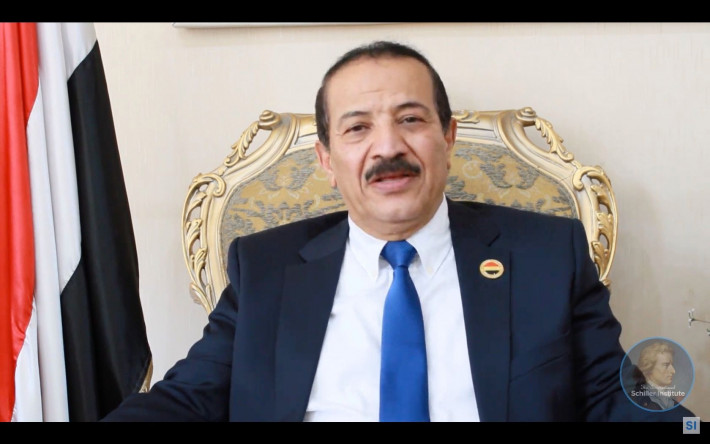
Mar. 22 (EIRNS)–An article in the Yemeni News Service Hodhod has a summary of the statement by His Excellency Eng. Hisham Sharaf to the Schiller Institute Conference March 20-21, 2021, “The World at A Crossroad: Two Months into the New Biden Administration”. It mentions the part where he states that Yemen intends to join and work within the framework of the New Silk Road. “Yemen will work its best within the umbrella of the Silk Road to become a successful and active element in the Silk Road Initiative”.
Read the article: “Foreign Minister of Yemen speaks during international conference.”

In this week’s Dialogue, Helga Zepp-LaRouche takes no prisoners in characterizing the true nature of the “Green New Deal/Great Reset” agenda: nothing but a Schachtian policy for depopulation. She also reviews developments concerning the future of Afghanistan: will the U.S. join in cooperation with Russia, China, and other nations of the region to support Afghanistan’s economic development—perhaps the only chance to save the very fragile and tenuous relations with Russia and China—or, will the evil outlook of geopolitics prevail? That question should, as Zepp-LaRouche says, keep you up at night.
Beethoven: Sparks of Joy – Beethoven’s contribution to a Dialogue of Cultures: his “Spanish Songs”
George Thomson was an Edinburgh-based publisher and collector of folk music, who commissioned classical arrangements of traditional folk melodies from composers such as Pleyel, Kozeluch, Weber, and Haydn. Beethoven, a passionate believer in the brotherhood of man, wholeheartedly took up the project, and between 1809 and 1820 contributed 179 compositions, the majority based on folk songs from the British Isles. Tucked among these, however, is a small collection, “23 songs of various nationalities” (WoO 158a), with melodies from all over Europe – from Ukraine to Italy to the Iberian Peninsula.
The Catalan soprano Monserrat Alavedra sings Beethoven’s “Spanish Songs” from this collection in both Spanish and German. (Unfortunately, no English translations are available.) [Notes by Margaret Scialdone.]