Top Left Link Buttons

Mary Jane Freeman

Author Archives

China Media Cover Schiller Institute Petition Rebuking Demonization of China

Schiller Institute’s China Petition in Chinese Media

Mar.25 (EIRNS) — The Schiller Institute petition denouncing the attacks on China signed by 30 leading experts, was reported in the Chinese media. The China Global Television Network, published an article on the petition but did not name the signatories. Then China Central Television republished the CGTN article. This was followed by a report in CCTV on the French Schiller Institute’s French translation of the petition with a summary in Chinese. Below is the CGTN article in full. Also see links at the end.

China experts urge cooperation, not confrontation with China

The West should do better to respond to an offer of cooperation from China rather than seek confrontation, and find a common way to solve the crises challenging all of humanity, according to a declaration published on Tuesday by the Schiller Institute, a political and economic think tank based in Germany.

The declaration, which was signed by over 30 experts, including the institute’s founder and president Helga Zepp LaRouche, denounced what it said was an intensifying international campaign against China.

“For some time, an international anti-China campaign has escalated, where think tanks, mainstream media and strategic reports of all sorts paint a picture of China and its alleged intentions which is simply not true and is extremely dangerous. An enemy image is being projected that in the worst case leads to war,” it said.

All signatories to the declaration have had “direct experience with China, be it that we have lived or worked there, or from repeated travel over longer periods of time.”

Based on their experience and witnesses, they said the Chinese people are “fundamentally more optimistic about the future than the West” after the nation’s successful poverty eradication campaign. And “trust in government is substantially greater,” which is illustrated and strengthened by the effective way China brought COVID-19 under control.

The statement also said that China has been making progress in science and technology as well as innovation, urging the West to “do better to respond to the offer of cooperation, than seeking confrontation.”
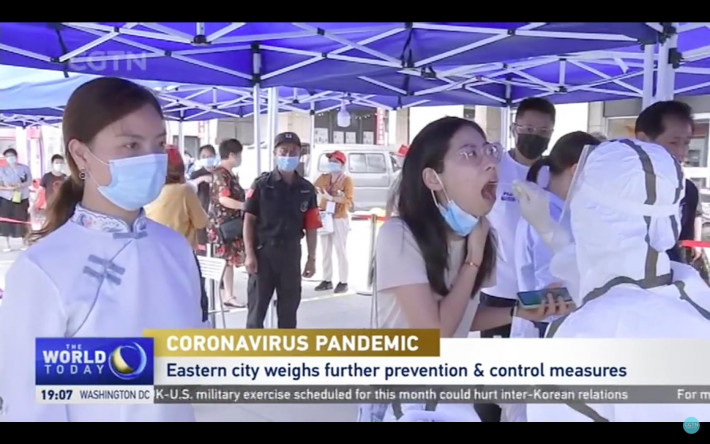
Links to CGTN story.

Link to CCTV story.

Link to CCTV report on French Translation.


China Institutes More Stringent Measures To Combat New COVID Outbreaks

Aug. 4 (EIRNS)—China is experiencing a resurgence of COVID, particularly of the new delta variant, and is implementing more stringent measures to deal with it. Most seem to have developed through imported cases, at the airport in Nanjing and in the south Yunnan province at the Myanmar border. But the provinces of Zhejiang and Henan, where there has been major flooding recently, have also been hit with new cases. The city of Wuhan is also again in the process of conducting nucleic acid testing on its 11 million people in order to avoid a replay of the terrible 2020 outbreak.

The State Council announced on Aug. 3 that COVID-19 prevention and control would now be “the top priority” for local governments. “Airports, harbors and land borders should be closely guarded to prevent imported COVID-19 cases. International travelers and cargo should be strictly separated from spaces where local people can enter,” Sun Chunlan, a member of the Political Bureau said in her comments at the press conference announcing the new measures.

“People that are most prone to infection should be placed in quarantine immediately. Regional investigations targeting close contacts should be completed within 24 hours,” she said. Sun required nationwide scrutiny of in-hospital infection control measures. “Hospitals that fail to meet the standards should carry out rectification or even suspend operations,” she said. There are now four high-risk areas for the COVID outbreak and 150 medium-risk areas. The country has already distributed 1.7 billion doses of the vaccine.


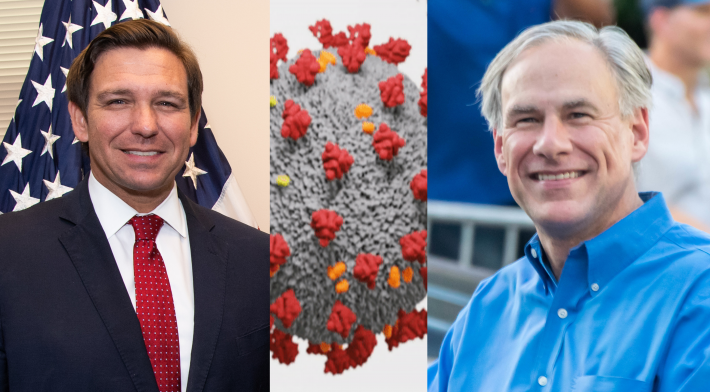
Florida and Texas Governors Stand Up for the Right To Die of COVID

Aug. 4 (EIRNS)—Governors Ron DeSantis (FL) and Greg Abbott (TX) are adopting policies in their states worthy of the Flagellant cult of the 14th century. They have each instituted a statewide ban on mask mandates and they have prohibited school districts from requiring masks in schools. Texas has even started fining teachers who dare to ask their students if they are vaccinated, or ask those who are not to mask. In Florida, counties are being threatened that their funding will be pulled if they issue mask mandates, and already that led to Broward County withdrawing its mask mandate.

As a result of this medieval lunacy, among other causes, one-third of all new COVID cases nationwide come from those two states.

DeSantis has also angrily denounced the suggestion that those who are not vaccinated and not masking or social distancing are responsible for getting sick. He insisted: “In Florida, there will be no lockdowns. There will be no school closures. There will be no restrictions and no mandates.”


Beethoven: Sparks of Joy!

Beethoven: Sparks of Joy – String Trio, Opus 9, No. 2

The Opus 9 no. 2 string trio differs from its siblings in its quietly introspective character, with Beethoven’s melodic genius fully on display, especially in the second and fourth movements.
Here it is in full score, performed by the Grumiaux Trio. [Notes by Margaret Scialdone.]


Climate Models: With Enough ‘Free Parameters,’ Data Will Confess to Anything

Aug. 3, 2021 (EIRNS)—One of the criticisms leveled against the climate models used to terrify the world with the unfathomable horror of a change of 1.5 degrees by the turn of the century, relates to how modelers deal with uncertainties.

The entire Earth is a very complex system to model, and our understanding of many of its processes—wind patterns, rainfall, ocean circulation—is incomplete. This means that models cannot claim to be based purely on fundamental physics and well-known laws of nature, the way a simple physics demonstration used in a classroom would.

Instead, each of the uncertain values that is incorporated into the final model has some “wiggle room” in the specific value given to it.

If there are only a few uncertainties, the model as a whole will have only a few adjustment points, and there may be a very small range of setting the uncertain parameters that results in the model accurately producing past data, against which it can be verified.

But if there are many “knobs” on the machine, so to speak, there can be many ways of adjusting them such that the model matches the past relatively well (given the extremely incomplete data, no one expects perfection), while offering wildly different predictions for the future.

Climate models have many free parameters, many knobs to adjust, such that their matching past data says little about their ability accurately to predict the future. In this sense, you can get the underlying climate data to confess anything you’d like about the future, including out- of-control warming.

The Executive Director of the CO₂ Coalition recently wrote about the origin of climate models: “The father of these models was Cold War military theorist John von Neumann, who wanted to see if we could cause drought in the Soviet Union. He failed, thank goodness. Von Neumann joked, ‘with four parameters I can draw an elephant, and with five I can make him wiggle his trunk.’”

Professor Will Happer uncovered a 2010 paper by Jürgen Mayer et al. (DOI: 10.1119/1.3254017) that does just that. They use a Fourier coordinate expansion with four complex parameters to successfully parameterize a shape resembling an elephant. And adding a fifth causes the trunk to move around as its path is traced.

(Unlike the cases in climate models, in this case there was no data against which to validate the parameters, so the authors were completely free to set them as they pleased.)

What can a climate modeler achieve with hundreds or thousands of free parameters?


28 Nations Participate in China’s Belt and Road Partnership on COVID Vaccines Cooperation

August 3, 2021 (EIRNS)—On June 23 of this year, at the Asia and Pacific High-Level Conference on Belt and Road Cooperation, presided over by China’s State Councilor and Foreign Minister, Wang Yi, 28 nations joined in launching the China Initiative for Belt and Road Partnership on Covid-19 Vaccine Cooperation. The statement announcing this initiative stressed that international cooperation and solidarity are key to fighting the pandemic, that “people and their lives” must be put first, and that no one is safe until everyone is safe. It emphasized that vaccines must be equitably distributed and that there must be “open, fair and non-discriminatory international cooperation on vaccines.”

A number of other recommendations for the BRI vaccine cooperation initiative included facilitating joint vaccine research, development and technological exchanges; promoting partnerships between vaccine producers and developing countries for joint vaccine production, to scale up global production; encouraging regional and multilateral development banks to provide more concessional financing to developing countries for their vaccine procurement and production; and “strengthening Belt and Road cooperation on connectivity to ensure cross-border flows of vaccines.”

According to the Chinese Foreign Ministry yesterday, in less than two months the BRI vaccine initiative has yielded impressive results, reaching cooperative agreements with several of the initiative’s 28 co-sponsors on a total of 775 million doses of vaccines, including in the form of concentrates, of which 350 million doses have been delivered. In addition, Chinese companies have started joint production with four co-sponsors of this initiative, whose names were not specified, and are discussing joint production “with other interested countries.” In today’s foreign ministry press conference, spokesman Wang Wenbin reported that China has provided vaccine assistance to over 80 countries and vaccines to 40 countries, also reporting that China is collaborating with other developing nations to mass produce the vaccine. It was also announced today that the World Health Organization has granted emergency use authorization to China’s Sinovac vaccine. (The full initiative statement is detailed here.)

The 28 countries include: Afghanistan, Bangladesh, Brunei, Cambodia, Chile, China, Colombia, Fiji, Indonesia, Kazakhstan, Kyrgyzstan, Laos, Malaysia, Maldives, Mongolia, Myanmar, Nepal, Pakistan, the Philippines, Saudi Arabia, Singapore, Solomon Islands, Sri Lanka, Tajikistan, Thailand, Turkmenistan, United Arab Emirates, Uzbekistan, and Vietnam.


Beethoven: Sparks of Joy!

Beethoven: Sparks of Joy – Opus 9, No. 1: A Gem Trio Dedicated to an Irishman Who Served in the Russian Army!

Beethoven’s Opus 9 is a delightful set of three string trios, deserving of broader popularity than they enjoy today. They were dedicated to one of his early patrons, Count Johann George von Browne, the son of an Irish soldier of fortune who had risen to the rank of major general in the Russian army. This one, Op. 9, no. 1, was written in 1798. Here is a riveting performance of the Opus 9 no. 1 from the Camerata Pacifica. [Notes by Margaret Scialdone.]


Beethoven: Sparks of Joy!

Beethoven: Spark of Joy – Opus 3, his first trio, reveals echoes of Mozart’s Divertimento K. 563

Beethoven’s earliest chamber works were composed for string trio (violin, viola, and cello). During the 1790s he published five string trios and the Opus 8 Serenade before abandoning the genre in favor of other combinations –  notably including the string quartet, and sonatas for piano and one other instrument. His first trio, known as Opus 3, takes as its model Mozart’s Divertimento K. 563 – both consist of six movements, and are composed in the key of E-flat – but even in his earliest works Beethoven is no imitator, but imbues each work with his unique creative spirit. Here is the Opus 3 with full score, performed by the Grumiaux Trio. [Notes by Margaret Scialdone.]


NASA’s Goddard Institute Pours Cold Water on Climate Change Sales Pitch

NASA’s Goddard Institute Pours Cold Water on Climate Change Sales Pitch

Aug. 1 (EIRNS)–Under the headline “U.N. climate panel confronts implausibly hot forecasts of future warming,” a July 27 article in Science magazine covers the bombshell that has just hit the IPCC’s climate modelers: “Many of the world’s leading models are now projecting warming rates that most scientists, including the model makers themselves, believe are implausibly fast.”

Now, the article says, “scientists have scrambled to understand what went wrong.” Some of them are wondering how they can “turn their models into useful guidance for policy makers” – which was their supposed raison d’être in the first place! Worst of all for them, their feet are being held to the fire by Gavin Schmidt, Director of NASA’s Goddard Institute for Space Studies, who said: “It’s become clear over the last year or so that we can’t avoid this [fixing the models].”

The IPCC is in trouble, because by the time the modelers’ bias was exposed, the supercomputing runs were already done and the IPCC report, based on these implausible fast warming rates, was nearing completion. The IPCC is now perilously close to being totally discredited, even by its own disciples. Meanwhile, other scientists, who actually measure phenomena rather than fiddle with models, are using recent observational data [gasp] “to rein them in.”

Here is a warning by one of the IPCC’s own climate projection leaders, Claudia Tebaldi, a climate scientist at Pacific Northwest National Laboratory: “For now, policy makers and other researchers need to avoid putting too much stock in the unconstrained extreme warming the latest models predict.”

Already climate papers are appearing using CMIP’s [Coupled Model Intercomparison Project] unconstrained worst-case scenarios for 2100. “But,” says the Director of NASA’s Goddard Institute for Space Studies, “that practice needs to change. You end up with numbers for even the near-term, that are insanely scary—and wrong.”


Death by Starvation: 400,000 to Die in Ethiopia by Thanksgiving

Aug. 1 (EIRNS)–The UN warned on Saturday of “catastrophic” food shortages set to sweep world’s hunger hotspots over the next three months. Among the 23 hotspots are Ethiopia’s embattled Tigray region, southern Madagascar, Yemen, South Sudan and northern Nigeria. These worst-case locations have now progressed to starvation and death situations. “Hunger Hotspots,” issued jointly by the UN’s Food and Agriculture Organization and their World Food Programme identified that in the August-November period “acute food insecurity is likely to further deteriorate.” Ethiopia is facing 401,000 people dying of starvation without an immediate intervention of humanitarian aid.


Page 40 of 55First...394041...Last