Top Left Link Buttons

Locations of our activity

Category Archives

Helga Zepp-LaRouche Addresses Institut Mandela Conference in Paris

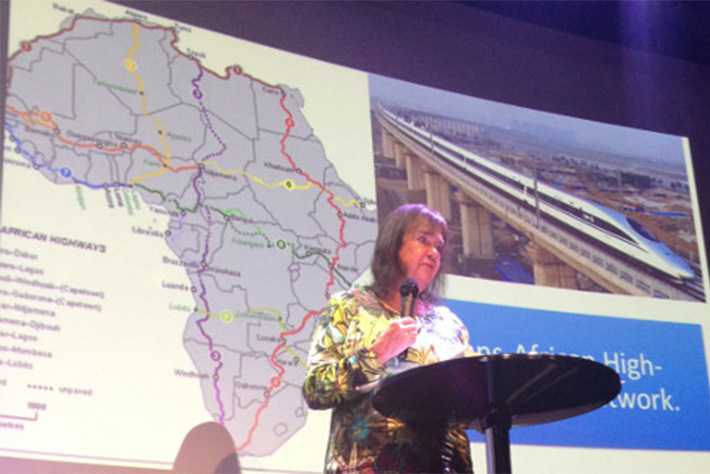
PARIS, July 10 – Schiller Institute President Helga Zepp-LaRouche was invited on July 6 to address the Institut Mandela for the African Economic and Consular Days in Paris.

Madame Zepp-LaRouche was invited on the subject “Partnership, Inclusive Growth and Infrastructure in Africa” following the publication of her call to the European Union to apply the model of the Singapore summit between President Trump and Chairman Kim Jong-un to a European development project for Africa. Her appeal, “History Is Now Being Written in Asia! The EU Summit Must Follow the Example of Singapore!” has been being circulated in the African networks in France, as well as throughout Europe.

The video of her remarks is available HERE and the transcript is below.

The first panel presented the “Singapore spirit” with the participation of the Ambassador of Eritrea, speaking on the end of the war with Ethiopia and the economic perspective of the biggest free trade zone in Djibouti, for real cooperation in the region.

Following her presentation was Ghana’s Minister Plenipotentiary and Deputy Head of Mission Bonaventure Adjavor at the Paris Embassy, who developed the concept of a new era for Africa—a new era of manufacturing from raw materials, and no longer merely exporting them. He used the example of cocoa, of which Ghana and Ivory Coast have 80% of world production, all of which goes for export. But he described that cocoa can be a primary material for manufacturing many products, including brandy, body lotion, chocolate, etc., and that the policy of President Nana Addo Dankwa Akufo-Addo’s government is to do that.

President Akufo-Addo, then newly elected, is famous for his public lecture to visiting French President Emmanuel Macron during their joint press conference on Dec. 4, 2017, in which Akufo-Addo said Africa “can no longer continue to make policy for ourselves … on the basis of whatever support that the Western world or France, or the European Union can give us…. We have to get away from this mindset of dependency. … Our concern should be what do we need to do in this 21st century to move Africa away from being cap in hand … to have a mindset that says we can do it … and once we have that mindset we’ll see there’s a liberating factor for ourselves.”

Helga Zepp-LaRouche then spoke, defining the long-term perspective for Africa and the world, presenting the World Land-Bridge report and the physical project for Africa within the framework of the Belt and Road dynamic, as in Ethiopia with the high-speed train. She also presented the other projects the Schiller Institute has developed or promoted including the Transaqua project, and the extension of the World Land-Bridge into Africa via a tunnel between Spain and Morocco and/or between Sicily and Tunisia.

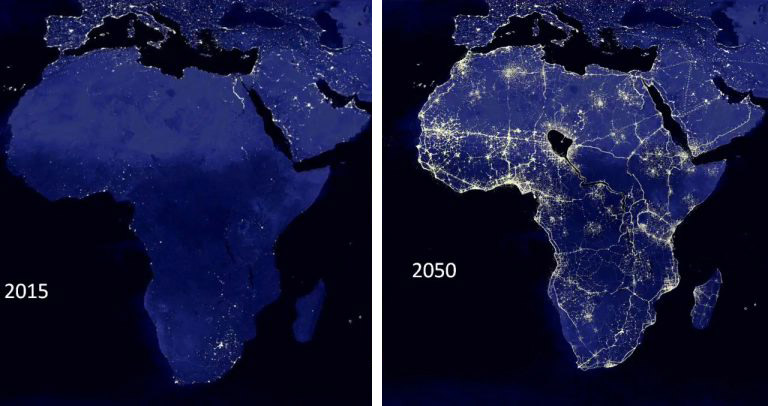
The audience was very challenged by the optimistic vision of Africa, as Mrs. Zepp-LaRouche showed the photograph of Africa from space at night, as it is now, and as it would be, all lit up, in 2050.

All 40 people in the room and on the panels were members of institutions, such as the International Organization of La Francophonie, and lawyers, entrepreneurs, public relations, etc.

The next speaker was the president of the Efficiency Club, formed by the Diaspora and first pan-African economic network of Europe. They are trying to stop the flow of remissions from the diaspora to Africa just to help their families survive. He developed the necessity to create a network of small and medium enterprises (SMEs) throughout the continent to provide jobs and not just subsistence on money.

Then a final panel was very interesting, with one of the panelists bringing in the economics of Alexander Hamilton, and how Africa has to go with this manufacturing economy. He also mentioned that Colbert had called Huygens and Cassini to France to develop a real science academy, and asserted that Africa has to do the same today. Many contacts were made … our time is now.

The Institut Mandela is dedicated to the strategic mission of Africa’s emergence as well as the “open society” values of peace through “intellectual diplomacy.” Its proposals are conveyed to public policymakers, the international community, private actors, and civil society, so that they can make visionary decisions. Its fundamental mission is to reorganize intellectually and institutionally the African countries.

The Institut’s activities revolve around six research areas:
Security and Development, Emergence of Africa, Geopolitics and Geostrategy of raw materials, Africanization of democracy, Prospects of African governance, Energy and Environment.

The Mandela Prizes are awarded annually to personalities or institutions to acknowledge their laudable actions in favor of Africa and peace, in the spirit of Pan-Africanism.

Transcript of Helga Zepp-LaRouche’s remarks:

Ladies and Gentlemen:

There is a profound reason for optimism for the African continent, because with the rise of China, and especially the New Paradigm which emerged with the Belt and Road Initiative, the world has been changing, especially in the last five years with an incredible speed. What China has done with the New Silk Road is to develop a new model of relations among each other, and it is an initiative which is open to all nations of the world.
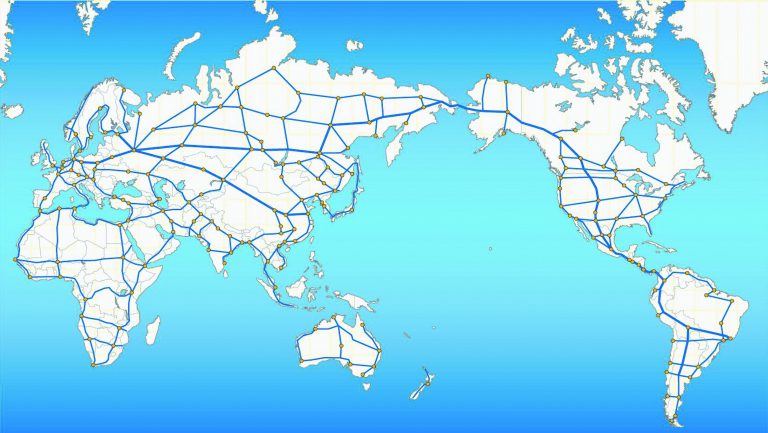
world-landbridge-768x433

So this map is actually a map of uniting all continents through tunnels and bridges, and as we can see, African development is an integral part of this world development.

What has happened is that with the offer to have a win-win cooperation, where according to the Chinese Foreign Minister Wang Yi, already 140 nations are participating, in various degrees, the spirit of the New Silk Road has actually captured the imagination of many countries in Africa, in Asia, and in Latin America, who see for the first time the concrete possibility to overcome poverty and underdevelopment in the short term.

In the last ten, but especially five years, what China has done is to create development potentials after centuries of colonialism and decades of IMF conditionalities, which were designed to prevent African and Third World development in general.

With this new change in the strategic situation there is the absolute perspective of turning Africa into a global powerhouse.

There has been a study published last November, that Africa is going to be the next factory of the world, and the Russian International Affairs Council, RIAC, just put out new figures showing the positive role of China in the development of Africa.

In 2000, the total trade between China and African states was $10 billion only. In 2014, the China was already Africa’s main trading partner, with a trade volume of $200 billion, and in 2017 China gave additional loans of more than $100 billion.
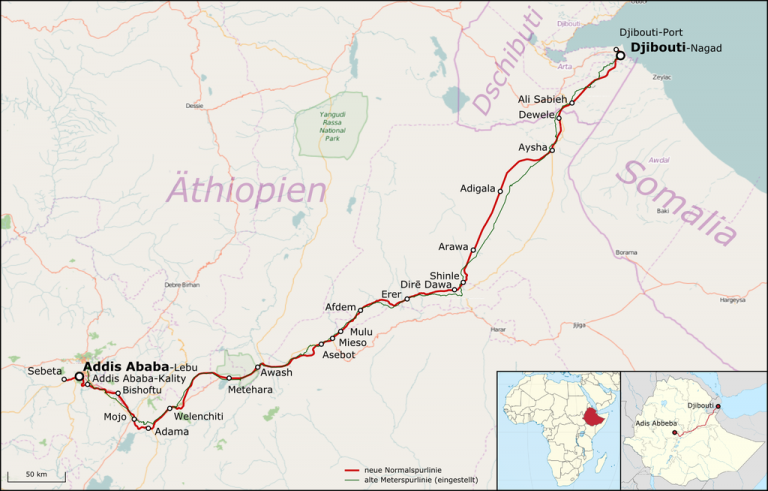
image93-768x491

(Next) Naturally, this is the Djibouti-Addis Ababa railway, which was built with Chinese help; it’s 750km long, and it now allows also to bring food aid to areas which are hit by drought which was not possible before. And this is just the very beginning. China also has developed a China-Africa Development Fund, which is financed by the China Development Fund, and also many of the other state banks of China have been involved in direct investments. Over the last decade, China took part in the creation of more than 100 industrial zones, 40% of which are already operational. They have helped to build 5,756km of railway, 4335km of motorways, 9 ports, 14 airports, 34 power stations, 10 large and 1,000 small hydroelectric power stations, and by the end of 2016, it had this number.

This coming September, there will be a big China-African Union summit which obviously will take this relationship to a new level.

There is a fundamental change, because previously the Western countries refused to invest in a real way in Africa, but with the second largest economy of the world, there is now the chance for African nations to replicate the Chinese model of development, each in their own African way. But nevertheless, in terms of the infrastructure and industrial development they can take China as a model, which after all, in the last 40 years had an incredible transformation, from being a very, very underdeveloped country, to now being an absolutely breathtaking, dynamic economy.

This is the positive side. On the other side, we are confronted with unprecedented challenges: Terrorism, financial turbulence, migrants, and a large percentage of the 68.5 million refugees worldwide are migrating from Africa, trying to get through the Sahara, many of them dying of thirst; or drowning in the Mediterranean, where in the last years, thousands if not tens of thousands of people have drowned.

Since the refugee crisis escalated in Southwest Asia and Africa in 2015, it became very clear how deeply disunited the European Union is. And especially in the recent weeks there was a total government crisis in Germany, which nearly ended the political career of Chancellor Merkel. There was demonstrated a complete erosion of the EU: No unity, no solidarity, tensions between France and Italy, total tensions between Eastern Europe and Western Europe. And it is also very clear that they could not come up with any solution, because all they could propose at the recent EU summit was a complete brutalization of the migrant issue: They want to militarize Frontex, to supposedly keep the refugees out of the EU, which is sort of a maritime border police, and there were event proposals to use the German army or even NATO, to put the refugees into “disembarkment camps,” as they call them, either within Europe or in North African states, all of which already have rejected to be the hosts of such camps.

And Pope Francis has compared these camps to the concentration camps of the Nazi period.

So, what has happened to “Western values”? What about human rights? What about democracy? These are barbarian proposals, and they’re not only inhuman, but they also will not work. They will not work: They all the time talk about that one needs to look at the root causes for the refugee crisis, but they never do.

So, I have a proposal how this can be changed: I call it the “Singapore Summit model.” We all have witnessed the very historic summit between President Trump and President Kim Jong-un of North Korea recently in Singapore. And it is very clear that it {is} the New Silk Road Spirit which has changed the environment in Asia, which made this summit possible in the way it took place, and it is also an example of how you can change, within a few months, a relationship of complete adversity and the potential trigger of a large nuclear war, which was the situation between the United States and North Korea, and turn it into cooperation. This agreement now includes the denuclearization of North Korea, in exchange for the promise from the United States, China and Russia to help to develop North Korea economically, and turn it into a prosperous nation.

My proposal was that the EU should have changed the agenda of their just-concluded summit, invite Chinese President Xi Jinping, and the African heads of state who already have successfully cooperated with China; and then present a comprehensive crash program for the development of the infrastructure in Africa. (Next slide) Where the presence of Xi Jinping would give this credibility, because China has delivered on development, and the idea would be to present such an integrated, continental transport plan, a trans-African transport network, which already has been proposed by Foreign Minister Wang Yi in 2014, and reiterated in 2016.

If these leaders, the Europeans, the Africans, and the Chinese leader would say that it is our intent to make a crash program for such a development, then this would be a signal to the young people now running away, risking their life in drowning in the Mediterranean, or ending up in a concentration camp, to participate in the economic buildup of their own country.

At the recent visit of French President Macron in Ghana, Ghana’s President Nana Addo Dankwa Akufo-Addo basically told Macron that, we don’t need your development aid crumbs; what we need is a real investment. And he called on the youth that they should not try to get to Europe, but that this energy these young people have should be used to build up the country. This would require training centers, very much like what Franklin D.

Roosevelt did with the New Deal, the CCC program, training especially young people in the Civilian Conservation Corps; and then, such a summit, making such a declaration of intent, could be like the Singapore Summit, a complete turnaround.

I think we have to use, also, Xi Jinping’s notion of “sustainability.” Not to mean “appropriate technologies,” which in reality means no technology, and not sustainability which means only green solar and wind, but it means total infrastructure and industrialization as the new definition of sustainability.

African nations do not have to repeat all the levels and phases of the industrialization of the Western countries, but like China they can leapfrog to the most advanced technologies, such as focussing on high-speed trains, on magnetic levitation, on the fourth generation nuclear power. Party of this plan should be, first, a regional infrastructure investment bank, like the AIIB for Asia,— like an African Infrastructure Investment Bank—and that should be parallelled with national credit mechanisms, or national banks, to have the internal financing of the infrastructure.

Secondly, there should be an integrated network of high-speed trains, waterways between rivers and lakes, the full development of hydropower projects, the fourth general of nuclear electricity generation, and desalination of large amounts of ocean water for irrigation. Also, as the Ambassador of Ghana already said this morning, there should not be the export of raw materials, at least not only, but high-end petrochemical and metallurgy, semi-finished and finished products upgrade the value chain in the country.

In addition, there should be a Green Revolution, not in the sense of the Greenies of Europe, but in the sense of the Green Revolution of Jawaharlal Nehru, who transformed the agriculture of India in this way. You need disease- and drought-resistant plants, modern food-processing, and addition, you need certain large-scale projects, such as (next slide) the tunnel through the Strait of Gibraltar which is an eminently doable project, because a feasibility study has already been concluded; a state treaty between Spain and Morocco does exist, so one could start to build this immediately. Also, a bridge or a tunnel, as we see in the picture on my right, between Sicily and Tunisia, which could be built, with a couple of islands in between, and integrate the European development with that of Africa. And naturally, also a high-temperature reactor in South Africa should be promoted.
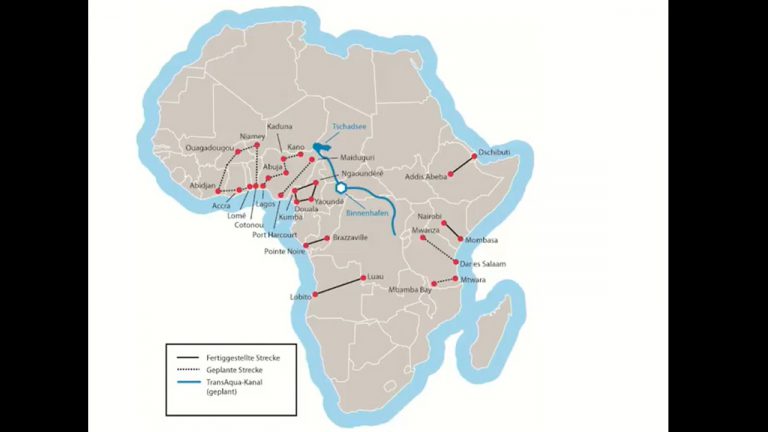
transaqua-768x432

(Next slide) The biggest infrastructure project ever, in the history of Africa, is Transaqua. In February of this year, there took place a big conference in Abuja, with the presidents of all of the countries of the Lake Chad Basin, who concluded that the only way to save Lake Chad, which now has dried out to about 10% of its original size, and fill it up through the water from some of the tributaries of the Congo River, from a 500 meter height, and then, through gravitation, you could bring this water all the way to Lake Chad, and not only have an inland shipping lane for all the participating countries, hydropower, large amounts of water for irrigation and refill Lake Chad. This would transport up to 100 billion cubic meters of water annually, and as I said, Lake Chad would again have the size of 25 square km — now it’s only one-tenth of that. This has been adopted by this Abuja conference and then a treaty was concluded between PowerChina, which is a large, Chinese engineering firm — which is famous for having built the Three Gorges Dam, so they are very knowledgeable and experienced in making such big projects together with the Italian engineering firm Bonifica. The Italian government at that conference, announced that they are paying EU1.5 million to have a feasibility ready in one year; and this is also a perfect model for a tripartite cooperation among African nations, China, and in this case, a European nation, Italy.

This will be not a long-term project. The leading engineer of PowerChina announced at the conference that they are confident that they can finish this project in 12 years, and it will be an industrialization in the heart of Africa which can have complete transformational character.
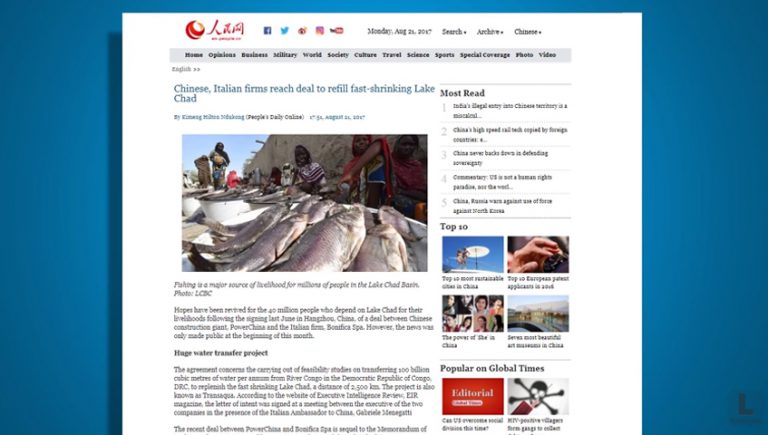
china-daily-coverage-768x435

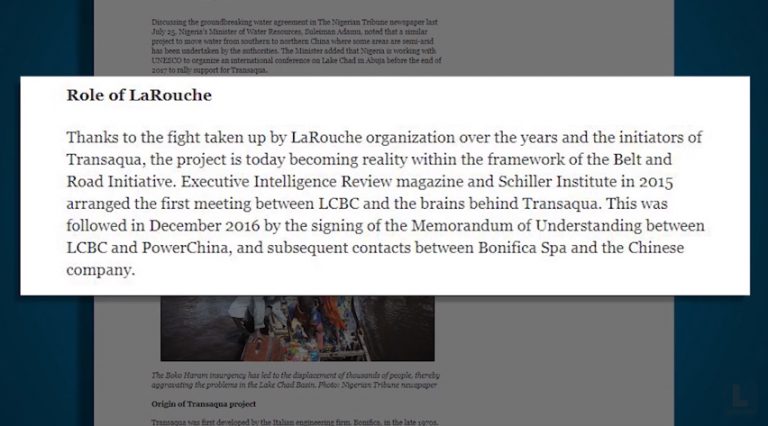
china-daily-larouche-768x426

(Next) People’s Daily already last August wrote an article about this, giving credit for this Transaqua project to the LaRouche movement and the Schiller Institute, because, we over the last three decades worked in many conference, advertising this to many people, and finally got the connection between PowerChina and Bonifica; and it’s now a state treaty between China and Italy. (Next) They emphasize in particular the role of our efforts in that.

This is, as I said, one of the results of our decades’ long work to help to industrialize Africa. (Next) This is a book which has a total plan for the industrialization of Africa which we already wrote in 1976, and this book was published in 1978.

So as you can see, this is not pouring from the heaven, but this movement, from the very beginning of the ideas of my husband, Lyndon LaRouche, stood for the industrial transformation of the southern hemisphere, simply because it’s the only way how you alleviate poverty, and create a good living standard for all the people.
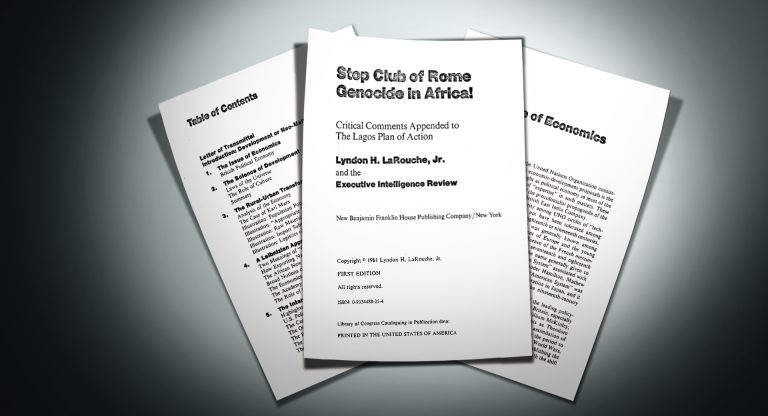
stop-club-of-rome-genocide-in-africa-pamphlet-768x416

(Next) In 1980, with the Lagos Plan of Action was published, my husband wrote a commentary to it, which already then was a very important conceptual approach how to tackle this problem of underdevelopment, by creating a continental infrastructure plan, new cities, science cities, and the education of the youth in particular. And we campaigned for this, for over really four decades;

NEW-S-ROAD_STU_cover-e1469459696387

(Next) The total work of this went into “The New Silk Road Becomes the World Land-Bridge,” which we published in 2014, after Xi Jinping announced the New Silk Road. And just about one week ago, we put out the World Land-Bridge report second edition, which has an updated plan for how to do this.

We conducted many conferences in Sudan, for the five countries around the Nile, how they could work together on development. And I also addressed an economic summit in Abuja in 1997.

In Europe we conducted many campaigns with the headline “The Future of Europe Lies in Africa.”

I think the application of the Singapore model is quite possible: Because the new Chancellor of Austria Sebastian Kurz, who is for one-half year the president of the European Union Council, has announced that he wants to conduct an EU-Africa summit before the end of the year. Now, Austria, while having a hard line on the migrants, on the other side, has in their coalition document of the two coalition parties in the government, a whole chapter that Austria wants to become the hub for the New Silk Road. And there are also many Central and Eastern European nations, Balkan nations, Southern European nations that all want to be the hub — for example, Spain and Portugal want to be not only the terminus of the Eurasian Silk Road towards the West, but they want to be the hub to the Portuguese- and Spanish-speaking countries around the world.

If they all cooperate on the New Silk Road this would be the way to do this, and since the refugee crisis will not go away, until you change, fundamentally, the policy towards an industrialization of Africa, I think this crisis can be turned into an chance. What the Schiller Institute is doing right now, and I would encourage all of you to help and do the same, is to have a full mobilization of all European nations and in Africa, which agree to actually put pressure on behalf of this perspective; and present the EU at this upcoming summit with the concrete outline of the necessary investments, with the participation of China, but also involve other countries, like India, Japan, even the United States, and do likewise. That if one approaches it like China — China builds a high-speed train, and I saw it with my own eyes, from Lanzhou to Urumqi in half a year — by doing it, by not simply building it one step after the other, but by starting to build it at 10 different places or even 20 different places. (Next slide) So if you had such a concrete plan you could start building it at many places at the same time.

We have outlined what projects could be in these two reports — we published one full report which is called “Extending the New Silk Road to West Asia and Africa,” which has many of these projects in it.
SI-africa-at-night-01

(Next slide) The left picture is, if you look at the electrification by night, this is how Africa is now. If one would go in the direction I just suggested, to extend the New Silk Road to Africa through a collaborative effort of all nations, then the African night sky could like the righthand picture, which is about equivalent of what you would see in the United States or Europe.

So, I think that this would turn Africa into a modern, prosperous continent, where all citizens would enjoy a safe, and happy and long life. So if we all act together in the spirit, Africa will be the new China with African characteristics.
Excellent Coverage of Schiller Conference by GBTimes

The Finnish-based private pro-China media outlet GBTimes ran excellent coverage of both days of the Schiller Institute conference in Bad Soden, Germany June 30 & July 1, 2018. Under the title “China’s Belt and Road Initiative Has Found a New Friend in the Schiller Institute,” Rosalie Falla reported on several aspects of the opening speech by Helga and the speech by Dr. Xu Jian of the China Institute of International Studies. The following day Falla published, “China’s deal with Italian firms will rescue Lake Chad,” summarizing the details of the great Transaqua project, a continental water project championed by the Schiller Institute and featured at the conference, and now under negotiation by African leaders, and Chinese and Italian firms.


Schiller Institute’s Stephan Ossenkopp Interviewed by Chinese Media

March 31, 2018 – The German-language {China.org} journal interviewed “German China expert Stephan Ossenkopp” two days ago, on the question of the U.S. Import tariffs against China. He said that the continuous, successful and most of all peaceful rise of China is making those western elites nervous that do not want to give up their hegemony in international trade regulations. Punitive tariffs and investment bans will however not change this historic trend. The time of unilateral global systems is past, he said.

Stephan O

The time of unilateral global systems is past

The enormous trade deficit of the USA viz. China is the result of a paradigm change of the US economy away from investments in innovative infrastructure and production, but into speculative financial products, Ossenkopp explained. If Trump really wants to make America strong again, he should reactivate the Glass-Steagall Act, end the disastrous Wall Street speculation and revitalize his infrastructure and space program with a focus on technologically advanced industrial production.

Trump, Ossenkopp added, should utilize the chances offered by the Silk Road initiative, to bring the USA back on the right track with investments in the real economy.


GBTimes Interviews Helga Zepp-LaRouche on China’s New Silk Road and Europe

Feb. 16 – GBTimes is a multimedia news site, based in Finland where it was founded by Chinese entrepreneur Zhao Yinong, and which refers to itself as a “bridge between China and the rest of the world.” It published the following interview with Helga Zepp-LaRouche on Feb. 16:

China’s ambitious plan to link itself with Europe and Africa through new Silk Road trade routes has so far received a mixed welcome in Europe. The Belt and Road initiative, the brainchild of Chinese President Xi Jinping, proposes to boost trade and economic integration across Eurasia through over $1 trillion worth of investments in railways, ports, power plants and other infrastructure links. The initiative has been officially endorsed by Central and Eastern European countries, many of which are hoping that Chinese investment could create jobs and improve infrastructure.

But Western European countries have been more cautious, with British Prime Minister Theresa May declining to sign up to the initiative during her recent trip to Beijing and French President Emmanuel Macron warning during his trip to China that the New Silk Road cannot be “one-way.” There are also concerns in Brussels about a lack of reciprocity in trade with China and increasing Chinese investment in critical infrastructure in Europe.

The German-based Schiller Institute, however, has for the past several years been campaigning for the Belt and Road initiative in Europe by organizing hundreds of conferences on the topic. Helga Zepp-LaRouche, the institute’s founder and president, talked to gbtimes.com about the initiative and why she believes Europe should embrace it.

Q: What is the Schiller Institute?

HELGA ZEPP-LAROUCHE: The Schiller Institute was founded in 1984 as a think tank, with the main idea behind it being that peace and order in the world would only function if each nation would relate to the best cultural tradition of the others and vice versa. One of the focuses was to fight for a just new world economic order, something like in the tradition of the Nonaligned Movement, especially inspired by the ideas of my husband, Mr. Lyndon LaRouche, and secondly to fight for a renaissance of classical culture. I gave it the name of [German philosopher] Friedrich Schiller because his image of man was the most noble and beautiful one and I thought such a conception was urgently needed in the political realm.

Q: How did you first get to know China?

ZEPP-LAROUCHE: I went to China for the first time in 1971 on a cargo ship, which was repaired in Shanghai. So, I had plenty of occasions to visit many factories, children’s palaces, and the countryside. I also went to Shenzhen, Qingdao and Beijing, and that left a very lasting impression on me because this was in the middle of the Cultural Revolution (1966-1976) and China was very much different then. But it started a deep interest on my side in Chinese philosophy and culture. And then I was also inspired by the changes which took place in China after the reforms of Deng Xiaoping, and I visited China many times in the 1990s and the 2000s, and especially after Xi Jinping announced the new Silk Road. And I could see the dramatic changes and the economic miracle which China has undergone. I feel very privileged that I have sort of personally witnessed the unbelievable transformation of China over almost 50 years.

Q: You mentioned President Xi Jinping who proposed the Belt and Road initiative in 2013. The Schiller Institute has been very supportive of this initiative. Why is this?

ZEPP-LAROUCHE: First, the Belt and Road initiative is presently the most important strategic initiative on the planet because it proposes what Xi Jinping calls a community for shared future of humanity. The idea of one humanity is a perfect conception for overcoming geopolitics, which was the reason for two world wars and, in the age of nuclear weapons, can lead to a terrible catastrophe just as big. If you look at the incredible progress this initiative has made in the five years since it was announced, you already see a tremendous transformation where the developing countries in Africa, Latin America and Asia, for the first time, have legitimate hope to overcome poverty and under-development. It just happens that the Belt and Road initiative is very much in accordance with proposals my husband and myself have made during the last decades. After the Soviet Union disintegrated in 1991 we proposed something that we called the Eurasian land bridge, which was the idea to connect the Eurasian peoples and industries through development corridors. The Chinese government picked up on the proposal to organize an international conference in Beijing in 1996, in which I participated as speaker. Already at that point China considered the development of the Eurasian land bridge a strategic initiative, but this was put on hold due to the Asian financial crisis of 1997. We were then extremely happy when Xi Jinping announced this policy in 2013 — with China’s economic power all these plans can now be realized. Why do you think the Chinese are interested in this idea of bridging the Eurasian continent? China has developed its own economic model of lifting its population out of poverty and it also wants to contribute to eliminating poverty on the world scale. I think that is a very different approach to many other countries. There are now only 30 million poor people left in China. In comparison, there are 90 million poor people in the European Union and more than 50 million people who are officially poor in the United States, but no clear plans to eliminate poverty in totality. So, you are saying China is currently the only major country that has a global vision? Yes. I participated in the Belt and Road forum in Beijing last year and everyone who participated in this conference had a distinct impression that we were witnessing the beginning of a new era of mankind. At the 19th National Congress of the Chinese Communist Party, Xi promoted the goal of having a fully developed, modern, culturally advanced, happy country by 2050 — not only happiness for the Chinese people, but for all the people in the world. Normally politicians in the West think at best until the next election, and I have not heard from any Western leader a plan on how to uplift the entire human species in the next 30, 40, 50 years. The idea to create happiness for the people as a policy goal was last heard during the American revolution when it was set in the American Declaration of Independence that it is a fundamental right to have life, freedom and happiness. This is a notion coming from Latin [sic — she said Leibniz] and it means the ability of people to develop their full potential. I have seen in China on many occasions that people really think that way. They have the idea that there is no limit to their ability to self-perfect to improve society and relations between nations, and it’s a completely different spirit to what you find anywhere in the West.
Q: All Central and Eastern European countries have officially joined the Belt and Road Initiative, but many Western countries including the U.K., France and Germany have been more cautious about it. Why do you think this is the case? ZEPP-LAROUCHE: When certain politicians in these countries say they want to insist on standards and rules, and that they don’t want the spreading of Chinese investment in Europe, I think it’s a question of geopolitical control. The EU for example could have developed Central and Eastern Europe, the Balkans, but they didn’t. When China then comes and starts to build the kind of infrastructure that the EU did not build, these countries are happy and want to go with the new Silk Road. And that causes some people who believe in geopolitics to see it as a threat. The present Western system is based not on the common good as a primary orientation, but on monetarist profit-making. This system benefits those who speculate and those who run the banking system. But it leads to such things like the 2008 financial crisis, which was a systemic crisis, and nothing has been done since other than quantitative easing and pumping money.

Q: But do you think China itself has overcome geopolitics?

ZEPP-LAROUCHE: I know that that is not the view of many politicians in the West, but I think assumptions about China are just people’s projections of what they themselves think. I am not a naive person — I have studied this in depth and looked at it closely — and I do think that China does not plan to dominate the world with its system. The Chinese model is more attractive, and many countries want to repeat what it has been doing, but I don’t think China wants to impose its values. My explanation for this is China’s Confucian tradition. For example, Christians are supposed to win other people over to Christianity, but Confucianism does not do that. Confucianism is perfectly happy to live in coexistence. And if you look at the entire history of China, you never had religious war. You had Buddhism, Confucianism, Taoism and Christianity all living in a perfect ecumenical harmony. So, I think in Chinese history, you don’t find anything which would give credibility to the claim that China is not doing what they say. I think they are doing exactly what they say they are doing and they mean it.

Q: What would it mean for Western European countries to join the Belt and Road Initiative?

ZEPP-LAROUCHE: It would mean that there would be a shift towards the real economy. Right now, you have this money-makes-money philosophy, but if you look at even an advanced country like Germany, there’s a tremendous backlog in infrastructure. There are warnings by some of the logistic organizations that Germany is about to lose its standard as a location for industrial development because of the collapse of the infrastructure. So, if European countries would join the new Silk Road it would mean that they could basically renew their infrastructure like China has done, and to build fast trains among all major cities. With the policy of the Troika [European Commission, European Central Bank and International Monetary Fund], the industries and the economies of the Southern European countries were destroyed. Now you see that with the advantages that come from Chinese investment in the Piraeus port and other projects in Greece, it’s going upwards. And with the EU, it went downwards. The same is true for Italy, Spain and Portugal. Europe could also participate with China in the reconstruction of Southwest Asia, of Syria, of Iraq, because you must bring economic development to these countries if terrorism is supposed to be eliminated. You have to give young people a future which they don’t have right now. It would mean you could solve the refugee problem in a human way.

Q: But do you think that some Europeans might be cautious about the growing Chinese influence because they think they might have to someday accept the same kind of restrictions on freedoms that China has at home?

ZEPP-LAROUCHE: Yes, but if people are worried that they may lose some of their hedonistic impulses — well, that might not be altogether such a bad thing. Because what we are seeing right now is a decadent society with all the violence, pornography and drug addiction. You have an opium epidemic in the United States, which is contributing to the fact that life expectancy is going down for the first time. If there is any parameter for the functioning of an economy, it is the life expectancy. If an economy is doing well, it’s increasing and obviously it’s an indicator that there is something fundamentally wrong if it’s going down because of suicide, alcoholism and drug addiction. On the other hand, there was just a poll made in Germany among 42 firms which were taken over by Chinese investors. In all cases, the management and the employees said that it was a positive thing that the Chinese took over, instead of speculators or hedge funds. I think some of these changes that come with more Chinese investment and influence would be beneficial. I would even go so far to agree with Leibniz, who said already in the 17th century that because of the superior morality of the Chinese, one should import Chinese missionaries to teach morality to the Europeans.

Q: So, you are optimistic that the acceptance of the Belt and Road initiative is growing in Europe eventually?

ZEPP-LAROUCHE: We have found that all people who do business in China or who have travelled to China or who are married with a Chinese person, are all positive, and they know that what China is doing is a historic transformation of humanity. The Belt and Road initiative is not just about economics; it’s not just about infrastructure from A to B, but it is really a new paradigm. And what I mean by new paradigm is a new way of understanding what is the role of humanity. We are the only creative species who can invent new technologies and sciences and change the mode of our existence. It’s not the nature of man to be greedy, to chase for stock market gains and try to exploit and dominate others. It’s the nature of man to develop our own potential to the fullest so that we can contribute to the development of the human species. And the new paradigm will be that more and more people, as time goes by, will be able to realize their true potential as human beings.

https://gbtimes.com/interview-with-helga-zepp-larouche-on-chinas-new-silk-road-and-europe


“A Dialogue of Cultures along the New Silk Road” held in Dresden, Germany

On April 21st, the Schiller Institute organized a cultural event in Dresden under the title “A Dialogue of Cultures along the New Silk Road,” with 150 attendees.

Lasting peace, stability and shared well-being should, of course, be at the heart of international relations. But this does not start at the negotiating table of politicians, but in all our hearts. And what could not unite the souls and hearts of our peoples better than the idea of truth, freedom and beauty. Cultural contributions, Music and poetry from different countries and cultures established a new standard of optimism among the audience

This event was a proof, that a qualitatively new world order {is} possible; that we, by seeing our own true self reflected in the beauty of other cultures, find that higher “placement,” from which that persisting nightmare of geopolitics can be overcome, once and forever!

This is the greeting from the Chinese Ambassador to Germany which was read to the audience:

Greetings from his Excellency, the Ambassador Shi of China, to the Schiller Institutes’ “Dialogue of Cultures along the New Silk Road”:
I am really pleased with the fact, that the Schiller Institute conducts a cultural dialogue centered around the implications of the New Silk Road. When the President of the People’s Republic of China Xi Jinping, presented the historical initiative of the “One Belt, One Road,” it was met with broad approval and support by the international community. During the past several years, the New Silk Road attracted a vast attention globally as an economic and infrastructure program. Yet, it is not only an economic corridor, but a road of a cultural exchange as well.

From a historical viewpoint, the New Silk Road began as a commodities trade route, but its significance reaches far beyond trade and became a major corridor for the communication of the
different cultures of the world. Via the Silk Road, the cultural centers of mankind were able to interact with each other through large distances, and by doing so, the great civilizations like
China, India, Arabia, and Europe learned from one another and respected each other. None of these civilizations at the time lost their independence or space for their own development because of the connectivity through the Silk Road, quite the opposite. The mutual learning enabled the countries to absorb additional knowledge and to gain new potency within their own peculiarities.

In the course of worldwide globalization and digitalization, a transcultural and supra-regional exchange and cooperation became ever more important. China wants to deliberate, build, and
profit from the “One Belt, One Road” initiative in a shared manner with all the countries alongside the New Silk Road. Thus, not only the economies of the countries along the road ought to be developed, but also the cultural exchange between China and the other nations. Until the end of 2017, China already signed more than 300 agreements for cultural exchanges with the governments of the countries along the New Silk Road, and implemented plans to that effect. Multilateral cultural cooperation mechanisms within the framework of the Shanghai Cooperation Organization, as well as among China and countries of eastern Europe, of Arabic nations, and of the ASEAN states, have already been established. This certainly contributed to the aim of bringing the people alongside the New Silk Road closer together.

It is my hope that the participating experts and artists are able to openly and profoundly exchange their views and thoughts within this dialogue, and I wish you all success.


Helga Zepp-LaRouche Coverage in Russian Satellite News Agency, Calls for Trump and Putin to Meet

Russian Satellite News Agency, Moscow, April 13th — Helga Zepp-LaRouche, the founder of Schiller Institute in Germany, said in an interview covered by the Russian Satellite News Agency that the sooner the Presidents of the United States and Russia meet, the more opportunity they will have to eliminate the two countries’ conflict threats.

The expert said: “As Trump said on Twitter, the deterioration of U.S.-Russian relations is largely the result of actions within the U.S. against him. Special investigations by Mueller and various committees of the country over the past year have found no ‘Russian traces.'”

LaRouche concluded: “The sooner Trump meets with Putin, the more opportunity they have to stop the provocation.”

U.S. President Trump discussed the possibility of holding bilateral meetings with Putin during the telephone conversation on March 20. However, according to the Kremlin, due to the sharp deterioration of relations between the two countries, the issue would not be discussed at the beginning of April.


Participates in the Beijing Belt and Road Forum for International Cooperation

Helga Zepp-Larouche Participates in the Beijing Belt and Road Forum for International Cooperation

‘We are in a phase-change for humankind!’

May 15 — Helga Zepp-LaRouche, founder and president of the International Schiller Institute, is right in the middle of the action in Beijing during the Belt and Road Forum for International Cooperation. This comes after decades of leadership by Lyndon and Helga LaRouche for just this kind of mobilization for worldwide development. Since the 1990s, and Zepp-LaRouche’s first participation in an international conference in China, where she called for a “Eurasian Land-Bridge,” she has become widely known as the Silk Road Lady.

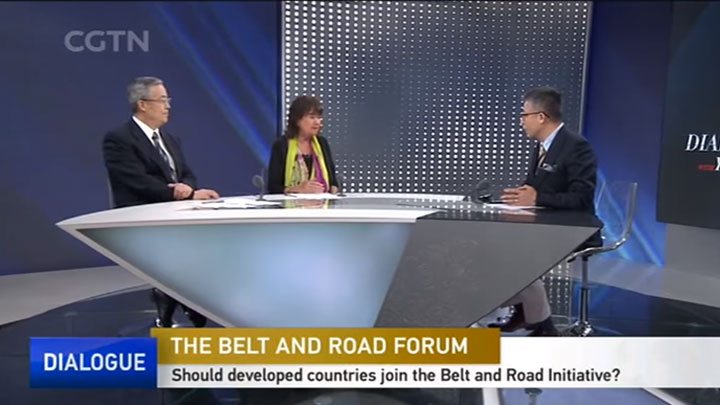
Helga Zepp-LaRouche on CGTN’s “Dialogue”

Representing the Schiller Institute, Helga Zepp-LaRouche spoke on May 14, on the first day of the B&R Forum, on the panel, “Belt and Road for Facilitating Strong, Balanced, Inclusive and Sustainable Global Economy.” She said, “The Belt and Road Initiative has the obvious potential of quickly becoming a World Land Bridge, connecting all continents through infrastructure, such as tunnels, bridges, reinforced by the Maritime Silk Road. As such, it represents a new form of globalization, but not determined by the criteria of profit maximization for the financial sector, but for the harmonious development of all participating countries on the basis of Win-Win cooperation.

(Xi Jinping opening speech: Video & Transcript)

“It is therefore important, that one does not look at the BRI from the standpoint of an accountant, who projects his statistical viewpoint of cost-benefit into the future, but that we think about it as a Vision for the Community of a Shared Future. Where do we want humanity as a whole to be in 10, 100, or even in a 1000 years?” Is it not the natural destiny of mankind, as the only creative species known in the universe so far, that we will be building villages on the moon, develop a deeper understanding of the trillions of galaxies in our universe, solve the problem of–’til now–incurable diseases, or solve the problem of energy and raw material security through the develipment of thermonuclear fusion power? By focusing on the common aims of humanity we will be able to overcome geopolitics and establish a higher level of reason for the benefit of all.”

Continue

In particular, Zepp-LaRouche addressed the question of the role of the United States, whose delegation in Beijing was led by a special adviser to Pres. Trump. Presenting the most positive, ‘big picture,’ Zepp-LaRouche explained, “Looking at the world land map, the United States is not merely a country surrounded by two oceans and two neighbors, but can be a center part of an infrastructure corridor which connects the southern tip of Ibero-America, through Central and South America, with the Eurasian transport system via a tunnel under the Bering Strait…”

Predictably, the geopolitics crowd, centered in London, is having a fit. The Economist in London today ran a stream of bilge, headlined, “The Economist explains, “What Is China’s Belt and Road Initiative?” They write that businessmen in Central Asia call it the “One Road, One Trap,” because B&R projects are unreliable. And “the Belt and Road Forum has an unfortunate acronymn, BARF,” etc.

But back in reality, not only does the Belt and Road Forum mark the process of potential world economic and scientific lift-off, but there is a vital process underway of deliberation over points of immediate suffering and possible all-out war. President Trump’s envoy in Beijing, Matthew Pottinger, is now in South Korea for consultations over concerns in the region. On Syria, as peace talks start on May 16, called “Geneva 6,” numbers of meetings are set for this week, of Mediterranean leaders who met in Beijing with both Xi and Putin. In Washington, D.C., May 16, Turkish President Recep Tayyip Erdogan will meet with President Trump. On May 17, in Sochi, Italian Prime Minister Paolo Gentiloni will meet with Putin. Likewise, Greek Prime Minister Alexis Tsipras met in Beijing with Xi, Putin, and also with Russian Foreign Minister Sergei Lavrov.

Today Helga Zepp-LaRouche summed up the great potential–our great challenge–by describing the May 14 opening of the Belt and Road Forum: “Yesterday was a fantastic, historic moment!” She was speaking on China Global Television Network’s “Dialogue with Yang Rui” program, run live, prime time. She exclaimed, “We are in a “phase-change for humankind!”


Helga Zepp-LaRouche on CGTN ‘Dialogue’

May 15, 2017

Helga Zepp-LaRouche is a feature guest in a program “Dialogue” on CGTN, 24-hour English news channel of China Central Television (CCTV), based in Beijing, on the eve of “the Belt and Road Forum” held on May 14 – 15 in China.

Transcript of Q&A on ‘Dialogue’

Q. What do you make of China’s global ambition?

Helga Zepp-LaRouche: I think it’s very important strategic initiative because it’s the only way how you solve all problems–regional, cooperation, underdevelopment, poverty. It’s really a historic mission. I cannot see anything else, not from the United States, for sure, not from Europe and so I’m really optimistic. I think yesterday was a fantastic, historic moment.

Q: But, do you think China is ready?

Zepp-LaRouche: Oh, I think so. First of all, the Chinese economic miracle of the last 30 years has surprised the world. And now through the Belt and Road Initiative, China is offering to export that model of development to other countries. And if you look at the success of the Belt and Road Initiative in the last four years, it is absolutely breathtaking! And I am shocked — every day the Chinese government comes up with a new initiative, which offers a solution to a problem. And it’s just very attractive idea. This is why so many countries want to be part of it. It’s much more attractive to have win-win cooperation in the context of the New Silk Road than to be part of a military alliance, which just gets countries into trouble. So this is why the whole center of power has completely shifted to Asia. And I am convinced that yesterday we experienced the formation of a new world economic order. It was a truly historic moment, and I think most of the participants at the Belt and Road Forum had that profound sense of being in the middle of making history for a new era for civilization. And I am very excited because this is a phase-change of humankind. I think we are on the verge of…

Yang Rui: No wonder President Xi Jinping calls the Belt and Road Initiative the project of the century.

Q: [India says] Hey, the Sino-Pakistani economic corridor will somehow go through the contentious territorial area of India, Kashmir; therefore, they refuse to get involved with the Belt and Road Initiative. The spokesperson of the Indian Foreign Ministry even protested against the idea of the economic corridor between China and its geopolitical rival, Pakistan. What do you think of the rivalry, the geopolitical rivalry that China wants to really keep a distance from?

Zepp-LaRouche: Well, first of all, India has always been the subcontinent and therefore they have a long tradition of geopolitical thinking. But, I think this has been reinforced by the British colonialism, and the British, and formerly the U.S. administration before Trump played on that. They played Pakistan as the state terrorism state, and trying to hype up sentiments in India to further this conflict. And I think the opposite is true. Because of the British division of India into Pakistan, Bangladesh and India, the only way how this can be overcome is increasing the connectivity among all the countries–Nepal, Bangladesh–all these countries want to be integrated. And they call it “connectivity”; they don’t call it the “Silk Road” and they don’t call it “Belt and Road Initiative,” because that’s associated with China. But in substance, all of these countries are urging for more development like that.

Q: What’s interesting is that both sides [China and U.S.] announced their joint projects, the list of projects, simultaneously. Do you think something must have been discussed at the Mar-a-Lago summit in Florida, between Trump and President Xi Jinping? And actually the announcement of this list of mega-projects between the two sides is an indispensable part of what has been agreed upon by the two heads of state?

Zepp-LaRouche: I think so, because President Trump has announced that he wants to have investment in $1 trillion worth of infrastructure in the next ten years. The American Society of Civil Engineers estimates that $4.5 trillion actually is required, and Chinese experts have said that the United States needs $8 trillion worth of infrastructure. Now China in the past years has shown a tremendous expertise in building fast trains and other projects of infrastructure, and China has also $1.4 trillion in U.S. Treasuries, which we have proposed it invest in an infrastructure bank or national bank in the United States, and then invest in the building of infrastructure. Now that would be a total game change. And if China, in return, would invest in the Chinese market, which is growing because of the growing buying power, you could replace the competition between the United States and China through cooperation. And then they could join hands and have joint investments in third countries, like rebuilding the Middle East, developing of Africa. I think it’s important that you’re not just talking about infrastructure and economics. We are really talking about a new era of civilization, where you replace geopolitics with a completely new set of relations among countries. And if the United States and China could solve this–you know, I have said many times that if President Trump would go for this, he could become one of the greatest Presidents in the history of the United States. And many of his critics don’t think that is possible, but I am absolutely convinced that we are very close to it.

Q: In effect, overseas observers pointed out, it seemed as if [President Xi] was talking to two audiences at the opening ceremony. For the international audience, he promised to export our technology, our ideas about Belt and Road Initiative, to reestablish the world order and to reconsider the idea of globalization internally. He also promised to rejuvenate the nation, to tell a China story through the Belt and Road Initiative…. To the surprise of many who are very skeptical about the economic relationship between Japan and China, two arch-competitors, economically and geopolitically as well, the Japanese government decided to send a senior delegation, which was headed by the head of the ruling party, the LDP, Liberal Democratic Party. And this head of the delegation also handed over a letter from Prime Minister Shinzo Abe to the host of the Belt and Road Initiative summit. What do you think of the possibility that Japan will seize this opportunity to drastically improve, not only the balance of ties, but also to enjoy the dividends of the Belt and Road Initiative, so that it will not be excluded from rebuilding the world economic order?

Zepp-LaRouche: I think it is very clear that Prime Minister Abe has the intention to do that. I think he sent de facto the number two of the LDP to the summit. I think it has to do with the change in perception that the world is indeed changing. If you look at the rapprochement between Russia and Japan over the last period where Abe has the intention to have a peace treaty during his time in office. There were many visits of Abe to Russia, and vice versa, Putin was in Tokyo, so I think given the fact that China has a very close relationship with Russia, and the offensive policies of the United States, of intervention in foreign wars — with Trump, he has said he doesn’t want to do this anymore, the situation in the South China Sea has completely shifted, it’s no longer such an important hot spot — I think we are on the verge of fixing the world according to completely new rules. And I think it’s really a time for people to rethink and not stick to old geopolitical schemes, which have been in the Cold War, because we are on the verge of a completely new era of civilization, and I think what Abe did, reflects that.

Q: Ironically, the young leader of the D.P.R.K. test fired a missile to coincide with the policy speech by President Xi Jinping at the Opening Ceremony. Yet the elected leader of the R.O.K., Mr. Moon, promised to reconsider the deployment of the THAAD, a missile…. That may have paved the way for an apparent improvement in the relationship, which has been frayed seriously by the THAAD deployment. What do you think of the R.O.K. delegation and in fact, a rumor went around the internet that President Trump called for a boycott of the belt and road summit saying “Hey, why did you invite the D.P.R.K. to attend the summit when the international society, through the UN Security Council imposed yet another economic sanction — which I believe is well underway — what do you think of the concerns, allegedly, the major concerns by the international media?… But I am afraid that those who are very skeptical about China’s intent, may point out, citing President Bush, Jr., that bad behavior should not be rewarded. So this invitation for the D.P.R.K. delegation has been very controversial. I’d like to have your take?

Zepp-LaRouche: Well, I think there are some people who are thinking in terms of the old paradigm of geopolitics, and they can just not imagine that a country, especially a large country like China would be motivated by Confucian ideas. And I have studied China for the better part of my life, and I have come to the conclusion that the present government, in particular, is not based on anything other but the Confucian idea of harmony among nations. And some people realize that. For example the Italian Prime Minister Gentiloni who at the Belt and Road Forum, gave a fantastic speech, where he said…

Q: Excuse me, but harmony would become a lost sense, if we do not respect some of the principles, which have a lot to do with national security. The nuclear program of the D.P.R.K. has indeed endangered three northern provinces if any nuclear fallout were to occur! That would be a major threat [crosstalk] to national security.

Zepp-LaRouche: But the new President of South Korea has basically said that he wants to go back to the Sunshine Policy of economic cooperation with the North. North Korea only has nuclear missiles because they were afraid they would have the same fate as Saddam Hussein or Qaddafi. And once the threat is away and we return to the Six Party Talks and the Sunshine Policy, and especially if this is in the context of the Belt and Road Initiative, I am absolutely confident that this problem will go away very shortly.

Q. The last question is whether there’s going to be a collision or a clash between Russia’s brainchild of having the Eurasian Economic Union and the Belt and Road Initiative? Because there have been speculations by the media who say, “Hey, Russia may show its great concern about China’s interference with the internal affairs of its traditional backyard, Central Asia through perhaps the role of the Shanghai Cooperation Organization.” And therefore, they focus on whether there’s going to be inconsistency and discrepancy between Russia’s Economic Union and the Belt and Road Initiative: What’s your take?

Zepp-LaRouche: You will be happy to hear that President Putin, who was the guest of honor at the Belt and Road Forum, already gave a press conference where he said that not only does Russia support the Belt and Road Initiative, but he will take an active role in promoting it. And if you look at the number of leaders and countries that are now joining, you have a total change in the dynamic– Tsipras from Greece, the Serbian government, the Czech Republic, Hungary, Belarus, Italy, Spain, Portugal, and Switzerland–all of these countries have said they want to become hubs of the Belt and Road Initiative. So even if the German Economic Minister at the Forum was not so friendly, let’s say, I think Germany will be soon surrounded by countries that want to be part of it, and I think this will tilt the situation. The former Prime Minister of France Raffarin gave a passionate speech why France should be in it, and he was sent by the new President Macron. So I’m absolutely convinced in half a year, the majority of the nations that are still reluctant will recognize that it is in their best interest. Because, for example, Germany should have a fundamental interest in cooperating. I mean, German industry, the Mittlestand, the medium-sized industry, are exactly the complementary kind of economic force that would perfectly work with China. And I think it will come around., I promise.

Yang: Despite the success of Emmanuel Macron, the European Union is indeed in trouble. And President Trump’s idea of prioritizing American interests, putting America first, may also isolate this country from the rest of the world. During this absence, China is said to be ready to assume the leadership. Is China ready? We’ll keep this discussion open. Until next time, goodbye.


BRF Agenda (pdf) The Fifth Global Think Tank Summit (pdf)


‘The Belt and Road becomes the World Land Bridge’

by Helga Zepp-LaRouche

Mrs. Zepp-LaRouche addressed the conference on Sunday and Monday, both at the Thematic Session on Think Tank Exchanges and at the 5th Global Think Tank Summit.


There has been a breathtaking dynamic of the New Silk Road in the three and a half years since pronounced by President Xi Jinping in 2013. The Belt and Road Initiative has the obvious potential of quickly becoming a World Land Bridge, connecting all continents through infrastructure, such as tunnels, bridges, reinforced by the Maritime Silk Road. As such, it represents a new form of globalization, but not determined by the criteria of profit maximization for the financial sector, but for the harmonious development of all participating countries on the basis of Win-Win cooperation.

It is therefore important, that one does not look at the BRI from the standpoint of an accountant, who projects his statistical viewpoint of cost-benefit into the future, but that we think about it as a Vision for the Community of a Shared Future. Where do we want humanity as a whole to be in 10, 100, or even in a 1000 years? Is it not the natural destiny of mankind, as the only creative species known in the universe so far, that we will be building villages on the moon, develop a deeper understanding of the trillions of galaxies in our universe, solve the problem of till now incurable diseases, or solve the problem of energy and raw material security through the development of thermonuclear fusion power? By focusing on the common aims of humanity we will be able to overcome geopolitics and establish a higher level of reason for the benefit of all.

It is obvious, that the World Land Bridge is ideal for completing the development of the landlocked areas of our planet. The colonization of nearby space will be the obvious next phase of the infrastructural opening up of the natural habitat of man.

Looking at the world land map, the United States is not merely a country surrounded by two oceans and two neighbors, but can be a center part of an infrastructure corridor which connects the southern tip of Ibero America through Central and South America with the Eurasian transport system via a tunnel under the Bering Strait. Since President Xi Jinping made the offer to President Trump for the US to join the Belt and Road Initiative, there is now a practical proposal on the table, where the US can become an integral part of the World Land Bridge. The infrastructure requirements of the US, which are enormous, could be a perfect opportunity to convert all or part of the $1.4 trillion China is holding in US Treasuries into such investments via an infrastructure bank. For example, the US really needs approximately 40,000 miles of fast train lines, if they would want to match the Chinese plan to connect every domestic larger city by fast train by the year 2020.

Continue

The US economy would experience a tremendous boost through such a grand scale infrastructure investment, and could in turn export into the fast growing Chinese market, and once competition is replaced by cooperation, the opportunities for joint ventures between the US and China in third countries are enormous.

Since President Trump has declared his intention to reintroduce the American System of Economy of Alexander Hamilton, Henry C. Clay and Abraham Lincoln, and also reintroduce the Glass Steagall legislation of Franklin D. Roosevelt, the possibility of an early establishment of a National Bank and a Credit System in order to channel Chinese holdings into infrastructure investments is near.

While more and more European nations, both outside and within the EU, are recognizing the tremendous potentials of the BRI and express the intention to become a hub for Eurasian cooperation, the EU itself has been reserved, to be diplomatic.

There is however one huge challenge, where the member states of the EU could be convinced to cooperate with the BRI: It is the refugee crisis. The only human way to heal this moral wound of Europe is the active integration of European nations in a Grand Design development plan for all of Africa with the BRI.

The positive new prospect of US-Russia de-escalation and military to military cooperation in Syria, along with the Astana process, now puts stabilization of the entire region in sight. Offers by China to extend the New Silk Road to Southwest Asia already exist.

The New Silk Road must–as the ancient one did–lead to an exchange of the most beautiful expressions of culture of all participating countries in order to succeed. The true meaning of Win-Win cooperation is not just the material benefit of infrastructure and industrial development, but of making the joyful discovery in other cultures of the beauty of their classical music, poetry and painting, and, by knowing them, strengthen our love for mankind as a whole.

In the building of the World Land Bridge all nations will cooperate on studying how to apply the laws of the Noosphere to the establishment of durable forms of self-government. The development of the creative mental powers of all people in all nations, will give all of mankind the sense of unity and purpose which will make our species truly human. When we organize our societies around scientific and artistic discovery, we will perfect our knowledge on how we can continuously advance the process of self-development of mankind, intellectually, morally and aesthetically, and we will find our freedom in necessity–doing our duty with passion!


Quotes of World Leaders from the Belt and Road Forum


Paolo Gentiloni
Italian Prime Minister

‘The Belt and Road Initiative is perhaps the most important infrastructure modernization project underway in the world today… Bringing the Chinese economy closer through this gigantic infrastructural operation is enormously interesting to Italy, not only for our government but also for our universities and public and private businesses.’


António Guterres
United Nations Secretary-General

‘The Belt and Road Initiative and the 2030 Agenda… aim to deepen ‘connectivity’ across countries and regions: connectivity in infrastructure, trade, finance, policies and, perhaps most important of all, among peoples.’


Alicia Barcena
Executive Secretary of the Economic Commission for Latin America and the Caribbean (ECLAC)

‘The Belt and Road Initiative represents a renewal and a profound commitment with the fundamental values of our global social and economic well-being: interconnection, deeper commercial and investment links, transparency and opening-up, and the need to ensure economic growth goes hand-in-hand with social progress. This is a speech concerning a change of era, Chinese President Xi Jinping made a very innovative proposal, with a panoramic perspective bringing together the objectives of all the countries.’


Hailemariam Desalegn
Ethiopian Prime Minister

‘The Belt and Road Initiative is the largest and non-conflicting economic cooperation of the 21st century.’


Jean-Pierre Raffarin
Special envoy of French President-elect Emmanuel Macron, Former French Prime Minister

‘This forum marks a new and decisive step in the progress of the initiative. To remedy the lack of infrastructure in Asia will require the efforts of all those good will ready to contribute to the region’s prosperity and that of the rest of the world.’


Michelle Bachelet
Chilean President

‘The breadth of the One Belt, One Road, the high level of participation and its strategic dimensions, highlight its capacity to become the biggest economic cooperation project in place today.’


Christine Lagarde
International Monetary Fund Managing Director

‘The Belt and Road Initiative aims to connect economies, communities, and people. It holds great potential to bring benefits in terms of high-quality infrastructure, inclusiveness, and economic cooperation.’


Matthew Pottinger
U.S. National Security Council East Asia Director

‘American companies have much to offer here. U.S. firms can offer the best-value goods and services required over the life of a project. U.S. firms have a long and successful track record in global infrastructure development, and are ready to participate in ‘Belt and Road’ projects.’


More Quotes


Jim Yong Kim
World Bank President

‘For those in the less developed community, our greatest task is to raise our aspirations to meet those of the people living in the countries that are still in need of many more investment for development. The Belt and Road Initiative is most remarkable for just the size of the aspiration.’


Milos Zeman
Czech President

‘The One Belt, One Road Initiative is the most significant project in all our modern history. I salute China for this courageous, long-term project.’


Philip Hammond
Special envoy of British Prime Minister Theresa May, Chancellor of the Exchequer

‘It is my belief that Britain, lying at the western end of the Belt and Road, is a natural partner in this endeavor.’


Najib Razak
Malaysian Prime Minister

‘With the vision of shared prosperity and win-win situation, I believe Malaysia and other countries will realize the potential of the Belt and Road Initiative. The initiative as one that can stimulate development among different sectors and industries via better infrastructure, in turn will facilitate world transportation and logistics, so all countries can access to larger markets.’


Roberto Azevedo
World Trade Organization Director-General

‘Infrastructure is essential. A lack of proper transport network was on top of the trade cost list and the One belt, One Road is hugely important in responding to this need.’


Recep Tayyip Erdogan
Turkish President

‘This is going to be the kind of initiative that will put an end to terrorism.’


Peter Thomson
President of the UN General Assembly

‘The Belt and Road Initiative brings enormous benefits to all involved and serves as a main driver of the global transformation emerged by the UN 2030 Agenda for Sustainable Development.’


Nawaz Sharif
Pakistani Prime Minister

‘Let me make it very clear, the China-Pakistan Economic Corridor, an economic undertaking, is open to all countries in the region.’


Alexis Tsipras
Greek Prime Minister

‘We highly value the importance of this initiative for people-to-people contact, cultural exchanges and tourism, and we see the great opportunities in the 21st Century Maritime Silk Road.’


Aleksandar Vucic
Serbian Prime Minister and President-elect

‘Serbia is China’s staunch friend and reliable partner. Serbia has benefited enormously from participating in the Belt and Road forum. Key projects of the Belt and Road Initiative have yielded positive results… Serbia expects to deepen cooperation with China in a host of areas, including the economy and trade, mining, infrastructure, finance, aviation and tourism.’


Brigitte Zypries
Special envoy of German Chancellor Angela Merkel, Minister of Economic Affairs

‘The Belt and Road Initiative aims to improve infrastructure between Asia and Europe. This will bring the world’s two largest trading partners in Asia and Europe closer.’


Shanghai Daily Interviews Helga Zepp-LaRouche

June 1, 2017

“I think the Belt and Road initiative signifies a revolutionary move to a new epoch of civilization. The idea of having a win-win cooperation among nations is the first time that a concrete concept has been offered to overcome geopolitics…”

– Helga Zepp-LaRouche

Read more


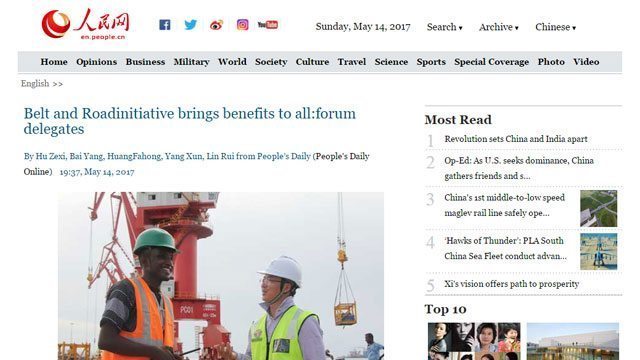
NewsGhana

May 16, 2017

“Belt and Road Enterprise Offers Assistance to All”

The Silk Road spirit followed by the Belt and Road initiative offers pioneering ideas for contemporary international cooperation, the delegates told the People’s Daily upon the arrival of the Belt and Road Forum for International Cooperation, agreeing that the proposal will bring benefits to all.

Read more


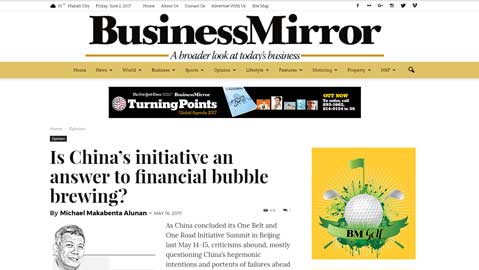
Business Mirror (Philippines)

May 16, 2017

“Is China’s initiative an answer to financial bubble brewing?”

Perhaps, it is wise to learn from history that every time there are solid developmental projects for the good of humankind, the ruling financial oligarchs of this world bank bankroll conflicts and world wars (i.e  the British oligarchs and Wall Street like  the Rothschilds, Harriman, Prescott Bush, et al funded Hitler initially).

Read more


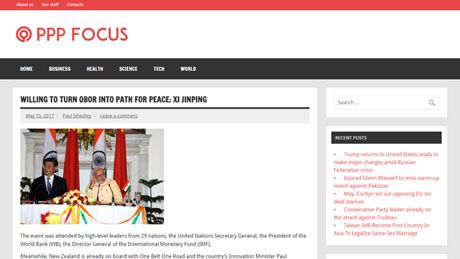
PPP Focus

May 15, 2017

Willing to Turn OBOR into Path for Peace: Xi Jinping

The event was attended by high-level leaders from 29 nations, the United Nations Secretary General, the President of the World Bank (WB), the Director General of the International Monetary Fund (IMF).

Read more


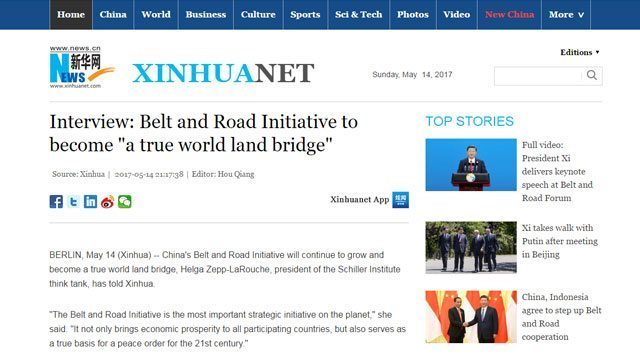
Belt and Road Summit: Xinhua Interview with Helga Zepp-LaRouche

May 14, 2017

Helga-Zepp-LaRouche-on-Xinhua-BRI

XinhuaNet Interview: Belt and Road Initiative to become “a true world land bridge

Read more


Belt and Road Summit: China Daily Interview with Helga Zepp-LaRouche

May 14, 2017

People’s Daily Online Interview: Belt and Road Initiative to become “a true world land bridge

Read more


Belt and Road Summit: China Daily (pressreader.com) Interview with Helga Zepp-LaRouche

May 15, 2017

China Daily (pressreader.com) Interview: Belt and Road Initiative to become “a true world land bridge

Read more


Eating Is a Moral Right, A Dialogue with 6 American Farmer Leaders

An excerpt from Panel IV of the Schiller Institute’s April 25-26, 2020 International Online Conference featuring American farm leaders speaking out against the dire situation American farmers, and therefore Americans, face due to the speculative cartelization of the global food supply. The panel’s moderator is Dennis Speed.

Bob Baker, Virginia; Schiller Institute agriculture co-coordinator
Joe Maxwell, Missouri; former Missouri Lt. Governor, co-founder of Family Farm Action Alliance
Tyler Dupy, Kansas; Executive Director of the Kansas Cattlemen’s Association
Frank Endres; California, member of the National Farmers Organization for 63 years
Bill Bullard; Montana, CEO R-CALF USA
Jim Benham, Indiana; State Pres. of Indiana Farmers Union, 20 Yr. National Board member, National Farmers Union
Mike Callicrate, Kansas; Colorado, Bd of Directors of Organization for Competitive Markets, Owner Ranch Foods Direct


Chinese TV Carries Comments from Helga Zepp-LaRouche and Bill Jones in Their Coverage of China’s “Two Sessions”

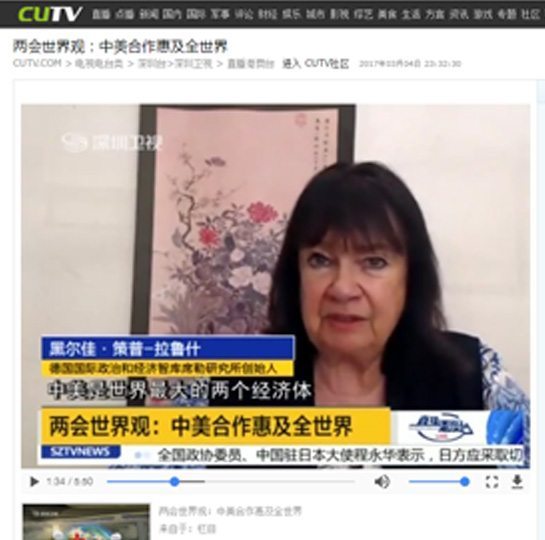
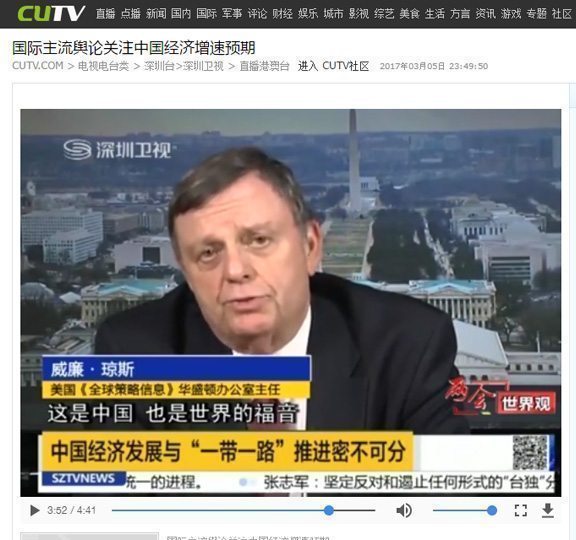
March 6, 2017 –China United Television, a major TV station in south China’s Shenzhen province, like most of the Chinese channels, is having ongoing news coverage of the two, week-long National People’s Congress and the CPPCC meetings. Interspersed in their coverage of the Congress are comments by Schiller Institute President Helga Zepp-LaRouche and {EIR} Washington Bureau Chief Bill Jones, based on answers to questions that had been pre-recorded and sent to the station for this purpose. The topics included the importance of the U.S.-China relationship, the significance of the Belt and Road, and the possibility of cooperation with the United States in infrastructure investment. Three of the segments can be found at:

http://www.cutv.com/v2/2017-3-4/G16ghgggihkoomjnjlombn.shtml
http://www.cutv.com/v2/2017-3-5/G17hihhhjilppojqhhkwrs.shtml
http://www.cutv.com/v2/2017-3-5/G15fgfffhgjnnmhjoklspo.shtml


Release: Schiller Institute Day of Action for Emergency Summit of Trump, Putin & Xi to Stop Danger of War

The Schiller Institute is organizing a Day of Action, Wednesday, January 15, to intensify support for the Institute’s January 7 “Call for Presidents Trump, Putin, and Xi To Convene an Emergency Summit to Address the Danger of War.” Activists on five continents will mobilize citizens, government officials, diplomats and institutions, in support of the call, which was authored by Schiller Institute President Helga Zepp-LaRouche.

January 15, which is the birthday of Dr. Martin Luther King, Jr., is the day of rallies and activity at appropriate locations, and on social media, websites, and all means of outreach. The Schiller Institute encourages all to commemorate the ideas and life’s work of Dr. King, by organizing for peace through economic development, as in the Call for the Emergency Summit.

The central international event will be at the United Nations in New York City, from 12 noon to 3 pm, Wednesday, January 15. Follow us on Facebook for on-the-ground reports from organizers throughout the world. To participate in New York, please contact: Lynne Speed, in New York, at (201) 562-9890.


Page 4 of 11First...345...Last