Join Helga Zepp-LaRouche in her live dialogue and discuss the issues and solutions that move the world and its people. Send your questions & comments to questions@schillerinstitute.org or post them in the next live stream. Please share the YouTube link with your friends, acquaintances, and colleagues to increase the reach of the solutions presented by the LaRouche movement.
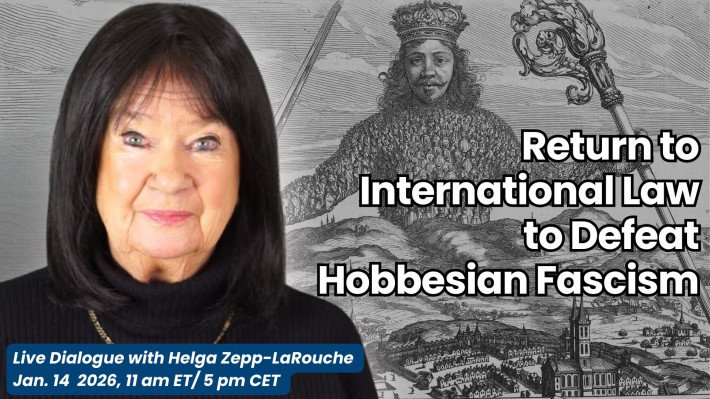
A nation can endure hardship, disagreement, and even bitter factional conflict—and still remain a republic. What it cannot survive is the steady replacement of law with raw force, until “authority” means nothing more than whichever armed agency arrives first. America is now witnessing, in real time, what it looks like when the Executive claims powers the Constitution never granted, while Congress stares, stunned, as if the words on the page were only ceremonial.
And yet something new is breaking through the fog: a real and broad backlash against the accelerating abuses. The expanded ICE deployments, the street clashes, the mistaken arrests, and the deadly raids are no longer being processed as “tough policy,” but as a rupture in the very idea of the republic. When the public can no longer tell whether elections are fair; when domestic “law enforcement” becomes indistinguishable from foreign occupation; when even basic rights of speech are treated as deportable offenses—then the country itself is coming undone.
This is the deeper danger hiding behind the day’s headlines: not only the shock of Minneapolis, nor the unsealed records of students targeted for their protected speech, nor the ongoing threats against Canada’s sovereignty, nor the propaganda drumbeat for war with Iran—but the emergence of a single, unifying principle across them all: might makes right. Abroad, it looks like seizure and intimidation. At home, it looks like a creeping constitutional vacuum filled by federal power grabs.
But there is a limit to a tyrant’s power—not because tyrants restrain themselves, but because reality eventually refuses to cooperate. Stauffacher expresses this in Schiller’s play Wilhelm Tell:
Yes! there’s a limit to the tyrant’s power!
When the oppressed looks round in vain for justice,
When his sore burden may no more be borne,
With fearless heart he makes appeal to Heaven,
And thence brings down his everlasting rights
Which there abide, inalienably his,
And indestructible as are the stars.
From the time of the American Revolution, through the War of 1812 and the Civil War, that “tyrant” was the British Empire, which ruled through military might, financial domination, and manipulation.
The question before the United States, entering the 250th anniversary of its founding, is whether we will merely condemn the swamp—endlessly describing the qualities of the mud, the anatomy of the parasites—or grasp the rope being thrown to us: a new paradigm worthy of the republic’s promise, grounded not in simple libertarian protest, but in the best intellectual tradition that shaped America itself: the Leibnizian idea that the purpose of government is the advancement of the general welfare, and the creative powers of the human mind.
That is why the Declaration of January 12 is not a “commentary” on the crisis, but a pathway out: a movement of world citizens, acting to restore international law, pursue international growth on the basis of physical economy, and build genuine development corridors—rather than lurching, outrage by outrage, into a new dark age.
There is a limit to the power of empire. The question is whether we choose, now, to install a new paradigm. Let us create a movement of world citizens!
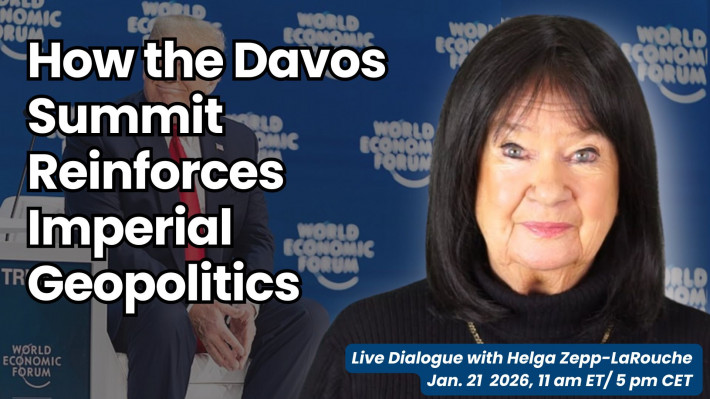
The 138th consecutive meeting of the International Peace Coalition opened with remarks by Helga Zepp-LaRouche, Schiller Institute founder and initiator of the International Peace Coalition. She discussed the implications of President Trump’s speech at Davos, during which he made clear his disdain for international law. She deplored his “typical mafioso-like” statements on Iran.
However, she said, the metaphorical glass is half-full, “maybe more than half-full”, in light of the meeting between Jared Kushner and Steve Witkoff with Vladimir Putin in Moscow on January 22, 2026, aimed at advancing a U.S.-backed peace plan to end the war in Ukraine. The meeting was described by the Kremlin as “useful” and “constructive.” What is important is that there is an ongoing dialogue, and the “spirit of Anchorage” has not fallen by the wayside. “If this is continued, it really could shift the balance,” Zepp-LaRouche said.
Russia will provide $1 billion for the reconstruction of Gaza. Putin also joked about the invitation by Trump to join his “Peace Council” with a $1 billion membership fee, saying, “I will pay the one billion, and you can take it out of the frozen assets.” Putin has made the offer to extend the last arms control treaty, START, which is due to expire in a few weeks. There has been no response yet from Trump.
Zepp-LaRouche reviewed some positive initiatives, and praised a new proposal from a French group: a petition to return to the founding charter of the UN, which will be reviewed, edited by IPC participants and brought back for a vote next week.
She was followed by Dr. Ted Postol, MIT Professor Emeritus and one of the world’s leading experts on nuclear weapons. He analyzed “the mythical idea of Golden Dome,” Trump’s proclaimed plan for anti-missile defense. It involves orbiting satellites with interceptors to catch ICBMs in boost phase. “Implicit in this idea is understanding that the existing ground-based systems have little or no capability,” since they can’t tell the difference between warheads and the hundreds of decoys which are deployed during the descent phase. Orbiting satellites have less than three minutes to intercept in boost phase, when the missile velocity is relatively slow and no decoys have yet been released. Their orbit must be low enough to maximize that window of opportunity, which will cause atmospheric drag and the lifespan of the satellite will only be about six years before it falls to earth. You would need 1100-1200 satellites in orbit to even think about an interception of one ICBM. The system scales 1000 to 1 – for a launch of 100 missiles, 120,000 satellites. You could “punch a hole in the Golden Dome satellite constellation” with an interceptor launched from below, “and your launch would go unopposed.”
Postol expressed his concern that “something is different about Trump in the past few months… something more extreme.” He said that some people have suggested that he may have had a minor stroke. “We have a criminal government right now in control of the United States.”
In response to Postol’s demolition of the Golden Dome scheme, Zepp-LaRouche asked, why is there no one in Trump’s team that will tell him this is unworkable? Postol said that people follow orders, they don’t ask questions. What followed was an exchange about the difference between Lyndon LaRouche’s conception of the Strategic Defense Initiative based on “new physical principles”, as opposed to what Reagan’s program became under the influence of LaRouche’s opponents.
Jens Jorgen Nielsen is the Former Moscow correspondent for the Danish daily Politiken, and an author of books on Russia and Ukraine, as well as being Director of the Russian-Danish Dialogue and assistant professor of communication and cultural differences. He addressed the issue of Trump’s desired annexation of Greenland, stressing that Greenland has its own government and people there are very concerned about the possibility of being occupied by US. Some factions there are calling for immediate independence from Denmark; what would Trump do under those circumstances? Most Danes and Greenlanders were not reassured that U.S. President Donald Trump and NATO Secretary General Mark Rutte reached an agreement over Greenland at the World Economic Forum that did not include them.
A short excerpt was presented from a video interview with Alberto Vizcarra, a leader of the National Front for Saving Mexican Agriculture. He described the dire state of Mexican agriculture, where exports have collapsed due to neoliberal economic policies. He went on to review the past proposals of LaRouche for projects in the mutual interests of Mexico and the US. Daniel Burke of the Schiller Institute announced a new international youth class series. He called the youth movement a “crucial strategic flank.”
Discussion
There was a further exchange between Zepp-LaRouche and Nielsen on what Nielsen calls a “law-based order” as opposed to a “rules-based order. Zepp-LaRouche suggested that “rules-based order” sounds like it is based on something arbitrary. They agreed that the abrogation of treaties, combined with the possible stationing of medium-range missiles in Europe, puts the world on edge.
One participant asked how we can we organize against ICE. This provoked several responses. Co-moderator Dennis Speed observed that America has long been a plaything of intelligence agencies, particularly British. What is going on in Minnesota is closely tied to the debacles in US foreign policy. To break from the downward spiral, we need action which is not merely non-violent, but which also poses solutions. The other IPC co-moderator, Dennis Small, stated that the only reason immigration is an issue is that US foreign policy has wrecked the economies of our neighbors to the south, causing waves of refugees.
Regular participant John Steinbach noted that nuclear weapons are never defensive in nature, and ABM systems are intended to block retaliation after a first strike.
Returning to the question of Greenland, Dennis Small said that the question of the Arctic is not merely a military one. It is a golden opportunity for international collaboration on economic development.
Zepp-LaRouche commented that Canadian Prime Minister Mark Carney’s speech at Davos has received much favorable attention, but it is a disguised reflection of Chatham House line. She said that he “stated something that was obvious, that rules-based order is a fraud.” However, the he people who are praising him are oblivious to economics, because he was the author of the “reset” policy.
Join Helga Zepp-LaRouche in her live dialogue and discuss the issues and solutions that move the world and its people. Send your questions & comments to questions@schillerinstitute.org or post them in the next live stream. Please share the YouTube link with your friends, acquaintances, and colleagues to increase the reach of the solutions presented by the LaRouche movement.
The egos of those who run Davos annual flight from reality would have you believe that there will be a real, free exchange of ideas there. In reality it is an exercise in control, with fake alternatives presented, all within the containment of the City of London’s imperial geopolitics. Will Donald Trump change that? Let’s see if he will denounce London’s control over the world economy through “financialization”, and embrace cooperation with the BRICS nations, based on the ideas of the American System as advanced by Lyndon LaRouche.
The greatest danger confronting the United States today, and much of the trans-Atlantic world, is not that it lacks resources, talent, or scientific capacity. It is that it no longer believes in the human mind—in the unique power of human beings to discover new physical principles, transform nature, and improve the conditions of life for generations yet unborn.
As Lyndon LaRouche once stated the issue bluntly: Do Americans still believe, in any significant way, that man is different than an animal? He posed this question at a 2004 event honoring Martin Luther King, Jr.:
Our teaching, we don’t teach that. Look at our standard curriculum. … What our education policies are now, nationally, are a crime. You don’t know anything—you learn to pass a test!…
We’re no longer concerned. We don’t believe, as a nation—we don’t believe in developing people! We have become like Rome, ancient Rome, a society of “bread and circuses.” Get your crumbs, and be entertained. …
For example, today, do people work? Is their mentality one of working? Do they believe in work? Do they believe the society gives them the opportunity to work? No. It doesn’t. It gives them the opportunity to get some money. …
The mentality of the country is that if you’re getting lucky, and winning the lottery, and winning at the track, that you’re getting ahead. Even though your industry is collapsing, your farm is gone, the city government can no longer afford to take care of your essential needs: We’ve gone into becoming a gambling society.
We rely on what? Mass entertainment! … Isn’t this something you really should be ashamed of?
We no longer regard human beings as human. We no longer understand what is human.
Against that civilizational decay comes the view of human identity implicit in today’s news report from China: The drive for controlled nuclear fusion is approaching a decisive phase, with major procurements underway and serious industry leaders now projecting net fusion gain and electricity generation by around 2030. Fusion, they insist, is no longer merely a physics experiment—it is becoming an engineering project, with industrial planning, real investment horizons, and the intention to make it economically viable.
This is what a society looks like when it is organized around the future. Not the future of quarterly profits, social-media hysteria, or geopolitical theatrics—but the future of human civilization itself. A nation committed to fusion is a nation committed to the idea that progress is real, that development is possible, and that the dignity of labor and discovery is not a slogan, but a mission.
Will the United States, and other nations of NATO, reclaim the moral and intellectual courage to take on such missions? To build a world defined not by empire and manipulation, but by cooperation in great projects worthy of the human species?
What we see coming from the White House is not leadership. It’s King Lear: a hollowed-out authoritarian demanding loyalty while the kingdom sunders, surrounded by flatterers, prone to tantrums and misjudgments, and confusing spectacle for legitimacy. Martin Luther King was the opposite species: not a performer hunting applause, but a servant of a mission, rooted in the forgotten men and women, measuring power by uplifting the least, and absolutely refusing the cop-out of “going along to get along.” As LaRouche put it: “As a leader … you have to find within yourself the strength not to flinch. Not to compromise.”
We need the moral courage to know that life is a talent, and that the only authority worth having is that which comes with improving the lives of others.
Harley Schlanger, Vice President of the Schiller Institute was interviewed on the English language Pakistan TV for their World This Morning Show. The interview was shown on national TV and covered the water conflict between India and Bangladesh. See Harley’s segment here.
Another interview was done on Iran’s Press TV on Trump’s Destabilization policies, on Press-tv Spotlight. Harley is one of two guests and the video can be found on the Press TV website.
Jan. 16, 2026 (EIRNS)—The 137th consecutive online meeting of the International Peace Coalition (IPC) on Friday, Jan. 16, was a strong call to action, with participants from the historic emergency roundtable on Jan. 12 engaging in intense dialogue about the next steps to be taken. The meeting commenced with an update by Schiller Institute founder Helga Zepp-LaRouche, who deplored the present situation as one where “might makes right, and international law is buried.”
Fortunately, it seems that the Iranian government has been able to defuse the imminent danger. Former CIA Director Mike Pompeo and the Jerusalem Post have revealed CIA/Mossad involvement in the anti-government demonstrations. Several countries in the region have intervened and asked the U.S. not to attack.
The European situation is tense. Trump has declared that he wants to “own” Greenland, and European leaders are warning that a U.S. military operation there would mean the end of NATO. A German court has ruled, without naming names, that the Nord Stream sabotage in September 2022 was carried out by a foreign state and its intelligence service.
Zepp-LaRouche emphasized the importance of the Emergency Roundtable Dialogue on Monday, Jan. 12, which was titled “It’s Worse Than You Think: The Implications of the Attack on Venezuela & How To Bring the World Back from the Brink”. The meeting produced a draft document with the name “Declaration of January 12” which is currently being reviewed by those participants of the roundtable and will be circulated shortly. She said we must demand from governments an immediate return to international law, and we must build an international civil society organization to step in when governments fail.
Peace and Development
H.E. Donald Ramotar, former President of Guyana (2011-2015), was one of the participants at the roundtable dialogue, and he offered some thoughts on the Declaration. He said that in his view, the economic proposals are important, but the emphasis must be on peace and stopping the danger of nuclear war. In response, Zepp-LaRouche said that decades of organizing have led the Schiller Institute to believe that the only way to successfully mobilize against war is by offering an alternative of economic development. In order to prevent another world war, President Franklin Delano Roosevelt had intended the Bretton Woods System to be an engine for development, but those institutions were subverted after his death. Her late husband, Lyndon LaRouche, had authored important economic proposals which were intended to complement the spirit of the anti-colonial Bandung Conference. Ramotar responded by saying he does not disagree that peace and development go together, and that his comments were more of a tactical nature; we must educate the people of the world on the entire spectrum of these ideas, but when we are addressing governments, a more narrow focus is sometimes more effective.
A Call to Activism
María de los Ángeles Huerta is a former Congresswoman of Mexico who also participated in the roundtable. She said that the return to gunboat diplomacy signals the collapse of the old paradigm and the potential for a new one, which must be characterized by sovereignty and interdependence. The Schiller Institute’s World Land-Bridge proposal is an example of what can be done.
Huerta proposed that we focus not only what states can do, but what we the people, organized internationally, can do. She called for the creation of committees that can break the media control and promote the plans like those of the Schiller Institute. The committees can act as watchdogs and whistleblowers, creating a counter-narrative and moving from being spectators of the collapse to being builders of the new order. She proposed the production of a founding video manifesto and a website with an interactive map of committees. The committees can approve and promote the January 12 Declaration.
Dr. Beatriz Bissio, Associate Professor in the Department of Political Science and the Postgraduate Program in Comparative History at the Federal University of Rio de Janeiro (UFRJ) in Brazil, said, “We live at a moment in history where we can feel that great transformations are underway.” We all understand that the U.S. is a hegemonic power in decline, which is withdrawing from crucial arms control agreements, making it explicit that it is prepared to impose its views by force. She agreed with Ramotar that this is a “mafia-style state.” We cannot rely on the responses of the states, Bissio said, so we must organize civil society as Congresswoman Huerta proposes.
Turning to the issue of Venezuela, she said that Acting President Delcy Rodríguez offers an intelligent response within the constraints of what is possible when confronting a hegemonic power. The Trump administration seeks to expel China from this hemisphere, but almost every country in Latin America has an extremely important relationship with China, for trade and infrastructure building. The red lines that the Trump administration has crossed are not a novelty, but a continuation of a long-term policy.
The left has not been able to exercise as much influence as it had during the heyday of the liberation movements; socialism must regain its appeal as an alternative to capitalism. In Dr. Bissio’s view, the IPC offers ideas which can help overcome “the fragmentation of progressive movements.” She works with a number of leftist/progressive coalitions, as well as with the “Bandung Spirit” organization, which promotes Sukarno’s ideas today, including his call for a reform of the United Nations. She suggested that the UN be hosted by a nation, perhaps in Africa, which is “not contaminated by the Cold War.”
Her remarks were endorsed by moderator Anastasia Battle, who proposed that the IPC begin to collaborate with the organizations she represents and seek other such organizations with which we can collaborate. Bissio noted “this happy coincidence” between the goals of her organizations, and those of the IPC, and said that we need joint work to meet “the demands of this historic moment.”
Returning to the Issue of Economics
IPC co-moderator Dennis Small intervened to say that “this question of economics is being decided for us by reality itself…. One of the most devastating weapons which has already been deployed is financial warfare.” Sanctions against Iran and Venezuela set the stage for instability in those nations. Milei won the presidency in Argentina due to “total financial warfare” from the IMF and others, which created a de facto coup d’état, Small said. The biggest problem that Brazilian President Lula faces is the Central Bank of Brazil, which is run by Wall Street and the City of London, and has very high interest rates and won’t provide credit for development. Brazil is the chief regional target of the oligarchs.
Bissio agreed totally, particularly on the question of Brazil’s central bank. One of the tools of the imperialists is that the media, in a systematic way, attack Lula’s initiatives, using “so-called specialists in the economic field” to avoid exposing themselves as oligarchic agents.
Discussion
A participant submitted a humorous proposal for a novel, in which the U.S. is run by a lunatic, the U.K. by a zombie, and Germany by a werewolf, who changes at every full Moon. He said that it could be a bestseller. The IPC decided this was a fantastic idea, and it will be floated to a few authors for consideration.
A regular attendee sent a question about Peru becoming a target due to the importance of its Chancay port for trade with China. Dr. Bissio commented that the surprising veto by Brazil of Venezuela’s entry to BRICS must be understood as a consequence of the internal conflicts in Brazil. This error was partially corrected by a statement calling the seizure of Maduro a kidnapping. Dennis Small observed that the British rely on the tactic of “divide and conquer,” and therefore, we must respond with Cusa’s “coincidence of opposites.” Peru, he said, should watch out for Nord Stream-style sabotage of Chancay Port. Brazil and Peru must work together, even though they have different political ideologies.
Congresswoman Huerta and Zepp-LaRouche both called for an immediate push to set up a website and the activation of the proposed committees. Ramotar agreed, and added that because of the strategic importance of the U.S., we must support and promote the U.S. Presidential campaign of Diane Sare. The electoral victory of Mamdani in New York City shows what is possible.
In conclusion, Zepp-LaRouche and the other participants of the IPC were set to launch with a call for volunteers to step forward, the creation of various committees, and the establishment of a central website for organizing purposes.
Join Helga Zepp-LaRouche in her live dialogue and discuss the issues and solutions that move the world and its people. Send your questions & comments to questions@schillerinstitute.org or post them in the next live stream.
Executive Intelligence Review sponsored an Emergency Roundtable Jan. 12, featuring leading political figures from around the world, which convened online under the theme, “It’s Worse Than You Think: The Strategic Implications of the Attack on Venezuela and How To Bring the World Back from the Brink.” Ten experts, from the Americas, Eurasia and Africa, representing long experience and tested judgment in international affairs, met for nearly three hours, with a live-stream audience averaging 1,200 participants, with translation in English, French, German and Spanish.
Helga Zepp-LaRouche, Editor-in-Chief of EIR, and founder and leader of the Schiller Institute, welcomed her 10 fellow panelists, saying: “We have assembled here today not to lament the unprecedented situation which can only be described as a threat to the existence of the entire human civilization, but to discuss, analyze, and catapult an international response to restore international law.”
The stern reports and evaluations that followed provided a powerful expression of the shock and disgust around the world at the violent actions of these past weeks, and the role of the United States government in acting with abandon to discard international law.
However, as one speaker said: “we are not here to become more knowledgeable” about the crises, but to confer on galvanizing action to change the situation. Proposals ranged from a “Declaration” to be issued, to consensus that the priority is to mobilize the forces of the Global Majority to discuss new “configurations” to be supported to restore international law and morality. Many confirmed that the UN General Assembly is still a formation of potential positive international impact. The idea was posed to create a “structured international civil organization.”
Several speakers made the point that the cultural and political situation inside the United States is a priority to transform and upgrade. There is a correspondence between the violence underway inside the United States, and the international lawlessness from Washington. As one senior U.S. diplomat stated, now is the time that “America must introspect.”
Zepp-LaRouche summed up at the conclusion of the discussion that an organizing grouping will be formed to formulate priorities and to move on followup action.
The discussion period allowed for several exchanges on how to make this Roundtable of leading figures the basis for a global movement. The proposals discussed were for a UN General Assembly action to stop the U.S. policy; creating a movement of civil society organizations to intervene globally; activate mass movements along the model of Mohandas Gandhi, Nelson Mandela, and Martin Luther King, Jr.; start a movement for the forgiveness of the unpayable debt; to remind Trump that he campaigned against the “Deep State,” but now appears to be run by that same Deep State.
Terming the event, “extremely productive,” Zepp-LaRouche called for everyone to reach out to good institutions and individuals. She noted—not in a religious, but in a humanitarian way—that Pope Leo XIV, on the occasion of the Jubilee year, has backed debt relief, and called for the “coincidence of opposites” way of thinking based on Nicholas of Cusa (15th century), which provides one path for organizing. The necessary elimination of the debt bubble must be controlled—an uncontrolled collapse could cause chaos. We should get this discussion to world leaders and institutions.
Extraordinary Panel
The discussants were truly an extraordinary gathering of expertise and morality, amounting to a Council of Elders. The moderator was Dennis Speed of the Schiller Institute. Presentations were made by the following speakers, in the order given, proceeding after the Mrs. Zepp-LaRouche’s opening:
Naledi Pandor, former South African Minister of International Relations and Cooperation;
Zhang Weiwei, Professor of International Relations at Fudan University in Shanghai;
Chas Freeman, former U.S. Ambassador;
Dmitri Trenin, Director and Academic Supervisor of the Institute of World Military Economy and Strategy at the HSE University in Moscow ;
Donald Ramotar, former President of Guyana;
Graf Hans-Christof von Sponeck, former UN Assistant Secretary General;
María de los Ángeles Huerta, former Mexican Congresswoman;
Namit Verma, Indian author and security analyst;
Dennis Small, EIR Ibero-America Editor; and
Lt. Col. Ralph Bosshard (ret., Swiss Army), former military adviser to the OSCE secretary general.
Video archive of the Roundtable will be available, and upcoming issues of the weekly EIR will publish selected transcripts. The following are selected highlights.
Zepp-LaRouche pointed to U.S. President Donald Trump’s recent declaration that he is not bound by international law, but only by his own mind, allowing the “might makes right” actions he is following. Trump’s call for increasing the U.S. defense budget from $1 trillion to $1.5 trillion, together with the military buildup across Europe, demonstrates that we are on a path to global nuclear war. She insisted that we are the only species capable of reason, and thus, can and must act to change this disastrous course. She reviewed her own proposal for “Ten Principles of a New International Security and Development Architecture” and noted that these ideas were contained also in the four global Initiatives of Chinese President Xi Jinping.
She called for a return to the principles of the 1648 Peace of Westphalia, placing the concept of “one humanity” above all, as also in the concept of a “coincidence of opposites” presented by Nicholas of Cusa in the 15th century, as a means of resolving differences by reaching a higher, unified vision. We must reach back to all the great thinkers of our different cultures, such as Confucius, Plato, and Leibniz, to restore a true love for humanity through agape.
Hon. Naledi Pandor addressed the horror expressed around the world at the illegal acts against Venezuela; and she warned that an attack on Cuba would be “a catastrophe.” She is the former South African Minister of International Relations and Cooperation, and Chair of the Nelson Mandela Foundation, who initiated the South Africa’s motion to the International Court of Justice (ICJ) to investigate Israel’s genocide in Gaza. Pandor pointed out that most of the Western nations accept that the West can override the interests of Russia. Developing countries have suffered under colonial rule, which the UN Charter was intended to eliminate, assuring the protection of the vulnerable from the strong. What is occurring now is the “most dangerous abuse of international law since 1948,” she said. The BRICS, the Hague Group (formed by nations of the Global South in January 2025 to defend the ICJ’s investigation of genocide in Palestine), the African Union, and other international organizations “must do more to restore international law,” while civil society organizations must also speak out. The UN must be reformed, so that those who break the rules of the Charter face a court. And individuals, too, must cause “good trouble.”
Prof. Zhang Weiwei expressed his outrage at Trump’s actions in Venezuela, terming it a “dangerous precedent” for the future. He noted that the U.S. had a “long history of reckless invasions,” adding that the new U.S. National Security Strategy granting power to the U.S. over all of the Western Hemisphere is “shortsighted and self-defeating,” which is destroying the country’s “soft power” by carrying out regime-change operations militarily, while using a “value-based humanitarian figleaf.” The U.S. action is destroying the UN Charter, which was “forged by two world wars.” He called for all nations to “unite to save the UN Charter.” He condemned the recent moves in Japan to restore the militaristic policies that had caused such destruction in World War II, insisting that China “will not accept the return of Japanese militarism,” and warned the U.S. and others that the world will not accept the end of the UN Charter.
Chas Freeman, former U.S. Ambassador to Saudi Arabia, expressed support for German President Frank-Walter Steinmeier’s recent denunciation of the U.S. being responsible for a “breakdown of values” and allowing the world to become a “den of thieves.” “My country,” he said, “has followed Israel in the law of the jungle,” acting like a mafia in protection rackets. “We are heading into a New Dark Age,” he warned. The genocide in Gaza, he said, demonstrates that “words won’t fix it” when there are such blatant crimes against humanity. The banning of free speech is a “disastrous misjudgment,” while the media refuse to even report that Russia had reasons for the invasion of Ukraine, or the blatant act of piracy of a Russian ship, or that the U.S. has turned Venezuela into a colony. Now the U.S. is even threatening its allies, pointing to Greenland. On Trump’s “brutal reassertion” of the Monroe Doctrine, he warns that “Venezuela is just an opening move.” In the face of such an “abyss of tyranny,” Freeman said, “rhetoric is not enough—if we can’t convince our governments to respect the Peace of Westphalia, we will perish.” Our rules have failed, and if the UN cannot enforce the peace, we must “find a work-around,” to either “repair or replace it.” Surely, the ambassador concluded, “we can stop this run to nuclear war.”
Dmitri Trenin, Russian military and economic strategist, gave a “bleaker view of the path ahead,” warning against the use of force. In particular, he said that Trump “won’t stop until someone strikes back.” He said that this forum was provoked by the attack on Venezuela, but he asked himself, is this the cause? Rather, he said, look at Iran, at the Israeli and U.S. war on Iran, which shows the worst that this can become. The advent of Trump, said Trenin, changed the priorities of the U.S., but they are still the same policies of the U.S. since World War II. But the “globalist collective West” is no more, now it is Trump’s personal force, while the hegemony of the U.S. is still in force. On Venezuela, he believes it was an “inside job,” as was also true in the Iraq war. What can be done? Trenin proposed that China and Russia must cooperate more, and that Iran must do more to defend itself. Trenin worries that the only protection of states over the past decades was the possession of nuclear weapons.
Donald Ramotar, the former President of Guyana, a neighbor of Venezuela, which has been threatened by Venezuela over contested territory, nonetheless asserted that the kidnapping of President Nicolás Maduro was a “giant step backwards for humanity.” The U.S. is asserting itself a “super colonial power, even against its allies in Europe.” He thinks this is MAGA, mafia style. There is no regard for sovereignty or international law—already seen in Gaza. The immediate target is China and the BRICS, to “push China out of South America and the Caribbean.” The targeting of the BRICS is because the sanctions failed to destroy Russia as intended, and the U.S. fears losing its position as the unipolar power. Those supporting democracy in the U.S. are powerless, and now chaos is breaking out in major U.S. cities. The military-industrial complex that Eisenhower warned about has taken over foreign policy, and is now moving on domestic policy. The policy will spark a new global battle for liberation, or nuclear war. The U.S. must mobilize against this madness. Ramotar praised Diane Sare for announcing her campaign for U.S. President.
Graf Hans-Christof von Sponeck from Germany, the former UN Assistant Secretary General, said he had studied and worked in the United States, but that what he sees now is not the “good” U.S. he used to appreciate. He proposes that the UN should activate Article 6 of the UN Charter, which allows for the expulsion of a country which consistently breaches the UN Charter, but added that perhaps the U.S. should have its membership “frozen” first. He also called for an integrated social forum internationally, a civil society institution to act on global policy.
Maria de los Angeles Huerta, a former member of the Mexican Congress warned of a “brutality unmatched threatening 2026,” with Mexico definitely threatened. She described this as the “death rattle of the bankrupt financial system.” In keeping with Helga Zepp-LaRouche’s Ten Principles, she proposed: development of the transoceanic rail connection between the Pacific and the Atlantic Ocean and an energy and monetary fund to protect all the countries of Latin America, as well as a security pact as a deterrent to “the new fascist policy of Donald Trump.” She called for support of an “Action Group” designed to find new pathways. She recommended joining in international actions on Jan. 17, when the World Without War group is demonstrating.
Namit Verma, a security expert from New Delhi, India, said that Trump’s actions are “so wild that it shocked the world into seeing the state we are in.” The world is itself responsible, since after World War II there was an agreement to tie the dollar to gold, keeping exchange rates stable, but on Aug 15, 1971, Nixon made a “unilateral declaration ending this policy, and we accepted it.” He said, there have been many more betrayals. Now, America is bankrupt. “Do we need to save a bankrupt Empire?” He said, “pragmatism has become opportunism.” It is time to call the bluff of the U.S. and of Trump.
Dennis Small,EIR Ibero America editor, presented the dimensions of the Western system debt and financial aggregates bubble, standing at $2.4 quadrillion. The system is bankrupt, and even worsening through the crypto bubble and bailouts. This is “Schachtian” economics as Hitler’s central banker Hjalmar Schacht devised it—printing money for mass military buildup to save the bubble and the Empire. One-third of the U.S. budget will be going to Wall Street through military spending and debt service. Thus the world economy is governed by the military ambitions of the Western leaders preparing for a war against Russia. Small referenced LaRouche’s “Four Laws” as the crucial alternative, including a global Glass-Steagall, and new national banks to provide credit, and currency controls for all nations, to allow an economic development drive with vast increased employment in productive jobs. Think of a Global Land-Bridge spanning the world.
Lt. Col. Ralph Bosshard, who served as the military advisor to the OSCE secretary general, said the unilateral attack on Venezuela sent a message to the world that universal law is finished. This is not new, he said, since the 1999 bombing of Yugoslavia without UN approval was already bypassing international law. Now we have nations building military coalitions among the 150 countries which are not already part of military alliances. The talk of a new Monroe Doctrine is absurd, since the original Doctrine was to stop the Spanish and Portuguese colonial powers from undertaking any operations in South America, not to make the U.S. into a colonial power, as is now taking place.
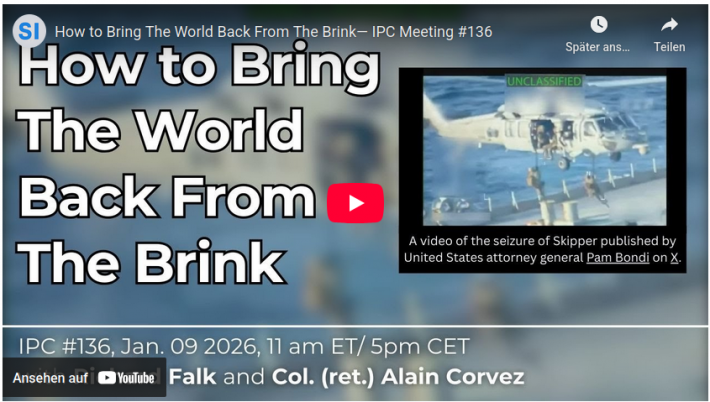
Jan. 9, 2026 (EIRNS)—The 136th consecutive weekly meeting of the International Peace Coalition opened with remarks by Helga Zepp-LaRouche, Schiller Institute founder and International Peace Coalition initiator. She warned that, in the wake of Donald Trump’s attack on Venezuela, “there is no more international law, and it has been replaced by ‘might makes right’ and the law of the jungle.” She then introduced Dennis Kucinich, former U.S. Congressman from Ohio and former U.S. Presidential candidate. Kucinich said that we are at an inflection point where we will either stand for peace, or watch the world disintegrate around us. He said that in addition to the Venezuela war, the murder of Renee Nicole Good by ICE operatives demonstrates the lawlessness of the Trump administration. This breakdown of order is leading us ever closer to another world war. “We are tiptoeing through the graveyard of history, pretending that a nuclear war can’t happen,” Kucinich said.
Zepp-LaRouche then noted Trump’s announcement that he wants to increase the military budget by 50% to $1.5 trillion, which should be seen in conjunction with the rearmament of Germany and Japan. Both Trump and JD Vance have stated that they want to take Greenland, and the spokeswoman for the Trump administration has statedly plainly that a military option is on the table.
She said it was important not to forget the attempted drone attacks on the residence of Russian President Putin. Europe’s “Coalition of the Willing” wants to station troops in Ukraine after a peace deal, which is “ludicrous” because the potential stationing of NATO troops in Ukraine is what started the war in the first place. She said that the killing of Renee Nicole Good was bad enough, but what was worse was Trump and Vance taking the side of the ICE agent who killed her. “The only tiny element of positive news,” Zepp-LaRouche acknowledged, was the unprecedented public reaction against the sanctions on Swiss Col. Jacques Baud.
Richard Falk is professor emeritus of international law at Princeton University, Euro-Mediterranean Human Rights Monitor’s Chairman of the Board of Trustees, and former UN Special Rapporteur on the situation of human rights in the Palestinian territories from 2008 to 2014. He analyzed the failure of the postwar framework established in 1945, which allowed the five nations that were winners of the war a privileged position, an unrestricted veto that was not contingent upon international law. There was one rule of law for the winners, and a different one for everyone else, which was “woven into the normative order,” he said. “The Nuremberg and Tokyo trials only held the losers accountable for their crimes.” Trump’s vision for the world is dominated by geopolitics, not the rule of law. The attack on Putin’s residence and the Venezuela intervention were designed to be immune from the restrictions of international law.
Zepp-LaRouche reiterated her view that geopolitics has been the cause of two world wars, and thanked Falk for shedding new light on the problem.
Col. (ret.) Alain Corvez (France), international consultant and former advisor to the French Defense and Interior Ministries, said that there are certain states, particularly the U.S. and Israel, which do not respect the UN Charter, and the Charter is therefore finished. He just returned from Iran, where he saw the unabashed lies of the international media. Life is difficult for the Iranians after 45 years of sanctions, and there are legitimate demonstrations, which the U.S. hopes to harness to make a “color revolution,” which will not succeed.
Prof. Fernando Garzón (Ecuador) is Director of Solidarity with Palestine and former consultant on Defense Policy Strategies. He agreed with Corvez that there are developments in Iran which, like Venezuela, are being misrepresented by the international media.
He described two models: The military operational model which has been increasing, such as in Gaza, and includes the use of AI, typified by Palantir, for military purposes. In Gaza there was a kind of experimentation which is now being applied in Venezuela, not solely by the U.S., but also with coordination with Britain and France.
The second model is governance, where military campaigns are associated with investments. The oil companies had begun to negotiate well in advance of the kidnapping of Maduro. The “Gaza Riviera” scheme, promoted by Trump’s son-in-law Jared Kushner and special envoy Steve Witkoff, applies a method where violent military actions are used to impose a business arrangement. An extremely important counterweight to all of this is the BRICS, which is trying to return to a civilized approach.
A snippet was aired of an Interview with Diego Sequera from Venezuela, who said that Americans are suffering economically and fed up with the endless wars. Trump’s oil grab will be financed by taxpayers, not Exxon.
Former Guyanese President Donald Ramotar observed that the Trump administration is trying to destroy the rule of law inside the U.S. itself, using the military domestically under various pretexts. The murder of Renee Nicole Good is one indication. This is contributing to the deterioration in the international situation.
Co-moderator Dennis Small said that the last ten days have seen a phase change, including three major developments: the drone attacks on the President of Russia; the attack on Venezuela and the threats against other nations; and the “cold-blooded assassination” of Renee Good. Small described this as “the Era of Shock and Awe,” the idea that using sheer terror, you can change the way the world functions. They are turning Venezuela, Cuba and others into “Gaza West,” the approach of “complete strangulation.”
U.S. Presidential candidate Diana Sare had announced her candidacy earlier than planned, in response to the Venezuela attack. She said that the CIA was probably involved in the drone attack on Russia’s President, and this was directed at Russia’s ability to respond to a nuclear attack. Russia provided the evidence to the U.S. military. Did Trump fire anyone? No, he went ahead with an attack on Venezuela and seized a Russian tanker.
Small announced that there will be an emergency round table discussion on Monday, Jan. 12 on “How To Bring the World Back from the Brink.”
Discussion
Humanitarian activist Rafed Aljoboury pointed out that the Venezuela attack happened immediately following Netanyahu’s U.S. visit, and asked, why would Iran aid America to suppress the resistance in Iraq? Colonel Corvez replied that the U.S. has always been against Iran. The Iranians did not associate themselves with U.S. in Iraq.
Frequent participant John Steinbach noted that Israel has a long history of acting as a U.S. proxy, collaborating with the worst right-wing regimes and suppressing independence movements all over the world, so this should be understood when we look at Israeli involvement in Venezuela. He asked Professor Falk to compare international law to the so-called “rules-based order.” Falk replied that there is a “geopolitical de facto veto” when we speak of international law.
Small responded to Aljoboury: if we try to go back and re-litigate each dispute among nations, we will lose. We must use the approach of the Treaty of Westphalia. It has always been British geopolitics that has manipulated very real grievances to play divide and rule.
Zepp-LaRouche said that the previously existing order, the attempt to impose a unipolar world, provoked a backlash and now we have chaos. President Putin has called for a new Eurasian Security Architecture, but if you have an order which does not include everyone, it won’t work. She has carefully studied President Xi’s Global Governance Initiative, and approves of it as a starting point for discussion. Her Schiller Institute proposal and the Chinese proposal are the only two universal plans on the table. Either we learn to think of the One Humanity first, or it cannot work.
ANASTASIA BATTLE: Welcome, everyone. This is the International Peace Coalition. This is our 136th consecutive meeting. Thank you all for joining us. My name is Anastasia Battle, and I will be your moderator today as well as Dennis Small.
Today, as I’m sure many people are aware we are in a full-out drive toward nuclear war. We have got to coordinate our activities as best we can among all our different organizations. As always I like to remind people why we created this International Peace Coalition 136 weeks ago, which was to unite the peace movement. Whether you’re from the left, right, whatever philosophy you believe in, religion that you worship, country you’re from, or language you speak, if you are for true peace and collaborating with other people to make that happen, then you are welcome here.
To start us off today, we’re going to do things a little bit differently, because we have a very special guest on to join us. We have Dennis Kucinich, so we’re going to have Helga open just for a little bit, and then go to Mr. Kucinich. Helga Zepp-LaRouche is the founder of the Schiller Institute and the initiator of the International Peace Coalition. Why don’t you start us off for just a couple of minutes?
HELGA ZEPP-LAROUCHE: Hello to all of you, and just to introduce the topic very briefly, I think the whole world is still in a state of shock after the intervention in Venezuela by U.S. special forces kidnapping President Maduro and bringing him to the United States into a—according to sources—extremely terrible jail in New York. This in a certain sense came as a shock; not so much that it’s the first time that the United States has occupied other countries or made interventionist wars. I think what shocked the world this time is the absolutely blatant character of the whole operation. Also what is following after it makes clear that, as of now, international law as it has developed with the UN Charter and out of the process of the Peace of Westphalia, which was a very important process to establish international law, that phase is over; there is no more international law. It has been replaced by might makes right and the law of the jungle. That obviously is uncorking and unleashing all kinds of things ranging from the attempt to possibly annex Greenland in some form, which is now on the agenda. But naturally there are many other instabilities in the world resulting out of it, and we are determined—and that is the purpose both of the IPC and also a special program we are making this coming Monday with EIR—we are trying to organize a resistance against that to say we have to have international law, or the danger is that these tendencies will develop a dynamic of their own, leading to a potential not far in the future global nuclear war.
So, having introduced that, I want to give the floor to Mr. Kucinich….
[resuming after Kucinich] So, following the intervention in Venezuela, President Trump has now announced that he wants to increase the U.S. military budget from $1 trillion—which is already an amazing figure—to $1.5 trillion; that’s a 50% increase. What supposedly justifies this is that Trump wants to have a dream army defending against all possible foes. Many people, including Tucker Carlson, commented on that, saying this means we are preparing for a big global war. Indeed, it does not make any sense otherwise. So, if you take the U.S. proposed $1.5 trillion military budget—which by the way has sent the shares in the military industrial firms skyrocketing: For example, the Swedish firm Saab has increased 25%, Rheinmetall 20%, and others also going up significantly. That obviously has to be seen together with the militarization going on in the European Union; Germany wanting to become the strongest army of Europe, which has even caused Putin to make remarks saying that Russia notes the fact and is prepared to answer any attacks appropriately. And naturally the militarization going on in Japan, where, now, according to various sources, Japan is trying to acquire nuclear weapons. That has caused the Chinese to make a report being very upset by the ongoing efforts by Japan to either have nuclear weapons themselves or participate in U.S. weapons—that’s the arrangement which exists with Germany and some other European countries already.
Then naturally the other absolutely hair-raising development which is showing that there is no end to this, is the fact that both President Trump as well as [Vice President] JD Vance have stated repeatedly that they want to take over Greenland. Greenland has some autonomous status, but otherwise belongs to the kingdom of Denmark. According to many statements, the Greenlanders, if they want a change in status, they want independence and not to be part of the United States. When the spokeswoman of the White House was asked if military means would be an option, she said yes, all options are on the table of the President. Then some statements were made saying, maybe we only will try to buy Greenland—that has been discussed many times before. There have been efforts to calculate how much it would cost to bribe the Greenlanders by buying each individual out. In any case, the argument given is that supposedly Greenland would be a big threat to the United States because of Russian and Chinese missiles. This is completely ludicrous; there has been no sign whatsoever that either Russia or China would want to do that. So, it’s just absolutely blatant.
Even Polish Prime Minister Tusk, who was more or less in the war party of the Coalition of the Willing before, has now also like the Prime Minister of Denmark Mette Frederiksen, said that if this happen, it makes NATO pointless, because if you have a tension, or a quarrel, or war-like actions within NATO, NATO will fall apart. So, in a joke, I want to say maybe Trump should do some military action if the net result is that NATO would go; but one shouldn’t make jokes with such terrible things.
The other thing which we have to not forget, because it was maybe even more important even if it was not played up in the media, was the fact that there was a drone attack with 91 drones on the residence of President Putin in Novgorod, Valdai, where there is also a nuclear command center. According to Russian Defense Ministry statements, they were able to neutralize all of these drones. But the implication of it was incredible, because if that would have been successful and Putin would have been killed, we would not be sitting here anymore. We would already be in an escalation way beyond a lost spiral of confrontation. Trump initially said he got a phone call from Putin and that he was very angry about it. Then, a little time later, he said no, he reversed his position. He said it was all a lie, it did not happen; it was all made up by Putin.
In the meantime, the relations between the United States and Russia have clearly worsened. Witkoff and Kushner were at a subsequent meeting of the Coalition of the Willing in Paris, where some kind of peace agreement or some deal was made whereby the French and the U.K. said they want to establish some kind of military hubs after a peace deal. That is completely ludicrous, because Russia has made clear many times that they will not accept European troops after some arrangement in Ukraine, because they are NATO troops, and that is why the whole conflict started in the first place. For these Europeans—especially the British and the French—to repeat that is just a provocation. Also, one has to note that the Russian media coverage about the United States after the attack on Venezuela has clearly shifted. While they had very positive coverage about Trump and other developments, they are shifting back to condemning the intervention in Venezuela and otherwise being very critical.
Then the big question is, how did this happen? Did Trump know about the drone attack? Was he mis-briefed by his own security team, the CIA? Some analysts have mooted that the CIA may have provided the Ukrainians with the information about the location where Putin supposedly would be. In any case, the Russian Defense Ministry had provided the U.S. military attaché in Moscow with the evidence that it was a drone attack, where the drones came from, what the aim was, and who possibly programmed these drones. There was no response by the West. In my view, you should really understand, if the head of the strongest nuclear power on the planet would have been killed in a decapitation strike, we would be at a point of no return. That has to be kept in mind, that we are experiencing a clearly worsening environment all around.
The European Union is considering some reaction to the Greenland threat; they haven’t said what yet. Even [German President] Steinmeier, who is one of the people who wants to have a strong army of Europe in Germany, seems to be shocked. At an event on the occasion of his 70th birthday by the Korber Foundation, Steinmeier said he is quite upset about a double epochal break. The first one would have been the military attack by Russia on Ukraine, but the second one would have been what happened with Venezuela. So, he puts them on the same footing, and he said this is now an effort to push the small- and medium-sized countries to the side. We are threatened with a situation in which those who have the least scruples are trying to turn the world into a robber den, where everybody can attack everybody else.
As you can see, the situation is getting extremely tense. What Mr. Kucinich mentioned, the ICE killing of this 37-year-old woman, Renee Nicole Good, the mother of three, who was clearly trying to drive her car away from these ICE agents. That is clear from video coverage. She was shot by one of these agents in the head, which is already horrible enough; but even more horrible is the fact that both President Trump and JD Vance clearly took the side of these ICE agents. JD Vance said this is a tragedy of her own making. Naturally this was in Minneapolis, where five years ago, George Floyd was killed. There are already signs that the American population is taking to the streets as they did a few years ago.
I think the situation is extremely serious. We have to make a real effort to mobilize any possible force for peace and for the return of legality and legitimacy of politics, a return to international law. I can only say the Pope, who is American, clearly contradicts what President Trump is doing. He came out defending the sovereignty of Venezuela, and demanded that the migrants must be treated humanely and with dignity; disapproving very clearly with the policy against the migrants of the Trump administration.
The only tiny element of positive news I can add is the fact that in the European Union, free speech, freedom of the press, freedom of opinion are being suppressed in ways which are really approaching a dictatorship, which was most clearly expressed in the sanctions against the Swiss former military Col. Jacques Baud, who got sanctioned and deprived of everything. His accounts, his freedom of travel, he cannot even buy food anymore; nor can people buy food for him. So, that completely outrageous development, which many people understood is not only targetting Colonel Baud, but it is meant to cause fear and terror in everybody who dares to express an opinion which is not in cohesion with the NATO narrative. It’s really a threat to the most fundamental rights of the citizens of the world, especially Europe. Now, the positive news about that is there is an unprecedented reaction. Many people are expressing their solidarity with Jacques Baud. One can only hope that the same happens in respect to all of these other things I mentioned, and that it will be indeed that the actions against Venezuela—while it was for sure not the first one—but the blatancy with which it was justified, will cause the whole world to assemble and demand that we must return not only to international law, but also that we must give ourselves a system of governance which allows for the human species to survive. That is why we are calling for the urgency to establish a new security and development architecture, which this time for sure must take into account the interests of every single country on the planet, or else it will not work.
That is what we will direct our efforts on, and that is what I wanted to say in the beginning.
Remarks During the Discussion:
Professor Falk, I thank you very much for your presentation, because you shed some new light on a problem which I have been addressing for a long time. For years, I have been saying that we have to overcome geopolitics, because geopolitics is the cause of two world wars in the 20th century. If we do not overcome it, we are at great risk to go into a third one, which would be the final one. But I think what you said about the flaws of the framework in the UN Security Council structure, attributing geopolitics to exactly that body makes complete sense. I think that gives more nourishment to the efforts to really go for reform; giving the countries of the Global South a much more appropriate voice according to their size. I think that is definitely very important.
I would really like to, again, even if I have said it many times, I really think we absolutely urgently need to discuss why we need a new security and development architecture which, in the tradition of the Peace of Westphalia, must agree on principles which take care of addressing the interests of every single country on the planet, or it will not work. If you have a so-called peace treaty where you do not pay attention to everybody, like in the Versailles Treaty, which was not a peace treaty, it was just a stepping stone to the Second World War. I think if we have learned any lesson from that sequence, then we have to come up with a solution which takes into account everybody.
I forgot to mention earlier that the Russians, in the meantime, have responded to the attack on the residence of President Putin in Novgorod, by deploying yesterday several Oreshnik systems, together with some other long-range missiles and drones. They attacked the drone factories in Ukraine, and the energy supply making these factories function. This clearly is a message, and I think if the West is not waking up, the Oreshnik missile, which has only been conventionally armed, but has a kinetic power approaching the destructive potential of a nuclear missile. There is no defense against it, which is why the Oreshnik could hit every single target in all of Europe. I think if that message is not understood and the policy corrected, we are in danger of an escalation of potentially absolutely fatal conditions.
But I just wanted to reiterate this need. Can we not initiate, on an international level, a discussion among countries? For example, if the Global South nations, the Non-Aligned Movement, the Group of the Friends of the UN Charter, and similar bodies would just convene an international conference in response to what has happened in the last several days, that there must be a new approach to establish a new security architecture. I think if such an initiative is not taken, things will just continue to spiral out of control.
[a bit later in the discussion] I would like to emphasize what Mr. Garzón had said in terms of the AI models being increasingly a factor in this kind of warfare. I think it’s a very terrible idea. If you think that the killing will be ultimatized by AI in the way we have seen it in Gaza, if it was the model for Venezuela, it’s even more hair-raising that that should be applied. I think in the case of the June attacks on Iran, it was the Palantir software which was used, supposedly where the progress of the Iranian nuclear program was calculated on the basis of such a Palantir model. That was used by the International Atomic Energy Agency to then put out statements which created a press environment for the attack by the U.S. and Israel. Five days later, the International Atomic Energy Agency said: “Oh, sorry, this was a mistake. This was not the real nuclear program of Iran. This was just a model, and we made some errors.” But then naturally it was too late. That shows you how dangerous these things are once you ultimatize these processes. I think it makes it all the more urgent to think about how we can get back to a system where AI and the use of AI in military affairs would be part of a new disarmament and arms control agreement.
Concerning the running out of the new START treaty by the way, I should have also mentioned the threatened, and as of now happening, deployment of U.S. medium-range missiles in Germany any time in 2026. This will make Germany a prime target for any kind of escalation. This will happen in 2026, not in February, I don’t know, but it could happen at any moment. I think we are in a very short timetable to change the environment, or else this is going completely out of control.
Closing Remarks:
I think Professor Falk has correctly stated that we have a world order crisis. It is pretty obvious from all the different things which have been said that we don’t have an order anymore: We have a complete spiraling chaotic situation where the previously existing attempt to establish a unipolar world order after the end of the Cold War had an incredible backlash, by most countries of the world not agreeing to be subjugated to such a unipolar world order. Now, we have a chaotic development, and I think—even if I repeat myself—we have to seriously think about putting this together on a higher level. There are, to my knowledge, very few proposals on the table. One is not popular at this moment, but it is coming from President Putin, who already in 2024 started to talk about the need for a new Eurasian security architecture. He has repeated that many times in various fora, in the Eurasian Economic Union meeting and similar events. It does appeal to a very large part of the Eurasian continent.
I always said if you have an order which does not include everybody—emphatically including the United States. Because if you don’t integrate the United States in some way, I do not believe the United States—over which the Damocles’ sword of a financial collapse is hanging—will decline into a peaceful country, like the Soviet Union did at the end of the Cold War. I think it will be answered with world war if we don’t change that. So, we have to include everybody; we have to include all the countries—Russia, China, North Korea, Iran, Cuba, and all the other countries which are always named to be the culprits.
The only proposal other than that which we have been pushing with the IPC and the Schiller Institute to my knowledge, comes from President Xi Jinping. In the last several years he has issued several initiatives—the Global Security Initiative, Global Development Initiative, Global Civilizational Initiative, and more recently, on the occasion of the annual summit of the Shanghai Cooperation Organization in Tianjin, China, the Global Governance Initiative. I looked at this Global Governance Initiative in great detail, and it is a very practical proposal for how to reorganize relations among nations based on the sovereignty of all, non-interference in the internal affairs of the other one, and how the voice of small countries can be as important as those of big countries. It has many such features, which I think are all useful as a starting point to discuss. I’m not saying that will necessarily be the last word of it, but I think our proposal for an international security and development architecture and that Global Governance Initiative of President Xi Jinping are, to my knowledge, the only two proposals which have this universal approach.
I think it should be clear to everybody that we are sitting as mankind emphatically in one boat for the first time in history. In the past, the Roman Empire collapsed and you had a beautiful Gupta period in India, but people didn’t know about it because it took months if not years to travel. Likewise, you had some cultures collapsing and others blooming, and it did not affect the whole world. This time, because of nuclear weapons, because of the internet, because of pandemics, and you can add AI and similar things, we are sitting in one boat. That is why I think emphatically that the approach has to be to establish a higher level of reason. The ideas of Nicholas of Cusa to talk about the coincidentia oppositorum; the ability of the human mind to always conceptualize the higher One, which provides a solution to address the problems which occur on the lower level from a higher principle. This is the only way we can go about it. I think we are, as a humanity, at the point where we need to learn to think of the one humanity first and then arrange the national interests and other civilizational interests in accordance to that higher One. That is why we always say “security and development architecture.” If you do not remedy at the same time the urgent problems of poverty, hunger, lack of fresh water, lack of health systems, and all of these things simultaneously, it cannot work.
So, we really need a very comprehensive proposal to be put on the table; and then we have to organize the countries and forces that are in favor of it. Since what I’m saying is in my view in accordance with the interests of the Global Majority, I think it’s not impossible to start to discuss that in a serious manner. I think the seriousness of the situation, which I think was expressed by all the participants today, should motivate us to really seriously go into this kind of organizing I’m proposing. One place this will be discussed is this coming emergency seminar of EIR on Monday [Jan. 12]. I would urge all of you to please organize between now and Monday everybody you can imagine, to participate in that. I think we have a very short window of opportunity to turn this around, and it will not last forever.
On the other side, I believe that the human mind and the human species is capable of reason and therefore it is not impossible that we realize this vision.
Join Helga Zepp-LaRouche in her live dialogue and discuss the issues and solutions that move the world and its people. Send your questions & comments to questions@schillerinstitute.org or post them in the next live stream.
The follow-on continues to the Jan. 3 U.S. attack on Venezuela and abduction of its President Nicolas Maduro and his wife from Caracas. The two were arraigned today on 12 counts before a Federal judge in New York City, each declaring their innocence; the next court action is March 17. Maduro’s Vice President Delcy Rodriguez was sworn in today as Acting President, and has made mild statements about “cooperation” in the context of terror in her nation and the Caribbean. The death count from the U.S.’s Jan. 3 airstrikes and action in Venezuela is reported as 80, with 32 of them being deceased Cuban nationals.
Drilling and conveyance of oil in the nation is now near standstill, because the tank farms, and tankers at anchor, have reached their limit to be able to store any more, given the U.S. blockade of shipping. Later this week, the White House intends to host U.S. oil executives in Miami, Florida, to take over in the name of “rebuilding” in Venezuela.
President Donald Trump indicated last night that Colombia and Mexico are in line for U.S. intervention if Washington so decides, along with the takedown of Cuba. Secretary of State Marco Rubio said the same. This evening Deputy Chief of Staff for Policy Stephen Miller likewise declared on CNN that, “The United States should have Greenland.”
Trump said that Colombia “is run by a sick man who likes making cocaine and selling it to the United States. And he’s not going to be doing it very long, let me tell you.” He said of Mexico, that “in every single call I have offered troops” to President Claudia Sheinbaum.
This whole situation shows, as described on Jan. 5 by Helga Zepp-LaRouche, Schiller Institute leader, that the world is in a new, “different phase” of breakdown. She also referred to the continued horror imposed on Gaza, the suppression of free speech in Europe, the operations against Iran, and more, as well as the U.S. being on a rampage in the Western Hemisphere.
On the particular looming danger of the United States placing nuclear-capable, long-range missiles in Germany this year, the International Peace Coalition, initiated by Zepp-LaRouche, released a statement on Jan. 5 for wide circulation and endorsement. Headlined, “International Peace Coalition Statement: Appeal to the American People, To President Trump, and To Congress!” the full text is below.
As of the time of preparation of this bulletin, a classified briefing on U.S. actions in Venezuela is being given, for the first time, by the Trump Administration to the Eight-Plus Congressional leaders of their two chambers, in particular, Armed Services and Intelligence. Many lawmakers are highly critical of Trump’s intervention, but unfortunately, only because Congress wasn’t briefed in advance, nor had it given authorization to the U.S. military buildup, and not because the lawmakers oppose the takeover of Venezuela and other nations.
In dramatic distinction, Diane Sare, twice former U.S. Senate candidate from New York, is providing briefings this week, in the course of organizing for her Jan. 10 kick-off campaign event in New York City for running for President of the United States as a LaRouche Independent.
On the Garland Nixon podcast today, Sare said that the U.S. attack on Venezuela “is an affront to the judgment of the world,” and explained why, and what are the responsibilities of the world to roll back the danger. She said, “I can’t believe you have Congressmen, such as my former Congressman Mike Lawler, saying, ‘This was absolutely required, and of course the President should not have told the Congress.’ That is so far from our Constitution, I find that absolutely astounding.”
The following statement has been released for broad international circulation by the International Peace Coalition. Signatures of endorsement can be added by signing below. Contact questions@schillerinstitute.org for more information.
The United States plans to station intermediate-range missiles (such as the SM-6, the Tomahawk, and hypersonic weapons such as Dark Eagle) in Germany as of 2026. These systems are to be deployed by the 56th U.S. Artillery Command, which was reactivated in November 2021 in Wiesbaden. The SM-6 has a range of 370 to 500 km; the Tomahawk cruise missile is capable of penetrating enemy territory at low altitude, and taking out command centers, bunkers and radar installations; while Dark Eagle is a hypersonic weapon with a range of up to 2,700 km, that flies at up to 17 times the speed of sound and is maneuverable as it approaches target. These systems are nuclear-capable and can be launched from Germany against strategic targets deep inside Russian territory, to hit Russian command centers, among other targets.
The decision to install these systems in Germany is a “cuckoo’s egg,” foisted upon then-Chancellor Olaf Scholz on July 10, 2024, at the NATO summit in Washington by President Joe Biden, and then put in President Donald Trump’s nest. Now, it threatens, at the very least, to sabotage the diplomatic solution to the war in Ukraine and it could, in the worst case, lead to war in Europe.
Russia’s President Vladimir Putin warned at the time, in July 2024, that Russia would take “mirror-image” steps and deploy its own intermediate-range weapons. This could create a situation even more dangerous than what existed in the early 1980s during the medium-range missile crisis, when both Pershing II and SS-20 missiles were permanently put on “launch on warning,” and the warning time from launch to target was reduced to only 4-10 minutes. At that time, hundreds of thousands of people took to the streets in Germany, because they recognized the threat that, with such extremely short warning times, a Third World War, this time a nuclear war, could wipe out the entire human race “by accident.”
Today, the situation is even more dangerous because the communication channels that were in place even during the Cuban Missile Crisis have been reduced to a handful of people. The deployment of these systems will make Germany a prime target for a first strike in any escalation. In that case, Germany will be wiped off the map.
The stationing of such U.S. weapons systems would represent a danger all the greater, as the so-called “Coalition of the Willing” (United Kingdom, France, and Germany), as well as the EU Commission, are on a sweeping militarization drive, ostensibly because Russia is preparing an attack on NATO member states. This assertion is in total contradiction with the statement of U.S. Director of National Intelligence Tulsi Gabbard, who said that U.S. intelligence assesses that Russia seeks to avoid a larger war with NATO, which would trigger implementation of NATO’s collective defense clause, under Article 5. She further wrote on X that U.S. intelligence also assesses that Russia’s battlefield performance shows that it “does not currently have the capability to conquer and occupy all of Ukraine, let alone Europe.”
Therefore, the stationing the U.S. weapons systems would have the effect of destroying the chances for a successful outcome of the negotiations between the Trump administration and the Russian government on normalization of relations.
Given the current rapid escalation of the disintegration of the international legal order—in which the principle of “might makes right” has replaced international law, where a genocide identified by the International Court of Justice is committed before the eyes of the world, and drone attacks are occurring, while censorship threatens freedom of expression, civil rights are suspended, and a state of overall lawlessness threatens—this deployment could be the last straw of strategic destabilization.
America is celebrating this year, in 2026, the 250th anniversary of the American Declaration of Independence, which sealed its victory in the first anti-colonial war against the British Empire. The Declaration of Independence and the U.S. Constitution represent a historic watershed that established the general welfare for the American people and the right to a government committed to that general welfare. In one of the most famous speeches ever given in America, then-Secretary of State John Quincy Adams declared on July 4, 1821:
“Wherever the standard of freedom and Independence, has been or shall be unfurled, there will her heart, her benedictions and her prayers be. But she goes not abroad, in search of monsters to destroy. She is the well-wisher to the freedom and independence of all. She is the champion and vindicator only of her own. She will recommend the general cause by the countenance of her voice, and the benignant sympathy of her example.”
America not only established, with its Revolution of 1776, the model of a sovereign republic, but also created, with Alexander Hamilton’s “American System of economics,” an economic model that serves the general welfare and has been applied in all countries that have successfully carried out an industrial revolution. Not least, the German economist Friedrich List took up in his writings the fundamental difference between the “American system” and the “British system,” which is solely based on profits for speculators and the financial oligarchy. The history of America since its founding has been marked by the British Empire’s attempts to reverse the success of the American Revolution. After the War of 1812 and the Civil War, in which Great Britain was allied with the Confederate states, proved that this was impossible by military means, British imperial circles repeatedly attempted to persuade the American establishment to adopt the model of the British Empire and establish a unipolar world order based on the special Anglo-American relationship.
The proud occasion of the 250th anniversary of the Republic of the United States should be taken as the occasion to revive the ideals in the tradition of the American Revolution, and in the tradition of John Quincy Adams, to support a partnership of sovereign republics around the world.
We, the undersigned, as German citizens and citizens of other nations, appeal to the sovereign power of the United States of America, the American people, as well as to President Trump and the U.S. Congress, to reverse the Biden administration’s highly dangerous decision, and to not install any new weapons systems on German soil!
Let us revive the German-American friendship in the tradition of Baron von Steuben, Friedrich List, and John F. Kennedy, which applies to all nations on this planet:
“We hold these truths to be self-evident, that all men are created equal, that they are endowed by their Creator with certain unalienable rights, that among these are life, liberty, and the pursuit of happiness.”