After convening on January 12, 2026 in an international virtual emergency roundtable dialogue, we the undersigned have issued this appeal to the world community. We join together to catalyze actions we believe must be taken to avert the plunge of human civilization into a potentially fatal catastrophe.
With the beginning of the year 2026, the world has moved into a new phase. International law is being abolished and replaced by the law of the jungle, by the so-called principle that “might makes right.” This complete breakdown of even the pretense of any adherence to a world order based on real principles of law threatens to escalate various regional conflicts into a new dark age, or even a global nuclear war.
For example: after the repeated commission of acts of piracy against the nation of Venezuela, and the kidnapping of the head of a sovereign country, we now have the announcement of the planned invasions and theft of natural resources of more countries such as Cuba, Mexico, Colombia, Iran, and possibly others, and territories such as Greenland. A militarization not seen in approximately 90 years evokes the panorama of a coming new world war, while the Western-dominated financial system, now almost entirely severed from the real economy, is threatened with a systemic meltdown even worse than the crisis of 2008.
The fig-leaf of “humanitarian interventions” and defense of the “rules-based order” has been entirely dropped in favor of an openly demonstrated aggressive imperialism and neocolonialism. So-called “Western values” are betrayed in favor of the threadbare illusion that there is any legitimacy left after those values have been buried. The absence of any efficient statecraft, and the use of military and economic force as a replacement of diplomacy as a means of conflict resolution, has led to the failure of post-World War II institutions such as the United Nations Security Council and the UN General Assembly. The failure to enforce the decisions of the highest courts, such as the International Court of Justice (ICJ), has left genocide, war crimes and crimes against humanity unpunished.
This deplorable condition of current affairs requires an urgent intervention, both by institutions, and the world’s people of good will. We therefore propose the creation of a World Civil Society Initiative, to work together with religious organizations and other civil groups, and the UN as a central partner, in order to uphold the UN Charter and the 1954 Five Principles of Peaceful Coexistence. Its immediate foci, among others, must be:
• The urgent convening of an international conference to discuss the principles for a New International Security and Development Architecture, and
• The creation of teams to work on aspects of the reconstruction of the world system. For example:
a) the elaboration of a “World Land-Bridge,” of economic development corridors for every continent;
b) the creation of ad hoc teams which must condemn the brazen foreign intervention into the internal affairs of Venezuela, and any similar interventions into the internal affairs of sovereign states in any part of the world, as well as the ongoing genocide in Gaza and similar violations of human dignity elsewhere;
c) the reorganization of the world financial system, including the creation of national banks for every country, and a new payment system devoted to the physical economy;
d) the revival of the best traditions of each world culture or civilization; and the encouragement of dialogue among them to promote
e) the exploration of new methods of thinking designed to establish a new paradigm in human history, such as the method of the Coincidence of Opposites.
An Immediate Action Group to implement this outlook is hereby constituted. It is open to representatives of any organization/institution, as well as to individuals, who wish to participate in the creation of a worldwide civil society initiative committed to the interest of the one humanity, and to guarantee the adhesion of a reformed UN to that ideal. It should be up to the respective representatives of all nations to determine what is the appropriate nonviolent direct action in the tradition of Mahatma Gandhi, Martin Luther King Jr., and Nelson Mandela in their country.
Let us create a movement of world citizens!
Initiating signers:
• Helga Zepp-LaRouche (Germany), Schiller Institute founder, EIR Editor-in-Chief
• Dr. Naledi Pandor (South Africa), former South African Minister of International Relations and Cooperation and current chair of the Nelson Mandela Foundation Board of Trustees
• Zhang Weiwei (China), Professor of International Relations at Fudan University in Shanghai and Director of its China Institute
• Dmitri Trenin (Russia), Director and Academic Supervisor of the Institute of World Military Economy and Strategy at the HSE University in Moscow
• Donald Ramotar (Guyana), former President of Guyana
• María de los Ángeles Huerta del Río (Mexico), former Mexican Congresswoman
• Namit Verma (India), Indian author and security analyst
• Dennis Small (United States), EIR Ibero-America Editor
• Lt. Col. (ret.) Ralph Bosshard (Switzerland), former military advisor to the OSCE Secretary General
Join Helga Zepp-LaRouche in her live dialogue and discuss the issues and solutions that move the world and its people. Send your questions & comments to questions@schillerinstitute.org or post them in the next live stream. Please share the YouTube link with your friends, acquaintances, and colleagues to increase the reach of the solutions presented by the LaRouche movement.
A nation can endure hardship, disagreement, and even bitter factional conflict—and still remain a republic. What it cannot survive is the steady replacement of law with raw force, until “authority” means nothing more than whichever armed agency arrives first. America is now witnessing, in real time, what it looks like when the Executive claims powers the Constitution never granted, while Congress stares, stunned, as if the words on the page were only ceremonial.
And yet something new is breaking through the fog: a real and broad backlash against the accelerating abuses. The expanded ICE deployments, the street clashes, the mistaken arrests, and the deadly raids are no longer being processed as “tough policy,” but as a rupture in the very idea of the republic. When the public can no longer tell whether elections are fair; when domestic “law enforcement” becomes indistinguishable from foreign occupation; when even basic rights of speech are treated as deportable offenses—then the country itself is coming undone.
This is the deeper danger hiding behind the day’s headlines: not only the shock of Minneapolis, nor the unsealed records of students targeted for their protected speech, nor the ongoing threats against Canada’s sovereignty, nor the propaganda drumbeat for war with Iran—but the emergence of a single, unifying principle across them all: might makes right. Abroad, it looks like seizure and intimidation. At home, it looks like a creeping constitutional vacuum filled by federal power grabs.
But there is a limit to a tyrant’s power—not because tyrants restrain themselves, but because reality eventually refuses to cooperate. Stauffacher expresses this in Schiller’s play Wilhelm Tell:
Yes! there’s a limit to the tyrant’s power!
When the oppressed looks round in vain for justice,
When his sore burden may no more be borne,
With fearless heart he makes appeal to Heaven,
And thence brings down his everlasting rights
Which there abide, inalienably his,
And indestructible as are the stars.
From the time of the American Revolution, through the War of 1812 and the Civil War, that “tyrant” was the British Empire, which ruled through military might, financial domination, and manipulation.
The question before the United States, entering the 250th anniversary of its founding, is whether we will merely condemn the swamp—endlessly describing the qualities of the mud, the anatomy of the parasites—or grasp the rope being thrown to us: a new paradigm worthy of the republic’s promise, grounded not in simple libertarian protest, but in the best intellectual tradition that shaped America itself: the Leibnizian idea that the purpose of government is the advancement of the general welfare, and the creative powers of the human mind.
That is why the Declaration of January 12 is not a “commentary” on the crisis, but a pathway out: a movement of world citizens, acting to restore international law, pursue international growth on the basis of physical economy, and build genuine development corridors—rather than lurching, outrage by outrage, into a new dark age.
There is a limit to the power of empire. The question is whether we choose, now, to install a new paradigm. Let us create a movement of world citizens!
Join Helga Zepp-LaRouche in her live dialogue and discuss the issues and solutions that move the world and its people. Send your questions & comments to questions@schillerinstitute.org or post them in the next live stream. Please share the YouTube link with your friends, acquaintances, and colleagues to increase the reach of the solutions presented by the LaRouche movement.
The egos of those who run Davos annual flight from reality would have you believe that there will be a real, free exchange of ideas there. In reality it is an exercise in control, with fake alternatives presented, all within the containment of the City of London’s imperial geopolitics. Will Donald Trump change that? Let’s see if he will denounce London’s control over the world economy through “financialization”, and embrace cooperation with the BRICS nations, based on the ideas of the American System as advanced by Lyndon LaRouche.
The greatest danger confronting the United States today, and much of the trans-Atlantic world, is not that it lacks resources, talent, or scientific capacity. It is that it no longer believes in the human mind—in the unique power of human beings to discover new physical principles, transform nature, and improve the conditions of life for generations yet unborn.
As Lyndon LaRouche once stated the issue bluntly: Do Americans still believe, in any significant way, that man is different than an animal? He posed this question at a 2004 event honoring Martin Luther King, Jr.:
Our teaching, we don’t teach that. Look at our standard curriculum. … What our education policies are now, nationally, are a crime. You don’t know anything—you learn to pass a test!…
We’re no longer concerned. We don’t believe, as a nation—we don’t believe in developing people! We have become like Rome, ancient Rome, a society of “bread and circuses.” Get your crumbs, and be entertained. …
For example, today, do people work? Is their mentality one of working? Do they believe in work? Do they believe the society gives them the opportunity to work? No. It doesn’t. It gives them the opportunity to get some money. …
The mentality of the country is that if you’re getting lucky, and winning the lottery, and winning at the track, that you’re getting ahead. Even though your industry is collapsing, your farm is gone, the city government can no longer afford to take care of your essential needs: We’ve gone into becoming a gambling society.
We rely on what? Mass entertainment! … Isn’t this something you really should be ashamed of?
We no longer regard human beings as human. We no longer understand what is human.
Against that civilizational decay comes the view of human identity implicit in today’s news report from China: The drive for controlled nuclear fusion is approaching a decisive phase, with major procurements underway and serious industry leaders now projecting net fusion gain and electricity generation by around 2030. Fusion, they insist, is no longer merely a physics experiment—it is becoming an engineering project, with industrial planning, real investment horizons, and the intention to make it economically viable.
This is what a society looks like when it is organized around the future. Not the future of quarterly profits, social-media hysteria, or geopolitical theatrics—but the future of human civilization itself. A nation committed to fusion is a nation committed to the idea that progress is real, that development is possible, and that the dignity of labor and discovery is not a slogan, but a mission.
Will the United States, and other nations of NATO, reclaim the moral and intellectual courage to take on such missions? To build a world defined not by empire and manipulation, but by cooperation in great projects worthy of the human species?
What we see coming from the White House is not leadership. It’s King Lear: a hollowed-out authoritarian demanding loyalty while the kingdom sunders, surrounded by flatterers, prone to tantrums and misjudgments, and confusing spectacle for legitimacy. Martin Luther King was the opposite species: not a performer hunting applause, but a servant of a mission, rooted in the forgotten men and women, measuring power by uplifting the least, and absolutely refusing the cop-out of “going along to get along.” As LaRouche put it: “As a leader … you have to find within yourself the strength not to flinch. Not to compromise.”
We need the moral courage to know that life is a talent, and that the only authority worth having is that which comes with improving the lives of others.
Join Helga Zepp-LaRouche in her live dialogue and discuss the issues and solutions that move the world and its people. Send your questions & comments to questions@schillerinstitute.org or post them in the next live stream.
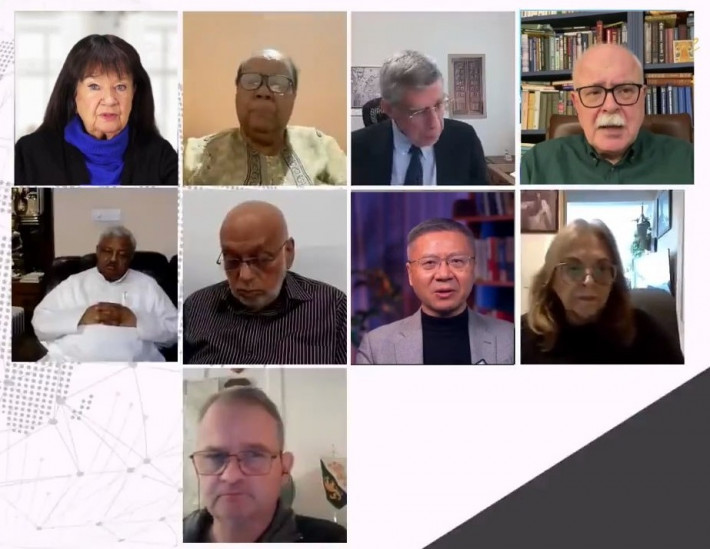
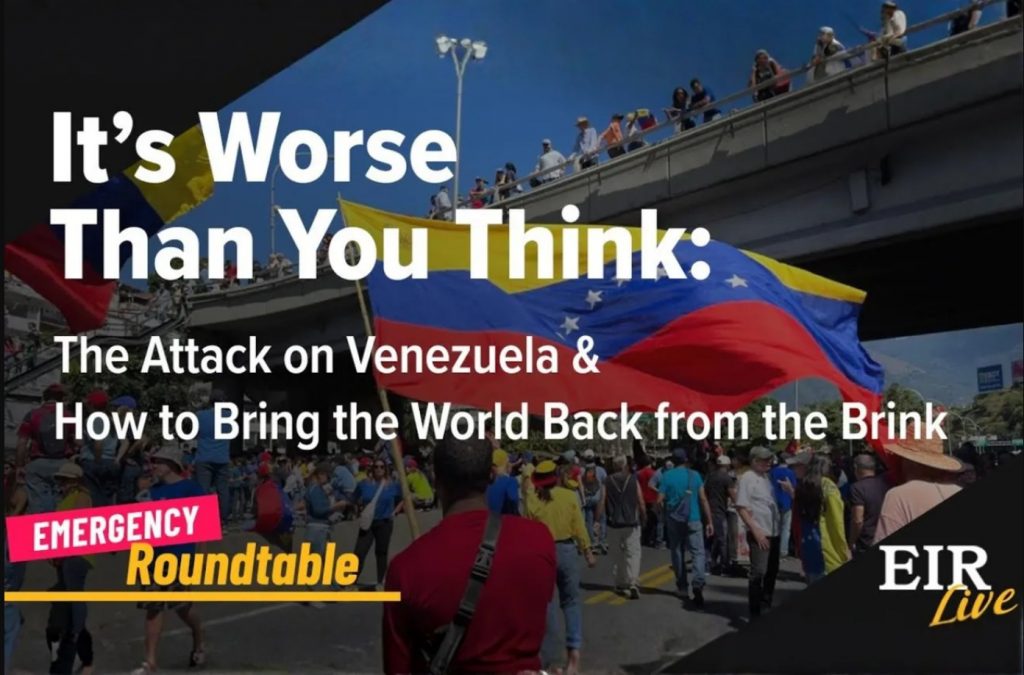
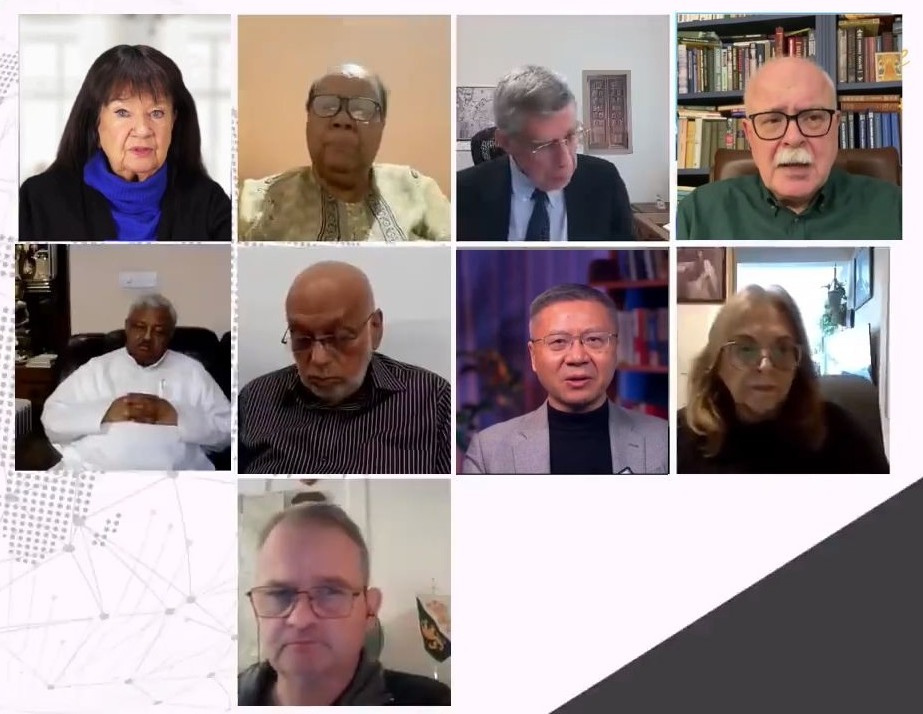
Executive Intelligence Review sponsored an Emergency Roundtable Jan. 12, featuring leading political figures from around the world, which convened online under the theme, “It’s Worse Than You Think: The Strategic Implications of the Attack on Venezuela and How To Bring the World Back from the Brink.” Ten experts, from the Americas, Eurasia and Africa, representing long experience and tested judgment in international affairs, met for nearly three hours, with a live-stream audience averaging 1,200 participants, with translation in English, French, German and Spanish.
Helga Zepp-LaRouche, Editor-in-Chief of EIR, and founder and leader of the Schiller Institute, welcomed her 10 fellow panelists, saying: “We have assembled here today not to lament the unprecedented situation which can only be described as a threat to the existence of the entire human civilization, but to discuss, analyze, and catapult an international response to restore international law.”
The stern reports and evaluations that followed provided a powerful expression of the shock and disgust around the world at the violent actions of these past weeks, and the role of the United States government in acting with abandon to discard international law.
However, as one speaker said: “we are not here to become more knowledgeable” about the crises, but to confer on galvanizing action to change the situation. Proposals ranged from a “Declaration” to be issued, to consensus that the priority is to mobilize the forces of the Global Majority to discuss new “configurations” to be supported to restore international law and morality. Many confirmed that the UN General Assembly is still a formation of potential positive international impact. The idea was posed to create a “structured international civil organization.”
Several speakers made the point that the cultural and political situation inside the United States is a priority to transform and upgrade. There is a correspondence between the violence underway inside the United States, and the international lawlessness from Washington. As one senior U.S. diplomat stated, now is the time that “America must introspect.”
Zepp-LaRouche summed up at the conclusion of the discussion that an organizing grouping will be formed to formulate priorities and to move on followup action.
The discussion period allowed for several exchanges on how to make this Roundtable of leading figures the basis for a global movement. The proposals discussed were for a UN General Assembly action to stop the U.S. policy; creating a movement of civil society organizations to intervene globally; activate mass movements along the model of Mohandas Gandhi, Nelson Mandela, and Martin Luther King, Jr.; start a movement for the forgiveness of the unpayable debt; to remind Trump that he campaigned against the “Deep State,” but now appears to be run by that same Deep State.
Terming the event, “extremely productive,” Zepp-LaRouche called for everyone to reach out to good institutions and individuals. She noted—not in a religious, but in a humanitarian way—that Pope Leo XIV, on the occasion of the Jubilee year, has backed debt relief, and called for the “coincidence of opposites” way of thinking based on Nicholas of Cusa (15th century), which provides one path for organizing. The necessary elimination of the debt bubble must be controlled—an uncontrolled collapse could cause chaos. We should get this discussion to world leaders and institutions.
Extraordinary Panel
The discussants were truly an extraordinary gathering of expertise and morality, amounting to a Council of Elders. The moderator was Dennis Speed of the Schiller Institute. Presentations were made by the following speakers, in the order given, proceeding after the Mrs. Zepp-LaRouche’s opening:
Naledi Pandor, former South African Minister of International Relations and Cooperation;
Zhang Weiwei, Professor of International Relations at Fudan University in Shanghai;
Chas Freeman, former U.S. Ambassador;
Dmitri Trenin, Director and Academic Supervisor of the Institute of World Military Economy and Strategy at the HSE University in Moscow ;
Donald Ramotar, former President of Guyana;
Graf Hans-Christof von Sponeck, former UN Assistant Secretary General;
María de los Ángeles Huerta, former Mexican Congresswoman;
Namit Verma, Indian author and security analyst;
Dennis Small, EIR Ibero-America Editor; and
Lt. Col. Ralph Bosshard (ret., Swiss Army), former military adviser to the OSCE secretary general.
Video archive of the Roundtable will be available, and upcoming issues of the weekly EIR will publish selected transcripts. The following are selected highlights.
Zepp-LaRouche pointed to U.S. President Donald Trump’s recent declaration that he is not bound by international law, but only by his own mind, allowing the “might makes right” actions he is following. Trump’s call for increasing the U.S. defense budget from $1 trillion to $1.5 trillion, together with the military buildup across Europe, demonstrates that we are on a path to global nuclear war. She insisted that we are the only species capable of reason, and thus, can and must act to change this disastrous course. She reviewed her own proposal for “Ten Principles of a New International Security and Development Architecture” and noted that these ideas were contained also in the four global Initiatives of Chinese President Xi Jinping.
She called for a return to the principles of the 1648 Peace of Westphalia, placing the concept of “one humanity” above all, as also in the concept of a “coincidence of opposites” presented by Nicholas of Cusa in the 15th century, as a means of resolving differences by reaching a higher, unified vision. We must reach back to all the great thinkers of our different cultures, such as Confucius, Plato, and Leibniz, to restore a true love for humanity through agape.
Hon. Naledi Pandor addressed the horror expressed around the world at the illegal acts against Venezuela; and she warned that an attack on Cuba would be “a catastrophe.” She is the former South African Minister of International Relations and Cooperation, and Chair of the Nelson Mandela Foundation, who initiated the South Africa’s motion to the International Court of Justice (ICJ) to investigate Israel’s genocide in Gaza. Pandor pointed out that most of the Western nations accept that the West can override the interests of Russia. Developing countries have suffered under colonial rule, which the UN Charter was intended to eliminate, assuring the protection of the vulnerable from the strong. What is occurring now is the “most dangerous abuse of international law since 1948,” she said. The BRICS, the Hague Group (formed by nations of the Global South in January 2025 to defend the ICJ’s investigation of genocide in Palestine), the African Union, and other international organizations “must do more to restore international law,” while civil society organizations must also speak out. The UN must be reformed, so that those who break the rules of the Charter face a court. And individuals, too, must cause “good trouble.”
Prof. Zhang Weiwei expressed his outrage at Trump’s actions in Venezuela, terming it a “dangerous precedent” for the future. He noted that the U.S. had a “long history of reckless invasions,” adding that the new U.S. National Security Strategy granting power to the U.S. over all of the Western Hemisphere is “shortsighted and self-defeating,” which is destroying the country’s “soft power” by carrying out regime-change operations militarily, while using a “value-based humanitarian figleaf.” The U.S. action is destroying the UN Charter, which was “forged by two world wars.” He called for all nations to “unite to save the UN Charter.” He condemned the recent moves in Japan to restore the militaristic policies that had caused such destruction in World War II, insisting that China “will not accept the return of Japanese militarism,” and warned the U.S. and others that the world will not accept the end of the UN Charter.
Chas Freeman, former U.S. Ambassador to Saudi Arabia, expressed support for German President Frank-Walter Steinmeier’s recent denunciation of the U.S. being responsible for a “breakdown of values” and allowing the world to become a “den of thieves.” “My country,” he said, “has followed Israel in the law of the jungle,” acting like a mafia in protection rackets. “We are heading into a New Dark Age,” he warned. The genocide in Gaza, he said, demonstrates that “words won’t fix it” when there are such blatant crimes against humanity. The banning of free speech is a “disastrous misjudgment,” while the media refuse to even report that Russia had reasons for the invasion of Ukraine, or the blatant act of piracy of a Russian ship, or that the U.S. has turned Venezuela into a colony. Now the U.S. is even threatening its allies, pointing to Greenland. On Trump’s “brutal reassertion” of the Monroe Doctrine, he warns that “Venezuela is just an opening move.” In the face of such an “abyss of tyranny,” Freeman said, “rhetoric is not enough—if we can’t convince our governments to respect the Peace of Westphalia, we will perish.” Our rules have failed, and if the UN cannot enforce the peace, we must “find a work-around,” to either “repair or replace it.” Surely, the ambassador concluded, “we can stop this run to nuclear war.”
Dmitri Trenin, Russian military and economic strategist, gave a “bleaker view of the path ahead,” warning against the use of force. In particular, he said that Trump “won’t stop until someone strikes back.” He said that this forum was provoked by the attack on Venezuela, but he asked himself, is this the cause? Rather, he said, look at Iran, at the Israeli and U.S. war on Iran, which shows the worst that this can become. The advent of Trump, said Trenin, changed the priorities of the U.S., but they are still the same policies of the U.S. since World War II. But the “globalist collective West” is no more, now it is Trump’s personal force, while the hegemony of the U.S. is still in force. On Venezuela, he believes it was an “inside job,” as was also true in the Iraq war. What can be done? Trenin proposed that China and Russia must cooperate more, and that Iran must do more to defend itself. Trenin worries that the only protection of states over the past decades was the possession of nuclear weapons.
Donald Ramotar, the former President of Guyana, a neighbor of Venezuela, which has been threatened by Venezuela over contested territory, nonetheless asserted that the kidnapping of President Nicolás Maduro was a “giant step backwards for humanity.” The U.S. is asserting itself a “super colonial power, even against its allies in Europe.” He thinks this is MAGA, mafia style. There is no regard for sovereignty or international law—already seen in Gaza. The immediate target is China and the BRICS, to “push China out of South America and the Caribbean.” The targeting of the BRICS is because the sanctions failed to destroy Russia as intended, and the U.S. fears losing its position as the unipolar power. Those supporting democracy in the U.S. are powerless, and now chaos is breaking out in major U.S. cities. The military-industrial complex that Eisenhower warned about has taken over foreign policy, and is now moving on domestic policy. The policy will spark a new global battle for liberation, or nuclear war. The U.S. must mobilize against this madness. Ramotar praised Diane Sare for announcing her campaign for U.S. President.
Graf Hans-Christof von Sponeck from Germany, the former UN Assistant Secretary General, said he had studied and worked in the United States, but that what he sees now is not the “good” U.S. he used to appreciate. He proposes that the UN should activate Article 6 of the UN Charter, which allows for the expulsion of a country which consistently breaches the UN Charter, but added that perhaps the U.S. should have its membership “frozen” first. He also called for an integrated social forum internationally, a civil society institution to act on global policy.
Maria de los Angeles Huerta, a former member of the Mexican Congress warned of a “brutality unmatched threatening 2026,” with Mexico definitely threatened. She described this as the “death rattle of the bankrupt financial system.” In keeping with Helga Zepp-LaRouche’s Ten Principles, she proposed: development of the transoceanic rail connection between the Pacific and the Atlantic Ocean and an energy and monetary fund to protect all the countries of Latin America, as well as a security pact as a deterrent to “the new fascist policy of Donald Trump.” She called for support of an “Action Group” designed to find new pathways. She recommended joining in international actions on Jan. 17, when the World Without War group is demonstrating.
Namit Verma, a security expert from New Delhi, India, said that Trump’s actions are “so wild that it shocked the world into seeing the state we are in.” The world is itself responsible, since after World War II there was an agreement to tie the dollar to gold, keeping exchange rates stable, but on Aug 15, 1971, Nixon made a “unilateral declaration ending this policy, and we accepted it.” He said, there have been many more betrayals. Now, America is bankrupt. “Do we need to save a bankrupt Empire?” He said, “pragmatism has become opportunism.” It is time to call the bluff of the U.S. and of Trump.
Dennis Small,EIR Ibero America editor, presented the dimensions of the Western system debt and financial aggregates bubble, standing at $2.4 quadrillion. The system is bankrupt, and even worsening through the crypto bubble and bailouts. This is “Schachtian” economics as Hitler’s central banker Hjalmar Schacht devised it—printing money for mass military buildup to save the bubble and the Empire. One-third of the U.S. budget will be going to Wall Street through military spending and debt service. Thus the world economy is governed by the military ambitions of the Western leaders preparing for a war against Russia. Small referenced LaRouche’s “Four Laws” as the crucial alternative, including a global Glass-Steagall, and new national banks to provide credit, and currency controls for all nations, to allow an economic development drive with vast increased employment in productive jobs. Think of a Global Land-Bridge spanning the world.
Lt. Col. Ralph Bosshard, who served as the military advisor to the OSCE secretary general, said the unilateral attack on Venezuela sent a message to the world that universal law is finished. This is not new, he said, since the 1999 bombing of Yugoslavia without UN approval was already bypassing international law. Now we have nations building military coalitions among the 150 countries which are not already part of military alliances. The talk of a new Monroe Doctrine is absurd, since the original Doctrine was to stop the Spanish and Portuguese colonial powers from undertaking any operations in South America, not to make the U.S. into a colonial power, as is now taking place.
Zepp-LaRouche, Schiller Institute’s founder and international president, held this speech at the successful diplomatic seminar in Copenhagen on December 11, 2025.
The diplomatic seminar was attended by 14 diplomats from 10 countries, with guest speakers H.E. Ambassador Prof. Dr. Manuel Hassassian and Helga Zepp-LaRouche, who travelled to Copenhagen from Germany. The title was “Can There Finally Be Peace Through Development Between an Independent Palestine, Israel and the Region? Build the Oasis Plan Now!”
The countries in attendance comprised six from Southwest Asia, one from Western Europe, one from Eastern Europe, one from Africa, and one from Asia. Five other countries had registered but were unable to attend. A few Schiller Institute supporters were also in attendance.
Ambassador Hassassian delivered a one-hour speech with his insightful analysis of the obstacles and prospects for peace, and a wonderful conceptual description of the Oasis Plan, which he fully supports. He answered two questions from Helga Zepp-LaRouche, the first about the new U.S. national security report implications for the conflict in Southwest Asia, and the second, in which she thanked the Ambassador for his support for the Oasis Plan, and said that the next step should be for a government to sponsor a conference to elaborate the plan, including students making AI animations to visualize it. Ambassador Hassassian also answered questions from two diplomats.
Zepp-LaRouche denounced the ongoing genocide in Palestine and described the Oasis Plan in more detail, in connection with the World Land-Bridge. She then gave a briefing based on her new document, “Withdraw from NATO! New National Security Strategy Requires New Security Architecture,” calling for a Westphalian peace process. She answered two questions from a Schiller Institute organizer, about the need for a new cultural renaissance, and about using Nicholas of Cusa’s method of conflict resolution in our time.
Speakers: H.E. Prof. Dr. Manuel Hassassian, the Palestinian Authority’s ambassador to Denmark, who is shortly retiring from his post in Denmark, will present his parting evaluation about the prospects and obstacles for peace and Palestinian independence. He is a supporter of the Schiller Institute’s Oasis Plan for peace through development. H.E. Prof. Dr. Manuel Hassassian has “a PhD in comparative politics and has over 25 years of academic experience, including as executive vice president at Bethlehem University. Prior to his current role, he served as the Palestinian Ambassador to the United Kingdom from 2005 to 2018. Professor Hassassian is a dedicated advocate for Palestinian rights and has been actively involved in international dialogues promoting peace in the Middle East.
Helga Zepp-LaRouche, founder and international president of the Schiller Institute and editor-in-chief of Executive Intelligence Review (via live video). Helga Zepp-LaRouche founded the Schiller Institute in 1984. She was married to Lyndon LaRouche (1922-2019) who, in 1975, proposed an Oasis Plan for peace through development between Israel and Palestine and the region. Since November 2022, she has been promoting the establishment of a New International Security and Development Architecture, and she initiated the International Peace Coalition in 2023.
Excerpt from the invitation:
The peace plan signed on October 9, 2025 was an inflection point in the long conflict between Israel and the Palestinians, and the Southwest Asia region as a whole. The living Israeli hostages and hundreds of Palestinian prisoners were released from captivity. A cease-fire was agreed upon, yet the killing in Gaza continues, albeit at a lower level. The demolition of structures continues. Humanitarian aid is constricted. Israeli settler violence escalates on the West Bank. Israeli Prime Minister Netanyahu continues to say that he will not allow an independent Palestinian state to be established. Many parts of the peace plan are undefined or disputed. The question is, how can the international community act to ensure that a genuine peace is achieved? One thing is to increase support for the independence of Palestine. But another crucial element is the need to promote the idea of “peace through development.” In 1975, Lyndon LaRouche (1922-2019), the American economist and statesman proposed an Oasis Plan – an ambitious infrastructure project to produce massive amounts of fresh water in the region, to increase economic productivity and to provide a vision of win-win cooperation between Israel and Palestine, and the region – to pave a pathway to peace. As LaRouche emphasized after the Oslo Accords were signed in 1993, the shovels have to hit the ground. That time, it did not happen. Can it happen now?
Moderator Tom Gillesberg, President, the Schiller Institute in Denmark: Helga Zepp-LaRouche over the last half decade has been engaged in so many projects of peace and development and creating prosperity for the world. But as she also said, as of late, she has also been the initiator and the driving force in the International Peace Coalition, which for more than two years, has been bringing together peace movements, and and other persons and groups from around the world to bring them into a discussion by saying, if you want to create peace, no matter where you are right now, we all have to work together because the challenges that stand in front of us right now are of a scale that we actually need to get everybody to collaborate. Very important for the discussions we just had is that she has been proposing ten points for a new security and development architecture for the world. How do you get this shared security for the world? You are not going to get it by leaving it to the European leadership right now, or leaving it to Donald Trump right now. You really need a leap in, what Ambassador Hassassian would say, powers of imaginations. And Helga definitely has that, and has put forward her points. So we are very, very happy that [you will speak to us.]
Helga Zepp-LaRouche: Let me ask a question. Who knows about the Oasis Plan? Are you familiar with it, or should I go through the basics?
Gillesberg: Maybe the basics.
Zepp-LaRouche: Okay, so I will. Given the fact that my presentation would be longer, I have to cut it now to a certain size [because of time constraints].
So as the ambassador said, the plight of the Palestinians right now is enormous. The ceasefire is not holding. Gaza is practically divided into three zones, a green zone, which is Israeli occupied, a yellow zone, which is where the border, so-called division line goes, and the red zone, which is supposed to be permanently rubble. It’s being dismissed as — because there are altogether, I think, 68 million tons of debris. This debris is, you know, many, bombs which did not explode, other missiles, things which are still war material and about 10,000 dead bodies under this debris. So it’s a unbelievable. And people are living in tents now. The winter is coming. The rain has been very heavy. So people are wet, have nothing to eat. They have no perspective. So I just think it’s very important that we in discussing all of that, do not forget that every day still children are dying. The malnutrition of children is enormous. Babies are born weighing less than a kilogram. Their life expectancy looks very bad as a result. So, you know, I just wanted to reemphasize – – I cannot go through a lengthy description of it – – but I think it is important, because it is completely intolerable that this situation continues despite the fact that there is a so-called peace plan. Just yesterday, Hassan Badran, who is Hamas official, basically said that there is no progress in the peace plan. I spare you the details of that.
Let me go through what our proposal is. When when I’m now talking about it, you have to have in mind where we are now, which is genocide, which is unbelievable humanitarian catastrophe. But if you don’t start with a vision, as the ambassador was, was saying, there is no way how you will get from that horrible condition to a better future. And therefore, let me start with the first picture. This is the the basic project. This is the idea – – This region actually, it’s not exactly visible here, but it’s all desert. I don’t know you. You all are from that region. But I have flown once from Khartoum to Jordan, to Jordan. And this is a 3.5 hour flight, three half hours over desert, desert, desert. So the idea basically is that, we have to create plenty new fresh water. So the idea is to make a canal. To take the second picture to create two canals, one to connect the Red sea and the Dead Sea, and another one to connect to the Mediterranean.
Now, because the the Dead Sea is 400 meter below sea. So therefore you can basically use the ocean water being pumped into this region or flowing into this region also for hydropower. Basically the the idea is to not only use existing fuel capacities like the oil and similar gas which is available in front of Gaza, but to build as quickly as possible small nuclear power plants. The fourth generation is inherently safe. You can use the the pebble bed reactor, the high temperature gas cooled reactor. These are all being in process already in China. Some of them were originally developed in Germany, but because Germany is so green, they were never put in there. But now China is having all of these reactors. Russia is building these reactors, as a mass production. That’s the idea for export to the countries of the global South, and then use this electricity to have large quantities of desalination of ocean water. And through some man made rivers, you can then distribute this water throughout the whole region, connecting it with other water resources like aquifers, like ionization of the atmosphere, which creates new rain patterns. I mean, this is a whole project which eventually should encompass the entire region from India to the Mediterranean, from the Caucasus to the Gulf.
So, this region, in the past, was a hub, in the times of the ancient Silk Road. This was a flourishing region. Damascus, for example, was a marvelous cultural high point. Baghdad, at a certain point, was the most developed city in the world. They had the most librarians, the most books of anybody in the Abbasid dynasty. Europe recaptured its own roots through the collaboration between Harun al-Rashid and Charlemagne. So this is a very rich history. We are not starting from scratch. The possibility to build that, it would be very easy to do. Technologically it’s a piece of cake. We had conferences on the Oasis plan with participation of Chinese scholars, among others, Professor Zhang Weiwei, who said, ‘yeah, China could do that. We have greened the desert in Xinjiang.’ And also in the northeast of China, there was a huge desert, which has been completely changed — it’s the size of a territory of Germany — where there is now forests, orchids, tourism. So the Chinese have the technological ability to do that. And as you know, the Chinese are doing everything very fast. If you go to the Germans these days, it takes a long time. But if you go to the Chinese, they build everything in half a year and it’s ready to go.
[Next slide] This is the nuclear power plants along the canals. [Next] This is how it will look like later on with the new man made rivers, which you can direct then in many directions. [Next] The reason why this is now eminently possible is because there is a huge change going on in the world. That is a plan we have developed, in 2014, when XI Jinping put the New Silk Road on the table in Kazakhstan. We published all our development studies, all over the world. We had worked on Africa plan, 40 year plan with India. Plan with Lopez Portillo for the integration of Latin America. A plan for the Pacific Basin. The next 50 years. When the wall came down [in Germany – edit], we developed the Eurasian Land Bridge as a proposal, as the economic basis for a peace order for the 21st century. So when XI Jinping announced the Silk Road as a Chinese policy, we updated all our plans. We put it in one book. You can find it at the book table. And this book was published immediately into Chinese, Arab, French, German and Korean. And it has been sent to 1000 universities and think tanks in China from the Zhongyang Finance Institute. They said this is the standard book for every scholar who wants to deal with the Silk Road, because it’s the most developed conception.
So many parts of this are being built already through the Belt and Road Initiative. China has made many projects. For example, the China-Pakistan Economic Corridor or the railroad from Kunming to Laos, the fast train from Jakarta to Bandung, many projects in Africa. The Great Ethiopia Renaissance Dam (GERD) has just been opened in September. This is now producing electricity for all of Ethiopia. But also a neighbor countries. So anyway, so this is the context.
Now on the political side, we are experiencing right now, a complete earthquake. Because with the publication of the new security strategy paper of the United States, there is a revolution. You know, this paper has interesting parts, bad parts, good parts, but it has completely upturned the apple cart, so to speak. The bad part is for sure that they are now putting a lot of emphasis on the Western Hemisphere. There is a threat of an invasion in Venezuela going on right now as we speak. But the good part for sure is that Trump wants to normalize relations with Russia, and the Russians are taking this very serious. They’re not naive, but they say that they have, basically very good discussions between Witkoff and Kirill Dmitriev. They just published the recent round went very well. So this is hopefully getting the Ukraine crisis under control. Naturally, I mentioned already that the Middle East is supposed to have less emphasis. The relationship with China is moved away from the coming war with China to more, the fight with the competitor, economic competitor, China.
How that plays out in the Indo-Pacific is not yet completely clear, but it is definitely a complete change to all previous security doctrines of the previous administrations, Biden and Obama and Clinton and so forth. So this has caused a complete upset in Europe because in the paper, it’s very harsh on criticism of Europe. It says that if Europe does not change, it will face civilizational erasure. Now that is a pretty strong language. It says Europe should watch out that in 20 years it’s still there, more or less. The reason given is implied that it’s the migration. Now, I have said similar things that if Europe doesn’t change, we will basically become marginal in history, but not because of migration, because of wrong economic policies and wrong cultural policies. But I have said something going in a similar direction. So now there is a huge freakout in Europe. Some of the strongest pro-Atlanticist politicians, they say we no longer can talk about the United States as an ally. There are even people who say that the United States is now becoming an enemy. I mean, it’s a complete freak out. I mean, I can only emphasize I have never seen something like that. So obviously this means a lot of changes.
The coalition of the willing, that is Germany, France, Great Britain and Poland and, you know, Baltic Chihuahuas, as Pepe Escobar always says. They want to continue the war in Ukraine. But everybody knows the Europeans without the United States don’t have the military means to do that. And they don’t have the economic means either. So how that plays out remains to be seen.
But, if you look at the world as a whole, you have the Middle East horror show, you know, with Gaza, what I just said, you have the Ukraine war, which means in any case, you know, the country is destroyed, the population is halved. It’s a terrible situation. You have now the danger of an escalation between Japan and China because of the new prime Minister Takaichi, making these provocative remarks on Taiwan. You have a pending invasion in Venezuela. So looking at this picture as a whole, and you have right now elements who want to increase the offensive mode of NATO. In the first week of December, the present head of the military commission of NATO, Italian Admiral Tarragona [UNCLEAR], he said that NATO should make a preventive attack against Russia. And, it turns out this interview was given already in mid November but published only beginning of December. And the spokeswoman of the Russian government, Maria Zakharova, in my view, correctly said this was an attempt to sabotage the negotiations around Ukraine by just creating another havoc.
So I, I at that point said, look, since the beginning of the special military operation in February 2022, I already had called for a new security and development architecture, which must put the whole world on a completely different basis, because it’s very clear the neoliberal order is not functioning. The effort to establish an unipolar world after the end of the Cold War did not function. It caused a tremendous blowback because it caused the countries of the global South to basically say, now they have to end colonialism and become the producer of their own value chain in their own country. So they have formed the BRICs with Russia, China, Brazil, India, South Africa, which is now 20 countries, and many more want to be part. There is the Shanghai Cooperation Organization, and these organizations want to build a new economic system with an own credit system, their own investment possibilities for development.
So the world is breaking apart. And that is why I say we need a new security and development architecture, which this time must take into account the interests of every single country on the planet, or it will not work. So therefore, you know, I basically issued a statement, three or four days ago calling for the exit from NATO because, you know, Germany is in a NATO alliance, which if it ever comes to war, there will be nothing left of Germany. Germany will be erased. We had a conference with Ted Postol, who is an eminent rocket and nuclear scientist who produced maps of where the nuclear bombs would fall in Germany if it comes to war. And it makes very clear that there would be nobody left, not one living person in Germany. So if Germany is in a military alliance, which in the worst case does not allow the survival of this country, obviously we are in the wrong military alliance. And, the character of NATO has clearly changed. You know, I mean, one can argue all kinds of things about NATO in the time of the Cold War. But, from NATO, which was relatively defensive in the 80s, it has transformed into an organization whose function obviously is to protect the progress of the unipolar world. It has expansion plans for the Pacific, global NATO, which is only aimed to contain Russia and China, and therefore, it’s not a North Atlantic alliance, but it has other ambitions. So therefore I said, why don’t we dissolve NATO? It should have been dissolved in ’91 when the Warsaw Pact was dissolved. And let’s replace it with a new security and development architecture, which, you know, must really be global because otherwise it does not function. The Peace of Westphalia worked because it recognized the interest of the other, of every other. And it led to peace.
When the Versailles Conference took place, or the Paris Peace Conference of 1919, they did not invite Russia, the Soviet Union. They did not invite China. And therefore, you know, it was the stepping stone to the Second World War. So what I have proposed is, from a European standpoint, you know, based on the tradition of the Peace of Westphalia, which ended 150 years of religious war, because people realized that if they would continue the war, nobody would be left alive to survive and enjoy the victory. Now, a very similar proposal has been made by President XI Jinping, who has in the recent years made four global initiatives: the global Security, global development, Global civilizational and global governance initiative, where the last one, the Global Governance Initiative, is exactly the same idea that you need a new security architecture where every country participates in. And every country, if it’s big or small, powerful or not, have one voice, that there is no right to interfere in the affairs, in the internal affairs of the other country. There is no way how you can force a country to adopt a different social system than that, based on its own choice and tradition. So it ends the idea of export, of human rights, democracy, and all of this, which has been the trademark of the European policy.
So therefore, you know,President XI Jinping has proposed the Global Governance Initiative. President Putin several times proposed a Eurasian new security architecture. They just two days ago had in the Valdai Club conference on that topic. So they mean it very serious to have a new security architecture. He has not spoken what should happen with the United States or other parts of the world. And I think it has to include everybody because otherwise it does not function.
Now, obviously, this is also urgently needed for another reason, and that is that we are sitting on a time bomb. The time bomb being the threat of a new systemic financial collapse, much worse than that of 2008, because in 2008 we already had a systemic collapse. At that time, the root causes were not eliminated, but it was just, quantitative easing by the central banks flooding the problem just by, you know, inventing liquidity without any limitation. And that naturally comes to an end because it borders hyperinflation if you do that. And now the central banks are practically left without any remedy, and the amount of money in the system has increased by a factor of magnitude of several magnitudes. So we are sitting on a unpayable bubble of 2 quadrillion outstanding derivatives and other speculative assets, cryptocurrencies, stablecoins, things which have no value and are just added bubbles to this gigantic everything bubble. And if this bubble collapses and it could collapse through a whole variety of reasons, it could be a bankruptcy, a chain reaction.It could be the insolvency of emerging markets. It could be when the Europeans are stealing the Russian assets in Belgium and other countries of several hundred billion dollars, where Russia already has announced that they would answer that with equal countermeasures. This could blow up the whole system. So we are sitting on a powder keg of landmines, you know, where there are thousands of such mines and one doesn’t know which one will be the one which will explode. But if this would happen, it would lead to a total, total collapse of the financial system and the economy, industry, agriculture.
So the only way to approach that would be to do what my late husband, Lyndon LaRouche, already anticipated, which would happen in 1971, where he predicted that the replacement of fixed exchange rates through floating exchange rates by President Nixon would lead to a systemic collapse. And that’s exactly where we are at. And what one would need to do is what Franklin D Roosevelt did with the Glass-Steagall Banking Separation Act in 1933. That is that you have to take control over the financial system through government actions. You have to protect the commercial banks, because these are the banks who give credit to industry, to agriculture, to trade. However, the investment banks and everything which has to do with speculation has to be separated out. They have to see if they can bring their books in order without government money, without taxpayer money. And if they don’t are not able to do that, they have to close down and declare insolvency.
But this system where you permanently take money from the taxpayers to finance the speculative gains of the billionaires, that has to stop, because this system has led to a situation where the class of billionaires is growing. You know, you have now thousands of billionaires, and you have some of them who want to become trillionaires like Elon Musk, Bill gates, they all want to now reach trillions. I think this is actually obscene. That one person should have a trillion or several trillion dollars or euros, while the majority of the people are getting poorer and poorer and poorer. So we need to have a global Glass-Steagall. That is, every country has to do that, and preferably they should do it in consultation and coordination. Because if only one country does it and the other ones are sitting there with their positions not covered, it could have an incredible disruptive effect. So therefore, you know, there must be a recognition that this is a problem we only can solve together. And for that, a Peace of Westphalia kind of approach where you first agree on principle; to move away from confrontation to cooperation, to use diplomacy and negotiations to resolve all conflicts and to respect the interest of the other. So if you agree on these principles, then you can do exactly what they did in the Peace of Westphalia negotiations, where in Münster and Osnabrück they were sitting for years on tables discussing every detail, territorial disputes, you know, ethnic religious questions. And once you agree on principle that you want to solve something together, then you can find the atmosphere and the approach to solve any problem because they are all man made. They’re not, you know, not natural catastrophes. They are man made problems so men can solve it.
So that is our approach and that is why we have issued the Schiller Institute has issued this call. It’s called, stop NATO or, Withdraw from NATO. The new security strategy requires a new security and development architecture. Now, we are circulating that proposal, and I think you have it here. Oh, it’s in the package. I would like you to read it, if you agree, if you are a diplomat, you may not want to sign it, but you may know somebody who would sign it, like a professor or a government official or some other person. Because we want that proposal to be earnestly on the table. It includes such questions like the Oasis Plan. It includes, for example, when President Trump and President Putin met in Anchorage, Alaska, they met. And in the aftermath, it became very clear that one of the projects – – maybe you can show the other map where one can see the Bering Strait. This is the tunnel planned between Alaska and eastern Russia. This is only 100km, and you can build a tunnel, which then would connect the Americas through infrastructure with the Eurasian continent. It would mean that not only you could open up the far east of Siberia, where you have enormous, raw material riches which are not developed because large part of it is permafrost.
So, for the last several years, the economic forum in Vladivostok was always featuring the idea of developing the far east of Siberia, because here you find all the elements of the Mendeleev table, periodic table. So it is all the raw materials in the world where, for example, countries who have not a lot of raw materials, like Germany, like Japan, many others could be part of this investment and be part of an enormous economic boom in both Russia and China has expressed great interest as well. So if that happens, you can make back the landbridge. You can soon travel from the southern tip of Chile and Argentina with a fast train all the way up in North Latin America, Central America, United States, Canada, Alaska. Then you go through the Bering Strait tunnel. You travel through the Trans-Siberian railway. You connect to the European transport network. The Spanish government has just made a feasibility study, I think, with the German tunnel builder Herrenknecht to build the Tunnel of Gibraltar. This is also a very small strait where if you would build this tunnel, which has to be very deep, but it’s technologically not a big problem. You could then continue to travel with the same train, which you started in Chile, all the way through Africa to the Cape of Good Hope. Now go back to the Eurasian, to the world. Land-bridge.
So soon, if we come to this agreement of a new security and development architecture and development architecture, emphatically saying, these kinds of projects will be all agreed upon because it is in the mutual interest of of all sides. And you will connect all continents through either tunnels or bridges, so that basically the whole world will be infrastructurally connected. And that is, if you think about it, that is the normal path of events. Because, I mean, if you think 10,000, 20,000 years ago the only civilization was on rivers, on the ocean, and people did not go inward. Why? Because it was very difficult. You could not just go into the inner parts of the continents. Only when the railway was developed, you had transcontinental railways in the United States, in trans-Siberia. And slowly but steadily, the inner parts of the continents were opened up for development. And when we built this world system, it will connect the whole world. It will be the basis for peace. And the German economist Friedrich List, already had the vision that this would happen sometime in the future. And he said, you know, there will come a time where space and time will be shortened in such a way that the whole world will be understanding itself as a one.
And that will have an incredible impact on the identity of how people think. They will no longer think, these other people and these people, but they will understand that we are all part of the one human species where it is in our interest to work together. So I think that as a peace vision, this concept is absolutely, important. Actually Africa is right now, the most interesting continent because, you know, all the other continents have demographic negative curves. The United States, China, Latin America, they all go down. Africa is the only continent which has population growth. And by the year 2050, they will have 2.5 billion people. That means 1 billion more in 25 years. Naturally, they will all be under 25. Logically. And that means, you know, we have to build 1 billion new productive jobs in Africa to accommodate these people.
So, we have proposed, therefore, joint ventures between Africa, China and European nations. Naturally, other countries are as well. And that way we could think of transforming the African continent in a few years. If you go in basic infrastructure, ports, railways, waterways, highways, integrated energy production, communication, industrial hubs and certain game changer projects like for example, I mentioned already the GERD, the Grand Ethiopian Renaissance Dam, as a perfect example because there China, Ethiopia, Italy and France were working together and this is a perfect project of what kinds of things can be done. There is now the plan we are working right now on the development plan for the Inga Dam in Congo. This will be a is actually several dams, and it will give electricity to all the countries around. Then another project is the Trans-Aqua project, which will basically industrialize 12 countries from the Congo to Lake Chad, because it’s the idea of taking 3% of the water which flows into the Atlantic and bring them from 500 kilometer heights through a system of canals to Lake Chad, where it will be used for irrigation. And you know that you can green the desert there as well. So that will be a game changer project. So that is basically how I think we should think about it, to intervene through peaceful development. So if you agree with that, then help us to distribute this call.
Moderator: We are running a little late, but maybe 1 or 2 quick questions if somebody has something.
Question: What one aspect that you have spoken about is the question of the culture and what what needs to be done to create a new renaissance of culture and how that would affect the rest of society.
Zepp-LaRouche: Well, the good news is that the renaissance of classical culture is already taking place in Asia, not in Europe, but in Asia, because the Asian countries, who all have a history, many of them 5000 years old, and they have, made a big effort. All of them. I mean, India, China, Persia, Vietnam, Thailand to actualize the knowledge about the ancient tradition in their populations, by making restoration, by digitalizing a lot of the cultural goods. So they understand that to be rooted in the best tradition of your own culture is the precondition to be oriented towards the future. Europe, unfortunately, has not done that yet. I hope that we can encourage them to do that. But I think the dialogue of cultures where every country and every civilization goes to their best tradition, and then that way you learn about the other one and vice versa. It will open people’s eyes. You know, it will be the best medicine against chauvinism, racism in all of these evils by simply showing people how beautiful the world is. Because I think the multiplicity of the different cultures is an enormous wealth, you know? And once you start knowing in depth the other culture, it opens your eyes about the limitless creativity of the human species. So I’m absolutely convinced that the cultural dialogue is an absolute important ingredient for our plan to work.
Question: And a related question. Recently you have been, expressing how important the statement by the Pope Leo the 14th about, referring to Nicholas of Cusa, of about –because the ambassador spoke about conflict resolution. Can you just say shortly, about the importance of of these ideas for the question of conflict resolution?
Zepp-LaRouche: Yes, because Nicholas of Cusa, who was an important, the most important thinker of the 15th century, at least in Europe, developed a new method of thinking, which he called the Coincidentia oppositorum, the coincidence of opposites. And that was, you know, he said that he had, when he travelled from Byzantium to Florence, in traveling over the ocean, he had a divine inspiration and all of a sudden thought, something which he recognized no human being had ever thought before. And it was a method, namely the idea that the human mind can always find the higher One, where all the contradictions on the level of the many is overcome. He discussed it from a theological standpoint that the One is naturally God, in which all contradictions are folded in which are then, let’s say, emanated through the creation, in the physical universe and on Earth. But the ability of the human mind to think that One which is of a higher magnitude and of a higher quality than the many, is a perfect conflict resolution. I have developed a habit to think that way a long time ago, because I come from Trier. And Nicholas, of course, naturally was called the [Treverensa], the person from Trier which comes from Bernkastel-Kues, which is half an hour away from Trier. And you know, I recognized something in his thinking, which, you know, you do not get stuck in contradictions. You don’t think that the progress comes from the conflict between A and B? And because A can never be B, and B never be A, and that contradiction moves things forward? No.
Nicholas of Cusa says that – – he was attacked for his writings, the Docta Ignorantia. I — the scholastic of his time, Johannes Wenck, who said Cusa is a heretic, he’s a pantheist. Cusa later discovered this writings, which he was not aware of for several years, and he wrote a little, counter paper called, In defensa Docta Ignoratiae [Apologia Doctae Ignorantiae]. And I can only advise you if you want to have a quick entry point in what he means, read that short document, because it says the Aristotelian is like the hunter and the hunted, and they’re running around and they’re searching. They don’t find each other. And while the person who looks at the world from the standpoint of the coincidentia oppositorum is like somebody who stands on a high tower and he sees from that height the search, the who searches and the process of searching. Or the hunter, the hunted, and the process of hunting. So it’s a completely different conceptualization of how you perceive what is going on around you. And I’m absolutely certain, even if it’s not easily provable, because Nicholas of Cusa was attacked by a certain faction in the church, for example, his books were put on the Index in the Council of Trent, so he was not very known for many centuries. So I cannot prove it through sources.
But from the idea content, I’m absolutely convinced that the Peace of Westphalia would not have been possible without the influence of Cusa’s thinking. And that method of the thinking, the One first, and then proceeding to look at the details, which are more tricky is a method of thinking you can apply for everything. I have done that effectively many times consciously where I said, no, I will not go that road. I will look at it from above and find a way how to solve something. I can only say I’m personally — and it’s very important. The Pope mentioned this in his sermon for the Jubilee Year, and he applied it for the present time, you know. He didn’t say – – He could have said it’s an important writings of a Cardinal of the 15th century. No, he said, he’s a very important thinker who is not yet very known, but he has found a way of bounding things together, which is very important in our troubled times. So he applied that same method of thinking to the present world situation, which is why – – We had a beautiful zoom meeting with Father Bury, who is a legendary priest. He was a he was part of the beatification of Mother Teresa. And he said that Nicholas of Cusa should be Canonized, and Lyndon LaRouche, who would have the same method of thinking, should be exonerated. So I think that is a very important idea.
See and read the first seminar speech by H.E. Ambassador Prof. Dr. Manuel Hassassian, who was the Palestinian ambassador to Denmark here.
Join Helga Zepp-LaRouche in her live dialogue and discuss the issues and solutions that move the world and its people. Send your questions & comments to questions@schillerinstitute.org or post them in the next live stream.
The follow-on continues to the Jan. 3 U.S. attack on Venezuela and abduction of its President Nicolas Maduro and his wife from Caracas. The two were arraigned today on 12 counts before a Federal judge in New York City, each declaring their innocence; the next court action is March 17. Maduro’s Vice President Delcy Rodriguez was sworn in today as Acting President, and has made mild statements about “cooperation” in the context of terror in her nation and the Caribbean. The death count from the U.S.’s Jan. 3 airstrikes and action in Venezuela is reported as 80, with 32 of them being deceased Cuban nationals.
Drilling and conveyance of oil in the nation is now near standstill, because the tank farms, and tankers at anchor, have reached their limit to be able to store any more, given the U.S. blockade of shipping. Later this week, the White House intends to host U.S. oil executives in Miami, Florida, to take over in the name of “rebuilding” in Venezuela.
President Donald Trump indicated last night that Colombia and Mexico are in line for U.S. intervention if Washington so decides, along with the takedown of Cuba. Secretary of State Marco Rubio said the same. This evening Deputy Chief of Staff for Policy Stephen Miller likewise declared on CNN that, “The United States should have Greenland.”
Trump said that Colombia “is run by a sick man who likes making cocaine and selling it to the United States. And he’s not going to be doing it very long, let me tell you.” He said of Mexico, that “in every single call I have offered troops” to President Claudia Sheinbaum.
This whole situation shows, as described on Jan. 5 by Helga Zepp-LaRouche, Schiller Institute leader, that the world is in a new, “different phase” of breakdown. She also referred to the continued horror imposed on Gaza, the suppression of free speech in Europe, the operations against Iran, and more, as well as the U.S. being on a rampage in the Western Hemisphere.
On the particular looming danger of the United States placing nuclear-capable, long-range missiles in Germany this year, the International Peace Coalition, initiated by Zepp-LaRouche, released a statement on Jan. 5 for wide circulation and endorsement. Headlined, “International Peace Coalition Statement: Appeal to the American People, To President Trump, and To Congress!” the full text is below.
As of the time of preparation of this bulletin, a classified briefing on U.S. actions in Venezuela is being given, for the first time, by the Trump Administration to the Eight-Plus Congressional leaders of their two chambers, in particular, Armed Services and Intelligence. Many lawmakers are highly critical of Trump’s intervention, but unfortunately, only because Congress wasn’t briefed in advance, nor had it given authorization to the U.S. military buildup, and not because the lawmakers oppose the takeover of Venezuela and other nations.
In dramatic distinction, Diane Sare, twice former U.S. Senate candidate from New York, is providing briefings this week, in the course of organizing for her Jan. 10 kick-off campaign event in New York City for running for President of the United States as a LaRouche Independent.
On the Garland Nixon podcast today, Sare said that the U.S. attack on Venezuela “is an affront to the judgment of the world,” and explained why, and what are the responsibilities of the world to roll back the danger. She said, “I can’t believe you have Congressmen, such as my former Congressman Mike Lawler, saying, ‘This was absolutely required, and of course the President should not have told the Congress.’ That is so far from our Constitution, I find that absolutely astounding.”
Join Helga Zepp-LaRouche in her live dialogue and discuss the issues and solutions that move the world and its people. Send your questions & comments to questions@schillerinstitute.org or post them in the next live stream.
The world, as Helga Zepp-LaRouche warned, is “hanging between hope and disaster,” and the outcome depends on whether action replaces inertia.
There are openings. The continued dialogue between Donald Trump and Vladimir Putin, described by both sides as productive, marks a meaningful path forward toward ending the conflict playing out in Ukraine.
Alongside diplomatic movement forward in this one respect, there are countervailing forces pushing the world toward wider war: U.S. arms transfers to Taiwan, China’s encirclement of the island in response, Europe’s rearmament drive, and preparations to station long-range missiles in Germany that would again place the continent on the nuclear front line. Ukraine’s drone attack on Putin’s residence—made not long after the Trump-Zelenskyy meeting on Dec. 28, was denounced by a self-described “very angry” Trump, as an action that leads away from peace.
Trump’s total support for Israeli Prime Minister Benjamin Netanyahu, including backing up Israel “100%” when it comes to the Gaza peace plan whose implementation it is stalling, is setting Trump up for being convinced to order further strikes on Iran.
Where diplomacy appears, Anglo-NATO forces invested in confrontation move to overwhelm it.
These are not separate crises. Ukraine, Taiwan, and Gaza are symptoms of a single failure—the refusal to replace geopolitics with a security order grounded in development. Without that shift, every ceasefire remains fragile, every negotiation exposed to provocation, every peace merely a reprieve.
Equally decisive is the internal front. The suppression of dissent across Europe and North America takes the form of sanctions on journalists, criminalization of protest, and expanding surveillance. Societies preparing for war silence the very voices needed to change course.
Yet an alternative is visible. Türkiye’s rapid construction of 455,000 homes after the 2023 earthquake demonstrates what is possible when state power is mobilized for life rather than destruction.
What could the hundreds of billions spent on weapons have done, if spent instead on rebuilding cities, expanding infrastructure, and removing the roots of conflict?
Acting to change history’s trajectory now means insisting on a new security and development architecture—making economic reconstruction the measure of security. The door leading to that future is still open. For now.
The following statement has been released by the Schiller Institute for immediate circulation internationally. It was written as a rallying call during this period of change and new strategic openings, and individuals are encouraged to endorse it. In addition, websites and journals are encouraged to publish this article in full or in part, with attribution to the Schiller Institute.
Dec. 8—Although the recently published 2025U.S. National Security Strategy (NSS) was received by some leading circles in Europe with a mixture of gnashing of teeth, temper tantrums, and despair, it should be considered, under the circumstances, as having usefully provoked a crisis that was long overdue. It represents a break with the U.S. President Joe Biden administration’s security doctrine regarding U.S. leadership in a unipolar world order in favor of a more balanced policy toward Russia. But at the same time it advocates for the losing strategy of trying to contain China, and, in particular, stop its economic cooperation with the nations of the Global South, especially in the Western Hemisphere. Under today’s conditions of a financial meltdown of the Trans-Atlantic system, the new document has created the opportunity for a rational reassessment of one’s own security interests and the redesign of the international security architecture.
The document expressly prohibits further expansion of NATO, which de facto rules out NATO membership for Ukraine, since the so-called “Coalition of the Willing” cannot impose such membership against the will of the United States. It also effectively ends the concept of a “Global NATO,” as well as the “interoperability” of the European Union (EU) with this Global NATO.
Instead of huffing and puffing about not needing “advice from outside,” as German Foreign Minister Johann Wadephul put it, Europeans would do better to take seriously the admittedly harsh wake-up call contained in the NSS paper, namely that the European continent will be unrecognizable in 20 years if the current trends of economic decline continue. It even warns of a “civilizational erasure.”
The biggest mistake we in Europe could make right now would be to arrogantly dismiss this warning as further proof of U.S. President Donald Trump’s unpredictability. For the “civilizational erasure” of Europe is a threat not only because of the continuation of the current economic policy—massive austerity in all social areas to the benefit of an unscrupulous arms industry—but even more imminently by the absolutely irresponsible and hopeless attempt to inflict a “strategic defeat” on Russia.
The new United States NSS offers a much-needed opportunity to withdraw from NATO, as it pursues a strategy that has not corresponded to our fundamental security interests for quite some time. NATO should have been dissolved at the end of the Cold War, just as the Warsaw Pact was in 1991, in favor of a peace order for the 21st century—which would have been entirely possible at the time. Instead, NATO transformed itself from a formerly defensive alliance into an offensive alliance. The final straw came when the highest-ranking NATO military officer, Admiral Giuseppe Cavo Dragone, chair of the NATO Military Committee, gave an interview where he called for a “more aggressive response by NATO to the war in Ukraine.” A “preemptive strike” against Russia, he said, was also conceivable, which could of course be considered a “defensive action.” George Orwell, anyone? “Attack is defense, war is peace!”
Russian President Vladimir Putin responded with unmistakable clarity that Russia had no intention of starting a war with Europe. He had already emphasized this hundreds of times. However, if Europe itself were to start such a war, he added, Russia would be “immediately ready” and such a conflict would be ended very quickly in Russia’s favor, unlike the “surgical” approach used in Ukraine. Russian political scientist Sergei Karaganov was even more direct in an interview with journalist Dr. Éva Péli on October 30 in Moscow, stating that if a major war broke out in Europe, Europe would cease to exist.
While serious efforts are being made by the American and Russian governments to end the war through negotiations, the European “Coalition of the Willing,” consisting of Germany, France, Great Britain, Poland, the Baltic states, and the EU Commission, continues to focus on inflicting a “strategic defeat” on Russia. It must be clear to any thinking person that this is impossible against what is now the world’s strongest nuclear power, unless one is willing to accept the end of humanity. Following the recent meeting of NATO foreign ministers in Brussels, Hungarian Foreign Minister Péter Szijjártó accused these European forces of trying to prevent peace efforts and drag Europe into a war with Russia. Hungarian Prime Minister Viktor Orbán even warned on Saturday (Dec. 6) in Kecskemet that European leaders had already decided to go to war against Russia and that a large Hungarian delegation would visit Moscow in the coming days.
Despite the fact that in Germany every statement about the war in Ukraine must repeat the mantra that it is “Putin’s unprovoked war of aggression in violation of international law” to avoid being labeled a Putin puppet, the near-unanimous view throughout the Global South and among American experts such as Jeffrey Sachs, John Mearsheimer, Ray McGovern, Chas Freeman, and many others, is that it was NATO’s fivefold eastward expansion by 1,000 km—contrary to the promise made at the end of the Cold War not to expand NATO “one inch” to the east—that triggered the war. By early 2022, offensive weapons systems near the Russian border had effectively created a reverse Cuban Missile Crisis, and Putin’s appeals for legally binding security guarantees were simply ignored.
The war could have ended in March 2022 with the Istanbul Agreement between Putin and Ukrainian President Volodymyr Zelensky, which was notoriously sabotaged by then-British Prime Minister Boris Johnson. Now, after almost four years of grueling war and the loss of millions of lives, there is no denying what the former Inspector General of the German Armed Forces and former Chairman of the NATO Military Committee, Harald Kujat, has repeatedly emphasized: that Ukraine has never been in a position to turn the strategic situation around—and certainly is not now, when entire sections of the front are collapsing, when frontline troops and forced conscripts are deserting in droves, and when international military experts openly discuss the fact that the war has been lost. In this situation, for the highest-ranking NATO officer to talk about preemptive strikes is highly irresponsible and amounts to a call for collective suicide.
In the nearly four years that this war of attrition has lasted, neither the EU Commission nor European heads of state have made any attempt to end the war through negotiations. On the contrary, when a diplomatic solution between Putin and Zelensky was practically agreed upon in March 2022 with the Istanbul Agreement, Europe, and of course then-President Biden, watched in silence as Boris Johnson squelched the opportunity. Now, when there is a justified prospect that the war could be ended by Trump and Putin, and relations between the two largest nuclear powers could be normalized, NATO is talking about preemptive strikes!
NATO is no longer an Atlantic defensive alliance, but considers itself as the military arm to defend the unipolar world order that has been pursued since the end of the Cold War. But that order has long since been replaced by the partnership between countries of the Global South, which are no longer willing to submit to the imperial and colonial structures of the collective West, but are building a new world economic order with their BRICS and SCO organizations, based on sovereignty and mutual and equal development. We must not oppose this new world order, which brings 500 years of colonialism to an end, and allows the nations of the Global Majority to overcome poverty and underdevelopment for the first time. We must rather cooperate with these countries and thus open a new chapter in human history!
In these times of epochal change, several regional crises have the potential to escalate into a major war. Following the ongoing catastrophe in the Middle East, a new and highly dangerous escalation between Japan and China has recently broken out. Now that Japanese Prime Minister Sanae Takaichi has questioned the One China policy, which is indisputable under international law, and even raised the possibility of Japanese military intervention in Taiwan, concern is growing throughout the Indo-Pacific region about the resurgence of militarism in Japan. This is very similar to what is occurring in Europe, and evokes the most terrible memories of the joint action of the Axis powers in World War II, which was responsible for 27 million deaths in the Soviet Union and 35 million casualties in China.
If we have learned anything from the two world wars, we should recognize that now is the time to reconnect to where we left off at the end of the Cold War, when we took the wrong turn. At that time, there was no longer an enemy, so it would have been very easy to establish a new international peace order. Today, 35 years later, the complete fallacy of the arrogant and short-lived prediction of the “end of history” is evident, as is the enormous boomerang effect of the attempt to establish a unipolar world order.
Each respective country must announce its withdrawal from NATO and, at the same time, convene a new conference in the tradition of the Peace of Westphalia, at which a new international security and development architecture must be developed that takes into account the interests of every nation on this planet.
Chinese President Xi Jinping has already proposed a similar approach with his Global Governance Initiative. President Putin has also raised the idea of a Eurasian security architecture. There is also hope because young people in Germany are participating in a school strike, since they neither want to serve as cannon fodder nor shoot people in foreign countries.
We have reached a point in the universal history of mankind where we must leave behind not only half a millennium of colonialism, but also the mindset that led to two world wars in the 20th century: geopolitics. We must leave behind once and for all the barbaric idea that we always need an enemy, that man is a wolf to man, as Thomas Hobbes, the ideologist of the British Empire, believed. This barbaric view of humanity is expressed in NATO’s promotional video “From Foresight to Warfight,” which states: “War will always remain an essential human endeavor. Manipulating the opponent’s emotions and understanding will be just as important as denying access to our spaces. The human mind will be a battle space in its own right.” Anyone who watches this video and does not reject this sick worldview has already lost the battle for his or her own mind.
We are the only species known in the universe that is endowed with creative reason, and we must now use it by putting the idea of one humanity first as we establish a new order.
Accordingly, we, the undersigned, endorse the Schiller Institute’s call for governments to withdraw from NATO, and initiate conferences for a new international security and development architecture in the tradition of the Peace of Westphalia.
Join Helga Zepp-LaRouche in her live dialogue and discuss the issues and solutions that move the world and its people. Send your questions, comments, and reports to questions@schillerinstitute.org or post them in the next live stream.
Dec. 15, 2025 (EIRNS)—“NATO has definitely outlived its legitimacy. We must urgently replace it with a new security and development architecture which this time must take into account the security and development interests of every single country on the planet,” Helga Zepp-LaRouche told an international gathering of youth on Sunday, Dec. 14. “I think that is absolutely the only way out of this crisis.”
The tension between two simultaneous and opposite trajectories in the world serves to underscore those wise words: On the one hand, we see a world of the Global Majority that is moving to consolidate relationships of cooperation, mutual respect, and win-win agreements for development; and on the other, a completely hysterical freakout from an increasingly irrelevant, yet nuclear-armed, elite class that would do anything to prevent peace in Ukraine—or to stir up a new conflict somewhere else on the globe.
Take the recent flurry of diplomatic activity on the part of the BRICS nations. Within the past week alone, leaders from China, India, Russia, Brazil, Iran, U.A.E., Saudi Arabia, and Jordan have met in various constellations to discuss bolstering bilateral relations, economic development perspectives, and how to strengthen the role of the BRICS and SCO in shaping a stable and prosperous world system.
Contrast that with the E3 Coalition of the Killing leaders, Starmer, Merz, and Macron, who are determined to sabotage efforts to bring peace in Ukraine—no matter the cost. Those three dwarfs convened in Berlin on Dec. 15, joining U.S. and Ukrainian delegations who had just concluded two days of discussions on a possible peace deal, in order to figure out how to, in the words of Russian Senator Vladimir Dzhabarov, “make every effort to stall and torpedo the peace plan,” despite the fact that strategic defeat of Russia—the largest nuclear power on the planet—is impossible.
But even if one conflict is brought to a resolution, as we may be nearing in the case of Ukraine, the crumbling system of geopolitics has still not been abolished, and as Helga Zepp-LaRouche has repeatedly warned, as one crisis is brought toward resolution, expect that other crises will break out. In Iran, fear is mounting that the psychotic Netanyahu government in Israel will use the recent tragic mass murder of Jews in Australia as the pretext for launching new strikes in Iran.
In the Western Hemisphere, which the recent “Trump Corollary” to the Monroe Doctrine declared to be the U.S. zone of influence, the situation in the Caribbean remains extremely tense: On Friday, Dec. 12 a midair collision just 40 miles from the Venezuelan coast was narrowly avoided by an astute commercial airline pilot who spotted a U.S. Air Force refueling plane flying towards Venezuela without its transponder on, in just enough time to avoid disaster. Elsewhere in Ibero-America, leaders of nations are being installed—through elections or otherwise, and much to the delight of “Narco” Rubio—which promise to weaken or renounce their relationships with China’s Belt and Road Initiative and step into line with the Western financial interests. The Dec. 14 election of Pinochet admirer and ultra-monetarist José Antonio Kast in Chile, along with promises of Bolivia’s Foreign Minister to replace Chinese mining companies in his country with American ones, are recent examples.
But, thankfully, there is no solution other than to change the entire system.
“If you have a world which is in such disarray, you cannot try to solve these problems one by one,” Zepp-LaRouche said in her address to the youth. “Even if they have their historical and factual specificity—each crisis has its own reasons and dynamic—they are all part of this overall development where you have the end of the system of 500 years of colonialism, and the emergence of a new system whereby the countries the Global Majority are trying to create a new, more just system. That conflict is the deeper reason behind all these regional expressions of conflict. Therefore, you have to try to resolve this in totality.”
Join Helga Zepp-LaRouche in her live dialogue and discuss the issues and solutions that move the world and its people. Send your questions, comments, and reports to questions@schillerinstitute.org or post them in the next live stream.
Dec. 8, 2025 (EIRNS)—When water turns into ice, there is no change in its chemistry or substance. Nonetheless, the phase change transforms the same material into a new and completely different state. Such is the case today, as the actors on the global stage are confronted with the insanity of today’s reigning policies of war, and—whether consciously or not—are being forced to change.
The most recent spark for this has been the Trump Administration’s new National Security Strategy (NSS), which has effectively declared Europe and NATO enemies of the U.S., not fit for survival into the future. The document’s release four days ago has unleashed unprecedented hysteria from across Europe and could even be the beginning of the end of NATO. There is much that can and should be criticized about the new doctrine, most particularly the fact that it calls for a return to Thrasymachus’ definition of justice as the “advantage of the stronger.” Yet at the same time, it is a complete break with the system which emerged at the end of the Cold War and which has brought the world closer to nuclear war than at any time previously. Therefore, its demise presents an opportunity to create a new system that is more just than its predecessor, and which legitimately takes into account the interests of others.
Former Russian President and currently Deputy Chairman of Russia’s Security Council Dmitry Medvedev noted: “It feels more like an attempt to steer a massive ship that’s been moving in the same direction for ages, just by force of habit, and finally decided to change course. For the first time in many years, Washington is openly talking about restoring ‘strategic stability’ in Eurasia and rebuilding ties with Russia.”
Exemplifying the insanity of the old system, and apparently immune to Trump’s criticism, the “Coalition of the Willing” leaders of the U.K., France, and Germany gathered in London on Dec. 8 with President Zelenskyy of Ukraine to plot their next steps in continuing the war against Russia. However, Trump seems to be losing patience with the antics, and the Europeans are losing almost all support from within their own nations. “I’m a little bit disappointed” with Zelenskyy, Trump said Dec. 7. “Russia’s fine with it … but I’m not sure that Zelenskyy’s fine with it.”
At the same time, warnings are being sounded about an attack on Venezuela. Brazilian President Luiz Inácio Lula da Silva is reportedly worried that a U.S. attack is imminent, and is working overtime to prevent one from occurring. The U.S. military has reportedly confirmed the deployment of a high-powered radar to Trinidad and Tobago that is within range of Venezuela’s shore. If the neocons in the Trump Administration are successful in initiating an attack, “that would inevitably not just be a war between the U.S and Venezuela,” said Celso Amorim, President Lula da Silva’s chief foreign policy adviser. “It would end up having global involvement.”
In discussion with associates on Dec. 8, Helga Zepp-LaRouche said that the new U.S. NSS and the response to it has created “a moment of utmost break in an order which existed in the post-Cold War period.” Zepp-LaRouche reiterated her call for NATO to be abolished, but not as an isolated step. Instead, we must force the recognition that “this whole effort to create a unipolar world after the end of the Cold War backfired tremendously”; the regime-change wars, the unilateral sanctions, unfair trade relations—all of this caused a blowback within the countries of the Global South, which increasingly saw the West as the enforcers of neocolonialism and China, for example, as offering an opportunity to finally overcome this. “Therefore, the only sensible way the world can get out of this crisis is to stop this narrow-minded thinking of geopolitical self-interest, and replace that thinking, which only leads to new conflicts and potentially even the annihilation of civilization.”
“That is why we should intervene with a concerted effort to catapult the whole debate onto the necessary level of a New Paradigm, of a new security and development architecture which must take into account every country on the planet. Otherwise it will not work.”