Billington: This is Mike Billington. I’m the co-editor of the Executive Intelligence Review and a member of the Schiller Institute and the LaRouche Organization. I’m delighted to have the opportunity to speak with you again.
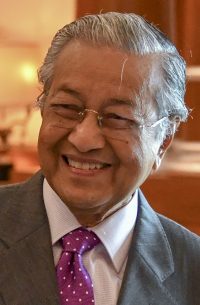
Billington: Tun Dato Seri Doctor Mahathir bin Mohamad was the Prime Minister of Malaysia from 1981 to 2003. 22 years and then again from 2018 to 2020. He also served as the Secretary General of the Non-Aligned movement internationally in 2003, and held many positions in government and in the public sphere in his long career in Malaysia. So we welcome you to this interview, sir.
Dr. Mahathir: Thank you.
Billington: This is not your first interview with EIR. In 1999, Gail Billington, my late wife, visited you in Kuala Lumpur conducting a long interview. And in 2014, I had the opportunity to meet you and conduct an interview with you in Putrajaya at your foundation. Both interviews were published in the EIR. But this interview comes at a moment of perhaps the greatest danger in recent history, perhaps even in all of human history, as we are moving rapidly towards war between nuclear armed powers which could destroy life on Earth. The US has openly declared that it wishes to “weaken,” or even “destroy,” Russia, while President Putin has responded to the US and NATO threat to allow Ukraine to use NATO long range missiles deep into Russian territory, by warning that this would be seen by Russia as an attack by NATO, and that Russia would respond appropriately. You, like EIR, have warned that the world was heading to such a cataclysmic crisis, and we are now there. You told Nikkei, the Japanese news service, in June: “We may be going towards a third world war, because if you press Russia too much, and you appear to be wanting to conquer Russia, they may want to use nuclear weapons. That is going to damage the whole world.” What is your view on this now and what must be done?
Dr. Mahathir: Well, the strange thing is that the Western Alliance and Russia were partners in the war against Nazi Germany. But the moment Germany was defeated, immediately the Western alliance formed NATO as a military alliance directed against their former partner, Russia. And so the tension grew. It would seem that the Western alliance needs an enemy all the time. So it has gone on through the Cold War. And now they still want the former Warsaw Pact countries to join NATO. This is a threat against Russia and, of course, Ukraine has a very long border with Russia. Russia objected to Ukraine joining NATO. I don’t see why Ukraine should join NATO, the relationship with Russia was all right and the relationship with the West was also alright, so there is no need to join NATO. But they insisted that Ukraine should join NATO. This was preempted by Russia, and now there is a war between Russia and Ukraine. That war cannot be won by Ukraine because Russia would not allow itself to be defeated. So we we may reach a situation where somebody has to give in or else the war will escalate, will involve the Western alliance against Russia. The attitude is that the war would solve this problem, but war will not solve the problem. They are going to lead to bigger wars, to a third world war. That is what I fear.
Billington: Indeed. At the same time, Israel has proven itself to be out of any control by international law, committing genocide against the Palestinians and now trying to draw Iran into a wider war, probably expecting the U.S. to join in, Malaysia, the current government in Malaysia, has spoken out strongly against the Israeli crimes, as you have also. This too could explode into nuclear war. How do you propose we deal with the whole Middle Eastern crisis?
Dr. Mahathir: Israel is behaving in this way simply because it is assured of backing by the US. Anybody who goes against Israel may have to face the US, and the US apparently supported Israel genocide in Gaza. This is very strange because normally the US would talk about human rights and the like. But with regard to Israel, the genocide carried out by Israel in Gaza is possible only because the US used the veto to prevent any action being taken against Israel. So we are going to see Israel behaving as if they are a great power and breaking all the international laws, because behind them is the US. It is the US which actually is behind the genocide taking place in Gaza.
Billington: There is the third site of possible war between nuclear powers, namely Asia, as the U.S. Insists on provoking a conflict with China and demanding that ASEAN (the Association of Southeast Asian Countries) and other Asian countries join them. Japan and Korea have already formed a military link with the United States, and ASEAN member, the Philippines, has allowed the US to set up bases there, while Washington has even proposed joint naval patrols in the South China Sea, which would quickly lead to an open military clash between the U.S. and China directly. What is your view of this in your backyard?
Dr. Mahathir: The relationship between China and Taiwan is a little bit strange, because China could actually conquer Taiwan if they want to. But they find Taiwan is useful to China because Taiwan invests a lot in China. And Chinese tourists go to Taiwan. Also, Taiwan has access to technologies which China is interested in. So China retains the claim that Taiwan is a part of China, but has done nothing to show that it will take over Taiwan by conquest. So the situation should be left at that. But unfortunately. The speaker of the Congress [Nancy Pelosi] visited Taiwan, and she knows very well that that is going to provoke China. And indeed, this is what happened. China wanted to show its military capabilities, and Taiwan is told [by the U.S.]that they should upgrade their military capability by procuring more weapons from the U.S.. So suddenly the tension has grown, and now we are faced with the possibility of a confrontation and violence between Taiwan and China in the first place and also may involve the United States. But of course, China sometimes behaves strangely, like claiming the entire South China Sea as being a part of China, but that cannot be settled through war. It can only be settled through negotiation, because if there is a war, the damage to all the ASEAN countries and to China would be terrible. So I think the US is trying to get the ASEAN countries to confront China. But ASEAN countries are very weak and they are not capable of fighting against China. Malaysia, for example, wants to make the Chinese market available to us, and so are the other ASEAN countries. So why should we confront China? Yes, China has a claim against Taiwan, but they have not invaded Taiwan.
Billington: What do you think about the situation with the Philippines, and how is that affecting the rest of ASEAN there, they’re becoming engaged in this way with the US against China?
Dr. Mahathir: When China was a third world country, very weak, Malaysia claimed an atoll in the South China Sea and built up facilities there. The Philippines did the same for Commodore Reef, but they withdrew. And when they withdrew, the Commodore Reef was unoccupied, and the Chinese moved in after claiming that the South China Sea belongs to them. But even such a move by China cannot be settled through a war against China. Philippines is not capable of fighting against China, and if the US gets involved, it will become another Third World War. So it is better if China and the Philippines negotiate a settlement between them without involving the United States.
Billington: Underlying this moment of great danger is the increasing disintegration of the Western financial system. The physical economies of the US and the European countries, especially Germany, are collapsing. Germany was once the industrial powerhouse of Europe and now is in a state of deindustrialization. You’ve been at the center of a fight against the domination of speculation and against speculators for much of your life. You told Gail in the 1999 interview, “When, for the first time, countries decided to float their currencies and allow the market to determine the exchange rates –that was way back in the 1970s — I felt even at that time that the sovereignty of countries had been lost.” Lyndon LaRouche, at that time, you probably know, that when Nixon took the dollar off of gold and launched the floating exchange rates in 1971, destroying the Bretton Woods system, LaRouche said that this would eventually lead to to a depression, to an economic collapse and even to war, perhaps even global nuclear war. He proposed at that time a return to the Bretton Woods system. But instead the deregulation of the world financial system continued. Is it too late now to return to the Bretton Woods?
Dr. Mahathir: Well, one would note that at Bretton Woods, the US dollar was valued at 35 US Dollars per ounce of gold. Today, it is 2,600 US Dollars per ounce of gold, which means that the US dollar has depreciated through the market. So it is not really a good standard. We should use gold as a standard and not the US dollar. But as you know, the US benefits from the use of dollars for settlement of trade, of trading between nations. Especially with oil, you have to settle in US dollars, which creates a demand for US dollars and therefore sustains its value. But actually the US dollar has no real value. It has depreciated very much. So we need an international currency based on gold for a standard. I think that would help stabilize the exchange and trade between nations. But of course, trade between nations can only be sustained if the world is at peace, and there is stability in the relations between countries. So what is happening now is that the US has provoked Russia, and there is a war between Russia and Ukraine. It’s also trying to provoke a war between Taiwan and China. And all these activities are not helping to stabilize the world.
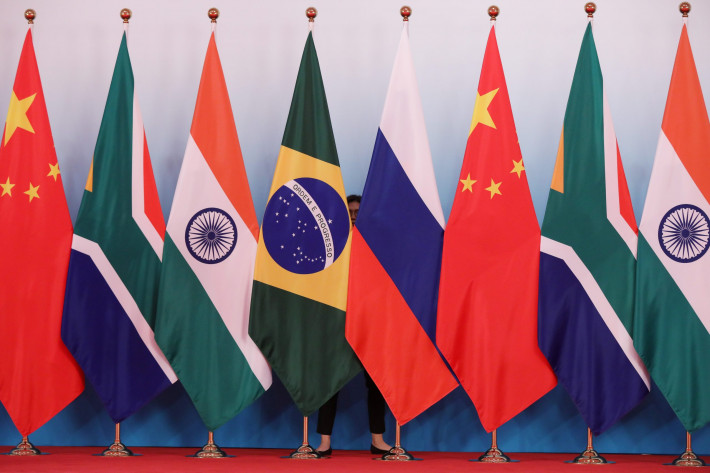
Billington: I’m sure you have followed closely the BRICS nations which are going to be holding their meeting in Kazan, Russia, on the 22-24th of this month, just a few weeks from now, a few days from now, actually, and one of the major issues to be discussed there is the possibility of establishing a new trade relationship. Not a new currency for nations, but a new currency to be used for trade. Do you think that will answer the question you’ve just raised?
Dr. Mahathir: Whatever it is, it must be a currency that is stable. Stability, I think, is provided by valuing it against gold. If you have just an agreement to use another new currency, there will be no stability because against the gold it will depreciate. So we need we need a currency that is based on gold.
Billington: You also told Gail in that 1999 interview that the increasing domination of speculation, dominating the markets, you said “will surely result in a new imperialism, more noxious and debilitating than the old.” And you added that we were “seeing a new kind of imperialism, where the weapon used is really capital, capital that can be used to impoverish country to the point where they have to beg for help. And when they beg, then you can impose conditions on them.” This appears to have gotten even worse since your comment in 1999. Your thoughts?
Dr. Mahathir: As you know, this idea about a new imperialism came from Sukarno [President Sukarno, president of Indonesia from 1950-1967]. He was the first person to coin the word “neocolonialism.” This is based on the management of trade, the trade between countries. For example, Malaysia produces rubber, but the market is in London, and Malaysia does not get the full benefit of producing rubber because all the trading is done in London. So there they can actually increase the value or decrease the value of the rubber. And when they do that it affects Malaysia. It’s the same with the currency. As you know, a currency is supposed to fluctuate because of the market. But it is not really the market. It is the currency traders. It pays for them to make money through short selling. They create money which they don’t have, and they sell the currency in the market, and the value of the currency depreciates. And then, of course, they buy the devalued money to deliver to the first customer they had who had bought at a higher price. This was what happened during the currency crisis. That is why we decided that they should not deal with our currency. We should fix our value, not the currency traders. It’s not the market. Because of the currency traders.
Billington: Right. In fact, in that regard, you engaged in a very famous conflict with the IMF and with the hedge funds and the currency traders who were waging financial warfare on Malaysia and other countries, other developing countries in the 1990s. Can you describe what you did and the results of that?
Dr. Mahathir: As you know, in 1997, 1998, the currency traders devalued their Malaysian currency. We were puzzled by the behavior of the Malaysian currency, especially the depreciation, until we found out that it was the currency traders. So if it is the currency traders, we need not adhere to international practice. We felt that we should stop currency trading. And that was what we did. And indeed when we fixed the exchange rate, the currency trading ceased, stopped completely. But to do that, you need to have financial strength. Malaysia had huge savings. So when we did that, we couldn’t get access to the American dollar at the price we fixed the exchange rate. But we had enough dollars in our savings to meet the demands of trade.
Billington: As part of that conflict, you gave a speech at an IMF conference in Hong Kong in which you discussed what you just described here. You described the currency speculation, what it was doing to the Malaysian ringgit and explained your imposition of currency controls. The Asian Wall Street Journal, which is no longer published, but it was published as an Asian edition at that time, and the front page of the Asian Wall Street Journal, on the same day as that famous speech in Hong Kong published an article which was called “LaRouche report helps feed Malaysian Attacks on Soros.” The article claimed that your attack on Soros “came from an unusual source of publications run by Lyndon LaRouche, Jr,” whom they described as an “eccentric” and a “conspiracy theorist.” They don’t mention the things that Soros said about you — when he had called you “a menace to his own country,” and predicted that your policies would bring ruin to Malaysia. Did that happen? And how do you see that process from the current perspective?
Dr. Mahathir: Well, we were trying to find out who was responsible, and we found that Soros had attacked Italy, the Italian lira, for example. He was actually made persona non grata in Italy. He also attacked the British pound. So it was Soros who was responsible for changing the values of currencies, and it must be him who was responsible for the devaluation of the Malaysian currency, too. At that meeting I did mention his name, but he denied it. Whether it is true or not, I don’t know. But anyway, we concluded that it was the currency traders who were responsible for devaluating our currency, and action had to be taken to stop them from dealing in Malaysian currency.
Billington: And it worked.
Dr. Mahathir: Yes, yes we did. Later on, even IMF agreed that what Malaysia did was right.
Billington: Helga Zepp-LaRouche, the wife of the late Lyndon LaRouche, who now leads the Schiller Institute and the international LaRouche movement, insisted that nothing less than what she calls “a new security and development architecture for all nations” can reverse this decline into war and economic destitution. She compares this to the 1648 Peace of Westphalia, which ended the religious wars of Europe by establishing the notion of sovereign nation states within which each nation’s interests have to include the interests of the others. What are your thoughts on that?
Dr. Mahathir: I did not study her writings deeply, but I think there is some substance in what she says. I think that nowadays we are more connected than ever before. So whatever happens in one country affects all the other countries of the world. On the one hand, the world has become a big market and you can make tons of money from trading with the world. But on the other hand, of course, what happens in one country can affect the other countries of the world. And when the U.S. makes a decision, it affects us. So we have to be constantly aware of what other countries are doing, because whatever they do will affect us in one way or another. For example, when they apply sanctions to a country, it’s not only that country that suffers. Other countries trading with that country also suffer. And Malaysia, as a trading nation, suffers a lot whenever sanctions are applied to any country, even to Russia or Iran. We suffer even though it was not the intention to punish us for anything. We have done nothing wrong. But the fact is that when sanctions are applied, other countries have to pay the price.
Billington: Helga has also proposed something she calls the “Ten Principles of a New International Security and Development Architecture.” She argues that the populations of the Western world have been so indoctrinated with banality, especially since the onset of the rock-drug-sex counterculture in the 1960s, that we must introduce reason and classical culture to get through this crisis. So she addresses the need for development of all countries, the need for education for all people, for health care for all people, and so forth. But it also includes as the 10th principle: “The basic assumption for the new paradigm is that man is fundamentally good and capable of infinitely perfecting the creativity of his mind and the beauty of his soul. And being the most advanced geological force in the universe, which proves that the lawfulness of the mind and that of the physical universe are in correspondence and cohesion, and that all evil is the result of a lack of development and therefore can be overcome.” She stated that this idea is fundamental to all the great religions of the world, but that it has been lost in the hedonistic ideologies dominating the West today. What are your thoughts on that, sir?
Dr. Mahathir: If you look at the world today, the world has shrunken. We have become very small. We are all neighbors of each other, and we need the United Nations more than ever to solve our problem. Unfortunately, the United Nations was designed in order to sustain the big powers who won the war 70-80 years ago. I think the world should not be held down by what happened 70-80 years ago. We should have no veto power for anybody in any country. The vote is given to everyone equally, irrespective of whether they are rich or poor, whether they are workers or they are capitalists. Each one has got one vote. In the UN, we find that five countries are superior to the rest of the world. Any one of them can frustrate 190 other countries. This is totally undemocratic. So if we want to have a world that is more stable and more peaceful, we need to get rid of these veto powers, and maybe amend some of the provisions of the United Nations, or even create a new organization where no one holds any veto power.
There is always talk about a kind of world government. Today, there are many common problems which affect all of us, all the countries. For example, climate change affects everybody, the Covid 19 affects everybody. We are feeling the effects of very common diseases. A currency crisis and all that. So whereas each country can deal with the simple crimes that occur in their country, but in terms of international common problems for the world, we need to have a new authority with clout, which can deal with the problems. For example, it is unacceptable that Israel can commit genocide openly and the world can do nothing. This is something that does not show that we understand, that the world has become small, and anything that is happening in any part of the world affects the rest of the world.
Billington: I’m sure you know that the UN General Assembly held a vote which overwhelmingly voted to demand that Israel stop the occupation, not just the current genocide, but obviously to stop the war, but also to stop the occupation, which has been illegal from its beginning. So that vote took place in the General Assembly, but they don’t have any enforcement power. So unfortunately, most people are, as you’ve indicated, the major powers that are benefiting from this, and especially the U.S., just ignore such a thing, and therefore nothing has happened. You have any recommendations on that?
Dr. Mahathir: Well, in the case of other countries, in Bosnia, for example, and also in many African countries, the UN sends a peacekeeping force to separate the combatants. But in the case of Gaza — no peacekeeping force has been sent to Gaza, and the Israelis are left to themselves, to do what they like. In fact, when Biden proposed a ceasefire, Netanyahu just ignored him and continued, even escalated, the killings. And now, it has spread to Lebanon. I can’t imagine a country as small as Israel can defy the feelings of the whole world, the opinion of the whole world. And this can only happen because behind Israel there is a great power which has a veto, which frustrates the whole United Nations.
Billington: You are currently engaged in a conflict with the Malaysian prime minister, Anwar Ibrahim. Actually you’ve been engaged for many, many years in various kinds of conflicts with Anwar Ibrahim. As you probably know I’ve written about this in the EIR a great deal. He has been accused by several of your own national newspapers of using the Malaysian Anti-Corruption Commission to open investigations into his adversaries and their families. And that includes you, and Daim Zainuddin, who was your finance minister at the time of your conflict with the IMF, and even two of your sons. You are reported by the press to have said: “This is an abuse of the rule of law.” At the same time that you rejected the demands of the IMF and the speculators. Anwar, who was at that time your Deputy Prime Minister, openly opposed you, and argued that you should accept the demands of the IMF and George Soros and the speculators. And if I understand it correctly, you fired him. Some say that Anwar is now out for revenge. What is the status of this current investigation?
Dr. Mahathir: Well, I support any move to reduce corruption in this country. Corruption, of course, is a very bad practice that affects the development of this country. But what we have learned is that on the one hand, the opposition is accused of corruption, but as for the people who support him, an accusation against them are dropped. For example, the Deputy Prime Minister was facing 47 charges in the court of law. Suddenly they dropped the charges. At the same time, I was accused by him publicly of stealing government money, of abuse of power, which I did not. So I told him, show proof that I have stolen money. He said that I have stolen billions. I said show proof. I don’t know where the billions are, because I have never stolen billions of dollars. Can you show proof? So I took him to court and asked him to show proof. He has not been able to show any proof for the past one whole year, but instead of that, he took action against my children. I mean, it’s not fair. It’s quite obvious that his anti-corruption thing is not sincere, in that he exempts his own supporters, but he took action against those who opposed to him, even though they have no evidence that they were involved in corruption. I challenge him to show that I have money. I am prepared to give all the money that he says I have to charity, 100%. He said only half, but i am willing to give 100% if you can show that I have the money.
Billington: Let me go back a bit. You mentioned Sukarno as bringing up the question of the New Imperialism or the new form of colonialism. As I’m sure you know, in 1955, he called the meeting which became known as the Bandung Conference, the Asia Africa Conference, which was the first meeting of former colonial powers without their colonial masters there. In that famous meeting, he made a call for what eventually turned into being the so-called Non-Aligned Movement. That spirit has been revived recently by many, including Malaysia, which participated in an effort to revive the Non-Aligned Movement. It also is being revived in the form of the new BRICS Association and the many, many Global South countries who aspire to join the BRICS. Their basic principles are very similar to the Five Principles of Peaceful Coexistence that were adopted by the countries at the Bandung Conference. This is something that Helga Zepp-LaRouche also points to often: that Sukarno’s speech at that event was essentially a call for a new world order based on that kind of principle, of honoring the rights of all countries. What’s your own view of the history of the Non-Aligned Movement and the current form of that with the BRICS?
Dr. Mahathir: The world is still divided into two confronting blocs, the East and the West. And other countries feel that they are being pressured to join one or the other. But these countries do not want to be involved in the confrontation between the U.S. and China and Russia. That is why there is a need once again to think about non-alignment, which was what was proposed by Sukarno. Today, that is still relevant. We want to get away from this confrontation because it is not good for us. We want to see a stable world where we can grow through trade with the whole world. But dividing the world into two parts and then applying sanctions and even taking military action and all that, these are very, very negative. These are not the way to solve the problems of the world. We need a stable world. We don’t need any blocks East or West, but we need a world where everybody is equal. And they should all solve their problems through the United Nations without the veto. That is what we need. But since we cannot change the United Nations, so they form BRICS. And again, that is another way of having non-alignment.
Billington: Do you think Malaysia will join the BRICS at the meeting this month?
Dr. Mahathir: Yes they have applied there. I don’t know what is the criteria for joining but certainly in spirit Malaysia believes in non-alignment.
Billington: Very interesting. Do you have any other thoughts that you’d like to leave with our readers and our followers? I know you followed the EIR on and off most of your life. What are your thoughts now for our followers?
Speaker2: I think this confrontation between East and West should stop. We should not divide the world into two. And we should have a workable United Nations that has no veto power. And of course, when a country is considered to be a recalcitrant, like the Israelis, then the world must take action to put a stop to this killing. Already they have killed 42,000 Palestinians and now more Palestinians living in Lebanon have been targeted, and the world basically shows that it has no power to do anything. It’s something not reasonable for civilized people to accept this kind of killing and do nothing about it.
Billington: Yes. We are certainly committed to resolving those fundamental problems facing mankind. As I said at the beginning, this is perhaps the greatest moment of danger that the human race has ever faced, given that it’s a nuclear age and the level of madness by some leaders who think that they can resolve problems through war, especially with nuclear weapons. This would mean the end of civilization. So we certainly appreciate your continuing battle to make your voice heard. We’re calling on citizens of the U.S. and of all the Western countries to recognize that their own fate rests in working with Russia and China, and not going to war with them, but actually having the kind of world cooperation that we need to have a peaceful world. So I thank you very much. We will get this interview out widely. Many, many people are looking forward to hearing your words. It’s been a long time since we’ve had a chance to speak like this, but it’s very much appreciated, I can assure you, by the growing movement that we represent. Helga Zepp-LaRouche has also initiated something called the International Peace Coalition, which has been meeting every week for 70 weeks now, over a year. There have been between 1000 and 2000 people attending those meetings every Friday afternoon, from 40 to 50 countries, virtually every week. The idea there is that people who believe in peace may have different political ideas, but those political ideas aren’t going to mean anything if we have a nuclear war. Nobody’s going to be around to enjoy the victory if we have a nuclear war and therefore we must get together and cooperate to bring about a peaceful resolution to these conflicts. That’s what we’re fighting to do. Your voice in that, in the International Peace Coalition, would be very valuable. And I invite you, if you possibly can, to join one of our meetings on Fridays. If you agree, we could perhaps use some quotes from this interview in one of those meetings. Would that be acceptable to you?
Dr. Mahathir: From what I see, I see openly we may hurt some people, but I always believe in freedom of speech. You should be able to hear what you like, as well as what you don’t like. My concern now is that there are too many warheads with nuclear material. And once you activate nuclear material. You cannot reverse it. You cannot even get rid of it as waste. There are these problems now of nuclear waste, which we cannot do anything about, and which is still going to hurt people with this radiation and the like.
Billington: Thank you very much. Very good to see you again. And I hope I get a chance to come back to Malaysia sometime. And I’ll come come to Putrajaya again and and pay my respects. Thank you.
Oct. 10—Earlier this month, in Moscow, Richard A. Black, Schiller Institute representative at the United Nations in New York, interviewed Dr. Georgy D. Toloraya, Executive Director of the Russian National Committee on BRICS Research, and concurrently Director of the Asian Strategy Center at the Institute of Economics and Chief Researcher of the Institute of China and Contemporary Asia of Russian Academy of Sciences. Mr. Black was in Moscow to speak at the 8th BRICS International School, October 2-4. His talk was titled, “The Role of Principle in the Current Development of BRICS.”
Richard Black: I just had the honor of giving a presentation on a panel of the Eighth BRICS International School in Moscow. Can you tell us how this yearly event was first launched? What is your view of what was accomplished this past week at the school?
Georgy Toloraya: First of all, about the school: The BRICS School was inaugurated in 2017 by the National Committee for BRICS Research (one of the first Russian NGOs, in existence since 2011). At that time, we gathered people from, mostly, five countries, about 30 of them, and it was very successful. Since that time, we have had this kind of function on an annual basis, constantly increasing the scope, and the participants of this school have already formed networks of future and current leaders of BRICS, which is very important. In this school they receive training from leading experts based in Russia and other BRICS countries, and we now include other international experts, like yourself. This year the event is also supported by BRICS-related units at the state-run Higher School of Economics and Moscow University of International Relations.
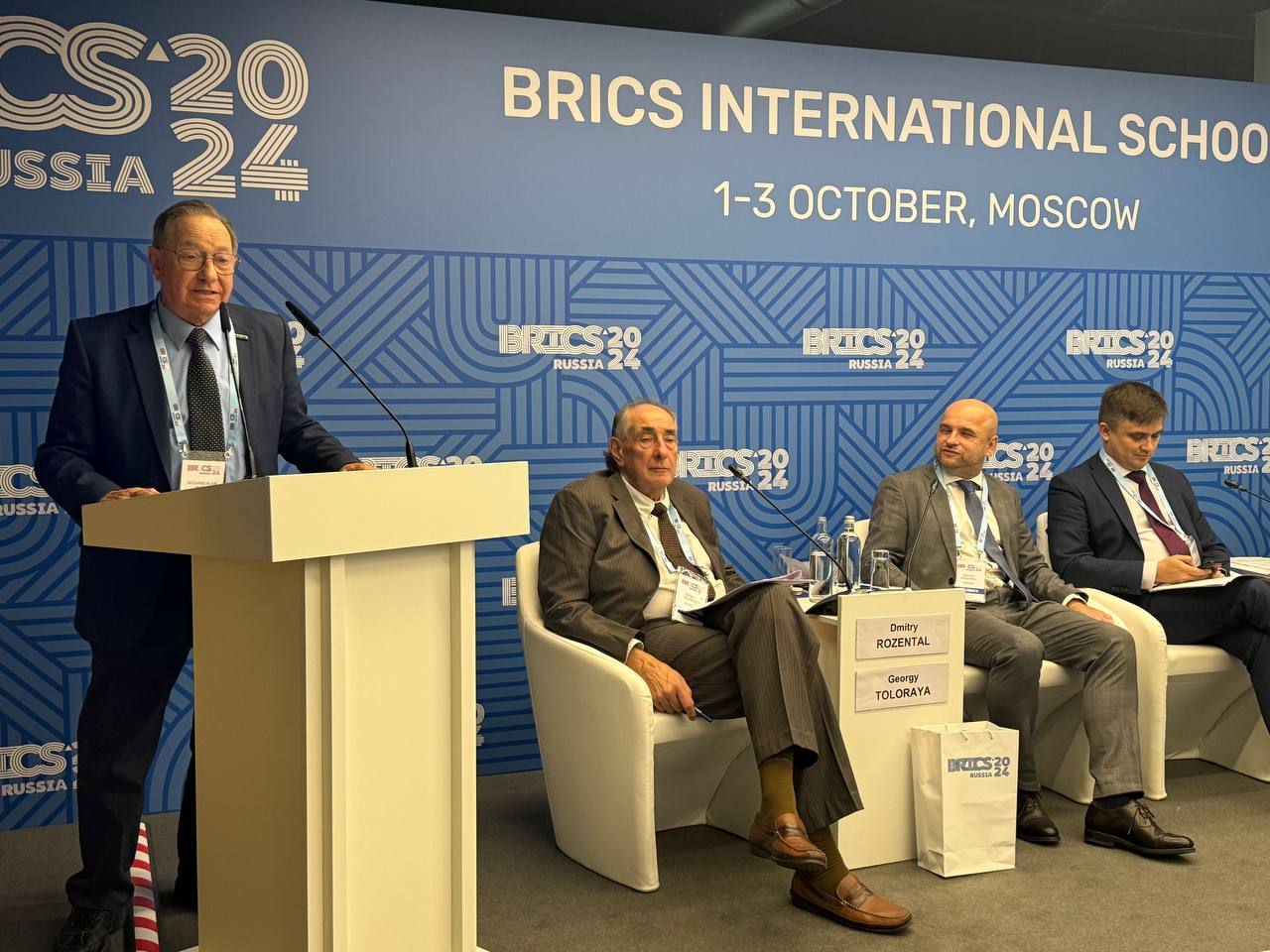
The Schiller Institute’s Richard Black speaking at the BRICS International School in Moscow (left), and Georgy Toloraya seated next on the right. Credit: 8th BRICS International School, Moscow.
This year it was particularly challenging, because we had some new countries joining the BRICS. As of this year, we had more than 40 countries represented at the BRICS School. We hope to continue with this practice in the future, because this is an important tool to promote knowledge of the BRICS among young people, provide direct contact, and for supporting networks and expanding mutual understanding.
‘Biggest BRICS Gathering Ever Held’
Black: How is BRICS evolving, as we approach the yearly Summit, here in Russia? How can the four or five new members of the BRICS be best integrated? What about the 30 or more nations which have expressed their hopes of joining?
Toloraya: The Kazan BRICS Summit is a real milestone, because it gathers the old and new members for the first time. Also BRICS plus/outreach countries are coming, altogether a quarter of a hundred top leaders, as well as a dozen more countries on a lower level. This is the biggest BRICS and BRICS outreach/plus gathering which was ever held. Simply in matter of numbers this is the most important international event in Russia this year (which also is significant for Russia as an indication of international recognition), and also one of the biggest events for Global South and East leaders.
Black: I understand that Kazan is an Islamic center of culture, renowned throughout Asia. Is there a special significance of the BRICS Summit being held in Kazan?
Toloraya: There is always strong competition among Russian cities to be the host to BRICS summits and events, because it means investment from the state, and development, and lots of international contacts. So it’s very beneficial, although a challenging task for any city or location.
Kazan is the capital of Tatarstan, one of the biggest and strongest republics in the Russian Federation, where the majority of population are ethnic Tatars. It’s a Muslim republic, but that was not a decisive factor for its self-identification. It’s an important coincidence to show that Russia is not only a Christian country, but also it has a strong Muslim minority, and Buddhist and other religions. Well, it’s still Russia proper, and it’s very good that the foreign leaders will see for themselves that Russia is multinational, very tolerant, and has a lot of cultural and national variety.
Black: Schiller Institute leader Helga Zepp-LaRouche has been circulating a concise document titled, “Ten Principles for a New International Security and Development Architecture.” Is this relevant for BRICS?
Toloraya: As I mentioned, look at the number of countries and actors, and the number of ideas and suggestions which have being flowing in from many sources, and all these ideas and principles will be discussed. It will be all the norm in the course of the Summit. Many ideas have been tossed around, including the Helga Zepp-LaRouche “Ten Principles,” which are also there in circulation in preparation for the Summit, along with many, many other ideas and suggestions which are important for the Global Majority to dwell upon: cooperation for a new world order—more just, and more transparent.
Toward a New Paradigm of International Relations
Black: In a TASS interview, Zepp-LaRouche expressed the suggestion that the Kazan BRICS Summit use its potential authority to launch “a new paradigm,” a new architecture of international relations, even amidst the war escalations in Southwest Asia and Europe. What are your thoughts on this proposal?
Toloraya: The new paradigm of international relations—new order, or new type of relations—all is being discussed by the BRICS for years, and not only discussed, but is being implemented in practice by the BRICS. It’s not in a direct way that these suggestions are implemented, but any suggestions available influence the discussion, and they finally determine the rules by which this new world-order construct will be built.
Black: As a Director of Asian Studies within the Institute of Economics and a Chief Researcher of the Institute of China and Contemporary Asia of the Russian Academy of Sciences, do you see a pathway—even if difficult—for practical improvement of India-China relations?
Toloraya: India and China have many problems between them—historically and more generally geostrategic ones. And as for BRICS, our rule is that the countries which have some issues between themselves don’t bring them to the table of the BRICS, because the BRICS is for providing joint vision, finding paths of cooperation and opportunities for collective efforts, not about discussing conflicts.
But, paradoxically, in many cases which I have witnessed, sometimes the discussion between the countries on different issues—general global issues—somehow helps them to look at their own bilateral contradictions from a new angle, find new solutions for them. Even having contacts on other matters helps the politicians and experts to better understand each other on the “damned issues.” So, it’s a useful tool to help settle these contradictions.
India-China contradictions exist in a much more fundamental way than between a number of other countries. But anyway, it’s easier to handle and manage them with BRICS than without BRICS.
Lyndon LaRouche’s Eurasian Land-Bridge Concept
Black: Do you see the prospects again for the ideas of American economist and statesman, Lyndon LaRouche, in Russia today? Concepts such as the Eurasian Land-Bridge; a principled, expert “dialogue of civilizations”; BRICS as a bridge from the East and South to the West; rising energy-flux densities of power plants supplied to the Global South?
Toloraya: I would say that some of the Lyndon LaRouche insights were very helpful. Dialogue of civilizations approach is the founding spirit in BRICS. The Eurasian Land-Bridge is actually now being embodied both in the Belt and Road concept of China and the Eurasian security concept—the Greater Eurasian cooperation concepts of Russia. So, this idea lives on, as well as other ideas, including the BRICS’ role as a bridge between the West and the Global Majority.
I would say that BRICS is a platform for collecting and codifying opinions for working out a joint position by the Global South and Global East and Global Majority—however vague this definition is—which can be negotiated with a more, I would say, coherent Western position, which is usually very well formulated within the G-7 and other collective Western institutions. So, BRICS provides maybe a discussion and a joint-position formulation platform, and a negotiation platform, provided the West would be interested in that kind of a dialogue. In fact a rudimentary mechanism of this nature can be witnessed in G20 activities.
Black: Helga Zepp-LaRouche has called for an extraordinary “Council of Reason” of former high government officials, scholars, and artists to debate and formulate a pathway out of the current deadly crisis. What is your view?
Toloraya: The Council of Reason, or as I have called it, the “Club of Wisemen,” which could gather together leading thinkers from BRICS countries, as well as from Western countries, I think it’s a very good idea to discuss the global issues, and at least express some opinion on that to make it clear for both sides.
I have doubts whether it is possible to persuade the West, or to make it change its position, because all attempts at this effort have been not very successful. But at least the West should be aware of the Global East & South joint position, not shrug it away.
I noticed that one of the New Development Bank former directors was frustrated enough to comment at this time of his resignation, that, in fact, the Western financial system is irreformable—it cannot be reformed—only another can be created, which would compete with it.
So, I think this might be the same with ideology. I think it is very difficult to achieve a convergence of the ideologies and practices which would both make it in Western interests and East-South interests, such that they merge together in a sort of recipe for global development and global peace. But we must coexist on one planet and should not let it perish. So the Wisemen (and women) should discuss and suggest some modus vivendi and modus operandi for the future. How the competing nations should behave themselves and interact. What common development and progress priorities, not artificially limited to neo-liberal values, can they pursue jointly and separately. How these processes can be globally governed in a just and representative manner. A sort of global Westphalian and human-centered development ideological construct of a kind.
Join Helga Zepp-LaRouche October 16, 11am Eastern/5pm CET in her Weekly Live dialogue and help usher in the Year of the New Paradigm for all Humanity. Send your questions, thoughts and reports to questions@schillerinstitute.org or ask them in the live stream.
The assembly of top leaders from dozens of countries next week in Kazan, Russia, may prove to be truly historic, particularly as it contrasts with the devastating decisions being taken by Anglo-American NATO and Israel.
Representatives of Palestine will attend, and they have been informed by their host President Vladimir Putin that Israel’s ongoing assault against them in both Gaza and the West Bank will be the theme of one of the events at the summit.
The fact that justice is coming neither from Anglo-American NATO, nor from the United Nations Security Council as it currently operates, draws greater attention to the BRICS as a meaningful discussion platform.
Some on this planet have their sights set upon higher goals. NASA plans for a Monday launch of its latest mission to Jupiter. And SpaceX has achieved a spectacular landing of its reusable Super Heavy booster rocket.
Join Helga Zepp-LaRouche October 16, 11am Eastern/5pm CET in her Weekly Live dialogue and help usher in the Year of the New Paradigm for all Humanity. Send your questions, thoughts and reports to questions@schillerinstitute.org or ask them in the live stream.
Billington: This is Mike Billington with the Executive Intelligence Review and the Schiller Institute. I’m very pleased to be here again today with Professor Jeffrey Sachs.
Prof. Sachs: Great to be with you.
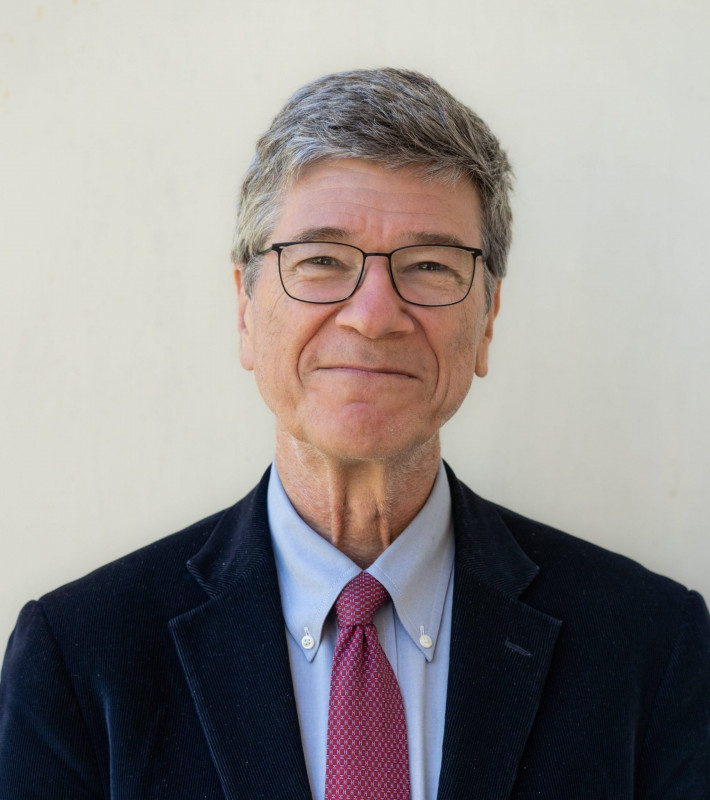
Speaker2: Prof. Sachs has done another interview with EIR earlier, which got very wide circulation, as this one will as well, given that we’re in an incredible moment in history. Professor Sachs is an economist and a public policy analyst of note, who is also a professor at Columbia University. He is director there of the Center for Sustainable Development. He has also served as an advisor to several UN secretary generals, including Antonio Guterres, Ban Ki moon, Kofi Annan, and has advised many governments around the world, primarily on economic and global economy issues. So, Professor Sachs, welcome.
Prof. Sachs: Great to be with you.
Billington: Let me start by asking you to describe your recent visits to China and your view of the transformation of China over these past decades, and your sense of their mission in the world today.
Prof. Sachs: I go to China typically 2 or 3 times a year, sometimes more, but I’m a frequent visitor. I’m an admirer of what China has accomplished, after all. When I first went to China in 1981, 43 years ago, China was an impoverished country. When I go to China now, of course, China is in an advanced economy, very sophisticated, playing a major positive role in the world economy. It is the low cost producer of many of the things that the world needs, in energy systems 5G, digital connectivity, electric vehicles. It just does a very, very good job. And this has been a lot of hard work, a lot of good planning, a lot of smart investments, a lot of innovation. I give China a lot of credit for that. I also think that China’s rise in the last 40 years has been good for the world, good for the US economy, good for Europe. It’s a general principle in the kind of economics I believe in, that trade is good and mutually beneficial, not a zero sum game, but a positive relationship that creates a larger world market, more incentives for innovation, more opportunities for specialization. And I think all of those things have happened. When I was in China this past time, I met with several government leaders. As usual, I went to some companies to look at, this time, at electric vehicles, because China has had actually hundreds of electric vehicle companies fiercely competing with each other, and now they’re the world’s low cost producers of high quality electric vehicles. So I wanted to see. We went to a company to learn about what they were doing, and it was extremely interesting.
Billington: You had mentioned you were going to Shandong, and I wondered if that had anything to do with Confucius, that being the home of Confucius. Was it?
Prof. Sachs: It did indeed, Because part of what I am doing right now is bringing philosophers and policy makers together in a series of workshops, some in China, some in Greece this year. we’re going to have a meeting in 2025, in Cambodia, and will continue to try to reach more of the world. But the idea there is that the great philosophical traditions in different parts of the world can enrich each other. So we went in Shandong province, to Qu Fu, which is Confucius’ birthplace, Confucius’ home is there. It’s known because that’s where he taught his pupils, and it became a shrine right away. 2500 years ago, and it remained a big temple site as emperor after emperor became Confucian. The courts of the great dynasties of China became Confucian, so the emperors would build new additions to this complex. And now it’s a very large center in Shandong province. We held a conference there of scholars of Confucian thought and of ancient Greek thought, to talk about the virtue ethics that characterizes both kinds of thought. Confucius lived roughly about a hundred years before Socrates and about 200 years before Aristotle. There’s a lot of similarity, actually. Differences, of course, but also similarities in the thinking of the ancient Greeks and this great Chinese tradition, because in both contexts, the idea was how to be good people, virtuous people, in order to have a virtuous society. So the idea is that we need values, not just force, not just will, not just desire, not just profit orientation. We actually need an awareness of what it means to be a good, decent person, what the Greeks called virtue. And of course, they didn’t use that word — they used arete to mean that as a kind of excellence of life. And Confucius had a similar idea in Confucian thought, has a similar idea of the kinds of good behavior that people should have and that lead to good societies. So it was a fun meeting. We had a few days in Qu Fu, and then we took the train, fast rail, very efficient, very cutting edge, to Beijing, and met at Tsinghua University and continued the discussion with scholars at Tsinghua University.
Billington: Are you writing that up?
Prof. Sachs: I am, we’re not only writing up the conference, I’m writing a little book about this, which I’m arguing that we need a new philosophical approach. I’m Aristotelian in my approach. I think what Aristotle said 2350 years ago was very, very smart about good societies. Good behaviour, how a political system should function. I think what a lot of the British thought in the last three centuries, which is our dominant way of thinking about economics and politics, got things a lot wrong, actually. So I’m arguing that we should go back to some of these more classical traditions to recover some of the real sources of wisdom to help us find our way through. I find that a lot of the British philosophy, that’s much more modern, it’s old, still, but from Hobbes, Locke, Hume, Smith and so forth, was really a kind of philosophy that was used by British imperialism, in fact, to justify a lot of bad behavior or to cause us to neglect a lot of things that are wrong and dangerous. And I think Aristotle got things a lot more accurately in his ethical and moral philosophy and political thought. So that’s what the conference volume will be about. And it’s also what I’m working on myself right now.
Billington: I should probably say that I have written in defense of Plato against Aristotle, which, of course is another whole area of interesting discussion. But the idea of comparing Greek thought and Confucian thought is absolutely critical in terms of getting the rest of the world to recognize that the roots of European civilization and the roots of Chinese civilization are indeed very, very parallel. Very close.
Prof. Sachs: Exactly. And we have so much that we can do to thrive together. And there’s so much admirable in the Confucian tradition, not only Confucius thought and those of leading disciples like Mencius, but also in what China accomplished over a period of 2000 years, a lot more peaceful international relations than Europe accomplished, for example. And that is very notable, very important, very much not understood in the Western world right now. But there were actually hundreds of years in which China, Vietnam, Korea, Japan never had a war with each other In the European context, this is unimaginable. Britain and France duked it out for hundreds of years across the English Channel. War after war, hundred years, war battles. They couldn’t stop fighting. Whereas actually, China and Japan almost never, ever, for a thousand years, had a battle. Except when the Western world showed up. And then the wars started. And it’s an amazing story. And it’s really interesting to understand, because even what China says today has a lot of Confucian elements in it, very clear, conscious, Confucian elements that we should live harmoniously internationally. We should solve problems in a harmonious way. These are really not platitudes. These are ideas that are very deeply embedded in Confucian thought. Whereas in Western thought, the idea that it’s natural that there’s a war of all against all, as Hobbes put it, is also embedded in our thought, as if that’s normal and natural, not weird.
But it is weird, actually. And it’s certainly not the way it should be. And so I think the idea that there’s a more basic ethical viewpoint in which you can actually say it would be normal to be at peace, not normal to be at war, is not naive and idealistic, but actually rather realistic. And the experience of East Asia showed that for hundreds and hundreds of years. It ended up being disrupted when the British showed up in their gunboats in the Pearl River in 1839, in what is absolutely one of the most cynical wars of modern history, because the British showed up and demanded that the Chinese open their markets to British sales of opium. The Chinese didn’t want to have an addicted population. But the British said, no, no, you have to open up to our opium. And they actually fought the Opium Wars — the first one, 1839 to 1842, a Second Opium War, roughly 1856 to 1860, over this unbelievably cynical idea. And that was the British Empire for you.
Billington: And it’s still free trade to the British and to, unfortunately, many of the American financial institutions that have adopted the British approach.
Prof. Sachs: It’s whatever makes money and don’t look back and don’t ask about the morality of it.
Billington: I’m going to switch subjects here. You published an article recently under the title “Israel’s ideology of genocide must be confronted and stopped.” Which, by the way, you may not know, it was republished today by the website of the International Movement for a Just World, by our joint friend Chandra Muzaffar. In that article you wrote, “Netanyahu purveys a fundamentalist ideology that has turned Israel into the most violent nation in the world.” Chas Freeman, whom you also know, this week in a speech that he gave in Massachusetts under the title “Is the Zionist State now doing itself in?” He warned that “the Zionist state of Israel and the Jews who inhabit it are now in jeopardy. Palestine is where the humane values of Judaism have gone to die.” Can Israel save itself?
Prof. Sachs: Well, it could save itself, but it is on a path of self-destruction right now, for two reasons. One is that it’s trying to pursue an indefensible course, indefensible in the sense of law, justice, morality, acceptability. And second, it’s trying to pursue an indefensible course in the literal sense of not militarily defensible. So it’s doing itself in in two ways. Let me explain. The whole history of Israel and the Zionist project, which started with the Balfour Declaration in 1917, has been fraught with the one difficult reality, which is that two different peoples: the Palestinian Arabs who were living there when the Balfour Declaration was made by the British Empire in 1917 during World War one; and the Jewish people who came to establish a Jewish homeland. This meant that there was conflict from the very beginning of the Balfour Declaration, because the Palestinian Arabs said this is our land. The Zionists said, well, this is our ancient historical land. And we of course, are facing banishment and anti-Semitism where we’re living in Europe. And conflict arose from the very beginning, from 1917 onward. And the Jews suffered the Holocaust at Hitler’s hands in World War two. And, of course, this was the most unimaginable, horrific event that a people could experience. And the refugees after the war, those who survived in Europe, were directed to Palestine.
Prof. Sachs: Their numbers swelled. Actually, it was partly cynical because even after the Holocaust, in the United States, there were people who said, “no, we don’t want the Jewish refugees here. Let them go to Palestine.” So after World War Two, the tensions between the two groups was absolutely stark. Already in 1946, 1947 and 1948. And there’s a lot of history that one could say, but nobody quite knew what to do. The British were still the Imperial overlord. They had the so-called “mandate,” but they wanted to get out, and they announced that they were leaving. And the UN, which was newly established, made a committee to recommend a partition, so that part would be a Jewish State of Israel and part would be a Palestinian state. There was, of course, a rather pro-Israel point of view in the technical work that went into the partition plan. So that when it was presented in 1947, the Jews constituted about 33% of the population at the time, and the plan gave them 56% of the land, while the Arabs, who constituted 66% of the population, were given 44% of the land. So the Arab countries in the UN objected, saying this is not fair. This is not a proper way to divide the map. The Jews, the settlers who were about to become a state of Israel, used a lot of violence and treachery and terror in 1947 and early 1948, to scare away the Arab population, what the Arabs call the Nakba.
And hundreds of thousands of Arabs left their homes in what would become the State of Israel. They fled for their lives because there were massacres by the Jewish settlers, by Jewish gangs and so forth, and the idea was to scare people away so that the area assigned to the Jews would be overwhelmingly Jewish.
Then Israel unilaterally declared independence in May 1948, and the Arab countries around said, “We don’t accept this.” They went to war, and Israel defeated the Arab armies with its backing of Western countries. That meant that there was a frozen conflict in 1949. Interestingly, in 1949, the UN voted that those who had been made refugees by the war, the Palestinians, had the right to return to their homes. But Israel was having none of it. Israel was saying, “We’re a Jewish state. We don’t want the Palestinians here. We’re not going to accept the UN call for a return of people to their homes.” And those people and their children and their children’s children became refugees and remain refugees to this day. In 1950, a UN mediator went to try to find a peaceful way to create a real partition that both sides could live with, and he was murdered by an Israeli gang. It’s presumed, with the Israeli government knowing. But the UN mediator was murdered.
And this is how it’s been since 1950. And I go with all of this to emphasize that Israel created a state. It won a war to do so. It then won another war in 1967 and took even more land. It’s right to say that basically all during this period, Israel acted in order to prevent a Palestinian state developing alongside the State of Israel, whereas the world community, meaning the governments in the UN, especially after 1967 and then as events unfolded in the 1970s, 1980s, 1990s, increasingly pressed for a Palestinian state to be granted sovereignty and borders and security alongside the State of Israel as the only way to to end this conflict. My own view, quite strongly, after more than 50 years of pretty intensive thinking and visiting this region and knowing lots and lots of people and living in Israel decades ago and watching this unfold, is that there will not be peace until there’s a state of Palestine. And I believe there needs to be a state of Palestine and a state of Israel, and they need to live next to each other. I would like it to be living next to each other and in normal ways. But if it can’t be a normal way, then living next to each other and separated by peacekeepers. But the point of this current war, and it goes back decades, is that Netanyahu, the prime minister, and his political allies absolutely reject the idea of a state of Palestine.
But that’s a problem. It means that Israel is ruling over about 8 million Palestinians who have no political rights. So it is said to be, and I think it’s accurate, to say an apartheid regime like the South African regime was under apartheid. And when confronted with this, Netanyahu has never had an answer, except the hope that, oh, well, those people should go someplace. They should leave their homes, and Israel should control all of this territory. In 1967, Israel won a war, another war. It expanded its Territory, and it came to occupy the Palestinian lands that were still those lands of Palestine after the 1948 war, and it took over those lands. Netanyahu said basically, from the beginning of his political career, he will never give this up. It’s too dangerous for Israel, he said, we’ll never give this up. But what does that mean for the Palestinians? Well, they never cared. Go someplace else. Who cares? And what Netanyahu thought for decades was, “Well, we’re powerful enough, and the US backs us, and the Palestinians, it’s just tough. If they want to live there without rights, okay, fine. But even better leave. Over time, Israel became even more radicalized. Netanyahu’s not the most radical in this, because what happened was that Netanyahu is probably motivated overwhelmingly by power and by the claim that Israel’s security demands domination.
He got joined by increasing numbers of his Israeli religious zealots who read the Bible and took it literally and said, “God promised us this land, so we have absolutely the right to do whatever we want. This is our land.” And there are people in the government in Israel now, like Bezalel Smotrich, who is the finance minister, and Ben Gvir, who is the security minister, who represent a radical religious nationalist biblical view who say, “We don’t care at all about the Palestinians, not even about security. We are redeeming the land that God promised the Jewish people 3000 years ago,” or whatever their chronology of the Bible. And that’s just how it’s going to be. So it’s zealotry.
Now, what this means in practice is that Israel is waging what I do regard as a genocidal war right now. That’s a technical term, by the way. It means violating the 1948 Genocide Convention. The government of South Africa has launched a lawsuit in the International Court of Justice making that claim. The court has not yet ruled. So when I say that it’s a genocidal action, it’s my prediction that the International Court of Justice will say, “Yes, Israel is violating the 1948 Genocide Convention.” I believe it is. There’s a mass slaughter of innocent women and children going on in the name of Israel’s right to control Gaza, the West Bank, East Jerusalem, all of these occupied lands.
So. Mike, the basic point of what I am writing is that Israel is pursuing a radical ideology which says we have the right to dominate. And since international law, public opinion, world opinion, morality rejects that and says, “No, there are millions of Palestinians. They have the right to political self-determination. They have a right to a state,” which is overwhelmingly what the world community says, it’s even what the US government says, though it doesn’t act upon it. I believe that what Israel is doing is carrying out an expanding war to try to defend the indefensible. And as I said, it’s indefensible in two senses — what they’re trying to defend, which is an apartheid state and continued dominance over Palestine, and permanent control over captured lands that international law says belong not to Israel, but to Palestine, to the people of Palestine. Israel is trying to defend what is in violation of international law, international ethics and the views of virtually all countries in the world.
But there’s a second point, which is that Israel believes that it can do this by murder, by ethnic cleansing, by military dominance. Netanyahu spoke at the podium of the UN General Assembly a couple of weeks ago, and he said, “The long arm of Israel reaches across the Middle East, and we will win,” he said repeatedly.
But we have to understand, first of all, it’s not Israel who has the long military arm, it’s the United States. Israel could not do this for one day without the US backing. So Netanyahu presumes that the US will do his bidding. But my view is, well, why should the US go to war so that Israel can control Gaza, or so that Israel can control the West Bank, when it’s our official policy that we want two states? Why do we go to a widening war that could even escalate into a nuclear war to defend an indefensible illegal claim of Israel? So I think Netanyahu’s wrong to think he just has the US in his back pocket so he can do what he wants.
But there’s even another matter. If one watches the real events militarily, and take Ukraine also as a case, the US can’t just defeat anyone it wants anymore. In fact, it has lost most of the wars of modern history. This is something that’s hard for a lot of Americans to understand. But we were defeated, in effect, by the Vietnamese, who suffered unbelievable deaths and casualties, but in the end could not be defeated by the US bombing and the US Air Force and the US troops on the ground.
And Afghanistan. We didn’t have a cakewalk there. We were there 20 years and ended up leaving, and the same government that we thought the US had overthrown in 2001 is back in power right now — the Taliban. All of America’s wars turn out to be a little optimistic. Right now, Ukraine is being defeated by Russia on the battlefield. So Netanyahu thinks two things: he thinks “I can get the US to do my bidding. And if I do, well, we’ll just crush Iran.” But that’s rather unlikely. Israel has around 10 million people. Iran has about ten times more than that. I’m just using round numbers. It’s a lot of arrogance. A lot of hubris. And I think a lot of miscalculation, to think, “If I can just bring the US into the war with Iran, we’ll crush the enemy.” Israel could get absolutely destroyed by this, because when we see Iran sending its missiles, and they do seem to be some hypersonic missiles there, they penetrate the so-called Iron Dome of Israel’s air defense. So Israel is not so secure, even if the US is engaged on Israel’s side, which I think is a terrible calculation for the US, to begin with, something we should not do. We shouldn’t be fighting for Israel’s right to control occupied Palestinian lands. It makes no sense, especially when we say that our policy is a Palestinian state living alongside the Israeli state. We know that that’s not Netanyahu’s policy. So why are we giving a blank check to Netanyahu when he’s fighting for a political aim, which we don’t even agree with?
Billington: Let me ask you something more on the historical side. When you think about Netanyahu’s relationship with Smotrich and Ben Ben-Gvir, for instance, you probably know that Netanyahu’s father was the number two man to, Yabotinsky, and Yabotinsky was recognized even by Israel’s founders as basically a Hitler figure.
Prof. Sachs: I wouldn’t put it that way. But I would say, kind of a terrorist figure and an extreme hardliner. But I think the point is right, that this is a very hard line faction that has never been able to see the real human side of what’s happening in this very small part of the world, where there are millions of people who do not want to be ruled by a Jewish state because they’re Palestinian Arabs. It’s simple.
Billington: On another subject. I just had an interview with Doctor Mahathir bin Mohamad, somebody whom I’ve interviewed in the past, and my late wife Gail, also did an interview with him way back in 1999, and I interviewed him in 2014. This is an extraordinary interview. He’s 99 years old now, but in excellent shape. Sharp as a tack. He said that one of the fundamental causes of the current danger of global war is the failure of the United Nations, due primarily to the veto power used over and over by the United States, essentially to prevent any effort to rein in Israel’s genocide. His quote was, “I think this confrontation between East and West should stop. We should not divide the world into two, and we should have a workable United Nations that has no veto power.” It needs to be dramatically reformed, he said, or a brand new institution must be created. I know you’ve been involved in efforts to reform the UN for a long, long time. In particular, I saw recently that you were a participant at something called the Summit For the Future.
Prof. Sachs: Yes
Billington: Just a couple of weeks ago at the UN, whose purpose was to address the question of the reform of the UN, among other things. So is there any progress in that event? Do you see a way forward on any of this?
Prof. Sachs: You know, it’s easy to be cynical about the UN because it doesn’t stop wars. And that’s what its main purpose is. It hasn’t solved the Ukraine war. It hasn’t solved the Israel-Palestine crisis and many other wars as well. And people say “It’s a talk shop and it doesn’t function.” And there’s truth to that.
But I take a somewhat different view, which is that we’ve had wars throughout human history, and it’s only one century that we’ve tried to have an international institution that would prevent or stop wars. The first attempt at that was the League of Nations, which was established after World War One, and it closed its shop after World War II because it had failed. The UN is the second attempt and the UN will be 80 years old next year. It was established in 1945 and it’s not working very well. I’ve spent most of my time and most of my professional life trying to help the UN because I believe in it, and I think it’s still a kid from the point of view of human history. We’re just 80 years into this venture of trying to make an international system, a global system, really work. And why doesn’t it work? Well, the main problem is the great powers. There are only a few major powers in the world. On the surface, the UN is supposed to be a group of equal sovereign countries. And in a way, that’s true in the UN General Assembly, with 193 states, each with one vote.
But in fact, as you point out, in the UN Security Council, which is the place where war and peace issues are acted upon, deliberated and acted upon. Five countries, the US, China, Russia, France and Britain, for historical reasons — at the end of World War two, as the UN was being created, they took it upon themselves in this new creation, in the Charter, to give themselves the power of veto. They actually not only gave themselves the power of the veto in the UN Security Council, but even a veto over changes of the UN charter itself! So this is a kind of a Catch 22. How do you reform the UN against the abuses of great powers if the great powers, each one by itself, can veto any change in the charter? We’re a little bit stuck on this right now.
Now, my argument would be the veto system, where each of these so-called P5 members, or permanent five members, can stop the functioning of the UN by an individual veto, as the US has done in the case of Israel and Palestine just recently, in fact, on a number of occasions, that’s not serving the real interests of the US, or the real interests of any of the major powers, because the wars are becoming extremely dangerous. We’re moving closer and closer to nuclear war, actually, because this is a great power confrontation, and it’s escalating before our eyes.
It’s very frightening. So I’m trying to argue, through reason and through evidence and through logic, that it’s in the interests of even the great powers to make this system work before we all blow ourselves up, or they blow us all up, to put it a little bit more accurately, because we’re not even asked our opinions about this. If we were asked, we’d say, “Don’t blow us up, stay away from nuclear war.”
But we need a pretty deep change. And if it’s going to work, inventing a new structure isn’t going to solve this problem. If the US says, “Well, I’m not part of it,” or “I’m not going to abide by the rules,” and so forth, then inventing a new one doesn’t solve any of the problems that we face right now.
What we need is a change of mindset. We need a different approach. We need a different idea. We need the idea of collective security. We need the idea that we are trapped in this together. We’re all on this planet. We are all extremely vulnerable to this escalation of war, and we need to reason our way through this before we get blown up. And this, I think, is the the main point of all of this. So far the US isn’t buying it. The US approach, and this is a deep issue, because if we step aside from the immediate issues of Israel and Palestine, there’s a deeper problem, which is that the US has been trying to run the world for decades, including how it acts in the Middle East.
But it’s what has gotten us into the Ukraine war. It’s what’s gotten us into countless wars, in Vietnam, in Afghanistan, in Iraq, in Syria, in Libya, in Ukraine, and many others that I could list. And these are wars of choice that the US security state has made because the US security state — really starting in 1945, by the way, but especially in hyperdrive starting in 1991 — said “We run the world and no one can tell us what to do.” Of course, this is absurd on one level, but it’s tragic at another level. It’s completely delusional. The US is 4.1% of the world population. How could we run the world? We’re one country out of 193. How could we run the world? But this has been the US attitude and the US deep state. The US security state views the UN.: “Okay, sometimes it can be helpful, but sometimes it’s a nuisance, because it’s trying to tell us what to do.” The US views the UN with a lot of disdain actually, much of the time. “Don’t tell us. We don’t even need to ratify treaties that all the rest of the world has signed on,” and so forth. This is very dangerous, this way of thinking.
And it’s increasingly out of touch with reality, because, also, what the United States deep state or security state has not noticed is that China has caught up, and other countries are catching up. The US is not so dominant in any sphere — in technology and economy and military power — that it can make this extraordinary claim that it’s the sole superpower and it can do what it wants. So, Mike, my point is we need to think this through better and then understand this has to change.
There are many proposals. For example, that these five countries could have a veto, but it could be overridden. There are 15 countries on the Security Council, five permanent, ten rotating. You could imagine that if there’s a veto by one of the five that, say, 11 or 12 of the Security Council could override the veto, say, “Yes, you vetoed it. But just like a presidential veto in the US Constitution can be overridden by a supermajority of the House and the Senate. Well, the same thing could be true in the Security Council. This would be completely reasonable. What happened, for example, when the vote came up to give Palestine statehood, which would be a crucial step to ending this war? Of course, Israel objected. It’s not on the Security Council. So it had no say in this, actually by international law. But the US on the Security Council said we will veto this on behalf of Israel.
It’s a pathetic example of US foreign policy, because we say we’re in favor of a state of Palestine. But then when it comes for a vote, we say, “Israel, what do you want? Oh, you want us to vote it down? Okay, we’ll vote it down.” And we vetoed it. And there was no override. There were 12 votes in favor of Palestinian statehood. There was one vote against, the United States, and there were two abstentions because US allies didn’t want to cross the United States, but they didn’t want to vote against Palestine either. What a mess. We stopped peace. There could be peace in the Middle East, but we stopped it.
That’s the sense in which the UN isn’t working right now. The vast majority of humanity is not the United States. The vast majority of humanity does not want the US to lead. It wants the world to operate according to the UN charter and international law, without one country being able to veto the will of the world. So there’s a call for reform. But there is the Catch 22 that the US can keep saying no. And I think as an American, I’m trying to say to other Americans, this is not in our interest, this idea of “go it alone” is not making us safer. It’s making us a lot less safe. And I’m trying to say to the US government, all your foreign policy over all these decades, it’s not working.
The United States is distrusted all over the world. The United States is regarded as a danger all over the world right now. What a terrible situation to be in. The so-called gains from all this power — where are they? We’ve spent maybe $7 trillion on these wasted, useless wars that have brought no results, that have raised the US public debt from a third of our national income to 100% of our national income, in just 25 years. We’re less secure now than we were in the past. We have competitors that can fight us on the battlefield and fight us to their advantage. The whole idea of US foreign policy needs to be rethought. We should be looking to the Security Council for collective security. But we’re not right now.
Now, the Biden administration has been awful, in my view. It’s been one of the worst governments in terms of US foreign policy. That’s saying a lot, by the way, because they’ve all been bad for decades. This idea of US dominance and being the sole superpower has been pretty consistent through Clinton, through Bush Jr., through Obama, through Trump, through Biden. This has been a deep state foreign policy, not something that’s Democrats versus Republicans. We need a complete change of viewpoint, because what we’re doing right now just is not working.
Billington: Doctor Mahathir pointed to the idea of non-alignment as the equivalent of saying, we can’t have this East versus West. I…
Prof. Sachs: It is a fascinating point, by the way, if I could just interject one point. All Ukraine needed to do and should have done to stay safe is to say, “We’re neutral.”
Billington: The March 2022 deal.
Prof. Sachs: Exactly. They had a government that wanted neutrality in 2014. Viktor Yanukovych was President, and the US helped to overthrow him precisely because the US deep state can’t stand neutrality. They say, “Oh, if you’re neutral, you’re against us.” But neutrality just really means “leave us alone.” It doesn’t mean we’re against anybody. It means we want to have decent relations on all sides. And if Ukraine today, just today, would say “We’re neutral, we don’t want NATO,” Russia would stop the war.
Billington: I think you’re right. The other thing that Mahathir said was — I brought it up, but he responded — he said, that’s really what the BRICS is trying to do. The UN has failed to create a non-aligned situation, so that’s what the BRICS is trying to do, that it’s attempting to create some sort of a non-alignment Process in the world. Do you think so?
Prof. Sachs: Essentially, what’s happening is that the US has its allies. And those allies, by and large, remain pretty closely tied to the US. Who are they? It’s the US, it’s Canada, it’s Great Britain, the European Union, it’s Japan, Korea, Australia, New Zealand. That’s pretty much what the US calls its friends and allies. Now, there are also places not on that list where the US has military bases. And that tends to scare the wits out of the host country. Those bases got there for some historical reason, but now those bases are where the US military and often the CIA operate and the host governments are often afraid: “If we cross the US, they’re going to overthrow our government,” and that’s a pretty frequent occurrence. So the US has its allies. If you add up the population of the US and its allies, Europe has about 450 million people in it. The US is about 340 million people. So that’s about 790 million people. Britain another 60. So that’s 850. Japan, roughly 100,000 million, South Korea 50 million. So a billion. If you’re rounding it up, the US and its allies are maybe around 1.2 billion people. The world has 8 billion people in it right now. So it’s a little more than an eighth of the world population. China, India together are 2.8 billion people. So you’re already talking about nearly 40% of the world population. Just the two. And they’re in the BRICS. You add in Russia, you add in the other countries that have newly joined — Brazil, Russia, India, China, South Africa were the original five, and now there’s Egypt and Ethiopia, Iran, the Emirates, makes nine. Saudi Arabia is kind of on the fence. I’m not sure whether they’re in or out. And then there’s a long, long list of wannabes. Turkey has applied to become part of the BRICS, which is really interesting because Turkey is a NATO country. But Turkey’s been rebuffed for so long, treated so badly by Europe. They say, “Okay, we’ll join the BRICS.” So there’s a long waiting list. My view is what the BRICS are basically representing is what you said. It’s the world that is “not the US and its military allies.” So that’s most of the world. And the US keeps saying “We lead the world.” But you look at who’s following the US in this parade. Maybe it’s an eighth of the world population, and it’s a terrible miscalculation. The US thought, “Okay, we’ll put sanctions on Russia and we’ll crush the Russian economy.” What happened? Well, most of the world said, “No, thank you. We’ll continue to trade with Russia. This isn’t our war. This is your war. We’re not interested.”
So this idea that the US leads the world is really out of date. It was never right. It was always delusional. But it’s way out of date right now. And what the BRICS represent by themselves, by the way, just with the nine or the ten, depending on whether Saudi Arabia is in or out, is about 46% of the world population. It’s about 36% of the world GDP, compared to, say, the G7 countries the US, Canada, France, Germany, Italy, Britain and Japan, which is 29% of the world GDP. So the BRICs is a major group. It’s nearly half of the world population. There’s a long waiting list to get in right now of other countries. It’s basically the countries that are not the US military allies. And I have to say, even the members of NATO are looking around right now saying: “Are we really, really in this for American hegemony? Are we really in this for American dominance? Is this why we want to have these wars? And this is why we have the Ukraine war?” The United States wants to have military bases on Russia’s border. Russia said no. It eventually turned into a war, not surprisingly. And so far, the other NATO countries, by and large have said yes. “Yes, the US is right, Russia is wrong.” But in fact, you know, behind the scenes, they’re saying this is ugly.
Billington: Hungary today, even before the scenes just said we will never allow Ukraine to be part of NATO.
Prof. Sachs: Yes, Hungary and Slovakia and the President of Croatia, and the winners of all the recent elections across Europe, by the way, are parties, so-called right or so-called left — it’s not even clear what these labels mean anymore — but against the war and anti-NATO, because they don’t want to fight world wars for US hegemony, just like the US, should not be fighting wars for Israel’s ownership of occupied lands. These wars make no sense.
Billington: The speaking of Russia, I was quite struck by your description, when you did this interview with Tucker Carlson, of this really incredible moment, sitting in the Kremlin across from Boris Yeltsin, when he came in and announced the end of the Soviet Union. But most interesting was that, you said he then asked you, “What’s the US response going to be?” And you answered that you totally believed at that moment that in fact the US would say, “Great, we’ll help any way we can for you to become a normal country,” which is the term that Yeltsin was using for what he aspired for Russia to be. And of course, you didn’t get that response in Washington. What happened when you came to the US with that proposal?
Prof. Sachs: The story in brief was that I became, through lots of quirks, twists and turns, an advisor to Poland in 1989, as Poland was making the transition from the Soviet style system to a democracy and a market economy. I worked with both the government, which was the last of the Communist governments, and then with the new post-communist government after elections took place on June 4th, 1989. I was in a very central role. I was kind of a kid, but I had ideas that were helpful for them. And one of the ideas, for example, was to cancel a lot of Poland’s debts, which had occurred during the Cold War period, so that Poland could have a fresh start. And I had another idea of helping them to stabilize their currency, to avoid a high inflation. I had the idea of creating a special fund to stabilize the Polish currency, and when I presented that to the US government in 1989, it was accepted within eight hours. I said, Poland needs $1 billion, and I presented the case to the National Security Adviser, General Scowcroft, one morning in September 1989. And by the end of the day, the White House said, “Okay, tell your friends they have a $1 billion stabilization fund.” Then Poland stabilized and it became integrated quickly within the Western European economies. It was a difficult period, for sure. This was a tumultuous era. But Poland began economic growth and stability, and it got Western financial help, and it got a large part of its debt canceled.
Well, Gorbachev’s economic advisor was watching, going to Poland. “What’s going on here?” And then he contacted me and said “We’d like to do the same thing, what do you think about Western help for us?” I said, “Of course, of course they’ll be Western help. Gorbachev’s a man of peace. He’s talking about a common European home. This is a dream that the US has hoped for decades. Of course, there will be help for Gorbachev.” And so I worked with a small team at MIT and Harvard in the spring of 1991 to make a proposal to make a plan for help for Gorbachev’s reforms. The leader of that, who was the one who was closest to the White House, to George H.W. Bush, took the plan, which was a very good, sensible plan, to the white House in the spring of 1991. It was flatly rejected. “No way we’re going to help the Soviet Union.” Complete dismissal. Gorbachev went back from the G7 summit in 1991 empty handed, and he was abducted in a in a putsch attempt. And that was basically the end of his power. And within a few months, the end of the Soviet Union itself.
Now, then, that was in August. In September, Yeltsin, was now the ascendant politician of Russia, not the Soviet Union. His economic advisor called me and said, “Okay, Jeff, come to Moscow, help us.” And I said, okay. So I went to Moscow and Boris Yeltsin was already President of Russia, but there was still the Soviet Union. And he said, “We want to be normal. We just want to be cooperative. We want to end this communist system. We want to just be a normal country, normal foreign policy” and so on. I said, “Great, this is unbelievable. We’re living through the dream world of history. It’s not the Soviet Union even who could object.” So it happened that in December, mid-December 1991, we had a meeting in the Kremlin, and I was the head of the delegation, a small delegation of Western economists. And Yeltsin and his economic team were to meet with us. We sat in a room in the Kremlin. This was the Cold War. This was 45 years ago. This was the mortal enemy. And here I am, I just have to say, it was 1991, so I was 37 years old. There I am, and Yeltsin comes across this giant room in the Kremlin, and he sits down face to face and literally, he says with a big smile on his face, “Gentlemen [because we were all men], I want to tell you, the Soviet Union is over.” And to hear this with your own ears in the Kremlin. This was through a translator, of course, just to be clear. And he pointed to the doorway in the back where he had just come out, and said: “Do you know who is in that room?” Of course, we didn’t know. And he said, “The leaders of the Soviet military, and they have just agreed to the dissolution of the Soviet Union.” So I heard it with my own ears. That moment, real time. Then we had a one hour or so meeting, and Yeltsin was pitch perfect. He said. “We want peace. We want to end this whole era. We want to be a normal economy. We want normal relations with everybody. We want peace with the United States.” Then they turned to me. I was head of the delegation, and, you know, I’m floating at this point because this is the end of the Cold War, and you’re sitting there watching this in real time. And I said, “Mr. President, this is the most wonderful news. This is the chance for peace in our era. We will help you. We’re here to help you, Mr. President. And I am determined to go home, back to my country, to the United States, to relay your message and your words that Russia wants peace. Russia wants a normal relationship.” Russia needed financial help because this is a real crisis right now economically. And I assured him, I said, “I can’t imagine this. Of course, this is the dream we’ve been waiting for for generations. The chance for peace, the chance to end the Cold War.” I really believed it.
I flew home and I went straight to Washington and straight to the IMF, actually, because they were the coordinating group. The deputy managing director told me — someone I knew: “No, it’s not going to happen.” “What do you mean, no?” And he stood there kind of with just a cold face. He was a messenger explaining, “No, it’s not going to happen.” I’m pretty stubborn. Pretty optimistic. You could say naive at that moment, but I thought, “You just don’t understand. The Cold War just ended. All that we’ve been working towards for decades. It’s over. Make peace. Give a little help.” And I was sure that it would happen. And I persisted in January 1992. February 1992. I think it was March 1992. I’m not absolutely sure. But somebody recently just sent me the tape when I appeared on the MacNeil Lehrer News Hour, on national television, together with the acting Secretary of State at the time, Lawrence Eagleburger. We were on together, and I made the case. “Of course, we have to help these people. Are you kidding? This is the greatest moment of world peace possible.” Eagleburger was saying, “No, no, we’re not going to do that, and so forth. We have to be very careful.” I don’t remember exactly his arguments, but I found it incredibly frustrating. And at the end of the show, the lights went off, the cameras went off. And he said to me very nicely, “Jeff, can I give you a lift back to the District?” We were in Alexandria, Virginia, the PBS studio. I said, “Yes, Mr. Secretary.” And we got in his car and he said to me, “I want to explain something to you, Jeff. You know, all the arguments you gave. It’s interesting. But the Polish finance minister was here last week, and he said the same thing you’re saying. And so I want to tell you, even if I agree with what you’re saying, I do want you to know it’s not going to happen.” I was a little perplexed because he just said, “Even if I agree with you,” and I said, “I don’t understand why.” He said, “Do you know what year this is?” I said, “Yes, I do. It’s 1992.” He said, “Do you know what that means, Jeff?” I said, “Well, do you mean that it’s a presidential election?” He said “yes. It’s not going to happen.”
Well, I thought anyway that it would happen because it was necessary to happen, that we would help, that we would stabilize, that we would have normal relations. But there were two senses in which it wasn’t going to happen. One was the short term political sense. The other was a much more serious one that I didn’t really appreciate at the time, even for years afterwards. That was the very moment that [Paul] Wolfowitz and [Dick] Cheney and others were plotting what they decided would be US hegemony. They didn’t want to help Russia. Russia was still an enemy. Russia was a big state. Russia was a challenger. Russia was a threat, in their view. So what they wanted was US power, US dominance. And this is, of course, what they put into action, what we call the neoconservatives. And they were there already in 1992 in the White House. By the time Clinton came in, I had high hopes. “Okay, maybe it’ll change with Clinton.” So I tried one more time. But just before Clinton took office, the person who had been advising Clinton on Russian affairs wrote to me or called me and said, “Jeff, I’m quitting. I’m not going to join the administration because they’re not interested either in helping.” I said, “No, it can’t be.” In retrospect, it’s amazing. I went in, I met the new team under Clinton. I explained how urgent it was to give financial help and to have normal relations. This was Strobe Talbott, who was the lead Russia adviser of Clinton, and Clinton’s roommate during his time at Oxford. The deputy was Victoria Nuland, who became one of the leading neoconservatives for the next 20 years. Clinton had the same attitude. “We’re not going to help. We’re going to expand NATO.” So what turned out, Mike, over the next 30 years, was that the US had no intention of having normal relations with Russia. The US wanted dominance. It wanted dominance through NATO expansion. It wanted dominance by leaving the various nuclear arms control agreements, like the Anti-Ballistic Missile Treaty or the Intermediate Nuclear Force Agreement or the Open Skies Agreement. The US said. “We’re doing it our way. We don’t need these treaties. We don’t need you. We don’t care about your objections to NATO enlargement. We don’t respect you. Basically, this is our show. We’ll take out Saddam Hussein, we’ll take out Bashar al Assad, we’ll take out the government in Afghanistan, we’ll overthrow Moammar Gaddafi, we’ll overthrow Yanukovych. This is the US show. Thank you very much. This is not the UN charter. This is not mutual respect. This is not collective security. This is a US led world, what we call the rules based order, which means we rule. That’s the order.”
Billington: One of the main weapons they used in this process was the weaponization of the dollar, with these massive sanctions all over the world, and secondary sanctions, and you name it, in addition to the regime change wars, when the sanctions didn’t work well enough. But as I’m sure you know, the BRICS meeting, which is coming up in just two weeks, is formulating new policies in this process on how to deal with the collapsing Western economies and how to run a more sane system. Putin. on October 4th, at a meeting, interestingly, of the Russian Security Council — not the economics team, but at the Security Council — used these words: “I suggest that we discuss measures for establishing an international payment system — one of the biggest challenges we face.” And again, this was a meeting on security, which certainly demonstrates that he knows that the war policy is driven by the collapsing Western financial system and that new systems are urgently necessary. So, as you’ve just described, you’ve been deeply involved with Russia. I think you’ve had similar relations with China and other nations on ideas for new systems. What do you expect from the BRICS meeting and what do you recommend?
Prof. Sachs: Basically, like you say, the US weaponized the dollar. And what that means is that most payments for international trade are actually denominated in dollars. They’re made in banks that hold dollar reserves. And they use a clearing system called SWIFT [Society for Worldwide Interbank Financial Telecommunication], which is based in Belgium. The US dominates that system, of course, because it’s the US dollar. The Fed is the ultimate issuer of the dollar. And geopolitically the US controls the SWIFT system. So what the US has been doing now for a couple of decades with countries that it doesn’t like — it’s a growing list because those countries don’t like what the US is doing — but countries like Iran, Afghanistan, Russia, Venezuela and others that the US aims at is putting on financial sanctions that in various ways prevent not only US trade with those countries, but any country trading with those countries that the US targets through this dollar based trading system. So if a country wants to — let’s say a Chinese company wants to import something from Russia, you’d say fine, they don’t care about US sanctions. But it’s not so simple, because when the Chinese company wants to make a payment, it would usually make a payment through its bank, which would then have a corresponding relationship, say, with a Russian bank, and the payment would be made. But the Chinese bank typically is a major bank in international commerce, and it would also use dollars even if the particular purchase of the Russian good was denominated in rubles or in renminbi. The Chinese bank would also be engaged in dollar based trade, because that’s how most trade is run. And then the US would say, “Ah, you’re dealing with Russia,” and the bank would say, “Yes, but not about you.” “It doesn’t matter. You’re violating our sanctions. So we’re going to cut you off not only for the Russia business, but for anything you’re doing in the international system.” These are the secondary sanctions that you’re talking about. So what happens is that even if countries don’t agree with the US sanctions, even if they want to stay out of this, they cannot trade with Russia right now, because the banks that they would use to make payments are vulnerable to the US sanctions.
I was recently in Mongolia, which is a country that lies between Russia and China. And naturally a lot of the economic trade is with Russia. They cannot trade right now on a normal basis, not because they don’t want to. Of course they want to. They even need to. Not because there aren’t things to sell and things to buy, but because the banks are afraid to have transactions with Russian counterparts, because the US will sanction the banks not on those transactions, but on Mongolia’s transactions with Europe, with the United States, with any place that uses the SWIFT account, which is most of the world trade.
So what Should Russia do? What should countries do that don’t want to be vulnerable to US sanctions, which, by the way, are illegal under international law because you’re not allowed to do this — the US is not allowed under international law to tell Mongolia you can’t trade with Russia. You can have sanctions, but they have to be voted on by the UN Security Council. Those are the only legal sanctions. Every year the UN General Assembly votes to say “no country can unilaterally tell other countries how to have their third party trade.” That’s illegal. But the US does it anyway because it doesn’t care about international law, it cares about US power. And so if countries want to have trade and not be subjected to this illegal system that the US hoists on these countries that it doesn’t like, it has to have non-dollar payments. That sounds easy. And it is easy in one sense. So don’t trade in dollars, trade in rubles, trade in renminbi, trade in rupees.
But the problem is you need also banks or institutions that are not also doing normal dollar business, which most of the world’s banks do, because they become vulnerable to the US if they’re going around US illegal sanctions with some non-dollar part of their business. So the long and the short of it, Mike, is that there needs to be a set of banks or other related institutions that just have no dollar business. They can be special vehicles that are established just to say, “No, we don’t like your sanctions. They’re not legal. And you can’t touch this institution because it has nothing to do with your SWIFT system. So how are you going to punish it?” I think that this is the direction that they’re heading, because they actually don’t want one country, or even one country and its NATO allies, deciding how they trade with other countries. If the US says such and such country is a bad behavior, take it to the UN, go to the UN Security Council, see how far you get. If you win the unanimous vote, you can put on sanctions, because UN sanctions are perfectly allowable. The Security Council has that power, but you don’t have the power to do it just by yourself.
Billington: So you’re optimistic that the BRICS will come up with a resolution to this?
Prof. Sachs: They will. Yes. Because this is not an enormously complicated technical problem. This is not some magic technology that only the US has. Now there is no way to trade other than through SWIFT. The SWIFT system actually is a little bit antiquated in the digital age. The way that SWIFT makes clearances is basically out of date, 10 or 20 years, perhaps. And so there are all sorts of technical solutions that the BRICS can do. And my view is they’ll do them, because they need to do them. They don’t want to live in a system where the US is able to crush their economy at will. It didn’t work with Russia because Russia has a highly fungible set of exports, mainly oil, that it could continue to trade, and a lot of the world wants their oil. And so the sanctions didn’t work to crush their economy. But when similar comprehensive sanctions were put on Venezuela to try to topple the government of Nicolas Maduro back in 2017, especially 2018, it did crush the Venezuelan economy, not because they couldn’t ship oil, by the way, but because they couldn’t get spare parts to keep the oil production going. And so Venezuela’s oil production collapsed with the US sanctions and the Venezuelan economy suffered a catastrophic decline. Interestingly, by the way, it didn’t lead to the toppling of the government, because the sanctions don’t have the political effect that the US dreams they do. They just have a nasty effect of impoverishing people, of making children die because they can’t get health care, because the hospitals can’t stock basic antibiotics and basic materials. So they create a lot of suffering. They don’t achieve America’s political goals. So they are weapons that go wildly off their aimed trajectory, but they do a huge amount of damage. They are plainly illegal, but a country like Venezuela couldn’t get around them. Russia was able to get around them.
Billington: Right. All ri ght. I’m going to bring up a philosophic issue. In July, you published a proposal for ten principles for Perpetual Peace in the 21st century. They began with the Five Principles of Peaceful Coexistence, which had been proposed by China and was adopted by the Asian-African Conference in Bandung in 1955. You proposed five additional principles which called for, among other things, eliminating overseas military bases and ended these regime change wars that we’ve discussed, a nuclear restraint and general disarmament, restraint on security policies, and reform of the UN. Helga Zepp-LaRouche also issued what she called ten principles of a New International Security and Development Architecture. And while I think she would generally agree with the importance of your proposed principles, she believed that underlying the global crisis we face today is the moral and cultural decline in the majority of the populations of the Western world, which you sort of hinted at yourself.
Prof. Sachs: Yes
Billington: Helga addressed the economic development of all nations, including the education and health care for all people. But more importantly, she added a philosophic point. Several actually, but especially the 10th Principle, which I’ll read: “The basic assumption for the new paradigm is that man is fundamentally good and capable of infinitely perfecting the creativity of his mind and the beauty of his soul, and being the most advanced geological force in the universe, which proves that the lawfulness of the mind and that of the physical universe are in correspondence and cohesion, and that all evil is the result of a lack of development, and therefore can be overcome.” So that’s that’s her 10th principle. This is something that most people can accept only with deep reflection. It’s not obvious. But, she said, it is in fact a common thread in all the world’s great religions, and is necessary if populations can be raised to a higher level of human creativity, as is needed if there’s going to be a truly global solution. So what are your reflections on this?
Prof. Sachs: Well, I like it a lot. It is almost a quote of Mencius, who was the leading disciple of Confucius, although two generations away, but the great brilliant thinker who followed Confucius. He said, “Human nature is good.” That was his argument. But he made a point. And I think it’s very similar to to what we just heard. He said, “Human nature is good, but it doesn’t mean all people are good. The goodness has to be cultivated.” And he said, “People are like sprouts. The seed has the potential to become the healthy plant, but it has to be nurtured in order to develop the right way.” So human beings are good doesn’t mean they’re automatically good, or that all humans are good, but that they have the potential for good. Aristotle had a similar point. Aristotle also said that human beings have the potential to be good, and actually have the human nature that aims for good. His idea was we have to use our heads. We have to be rational. Learn to think rationally and train ourselves not to be carried away by hostile emotions, or by impulses, or by instinct, but learn to think. And he called that practical wisdom. And there’s an ancient Greek term for it called phronesis, which is the ability to use reason, to choose well, to make peace, to behave as good citizens, to be friends.
And just like Confucius and Mencius, Aristotle said, we have the potential, but it’s not guaranteed. There obviously are a lot of bad people, but we should cultivate the good. And so the idea of an ethics is — and I think it’s exactly the statement you read — it’s not to say the world is perfect and wonderful and human beings are good. It’s to say we can develop the good side of our human nature. We have bad tendencies. We have tendencies to cheat, to lie, to follow impulses, to become addicted to power or to other things. But we can cultivate the good side with practice, with mentorship, with reading good books like the Nicomachean Ethics by Aristotle or the Analects by Confucius, and reflecting on what they teach. We can become good people. And that was, of course, Confucius’s life mission, going around from kingdom to kingdom. It did not work very well in his lifetime, trying to convince the rulers to be good people and to rule by virtue rather than to rule by force or by greed. But he had the long term success that even hundreds of years after his death, a new emperor in the Han dynasty arose and said, that’s the philosophy I want to follow. He got the Confucian learned scholars to come to his court and built a Confucian philosophy of governance in China.
This was already 2000 years ago, and it lasted basically until today. And so in this sense, uh, this idea that we need an ethics of the good to underpin what we’re doing, I think is very correct, very real. I was trying to make a list of how do we end these useless wars by the direct action: stop! The US has 750 overseas military bases. Are you kidding? That’s already a kind of craziness. How can a country have 750 overseas military bases? Who do they think they are? What are we doing? Why are we spending hundreds of billions of dollars a year on this? And so I say, stop that! Stop all of this CIA led regime change operation business, which has gone on for decades, where you have these secret operations to overthrow governments. This doesn’t work. It destabilizes countries. It makes wars and danger. Very importantly, the US walked out of several nuclear arms control agreements. We basically barely have a nuclear arms control framework at this point. And all indications are we’re heading closer and closer to nuclear war. And so I think that this also deserves urgent attention. And then I point out at the end on my list that we actually have a lot of things we need to do together that we’re not doing if we want to have prosperity, if we want to have safety, we have to cooperate.
And so we should also be directing attention to win win ideas. Now, by the way, China has put forward these five principles and I add these five of my own. But China’s five principles are really attractive. They start with mutual respect. They call for non-intervention in the internal affairs of other countries. That’s also a basic standard of international law. They call for win win cooperation. In other words, they’re smart Confucian ideas of how to get along. And I’m hoping, practically, that given all of these wars, these disasters, I want the countries in the UN actually to vote a list like this in the not too distant future. In other words, to reflect not just as an op ed piece or a thought piece, but actually to put a set of principles together that at least can show the world this is a standard of good behavior, of statecraft. This is how we think countries should act so that we don’t blow ourselves to pieces. I think it will make a difference because even though not everyone behaves according to principles that are set, it helps people to understand what’s possible. I hope the General Assembly will do this in a very practical way. At least. I’m trying to push the point, suggest the point to the governments right now.
Billington: We’re going to have a special event on October 26th in in Manhattan. If you’re going to be back in New York, I encourage you to to attend. We’re getting a large hall. We’re going to try to do sort of a shock effect conference with a thousand or more people. It’s going to be leading speakers of the sort that we’ve been having on our International Peace Coalition weekly meetings. But we’re also going to have a classical music concert, classical music, including spirituals.
Prof. Sachs: Sounds great.
Billington: Musicians like Marian Anderson and others showed that the spirituals are more than folk songs or something. They are classical in nature. They come from the heart and the mind. The idea here is to sort of insist that a higher level of culture, and especially classical music, is essential if people are going to change the way they think. And you said before, we have to make people think in a different way, and this is the intent of that event.
Prof. Sachs: I’ll still be in Europe, traveling, so I’ll miss that. But it sounds like a glorious occasion. Yes, I watched, by the way, in 2017, 2018 when the G-20 was hosted by Germany in Hamburg. Angela Merkel called for a concert for the leaders, and I happened to be sitting in the audience in a balcony just over the world leaders of the G20. And of course, the last piece on the program that evening was Beethoven’s Ninth, with the Ode to Joy. You should have seen the faces of the world leaders, because even the most hardened — everyone just lit up, because it’s a universal language. If we could get a little Beethoven into this, a little bit of Ode to Joy, and all men are brothers, alle Menschen werden Brüder, it does work. It touches the heart. So it’s a great idea.
Billington: Which was Beethoven’s intention. Exactly. It worked. That’s why we call ourselves the Schiller Institute.
Prof. Sachs: Yes, exactly. And the great Schiller ode. So it really works.
Billington: Unfortunately, that’s not what our colleges are teaching their children these days. Um, you’re still a professor at Columbia, I believe. As you know, there were major peace demonstrations at Columbia in the spring and many other campuses. Of course, the situation has gotten far worse since that time. And yet there appears to be very little protest at the universities, even though they’ve opened up and so forth. Representative Steve Scalise, said just a couple of days ago, that Congress is “acting to stop the anti-Israel protests on the campuses,” telling them, quote, “Your accreditation is on the line. You’re not playing games anymore, or else you’re not a school anymore.” And he added, “We’re bringing Legislation to the floor to continue to confront it, to stand up against it, to show we support Israel.” Is this suppression working, or are there other causes that there has not been a resurgence on the campuses this fall?
Prof. Sachs: Well, look, basically, the students who were calling for justice for the Palestinians had the police called on them. That’s it. So they were arrested. That happened last spring. That shuts down a lot of activity. The university took an extremely hard line. It forgot that it’s a university. It forgot that it is a community of students and professors who are also not only an educational community, but a moral community. It forgot all of that because the police were basically called from the start. It was dreadful. And of course, administrators across the country are bullied and cowed by what Congress is doing. Not just Congress, but by their own boards, their own donors and so on. I’m very proud of our students. I’m very proud when they demonstrate. I think that universities also should respond to this by all sorts of lectures and workshops and discussions and debates and learning about the history, and using the intellectual qualities of the university to help educate. And very little of that has happened, and it’s really a disappointment.
Billington: I appreciate this very much. I think this will have a very big effect around the world.
Prof. Sachs: Good to speak with you about all these issues. It’s it’s really troubling and very dangerous time.
Billington: Do you have any final thoughts that you’d like to go to our readers and supporters?
Prof. Sachs: Well, I think everyone needs to tell your respective governments everywhere: make peace. These are wars. The war theorist von Clausewitz said when he wrote his magnum opus On War in the 1830s: “War is the continuation of politics by other means or with other means.” And so when you see war, think politics. When you look at the war in the Middle East, the politics there are that Israel has blocked a state of Palestine. And that’s the way to peace. When you think about the war in Ukraine, the politics is that the United States insisted that Ukraine be in the US military alliance, rather than a neutral country, which would have kept Ukraine safe, and which would make Ukraine safe now when that proper position is taken. So all of these fights can be resolved through sensible politics. And yet we’re in a war mongering era, and it’s extremely important that our governments hear from us. They’re not listening, they’re not asking our opinions, but we should give them our opinions. We want peace. We want solutions to this. We want to avoid this very dire and very real nuclear threat, above all. And so I want to thank you for what you’re doing and for also the discussion we’ve just had. And people everywhere should be working for peace.
Today’s 71st consecutive weekly online meeting of the International Peace Coalition (IPC) began with an overview presented by Helga Zepp-LaRouche, founder of the Schiller Institute, reminding participants that two regional crises have the potential to escalate to nuclear war. She speculated that a “private démarche” from Putin may have caused Biden to stop short of giving his blessing to Ukrainian missile strikes into Russia. Russia’s concerns “not to have offensive weapons systems immediately at their border” have not been addressed. As the Ukraine war is rapidly coming to an end, NATO must decide whether to offer an acceptable peace formula to Russia, or to escalate.
She said that the world is waiting to see how Israel will retaliate against Iran; Israel cannot attack Iran’s underground nuclear facilities, as suggested by former President Donald Trump, without the use of nuclear weapons.
Interview with Mahathir bin Mohamad
EIR Editorial Board member Mike Billington introduced an excerpt from his Oct. 6 video interview with 99-year-old former Prime Minister of Malaysia Mahathir bin Mohamad, describing how, during the Asian Crisis of the 1990s, Mahathir successfully defended his nation against the IMF, hedge funds, and George Soros, using currency controls. He said that this, of course, infuriated the financial oligarchs.
Mahathir described how the U.S. is trying to get the ASEAN countries to confront China. Countries of the Global South are being pressured to take sides in an East-West bloc confrontation, but they want a stable world where they can grow with trade; dividing the world into blocs is counterproductive. We would prefer to solve problems with the United Nations, but since that isn’t working due to vetoes in the Security Council, BRICS is necessary. When a country is recalcitrant like Israel, the world must take action.
Billington recalled how the Wall Street Journal Asia said Mahathir was influenced by Lyndon LaRouche in his opposition to Soros. Mahathir responded that “it was Soros who was responsible for changing the values of currencies.” Soros predicted that Mahathir would destroy Malaysia’s economy, but the exchange controls were a success.
Southwest Asia: Injecting Fear
Scott Ritter, former UN weapons inspector, promised to continue to “inject fear,” because, “The world is not a safer place than it was the last time I spoke.” If present policies continue, nuclear war is inevitable, he said. He then shocked the participants, saying that Iran is now a nuclear power. They have the technology required to make a simple nuclear weapon, and the Iranian parliament has recommended that Iran withdraw from the Nuclear Non-Proliferation Treaty (NPT). “Iran is putting the world on notice that it has nuclear-weapons capability.”
He examined some of the implications of this development. Iran is now a member of BRICS—if Israel attacks, how will Russia respond? “Russia will have Iran’s back.” Ritter agreed with Zepp-LaRouche’s assessment that you can’t attack their facilities without using nuclear weapons, so candidate Trump is de facto encouraging Israel to launch a nuclear strike against Iran. The U.S. vote on Nov. 5 matters, but only if we can get candidates to “walk away” from the use of nuclear weapons.
Zepp-LaRouche responded: “Scott, you succeeded to scare me to death.” Ritter clarified that Iran has not formally declared that it has a nuclear weapon, but if they withdraw from the Nuclear Non-Proliferation Treaty, they could develop a weapon in “less than a week.” He added that “This is a problem of Israel’s own making,” and “the last thing the U.S. wants is for Israel’s nuclear weapons to be discussed in the UN Security Council.” Ritter asked, why did the U.S. UN Ambassador reverse position on two UN resolutions regarding Gaza? Israeli Prime Minister Benjamin Netanyahu has disregarded President Joe Biden’s advice, and now Biden is making him pay a price. But the U.S. seems to have lost the ability to pressure Israel.
Bassam El Hachem, executive committee member of Independents for Lebanon, presented a Lebanese perspective that behind Iran, you have powers such as Russia and China, and behind Israel you have the United States. Following the Oct. 7, 2023 attacks, there was intensive media manipulation with false tales of mass rapes and killing of children. He estimated that there have been 150,000 victims of Israel’s reprisals, but after one year, they have achieved none of their goals. In both Gaza and Lebanon, they are simply carrying out an extermination war under the guise of a military operation. Western leaders rushed to Israel to embrace Netanyahu, permitting him to carry out all sorts of atrocities, while repeating that Israel has the right to defend itself.
El Hachem disagreed on one point with Ritter: The U.S. is not incapable of restraining Israel, they are complicit. In 1993 an historic agreement was signed, the Oslo Accords, including the agreement for a Palestinian state. Two years later, on Nov. 4, 1995, Israeli Prime Minister Yitzhak Rabin was assassinated, and the main culprit was Netanyahu. Last July the Knesset declared the Palestinian state to be null and void, and then passed the “Nation-State” law, formalizing apartheid. They intend to expel Palestinians into Egypt, Jordan and Lebanon. All of these elements were in the background to the Oct. 7, 2023 attack.
Layla Elabed, co-founder and co-director of the Uncommitted National Movement, described her role as a leader of the “Listen to Michigan” project. In Michigan they won over 10% of the primary vote, not just from Arab-American or Muslim-American voters. It spread to Minnesota, Washington and Wisconsin. They had 30 anti-war delegates to the Democratic National Convention. However, the Harris campaign has signaled that they are willing to lose the state of Michigan and sacrifice the youth vote, in order to continue supporting Israeli genocide. Nonetheless, Elabed’s group has made a political assessment that the best way to influence policy is to oppose Trump and permit Harris to take the White House, without endorsing Harris.
Discussion
During the discussion period, Zepp-LaRouche warned against fixating on the U.S. elections, saying that “we have to completely change the entire collective West.”
Independent Congressional candidate in the Bronx Jose Vega (CD15) urged participants to carry out public interventions like the ones he and his colleagues have done. He asked, how can individuals be confident that it will make a difference? Zepp-LaRouche responded with a distich from German poet Friedrich Schiller, “Always strive for completion, and if you can’t be complete in yourself, become part of something that is complete.” She said that the IPC provides the vehicle required: “It’s better that people have sleepless nights and start to think.”
One participant brought up again the problem of the UN being paralyzed by the veto power of the permanent UN Security Council members. Zepp-LaRouche said that we need to mobilize the citizenry in every nation. A number of participants described their efforts to do this. One man from a pro-Palestine organization in Costa Rica read a proclamation from his group, comparing the genocide in Gaza to the Holocaust. A representative of Veterans For Peace read a letter issued by his organization which calls for an investigation of U.S. Secretary of State Antony Blinken for lying to Congress and other misdeeds.
In conclusion, Helga Zepp-LaRouche asserted that Scott Ritter’s assessment is either 100% correct or in the upper 90% range, and agreed with moderator Dennis Speed that the Nov. 5 U.S. election will not be important if we are all dead by then. Therefore, we must continue to mobilize with the IPC.
Join Helga Zepp-LaRouche October 9, 11am Eastern/5pm CET in her Weekly Live dialogue and help usher in the Year of the New Paradigm for all Humanity. Send your questions, thoughts and reports to questions@schillerinstitute.org or ask them in the live stream.
The world is sitting on an absolute powder keg, as there are now two major conflicts which could erupt at any moment into a global war. Israeli Defense Minister Yoav Gallant is scheduled to visit Washington this week where he will be discussing a potential response to Iran’s missile attack last week, and at the same time working to bring the U.S. fully into Israel’s war against Iran. Despite the echo chamber that exists in Washington, there are even some voices across the trans-Atlantic that recognize that nothing good will come if this policy is continued—as French President Emmanuel Macron has most recently exhibited in calling for an end to weapons shipments to Israel.
However, after one full year of Israel’s medieval-like barbarity in Gaza, and now in Lebanon, the world is no longer the place as it was. As has been hinted before, Gaza is not only the graveyard of innocent children—it is also the graveyard of the “rules-based order.”
At the same time, Russia’s recent victory in the town of Ugledar [Vuhledar] has unleashed something of a panic in the West, exposing a far more stark reality than is allowed to be shown on the pages and television screens of mainstream media. A conflict which could have been avoided had the neoconservative Russophobes in NATO agreed to negotiations and an acceptance of Russia’s national interests has now become a bellwether of the ineffectiveness of NATO as a whole—at the cost of hundreds of thousands of lives and perhaps Ukraine’s nationhood itself.
Western officials are now scrambling on both sides of the Atlantic, as new proposals for a ceasefire in Ukraine are floated and President Biden along with his teleprompter will visit Germany at the end of the week to discuss other options. These will include “Trump-proofing” NATO and the creation of a long-term war footing against Russia. But NATO unity and planning are not looking good, as exemplified by Slovakia’s Prime Minister Robert Fico, who has said he will never allow neighboring Ukraine into NATO as long as he is in office.
Nonetheless the danger remains enormous as those committed to defending their doomed worldview are driving the world toward a thermonuclear showdown.
In discussion with associates today, Helga Zepp-LaRouche emphasized that these next four weeks leading into the U.S. November elections are going to be decisive, and will see numerous inflection points as the world is going through this current upheaval. Tensions are likely to only increase—hopefully not to the point of no return—but the outcome is not yet decided. Openings to organize and introduce new ideas about which direction the world must go in will also increase, and it will be an opportunity to build momentum for a principled response to this crisis.
Join Helga Zepp-LaRouche October 9, 11am Eastern/5pm CET in her Weekly Live dialogue and help usher in the Year of the New Paradigm for all Humanity. Send your questions, thoughts and reports to questions@schillerinstitute.org or ask them in the live stream.
Ambassador Jack Matlock, fromer United States Ambassador to the Soviet Union, 1987-1991.
Dr. Ted Postol, Professor Emeritus of MIT, Leading expert on nuclear weapons.
Rainer Rupp, Military and Intelligence expert (Germany)
Col. (ret,) Alain Corvez, International Strategy Consultant. Former International Relations Consultant of the Defense and Interior Ministries, Paris.
Wolfgang Effenberger (Germany), Author, „Pax Americana“(2004) & „Die unterschätzte Macht Von Geo- bis Biopolitik Oligarchen transformieren die Welt“ (2022).
Helga Zepp-LaRouche, Founder of the Schiller Institute
It seems as if the memory of the destruction and suffering of two World Wars has been wiped out. Ever more powerful and wider-ranging weapons are being supplied for the war against Russia, as if there were no red lines in the fight against the nuclear power that is Russia. Vladimir Putin’s patience is being interpreted as weakness, which is a potentially fatal miscalculation!
Should permission be given to use American and British long-range missiles to attack deep into Russian territory, the risk of escalation to nuclear war would be greater than during the Cuban missile crisis. President Putin has warned that the use of such weapons would mean that NATO countries are at war with Russia, and Russian Deputy Foreign Minister Ryabkov has announced a revision of Russia’s nuclear doctrine, which at this point provides for the use of Russian nuclear weapons only in the event of a threat to the existence of Russian territory.
On August 26, the New York Times announced that President Biden had already changed the U.S. nuclear doctrine back in March of this year, to anticipate the threat of a three-front war against Russia, China and North Korea. The U.S. (!) decision to station American medium-range missiles in Germany from 2026 on, announced by the German Chancellor in July, must be seen in this strategic context. There was no debate on the issue in the Bundestag or in public. Now it’s reported that the Pentagon has commissioned a study on the effects of radioactive fallout on global agriculture, and in particular in Eastern Europe.
Should it come to war, Germany will be the prime target for attack, and if nuclear weapons are used, nothing will be left of Germany, no industry, no cities, no infrastructure – and no people. In other words, we are trapped in a military strategy, in which there will be no survival in the worst case. Is that in Germany’s interest?
At the end of the Cold War and German reunification, there was an opportunity to establish a peace order for the 21st century. This great opportunity for mankind was missed due to the West’s unparalleled triumphalism, all the promises made to Mikhail Gorbachev and Boris Yeltsin were broken, and today, we are on the brink of a global nuclear war that threatens to wipe out all life on this planet.
A nuclear war cannot be won and must therefore never be waged. John F. Kennedy warned the world after the Cuban Missile Crisis that a nuclear superpower should never be put in a position where it had to choose between “either a humiliating defeat or nuclear war”. Never has it been more urgent to resolve a conflict through diplomacy than today.
These issues will be discussed in a zoom seminar by the following witnesses and scientists, whose life’s work and expertise make them eminently qualified to initiate the urgently needed public discussion which is now lacking in Germany.
Are We Sleepwalking Into World War 3 — Ambassador Jack Matlock
“We Are Looking into the Abyss of the End of Human Civilization” — Ted Postol
Sept. 28, 2024 (EIRNS)—Schiller Institute founder Helga Zepp-LaRouche will be one of the featured speakers at a major international conference on the BRICS, which will take place at San Marcos University in Lima, Peru on Oct. 3, from 11 a.m.-2 p.m. (ET), and live-streamed on YouTube in both English and Spanish.
The event, “The BRICS: Development Strategies and Cooperation Mechanisms in the Multipolar World,” is sponsored by the Russian Embassy in Peru, San Marcos University, and the Schiller Institute-Peru, and it is one of more than 200 official BRICS-related events being organized worldwide in preparation for the Oct. 22-24 Kazan BRICS summit by this year’s host, Russia.
The Lima event will be opened by the Chancellor of San Marcos University, and it will be addressed in person by the ambassadors in Peru of Russia, Brazil, China, Egypt and India.
A panel of international experts will then make video-recorded presentations:
Viktoria Panova (Russia), head of the BRICS Russian Expert Council;
Helga Zepp-LaRouche (Germany), founder of the Schiller Institute;
Marta Fernández (Brazil), director of the BRICS Policy Center—Brazil;
Counsellor Ahmed Magdy (Egypt), Department of Multilateral Economic Relations of the Foreign Ministry;
Mr. Nilanjan Ghosh (India), Director of the Center for New Economic Development;
Dr. Michele Geraci (Italy), former Undersecretary of State at the Ministry of Economic Development;
and other experts from Peru and other nations.
The event will be streamed live, in English and Spanish.
Sept. 27—More than a thousand scientists, academics, medical professionals and activists from around the world joined forces today for the 69th weekly online meeting of the International Peace Coalition (IPC). The opening presentations were broadcast live on YouTube, and several other platforms, and are available here.
Helga Zepp-LaRouche, founder of the Schiller Institute and initiator of the IPC, began her remarks by citing the most obvious danger as stemming from the Sept. 25 announcement by Russian President Vladimir Putin of the revision of Russia’s nuclear weapons doctrine. That policy change was in direct response to the escalating open threats from the U.S. and NATO to give Ukraine permission to begin bombing Russian cities with Western guided weapons. She pointed to the brawl behind the scenes in Washington, with restraint being urged by military leaders in the Pentagon, which appears to have temporarily persuaded President Biden to not sign on to the “target list” of Russian cities to be bombed—which British Prime Minister Keir Starmer brought to the White House on Sept. 13—and also restrained any similar deal with Ukraine’s acting President Volodymyr Zelensky when he met Biden in the White House on Sept. 26. This dangerous escalation toward open confrontation with the world’s largest nuclear power by the politically unstable U.S. and European nations is now joined by the escalation of Israel’s effort to spread the genocidal war on Palestinians in Gaza and the West Bank into Lebanon, trying to draw Iran into the conflict.
China Is Not a Threat
Zepp-LaRouche excoriated the geopolitical madness of U.S. Deputy Secretary of State Kurt Campbell, who, speaking to the U.S. House of Representatives, called China the greatest threat to the U.S. ever, not only militarily but also technologically and through its relations with the Global South. “This is a lie, which must not be allowed to stand,” she said. China is not an aggressive country and doesn’t have imperial ambitions. It has developed its economy and its people and is now doing the same across the Global South, with the intention of ending the legacy of colonialism through building infrastructure, education, health, industry and agriculture—and is succeeding. She reported that she had just returned from the “International Peace Day” celebration in Shandong, China, and contrasted that to her first visit to China in 1971, marking the astonishing transformation of the nation from extreme poverty to rapid development.
“If the West would say ‘We cooperate, we stop the fight for supremacy. We agree that the world is a multi-polar world and we move from confrontation to cooperation,’ all these conflicts would virtually evaporate overnight. Because if the large powers—the United States and China and by the same token, Russia—would enter such a mode of cooperation, all regional conflicts would be immediately extremely manageable. So, the way out is very clear. And I can only say the International Peace Coalition is mobilizing to educate people that there is a way out. The threat is enormous; it is breathtaking. But the way out of this situation would be relatively easy.”
The View from Europe
Biden will be visiting Germany on Oct. 12. Zepp-LaRouche will address the dangerous implications of this visit frontally in a German-based Zoom conference to be held on Oct. 2. Featured guests will include Jack Matlock, U.S. Ambassador to the Soviet Union from 1987 to 1991, Dr. Theodore Postol, professor emeritus of Science, Technology and International Security at MIT, as well as German and French experts. The primary focus of the conference will be on the crisis now erupting in Germany: “Should it come to war, Germany will be the prime target for attack, and if nuclear weapons are used, nothing will be left of Germany: no industry, no cities, no infrastructure—and no people. Is that in Germany’s interest?” states the invitation to the conference.
Zepp-LaRouche concluded her opening remarks by stressing that “we need to mobilize to really take to the streets; get large numbers of people to the streets to protest this. And more fundamentally, to work internationally to get the new security and development architecture on the agenda. That is what we should be discussing here.”
Prof. Glenn Diesen, a well-known Norwegian strategic analyst, detailed Putin’s new nuclear doctrine, including the declaration that an attack by a non-nuclear state, supported by a nuclear state, would be treated as a joint attack, with an appropriate response—and that an attack on Belarus would be treated in the same way. This is clearly a Russian response to the 2022 policy conference in the U.S. which concluded that a nuclear assault on Russia would provoke a nuclear response, so better to strike Russia’s ally Belarus.
Steven Starr, an expert on nuclear weapons, warned that since the collapse of the Soviet Union, the fear of nuclear weapons has been lost in the U.S., and the danger of nuclear war is no longer taught in U.S. schools. He showed a video of the explosion from the Russian “Tsar Bomb,” the most powerful thermonuclear weapon ever created, and a video depicting all-out nuclear war between Russia and NATO, leading rapidly—in only 72 minutes total—to the killing of 85 million people. This would be followed by a “nuclear winter,” caused by soot from the explosions filling the stratosphere, blocking sunlight, and resulting in a prolonged global cooling effect that would kill most life on Earth. “Nuclear winter” has been called a “false theory” by some, but in reality is an existential issue for mankind. His presentation is here.
Dr. Feroze Sidhwa, a California trauma surgeon and fellow of the American College of Surgeons, who travelled with Dr. Mark Perlmutter to Gaza this Spring, reported that in addition to the mass death by starvation, that health and sanitation facilities have been virtually eliminated, that there is only one toilet for every 4,000 people, four liters of water per person (15 liters is considered the minimum for emergency situations), concluding that if this U.S. sponsored genocide were not stopped, the world is in grave danger.
Dr. Jorge Rachid, a medical doctor from Buenos Aires, Argentina, announced the founding of the Argentine/Latin American chapter of the IPC, whose founding members include the 1980 Nobel Peace Prize recipient Adolfo Perez Esquivel. Dr. Rachid told the gathering that he will be going with a team of Argentine doctors to Gaza. He concluded by naming Gen. Laura Richardson, the Commander of U.S. Southern Command, as personally responsible for the effort to break all ties of South American nations with Russia and China, on behalf of BlackRock and other hedge funds.
The discussion section of the meeting began with Jose Vega describing the effort by his New York congressional campaign team to distribute a report on Gaza, from doctors Perlmutter and Sidhwa, to delegates attending the UN General Assembly, only to have UN security guards engage in blatant censorship by confiscating the report from delegates!
Jacques Cheminade, the head of the LaRouche-associated Solidarité et Progrès party in France, reported on the Sant’Egidio peace forum of 3,000 people in Paris, with representatives of various religions from around the world, which received a message from Pope Francis. Cheminade read a statement on the breakdown of the global financial system driving the wars, which the chair, a former French Ambassador to the Vatican, attempted, unsuccessfully, to stop. He and his associates distributed over 1,000 leaflets to the participants.
A Spaniard reported that there would be demonstrations in 50 Spanish cities on Sept. 28 in defense of Palestine, with supporting strikes by several trade unions, calling for ending diplomatic relations and arms shipments to Israel. The Spanish government recognizes Palestine, but has failed to take actions against Israel. Another person from Spain reported that on Oct. 2, the International Day of Non-Violence, the World March for Peace and Non-Violence will start in San José, Costa Rica.
Rallies for peace will escalate on Sept. 28, with a Humanity for Peace rally in Stockholm, Sweden—with statements of solidarity from several Americans including former CIA analyst Ray McGovern and Col. (ret.) Douglas Macgregror—in parallel with the Rage Against the War Machine rally being held in Washington, D.C. That same day, the Peace and Freedom Rally will be held in Kingston, NY featuring Scott Ritter, and other prominent speakers. There will also be major peace demonstrations across Germany on October 1.
Join Helga Zepp-LaRouche September 11, 11am Eastern/5pm CET in her Weekly Live dialogue and help usher in the Year of the New Paradigm for all Humanity. Send your questions, thoughts and reports to questions@schillerinstitute.org or ask them in the live stream.
A portion of the concluding statement of the remarkable discussion of the International Peace Coalition (IPC), made by Schiller Institute founder Helga Zepp-LaRouche, hit the nail on the head. The session, entitled the “New U.S. Nuclear Doctrine: Reason for the World to Worry,” first laid out the severely advanced nature of the thermonuclear confrontation. Zepp-LaRouche addressed the root cause of the war drive and, hence, the solution:
“…the underlying reason of the conflict is on the one side, the pending threatening collapse of the trans-Atlantic system sitting on the $33 trillion of U.S. debt, but furthermore, $2 quadrillion outstanding in derivatives which could be detonating at any moment. Then secondly, that the real cause and the change in the strategic doctrines in the U.S. which was then accompanied by a uniform blasting of Russia and China by all the trans-Atlantic think tanks, which really started in 2017. The reason being the rise of China and the rise of the BRI, where China extended the Chinese economic model to other developing countries.…
“As some of you may know, the Eurasian Land-Bridge was our design for a peace order in 1991, when the Soviet Union collapsed. A lot of what China is doing now is in affinity with what my late husband and our movement did for half a century.
“Therefore, you don’t solve the problem by just making a new defense treaty or disarmament treaty or any such thing. You have to address the root causes, which means you have to have a change in the paradigm.
“I think we can become friends again with not only the Russians, but also every other country in the world or people in the world if we consider that we are the one humanity. Whatever historical, ethnic and other divisions may separate us, we must make the jump to first think about the interests of humanity as a whole, and then go to our national interests. In a certain sense, it’s the opposite of America First. America second, or American in line with humanity first. I think that mental jump has to be made.
“I think we need to address the conflict that President Ramotar said, the world is falling into two blocs. That should not happen. We have to have a situation where the United States and European nations stop this geopolitical nonsense and say we cooperate with the Global Majority. If the countries of the Global South are now finally after 600 years of colonialism intending to build their own system which allows for their economic development; we should not fight it, we should support it.”
September 8 marked the 102nd birthday of Lyndon LaRouche—the world-historic statesman and the most accurate economic forecaster of his time. There is no one whose life and contributions stand more at the center of current world history than LaRouche, and at the same time whose enemies tried harder to silence, slander, and eliminate him. As the current world system is in a process of breakdown, shifting from the post-World War II order to a new, post-colonial architecture (if we survive such a transition), there is no one whose work will play a more definitive role in determining the success of a new system than Lyndon LaRouche—whose legacy is currently being carried forward by his wife, Helga Zepp-LaRouche.
The LaRouche movement has for decades been addressing the world’s historical direction from the highest level, including the higher vision of development that makes it possible to resolve the crises in Southwest Asia. The International Peace Coalition, convened by Schiller Institute founder Helga Zepp-LaRouche, is taking on the task of galvanizing efforts to stop war, while presenting at the same time the parameters of an active, energetic peace worthy of the inherent dignity of our human species.
Join Helga Zepp-LaRouche September 11, 11am Eastern/5pm CET in her Weekly Live dialogue and help usher in the Year of the New Paradigm for all Humanity. Send your questions, thoughts and reports to questions@schillerinstitute.org or ask them in the live stream.