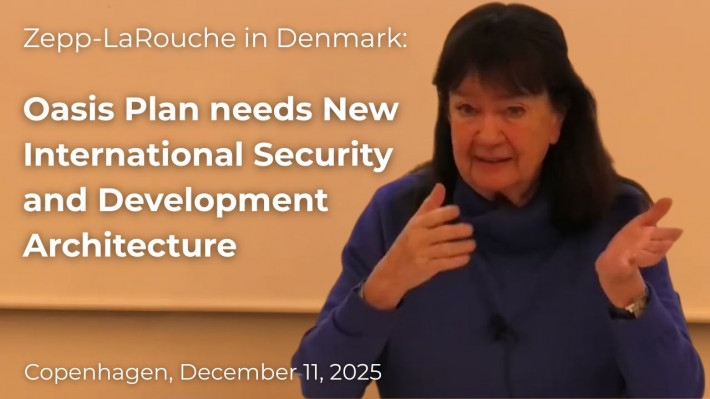
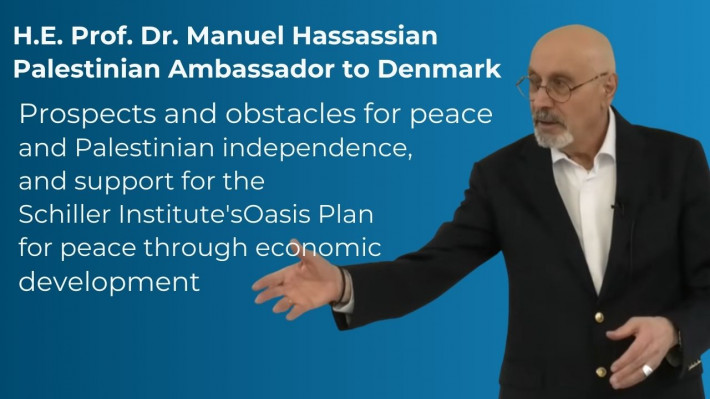
Diplomatic seminar speech #2: H.E. Prof. Dr. Manuel Hassassian, Palestinian Ambassador to Denmark, held this speech at the Schiller Institute’s successful diplomatic seminar in Copenhagen on December 11, 2025: Prospects and obstacles for peace and Palestinian independence, and support for the Schiller Institute’s Oasis Plan for peace through economic development.
H.E. Prof. Dr. Manuel Hassassian, who has just retired from his post in Denmark, presented his parting evaluation about the prospects and obstacles for peace and Palestinian independence, and his support for the Schiller Institute’s Oasis Plan for peace through development. A transcript will be available later.
See also part 1 with the speech by Helga Zepp-LaRouche and The Oasis Plan — LaRouche’s Solution for the Middle East.
Transcript:
Moderator Tom Gillesberg, President, the Schiller Institute in Denmark:
I am happy to welcome you all to this seminar arranged by the Schiller Institute. I want to thank you all very much for coming. The title is: Can there finally be peaceful development between an independent Palestine and Israel and the region. Build the Oasis plan now!
And this is a very special occasion because His Excellency Ambassador Prof. Dr. Manuel Hassassian, who has been the ambassador of Palestine to Denmark since 2019, has chosen to honor us, speaking with us here today as one of the last things that he ends up doing here in Denmark before he goes into retirement, retiring to to East Jerusalem, where I’m sure you will be involved in many different things. We have been very grateful for his collaboration on the issue of how to stop the atrocities in Palestine, but also with what we have been moving forward, which is the idea of an Oasis Plan, not just saying the bad stuff has to end somehow, but also what should take over. How can we have a development perspective for a coming, independent Palestine, but also for the whole region? The only way we can see that you really can move this whole thing forward.
And then we also have Helga Zepp-LaRouche who has come up from Germany, to afterwards speak on these matters. The ambassador has only an hour slot for us, so he will speak first, and then afterwards we will take questions. Then we will give the word to Helga who is the president and founder of the Schiller Institute.
—
H.E. Ambassador Prof. Dr. Manuel Hassassian:
Thank you very much for the introduction, I’m always pleased to share ideas with you. I have been engaged with the Schiller Institute for 2 or 3 years now, and I have become one of their champions. Every time I’m invited to a seminar or to an interview, I never say no. It’s not that they have an influence on me, it’s because of my deep conviction in the Oasis Plan which prompts me to talk about it, and how it relates to development in the Middle East, and in particular to Palestine.
There is always an end to everything. Maybe I will finish my tenureship as an Ambassador, but rest assured, I have many other positions that I will be practicing when I go back home. Professors never retire, and if they do retire, they end up writing books and articles and giving interviews. So my brain will be always alert to also see the Schiller Institute developing its ideas, and especially a plan that has existed for the last 3 or 4 decades. It is a sound plan, which I will try my best to summarize in the second part of my discussion today, and to relate it to the Middle East, because I think it’s worthwhile. When you are invited by the Schiller Institute, you have to talk about this plan, because this plan is considered to be their basic objective when it comes to development.
There is often a debate; which comes first, politics or business? Are economic relations between two adversaries more important than solving the political issues, or is this cataclysmic, to the effect that without having a political agreement, there will never be economic cooperation? It’s like the chicken and the egg; philosophically, we cannot determine (the answer). But I have come to a conclusion that both can go in parallel. We don’t need to solve our differences politically in order to start trying to cooperate economically for development purposes. Abject poverty is always the essence of conflict. When there is an economic boom, we don’t have conflict. Always, conflict is a result emanating from two parties that are not in parity with each other, and that’s why there is an imbalance when we talk about negotiations or conflict resolution. This is a very classic case when it comes to the Palestinians. The Palestinians have embarked on a process of negotiations since 1988. It was crowned by the Oslo agreement with all its loopholes. We ended up having a more complicated situation where Gaza is suffering from a war of genocide; let alone the West Bank, which is not spared by the attacks of the settlers and the expansion, like creeping annexation into the West Bank, where it is now rendered, as I always say, an island archipelago, like a Swiss cheese with no geographic contiguity whatsoever. And we talk about the West Bank, Gaza and East Jerusalem which only comprise 22% of historic Palestine.
And we always say that we made our painful concession back in 1988, when we accepted the State of Israel and declared our unilateral independence on historic Palestine, which are the borders of 1967, meaning the West Bank, Gaza and Jerusalem. But eventually, what we have witnessed for the last 30 years is that this process is completely dead now, and talking about a two state solution is like being in the desert pretending that there is water like a mirage. Although it is the talk of the town, although there is no other solution, practically, pragmatically, except the two state solution, although we have accepted the State of Israel on 78% of Palestine, yet that is also slipping from our hands. So what does Israel want? Israel wants to maintain the status quo, which is ‘occupation plus’. They need to take half of the West Bank under the rubric of biblical prophecy; this is Eretz Israel, part of what God, the real estate agent, has offered them. We look now at the situation in Palestine, and we see it’s impossible, even through choosing between constraints, which is the pragmatic approach, it is still impossible to see an independent Palestinian State on the territories of 1967. I always say there (needs to be) a divine intervention to solve this problem, or a miraculous solution to this problem. It seems as though we have lost the human touch in getting a certain solution to this conflict, and we are resorting to international and divine intervention.
It is so unfortunate that we have a weak international community. And it is so unfortunate that we have a broker of peace that proved to be dismal in its policies, because of its unwavering support to that of the peace process, which is the United States of America, which has proved to be a total failure. And that’s why what we witness today in Palestine, Israel and its cataclysmic effect, as a result of such a policy by the United States, we have reached to a point of nowhere. So either we need a magic wand to come up with a solution, or the international community, and especially Europe, will shoulder the responsibility and show its political teeth, that you, the United States of America, you cannot be the only monopoly, unipolar power, trying more or less to control the Middle East and the rest of the world. In the 1990s, we referred to the Americans, with the crumbling of the Soviet Union, as the unipolar power. And you were so hopeful you called it the Pax Americana. And this Pax Americana came out to be one of the greatest disasters to the people in the Middle East. Now, all Presidents of the United States have showed empathy and sympathy to the Palestinian people, but they have never shown political teeth to solve this problem, because they are always subdued by AIPAC and by the Zionist lobby, not only in the United States, but all over the world.
And there is an organic relationship between the vested interests of AIPAC and that of the Congress, which I consider to be our enemy. Now, the White House is quite friendly, sometimes Presidents are very supportive. They empathize and they sympathize with the Palestinians. But Congress has been our basic enemy. Because Congress drafts the laws. Congress sends aid to Israel, Congress allows arms deals with Israel, and Congress imposes embargos on any nation that is against Israel. So our enemy is Congress, and actually 80% of the decision-making process in the United States is made by Congress. It’s not by the chief executive, which is the United States President. So it is a very hard task for us to penetrate or to permeate, as we say, the lobby in Washington. Now, whether I want to call it fortunate or unfortunate, the war on Gaza, which is a genocide by all definitions, even by Raphael Lemkin, and he is a Jew himself, who coined the word genocide. It is a genocide that is going on in Gaza. And this genocide brought out the public outcry and the support, which we have never seen on American campuses, except for when the war in Vietnam took place, and (the students) marched in the streets and made history by stopping the war. We have seen it only recently in the United States of America. And that was, for me, what we call in physics, a quantum leap in public opinion and in support of the Palestinian people.
Regardless of the machine that the United States Israel have in terms of controlling and guiding what we call the public media, we managed to penetrate that as Palestinians, because the international community cannot turn a blind eye on what is happening on the ground in Gaza and in the West Bank. So as we say in French, it’s a ‘coup de grace’ that such an unfortunate event led to the recognition of the Palestinians, and led some European states to recognize the State of Palestine. But it is so unfortunate that still today, the Kingdom of Denmark did not make the effort to recognize the State of Palestine. And I’m talking Great Britain, Spain, all of these big powers in Europe, had already recognized the state of Palestine. Now, the recognition of the State of Palestine
in itself does not preempt the negotiations of trying to put on the contours of that state, which we call Palestine, because that will be based on parity negotiations between two states, and not between an occupier and an occupied. Because in a situation where there is occupier and occupied, there is a total asymmetry. And that’s why we call it the influence of the top dog, Israel, over the underdog. And in this case, the top dog is totally supported by those who are considered to be the honest brokers of peace, i.e. The United States. With all my experience in negotiations, we have never negotiated with Israelis. We used to sit in a table like this, L-shaped. And political leaders of Israel would not come and sit to negotiate with us, but military leaders, top brass. They would come with maps and with sticks: This is for us, this is for us, this is this, this is this. So it was what we call the ‘diktat of power politics’. So we never had negotiations. Negotiations are when there is symmetry, when there is parity. When we look into each other’s eyes and try basically to negotiate, believing that you go to the negotiating setup, with the maximalist position. But through the process of what we call an “aria”, which is a theory in conflict management, you end up fulfilling the optimum, and not the maximum, and both parties will be at the same level. And that’s why we have a breakthrough, and we have a deal. But you can never have ‘top dog’ dictating the political situation and the negotiations, and believe that there is an agreement. There will never be an agreement. Agreement is based on concessions. You have to make concessions in order to reach the optimum. And just to give you an example, when this model of conflict management was developed, I was one of the participants in this model, as far as a practitioner in conflict management. Although my area was the Middle East, through experience and teaching for 26 years, I developed my skills in conflict management.
That’s why I’m a cool professor, where I don’t antagonize my audience, but I try to find solutions. It’s not enough to sit here and try to describe the ugly occupation of Israel. Everybody knows what occupation is. Europe has passed through occupation. Many countries have passed through occupation and racism, South Africa and what have you. So there are plenty of examples. But the effort and the boldness is how to circumvent the process from a zero sum conflict into a win win situation. This is the real effort of people who have in mind the mindset of accepting the other, while not trying to underestimate their acquiescence of their political aspirations. So this synchronized effort is extremely important because if you don’t make this balance, you end up losing. And we call this theory ‘aria’, the musical aria in opera, where A stands for the adversarial position. You come into negotiations with the idea of a zero sum conflict; your gains are my losses. And you debate. Let’s take the question of right of return in the United Nations. And there is an open floor between the Palestinian ambassador and the Israeli ambassador, to put their own rationale as to why the ‘right of return’ should be possible for the Palestinians. Now this situation ends up in a total adversarial position. You see the negotiators scream “body language”. They want to control the other members of the United Nations through the body language and through the tone to win the battle.
And that’s why they don’t make sense. They start resorting to all kinds of stupid examples just to score a point. So we call this adversarial position where you reach a point; it’s point blank. There is nothing much you could do anymore. So we take a break session and we go into separate rooms, and we try to rationalize the stupid talk that we had introduced. Does this make sense? Does that make sense? Poor fools. That’s stupid. So what we call the soul-searching, the process of trying to factor in the psychological pressure through taking a rational decision-making process, (is what) makes you become more pragmatic, choosing between constraints, and more practical, in finding plausible solutions. This is what we call the stage ‘reflexive’. You reflect on both sides’ arguments, and you come up with a third stage, which is the integrative stage. Now this is all empty. We look at the glass as half empty when we are in an adversarial stage. Now we look at it as half full. What can we accomplish together by prioritizing our national interests, which could be a common ground to start building the momentum of accepting each other and finding a solution? This in itself is called the integrative, or what we call ‘search for common ground’.
The last part is when you agree, you try to prioritize both sides. Which ideas are more plausible? You start with the easiest ones, and I give you an example. I was engaged in 52 second-track negotiations with Israelis, and the third party was Europeans and Americans. And every time we brought the six intractable issues. And when it came to Jerusalem, the first thing – a collision – on the question of sovereignty in Jerusalem. Sovereignty is nonstarter. You don’t start with sovereignty because each will claim that sovereignty belongs to them. And that’s why we say, let’s start from the bottom up. What do you mean by the bottom up? Let’s say that we have two independent municipalities, Palestinian and Israeli, and there is an upper municipality like the Vatican, hmm? trying to be the last resort if there is a conflict. You refer to this, what we call the umbrella municipality, that will deal with solving the conflicting issues. And that in itself will pave the way, basically, to understand infrastructural development. And here comes the economic part. Security, security arrangements, mobility – crossing from East and West Jerusalem with clear surveillance to make sure that there are no spoilers; these are the details that you start with in building the momentum. Then the question of sovereignty becomes an important issue, but yet we come up with different kinds of sovereignty. And I’ve written on this issue a long time ago where I devised 15 models of sovereignty in Jerusalem.
And as I said, one of them is shared sovereignty. Another one is joint sovereignty. A third one is God’s sovereignty. A fourth one is scattered sovereignty. A fifth one is un-sovereign sovereignty, and the saga continues. And I described each one with its pros and cons. Don’t tell me that everything is absolute in this world, for everything there is a solution. It depends on the mindsets. In all second-track negotiations, we managed to find common ground on the six intractable issues that comprise the essence of conflict between Palestine and Israel. But in what we call the first-hand negotiations, between the politicians on the government level, that has always been a non-starter. Although everybody knows the solutions to all these issues, we have to be prepared psychologically for what we call the painful concession. You have to be prepared psychologically for the painful concession. And that’s why if you go there with an attitude of maximalism, you cannot achieve peace. Conflict will resume.
Ladies and gentlemen, wars are quick fixes, but peace is a tormented path. It is a process that is very painful. It needs tolerance, it needs political vision, it needs to think outside of the box. But if you have the upper hand, like Israel, war is easier for them than negotiations. But also, we say war is not a solution. The Ottoman Empire ruled the entire Middle East for four centuries. Eventually there came a time when it totally crumbled, and all of the countries in the Middle East and Africa, and what have you, became independent.
But then we had a different form of colonialism, European colonialism, which also did not last long in the Middle East. So once you know the solution, all you need to do is find a process. And one of the processes of having a breakthrough is something called economic development. And here comes the Oasis Plan. Look, I have so many things written here, but I always want to speak from my heart, and this is what I do. I cannot but prepare myself, but I don’t read what I write because when I start speaking, I try to be more pragmatic, closer to your hearts and to your brains than just reading a document where it goes from here and goes up from there.
Now the two state solution. I just published an article, maybe a month ago, I called it “From Reality to Illusion”. If you look at the ground today, there is no two state solution, nothing left from the West Bank to be independent and to be contiguous geographically with what we call Gaza and that of East Jerusalem. And it’s not only Gaza that is suffering and in war, but also the West Bank and the East Jerusalemites. So we have a total onslaught on the Palestinian people. Israel wants the geography and not the demography of the Palestinians.
Israel, once the historical land of Israel, they allege, through their biblical prophecy, that God gave it to them 2000 years ago. Are we still in the age of religion, with God being a part and parcel of preferring one people against another? Where is the justice? If God is our reference of justice, fairness, then there is something wrong with our God. What is this chosen people? Blacks. Asiatic, Arabs, Europeans, Hispanics – we are all equal. We are all human beings. And that’s why we always resort to the international humanitarian law. We resort to human rights because everybody is equal. No preferences for God! So please, never factor in the religious dimension in this conflict, because our conflict with Israel is not based on religion. This is Islamophobia – it’s wrong. Our struggle is a national struggle. We are struggling to gain our independence, to fulfill our inalienable right to self-determination, which has been given to every single nation in the world except us. Today, our conflict is considered the longest modern occupation in history. When is it going to end? Why? We had the civilization, we had history, we have geography, we have demography. Why are we denied our right to self-determination? Sometimes they say ‘Hamas, and this and that’. What’s Hamas? Hamas is an integral part of Palestinian society. Yes, we don’t approve of their methods, but they are considered to be opposition to the Palestinian Authority.
And in a democratic entity, we have the right to have opposition. You want to tell me that Israel is a democracy only, and nobody attacks the settlers who are considered to be the counterpart of Hamas? And why do they accept them as part and parcel of their society? And they never criticize them, but they want the Palestinian Authority to criticize Hamas. Where is the fairness in this? Now, as I said, I don’t approve of Hamas’ ideology, but I cannot deny that they are part and parcel of a resistance movement, that they believe in armed struggle. Before them, we, the PLO, believed in armed struggle for 25 years. Then we realized that armed struggle is not a solution. We were terrorists, now we are not terrorists. Tomorrow, Hamas, when it is engaged in negotiations, and once we solve the issue of Gaza and what have you, believe me, the United States will remove Hamas from its terrorist list. So this is a process. We cannot deny what is on the ground, we have to deal with it. Regardless of whether you approve or disapprove of their policies, you cannot negate them. They are a power to reckon with, they are still there. They have their arms and they are still resisting the occupation. I believe that at this stage, intellectuals and academics have reached a certain kind of a conviction that there is no two-state solution anymore.
We have to struggle for a one-state solution like South Africa’s, where democracy will be the rule of the game, and the talk of the town. By elections, (we will have) majority rule and minority rights. Of course, Israel’s one-state solution is ‘occupation plus’. They don’t believe in the electoral process, neither in accepting the one-state solution as a permanent solution to sustain the longevity of peace in the future. So this mentality of occupation and control, and destruction and displacement, and the forceful diasporaization and the constant killings – they believe that these are the mechanisms of creating havoc, and making people voluntarily leave. Ladies and gentlemen, the Palestinians left in 1948, but they’re not going to repeat the same Nakba, as we say, the debacle. Today, the (number of) Palestinians inside Israel proper and that of the West Bank, Gaza and East Jerusalem are almost equal to that of the Israeli population. How could they control 7 to 8 million Palestinians, living basically in the West Bank and in the adjacent countries like Jordan? How can they? They have to find a plausible solution to coexist, and to live in conviviality, because this is the essence of security for the State of Israel. Israel, with all its war machines, have never secured its borders, have never secured its internal conditions. As long as there is conflict, Israel is insecure. And that’s why the psychological dimension of fear and distrust reigns supreme in the lexicon of Israel.
So they have to shift from this part to another part, which is the acceptance of the other and finding a common ground. Security is an obsession for Israel. It’s like in mathematics when you say ten over zero is undefined. Everything is explained and rationalized through the security modus operandi. And that’s why they are totally obsessed. And I believe that every Israeli needs a shrink to overcome this obsession of security. And of course, this has something to do with history, with the Holocaust, with the pogroms and what have you. It’s not something that is of our creation. What is Hamas compared to Nazi Germany and what happened there? And it’s so unfortunate that Israel does not believe that what it’s doing as genocide, while we believe in the Holocaust and we support the Holocaust in terms of being sympathetic to the Jewish people and what they have suffered. And you were amongst the first to receive the Jewish survivors in Palestine, where 99% of the population were Palestinians. All these ships that came to Palestine, we opened our hands and we received them as refugees. But it turned out that these refugees came with a project called Zionism, which is the creation of colonies and displacing the indigenous population. This was shown to us in the last seven decades. Now, I think I spoke a lot on the conflict, but I hope that I will always bring up cheerful aspirations, because if we don’t have hope, there will never be a solution.
And I always quote the Italian philosopher in all my speeches, because I totally believe in him and in his philosophy. Antonio Gramsci, when he says there is always pessimism of the intellect, but always optimism of the goodwill. So as a politician, as an ambassador, as an academic, I have to be hopeful so that I can be creative. And there is no solution without creativity and innovation. We need to be creative, we need to think outside of the box, and we need to exert strenuous efforts in finding what I call Aristotle’s golden mean. You don’t go to the extreme to solve it, you go to the middle. And that’s why we also have in Islam (ARABIC WORD HERE) which is Aristotle’s golden mean. Aristotle took it from Islam, It was not his invention. The question of social equity, social justice was in Islam before being part and parcel of the French Revolution in the 19th century, where all the philosophers, all the poems, all the poets came out from Europe. And it’s the same Europe that is now totally impotent in trying to find solutions to big problems where they are considered to be stakeholders. And I was the first to invent, and I take credit for myself, (sometimes I like self-indulgence when I see people repeating my slogans). In my first speech to the British Parliament, going back to 2005, and of course Britain was part of the EU, I said “we don’t want Europe to be a payer because paying is sustaining occupation, but we want them to be players”. And players need to have political teeth in order to make changes, and to not be totally subservient to the diktat of American foreign policy in the region. And I tell you, between Democrats and Republicans for the last six, seven decades, we never had any substantial change in foreign policy when it comes to the Middle East. Whether the Republicans are in power, or the Democrats – we call them Tweedledum and Tweedledee. And they have been based on four important pillars: One, the unequivocal support of the State of Israel as a proxy regime; Two, trying to control the oil and the oil prices in the Middle East; Three, trying to contain communism which was then substituted by the creating of Islamic fundamentalism. Ladies and gentlemen, Islamic fundamentalism was always supported, and it was created in 1928 by Hassan al-Banna in London, and Daesh was created by Hillary Clinton, just for your information. Because imperialism cannot nourish and flourish (unless it creates) an enemy. The hocus-pocus of communism faded, crumbled, so they created another enemy, which is Islamic fundamentalism. And Fourth; try to curb any kind of national liberation movements, which they then dub as being “terrorists”. These are the four cornerstones. Study them and go through history telegraphically and see to what extent my analysis is absolutely right.
There is no change, no change. The change should come from Europe because it is the only power [it consists of 44 countries per UN – mbg] that could stand in front of the United States, although there is some tension between Europe and the United States in terms of policies and economic interests. But eventually Europe’s interest lies much more with the Middle East – with the oil, with the silk road, with the trade. But with America, it is like a strategic ally when it comes to NATO and when it comes to military cooperation. Americans don’t care about Europe. They want them to be subdued under their flank and do their business. Americans only care about their own national interests. And believe me, once Israel becomes a strategic liability, they will stop helping Israel. And that’s why I always say: Israel, you should make your concessions when you are at the crescendo of power. You don’t make concessions when you are weak. And if you want to be a legitimate Middle East country accepted by the Arab and Islamic world, 59 countries, you should give the Palestinians their right to a state and to their self-determination. And we, the Palestinians, will give them the legitimate birth certificate in the Middle East to be part and parcel of one of us, like the 60th state in the Middle East. So Israel has to make its choices.
Prolonging procrastination, creating conflicts, objective conditions – this is not going to bring peace to the Israeli people. And today, the Israeli people are living in a garrison state, in a fortress. They are totally psychologically constrained. And they cannot really find their freedom by being at war with all these Islamic and Arab countries. Now 20 years down the pipeline, are the Palestinians going to still be factionalized and atomized? Are the Arab and Muslim states also going to be divided? Is the United States of America going to continue 20 years from now as the unipolar power, controlling through monopoly, world politics? Are the 2 billion Muslims going to sit idly and watch the desecration of Al-Aqsa mosque? Things are going to change because we believe in the dynamism of history, and history is based on contradictions. And this is where I believe in the dialectical materialism which Marx has taken from Hegel. That an idea creates in itself an anti-idea. And the synthesis of the idea and its opposition creates a synthesis in an idea which is a combination of both, which in itself becomes the idea, where its contradiction comes. And this is the process of development, it is based on contradictions. So there is nothing constant in history. History as we say, is past politics and politics is present history. So we can see a Catholic marriage there.
There was no politics. It used to be the history of diplomacy, how countries used to relate with each other. I don’t believe political science is a science, because science is based on behaviorism and statistics, but you cannot control the emotions and the psyche of a human being to factor it in numbers. So I don’t believe in political science. I believe in political diplomacy. I am a traditionalist, and I claim to be a traditionalist. I cannot try to quantify human behavior.
Now, let me finish by just saying, the situation in Gaza today is precarious at best. The ceasefire is fragile. Skirmishes are still continuing. Bombing is still continuing. Since the ceasefire until today, almost 500 people have been killed. The agreement said 600 trucks should go in. We are getting much less than that today. Gaza is suffering from heavy rains, and all these tents are in the air now. And these dire conditions are making life impossible, with scarcity of water, with scarcity of food. The Gazans are still suffering in a very painful way. Trump’s 20-point plan, which people refer to it as ‘peace’ – it’s not a peace plan, there is no vision there. It’s a ceasefire with certain conditions, but not a peace plan. Now we are waiting for Trump’s second stage of implementing his 20-point peace plan. And this is what we call the transitional period, where Gaza eventually will be reconstructed. And then the Palestinian Authority will be involved, along with the first Governor to Gaza, a new form of colonialism, championed by Tony Blair. But I don’t know now if Tony Blair is still on the agenda, because he is considered persona non grata. When he was Prime Minister I had the experience, as the Ambassador in London, to learn what I call the “sleeky” diplomacy from the Brits. I stayed there 13 years, so I understand their psyche and how they think. Of course, he has been discredited since 2006 when he, with President Bush, invaded Iraq on the pretext of weapons of mass destruction and everybody knows around the table there were no weapons of mass destruction. And he was the head of the quartet, and he achieved nothing as far as we are concerned. And now he is being imposed to become the Governor of Gaza, not running it from Gaza, but from Egypt.
So we don’t know where that stands, and, there are many, many international countries that don’t want to be involved with ‘boots on the ground’ in Gaza. They don’t want to be part of what he calls this peace initiative, because they don’t trust the United States and they don’t trust Israel. Israel now controls more than half of Gaza. (Right, doctor Hassona?) More than what they call the yellow line, and they think that this is their security arrangement, it’s like their buffer zone. So what are we talking about – where is the two-state solution? Where is the international community that shouldered the two-state solution as the only solution to this conflict? So for me it is enigmatic. Either I’m stupid and naive in not understanding world politics, or I am blunt enough to expose what Israel and the United States are considering creating a new Middle East, that is based on their own national interests.
Now, here I have to not improvise, because I want to be accurate when I talk about the Oasis Peace Plan. So allow me, and I need Helga and our colleagues to tell me whether I am right in describing fully what the Oasis Plan is. I tell you, I’m not here to market the Oasis Plan, and I’m not part of the Schiller Institute, but I’m a supporter of the Schiller Institute because I believe in their plan.
So I will do it at any time, even if I’m retired! Helga picks up the phone, she tells me, “We want you to come and speak about the Oasis Plan”. I’m always ready, whenever you want. So that’s my commitment to the Oasis Plan. And I did not decline coming here, although my time is so precious – I’m leaving next Thursday, I have so many commitments. But I said, this is the speech of The Last of the Mohicans. And let me just outline to you in a nutshell, because the Oasis Peace Plan is a big document and it has to be read meticulously. It needs an economic background to understand the complexity, yet it has as an objective, the subtle solution, which is so crystal clear.
When I looked at the Oasis Plan, I said that there is a great benefit for the Middle East region and for Gaza. The Oasis Plan presents a transformative vision for the Middle East built on regional economic integration, water security and sustainable development. It aims to replace cycles of conflict with shared prosperity.
The plan connects regional economies through energy grids, water networks, transportation corridors and industrial hubs. This interdependence generates collective incentives for stability, investment, and long-term cooperation. As water is a scarcity in the Middle East, it prioritizes water security and climate resilience on a large scale, with desalination, and water-sharing mechanisms, combined with renewable energy. It strengthens agriculture, reduces migration pressures, and supports sustainable urban development.
It reduces drivers of instability. Regional connectivity lowers the costs associated with conflicts and raises the value of peace. The Oasis Plan creates practical avenues of collaboration among the Arab states, Israel, and international partners. By focusing on mutual economic gains, it shifts the political dynamics from confrontation toward problem solving and constructive, ambiguous diplomacy.
Specifically, Gaza stands to gain immediate improvements from the Oasis Plan through, first, desalination plants, stable power generation, upgraded sanitation and restored infrastructure. It is a path to economic recovery, linking Gaza to regional markets, and to the West Bank, through energy, trade, transport corridors, for a sustainable economy. Industrial zones, agricultural revitalization and job-creating infrastructure projects provide a foundation for long-term stability.
It reduces tensions and supports political stabilization, establishing a basis for future political settlement. The Oasis Plan provides the material infrastructure necessary for governance, mobility, and regional cooperation.
To summarize, the Oasis Plan is a regional development plan, which offers a shared vision of a solution to the chronic scarcity of water and electricity. It is a stabilizing framework that reduces tension by creating a partnership based on shared economic interest and practical cooperation, which will bring tangible benefits of peace. It is a lifeline for Gaza providing water, power, reconstruction, job opportunities, and connection to regional markets; a foundation for future peace by improving living conditions and regional interdependence.
I believe that today it is high time that this plan should be taken seriously by the international community. Let’s not invent new plans, because we already have a plan that has been practiced and implemented in China and other parts of the world. It has been a success story. Why can’t it be a success story for Gaza and for the Middle East? We don’t need to improvise and to reinvent the wheel, while we have a solid plan that really caters to the needs of all the peoples in the region. That’s why I recommend the Oasis Plan.
When I go back, I hope that I will have a meeting with the advisors to the President [Palestinian Authority President Mahmoud Abbas], to introduce this plan to him, because whether Israel likes it or not, whether the Americans like it or not, the Palestinian Authority is going to be part of the reconstruction process. We have a plan in the Palestinian Authority that was put together with that of Egypt, and presented to the international community.
And as I said in the beginning, we have to be hopeful, because this is the nature of human beings. We ought to find better conditions. Peace is difficult to attain. War is easy to wage. But if we have the stamina, creativity, incentives, the innovation, power, and skills to implement the ideas of our ingenious minds, I think we can find a solution.
God gave us this gift of choosing the right things in our lives. And if we believe in the values of humanity, and that I am a Palestinian with human values, and trust that humanity will never let the Palestinian people continue to suffer and to live under occupation, then I plead with the international conscience, not only as an emotional request, but as a rational request. There is always a solution to every conflict. Maybe that solution does not please you 100 percent, but it is the way to start, and there is always one step towards heaven. Thank you very much.
—
QUESTIONS AND ANSWERS
Tom Gillesberg: Thank you very much.
Hassassian: Thanks.
Tom Gillesberg: My pleasure and I hope you have a few minutes for questions.
Hassassian: Yes, of course. And, difficult questions. Helga.
Tom Gillesberg: You can have the honor of asking the first one.
Helga Zepp-LaRouche: Your Excellency, I’m very happy about your speech because I think it is that attitude of optimism which will make the Oasis Plan become a reality. My immediate question to you is, you said Pax Americana did not bring good things to the Middle East. Now, there is a new National Security Strategy just published by the Trump administration, which breaks with previous priorities. This de-emphasizes Europe, it puts the primary emphasis on the Western Hemisphere, and it also decreases the emphasis on the Middle East. So given the changes inside the United States, because of the protests by a lot of young people to what is happening in Gaza, which has also influenced the MAGA movement, there is a certain amount of tension between certain MAGA politicians and President Trump, which are quite intense inside the United States. So what do you think will be the effect in practical terms of the new security strategy for the Oasis home?
Ambassador Hassassian: Well, I have to admit to you, I didn’t read the document yet, but I can try to improvise as much as I can. There is a big contradiction today in the United States between public opinion and that of President Trump’s administration. President Trump, unfortunately, is turning out to [believe in] racial supremacy. He doesn’t believe in the migration, he doesn’t believe in the immigrants. He is slurring everything that is anti-WASP, which is White, Anglo-Saxon, Protestant. And you have seen his campaign against the Somalian Congresswoman. The United States is what we call a mélange of ethnicities, it is considered to be the melting pot. And now it is turning out to be a government that is based on religion, color and race. I don’t believe in what the security of the United States in the past has really achieved, because we have seen that the security of the world is controlled by the United States through NATO. We don’t see any independence of NATO from that of the United States. And we see today an opposing power, which is Russia, Iran, South Korea, and to a certain extent now India is moving in that direction as the counterpart to the hegemony of the United States in the world. So now we are witnessing a rise of multipolarity and not a unipolar power. And this has been a total defiance for America’s hegemony, not only militarily but also economically. If you go to China today and look at their national treasure, they have trillions of dollars more than the United States of America. So the economy is not controlled by the United States anymore, and the dollar is not going to be the international currency. So it’s a matter of time. And I tell you, security is totally tied to economic interests. And that’s why I believe that no matter what the Americans do, they have to understand that a balance of power is the only way towards security and peace.
Resumé of question 2 from a diplomat: A diplomat thanked the Ambassador for his towering intellectual presence in Denmark, and extended best wishes for the future. Besides state-to-state political and diplomatic efforts, are there people on both sides of this unresolved conflict who are willing to talk to each other in the spirit of peace, to find a solution?
Ambassador Hassassian: I think that’s a very, very good question. I will start by saying there is a big difference between peace building and peacemaking. Signing a peace treaty does not give you peace and tranquility, It’s signing a document and it’s done between governments. But peace building is when you prepare your civil society to connect with the other civil society, where people-to-people interaction creates a modus operandi of conviviality and coexistence. This sustains the peace process. So peace building comes before peacemaking, because when you build peace, then the sustainability and the longevity of that peace will be based on the mutual interaction, the mutual trust, the mutual non-fear of each other, which makes it plausible and practical. Now before the second Intifada, which was in 2002, we had, through what we call the Oslo peace process, total communication, on people to people and on the grassroots levels, between Israeli society and that of Palestinian society. It’s only in the second Intifada, when the Intifada became militarized that we lost our connection, that the Israeli society began leaning towards the right. And that’s why we have Netanyahu being elected time and again, because that society lost the power of what we call “peace now”. And that organization has dwindled; all the liberal parties in Israel have lost. And today, what we have is an extreme right-wing public that supports Netanyahu with all his, let’s say, faults and deficiencies, because Israelis always (support) their leadership during war. During peace, they could be very vociferous in opposing, through a democratic electoral process.
But during war, they stick to their leadership. And that’s why Netanyahu is trying to linger the situation in Gaza, to secure another election next year. And once that is done, I will say the Palestinian issue will be gone in the sky, because Netanyahu believes in not relinquishing one inch from the occupied territories. His revisionist father, who was a professor at Hebrew University, taught him this: never give one inch of the land of Israel. So he is not a peacemaker. He is a warmonger who believes like a vulture. Nurturing himself with conflict and trying to always expose the Israeli public through the fear of Iran’s atomic bombs, through the fear of Hamas and other Islamophobic ideas, to make them cling to him as the only savior for the land of Israel. So he uses this psychological approach to retain his power. But I totally believe in what you have said, Mr. Ambassador. I think peace cannot be just signing a document. Peace should be based on reciprocity, on mutual respect of each other and trying to put a common ground of interest that sustains and makes that peace, the longevity of which will bring security, and security cannot be achieved in the Middle East without resolving the Palestinian-Israeli conflict.
Resumé of question 3 from a diplomat: Regarding the Oasis peace plan, do you think that agreements on the technical level will bring peace on the political level, or vice versa? Is it like the chicken and the egg? Or will normalizing relations, as was starting before the war in Gaza, lead to peace, or the other way around?
Ambassador Hassassian: Maybe this part that I referred to, you were not still here. But I will reiterate again, I always say, and I debated a famous professor, Gideon Fishelson, back in 1990. We had a debate at the Notre Dame Center in Jerusalem, where the moderator was the Consul General of America, Philip Wilcox. And I’m here on record in what I’m saying. His approach was, Gideon, which later was adopted and plagiarized by Shimon Peres, that economic development leads to peace, that economics comes first before any political resolution of conflict. I say, there is no harm in having political negotiations, with the innovation of economic development in principle, without one prioritized over the other. We could have negotiations, and if you have negotiations, what do you have? Ceasefire. Right? Peace. And how could you nourish peace and try to encourage people to accept the negotiations with all its ups and downs, by improving their economic conditions. When do you have conflict? When there is abject poverty, when there is no symmetry, with one society controlling and the other being totally subdued. My argument back in 1990, which is almost 35 years ago, and I was a handsome young chap at that time, I said, politics comes first, then economics. But today I think I am a little bit more mature, to say that one does not precede the other, but they can go in parallel. And this is what we are hoping with the ceasefire, which will lead to the national reconstruction and the physical reconstruction of Gaza, where economic development takes place, where job opportunities are created; then this will also pave the way for political resolution.
It does not complicate it, but it will pave the way for a subtle resolution in the final analysis. So here I cannot be philosophical by saying, which comes first, the Big Bang theory or the absolute God, like what Hegel taught us. We cannot say that the chicken comes before the egg, or the egg comes before the chicken. So I would say that these questions are like a Catholic marriage; they are intertwined, organically intertwined, to the point one complements the other and vice versa. And that’s why when I talk about the Oasis Plan, it’s a plan that is complete. There are no loopholes, maybe there are loopholes in the practical implementation of it in certain cases. But as a plan in itself, I think it is worthwhile studying, and it is worthwhile considering. And I’m sure I’m not just talking about Gaza. I’m talking about India in its development, Pakistan in its development, Bangladesh and all third world countries. You are not third world, but you are big countries, vast countries that you have so many problems in agriculture, in trade, in water, salination, in physical development and what have you. So why not take this plan as a pilot? Try it. If it works, it works. If it doesn’t work, (inaudible) we say in French, to hell with it. But I think it is worthwhile.
We cannot always say no, no, no. Israel has been saying no, no, no. One day they have to say yes. We, the PLO said no, no, no. Whoever thought that after 25 years of armed struggle, we start believing that pragmatism and political accommodation is the only way out? And we embarked on this almost 37 years ago, and still we are hopeful. With all the ups and downs, with all the complexities of the situation, we are still in a process where we believe eventually peace will prevail and reign supreme. Your question is very important, extremely important. I was one of those who opposed the Abrahamic Accords. I said, this is premature. Giving the Israelis the privilege of cooperation with the Arab world, while they had been boycotted by the Arab world for so many years, this was given to the Israeli’s on a golden platter, while they were subduing the Palestinians and killing us in Gaza. This is wrong. I will believe in the Abrahamic Accords when we achieve a ceasefire and we achieve peace; when we go back to the 2002 Arab Peace Initiative, which was initiated by Saudi Arabia, and the Beirut summit conference, where 59 countries had agreed to that. Then we can talk about cooperation. Right?
Resumé: Ambassador Hassassian said that the normalization agreements that have been signed are not peace, but long-term truce arrangements — non-war existence, but not genuine peace.
Ambassador Hassassian: The same goes for the (Wadi Araba) peace initiative between Jordan and Israel. Do you think there is peace? Do you think the Israelis now roam in the streets of Amman safely? No. It’s only a peace agreement and not peace building. The peoples of the Middle East will accept Israel as a full fledged, legitimate member of the Middle East nation states, when they recognize the inalienable rights of the Palestinians to self-determination and to their statehood. Read my lips and I am a peacenik. And my peace is totally circumvented by the fact that I cannot accept peace while there is occupation. Resistance, not necessarily physical, nonviolent resistance, peaceful resistance, crying out for our inalienable rights in the international arena, in the human rights organizations, in the ICC, ICJ; that is our strategy of fighting Israel and its racist policy in the West Bank, Gaza and Jerusalem. So we cannot have peace without the deep conviction that peace will come only through concessions on both sides. We made our concessions. We gave Israel 78% of Palestine. What else do they want? We did our share. Israel has to make its choice, and there is no other choice for the existence of Israel. Read my lips, 30 years down the pipeline, if they continue with this hegemonic attitude of controlling and subduing the Palestinians. I always say you make peace, you agree to peace, you make concessions, when you are at the crescendo of power. And how do we define power? I came up with a definition of power. Power is the capacity to elicit desired responses, the capacity to elicit desired responses. So diplomacy is the safest way to gain your national objectives rather than going to war. From the ancient civilizations, from the Sumerian civilization, up until now, how many civilizations came to the world and crumbled by creating a prime culture and another civilization? Do you think America will be forever the power that controls the world? We thought at one time that Islam would be prevalent as a leading civilization for so many centuries. But in the 19th century, we saw the emergence of what we call material civilization, coming up from Europe and becoming the leading civilization of today. The same contradiction within this civilization will lead to another one. And this is the process of history and change in history. So let us not be object of history. Let us be the subject of history and try to be active players in history making. I hope this didn’t lecture you and I apologize, since I’m a professor, I sometimes don’t know when to stop.
Tom Gillesberg: I think of what you said, of Europe and the present circumstances of the political leadership of Europe, and the total absence of diplomacy and the seeming total absence of capacity, of empathy, of thinking through, of reflecting, of putting yourself in the other’s shoes. I think probably we will have to not send you back to Jerusalem, but make a European Academy of Diplomacy and then having European leaders coming to school again. Because this idea that you need shared security – security can only be shared, you can never have it for yourself. And if you see the Europeans right now, they’re bumbling around, they don’t know what to do. Now, we can’t even just do what the US is saying – what are we supposed to do? Well, maybe you should listen to these wise words. Maybe you have to take them to school and teach them how diplomacy works? And the beauty is, you can actually do this while Europe still has a capacity. Right now the European economy is tumbling down the hills. But still, if Europe would find its way, you would be able to salvage something, I think. But not if it’s just left to itself because then there’s no vision, there’s no hope, there’s no future. But if Europe would actually be engaged in building up Gaza, building up Africa, building up the world, then maybe Europe would also be able to find its identity again, not as a war maker, but as a peacemaker. Helga, you have the floor.
Helga Zepp-LaRouche: I would like to thank you very much for almost two years of your cooperation with the Schiller Institute, with this project. And I think you are aware of the fact that there are many people in the world who have already expressed their endorsement for the Oasis Plan. So we plan to continue this campaign. As a matter of fact, I also want to invite all of you to attend every week or at least one day if you have time, every Friday at 5:00, we have a meeting of the International Peace Coalition, and one topic we always discuss there is the issue of peace in the Middle East and Gaza. Since the question was asked before, we had a lot of pro-peace speakers from Israel, also naturally from Palestine and other Arab countries. So I think that strengthening this dialogue is a very important question. So please come to this meeting because it’s a very important way to be in tune with this effort. Otherwise, I just want to say that we have excellent people endorsing the Oasis plan, like Doctor Naledi Pandor, the former Foreign Minister from South Africa, and various other leading individuals. At this point, it is clear that the next step in making the Oasis plan a reality, will be to have a physical conference, not just online and not just in private circles like here. We have to find a government, preferably of the Middle East, which would sponsor a conference on the project, because I’m quite certain that if, for example, we could bring together young people from Palestine, Israel, Syria, Lebanon, Yemen, Iraq, Afghanistan, these are all countries who have had enormous sufferings from interventionist wars.
And in many situations, the humanitarian situation is equally precarious. Maybe not as bad as Gaza, but Syria is a catastrophe, Yemen is a catastrophe, Afghanistan is still suffering enormously. So if there would be a conference, let’s say organized by Jordan, by Egypt or the Emirates, or any country which is in a position to do that, and you would invite students, you would have animations with AI, and you can make the Oasis Plan real. You could have a vision of how the deserts would be green, how where there is nothing right now, there would be highways and railways, forestry, agriculture, plantations, orchards. Because that all would be possible through the Oasis Plan. And then young people would get an idea that this vision is something to fight for, for their own future, and they could become a leverage on their government to actually move in the direction of supporting it. So I’m actually convinced that the next step has to be such a conference, because just imagine if we would have scholars speaking about it, showing animations, how the entire region from India to the Mediterranean, from the Caucasus to the Gulf states, this would all be green. It would all be like it used to be in the ancient Silk Road. It was a hub between Asia, Africa and Europe. And that way one could then use these videos for education afterwards in universities. So you could really make a total change through having such a conference. And I just want to put this idea in your head before you’re leaving it!
Ambassador Hassassian: Well taken. Let me just (clench/finish?) by saying a few words. Thank you for inviting me, thank you always for inviting me to speak. I think this has been a good forum for an Ambassador to speak about his country and about the suffering of his people, yet with a hopeful note that there is always a peaceful solution, and there is no other solution except through peace and through political accommodation. We hope for success, and as I told you, I will be one of your soldiers in terms of supporting the Oasis Plan. And all I can say, is that a vision is the motor of development. Without a vision, there is no development. And without taking risks there is no profit. So we have to be wise, vociferous, deeply convinced in our ideas, open for criticism, open for improvement, because there is no absolute idea. The absolute idea goes to God only and not to human beings. So there are always certain niches, as we say, for developing. Maybe, I don’t promise, I have two books to finish, but maybe I will write an article, and send it to you telling you where the gaps are that we have to fulfill in the Oasis plan. And I promise you that. Thank you very much, ladies and gentlemen.
Michelle Rasmussen: We have a couple of gifts for you. This is a Schiller Institute certificate of appreciation to the ambassador in appreciation of your cooperation with the Schiller Institute, and for promoting the Oasis plan for peace through development.
Ambassador Hassassian: Thank you so much.
I would like just to say one word, if you allow me to do so. I think that this forum should be open to all Ambassadors, to come and give the experiences of their countries in the process of development, so we can learn from each other. Regardless of the Oasis Plan, just to share their history and their experience in developing their land, and how they can learn from the Oasis Plan to improve their plans of development. I think this should be a good forum for them. That’s my recommendation.
Helga Zepp-LaRouche: Yes, we will do that. And I think we are already in the process of doing it with some African nations because, as you know, Doctor Pandor said that Oasis Plan and the Africa 2063 Plan are identical in outlook and they should be looked at together. So maybe that would also be a topic for one of the future meetings.
Ambassador Hassassian: I wish you all the success. I wish my colleagues, Ambassadors all the success. Denmark is not a la la land. It has been very difficult for me to deal with such a conservative government, but I’m sure that you can improve your bilateral relations. And please, always in your speeches, in your deliberations with the Foreign Ministry, don’t forget Palestine. Thank you. I will cherish this (the Schiller Institute Certificate of Appreciation).