
Top Left Link Buttons

tobi

Author Archives

On the Escalation Ladder to Nuclear War: Where Are the Responsible Figures?

by Helga Zepp-LaRouche

July 26—The strategic situation threatens to spiral completely out of control in the short term due to two escalating regional wars—in Ukraine and the Middle East—potentially resulting in a global economic depression within weeks or, at most, months, or perhaps even leading in the short term to a nuclear Third World War. This existential concern is shared by a large portion of the population in the so-called “collective West,” yet the political establishment of the West—with few exceptions—makes not the slightest attempt to bring the war in Ukraine to an end through diplomacy and negotiation. While such efforts do exist regarding the war against Iran, they currently lack the necessary programmatic approach, and consequently, the requisite impact.

In the so-called Middle East—or more accurately, Southwest Asia—the United States is sinking into a strategic quagmire through its repeated bombing campaigns. These campaigns offer no prospect of a winner but will bring unspeakable suffering to millions of civilians across many countries, further impoverish the world’s poorest, trigger new refugee crises, and—in the worst-case scenario—escalate into a global war. This two-times unprovoked war of aggression against Iran has already fundamentally altered the balance of power in the region: the world’s strongest military power—the United States—and Israel, also an extremely powerful military force, have failed to defeat Iran, a nation of medium strength whose resilience was clearly vastly underestimated. The U.S.’s unilateral withdrawal from the Memorandum of Understanding signed on June 17 was likewise unprovoked, given that Article 5 of the MoU had officially granted Iran control over the Strait of Hormuz. Thus, whether they admit it or not, the U.S. has now lost the war with Iran—adding it to the list that includes Vietnam, Afghanistan, Iraq, and Syria, alongside various other retreats.

The Gulf Cooperation Council states will have to draw the inevitable conclusion that the presence of U.S. military bases on their soil did not guarantee the promised security, but instead turned them into targets for Iranian retaliatory strikes. Recent mutual attacks on civilian infrastructure—and desalination plants in particular—threaten to potentially depopulate these desert nations. Kuwait relies on desalinated water for approximately 42% of its needs, the UAE for 52%, Bahrain for 68%, and Qatar for 77%. Without these desalination plants, these states are essentially deserts where no one can live.

After 13 nights of merciless American attacks on military and civilian installations in Iran, there is now a pause, likely due less to the allegations of war crimes than to a shortage of the U.S.’s ammunition—something one cannot say without risking imprisonment, according to U.S. Ambassador to the United Nations Mike Waltz—and probably also protests from Gulf States fearing for their survival. Furthermore, the renewed fighting between Yemen and Saudi Arabia has demonstrated the consequences for the global economy should the Bab el-Mandeb Strait be blocked; such a scenario would force an additional 12-15% of global trade and roughly 30% of container shipping to take the significantly longer detour around Africa’s Cape of Good Hope.

The Sword of Damocles Looms

Despite the daily fluctuations by U.S. President Donald Trump, regarding the likelihood that this arbitrarily instigated war could still be ended by a “deal,” the Sword of Damocles continues to hang over everyone’s heads. Namely, the risk that the advice of certain warmongers to invade Iran with U.S. ground troops might be heeded—leading to massive shipments of “body bags” of dead soldiers back home, and, as a last resort, the use of tactical nuclear weapons to eliminate the Iranian nuclear facilities.

If this inhumane and desperate act of madness were to occur, it would immediately escalate beyond the region. Even though Iran has no formal military assistance pact with any other country, it is hardly conceivable that Russia and China would stand idly by while nuclear weapons are used against Iran. Annie Jacobsen, American author of the 2024 bestselling book Nuclear War: A Scenario, emphasized in an interview this week that anyone at the Pentagon who has considered this scenario knows that a nuclear war, however it begins, can only end in one way: with total, apocalyptic annihilation.

It is an almost macabre speculation about which war is more dangerous: the one against Iran or the one in Ukraine, which is in reality a complete proxy war by NATO against Russia.

General (ret.) Harald Kujat, former Inspector General of the German Armed Forces and Chairman of the NATO Military Committee, recently warned in the Swiss newspaper Zeitgeschehen im Fokus (Current Events in Focus), quoting the actuality of quotes of former Chancellor Helmut Schmidt, that the situation was worsening day by day, just as it had been in August 1914. He accused Western political leaders of never having attempted to prevent the war through diplomacy, but on the contrary, of having done everything in their power to prolong it and of providing financial, political, and material support.

Kujat ruthlessly criticizes the Western governments, and especially the German government: He criticizes the multiple transgressions of Russia’s absolute red lines, such as Ukraine’s attacks with NATO and/or U.S. support against strategic targets of Russia’s nuclear triad; the German government’s attempts to promote Ukraine’s NATO accession, another absolute red line for Russia; and, more generally, NATO’s de facto participation in Ukraine’s war against Russia, a war that would have ended long ago without massive arms deliveries, financial aid, training, satellite reconnaissance, and real-time target data, etc., and which Russia views as precisely that. Kujat rejects the claim that the coming war with Russia is inevitable, a claim the population is being prepared for daily through propaganda, as he does in many other articles, by pointing to the lack of cui bono and Russia’s insufficient capacity to invade a European country. Conversely, the conventional war for which Europe appears to be preparing, coupled with a delayed and questionable U.S. involvement, threatens to create a situation in which neither side can achieve a swift victory, thus creating the risk of the first use of nuclear weapons by one side or the other to force a resolution. According to Kujat, a nuclear winter would last approximately fifty years.

Even though both wars had ostensibly different triggers, the underlying dynamic in both stems from the same cause: the West as a whole could not resist the temptation, after the end of the Cold War, to succumb to an arrogant triumphalism. And while it was initially the Anglo-American neoconservatives who attempted to establish a unipolar world order, it was later the Europeans who adapted to this attempt, even sabotaging Trump’s initially perhaps earnest peace policy through a “coalition of the willing.” The unspeakable demonization of Russia only flared up again when Russian President Vladimir Putin set about asserting Russia’s role as a world power and sought to halt its containment. And China has done nothing wrong except violate the Wolfowitz Doctrine, which states that no nation or group of nations can ever be allowed to surpass the United States in political, economic, or military strength.

As a result of the boundless overconfidence of leading circles in the West, who accepted Western dominance in the world as their inherent birthright, and a long series of errors and mismanagement, as well as the complete lack of a positive vision for the future, which is now being replaced by aggressive militarism, the world order lies in ruins. We have—hopefully—only a very small window of opportunity left to end these wars through genuine diplomacy and to rebuild the shattered trust.

A New Framework for International Relations

There is only one promising way to save world peace: We must immediately place the establishment of a new global security and development architecture on the international agenda and seriously create a new framework for international relations. This must be based on the UN Charter, the Five Principles of Peaceful Coexistence, and the lessons of the Peace of Westphalia, which emphasize that a peaceful order can only succeed if it takes into account the interests of “the other.”

In other words, the principle of indivisible security must be reinstated. Besides the Schiller Institute’s proposal for such a new architecture, formulated in the Ten Principles, China, with its four global initiatives, and especially its Global Governance Initiative, has so far made the most comprehensive proposal in this regard.

The month of August must be used intensively to prepare the formalization of the discussion on a new architecture, to initiate initial diplomatic preparations, and to take corresponding steps in parliaments and other relevant institutions. This year’s UN General Assembly—if we make it to September—may be humanity’s last chance to escape annihilation.

Kujat writes in the cited article: “To prevent the worst from happening, Europeans are now more than ever required to correct miscalculations and to act with realism, a sense of responsibility, and reason. In the current situation, negotiations to end the war must be seen not only as preventing a major European war, but also as an opportunity to avert Ukraine’s military defeat and to secure its continued existence as a sovereign, independent, and viable state. Now, individuals with strategic judgment and security policy foresight are needed, individuals who are guided by German interests and the constitutional mandate for peace, in order to find ways out of the danger of a major European war.”

These individuals, who exist in every country, must now step forward and demonstrate their responsibility. At stake is the mandate for peace enshrined in the German Basic Law and the question of whether we, as a human species, are morally capable of survival.

Please contact: helga-zepp@proton.me


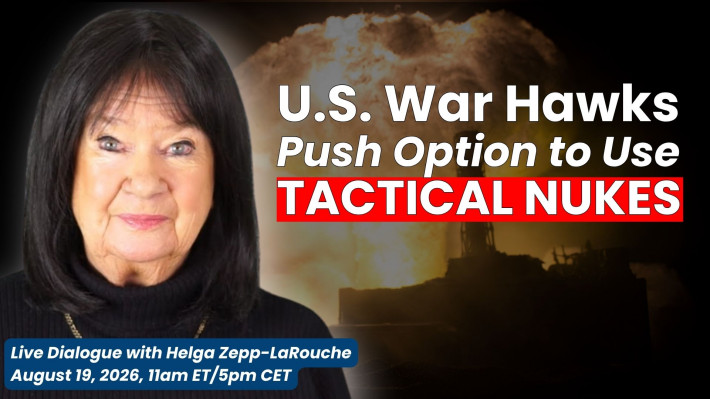
Live Dialogue with Helga Zepp-LaRouche: On the Escalation Ladder to Nuclear War: Where Are the Responsible Figures?

Join Helga Zepp-LaRouche in her live dialogue and discuss the issues and solutions that move the world and its people. Send your questions & comments to questions@schillerinstitute.org.

Please share the YouTube link with your friends, acquaintances, and colleagues to increase the reach of the solutions presented by the LaRouche movement.

Wednesday, July 29, 2026, 11am ET/ 5pm CET

In her new article “On the Escalation Ladder to Nuclear War: Where Are the Responsible Figures?”, soon to be published in the EIR Magazine, Helga Zepp-LaRouche addresses the current danger of nuclear war resulting from an escalation in two volatile flashpoints—Ukraine and the Middle East.

Zepp-LaRouche writes:

The strategic situation threatens to spiral completely out of control in the short term due to two escalating regional wars—in Ukraine and the Middle East—potentially resulting in a global economic depression within weeks or, at most, months, or perhaps even leading in the short term to a nuclear Third World War. This existential concern is shared by a large portion of the population in the so-called “collective West,” yet the political establishment of the West—with few exceptions—makes not the slightest attempt to bring the war in Ukraine to an end through diplomacy and negotiation. While such efforts do exist regarding the war against Iran, they currently lack the necessary programmatic approach, and consequently, the requisite impact.

Join Helga Zepp-LaRouche for her weekly Live Dialogue and discuss her analysis and the implications for the current strategic situation.


The Road to War Is a Road of No Return

Report on the 163rd meeting of the International Peace Coalition (IPC)

July 26, 2026 (EIRNS)—The 164th consecutive weekly meeting of the International Peace Coalition (IPC) commenced with remarks by Helga Zepp-LaRouche, Schiller Institute founder and IPC initiator, who called attention to very important recent statements by retired German Air Force four-star general Harald Kujat.

She noted that it is incomprehensible to him how world leaders can be so oblivious to the lessons of history that they could seriously contemplate a third world war. She referred specifically to the threat of a U.S. attack on Iranian facilities that are located deep in Pickaxe Mountain, “out of reach of bunker buster bombs…. What hangs there in the air is the potential that a nuclear weapon could be used.” Due to the blockage of the Strait of Hormuz and the Bab el-Mandeb Strait at the entrance to the Red Sea, both of which are vital to shipments of many products including crude oil and oil products, liquified natural gas, and various types of fertilizer, “A hunger crisis in the world is already pre-programmed.” She commented further on the “strange agreement” of U.S. President Donald Trump with the Saudis which purportedly provides assistance for nuclear energy development, but also requires Saudi Arabia to sign the Abraham Accords, which the Saudis will absolutely not do. Unfortunately, she said, after 164 weeks of IPC meetings, “we are closer to nuclear war than when we started.”

Jack Gilroy is a regular IPC participant who represents Veterans for Peace, Pax Christi–New York State, and Pax Christi International. He opened by saying, “People cannot continue to live in denial” about the war danger. He reminded the participants of how, during the Cuban Missile Crisis, President John F. Kennedy used trusted friends like Norman Cousins as backchannel intermediaries to Pope John XXIII. He then gave an update on his organization’s Letter to Archbishop Wester, which was scheduled to be sent in hard copy on the same day the IPC meeting took place.

In the Shadow of Jonathan Pollard

Jose Vega, independent candidate for New York’s 15th Congressional District in the Bronx, briefed the participants on Section 219 of the 2027 National Defense Authorization Act (NDAA). This section is titled “American-Israeli Defense Technology Cooperation Initiative,” but it were better called the “Jonathan Pollard Defense Technology Cooperation Initiative,” because it would share with the Israeli military the same sort of intelligence products which Pollard stole for them, and for which he was convicted of espionage. The NDAA, with this benighted section intact, has unfortunately now passed the House. Israeli Prime Minister Benjamin Netanyahu personally takes credit for this section, which he says moves Israel’s status from aid recipient to formal partner. This has become controversial nationwide, due to the efforts of the IPC and former Congressman Dennis Kucinich to expose it. Vega listed journalists and podcasters on both the left and right who have covered this. Even U.S. Rep. Alexandria Ocasio-Cortez (AOC), the Democratic Congresswoman for New York’s 14th C.D. (which includes the eastern part of the Bronx and parts of north-central Queens in New York City) has commented on it.

Prof. Clifford Kiracofe of the Washington Institute for Peace and Development explained the importance of calls and emails to elected officials. Hand-written postcards are perhaps the most effective means of communication, as they are instantly accessible and personal. He explained how the offending Section 219 could be deleted in the House-Senate reconciliation process.

Referring to the need for a new international security and development architecture as proposed by Zepp-LaRouche, he emphasized, “It’s extremely important that we have that vision in front of us.” He recalled that the German philosopher Friedrich Nietzsche was an important force behind the rise of militarism in the 19th Century, but there were also many conferences that focused on diplomacy, which is what we need today.

Moderator Anastasia Battle made a point of announcing the phone number for the U.S. Capitol Switchboard, 202-224-2131, for people to call their Congressman and Senators.

Larry Johnson, former CIA intelligence official and a member of Veteran Intelligence Professionals for Sanity (VIPS), predicted a major assault by the United States against Iran on the day of the IPC meeting, “after the stock market closes.” He also forecast a response by Iran that would be directed at Israel, including its refineries that produce diesel and aviation fuel. He said it is obvious that Russia and China are aiding Iran; both countries are interested in testing U.S. response to their weapons technology, and they are also glad to see the United States expending its arsenal.

Zepp-LaRouche responded, saying, “I think that if this happens, we are in a new geometry of destruction.”

Kiracofe asked Johnson to comment on Pakistan. Johnson said that the United States presently has a major influence in Pakistan, in part because Pakistan is presently requesting a $10 billion financial support facility from the U.S. Many feel that imprisoned Pakistani leader Imran Khan was undemocratically ousted from his elected role as President. He went on to say that reports of disunity in Iran are exaggerated and propagandistic.

Kiracofe referenced his own, 2024 book, Dark Crusade: The Israel Lobby and Christian Zionism. He briefly discussed the history of Christian Zionism, and how it views Russia, China and Iran as the bad guys who must be vanquished in order to arrange a successful Apocalypse. The British have used it for geopolitical purposes, “in the Palmerston mode.” “Frankly, it’s a counterintelligence issue,” he said, and warned that self-described “U.S. Secretary of War” Pete Hegseth and U.S. Ambassador to Israel Mike Huckabee are Christian Zionists. All the conventional churches consider it a heresy, but it plays a key role in U.S. politics, which is why we have Section 219 of the NDAA.

Zepp-LaRouche responded, “The fact that the United States now is acting on a Palmerston profile is no coincidence,” referring to mid-19th-Century British Prime Minister and Foreign Secretary Lord Palmerston. When the British realized they could not conquer the U.S. militarily, they shifted gears to a strategy of persuading the United States to adopt a British imperial world outlook. This is an irony of history, and there are others: “In Germany, they have no problem with joining the fight against the International Court of Justice and the International Criminal Court.”

Johnson said in conclusion, “The one country in the world that has consistently violated every international agreement is the United States…. It’s not China which has 700 military bases scattered all around the world.” Yet the United States has the illusion that “we’re the good guys.”

Discussion

Zepp-LaRouche said that the United Nations General Assembly is the immediate focal point for international collaboration for peace. She noted that the ASEAN nations had issued a statement in opposition to the U.S. war against Iran. The BRICS nations, who have also played an important role, have all been targeted by the neocons with various kinds of internal destabilization.

A British woman who is a regular IPC participant praised the work of Francesca Albanese, an Italian legal scholar and, since May 2022, UN Special Rapporteur on the occupied Palestinian territories, and announced the publication of Albanese’s new book, When the World Sleeps: Stories, Words, and Wounds of Palestine.

A farm activist from Missouri reported on how his organization uses EIR and IPC materials in their activism, and endorsed the practice of calling the U.S. Congress.

Zepp-LaRouche said in her concluding remarks, “There is an unbelievable dismantling of civil rights in Europe and also the United States.” We need treaties to control the use of artificial intelligence (AI) for military purposes. She urged the participants to take Jack Gilroy’s letter to any religious institution with which they may be affiliated, warning, “Many of them speak a language which is not the language of peace.” The Pope has said “the road to war is a road of no return,” and that should be taken very seriously. She urged people to circulate computer translations of the article by Kujat.

eir


Letter To Archbishop John Wester, To Urge Pope Leo XIV to Call for a Peace Conference

The following Letter to US Archbishop John Wester to Appeal to Pope Leo XIV to Call for a Peace Conference was sent on July 24, 2026. The Letter was initiated by Jack Gilroy in the International Peace Coalition meeting # 162, July 10, and has been endorsed by many individuals and organizations, expressing great urgent concern about the growing danger of nuclear war. Circulation of the Letter will continue over the coming days to galvanize increasing support for this Appeal.

July 24, 2026

Most Reverend John C. Wester, D.D.

Archdiocese of Santa Fe

Dear Archbishop Wester:

Congratulations on being named Pax Christi USA’s Teacher of Peace for 2026! It is such a well-deserved honor. Ever since your first trip to Japan and your pastoral letter, “Living in the Light of Christ’s Peace: A Conversation toward Nuclear Disarmament,” you have become a leading voice for the abolition of nuclear weapons in the Catholic Church and throughout the U.S. Establishing the “Partnership for a World without Nuclear Weapons” has extended that reach even farther. We are so pleased that you will be receiving this award in the coming months.

As you know, the threat of nuclear war seems to be increasing daily despite the 100 nations that have signed the Treaty on the Prohibition of Nuclear Weapons (TPNW), 75 of whom have also ratified it. This year’s Non Proliferation Treaty Review Conference was a disappointment once again. New START was allowed to expire. Russia, the U.S., and Israel, all nuclear states, are at war. Finland’s president recently signed legislation to allow the import and transit of nuclear weapons. And Lithuanian leaders are said to have agreed to amend the constitution to allow Lithuania to host nuclear weapons in the future.

In short, we are getting as close to nuclear war as we were during the Cuban Missile Crisis of 1962. That crisis ended with diplomacy that saved the planet, and Pope John XXIII was a key figure in making that happen. His influential role is not well known, but it was he who spoke out to set the needed moral tone that helped each side to act for peace.

This is how it developed: In fall 1962, Journalist Norman Cousins convened in Andover, Massachusetts, an informal discussion group of Soviet and American academicians. Providentially, they met on October 22, the evening Kennedy addressed the nation on the Soviet nuclear missile threat in Cuba and ordered the Navy to intercept any additional shipments.

Included among those invited by Cousins was a Vatican adviser to Pope John XXIII, Rev. Felix Morlion. He asked if a papal intervention might help defuse the situation. Cousins phoned the White House; a Soviet member of the informal group phoned Moscow. Both got a nihil obstat. Fr. Morlion notified the Vatican.

On October 25, Vatican Radio broadcast a strong appeal by Pope John for peace to world leaders, in particular Kennedy and Khrushchev. It stated in part: “With your hand on your conscience may each one hear the anguished cry which is raised to the skies from all parts of the earth: Peace, peace! We renew this solemn plea today.”

Pravda immediately printed the Pope’s message with a banner headline. And on October 28, when Khrushchev announced the pull-out of the missiles from Cuba, Pravda reprinted the Pope’s message, praising the Pope’s “realism on the question of peace.” In turn, the United States withdrew missiles from Turkey. Hundreds of millions gave a sigh of relief, and negotiations between the U.S. and the USSR led to the first nuclear test ban in 1963.

Weeks later, Khrushchev told Cousins how much he admired Pope John, saying: “During that week of the Cuban missile crisis the Pope’s appeal was a real ray of light. I was grateful for it.”

Several years after that, Khrushchev’s son Sergey said that the words of Pope John XXIII were strongly persuasive on the consciences of people, especially those of his father and Kennedy.

With this in mind, we were thinking it might be time for something similar to happen today. Might Pope Leo XIV call for a Peace Conference to withdraw nuclear weapons from the Russian border and call for the abolition of nuclear weapons worldwide? He already suggested something along these lines at the 80th anniversary of the atomic bombings of Hiroshima and Nagasaki when he prayed that those bombings would “serve as a call to the international community to renew its commitment to pursuing lasting peace for our whole human family — ‘a peace that is unarmed and disarming’” Perhaps the Vatican or another neutral location such as Vienna or Geneva could be the venue.

Would you be able to help bring this recommendation to Pope Leo? We believe you, as a strong and highly-respected advocate for the abolition of nuclear weapons, would be the ideal diplomat to encourage Pope Leo to bring Heads of State Putin, Trump, and Xi Jinping together to plan an end to nuclear weapons and to pave a new road of economic conversion from a war economy to economic development for all people everywhere. Your intercession and the strong leadership of Pope Leo could move us away from the sheer madness we are now experiencing.

Sincerely,

Jack Gilroy, Pax Christi New York State Council; Veterans For Peace;
Ban Killer Drones; International Peace Coalition of the Schiller Institute

Rosemarie Pace, Ed.D., PCNYS Coordinator; USA Palestine Solidarity Working Group; Pax Christi International Sudan Working Group

In collaboration with The Pax Christi New York State Council

Pax Christi USA (PCUSA) Teacher of Peace Honorees who have endorsed this letter: (See more on these in the complete listing of endorsements below.)

  • James V. Albertini (2010)
  • Roy Bourgeois (1997)
  • Marie Dennis (2022)
  • James W. Douglass (1994)
  • Kathy Kelly (1998)
  • William P. Quigley (2003)
  • Martin Sheen (1999)

Endorsements as of August 9, 2026:

  • Maurizio Abbate, Chairman of ENAC – National Institute for Cultural Activities, Italy
  • Akbar Ahmed, Distinguished Professor, American University, Washington D.C., Former Pakistani Diplomat
  • Muhammad Salim Akhtar,  National Director American Muslim Task Force on Civil Rights and Elections
  • Jim Albertini, PCUSA Teacher of Peace, 2010
  • Dr. Abdullah al-Ahsan, Professor of Comparative Civilization; former Vice President of JUST International, Movement for a Just World
  • All Saints Parish, Syracuse, New York
    –> Fr. Fred Daley, Pastor
    –> Meg Ksander, Pastoral Associate
  • Missy Androu, St Anthony Church Solidarity Community
  • Syed Azhar, National Director, Pakistani American Democratic Forum
  • Dr. Abdoulaye Balde,  United States,  Founding member Futa Islamic Center, New York
  • Karen Ball, Board Member, Pax Christi Texas, San Antonio Chapter
  • Roger C. Barnes, Professor Emeritus, University of the Incarnate Word, San Antonio, TX
  • Franco Battaglia, President of Chemical Physics, University of Moderna, founder, Italy
  • Anastasia Battle, Schiller Institute, International Peace Coalition Co-Initiator
  • William O. Beeman, Professor Emeritus and Former Chair of Anthropology, University of Minnesota
  • Carolyn Bentley, Pax Christi Dallas, TX & Dallas, TX Peace and Justice Center
  • Guus Berkhout, Emeritus Professor of Geophysics, Delft University of Technology; Member of the Royal Netherlands Academy of Arts & Science; ECD Ambassador, CLINTEL founder
  • Ronald Bettag, Schiller Institute, International Peace Coalition, Texas USA
  • Fr. Roy Bourgeois, PCUSA Teacher of Peace 1997
  • Kathy Boylan, Catholic Worker, Washington D.C.
  • Fr. Harry Bury, Twin Cities Nonviolent, Author. Member of U.S. Catholic Priests Association
  • Ken Butigan, Co-Director, The Catholic Institute for Nonviolence (DePaul University, Chicago)
  • Right Reverend John Bryson Chane D.D., 8th Bishop, Episcopal Diocese of Washington D.C.
  • Fr. Daniel Clayton, Priest of the Diocese of Dallas, TX
  • Catherine Clubb Foley, Pax Christi Houston, TX Member
  • James C. Cobey, Founder, Health Volunteers Overseas; Steering Committee, Voices From the Holy Land; Shared 1997 Nobel Peace Prize as part of work with Physicians for Humanity
  • Jay Coghlan, Executive Director, Nuclear Watch, New Mexico
  • Marjorie Cohn, Professor Emerita, Thomas Jefferson School of Law; Dean, People’s Academy of International Law
  • Gerry Condon, Facilitator, Nuclear Abolition Working Group of Veterans for Peace
  • M. Phyllis Cunningham, Pax Christi, Metro New York
  • Bob Cushing, A Founding Father of the Association of U.S. Catholic Priests
  • Dr. Thomas Clough Daffern, Director, International Institute of Peace Studies and Global Philosophy
  • Arthur Dawes, Pax Christi Texas Board President & the full Texas Pax Christi Chapter
  • Fr. John Dear, “Beatitude Center for the Nonviolent Jesus” & “The Nonviolent Jesus Podcast”
  • Pat Delgado, Pax Christi El Paso Coordinator & Pax Christi Texas Board Member
  • Sylvia Demarest, Retired Lawyer and Substack writer
  • Marie Dennis, Pax Christi USA (PCUSA) Teacher of Peace 2022, Ambassador of Peace, & Senior Program Director of Pax Christi International’s Catholic Nonviolence Initiative
  • Joan Dolan, Pax Christi Texas
  • Jim Douglass, PCUSA Teacher of Peace 1994, author
  • Imam Mohammad Ali Elahi, U.S., Islamic House of Wisdom, Dearborn Heights, MI
  • Joseph Essertier, Associate Professor, Nagoya Institute of Technology
  • Joseph Fahey, Co-founder & Former General Secretary of PCUSA
  • Professor Richard Falk, Professor Emeritus of International Law at Princeton University; Former U.N. Special Rapporteur on Human Rights in the Palestinian Territories; Vice President, Nuclear Age Peace Foundation
  • Mike Ferner, Former national president, Veterans For Peace
  • Norma Field, Professor Emerita, University of Chicago (Home of the Fermi Experiment)
  • Jill Frasier, Pax Christi Metro New York Board Member
  • Chrisopher Fogarty, President of Friends of Irish Freedom Chicago
  • Hiroshi Fujimoto, Research Fellow, International Peace Research Institute, Meiji Gakuin University (Japan)
  • Rev. David Gerlich, Honolulu, Hawaii, author of Jesus Christ He Still Matters
  • Paul Gessler, Veterans for Peace, Ft. Collins, Colorado
  • Sr. Carol Gilbert, Dominican Sister and Plow Shares activist
  • Liliani Gorini, Chairwoman of Movisol, Italy
  • Clare Grady, Plowshares Activist
  • Elliot Greenspan, Schiller Institute, International Peace Coalition, New Jersey USA
  • Claudio Guidici, Chairman of Uritaxi – Taxi drivers trade union
  • Joyce Hall, Pax Christi Dallas, TX Coordinator & Member of the Pax Christi TX Board
  • Rick Halperin, Director, Southern Methodist University Human Rights program
  • Jaap Hanekamp, Associate Professor of Chemistry, Utrecht University of the Netherlands
  • Jovita Harrah, Pax Christi Northern California
  • Leslie Harris, CODEPINK; Veterans For Peace; Dallas Peace and Justice Center  
  • Fr John Heagle, Director of Priests Against Genocide
  • Johannes Heibel, Peace Activist, Germany
  • Ira Helfand, Former President of International Physicians for the Prevention of Nuclear War; Co-founder Back from the Brink
  • Bernie Holland, United for Peace, UK
  • Saskia Hostetler, Anti-war activist, technology harm advocate – Portland, Oregon, USA
  • Ivana Nikolic Hughes, President, Nuclear Age Peace Foundation, Senior Lecturer in the Discipline of Chemistry at Columbia University
  • Vic Hummert, Former Maryknoll Priest and Author
  • Wally Ingle, Pax Christi Hawaii
  • Hadi Jawad, Human Rights Dallas, TX
  • Frank Kartheiser, Catholic Workers Movement, MA, USA
  • Professor Yoshiyuki Kato, Rikkyu University, Japan
  • Tarak Kauff, New York Member of Veterans For Peace; Editor: Peace & Planet New
  • Kathy Kelly, PCUSA Teacher of Peace 1998
  • Sr. Martha Ann Kirk, Th.D., University of the Incarnate Word
  • Dennis Kucinich, Former Mayor of Cleveland and Former U.S. Representative from Ohio
  • Jonathan Kuttab, Executive Director, Friends of Sabeel North America
  • Peter Kuznick, Professor of History and Director of Nuclear Studies Institute at American University, Washington, D.C.
  • Yuba Nath Lamsal, Former Nepal Ambassador to Denmark; with concurrent accreditation to Norway, Sweden, Finland and Lithuania, May 2017 to June 2021; a 30-plus years career in journalism, as editor of The Rising Nepal daily. An ardent opponent of nuclear weapons
  • Helga Zepp LaRouche, Founder, Schiller Institute, and Initiator of the International Peace Coalition
  • Kees le Pair, Assistant Professor American University Beirut, Lebanon; National Science Foundation, Wash. D.C.; research with Philips, Siemens; science advisor – Netherlands
  • Nydia Leaf, Pax Christi, Metro New York Member
  •  Dr. Richard G. Linowes, President, Clarewood University, Reston, VA
  • Jeff Mason, Pax Christi Quad Cities, USA
  • Gavan McCormack, Emeritus Professor, Australian National University
  • Raymond McGovern, Former CIA Analyst, Current Peace Activist
  • Evalee Mickey, Peace activist, North Liberty, Louisiana, USA
  • Josef Miklosko, former Deputy Prime Minister of the Czech and Slovak Federal Republic; former Ambassador of the Slovak Republic in Italy, San Marino, and Malta; former secretary of the commission of the Conference of Bishops of Slovakia: Justice and Peace
  • Carlo Levi Minzi, Pianist, Italy
  • Claudia Morgan, Pax Christi Texas Board
  • Nick Mottern, Coordinator-Ban Killer Drones and the Weaponized Drone Ban Treaty Campaign
  • Muslim Democratic Caucus c/o President Amir Rahmam
  • Satoko Oka Norimatsu, Director, Peace Philosophy Centre; Editor, The Asia-Pacific Journal: Japan Focus
  • Nancy Oetter, Regional Coordinator, Pax Christi Illinois
  • Melissa Parke, Executive Director International Campaign to Abolish Nuclear Weapons (ICAN) 
  • Johanna Parkinson, Dallas Area Interfaith
  • Margaret M. Power, President, Historians for Peace and Democracy (USA)
  • Pax Christi Little Rock, Arkansas
  • Pax Christi Metro New York Board
  • Pax Christi New York State Council: John Amidon, Ben Salmon Chapter Pax Christi Upstate New York; Veteran For Peace; Co-Founder Kateri Peace Conference; Tom Casey, Pax Christi Western New York; Pierre Fidelia, Pax Christi Metro New York Board President; Bob Keeler, Pax Christi Long Island; Ed Kubik, Pax Christi Long Island; Mary Beth Moore, SC, Pax Christi Long Island; Mark Scibilia-Carver, Ben Salmon Chapter Pax Christi Upstate New York
  • Lorin Peters, Pax Christi Moderator of the Northern California Chapter, Pax Christi U.S. Disarmament Working Group
  • Bill Quigley, Pax Christi USA Teacher of Peace 200; Emeritus Professor of Law, Loyola University New Orleans, Louisiana
  • Steve Rabson, Professor Emeritus, Brown University, Veteran, U.S. Army
  • Judith Robinson, Retired Russia Desk Officer for USAID, Dept. of Commerce BISNIS Unit, & State Department Education & Transportation USA
  • Paz Rosales, RSCJ, Sisters of the Sacred Heart of Jesus, Spain
  • Jean Ross, Vote Climate Board Chair
  • Alessia Ruggeri, Trade unionist, Italy
  • Susan Schnall, President Veterans for Peace USA
  • Meinrad Schneckenleithner, former Vice-President Pax Christi Austria
  • E. Martin Schotz, MD, author and active advocate for peace and nuclear disarmament
  • Martin Sheen, Actor & Pax Christi USA Teacher of Peace 1999
  • Aftab Siddiqui, President, Dallas, TX Peace and Justice Center
  • Martin Sieff, Former Chief Political Correspondent, United Press International, Three time Pulitzer Prize Nominee
  • Sisters of the Sacred Heart of Jesus — Province of Venezuela Provincial,
    Sister Fernanda Vacas Navarro, RSCJ
    Sister Emilia M. Martinez Rivas, RSCJ
  • Alice Slater, World Beyond War
  • Rev Robert Smith, Pastor, New Bethel Baptist Church, Detroit, MI; and Founder Haiti Mission Alliance
  • Fr. Martin Solma, SM – Kalaepohaku Marianist Coummunity, Honolulu, Hi
  • St Lucy’s Catholic Church, Syracuse NY, Fr Jim Mathews, Pastor; Margot Goldsmith, Pastoral Assistant; Corinne Driscoll, Chair of Justice & Peace Committee 
  • John Steinbach, Coordinator, Hiroshima Nagasaki Peace Committee-North Capitol Area, Washington, D.C.
  • Elaine Sullivan, M.Ed., LPC; LMFT, Counselor; former Benedictine Nun, Dallas, TX 
  • Fr. Bernard Survil, U.S. Catholic Priests Association
  • Alice Sutter, Raging Grannies NYC
  • David Swanson, Executive Director of World Beyond War
  • Diane Swords, Syracuse Peace Council
  • Br. Terence J Taffe, Cap., MA, LMSW. Province of St Mary, Capuchin Order
  • Takao Takahara, Professor, and former Director of International Peace Research Institute, Meiji Gakuin University, Tokyo, Japan
  • Fr. Tim Taugher, Pastor, St. Francis of Assisi Parish, Binghamton, NY
  • Kateri Tekakwitha Interfaith Peace Conference
  • Ellen Thomas, Proposition One Campaign for a Nuclear-Free Future
  • Chris Todhunter,  Teacher, The School of Philosophy and Economics Science in London, author
  • Dr. Mohammad A. Toor, Chairman of Board of Trustees Pakistani American Congress; President, American Pakistani Physicians for Justice & Democracy; Chairman of American Muslim Alliance
  • Regis Tremblay, Crimea, Director “Thirty Seconds to Midnight”
  • Patricia Tweedy, Pax Christi Metro New York Board
  • Veterans for Peace Chapter 10, Albany NY
  • Lawrence B. Wilkerson, Colonel, U.S. Army (Retired), Former Chief of Staff to the U.S. Secretary of State
  • Jim Wohlgemuth, Veterans For Peace Coordinator of the Hector Black Chapter – Nashville, TN
  • Ann Wright, Retired Colonel, US Army, and Diplomat; author, Dissent: Voices of Conscience; Whistleblower; Board of Directors, CODEPINK
  • Zool Zulkowitz, New York Directors Guild of America; Artistic Director, The Rising Together Theater Company; Jewish Voice for Peace; Veterans For Peace

EIR Roundtable: Solve the Immigration Crisis with Development; What You Need to Know About the Strategic Significance of Pope Leo’s Encyclical

EIR has issued the following invitation to its July 31 Emergency Roundtable Dialogue.

As the Iran and Ukraine wars fester and threaten to escalate into nuclear World War III, it has become clear that, if humanity is to survive, we will have to discover and implement a way to achieve a durable peace for all, based on development for all, security for all, and above all human dignity for all. In the last two months, a new strategic factor has come into play which brings that opportunity a lot closer.

Pope Leo XIV’s recent week-long trip to Spain, combined with his May 15 first encyclical, Magnifica Humanitas, has issued a call for humanity to act as one in its common purpose of seeking peace and development for all nations by ending colonialism in all its forms once and for all; he has grounded that call to action in a concept of Man’s essential dignity (“The desire for goodness, beauty and truth is rooted in the very DNA of humanity”); and he has specifically applied this approach to the horrendous problem of global forced migration that affects hundreds of millions of desperate migrants—and the countries that receive them: “We are speaking, above all, of people created in the image and likeness of God, rather than of legal categories or problems to be managed.”

In so doing, the Pope has followed through on his earlier commitment to the Coincidence of Opposites method of the XV century Cardinal Nicholas of Cusa, and he has also spoken not only for Catholics, but for many billions more of other faiths who share this outlook. He has introduced a principle which, if spread and applied globally, can play a major role in the construction of a new international security and development architecture.

As EIR Editor-in-Chief Helga Zepp-LaRouche wrote in a June 17 statement about the Pope’s encyclical:

“Of all the important and urgent speeches delivered recently by politicians and experts from many countries with the aim of preventing the strategic situation from escalating into a catastrophe that would wipe out the human race, Pope Leo XIV’s intervention—with his encyclical Magnifica Humanitas and the addresses he delivered during his recent trip to Spain—is, in my best judgment, by far the most important. When historians later examine the question of what—hopefully—proved to be the decisive factor in bringing Western civilization, in the midst of a deep spiritual and cultural crisis, to change course, they will come upon the role played by the Pope, and the willingness of a sufficiently large number of believers and people of good will to take his words to heart and bring about a change in policy…

“At the same time, he indicates the way out of the crisis, which is within reach, namely, that people summon up the highest ideal of the Christian view of humanity, and put it into practice…

“Among the various aspects of these [failed Western] policies, all of which are building blocks of the new Tower of Babel, are the idolatry of profit at the expense of the poorest, the financial interests that fuel tensions and conflicts to keep the war industry up and running, and support for modern forms of slavery.”

Zepp-LaRouche then quoted the Pope’s encyclical Magnifica Humanitas:

“81. A litmus test for social justice today is the treatment of migrants, refugees and those forced to move due to poverty, violence, climate change and environmental disasters… It means promoting the right to remain in one’s homeland in peace and security by addressing the root causes that force people to migrate, including those linked to economic injustices and the climate crisis. When these rights are respected, migration can become an opportunity for encounter and mutual enrichment among peoples.”

Zepp-LaRouche insisted:

“Instead of clinging to an inhuman neo-colonialist mindset, the governments of Europe and the U.S. are called upon to immediately commit to international cooperation aimed at completely eradicating poverty and underdevelopment in all nations on this planet.”

These tasks are both immediate and achievable. Zepp-LaRouche stated in a June 17 webcast:

“The continent of Africa will have 2.5 billion people by the year 2050. And that means that if you want to deal with the migration crisis in a human way, we have to create 1 billion new productive jobs in the next 25 years. And that would be a totally welcomed reversal of the present policy. It would at the same time also help the European governments and countries to get out of the economic crisis by having a tripartite cooperation with the BRICS countries.

“And for the United States, the same thing is valid. If you look at the migration crisis at the U.S.-Mexican border, it’s definitely the same approach which the United States should take in respect to the so-called Western Hemisphere. By joining hands with China, rather than trying to drive China out of Latin America, they should join and build things like the Chancay port, which is already built in Peru, but connect it to a bi-oceanic railway from the Atlantic to the Pacific. And in that way connect that with other great infrastructure projects. That would eliminate the root causes for the migrant problem in Latin America as well.”

The combination of the extremely dangerous global situation and this new hopeful strategic flank, require full deliberation by leading international thinkers. That is the purpose of the upcoming July 31 EIR Roundtable Dialogue, which will consist of two panels: A) Pope Leo and the Dialogue of Civilizations; B) Development Drive Means Billions of New Jobs, No Refugees, No War.

📅Online roundtable forum: 11 a.m. ET on Friday July 31 2026
Livestream in English on YouTube, and in Spanish, German and French simultaneous interpretation on Zoom.
https://us02web.zoom.us/j/83910952588?pwd=oriOURhs2ZOjZzAtzGzhv5MZAhsiDu.1
Passcode: 850621

Panel 1 (11:00—1:00)

A Dialogue of Civilizations: Development or World War III

Moderator: Dennis Speed

  • Helga Zepp-LaRouche (Germany): Editor-in-Chief, EIR
  • Liu Chang (China): spokesman for the Embassy of China in the U.S
  • Rostam Adabinia (Iran): Minister Counselor, embassy of Iran in Mexico
  • Richard Falk (U.S.): professor emeritus of international law, Princeton University
  • Remi Lebrun (France): Schiller Institute
  • Fr. Harry Bury (US), Twin Cities Nonviolent, Author. Member of U.S. Catholic Priests Association
  • Jack Gilroy (U.S.): member Veterans for Peace, Pax Christi
  • Daisuke Kotegawa (Japan): former Executive Director for Japan, IMF

Q&A

Panel 2 (1:30—3:30)

Solving the Migrant Crisis: Does Mankind Have the Moral Fitness to Survive?

Moderator: Anastasia Battle

  • Dennis Small (U.S.): EIR Ibero-America director
  • Mário Maurici (Brazil): Member and First Secretary of the São Paulo State Legislature
  • Donald Ramotar (Guyana): former President of Guyana
  • María de los Ángeles Huerta (Mexico): former congresswoman
  • Diane Sare (U.S.): independent candidate for President of the United States
  • SEM Ambassador Youssouf Abassalah, Ambassador of the Republic of Chad to Germany
  • Timothy Ninsiima (Uganda): youth leader
  • Claudio Celani (Italy): co-editor, EIR Strategic Alert Service
  • Adama Coulibaly (Burkina Faso): former Chief of Staff to the Min. of Communication

Q&A


Brazil Presidential Advisor Celso Amorim: The Money for Wars Is Taken Away From Development

July 25, 2026 (EIRNS)–Celso Amorim, Special Advisor to Brazilian President Lula da Silva, stated that peace and development are indivisible; each requires the other to be achieved, he emphasized in an exclusive July 24 interview with EIR’s Dennis Small. He spoke of how the wars ongoing around the world harm the global economy, taking government monies out of the health care, infrastructure and other investments needed, especially in the developing countries, while increasing the costs of such basic inputs as fuels and fertilizers. As for the growing danger of nuclear war, Amorim reiterated Brazil’s long-standing advocacy of nuclear disarmament by all nations, without distinction.

Brazil seeks respectful relations with all nations, China, the United States, India, et.al., with pragmatic cooperation on economic projects despite their differences. That is why Brazil seeks a multipolar world, as seen in its participation in groups such as the BRICS. That is why Brazil also seeks to foster South American integration. With such neighbors as Peru, South America can accomplish in the 21st century what the United States did in the 19th century, establishing a usable link between the Atlantic and the Pacific.

Is such a world possible? Amorim insisted: “If you do not believe in the future, what is the point of life? For our children and our grandchildren, and the children of other people…”

Brazil, a founding member of the BRICS, is the largest country in South America, both in population and territory. Amorim, today Special Advisor to the President, served as Foreign Minister in President Lula’s first two terms in office (2003-2010), and Defense Minister under President Dilma Rousseff from 2011-2013.


Live Dialogue with Helga Zepp-LaRouche: We Are Approaching a Nuclear War which Will Destroy Civilization

Join Helga Zepp-LaRouche in her live dialogue and discuss the issues and solutions that move the world and its people. Send your questions & comments to questions@schillerinstitute.org.

Please share the YouTube link with your friends, acquaintances, and colleagues to increase the reach of the solutions presented by the LaRouche movement.

Wednesday, July 22, 2026, 11am ET/ 5pm CET

In an interview on YouTube, Harald Kujat of Germany warned against the military buildup against Russia in the following words. Gen. Kujat is a retired German Four-Star Air Force General; former Chief of Staff of the German Armed Forces; and was Chairman of the NATO Military Committee from 2002-2005.

“We are dealing with a nuclear power—namely, the largest nuclear power on this Earth. Through the use of nuclear weapons, we are capable of bringing about the end of the world. And if that is not an incentive to prevent an escalation into a war with the largest nuclear power, then I do not know what else it would take. At the very least, it would mean that here in Europe, the use of nuclear weapons would trigger at least a 50-year Nuclear Winter.

“How is this European continent supposed to survive if there is a war here? We have witnessed the destruction of the Second World War. A future war would surpass that by many times over. Where has this historical knowledge actually gone among our politicians? Where is the understanding of the dangers we are exposed to today?”

————

We in the Schiller Institute, which founded and convenes the International Peace Coalition weekly, fully agree with this assertion of General Kujat that the world–not only Europe–is sliding towards a pit of war which looks, with every passing day, more likely to be a nuclear war, from which no nation would recover; and at this point, no one can say how long it will be before we cannot reverse that slide.

Helga Zepp-LaRouche, founder of the Schiller Institute, remarked today that General Kujat’s statement expresses the view of humanity’s future, which she has held for some time. “We have never been at this level of danger before,” she said, not in the Cuban Missile Crisis, not in World War II.

The march to world war must be stopped before the arrogant and ignorant confidence of so many political “leaders” of the West makes it unstoppable.

Therefore we are organizing our political activities and economic collaborations, and the independent campaigns of Diane Sare for President, Jose Vega in the Bronx C.D. 15, and those independent candidates around the country who will accept this responsibility, to stop this march to world war, and to open regional paths to economic development and peace.

This is epitomized by the proposed “Extended Oasis Plan for Southwest Asia” which must be implemented, now after 50 years since it was first proposed by the American economist and statesman Lyndon LaRouche, in order to restore peace in that region.


“The United States Is Engaged in Self-Attrition”

Report on 163rd meeting of the International Peace Coalition (IPC)

July 17, 2026 (EIRNS)—The 163rd consecutive weekly meeting of the International Peace Coalition (IPC) opened with remarks by Helga Zepp-LaRouche, Schiller Institute founder and IPC initiator. She observed that for the 6th day in a row, the United States has massively bombed Iran, targeting civilian infrastructure. Iran has responded by attacking U.S. bases and has asked the Houthis in Yemen to target the Bab al-Mandeb Strait on the Red Sea, another important chokepoint in addition to the Strait of Hormuz. This can “plunge the world into a depression, a hunger catastrophe, an energy crisis,” as early as August, Zepp-LaRouche warned.

In Europe, “Ukrainians have started to massively target Russian facilities in the Black Sea, and in retaliation Russia has begun to hit ports in the Odessa region—that massively affects grain, oil and fertilizer” Zepp-LaRouche said, noting that this poses a double-edged threat to world food supplies, since Russia alone supplies over 10% of global grain exports. On the other hand, she said, you have the insane decision by Germany to purchase the U.S.-made Tomahawk cruise missiles and station them on German soil—we are facing a resumption of the medium-range nuclear missile crisis from the 1980s.

In the United States, an increasingly delirious U.S. President Donald Trump went on national TV to charge that 220 million files on U.S. voters were stolen by China in 2020.

Zepp-LaRouche tempered her presentation with some favorable developments. She reported that Russia, China and the Vatican are working to curtail abuses of artificial intelligence (AI). Russia and China have agreed to form for this purpose the World Artificial Intelligence Cooperation Organization, to be headquartered in Shanghai. Similarly, at the summer residence of Pope Leo XIV in the city of Castel Gandolfo, Italy, in a 3-day meeting, 30 Nobel Prize laureates and top experts agreed upon the Rome Declaration on Nuclear Weapons and AI. Meanwhile, in the United States, 104 Congressmen voted to de-fund Israel. This was not sufficient to pass the amendment, but it was nonetheless significant, marking the first time that a substantial number of Congressmen defied the wishes of the Israel lobby.

Jack Gilroy is a regular IPC participant, representing Veterans for Peace, Pax Christi–Upstate New York, and Pax Christi International. He gave an updated report on the initiative to emulate the diplomacy of Pope John XXIII during the October 1962 Cuban Missile Crisis, when Pope John served as an intermediary between U.S. President John Kennedy and Soviet leader Nikita Khrushchev and helped to defuse a situation where the world was on a hair-trigger for nuclear war.

Joe Maxwell is the former Lt. Gov. of Missouri; a lawyer; a retired First Sergeant and 20-year veteran in the Missouri National Guard; Cofounder of Farm Action; and current President of the Farm Action Fund. He commended the Schiller Institute and the IPC for 163 weeks of leadership. He went on to present an exhaustive report on the impact that American farmers and rural communities are facing because of the wars that were initiated in Ukraine and Iran, coming on top of an already difficult situation for independent family farms. The United States is losing, on average, 63 farms a day (small, and middle-sized)—as American families are struggling to afford food. Four companies control 85% of the cattle processing in the U.S. Maxwell went on to present similar statistics for other commodities. Farmers in the U.S. are also being squeezed on the input side; fertilizer prices have doubled, and diesel fuel has gone up 40%. U.S. farmers will lose $31 billion this year, between the monopolistic policies of international agribusiness and the wars.

U.S. independent presidential candidate Diane Sare listed the chokepoints that imperil the world economy: the Strait of Hormuz, the Bab al-Mandeb Strait on the Red Sea, the “Epstein class” takeover of Albania on the Adriatic Sea, and Ukraine’s attacks on Russian shipping routes in the Black Sea. She lamented that these threats were worsening while the United States is being led by a “witless, malignant narcissist in the White House.” The world is still coasting on oil that was in transit before Hormuz was closed, so there is a delayed reaction to the closure of the strait, but soon the full impact will be felt.

Sare reported that a critical flank is the battle around the 2027 National Defense Authorization Act (NDAA) in the Congress. Representatives Thomas Massie (R-KY) and Ro Khana (D-CA) have an amendment to strip the now-notorious section 219 from the NDAA, the section which effectively merges the military and intelligence functions of the United States with those of Israel. The move to strike it is an action which Sare supports (see her statement. She reported on how Congressman Adam Smith (D-WA) changed his vote on another amendment, Amendment #8, also introduced by Rep. Thomas Massie, to strip $3.3 billion in U.S. military aid to Israel from the 2027 State Department appropriations bill. This is proof in principle that Congress can change, in order to respond to the wishes of their constituents.

Zepp-LaRouche posed a question to Maxwell: what are the delayed effects of fertilizer shortages? He responded by saying that if you cut off nitrogen fertilizer, it takes about a year for the impact of higher prices and shortages to be felt. The result is less food, and mass hunger. Co-moderator Dennis Speed followed up, by suggesting that the IPC should explore the relationship between attacks on agriculture and the migrant crisis, because food shortages compel people to move in search of food in order to survive. Zepp-LaRouche agreed that the denial of development will cause the migrant crisis to explode.

“The United States is Depleting Itself”

Dennis Speed introduced frequent IPC participant Larry Johnson, who signed on to the meeting after finishing another commitment. Johnson is a former CIA intelligence official and a member of Veteran Intelligence Professionals for Sanity (VIPS). Johnson noted that Iran had lived through six days of continuous bombing since he had spoken at the last IPC meeting one week ago. Contrary to the frequent, hysterical proclamations of triumph coming from the Trump administration, “Iran holds the strategic edge in this battle,” Johnson said. He painted a devastating picture of the attrition in U.S. military capabilities under the conditions of the war with Iran: at the rate in which missiles are being consumed, Lockheed Martin made only 7 days’ worth of missiles over the past year. We are running out of ordnance. “The United States is engaged in self-attrition,” Johnson said. “All Iran has to do is hammer U.S. bases every day with ballistic missiles… the United States is being effectively driven from the Persian Gulf.” After the United States denied China access to its Global Positioning System in the 90s, China created an independent BeiDou Navigation Satellite System which Iran is now accessing. “The United States is depleting itself.” The U.S. has caused global shortages of diesel and aviation fuel, which inevitably affects our military capabilities.

Discussion

Zepp-LaRouche asked Johnson whether there are people in the Pentagon that understand the consequences of these policies and who can respond intelligently. Johnson answered that they have underestimated Iran’s resolve. Before long, Trump will be forced to make major concessions and find some way to sell them to his base in a face-saving way, claiming that he is magnanimously responding to Iranian pleas for mercy. Meanwhile, the U.S. is systematically relocating its forces out of the region, to move them out of range of Iranian missiles.

In response to a question about the 41-43 million persons who attended the funeral of Iranian Supreme Leader Ayatollah Ali Khamenei, Zepp-LaRouche called it the largest demonstration in world history, and an assertion of “thousands of years of identity of a civilization.”

eir


Live Dialogue with Helga Zepp-LaRouche: U.S. Escalation in the Strait of Hormuz Threatens Fragile Financial System

Join Helga Zepp-LaRouche in her live dialogue and discuss the issues and solutions that move the world and its people. Send your questions & comments to questions@schillerinstitute.org.

Please share the YouTube link with your friends, acquaintances, and colleagues to increase the reach of the solutions presented by the LaRouche movement.

Wednesday, July 15, 2026, 11am ET/ 5pm CET

Sometimes, “being reasonable” is the most revolutionary thing an individual, and certainly a population or nation, can do. An epidemic of Reason breaking out among the people of the United States, in the 250th year of the nation’s birth, would be most welcome by the rest of the world.

It is, for example, entirely unreasonable to allow section 219 of the National Defense Authorization Act to be passed by a Congress that, in so doing, renders itself powerless in the very matters of war and peace, for which it, as representatives of the American people—not monied lobbies—and no other branch of government, or unelected civil service, or permanent bureaucracy, must be held accountable, according to the Constitution of the United States. That is, it is not within the powers of the Congress, by its passing what should be called the “Jonathan Pollard U.S.-Israel War Technology Cooperation Initiative” to arbitrarily abdicate, to decide to not be the Congress, to repudiate the powers of that body. That would require a deliberate alteration of the Constitution of the United States. A passage of House Section 219 (and its counterpart, Senate Section 1217) would be treason against the nation, and the world.

Independent Presidential candidate Diane Sare, former Congressman Dennis Kucinich, and now several others have pointed this out. Now, the most reasonable among the American people—as well as those outside of the United States who realize the danger such an action poses to the world— must take unified action, by any and all appropriate means, to reverse this course.

It is essential that the people be reasonable, since the Trump Presidential Administration is not. Helga Zepp-LaRouche yesterday reported, “Now, obviously, the NATO summit, which just concluded in Ankara, was fraught with absurdities as well. I think the most ridiculous statement coming out of the summit was by Trump, who said that there was so much love in the air in this meeting. Now, how you can have love in the presence of all of these warmongers is very difficult to imagine, but he claims that this was happening. And obviously he’s very happy, because he got these stupid Germans, namely Pistorius and Merz, to buy the Tomahawk cruise missile for at least $1.2 billion, plus a couple of millions. While before, Biden had basically promised that these Tomahawk missiles would be put there in Germany for nothing, because it’s obviously in the very interest of whoever is the war faction in the United States, and totally contrary to the interest of Germany, which is being made a prime target for such a medium-range, nuclear-capable first-strike missile, which heightens the security problems of Germany. But now instead, Germany is paying for it.

“But, if you think about it, in the previous design, it was part of a multi-domain operation concept, to which belonged satellites, intelligence, electronic warfighting, cyber capabilities, data fusion, aiming, and far-reaching precision strikes, were all part of one coherent package. And the Tomahawk was the top of the spear. Now, Germany is buying the top without the spear, having all the costs, and it’s completely insane. So, it’s naturally clear that Trump is happy to sell that, but it just shows you the insanity.”

“O judgement!! thou art fled to Brutish beasts, And men have lost their reason.” Would that Shakespeare’s admonition in Mark Antony’s Act Three speech in Julius Caesar might enlighten those that should wonder how the mass assassination policies of the Israeli regime and the American government carried out in Iran actually resulted in the largest assembly ever recorded in human history—over 40 million people in Iran. Millions of those people believed they were possibly walking to their deaths, and assembled nonetheless.

“The awful Shadow of some unseen Power floats, though unseen, among us.” Members of the Epstein class deny that power exists. That power, and the Power of Reason, by the way, are actually identical. In the document “Quo Vadis, Humanitas?” issued by the Vatican’s International Theological Commission, the authors state that “The purpose of this document is not only to offer a discernment capable of weighing the anthropological consequences of techno-scientific discoveries and the corresponding ethical choices of people and societies today…. The theoretical-practical nature of theology encompasses the proclamation of faith (kerygma) and education in a vision of humanity, in dialogue with scientific progress, in which everything that is good can be integrated.” Such “heavy ideas” have always been the province of the Executive Intelligence Review, and its founder and “chief intelligence officer,” the late economist and statesman Lyndon LaRouche. In 1983, he observed:

“In popular jargon, and unfortunately, also amongst some elements of our political intelligence community, there is an obsession with the modern American habit of demanding that reality and ideas come in popularly advertised brand-name packages, with contents explained in the same simplistic terms as a typical ‘Madison Avenue’ advertising slogan.… The sort of person who insists that his facts should come in popularly advertised brand-labeled packages should not expose himself to the mental anguish he will suffer in confronting even the simple day-to-day truths of routine counterintelligence work. On this level, the world is very complicated; in this realm, there are few allies, and almost no one operates openly under the brand label of the one, two, or three interests he ultimately serves.”

Once, in a conversation about challenging people to change the world through organizing others to think about “heavy ideas,” LaRouche referred to the often-stated complaint about his “long policy papers” and “complicated” presentations. He proposed, “The way to respond to that, is to pose this question: ‘Maybe you are too uncomplicated to survive?’” Executive Intelligence Review was created to qualify any thinking person to discover and adopt solutions, to “know what to do,” including how to create a New Security and Development Architecture, as is discussed by Schiller Institute founder Helga Zepp-LaRouche in her Ten Principles for a New Security And Development Architecture.

A Council of Reason is immediately needed. It must be assembled from citizens, particularly young citizens from around the world, and those that believe in the world-historic importance of the international revolution of 250 years ago, summarized in the American Declaration of Independence. That began a process which Indonesia’s Sukharno called, at the First Summit of Non-Aligned Nations in 1955, “the first successful anti-colonial revolution in history.” It is not enough to, as India is presently doing, close down places like the “Jaipur Polo Ground, where King Charles III, then Prince of Wales, had played,” and other symbols of British colonial rule. It is Winston Churchill’s “empire of the mind” that must be defeated by the power of Reason, and a Council of Reason that knows, and acts upon “what is to be done.”


“A Very Important Clarion Call to the Americans”

Report on International Peace Coalition, Week 162

July 10, 2026 (EIRNS)—At the outset of the 162nd consecutive online meeting of the International Peace Coalition (IPC), Schiller Institute founder and IPC initiator Helga Zepp-LaRouche warned that “both theaters of war… are escalating.” The recent NATO summit produced nothing but more calls for confrontation in Ukraine between Europe and Russia. She called attention to the announcement by German Chancellor Friedrich Merz that the United States had approved the sale of Tomahawk cruise missiles and the corresponding ground-based Typhon launchers to Berlin. Tomahawk missiles are offensive, nuclear-capable weapons. Trump had rejected a request from Ukrainian Acting President Volodymyr Zelenskyy in October 2025 to provide them.

In Iran, the Memorandum of Understanding between Iran and the United States has collapsed. Between 41 and 43 million people joined in events to mourn assassinated Supreme Leader Ayatollah Ali Khamenei, the largest funeral in recorded history. “The population is rallying around the government more than ever before,” she said.

The one bright spot is Pope Leo XIV’s encyclical, Magnifica Humanitas, and the Pope’s message on July 4 is “a very important clarion call to the Americans,” Zepp-LaRouche emphasized. Instead of traveling to the United States to deliver his remarks in person, he visited the Italian island of Lampedusa in the Mediterranean where migrant refugees are being held. Zepp-LaRouche concluded, “If we do not change course very very soon… we may reach a point of no return.”

President Donald Ramotar, former president of Guyana (2011-2015), warned that the migrant issue has become a global problem, and is being used as a political football by governments with failed economic policies. He recounted the history of the Windrush Generation, an “invited exodus” of Caribbean migrants who arrived in the United Kingdom between 1948 and 1971 to help rebuild the nation after World War II. Now they or their descendants are being expelled. In the Western Hemisphere, there is migration caused by military coups or economic sanctions sponsored by the U.S. There is also the “Brain Drain,” where highly educated people in the Global South are being deliberately targeted. More than 70% of Guyanese university graduates are being lured to jobs in the U.S. Cuba has the human capital necessary to rapidly develop, but the economic warfare from the United States has created a crisis that forces people to emigrate. The solution is development. Ramotar said further that colonial policies are still in effect; raw materials are being extracted and exported by foreign interests and not being used for the development of our nations. “The vultures are gathering” now that Guyana has found uranium, in addition to its oil and gold wealth. He decried “the false impression that China wants to take over the world,” and described the mutually beneficial relationship that his country has had with China.

Jack Gilroy, an activist with Veterans for Peace, Pax Christi–New York State, and Pax Christi International, recalled the trauma of the Cuban Missile Crisis in October 1962, and the crucial role played by Pope John XXIII at that time. The Russians saw the pope as a voice of reason and his message resonated with them.

Edouard Husson is a professor, historian, and editor-in-chief of the newsletter Brennus in Paris. He commented on the fact that U.S. President Donald Trump had Iranian Supreme Leader Khamenei assassinated and then seems surprised and shocked when the Iranian population rallies around him. He described the massive turnout for Khamenei’s funeral as an event as significant as the fall of the Berlin Wall. “Western leaders no longer know how to win the wars they start, nor do they know how to make peace.”

Dr. Chandra Muzaffar, Founder and President of the International Movement for a Just World (JUST) in Malaysia, said, “We must resolve the root crisis, which is the dispossession of the Palestinian people… The vast majority of humankind wants to resolve this issue,” but the United States is the obstacle to resolving it.

Larry Johnson, former CIA intelligence official and a member of Veteran Intelligence Professionals for Sanity (VIPS) observed that the recent NATO summit had made matters worse in both Europe and the Middle East. Small went on to analyze the economic causes of refugee flows from Mesoamerica to the U.S., which he characterized as misery “imposed by Wall Street and the City of London.” Johnson replied first with a sports analogy, recalling the first time Muhammad Ali or Willie Mays was defeated and comparing that to the ongoing demise of the once-mighty United States. As examples, he cited how the Houthis stopped the U.S. Navy cold in the Red Sea, and now Iran has prevailed over the U.S. military. If the United States were to attempt a ground invasion of Iran, any viable staging area for a large amount of U.S. troops would be completely vulnerable to precision attacks by Iranian drones and missiles, a completely different situation than the U.S. faced with its invasion of Iraq. The funeral of Khamanei was unprecedented in world history, Johnson said, and compared it to the U.S. response to the Japanese attacks on Pearl Harbor on Dec. 7, 1941. “The real issue remains oil,” he said. 70% of the U.S. oil refineries are set up to process heavy crude, which does not come from domestic production and is essential to produce diesel and aviation fuel. We have been drawing down the Strategic Petroleum Reserve, and it is significantly depleted.

Johnson also noted the significance of the fact that Russia has moved from the use of the term “Special Military Operation” to calling the situation in Ukraine a war. He mocked the propaganda in the West which asserts that Ukraine has the upper hand, which he called “delusional bullshit.”

The Crumbling Empire

Zepp-LaRouche responded to the other speakers, stating that “all the colonial wars have been lost” but narrative control has been strengthened. She asked the other speakers for their views on this topic, and what followed was a wide-ranging discussion which included a focus on recent events in Bangladesh. Husson described how “divide and rule” tactics are used to keep French politics from addressing the real topics: war and peace, and economic collapse.

Ramotar asked that we imagine the potential for China and India to enter a collaborative relationship. The government of India vacillates between anticolonialism, and Hindu chauvinism which pushes them to collaborate with Israel due to shared hatred of Islam. “The old tactics of divide and rule are still a very potent weapon.”

Johnson mused that “when you have leaders consumed with their own hubris, and oblivious to facts,” you get what we have today. He zeroed in on the controversy about the sale of F-35 fighters to Türkiye, and recited an astonishing litany of technical problems that afflict the plane. “Why do you want to give Turkey a turkey?” he quipped.

Moderator Anastasia Battle reminded participants to contact the U.S. Congress and urge them to strike section 219 from the National Defense Authorization Act, to prevent the effective merger of U.S. and Israeli military and intelligence functions.

Discussion

German activist Jonathan Thron reported on a presentation to a chapter meeting of the NachDenkSeiten newsletter on the potential for nuclear fission and fusion energy, and the BRICS. He commented that “people are really looking for optimism,” and the “green” outlook is no longer dominant. A participant asked, what about artificial intelligence (AI) and the use of data centers, which consume extraordinary amounts of energy? “The development of AI is a natural development,” Thron replied; “do we use it for good purposes or bad purposes?” Zepp-LaRouche noted that first unprovoked war of aggression against Iran was based on fraudulent intelligence from Palantir, the huge AI firm.

Zepp-LaRouche closed by saying that a conclusion we can draw from this discussion is that we need to sharpen our understanding of empire and colonialism. Friedrich Schiller, the German poet, philosopher and historian after whom the Schiller Institute is named, wrote the Revolt of the Netherlands for only one reason, to show that empires can be defeated.

eir


Page 2 of 34123...Last