The following are excerpts from the meeting:
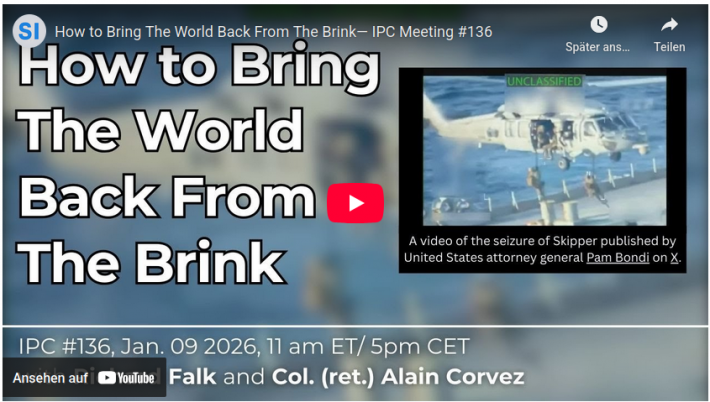
ANASTASIA BATTLE: Welcome, everyone. This is the International Peace Coalition. This is our 136th consecutive meeting. Thank you all for joining us. My name is Anastasia Battle, and I will be your moderator today as well as Dennis Small.
Today, as I’m sure many people are aware we are in a full-out drive toward nuclear war. We have got to coordinate our activities as best we can among all our different organizations. As always I like to remind people why we created this International Peace Coalition 136 weeks ago, which was to unite the peace movement. Whether you’re from the left, right, whatever philosophy you believe in, religion that you worship, country you’re from, or language you speak, if you are for true peace and collaborating with other people to make that happen, then you are welcome here.
To start us off today, we’re going to do things a little bit differently, because we have a very special guest on to join us. We have Dennis Kucinich, so we’re going to have Helga open just for a little bit, and then go to Mr. Kucinich. Helga Zepp-LaRouche is the founder of the Schiller Institute and the initiator of the International Peace Coalition. Why don’t you start us off for just a couple of minutes?
HELGA ZEPP-LAROUCHE: Hello to all of you, and just to introduce the topic very briefly, I think the whole world is still in a state of shock after the intervention in Venezuela by U.S. special forces kidnapping President Maduro and bringing him to the United States into a—according to sources—extremely terrible jail in New York. This in a certain sense came as a shock; not so much that it’s the first time that the United States has occupied other countries or made interventionist wars. I think what shocked the world this time is the absolutely blatant character of the whole operation. Also what is following after it makes clear that, as of now, international law as it has developed with the UN Charter and out of the process of the Peace of Westphalia, which was a very important process to establish international law, that phase is over; there is no more international law. It has been replaced by might makes right and the law of the jungle. That obviously is uncorking and unleashing all kinds of things ranging from the attempt to possibly annex Greenland in some form, which is now on the agenda. But naturally there are many other instabilities in the world resulting out of it, and we are determined—and that is the purpose both of the IPC and also a special program we are making this coming Monday with EIR—we are trying to organize a resistance against that to say we have to have international law, or the danger is that these tendencies will develop a dynamic of their own, leading to a potential not far in the future global nuclear war.
So, having introduced that, I want to give the floor to Mr. Kucinich….
[resuming after Kucinich] So, following the intervention in Venezuela, President Trump has now announced that he wants to increase the U.S. military budget from $1 trillion—which is already an amazing figure—to $1.5 trillion; that’s a 50% increase. What supposedly justifies this is that Trump wants to have a dream army defending against all possible foes. Many people, including Tucker Carlson, commented on that, saying this means we are preparing for a big global war. Indeed, it does not make any sense otherwise. So, if you take the U.S. proposed $1.5 trillion military budget—which by the way has sent the shares in the military industrial firms skyrocketing: For example, the Swedish firm Saab has increased 25%, Rheinmetall 20%, and others also going up significantly. That obviously has to be seen together with the militarization going on in the European Union; Germany wanting to become the strongest army of Europe, which has even caused Putin to make remarks saying that Russia notes the fact and is prepared to answer any attacks appropriately. And naturally the militarization going on in Japan, where, now, according to various sources, Japan is trying to acquire nuclear weapons. That has caused the Chinese to make a report being very upset by the ongoing efforts by Japan to either have nuclear weapons themselves or participate in U.S. weapons—that’s the arrangement which exists with Germany and some other European countries already.
Then naturally the other absolutely hair-raising development which is showing that there is no end to this, is the fact that both President Trump as well as [Vice President] JD Vance have stated repeatedly that they want to take over Greenland. Greenland has some autonomous status, but otherwise belongs to the kingdom of Denmark. According to many statements, the Greenlanders, if they want a change in status, they want independence and not to be part of the United States. When the spokeswoman of the White House was asked if military means would be an option, she said yes, all options are on the table of the President. Then some statements were made saying, maybe we only will try to buy Greenland—that has been discussed many times before. There have been efforts to calculate how much it would cost to bribe the Greenlanders by buying each individual out. In any case, the argument given is that supposedly Greenland would be a big threat to the United States because of Russian and Chinese missiles. This is completely ludicrous; there has been no sign whatsoever that either Russia or China would want to do that. So, it’s just absolutely blatant.
Even Polish Prime Minister Tusk, who was more or less in the war party of the Coalition of the Willing before, has now also like the Prime Minister of Denmark Mette Frederiksen, said that if this happen, it makes NATO pointless, because if you have a tension, or a quarrel, or war-like actions within NATO, NATO will fall apart. So, in a joke, I want to say maybe Trump should do some military action if the net result is that NATO would go; but one shouldn’t make jokes with such terrible things.
The other thing which we have to not forget, because it was maybe even more important even if it was not played up in the media, was the fact that there was a drone attack with 91 drones on the residence of President Putin in Novgorod, Valdai, where there is also a nuclear command center. According to Russian Defense Ministry statements, they were able to neutralize all of these drones. But the implication of it was incredible, because if that would have been successful and Putin would have been killed, we would not be sitting here anymore. We would already be in an escalation way beyond a lost spiral of confrontation. Trump initially said he got a phone call from Putin and that he was very angry about it. Then, a little time later, he said no, he reversed his position. He said it was all a lie, it did not happen; it was all made up by Putin.
In the meantime, the relations between the United States and Russia have clearly worsened. Witkoff and Kushner were at a subsequent meeting of the Coalition of the Willing in Paris, where some kind of peace agreement or some deal was made whereby the French and the U.K. said they want to establish some kind of military hubs after a peace deal. That is completely ludicrous, because Russia has made clear many times that they will not accept European troops after some arrangement in Ukraine, because they are NATO troops, and that is why the whole conflict started in the first place. For these Europeans—especially the British and the French—to repeat that is just a provocation. Also, one has to note that the Russian media coverage about the United States after the attack on Venezuela has clearly shifted. While they had very positive coverage about Trump and other developments, they are shifting back to condemning the intervention in Venezuela and otherwise being very critical.
Then the big question is, how did this happen? Did Trump know about the drone attack? Was he mis-briefed by his own security team, the CIA? Some analysts have mooted that the CIA may have provided the Ukrainians with the information about the location where Putin supposedly would be. In any case, the Russian Defense Ministry had provided the U.S. military attaché in Moscow with the evidence that it was a drone attack, where the drones came from, what the aim was, and who possibly programmed these drones. There was no response by the West. In my view, you should really understand, if the head of the strongest nuclear power on the planet would have been killed in a decapitation strike, we would be at a point of no return. That has to be kept in mind, that we are experiencing a clearly worsening environment all around.
The European Union is considering some reaction to the Greenland threat; they haven’t said what yet. Even [German President] Steinmeier, who is one of the people who wants to have a strong army of Europe in Germany, seems to be shocked. At an event on the occasion of his 70th birthday by the Korber Foundation, Steinmeier said he is quite upset about a double epochal break. The first one would have been the military attack by Russia on Ukraine, but the second one would have been what happened with Venezuela. So, he puts them on the same footing, and he said this is now an effort to push the small- and medium-sized countries to the side. We are threatened with a situation in which those who have the least scruples are trying to turn the world into a robber den, where everybody can attack everybody else.
As you can see, the situation is getting extremely tense. What Mr. Kucinich mentioned, the ICE killing of this 37-year-old woman, Renee Nicole Good, the mother of three, who was clearly trying to drive her car away from these ICE agents. That is clear from video coverage. She was shot by one of these agents in the head, which is already horrible enough; but even more horrible is the fact that both President Trump and JD Vance clearly took the side of these ICE agents. JD Vance said this is a tragedy of her own making. Naturally this was in Minneapolis, where five years ago, George Floyd was killed. There are already signs that the American population is taking to the streets as they did a few years ago.
I think the situation is extremely serious. We have to make a real effort to mobilize any possible force for peace and for the return of legality and legitimacy of politics, a return to international law. I can only say the Pope, who is American, clearly contradicts what President Trump is doing. He came out defending the sovereignty of Venezuela, and demanded that the migrants must be treated humanely and with dignity; disapproving very clearly with the policy against the migrants of the Trump administration.
The only tiny element of positive news I can add is the fact that in the European Union, free speech, freedom of the press, freedom of opinion are being suppressed in ways which are really approaching a dictatorship, which was most clearly expressed in the sanctions against the Swiss former military Col. Jacques Baud, who got sanctioned and deprived of everything. His accounts, his freedom of travel, he cannot even buy food anymore; nor can people buy food for him. So, that completely outrageous development, which many people understood is not only targetting Colonel Baud, but it is meant to cause fear and terror in everybody who dares to express an opinion which is not in cohesion with the NATO narrative. It’s really a threat to the most fundamental rights of the citizens of the world, especially Europe. Now, the positive news about that is there is an unprecedented reaction. Many people are expressing their solidarity with Jacques Baud. One can only hope that the same happens in respect to all of these other things I mentioned, and that it will be indeed that the actions against Venezuela—while it was for sure not the first one—but the blatancy with which it was justified, will cause the whole world to assemble and demand that we must return not only to international law, but also that we must give ourselves a system of governance which allows for the human species to survive. That is why we are calling for the urgency to establish a new security and development architecture, which this time for sure must take into account the interests of every single country on the planet, or else it will not work.
That is what we will direct our efforts on, and that is what I wanted to say in the beginning.
Remarks During the Discussion:
Professor Falk, I thank you very much for your presentation, because you shed some new light on a problem which I have been addressing for a long time. For years, I have been saying that we have to overcome geopolitics, because geopolitics is the cause of two world wars in the 20th century. If we do not overcome it, we are at great risk to go into a third one, which would be the final one. But I think what you said about the flaws of the framework in the UN Security Council structure, attributing geopolitics to exactly that body makes complete sense. I think that gives more nourishment to the efforts to really go for reform; giving the countries of the Global South a much more appropriate voice according to their size. I think that is definitely very important.
I would really like to, again, even if I have said it many times, I really think we absolutely urgently need to discuss why we need a new security and development architecture which, in the tradition of the Peace of Westphalia, must agree on principles which take care of addressing the interests of every single country on the planet, or it will not work. If you have a so-called peace treaty where you do not pay attention to everybody, like in the Versailles Treaty, which was not a peace treaty, it was just a stepping stone to the Second World War. I think if we have learned any lesson from that sequence, then we have to come up with a solution which takes into account everybody.
I forgot to mention earlier that the Russians, in the meantime, have responded to the attack on the residence of President Putin in Novgorod, by deploying yesterday several Oreshnik systems, together with some other long-range missiles and drones. They attacked the drone factories in Ukraine, and the energy supply making these factories function. This clearly is a message, and I think if the West is not waking up, the Oreshnik missile, which has only been conventionally armed, but has a kinetic power approaching the destructive potential of a nuclear missile. There is no defense against it, which is why the Oreshnik could hit every single target in all of Europe. I think if that message is not understood and the policy corrected, we are in danger of an escalation of potentially absolutely fatal conditions.
But I just wanted to reiterate this need. Can we not initiate, on an international level, a discussion among countries? For example, if the Global South nations, the Non-Aligned Movement, the Group of the Friends of the UN Charter, and similar bodies would just convene an international conference in response to what has happened in the last several days, that there must be a new approach to establish a new security architecture. I think if such an initiative is not taken, things will just continue to spiral out of control.
[a bit later in the discussion] I would like to emphasize what Mr. Garzón had said in terms of the AI models being increasingly a factor in this kind of warfare. I think it’s a very terrible idea. If you think that the killing will be ultimatized by AI in the way we have seen it in Gaza, if it was the model for Venezuela, it’s even more hair-raising that that should be applied. I think in the case of the June attacks on Iran, it was the Palantir software which was used, supposedly where the progress of the Iranian nuclear program was calculated on the basis of such a Palantir model. That was used by the International Atomic Energy Agency to then put out statements which created a press environment for the attack by the U.S. and Israel. Five days later, the International Atomic Energy Agency said: “Oh, sorry, this was a mistake. This was not the real nuclear program of Iran. This was just a model, and we made some errors.” But then naturally it was too late. That shows you how dangerous these things are once you ultimatize these processes. I think it makes it all the more urgent to think about how we can get back to a system where AI and the use of AI in military affairs would be part of a new disarmament and arms control agreement.
Concerning the running out of the new START treaty by the way, I should have also mentioned the threatened, and as of now happening, deployment of U.S. medium-range missiles in Germany any time in 2026. This will make Germany a prime target for any kind of escalation. This will happen in 2026, not in February, I don’t know, but it could happen at any moment. I think we are in a very short timetable to change the environment, or else this is going completely out of control.
Closing Remarks:
I think Professor Falk has correctly stated that we have a world order crisis. It is pretty obvious from all the different things which have been said that we don’t have an order anymore: We have a complete spiraling chaotic situation where the previously existing attempt to establish a unipolar world order after the end of the Cold War had an incredible backlash, by most countries of the world not agreeing to be subjugated to such a unipolar world order. Now, we have a chaotic development, and I think—even if I repeat myself—we have to seriously think about putting this together on a higher level. There are, to my knowledge, very few proposals on the table. One is not popular at this moment, but it is coming from President Putin, who already in 2024 started to talk about the need for a new Eurasian security architecture. He has repeated that many times in various fora, in the Eurasian Economic Union meeting and similar events. It does appeal to a very large part of the Eurasian continent.
I always said if you have an order which does not include everybody—emphatically including the United States. Because if you don’t integrate the United States in some way, I do not believe the United States—over which the Damocles’ sword of a financial collapse is hanging—will decline into a peaceful country, like the Soviet Union did at the end of the Cold War. I think it will be answered with world war if we don’t change that. So, we have to include everybody; we have to include all the countries—Russia, China, North Korea, Iran, Cuba, and all the other countries which are always named to be the culprits.
The only proposal other than that which we have been pushing with the IPC and the Schiller Institute to my knowledge, comes from President Xi Jinping. In the last several years he has issued several initiatives—the Global Security Initiative, Global Development Initiative, Global Civilizational Initiative, and more recently, on the occasion of the annual summit of the Shanghai Cooperation Organization in Tianjin, China, the Global Governance Initiative. I looked at this Global Governance Initiative in great detail, and it is a very practical proposal for how to reorganize relations among nations based on the sovereignty of all, non-interference in the internal affairs of the other one, and how the voice of small countries can be as important as those of big countries. It has many such features, which I think are all useful as a starting point to discuss. I’m not saying that will necessarily be the last word of it, but I think our proposal for an international security and development architecture and that Global Governance Initiative of President Xi Jinping are, to my knowledge, the only two proposals which have this universal approach.
I think it should be clear to everybody that we are sitting as mankind emphatically in one boat for the first time in history. In the past, the Roman Empire collapsed and you had a beautiful Gupta period in India, but people didn’t know about it because it took months if not years to travel. Likewise, you had some cultures collapsing and others blooming, and it did not affect the whole world. This time, because of nuclear weapons, because of the internet, because of pandemics, and you can add AI and similar things, we are sitting in one boat. That is why I think emphatically that the approach has to be to establish a higher level of reason. The ideas of Nicholas of Cusa to talk about the coincidentia oppositorum; the ability of the human mind to always conceptualize the higher One, which provides a solution to address the problems which occur on the lower level from a higher principle. This is the only way we can go about it. I think we are, as a humanity, at the point where we need to learn to think of the one humanity first and then arrange the national interests and other civilizational interests in accordance to that higher One. That is why we always say “security and development architecture.” If you do not remedy at the same time the urgent problems of poverty, hunger, lack of fresh water, lack of health systems, and all of these things simultaneously, it cannot work.
So, we really need a very comprehensive proposal to be put on the table; and then we have to organize the countries and forces that are in favor of it. Since what I’m saying is in my view in accordance with the interests of the Global Majority, I think it’s not impossible to start to discuss that in a serious manner. I think the seriousness of the situation, which I think was expressed by all the participants today, should motivate us to really seriously go into this kind of organizing I’m proposing. One place this will be discussed is this coming emergency seminar of EIR on Monday [Jan. 12]. I would urge all of you to please organize between now and Monday everybody you can imagine, to participate in that. I think we have a very short window of opportunity to turn this around, and it will not last forever.
On the other side, I believe that the human mind and the human species is capable of reason and therefore it is not impossible that we realize this vision.