

Report on International Peace Coalition, Week 161
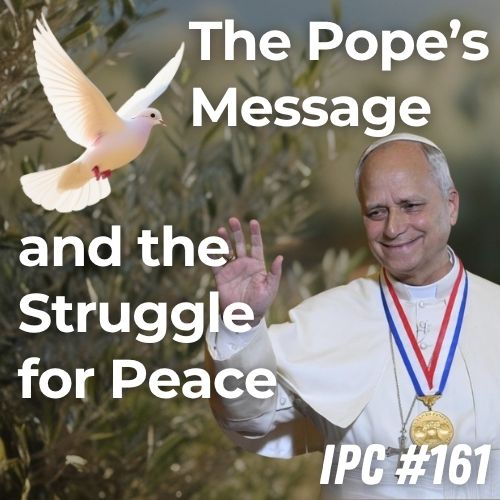
July 4, 2026 (EIRNS)—The 161st consecutive weekly meeting of the International Peace Coalition (IPC) took the unusual step of starting an hour later than usual, so that participants could view the live video address of Pope Leo XIV as he accepted the 38th Liberty Medal from the National Constitution Center in Philadelphia. Helga Zepp-LaRouche, Schiller Institute founder and IPC initiator, reported that “he represents in his person and his teaching… the values of the American Revolution and the founding fathers.” She recommended that everyone read his recent encyclical, Magnifica Humanitas, because the present state of American policy has deviated so far from those values.
Other IPC participants had varying reactions to the pope’s address. Ray McGovern, former CIA analyst, and cofounder of Veteran Intelligence Professionals for Sanity (VIPS), prefaced his remarks by saying, “I’m a cradle Catholic.” He went on to acknowledge that Pope Leo is speaking out, but “in abstractions and generalities,” and he chose not to speak freely about “the blood-stained face of history.” He drew a comparison to the role of Pius XII, who also spoke in abstractions during World War II.
Later in the meeting, Zepp-LaRouche conceded that “maybe the Pope could have spoken more clearly against the war.” But she pointed out that leading warmongers in the United States have reacted sharply to comments by the Pope, and she said that there is a German proverb: “hit dogs bark,” meaning that their hysterical reactions were proof that the pope’s words had reached their intended targets.
McGovern said later that upon reflection, he still feels that he was not “too harsh on Pope Leo.” The United States is participating in a war of aggression and a genocide, and the Pope failed to “stick his neck out” and address these things directly, unlike Jesus who “didn’t speak in platitudes.”
Father Harry Bury, a renowned Catholic priest for 70 years, lifelong peace activist, member of the U.S. Catholic Priest Association, and the founder of Twin Cities Nonviolent, said that while this is a dangerous time that is escalating toward a third world war, he is still hopeful because of two factors: the Schiller Institute’s Oasis Plan, and the Pope’s recent encyclical.
During the discussion period, co-moderator Dennis Small called attention to the fact that the government of Spain has announced an amnesty for 1.3 million migrants. Two weeks earlier the Pope was in Spain, where he said that we need to have development so that people can remain in their home nations and not be forced to leave in order to survive. Mexican farm activist Alberto Vizcarra added that the Pope applies the doctrine of the “common good” to agriculture, which must prioritize the needs of humanity over the profits of speculators.
In her concluding remarks, Zepp-LaRouche said that the recent encyclical is “a very powerful intervention”; what he said about the American Revolution is more perceptive than the comments of anyone outside of Lyndon LaRouche and his collaborators. “We have to get Americans back to their soul,” she said.
Another participant noted that Peter Thiel of Palantir accuses the Pope of being an agent of communism because he calls for regulation of Artificial Intelligence.
The Current Strategic Picture
Zepp-LaRouche observed that it is difficult to say which theater of war is more dangerous, the Middle East or Ukraine. The answer is probably Ukraine, since it involves a direct conflict between NATO and Russia. Russian Foreign Minister Sergey Lavrov has publicly questioned the intention behind the Aug. 15, 2025 Anchorage, Alaska meeting between Presidents Donald Trump and Vladimir Putin. While the summit had seemed to offer a pathway to resolve the conflict, top leaders now wonder if it may have been a strategic deception by the West, like the Minsk Accords of 2014-2015. In the Middle East, the June 17 U.S.-Iran Memorandum of Understanding is “in complete shambles.” “Day by day, hour by hour, the energy and fertilizer crisis around the world is getting worse,” she said. The United States and Israel have foolishly pursued a policy of assassinating moderate Iranian leaders, putting the hardliners in control.
Prof. Richard Anderson Falk, professor emeritus of international law at Princeton University, Euro-Mediterranean Human Rights Monitor’s Chairman of the Board of Trustees and former United Nations Special Rapporteur on the situation of human rights in the Palestinian territories from 2008 to 2014, observed that the current crisis ironically overlaps the “fake celebration” of the 250th anniversary of the American Revolution. World leaders are captive to a dangerous ideology “rooted in militarist geopolitics.” Because they can’t accept the reality of military supremacy leading to political defeat, they are driving us closer to the nuclear precipice. They refuse to learn the lessons of the limits of military power. There is also the pernicious problem of private sector militarism: “Wars are profitable whether they are won or lost.” The founders of the United States understood that a democratic republic can’t handle peacetime militarism.
Ray McGovern added that there is an additional factor of danger to the NATO-Russia confrontation: Finland and Lithuania have announced that they will deploy nuclear weapons on their territory, and it is likely that the other Baltic states, Estonia and Latvia, will follow suit.
Professor Bassam el Hachem, Professor of Political Sociology at the University of Lebanon, said that Lebanon is more mobilized than ever against the American and Israel aggression. Hezbollah is called terrorist because they are resisting Israel. Israel is not satisfied with occupying Palestine; they want to go farther with a “Greater Israel” plan. He added that the attack on Iran in the midst of negotiations was a “dirty knife in the back of the Iranians.”
Co-moderator Dennis Speed read a message from Dennis Kucinich, former U.S. Congressman from Ohio and former U.S. Presidential Candidate, who was unable to attend in person. Kucinich is focused on Section 219 of the National Defense Authorization Act (NDAA), which would merge U.S. defense and intelligence with Israelʼs defense technology capabilities. Speed reported that in a phone discussion with Kucinich, they both agreed that it should be called the Jonathan Pollard initiative, after the American-born Israeli spy and former intelligence analyst who was sentenced in 1987 to life imprisonment in the United States for spying for Israel, released in 2015, now lives in Israel and has even called for Israel to use nuclear weapons against Iran. Congress should not be asked to vote on the $901 billion NDAA without hearing debate on amendments. Kucinich urged everyone to read his July 2 article U.S.-Israel Military Merger Delayed: Here’s Why and How You Can Stop It.
Report from a Mexican Farm Activist
Baltazar Valdez Armentía, leader of United Farmers of Sinaloa and on the Steering Committee of the National Front to Save the Mexican Countryside, said that Mexican agriculture was threatened by three factors: the geopolitical crisis, including the Iran war which is causing shortages in energy and fertilizer; environmental collapse; and predatory financiers who make hunger central to their business strategy. “While farmers receive a pittance for their crops,” speculators rig the game to maximize their profits. His movement calls upon the Mexican government to confront the transnational agro-financial corporations. They are demanding parity prices and protective tariffs, a crackdown on speculation, and the construction of adequate infrastructure.
Report from Philadelphia
Independent congressional candidate Jose Vega (in New Yorkʼs 15th C.D., the Bronx) reported that he was in “an undisclosed location” in Philadelphia. The free outdoor public viewing of the Pope’s livestreamed remarks at the National Constitution Center in Philadelphia was cancelled due to heat, so Jose took the opportunity to organize people who showed up hoping to attend. He commented on the recent election victories by insurgent Democrats, and observed that Republican Congressman Dan Crenshaw lost his primary as part of the same process we see in Maine, Michigan, New York and Colorado. We don’t have time to wait for new Congressmen to be sworn in, insisted Jose. “We need to be thinking about how to rebuild the parts of the world that we have destroyed,” using the method of the Oasis Plan. We can’t just be defined by what we oppose.
eir