

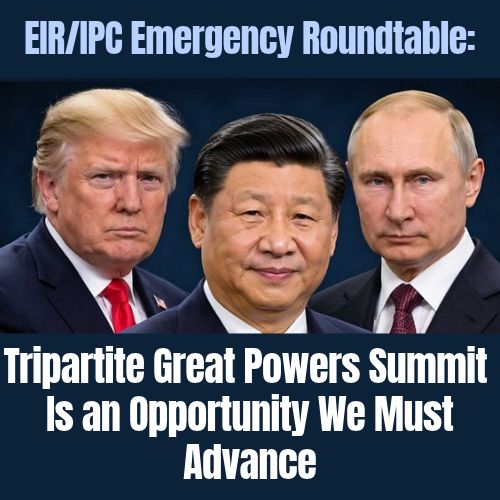
Report on EIR/IPC #181 Roundtable
by Marcia Merry Baker,Daniel Platt (EIRNS) — Nov. 20, 2026
The EIR Emergency Roundtable Nov. 20, held just a day after the historic Shenzhen summit of the heads of state of China, Russia, and the United States, on the sidelines of the APEC annual conference, comes as an invaluable platform for carrying forward the potential to benefit humanity embodied in the historic meeting of President Xi Jinping, President Vladimir Putin, and President Donald Trump. Helga Zepp-LaRouche, EIR Editor-in-Chief, founder of the Schiller Institute, and convenor of the online Roundtable, said in her opening remarks, “We are at the beginning of a new era, provided we do our job right.” She said repeatedly that the summit is a major step toward overcoming geopolitics, and that we must reach out, and make sure that the man on the street knows about this.
The EIR international event was titled, “The Tripartite Summit of Xi, Putin, and Trump: Is Humanity Capable of Self-Government?” Organized on one week’s notice, the conference brought together 13 speakers, from 11 countries. Besides representing the three Summit countries—-China, Russia and the United States, speakers also represented the five founding members of the BRICS—Brazil, Russia, India, China, South Africa—and also Iran, a new BRICS member—as well as participants from Pakistan, Argentina, France and Germany. The event was simultaneously interpreted from English into Spanish, French, German and Italian. The livestream audience, numbering about 1,500 with co-streaming, included viewership from well over 50 countries.
The text of the EIR invitation to the Roundtable, which was jointly sponsored by the International Peace Coalition—initiated by Zepp-LaRouche—was prophetic on the potential embodied in the Nov. 19 tripartite summit: “Its outcome, although uncertain at this time, could open the door to a new era of Mankind, where wars, poverty, moral depravity and the law of the jungle are replaced by a new international security and development architecture—along the lines of what China’s President Xi Jinping has called his Global Governance Initiative—which is worthy of the dignity of Man.”
The five-hour Roundtable presentations and discussion sessions were organized into two panels, addressing the necessity for “indivisibility,” first in terms of security, and secondly, development. Video archive is available for the full event in multiple languages.
Panel One: Why Security Must Be Indivisible
Moderator Dennis Speed, of the Schiller Institute-U.S., situated the Nov. 19 Putin/Xi/Trump summit in the context of the history of the campaign of Lyndon LaRouche and his movement for just such a summit, and for a new security and development paradigm to replace the one which is presently collapsing. Speed showed the cover of a 1983 EIR Special Report by LaRouche, “A Fifty-Year Development Policy for the Indian-Pacific Oceans Basin.”
Helga Zepp-LaRouche, speaking from Germany, emphasized in her keynote address the importance of the tripartite summit, the first of its kind, in taking an important step towards finally ending geopolitics. Two of the three participating nations represent 86% of all nuclear weapons and almost half of the world’s GDP. She discussed the Summit’s “Declaration Toward Peace.” The three nations, all founding members of the United Nations, committed themselves to reform the U.N. and reassert the principles of its founding document. They called for the protection and expansion of flows of refined petroleum products. They criticized the International Criminal Court for overstepping its jurisdiction. And most significantly, they reasserted that “Nuclear War cannot be won, and must never be fought.”
Zepp-LaRouche, who recently attended several international conferences in China, cited the Four International Initiatives of China, and their relevance to solving the global crises we face. “The Global South is completely aware of the unparalleled success of the Chinese economic miracle,” she said, adding that the whole world can learn from China’s poverty eradication initiatives. Contrary to British Lord Palmerston’s claim that countries have no friends, only interests, China is behaving like a friend. We are now ending 500 years of colonialism. “The under-development of the Global Majority cannot be the destiny of the human species,” concluded Zepp-LaRouche.
Prof. Zhang Weiwei, Professor of International Relations at Fudan University in Shanghai, described the summit as a “landmark event.” It’s not Yalta 2.0, as some have been saying, it’s Shenzhen 1.0. It is not a division of the world into competing blocs; it’s a different world now, a multipolar world. There are over 60 wars in the world today that continue to drag on. Security is indivisible, not a zero-sum competition among nations. The old logic of competing regional security blocs must be discarded. Zhang explained China’s Four International Initiatives in detail—for development, security, civilization and governance. “We may build a world where every nation can feel safe, where every civilization can thrive.”
Alexander Repkin, Deputy Permanent Representative of the Russian Federation to the United Nations, spoke from New York. He elaborated on each of the points of the Shenzhen’s tripartite joint “Declaration Toward Peace”: to reform the United Nations to enable it to respond more effectively to global challenges and uphold international peace and security; to protect and expand energy supply chains; to prevent the ICC from abusing its jurisdiction (and thereby reaffirm our commitment to international law); and to assert that nuclear war cannot be won and must never be fought. He voiced his support for Zepp-LaRouche’s comments, especially on the end of colonialism. He also reported on the recent Russia-Africa Summit.
In response, Zepp-LaRouche thanked the Chinese and Russian speakers for their explanation of what was presented in Shenzhen, because in the West people do not know what is happening, due to the corruption of our news media. Prof. Zhang stated that “Europe deserves much better leaders.” With their popular support at around 10%, “it makes democracy a joke.”
Mr. Repkin emphasized that China is a great power, and Shenzhen is its technological capital. Commenting on those who compare the tripartite summit to the Yalta summit in 1945, he noted that Yalta was not a conference to divide the world; the world had already been divided. It was a conference to establish peace and a post-war order.
Zepp-LaRouche stressed that we must reach ordinary people, which is the only way to stop the so-called Coalition of the Willing from further escalating the war. Zhang reported that he saw polls in Italy which indicate that in many European countries, China is viewed far more favorably than is the United States.
The Global Governance Initiative—Relevance, Urgency
Seyed Hossein Mousavian is the former Iranian Ambassador to Germany, a position he held from 1990-1997. Speaking from Europe, he said that the Iran situation presents an opportunity to confirm the relevance of China’s Global Governance Initiative. Sovereignty must be respected, and U.S.-Israeli disputes with Iran should not be resolved with use of force. Iran should enjoy the same status under international law as other nations; Iran wishes to cooperate with the IAEA, to ensure respect for Iran’s right to peaceful nuclear energy combined with Iran’s commitment to not develop nuclear weapons. Disputes should be resolved through multinational negotiations, not unilateral moves by powerful countries. Multilateral agreements must not be abandoned unilaterally, as was the case when Trump withdrew from the Joint Comprehensive Plan of Action (JCPOA), commonly known as the Iran nuclear deal. A sustainable regional security framework is needed. China could facilitate multilateral negotiations to end the war, and Ambassador Mousavian presented a five-step plan for China’s consideration.
Purnima Anand, President of the BRICS Forum India, said that security is more than military alliances. It also means economic security and freedom from poverty. Security must be indivisible, applying to small nations as well as the powerful, and cannot be zero-sum. BRICS has become a significant force in the world, representing a substantial part of humanity. BRICS must participate in reforming global institutions to make them more representative. BRICS should not become a competing bloc or an instrument of confrontation. The tripartite summit and the BRICS represent different but complementary trends toward greater emphasis on dialogue. Science and technology must improve human life, not increase insecurity, and the principle that “nuclear war cannot be won, and must never be fought” must be at the center of security policy.
Dr. Yasir Masood, a political and security analyst, academic, and broadcast journalist in Pakistan, also took up China’s Global Governance Initiative, saying that it is not a replacement for the U.N. system, but a measure to reform and enhance it. The demands made at the 1955 Bandung Conference remain relevant, and the GGI reiterates them today. Can one country build lasting security, while disregarding other nations’ legitimate security concerns? Collective defense arrangements must be accompanied by extensive diplomacy. “International cooperation does not require ideological convergence,” he insisted. We must ensure that one part of the world does not develop at the expense of another; this is the real test of the Global Governance Initiative.
Discussion: Tripartite Summit a Good Precursor
Diane Sare, independent presidential candidate in the United States, began the discussion section as a respondent to the speakers. She referred to more enlightened periods in American history, and said that the tripartite summit was “a good precursor,” but we must address the root cause of the conflicts all over the world by reorganizing the bankrupt financial system and re-orienting it toward development.
Zepp-LaRouche said that in addition to economic development, we need a dialogue of civilizations, so that “people can learn to love other cultures.” This is what is needed to change the paradigm. We need what in Christianity is called agape, the equivalent of the Chinese concept of Ren (Chinese: 仁).
A questioner asked for specific suggestions on how to reform international institutions. Purnima Anand responded by saying that we need new institutions to address inequalities of development, and the developed nations should not make environmentalist demands that suppress the development of those who are not yet developed. Dr. Masood pointed to the example of Africa, where there are still children dying of hunger, indicating a failure of the international system. Blocs of nations are still trying to create security at the expense of others. He referred to the International Monetary Fund as “economic hitmen.” Diane Sare suggested that if we look at the world with the eyes of the four astronauts coming back from the moon, problems that we consider insurmountable could be resolved. Dr. Masood endorsed Zepp-LaRouche’s call for a dialogue of civilizations.
Panel Two: Indivisible Development
The second panel was chaired by Anastasia Battle, from the Schiller Institute-United States, who is moderator of the International Peace Coalition.
Dennis Small, Ibero-American Editor for the Executive Intelligence Review, opened the panel by asserting that in order to “solve the riddle” of indivisible development, one must “think like Confucius, not like Kant.” The false notion that development is a zero-sum game comes from the mistaken belief that resources are finite. Small cited Lyndon LaRouche to the effect that technological progress must be shared among nations of all sizes and stages of development, or “there can be no durable peace on this planet.” Small added that “the only way there can be peace between the nations of East and West, is if they jointly collaborate in the development of the South.” He compared the concept of Mutually Assured Destruction (MAD) to German philosopher Immanuel Kant’s “negation of the negation,” which Kant offered in the place of actual human creativity, which Kant thought was impossible.
By way of contrast, Confucius, in his Analects, said that if the people are led by virtue, as opposed to laws, they will experience shame with wrong-doing and come to prefer the good. Small added a famous quote from Mexican President Benito Juárez: “with individuals, as among nations, respect for the rights for others is peace,” and proposed a slight improvement: “with individuals, as among nations, respect for the rights for others to develop is peace.”
Small asserted that our present financial system is in fact a zero-sum system, where for one person to prosper, another person must suffer, which Small maintained was a “Satanic system.” The alternative is a “win-win” system of general development, as advocated by China. Small concluded with another quote from LaRouche: “Leadership consists of not denying the crisis in the first place.”
Fr. John Heagle, Director of Priests Against Genocide (USA), and a member of the Association of U.S. Catholic Priests, thanked Zepp-LaRouche for her comments about the end of 500 years of colonialism. He spoke, from his perspective as a priest, about the transformation of the Catholic Church from a Eurocentric church to a church for all humanity. He characterized Gaza as a “test case for humanity,” and criticized what he called “delusional Christian Zionists” who are complicit in a neocolonialist policy, and “actually cheering on the end of the world.” Describing their “apocalyptic arrogance,” he gave the example of how they want us to pay for their plans with our tax dollars. We cannot have peace without truth and justice. He concluded by echoing Pope Leo’s call for a “disarmed and disarming peace.”
Rubén Guzzetti of the Argentine Institute for Geopolitical Studies (IADEG), who provided a pre-recorded video for his presentation, also referred to the teachings of Pope Leo. Guzzetti described how the Pope, in his recent visit to Argentina, presented a vision for humanity in stark contrast to the rule of Argentine President Javier Milei, which Guzzetti described as “social genocide.” He noted that the tripartite summit in Shenzhen was addressing issues which the Schiller Institute and the Catholic Church had addressed for years, and called the summit “very promising.” In order to move the world out of the present crisis, we need an approach of indivisible security, and a new financial system based on productive credit.
From Brazil, Prof. Lier Pires Ferreira, head of Nu-BRICS, opened his remarks with the famous quote from Pope Paul VI: “Development is the new name for peace.” If we look at the case of Brazil, what happened on Oct. 25 was not only an election, but a crossroads, a civilizational turning point. It was a harsh defeat for the extreme right, for “the voracious interests of international speculative capital.” Ferreira said that “Lula’s victory transcends the borders of Brazil.” The battle for peace is waged not just on the economic level, but also on a cultural and spiritual level, which brings us again to the importance of the visit of Pope Leo to South America. The Pope confronted “market fundamentalism” which turns everything and everyone into merchandise. True peace will not come from the heavens above, or from the invisible hand of the marketplace. Only where development flourishes can true peace take root.
Speaking out for peace, the next speaker was from France, Nicolas Dupont-Aignan. Mayor of Yerres, and a former French parliamentarian, he is currently the presidential candidate of the Debout la France Party. He praised the pro-peace tradition of de Gaulle and Chirac (who declined to join the Iraq war), and denounced Macron and the current gang of war-hungry European leaders. He laid special emphasis on the importance of the Gaullist policy of contributing to the decolonization and development of Africa.
Rounding out the speakers’ roster, Abbey Makoe, a journalist, political commentator, and the founder and Editor in Chief of the Global South Media Network (GSMN), spoke from South Africa. He said that people in the West don’t like to talk about history, because they are on the wrong side of it. The developed nations need to look back, and acknowledge their role in the underdevelopment of Africa through centuries of looting. Poverty is one thing, but impoverishment is man-made, something imposed by exploiters. He said that all humans have red blood, despite cultural and economic differences, and we must all come to the negotiating table, rather than resorting to violence and war.
Discussion: Sovereignty, and a Positive Program
Dennis Small opened the discussion section by noting that Charles de Gaulle was a fierce nationalist, and also a fierce opponent of the colonial exploitation of Africa. Small expressed the view that one must be both of those things, a view that was echoed by Nicolas Dupont-Aignan, who added that true sovereignty must include economic sovereignty. He warned that private oligarchical interests wield more power than most nations.
Abbey Makoe lamented that African nations are constantly forced to choose a side in East-West disputes, and “we pay a price, whichever side we choose.” He said that the developed nations continue to plunder Africa surreptitiously, by sponsoring puppet regimes. “People cannot continue to prosper on the back of others, and expect that they will enjoy a peaceful night’s sleep.”
In conclusion, Dennis Small said, “David will have to take on Goliath, and there’s no way around it.” We will need a complete reorganization of the current bankrupt financial system in order to finance the development projects that can create the basis for peace. He pointed out that all of the founding nations of the BRICS were represented at today’s round table discussion.
Finally, Small raised “a contentious point”: political ferment is not enough. There has to be a positive program. In the U.S., we routinely “vote the bums out,” and somehow that is not sufficient to solve our problems. Look at how the Democratic Party is now denouncing Trump for the one thing he is doing right, his meeting with Xi and Putin in Shenzhen. But what Confucius affirmed and Kant denied is that man is capable of making universal creative discoveries, and as Helga Zepp-LaRouche insists in her Ten Principles, humans are essentially good and predisposed to making those discoveries. That, and only that, is the scientific basis for asserting that development must be indivisible.